From Surf Wiki (app.surf) — the open knowledge base
Native Americans in the United States
Indigenous peoples of the United States
Indigenous peoples of the United States
| Field | Value | |
|---|---|---|
| group | Native Americans | |
| image | Indigenous Americans by county.png | |
| image_caption | Proportion of Native Americans in each county as of the [2020 US census](2020-us-census) | |
| population | **Alone (one race)** | |
| **3,727,135** ([2020 census](2020-united-states-census)) | ||
| 1.12% of the total US population | ||
| • Native Americans: 2,251,699 (0.67%) | ||
| • Native Hispanics: 1,475,436 (0.45%) | ||
| **In combination (multiracial)** | ||
| **5,938,923** ([2020 census](2020-united-states-census)) | ||
| 1.79% of the total US population | ||
| **Alone or in combination** | ||
| **9,666,058** ([2020 census](2020-united-states-census)) | ||
| 2.92% of the total US population | ||
| popplace | Predominantly in Alaska and the Western and Midwestern United States due to the policy of Indian removal, with smaller communities remaining in the East. | |
| region1 | California | |
| pop1 | 631,016 | |
| ref1 | ||
| region2 | Oklahoma | |
| pop2 | 332,791 | |
| ref2 | ||
| region3 | Arizona | |
| pop3 | 319,512 | |
| ref3 | ||
| region4 | Texas | |
| pop4 | 278,948 | |
| ref4 | ||
| region5 | New Mexico | |
| pop5 | 212,241 | |
| ref5 | ||
| languages | **English** | |
| **Native American languages** | ||
| (including Navajo, Central Alaskan Yup'ik, Tlingit, Haida, Dakota, Seneca, Lakota, Western Apache, Keres, Cherokee, Choctaw, Creek, Kiowa, Comanche, Osage, Zuni, Pawnee, Shawnee, Winnebago, Ojibwe, Cree, O'odham) | ||
| **Spanish** | ||
| **Native Pidgin** (extinct) | ||
| **French** | ||
| religions | {{plainlist | |
| ** Predominantly Traditional Native American religions, unique to specific tribes or bands<ref name | "pritzker331"Barry Pritzker, *A Native American Encyclopedia: History, Culture, and Peoples* (Oxford University Press, 2000), 331. | |
| * Native American Church<ref name | "pritzker331" / | |
| related-c | {{plainlist |
3,727,135 (2020 census) 1.12% of the total US population • Native Americans: 2,251,699 (0.67%) • Native Hispanics: 1,475,436 (0.45%)
In combination (multiracial) 5,938,923 (2020 census) 1.79% of the total US population
Alone or in combination 9,666,058 (2020 census) 2.92% of the total US population Native American languages (including Navajo, Central Alaskan Yup'ik, Tlingit, Haida, Dakota, Seneca, Lakota, Western Apache, Keres, Cherokee, Choctaw, Creek, Kiowa, Comanche, Osage, Zuni, Pawnee, Shawnee, Winnebago, Ojibwe, Cree, O'odham) Spanish Native Pidgin (extinct) French
- Predominantly Traditional Native American religions, unique to specific tribes or bands
- Native American Church
- Christian, denomination dependent on tribe
- Protestant
- Catholic
- Russian Orthodox (mostly in Alaska) }}
| related-c = {{plainlist|
- Indigenous peoples of the Americas
- Indigenous peoples in Canada
- Indigenous peoples of Mexico
- Indigenous peoples of South America
Native Americans (also called Indians, American Indians, First Americans, and Indigenous Americans) are the Indigenous peoples of the United States, particularly of the lower 48 states and Alaska. They may also include any Americans whose origins lie in any of the Indigenous peoples of North or South America. The United States Census Bureau publishes data about "American Indians and Alaska Natives", whom it defines as anyone "having origins in any of the original peoples of North and South America ... and who maintains tribal affiliation or community attachment". The census does not, however, enumerate "Native Americans" as such, noting that the latter term can encompass a broader set of groups, e.g. Native Hawaiians, which it tabulates separately.
The European colonization of the Americas from 1492 resulted in a precipitous decline in the size of the Native American population because of newly introduced diseases, including weaponized diseases and biological warfare by colonizers, wars, ethnic cleansing, and enslavement. Numerous scholars have classified elements of the colonization process as comprising genocide against Native Americans. As part of a policy of settler colonialism, European settlers continued to wage war and perpetrated massacres against Native American peoples, removed them from their ancestral lands, and subjected them to one-sided government treaties and discriminatory government policies. Into the 20th century, these policies focused on forced assimilation.
When the United States was established, Native American tribes were considered semi-independent nations, because they generally lived in communities which were separate from communities of white settlers. The federal government signed treaties at a government-to-government level until the Indian Appropriations Act of 1871 ended recognition of independent Native nations, and started treating them as "domestic dependent nations" subject to applicable federal laws. This law did preserve rights and privileges, including a large degree of tribal sovereignty. For this reason, many Native American reservations are still independent of state law and the actions of tribal citizens on these reservations are subject only to tribal courts and federal law. The Indian Citizenship Act of 1924 granted US citizenship to all Native Americans born in the US who had not yet obtained it. This emptied the "Indians not taxed" category established by the United States Constitution, allowed Natives to vote in elections, and extended the Fourteenth Amendment protections granted to people "subject to the jurisdiction" of the United States. However, some states continued to deny Native Americans voting rights for decades. Titles II through VII of the Civil Rights Act of 1968 comprise the Indian Civil Rights Act, which applies to Native American tribes and makes many but not all of the guarantees of the U.S. Bill of Rights applicable within the tribes.
Since the 1960s, Native American self-determination movements have resulted in positive changes to the lives of many Native Americans, though there are still many contemporary issues faced by them. Today, there are over five million Native Americans in the US, about 80% of whom live outside reservations. As of 2020, the states with the highest percentage of Native Americans are Alaska, Oklahoma, Arizona, California, New Mexico, and Texas.
History

The history of Native Americans in the United States began tens of thousands of years ago with the settlement of the Americas by the Paleo-Indians. The Eurasian migration to the Americas occurred over millennia via Beringia, a land bridge between Siberia and Alaska, as early humans spread southward and eastward. Archaeological evidence suggests these migrations began 25,000 years ago and continued until around 12,000 years ago. Some may have arrived even earlier, fishing in kayaks along what is known as the "Kelp Highway". Major Paleo-Indian cultures included the Clovis and Folsom traditions, identified through unique spear points and large-game hunting methods.
Around 8000 BCE, as the climate stabilized, new cultural periods like the Archaic stage arose, during which hunter-gatherer communities developed complex societies. The Mound Builders created large earthworks, such as at Watson Brake and Poverty Point, which date to 3500 BCE and 2200 BCE. By 1000 BCE, Native societies in the Woodland period developed advanced social structures and trade networks, with the Hopewell tradition connecting the Eastern Woodlands to the Great Lakes and the Gulf of Mexico. This period led to the Mississippian culture, with large urban centers like Cahokia—a city with complex mounds and a population exceeding 20,000 by 1250 CE.
Ethnographers classify the Indigenous peoples of North America into ten cultural areas inhabited by groups who share certain cultural traits: the Arctic, Subarctic, Northeastern Woodlands, Southeastern Woodlands, Great Plains, Great Basin, Northwest Plateau, Northwest Coast, California, and Southwest (Oasisamerica). At the time of the first contact, Indigenous cultures varied widely, with some Northeastern and Southwestern groups being matrilineal and organized on collective bases unfamiliar to Europeans. Land was typically held communally, in contrast to European property rights traditions. These differences, compounded by shifting alliances and warfare, generated political tension, ethnic violence, and disruption.
Beginning near the end of the 15th century, migration of Europeans to the Americas led to centuries of population, cultural, and agricultural transfer between Old and New World societies, known as the Columbian exchange. Because most Native groups preserved their histories by means of oral traditions and artwork, the first written accounts of contact were provided by Europeans.
Native Americans suffered high fatality rates from contact with European diseases that were new to them, and to which they had no immunity. Smallpox was especially devastating. Populations in some regions fell by 90 percent or more in the first century after contact. Pre-Columbian population estimates for the area of the modern U.S. range from 2 to over 18 million. By the end of the 18th century, numbers had collapsed to around 600,000 due to disease, warfare, and genocide.
After the thirteen British colonies revolted and established the United States, George Washington and Henry Knox advocated a "civilizing" policy to assimilate Native Americans as U.S. citizens. Assimilation, whether voluntary—as with the Choctaw—or forced, remained a central policy. During the 19th century, the ideology of manifest destiny drove westward expansion, increasing pressure on Native lands. The Indian Removal Act of 1830 authorized mass relocations west of the Mississippi River, resulting in ethnic cleansing and forced marches such as the Trail of Tears.
A justification for conquest and subjugation stemmed from dehumanizing stereotypes like those in the United States Declaration of Independence, which described Native Americans as "merciless Indian savages". Two sculptures reflecting this view of the Natives were commissioned by the U.S. government and stood outside the U.S. Capitol for over a century: The Rescue (1837) whose sculptor Horatio Greenough wrote that it was "to convey the idea of the triumph of the whites over the savage tribes", and The Discovery of America (1844) which depicted a triumphant Columbus and a "female savage" according to the Pennsylvania senator James Buchanan who proposed the sculpture.
Native resistance persisted in the American Indian Wars, including the Dakota War of 1862, Great Sioux War of 1876, Snake War, Colorado War, and Texas–Indian Wars. One of the last major events was the Wounded Knee Massacre in 1890, where up to 300 Lakota were killed during a Ghost Dance gathering.
In the 20th century, Native Americans served in significant numbers during World War II, marking a turning point in visibility and involvement. Post-war, activism grew with the American Indian Movement and others pressing for rights. The Indian Self-Determination and Education Assistance Act of 1975 recognized tribal autonomy, leading to Native-run schools and economic initiatives. By the 21st century, Native Americans had achieved greater control over tribal lands and resources, though many communities continue to face the legacies of displacement and economic inequality. Over 70% of Native Americans now live in cities, navigating cultural preservation and ongoing discrimination.
Contemporary Native Americans maintain a unique relationship with the United States, with sovereignty and treaty rights forming the basis of federal Indian law and the trust relationship. Since the late 1960s, cultural activism has expanded Indigenous presence in politics, media, education, and literature. Independent newspapers, television (e.g. First Nations Experience), Native American studies programs, tribal schools, and language revitalization efforts have strengthened cultural identity.
The terms used to refer to Native Americans have been controversial. Usage varies by region and generation, with many older Native Americans preferring "Indian" or "American Indian", while younger generations often choose "Indigenous" or "Aboriginal". The term "Native American" has not traditionally included Native Hawaiians or some Alaska Natives such as Aleut, Yup'ik, or Inuit, while in Canada, First Nations, Inuit, and Métis are the common designations.
Demographics

The 2020 census reports the U.S. population at 331.4 million; of this, 3.7 million people, or 1.1 percent, reported American Indian or Alaska Native ancestry alone. In addition, 5.9 million people (1.8 percent), reported American Indian or Alaska Native in combination with one or more other races.
The definition of American Indian or Alaska Native used in the 2010 census was as follows:
According to Office of Management and Budget, "American Indian or Alaska Native" refers to a person having origins in any of the original peoples of North and South America (including Central America) and who maintains tribal affiliation or community attachment.
Despite generally referring to groups indigenous to the continental US, this demographic as defined by the US Census Bureau includes all Indigenous people of the Americas, including Mesoamerican peoples such as the Maya, as well as Canadian and South American natives. In 2022, 634,503 Indigenous people in the United States identified with Central American Indigenous groups, 875,183 identified with the Indigenous people of Mexico, and 47,518 identified with Canadian First Nations. Of the 3.2 million Americans who identified as American Indian or Alaska Native alone in 2022, around 45% are of Hispanic or Latino ethnicity, with this number growing as increasing numbers of Indigenous people from Latin American countries immigrate to the US and more Latinos self-identify with Indigenous heritage. Of groups Indigenous to the United States, the largest self-reported tribes are Cherokee (1,449,888), Navajo (434,910), Choctaw (295,373), Blackfeet (288,255), Sioux (220,739), and Apache (191,823). 205,954 respondents specified an Alaska Native identity.
Native Hawaiians are counted separately from Native Americans by the census, being classified as Pacific Islanders. According to 2022 estimates, 714,847 Americans reported Native Hawaiian ancestry.
The 2010 census permitted respondents to self-identify as being of one or more races. Self-identification dates from the census of 1960; prior to that the race of the respondent was determined by the opinion of the census taker. The option to select more than one race was introduced in 2000. If American Indian or Alaska Native was selected, the form requested the individual provide the name of the "enrolled or principal tribe".
Population since 1880
Censuses counted around 346,000 Native Americans in 1880 (including 33,000 in Alaska and 82,000 in Oklahoma, back then known as Indian Territory), around 274,000 in 1890 (including 25,500 in Alaska and 64,500 in Oklahoma), 362,500 in 1930 and 366,500 in 1940, including those on and off reservations in the 48 states and Alaska. Native American population rebounded sharply from 1950, when they numbered 377,273; it reached 551,669 in 1960, 827,268 in 1970, with an annual growth rate of 5%, four times the national average. Total spending on Native Americans averaged $38 million a year in the late 1920s, dropping to a low of $23 million in 1933, and returning to $38 million in 1940. The Office of Indian Affairs counted more American Indians than the Census Bureau until 1930:
| Decade | American Indians, Census Bureau | American Indians, Office of Indian Affairs | Alaska Natives |
|---|---|---|---|
| 1890 | 248,253 | 249,278 | 25,354 |
| 1900 | 237,196 | 270,544 | 29,536 |
| 1910 | 265,683 | 304,950 | 25,331 |
| 1920 | 244,437 | 336,337 | 26,558 |
| 1930 | 332,397 | 340,541 | 29,983 |
American Indians and Alaska Natives as percentage of the total population between 1880 and 2020:
| State/Territory | 1880 | 1890 | 1900 | 1910 | 1920 | 1930 | 1940 | 1950 | 1960 | 1970 | 1980 | 1990 | 2000 | 2010 | 2020 | Alabama Alabama | Alaska Alaska | Arizona Arizona | Arkansas Arkansas | California California | Colorado Colorado | Connecticut Connecticut | Delaware Delaware | Florida | Georgia (U.S. state) Georgia | Hawaii Hawaii | Idaho Idaho | Illinois Illinois | Indiana Indiana | Iowa Iowa | Kansas Kansas | Kentucky Kentucky | Louisiana Louisiana | Maine | Maryland Maryland | Massachusetts Massachusetts | Michigan Michigan | Minnesota Minnesota | Mississippi Mississippi | Missouri Missouri | Montana Montana | Nebraska Nebraska | Nevada Nevada | New Hampshire | New Jersey New Jersey | New Mexico New Mexico | New York New York | North Carolina North Carolina | North Dakota North Dakota | Ohio Ohio | Oklahoma Oklahoma | Oregon Oregon | Pennsylvania Pennsylvania | Rhode Island Rhode Island | South Carolina South Carolina | South Dakota South Dakota | Tennessee Tennessee | Texas Texas | Utah Utah | Vermont | Virginia Virginia | Washington Washington | West Virginia | Wisconsin Wisconsin | Wyoming Wyoming | District of Columbia Washington, D.C. | Puerto Rico | **** |
|---|---|---|---|---|---|---|---|---|---|---|---|---|---|---|---|---|---|---|---|---|---|---|---|---|---|---|---|---|---|---|---|---|---|---|---|---|---|---|---|---|---|---|---|---|---|---|---|---|---|---|---|---|---|---|---|---|---|---|---|---|---|---|---|---|---|---|---|---|
| 0.0% | 0.1% | 0.0% | 0.0% | 0.0% | 0.0% | 0.0% | 0.0% | 0.0% | 0.1% | 0.2% | 0.4% | 0.5% | 0.6% | 0.7% | ||||||||||||||||||||||||||||||||||||||||||||||||||||||
| 98.7% | 79.1% | 46.5% | 39.4% | 48.3% | 50.6% | 44.8% | 26.3% | 19.1% | 16.8% | 16.0% | 15.6% | 15.6% | 14.8% | 21.9% | ||||||||||||||||||||||||||||||||||||||||||||||||||||||
| 37.5% | 34.0% | 21.5% | 14.3% | 9.9% | 10.0% | 11.0% | 8.8% | 6.4% | 5.4% | 5.6% | 5.6% | 5.0% | 4.6% | 6.3% | ||||||||||||||||||||||||||||||||||||||||||||||||||||||
| 0.0% | 0.0% | 0.0% | 0.0% | 0.0% | 0.0% | 0.0% | 0.0% | 0.0% | 0.1% | 0.4% | 0.5% | 0.7% | 0.8% | 0.9% | ||||||||||||||||||||||||||||||||||||||||||||||||||||||
| 2.4% | 1.4% | 1.0% | 0.7% | 0.5% | 0.3% | 0.3% | 0.2% | 0.2% | 0.5% | 0.9% | 0.8% | 1.0% | 1.0% | 1.6% | ||||||||||||||||||||||||||||||||||||||||||||||||||||||
| 1.4% | 0.3% | 0.3% | 0.2% | 0.1% | 0.1% | 0.1% | 0.1% | 0.2% | 0.4% | 0.6% | 0.8% | 1.0% | 1.1% | 1.3% | ||||||||||||||||||||||||||||||||||||||||||||||||||||||
| 0.0% | 0.0% | 0.0% | 0.0% | 0.0% | 0.0% | 0.0% | 0.0% | 0.0% | 0.1% | 0.1% | 0.2% | 0.3% | 0.3% | 0.4% | ||||||||||||||||||||||||||||||||||||||||||||||||||||||
| 0.0% | 0.0% | 0.0% | 0.0% | 0.0% | 0.0% | 0.0% | 0.0% | 0.1% | 0.1% | 0.2% | 0.3% | 0.3% | 0.5% | 0.5% | ||||||||||||||||||||||||||||||||||||||||||||||||||||||
| 0.3% | 0.0% | 0.1% | 0.0% | 0.1% | 0.0% | 0.0% | 0.0% | 0.1% | 0.1% | 0.2% | 0.3% | 0.3% | 0.4% | 0.4% | ||||||||||||||||||||||||||||||||||||||||||||||||||||||
| 0.0% | 0.0% | 0.0% | 0.0% | 0.0% | 0.0% | 0.0% | 0.0% | 0.0% | 0.1% | 0.1% | 0.2% | 0.3% | 0.3% | 0.5% | ||||||||||||||||||||||||||||||||||||||||||||||||||||||
| 0.0% | 0.0% | 0.0% | 0.0% | 0.0% | 0.0% | 0.0% | 0.0% | 0.1% | 0.1% | 0.3% | 0.5% | 0.3% | 0.3% | 0.3% | ||||||||||||||||||||||||||||||||||||||||||||||||||||||
| 10.0% | 4.8% | 2.6% | 1.1% | 0.7% | 0.8% | 0.7% | 0.6% | 0.8% | 0.9% | 1.1% | 1.4% | 1.4% | 1.4% | 1.4% | ||||||||||||||||||||||||||||||||||||||||||||||||||||||
| 0.0% | 0.0% | 0.0% | 0.0% | 0.0% | 0.0% | 0.0% | 0.0% | 0.0% | 0.1% | 0.1% | 0.2% | 0.2% | 0.3% | 0.8% | ||||||||||||||||||||||||||||||||||||||||||||||||||||||
| 0.0% | 0.0% | 0.0% | 0.0% | 0.0% | 0.0% | 0.0% | 0.0% | 0.0% | 0.1% | 0.1% | 0.2% | 0.3% | 0.3% | 0.4% | ||||||||||||||||||||||||||||||||||||||||||||||||||||||
| 0.1% | 0.0% | 0.0% | 0.0% | 0.0% | 0.0% | 0.0% | 0.0% | 0.1% | 0.1% | 0.2% | 0.3% | 0.3% | 0.4% | 0.5% | ||||||||||||||||||||||||||||||||||||||||||||||||||||||
| 0.2% | 0.1% | 0.1% | 0.1% | 0.1% | 0.1% | 0.1% | 0.1% | 0.2% | 0.4% | 0.7% | 0.9% | 0.9% | 1.0% | 1.1% | ||||||||||||||||||||||||||||||||||||||||||||||||||||||
| 0.0% | 0.0% | 0.0% | 0.0% | 0.0% | 0.0% | 0.0% | 0.0% | 0.0% | 0.0% | 0.1% | 0.2% | 0.2% | 0.2% | 0.3% | ||||||||||||||||||||||||||||||||||||||||||||||||||||||
| 0.1% | 0.1% | 0.0% | 0.0% | 0.1% | 0.1% | 0.1% | 0.0% | 0.1% | 0.1% | 0.3% | 0.4% | 0.6% | 0.7% | 0.7% | ||||||||||||||||||||||||||||||||||||||||||||||||||||||
| 0.1% | 0.1% | 0.1% | 0.1% | 0.1% | 0.1% | 0.1% | 0.2% | 0.2% | 0.2% | 0.4% | 0.5% | 0.6% | 0.6% | 0.6% | ||||||||||||||||||||||||||||||||||||||||||||||||||||||
| 0.0% | 0.0% | 0.0% | 0.0% | 0.0% | 0.0% | 0.0% | 0.0% | 0.0% | 0.1% | 0.2% | 0.3% | 0.3% | 0.4% | 0.5% | ||||||||||||||||||||||||||||||||||||||||||||||||||||||
| 0.0% | 0.0% | 0.0% | 0.0% | 0.0% | 0.0% | 0.0% | 0.0% | 0.0% | 0.1% | 0.1% | 0.2% | 0.2% | 0.3% | 0.3% | ||||||||||||||||||||||||||||||||||||||||||||||||||||||
| 1.1% | 0.3% | 0.3% | 0.3% | 0.2% | 0.1% | 0.1% | 0.1% | 0.1% | 0.2% | 0.4% | 0.6% | 0.6% | 0.6% | 0.6% | ||||||||||||||||||||||||||||||||||||||||||||||||||||||
| 1.1% | 0.8% | 0.5% | 0.4% | 0.4% | 0.4% | 0.4% | 0.4% | 0.5% | 0.6% | 0.9% | 1.1% | 1.1% | 1.1% | 1.2% | ||||||||||||||||||||||||||||||||||||||||||||||||||||||
| 0.2% | 0.2% | 0.1% | 0.1% | 0.1% | 0.1% | 0.1% | 0.1% | 0.1% | 0.2% | 0.2% | 0.3% | 0.4% | 0.5% | 0.6% | ||||||||||||||||||||||||||||||||||||||||||||||||||||||
| 0.0% | 0.0% | 0.0% | 0.0% | 0.0% | 0.0% | 0.0% | 0.0% | 0.0% | 0.1% | 0.3% | 0.4% | 0.4% | 0.5% | 0.5% | ||||||||||||||||||||||||||||||||||||||||||||||||||||||
| 38.3% | 7.8% | 4.7% | 0.8% | 2.0% | 2.8% | 3.0% | 2.8% | 3.1% | 3.9% | 4.7% | 6.0% | 6.2% | 6.3% | 9.3% | ||||||||||||||||||||||||||||||||||||||||||||||||||||||
| 1.0% | 0.6% | 0.3% | 0.3% | 0.2% | 0.2% | 0.3% | 0.3% | 0.4% | 0.4% | 0.6% | 0.8% | 0.9% | 1.2% | 1.2% | ||||||||||||||||||||||||||||||||||||||||||||||||||||||
| 13.9% | 10.9% | 12.3% | 6.4% | 6.3% | 5.3% | 4.3% | 3.1% | 2.3% | 1.6% | 1.7% | 1.6% | 1.3% | 1.2% | 1.4% | ||||||||||||||||||||||||||||||||||||||||||||||||||||||
| 0.0% | 0.0% | 0.0% | 0.0% | 0.0% | 0.0% | 0.0% | 0.0% | 0.0% | 0.0% | 0.1% | 0.2% | 0.2% | 0.2% | 0.2% | ||||||||||||||||||||||||||||||||||||||||||||||||||||||
| 0.0% | 0.0% | 0.0% | 0.0% | 0.0% | 0.0% | 0.0% | 0.0% | 0.0% | 0.1% | 0.1% | 0.2% | 0.2% | 0.3% | 0.6% | ||||||||||||||||||||||||||||||||||||||||||||||||||||||
| 23.2% | 9.4% | 6.7% | 6.3% | 5.4% | 6.8% | 6.5% | 6.2% | 5.9% | 7.2% | 8.1% | 8.9% | 9.5% | 9.4% | 12.4% | ||||||||||||||||||||||||||||||||||||||||||||||||||||||
| 0.1% | 0.1% | 0.1% | 0.1% | 0.1% | 0.1% | 0.1% | 0.1% | 0.1% | 0.2% | 0.2% | 0.3% | 0.4% | 0.6% | 0.7% | ||||||||||||||||||||||||||||||||||||||||||||||||||||||
| 0.1% | 0.1% | 0.3% | 0.4% | 0.5% | 0.5% | 0.6% | 0.1% | 0.8% | 0.9% | 1.1% | 1.2% | 1.2% | 1.3% | 1.2% | ||||||||||||||||||||||||||||||||||||||||||||||||||||||
| 13.0% | 4.3% | 2.2% | 1.1% | 1.0% | 1.2% | 1.6% | 1.7% | 1.9% | 2.3% | 3.1% | 4.1% | 4.9% | 5.4% | 7.2% | ||||||||||||||||||||||||||||||||||||||||||||||||||||||
| 0.0% | 0.0% | 0.0% | 0.0% | 0.0% | 0.0% | 0.0% | 0.0% | 0.0% | 0.1% | 0.1% | 0.2% | 0.2% | 0.2% | 0.3% | ||||||||||||||||||||||||||||||||||||||||||||||||||||||
| 100.0% | 24.9% | 8.2% | 4.5% | 2.8% | 3.9% | 2.7% | 2.4% | 2.8% | 3.8% | 5.6% | 8.0% | 7.9% | 8.6% | 16.0% | ||||||||||||||||||||||||||||||||||||||||||||||||||||||
| 3.5% | 1.6% | 1.2% | 0.8% | 0.6% | 0.5% | 0.4% | 0.4% | 0.5% | 0.6% | 1.0% | 1.4% | 1.3% | 1.4% | 4.4% | ||||||||||||||||||||||||||||||||||||||||||||||||||||||
| 0.0% | 0.0% | 0.0% | 0.0% | 0.0% | 0.0% | 0.0% | 0.0% | 0.0% | 0.0% | 0.1% | 0.1% | 0.1% | 0.2% | 0.2% | ||||||||||||||||||||||||||||||||||||||||||||||||||||||
| 0.0% | 0.1% | 0.0% | 0.1% | 0.0% | 0.0% | 0.0% | 0.0% | 0.1% | 0.1% | 0.3% | 0.4% | 0.5% | 0.6% | 0.7% | ||||||||||||||||||||||||||||||||||||||||||||||||||||||
| 0.0% | 0.0% | 0.0% | 0.0% | 0.0% | 0.1% | 0.1% | 0.1% | 0.1% | 0.1% | 0.2% | 0.2% | 0.3% | 0.4% | 0.5% | ||||||||||||||||||||||||||||||||||||||||||||||||||||||
| 20.6% | 5.7% | 5.0% | 3.3% | 2.6% | 3.2% | 3.6% | 3.6% | 3.8% | 4.9% | 6.5% | 7.3% | 8.3% | 8.8% | 11.1% | ||||||||||||||||||||||||||||||||||||||||||||||||||||||
| 0.0% | 0.0% | 0.0% | 0.0% | 0.0% | 0.0% | 0.0% | 0.0% | 0.0% | 0.1% | 0.1% | 0.2% | 0.3% | 0.3% | 0.4% | ||||||||||||||||||||||||||||||||||||||||||||||||||||||
| 0.1% | 0.0% | 0.0% | 0.0% | 0.0% | 0.0% | 0.0% | 0.0% | 0.1% | 0.2% | 0.3% | 0.4% | 0.6% | 0.7% | 1.0% | ||||||||||||||||||||||||||||||||||||||||||||||||||||||
| 0.9% | 1.6% | 0.9% | 0.8% | 0.6% | 0.6% | 0.7% | 0.6% | 0.8% | 1.1% | 1.3% | 1.4% | 1.3% | 1.2% | 1.3% | ||||||||||||||||||||||||||||||||||||||||||||||||||||||
| 0.0% | 0.0% | 0.0% | 0.0% | 0.0% | 0.0% | 0.0% | 0.0% | 0.0% | 0.1% | 0.2% | 0.3% | 0.4% | 0.4% | 0.4% | ||||||||||||||||||||||||||||||||||||||||||||||||||||||
| 0.0% | 0.0% | 0.0% | 0.0% | 0.0% | 0.0% | 0.0% | 0.0% | 0.1% | 0.1% | 0.2% | 0.2% | 0.3% | 0.4% | 0.5% | ||||||||||||||||||||||||||||||||||||||||||||||||||||||
| 20.8% | 3.1% | 1.9% | 1.0% | 0.7% | 0.7% | 0.7% | 0.6% | 0.7% | 1.0% | 1.5% | 1.7% | 1.6% | 1.5% | 4.1% | ||||||||||||||||||||||||||||||||||||||||||||||||||||||
| 0.0% | 0.0% | 0.0% | 0.0% | 0.0% | 0.0% | 0.0% | 0.0% | 0.0% | 0.0% | 0.1% | 0.1% | 0.2% | 0.2% | 0.2% | ||||||||||||||||||||||||||||||||||||||||||||||||||||||
| 0.8% | 0.6% | 0.4% | 0.4% | 0.4% | 0.4% | 0.4% | 0.4% | 0.4% | 0.4% | 0.6% | 0.8% | 0.9% | 1.0% | 1.0% | ||||||||||||||||||||||||||||||||||||||||||||||||||||||
| 9.6% | 2.9% | 1.8% | 1.0% | 0.7% | 0.8% | 0.9% | 1.1% | 1.2% | 1.5% | 1.5% | 2.1% | 2.3% | 2.4% | 4.8% | ||||||||||||||||||||||||||||||||||||||||||||||||||||||
| 0.0% | 0.0% | 0.0% | 0.0% | 0.0% | 0.0% | 0.0% | 0.0% | 0.1% | 0.1% | 0.2% | 0.2% | 0.3% | 0.3% | 0.5% | ||||||||||||||||||||||||||||||||||||||||||||||||||||||
| 0.4% | 0.5% | 0.5% | ||||||||||||||||||||||||||||||||||||||||||||||||||||||||||||||||||
| 0.7% | 0.4% | 0.3% | 0.3% | 0.2% | 0.3% | 0.3% | 0.2% | 0.3% | 0.4% | 0.6% | 0.8% | 0.9% | 0.9% | 1.1% |
Absolute numbers of American Indians and Alaska Natives between 1880 and 2020 (since 1890 according to the Census Bureau):
| State/Territory | 1880 | 1890 | 1900 | 1910 | 1920 | 1930 | 1940 | 1950 | 1960 | 1970 | 1980 | 1990 | 2000 | 2010 | 2020 | **** | Non-Hispanic | 345,888 | 273,607 | 266,732 | 291,014 | 270,995 | 362,380 | 366,427 | 377,273 | 551,669 | 800,409 | 1,425,250 | 1,793,773 | 2,068,883 | 2,247,098 | 2,251,699 |
|---|---|---|---|---|---|---|---|---|---|---|---|---|---|---|---|---|---|---|---|---|---|---|---|---|---|---|---|---|---|---|---|---|
| Alabama Alabama | 213 | 1,143 | 177 | 909 | 405 | 465 | 464 | 928 | 1,276 | 2,443 | 9,239 | 16,506 | 22,430 | 28,218 | 33,625 | |||||||||||||||||
| Alaska Alaska | 32,996 | 25,354 | 29,536 | 25,331 | 26,558 | 29,983 | 32,458 | 33,863 | 42,522 | 50,814 | 64,103 | 85,698 | 98,043 | 104,871 | 111,575 | |||||||||||||||||
| Arizona Arizona | 22,199 | 29,981 | 26,480 | 29,201 | 32,989 | 43,726 | 55,076 | 65,761 | 83,387 | 95,812 | 154,175 | 203,527 | 255,879 | 296,529 | 319,512 | |||||||||||||||||
| Arkansas Arkansas | 195 | 250 | 66 | 460 | 106 | 408 | 278 | 533 | 580 | 2,014 | 12,713 | 12,773 | 17,808 | 22,248 | 27,177 | |||||||||||||||||
| California California | 20,385 | 16,624 | 15,377 | 16,371 | 17,360 | 19,212 | 18,675 | 19,947 | 39,014 | 91,018 | 227,757 | 242,164 | 333,346 | 362,801 | 631,016 | |||||||||||||||||
| Colorado Colorado | 2,684 | 1,092 | 1,437 | 1,482 | 1,383 | 1,395 | 1,360 | 1,567 | 4,288 | 8,836 | 20,682 | 27,776 | 44,241 | 56,010 | 74,129 | |||||||||||||||||
| Connecticut Connecticut | 255 | 228 | 153 | 152 | 159 | 162 | 201 | 333 | 923 | 2,222 | 4,822 | 6,654 | 9,639 | 11,256 | 16,051 | |||||||||||||||||
| Delaware Delaware | 5 | 4 | 9 | 5 | 2 | 5 | 14 | 0 | 597 | 656 | 1,380 | 2,019 | 2,731 | 4,181 | 5,148 | |||||||||||||||||
| Florida Florida | 780 | 171 | 358 | 74 | 518 | 587 | 690 | 1,011 | 2,504 | 6,677 | 24,714 | 36,335 | 53,541 | 71,458 | 94,795 | |||||||||||||||||
| Georgia (U.S. state) Georgia | 124 | 68 | 19 | 95 | 125 | 43 | 106 | 333 | 749 | 2,347 | 9,876 | 13,348 | 21,737 | 32,151 | 50,618 | |||||||||||||||||
| Hawaii Hawaii | 0 | 0 | 0 | 0 | 0 | 0 | 0 | 0 | 472 | 1,126 | 2,833 | 5,099 | 3,535 | 4,164 | 4,370 | |||||||||||||||||
| Idaho Idaho | 3,585 | 4,223 | 4,226 | 3,488 | 3,098 | 3,638 | 3,537 | 3,800 | 5,231 | 6,687 | 10,405 | 13,780 | 17,645 | 21,441 | 25,621 | |||||||||||||||||
| Illinois Illinois | 140 | 98 | 16 | 188 | 194 | 469 | 624 | 1,443 | 4,704 | 11,413 | 19,118 | 21,836 | 31,006 | 43,963 | 96,498 | |||||||||||||||||
| Indiana Indiana | 246 | 343 | 243 | 279 | 125 | 285 | 223 | 438 | 948 | 3,887 | 9,495 | 12,720 | 15,815 | 18,462 | 26,086 | |||||||||||||||||
| Iowa Iowa | 821 | 457 | 382 | 471 | 529 | 660 | 733 | 1,084 | 1,708 | 2,992 | 6,311 | 7,349 | 8,989 | 11,084 | 14,486 | |||||||||||||||||
| Kansas Kansas | 1,499 | 1,682 | 2,130 | 2,444 | 2,276 | 2,454 | 1,165 | 2,381 | 5,069 | 8,672 | 17,829 | 21,965 | 24,936 | 28,150 | 30,995 | |||||||||||||||||
| Kentucky Kentucky | 50 | 71 | 102 | 234 | 57 | 22 | 44 | 234 | 391 | 1,531 | 4,497 | 5,769 | 8,616 | 10,120 | 12,801 | |||||||||||||||||
| Louisiana Louisiana | 848 | 628 | 593 | 780 | 1,069 | 1,536 | 1,801 | 409 | 3,587 | 5,294 | 12,841 | 18,541 | 25,477 | 30,579 | 31,657 | |||||||||||||||||
| Maine Maine | 625 | 559 | 798 | 892 | 830 | 1,012 | 1,251 | 1,522 | 1,879 | 2,195 | 4,360 | 5,998 | 7,098 | 8,568 | 7,885 | |||||||||||||||||
| Maryland Maryland | 15 | 44 | 3 | 55 | 32 | 50 | 73 | 314 | 1,538 | 4,239 | 8,946 | 12,972 | 15,423 | 20,420 | 31,845 | |||||||||||||||||
| Massachusetts Massachusetts | 369 | 428 | 587 | 688 | 555 | 874 | 769 | 1,201 | 2,118 | 4,475 | 8,996 | 12,241 | 15,015 | 18,850 | 24,018 | |||||||||||||||||
| Michigan Michigan | 17,390 | 5,625 | 6,354 | 7,519 | 5,614 | 7,080 | 6,282 | 7,000 | 9,701 | 16,854 | 44,712 | 55,638 | 58,479 | 62,007 | 61,261 | |||||||||||||||||
| Minnesota Minnesota | 8,498 | 10,096 | 9,182 | 9,053 | 8,761 | 11,077 | 12,528 | 12,533 | 15,496 | 23,128 | 36,527 | 49,909 | 54,967 | 60,916 | 68,641 | |||||||||||||||||
| Mississippi Mississippi | 1,857 | 2,036 | 2,203 | 1,253 | 1,105 | 1,458 | 2,134 | 2,502 | 3,119 | 4,113 | 6,836 | 8,525 | 11,652 | 15,030 | 16,450 | |||||||||||||||||
| Missouri Missouri | 113 | 128 | 130 | 313 | 171 | 578 | 330 | 547 | 1,723 | 5,405 | 14,820 | 19,835 | 25,076 | 27,376 | 30,518 | |||||||||||||||||
| Montana Montana | 23,313 | 11,206 | 11,343 | 10,745 | 10,956 | 14,798 | 16,841 | 16,606 | 21,181 | 27,130 | 37,623 | 47,679 | 56,068 | 62,555 | 67,612 | |||||||||||||||||
| Nebraska Nebraska | 4,541 | 6,431 | 3,322 | 3,502 | 2,888 | 3,256 | 3,401 | 3,954 | 5,545 | 6,624 | 9,059 | 12,410 | 14,896 | 18,427 | 23,102 | |||||||||||||||||
| Nevada Nevada | 9,603 | 5,156 | 5,216 | 5,240 | 4,907 | 4,871 | 4,747 | 5,025 | 6,681 | 7,933 | 14,256 | 19,637 | 26,420 | 32,062 | 43,932 | |||||||||||||||||
| New Hampshire New Hampshire | 63 | 16 | 22 | 34 | 28 | 64 | 50 | 74 | 135 | 361 | 1,342 | 2,134 | 2,964 | 3,150 | 3,031 | |||||||||||||||||
| New Jersey New Jersey | 74 | 84 | 63 | 168 | 106 | 213 | 211 | 621 | 1,699 | 4,706 | 10,028 | 14,970 | 19,492 | 29,026 | 51,186 | |||||||||||||||||
| New Mexico New Mexico | 33,224 | 150,44 | 13,144 | 20,573 | 19,512 | 28,941 | 34,510 | 41,901 | 56,255 | 72,788 | 106,585 | 134355 | 173,483 | 193,222 | 212,241 | |||||||||||||||||
| New York New York | 5,958 | 6,044 | 5,257 | 6,046 | 5,503 | 6,973 | 8,651 | 10,640 | 16,491 | 28,355 | 43,508 | 62,651 | 82,461 | 106,906 | 149,690 | |||||||||||||||||
| North Carolina North Carolina | 1,230 | 1,516 | 5,687 | 7,851 | 11,824 | 16,579 | 22,546 | 3,742 | 38,129 | 44,406 | 65,808 | 80,155 | 99,551 | 122,110 | 130,032 | |||||||||||||||||
| North Dakota North Dakota | 8,329 | 8,174 | 6,968 | 6,486 | 6,254 | 8,387 | 10,114 | 10,766 | 11,736 | 14,369 | 19,905 | 25,917 | 31,329 | 36,591 | 38,914 | |||||||||||||||||
| Ohio Ohio | 130 | 206 | 42 | 127 | 151 | 435 | 338 | 1,146 | 1,910 | 6,654 | 15,300 | 20,358 | 24,486 | 25,292 | 30,720 | |||||||||||||||||
| Oklahoma Oklahoma | 82,334 | 64,456 | 64,445 | 74,825 | 57,337 | 92,725 | 63,125 | 53,769 | 64,689 | 98,468 | 171,092 | 252,420 | 273,230 | 321,687 | 332,791 | |||||||||||||||||
| Oregon Oregon | 6,249 | 4,971 | 4,951 | 5,090 | 4,590 | 4,776 | 4,594 | 5,820 | 8,026 | 13,510 | 29,783 | 38,496 | 45,211 | 53,203 | 62,993 | |||||||||||||||||
| Pennsylvania Pennsylvania | 184 | 1,081 | 1,639 | 1,503 | 337 | 523 | 441 | 1,141 | 2,122 | 5,533 | 10,928 | 14,733 | 18,348 | 26,843 | 31,052 | |||||||||||||||||
| Rhode Island Rhode Island | 77 | 180 | 35 | 284 | 110 | 318 | 196 | 385 | 932 | 1,390 | 3,186 | 4,071 | 5,121 | 6,058 | 7,385 | |||||||||||||||||
| South Carolina South Carolina | 131 | 173 | 121 | 331 | 304 | 959 | 1,234 | 554 | 1,098 | 2,241 | 6,655 | 8,246 | 13,718 | 19,524 | 24,303 | |||||||||||||||||
| South Dakota South Dakota | 20,230 | 19,854 | 20225 | 19,137 | 16,384 | 21,833 | 23,347 | 23,344 | 25,794 | 32,365 | 45,525 | 50,575 | 62,283 | 71,817 | 77,748 | |||||||||||||||||
| Tennessee Tennessee | 352 | 146 | 108 | 216 | 56 | 161 | 114 | 339 | 638 | 2,276 | 6,946 | 10,039 | 15,152 | 19,994 | 28,044 | |||||||||||||||||
| Texas Texas | 992 | 708 | 470 | 702 | 2,109 | 1,001 | 1,103 | 2,736 | 5,750 | 17,957 | 50,296 | 65,877 | 118,362 | 170,972 | 278,948 | |||||||||||||||||
| Utah Utah | 1,257 | 3,456 | 2,623 | 3,123 | 2,711 | 2,869 | 3,611 | 4,201 | 6,961 | 11,273 | 19,994 | 24,283 | 29,684 | 32,927 | 41,644 | |||||||||||||||||
| Vermont Vermont | 11 | 34 | 5 | 26 | 24 | 36 | 16 | 30 | 57 | 229 | 1,041 | 1,696 | 2,420 | 2,207 | 2,289 | |||||||||||||||||
| Virginia Virginia | 85 | 349 | 354 | 539 | 824 | 779 | 198 | 1,056 | 2,155 | 4,853 | 9,867 | 15,282 | 21,172 | 29,225 | 40,007 | |||||||||||||||||
| Washington Washington | 18,594 | 11,181 | 10,039 | 10,997 | 9,061 | 11,253 | 11,394 | 13,816 | 21,076 | 33,386 | 61,233 | 81,483 | 93,301 | 103,869 | 121,468 | |||||||||||||||||
| West Virginia West Virginia | 29 | 9 | 12 | 36 | 7 | 18 | 25 | 160 | 181 | 751 | 2,317 | 2,458 | 3,606 | 3,787 | 3,706 | |||||||||||||||||
| Wisconsin Wisconsin | 10,798 | 9,930 | 8,372 | 10,142 | 9,611 | 11,548 | 12,265 | 12,196 | 14,297 | 18,924 | 30,553 | 39,387 | 47,228 | 54,526 | 60,428 | |||||||||||||||||
| Wyoming Wyoming | 2,203 | 1,844 | 1,686 | 1,486 | 1,343 | 1,845 | 2,349 | 3,237 | 4,020 | 4,980 | 8,192 | 9,479 | 11,133 | 13,336 | 13,898 | |||||||||||||||||
| District of Columbia Washington, D.C. | 5 | 25 | 22 | 68 | 37 | 40 | 190 | 330 | 587 | 956 | 986 | 1,466 | 1,713 | 2,079 | 3,193 | |||||||||||||||||
| 273,607 | 266,732 | 291,014 | 270,995 | 362,380 | 366,427 | 377,273 | 551,669 | 827,268 | 1,519,995 | 1,959,234 | 2,475,956 | 2,932,248 | 3,727,135 |
Population distribution
78% of Native Americans live outside a reservation. Mono-racial individuals are more likely to live on a reservation than multiracial individuals. The Navajo, with 286,000 mono-racial individuals, is the largest tribe if only non-multiracial individuals are counted; the Navajo are the tribe with the highest proportion of mono-racial individuals, 86.3%. The Cherokee have a different history; it is the largest tribe, with 819,000 individuals multiracial, and it has 284,000 mono-racial individuals.
Urban migration
As of 2012, 70% of Native Americans live in urban areas, up from 45% in 1970 and 8% in 1940. Urban areas with significant Native American populations include Minneapolis, Denver, Phoenix, Tucson, Chicago, Oklahoma City, Houston, New York City, and Los Angeles. Many live in poverty. Racism, unemployment, drugs and gangs are common problems which Indian social service organizations such as the Little Earth housing complex in Minneapolis attempt to address.
Population by tribal grouping
Below are numbers for U.S. citizens self-identifying to selected tribal groupings, according to the 2010 U.S. census.
| Tribal grouping | Tribal flag | Tribal seal | American Indian & Alaska Native Alone one tribal grouping reported | American Indian & Alaska Native Alone more than one tribal grouping reported | American Indian & Alaska Native Mixed one tribal grouping reported | American Indian & Alaska Native Mixed more than one tribal grouping reported | American Indian & Alaska Native tribal grouping alone or mixed in any combination | Total | Apache | Arapaho | Blackfeet | Canadian & French American Indian | Central American Indian | Cherokee | Cheyenne | |||||||||||||||||||||||||||||||||||||||||||||||||
|---|---|---|---|---|---|---|---|---|---|---|---|---|---|---|---|---|---|---|---|---|---|---|---|---|---|---|---|---|---|---|---|---|---|---|---|---|---|---|---|---|---|---|---|---|---|---|---|---|---|---|---|---|---|---|---|---|---|---|---|---|---|---|---|---|
| (Northern and Southern) | Chickasaw | Choctaw | Colville | Comanche | Cree | Creek | Crow | Delaware (Lenape) | Hopi | Houma | Iroquois | Kiowa | Lumbee | Menominee | Mexican American Indian | Navajo | Ojibwe | Osage | Ottawa | Paiute | Pima | Potawatomi | Pueblo | Puget Sound Salish | Seminole | Shoshone | Sioux | South American Indian | Spanish American Indian | Tohono O'odham | Ute | Yakama | Yaqui | Yuman | All other American Indian tribes | American Indian tribes, not specified | Alaska Native tribes, specified | Alaskan Athabaskans | Aleut | Inupiat | Tlingit-Haida | Tsimshian | Yup'ik | Alaska Native tribes, not specified | American Indian or Alaska Native tribes, not specified | |||||||||||||||||||
| 2,879,638 | 52,610 | 2,209,267 | 79,064 | 5,220,579 | ||||||||||||||||||||||||||||||||||||||||||||||||||||||||||||
| 63,193 | 6,501 | 33,303 | 8,813 | 111,810 | ||||||||||||||||||||||||||||||||||||||||||||||||||||||||||||
| [[File:Flag of Arapaho Nation.svg | 50px]] | 8,014 | 388 | 2,084 | 375 | 10,861 | ||||||||||||||||||||||||||||||||||||||||||||||||||||||||||
| [[File:Flag of the Blackfoot Confederacy.jpg | 50px]] | 27,279 | 4,519 | 54,109 | 19,397 | 105,304 | ||||||||||||||||||||||||||||||||||||||||||||||||||||||||||
| [[File:Metis Blue.svg | 50px | alt=]] [[File:Metis Red.svg | 50px | alt=]] | 6,433 | 618 | 6,981 | 790 | 14,822 | |||||||||||||||||||||||||||||||||||||||||||||||||||||||
| 15,882 | 572 | 10,865 | 525 | 27,844 | ||||||||||||||||||||||||||||||||||||||||||||||||||||||||||||
| [[File:Flag of the Cherokee Nation.svg | 50px]] | [[File:Great seal of the cherokee nation.svg | 50px]] | 284,247 | 16,216 | 468,082 | 50,560 | 819,105 | ||||||||||||||||||||||||||||||||||||||||||||||||||||||||
| [[File:Flag of Northern Cheyenne.svg | 50px]] | 11,375 | 1,118 | 5,311 | 1,247 | 19,051 | ||||||||||||||||||||||||||||||||||||||||||||||||||||||||||
| 27,973 | 2,233 | 19,220 | 2,852 | 52,278 | ||||||||||||||||||||||||||||||||||||||||||||||||||||||||||||
| [[File:Choctaw flag.svg | 50px]] | [[File:Choctaw seal.svg | 50px]] | 103,910 | 6,398 | 72,101 | 13,355 | 195,764 | ||||||||||||||||||||||||||||||||||||||||||||||||||||||||
| 8,114 | 200 | 2,148 | 87 | 10,549 | ||||||||||||||||||||||||||||||||||||||||||||||||||||||||||||
| 12,284 | 1,187 | 8,131 | 1,728 | 23,330 | ||||||||||||||||||||||||||||||||||||||||||||||||||||||||||||
| 2,211 | 739 | 4,023 | 1,010 | 7,983 | ||||||||||||||||||||||||||||||||||||||||||||||||||||||||||||
| [[File:Muscogee Nation Seal.png | 50px]] | 48,352 | 4,596 | 30,618 | 4,766 | 88,332 | ||||||||||||||||||||||||||||||||||||||||||||||||||||||||||
| 10,332 | 528 | 3,309 | 1,034 | 15,203 | ||||||||||||||||||||||||||||||||||||||||||||||||||||||||||||
| 7,843 | 372 | 9,439 | 610 | 18,264 | ||||||||||||||||||||||||||||||||||||||||||||||||||||||||||||
| 12,580 | 2,054 | 3,013 | 680 | 18,327 | ||||||||||||||||||||||||||||||||||||||||||||||||||||||||||||
| [[File:Flag of the United Houma Nation.svg | 50px]] | 8,169 | 71 | 2,438 | 90 | 10,768 | ||||||||||||||||||||||||||||||||||||||||||||||||||||||||||
| [[File:Flag of the Iroquois Confederacy.svg | 50px]] | [[File:Haudenosaunee seal.png | 50px]] | 40,570 | 1,891 | 34,490 | 4,051 | 81,002 | ||||||||||||||||||||||||||||||||||||||||||||||||||||||||
| 9,437 | 918 | 2,947 | 485 | 13,787 | ||||||||||||||||||||||||||||||||||||||||||||||||||||||||||||
| 62,306 | 651 | 10,039 | 695 | 73,691 | ||||||||||||||||||||||||||||||||||||||||||||||||||||||||||||
| 8,374 | 253 | 2,330 | 176 | 11,133 | ||||||||||||||||||||||||||||||||||||||||||||||||||||||||||||
| 121,221 | 2,329 | 49,670 | 2,274 | 175,494 | ||||||||||||||||||||||||||||||||||||||||||||||||||||||||||||
| [[File:Great Seal of the Navajo Nation.svg | 50px]] | 286,731 | 8,285 | 32,918 | 4,195 | 332,129 | ||||||||||||||||||||||||||||||||||||||||||||||||||||||||||
| 112,757 | 2,645 | 52,091 | 3,249 | 170,742 | ||||||||||||||||||||||||||||||||||||||||||||||||||||||||||||
| 8,938 | 1,125 | 7,090 | 1,423 | 18,576 | ||||||||||||||||||||||||||||||||||||||||||||||||||||||||||||
| 7,272 | 776 | 4,274 | 711 | 13,033 | ||||||||||||||||||||||||||||||||||||||||||||||||||||||||||||
| 9,340 | 865 | 3,135 | 427 | 13,767 | ||||||||||||||||||||||||||||||||||||||||||||||||||||||||||||
| [[File:O'odham unofficial flag.svg | 50px]] | 22,040 | 1,165 | 3,116 | 334 | 26,655 | ||||||||||||||||||||||||||||||||||||||||||||||||||||||||||
| 20,412 | 462 | 12,249 | 648 | 33,771 | ||||||||||||||||||||||||||||||||||||||||||||||||||||||||||||
| 49,695 | 2,331 | 9,568 | 946 | 62,540 | ||||||||||||||||||||||||||||||||||||||||||||||||||||||||||||
| 14,320 | 215 | 5,540 | 185 | 20,260 | ||||||||||||||||||||||||||||||||||||||||||||||||||||||||||||
| 14,080 | 2,368 | 12,447 | 3,076 | 31,971 | ||||||||||||||||||||||||||||||||||||||||||||||||||||||||||||
| 7,852 | 610 | 3,969 | 571 | 13,002 | ||||||||||||||||||||||||||||||||||||||||||||||||||||||||||||
| [[File:Pine Ridge Flag.svg | 50px]] | 112,176 | 4,301 | 46,964 | 6,669 | 170,110 | ||||||||||||||||||||||||||||||||||||||||||||||||||||||||||
| 20,901 | 479 | 25,015 | 838 | 47,233 | ||||||||||||||||||||||||||||||||||||||||||||||||||||||||||||
| 13,460 | 298 | 6,012 | 181 | 19,951 | ||||||||||||||||||||||||||||||||||||||||||||||||||||||||||||
| 19,522 | 725 | 3,033 | 198 | 23,478 | ||||||||||||||||||||||||||||||||||||||||||||||||||||||||||||
| 7,435 | 785 | 2,802 | 469 | 11,491 | ||||||||||||||||||||||||||||||||||||||||||||||||||||||||||||
| 8,786 | 310 | 2,207 | 224 | 11,527 | ||||||||||||||||||||||||||||||||||||||||||||||||||||||||||||
| [[File:Flag of the Pascua Yaqui Tribe of Arizona.svg | 50px]] | 21,679 | 1,516 | 8,183 | 1,217 | 32,595 | ||||||||||||||||||||||||||||||||||||||||||||||||||||||||||
| 7,727 | 551 | 1,642 | 169 | 10,089 | ||||||||||||||||||||||||||||||||||||||||||||||||||||||||||||
| 270,141 | 12,606 | 135,032 | 11,850 | 429,629 | ||||||||||||||||||||||||||||||||||||||||||||||||||||||||||||
| 131,943 | 117 | 102,188 | 72 | 234,320 | ||||||||||||||||||||||||||||||||||||||||||||||||||||||||||||
| 98,892 | 4,194 | 32,992 | 2,772 | 138,850 | ||||||||||||||||||||||||||||||||||||||||||||||||||||||||||||
| 15,623 | 804 | 5,531 | 526 | 22,484 | ||||||||||||||||||||||||||||||||||||||||||||||||||||||||||||
| 11,920 | 723 | 6,108 | 531 | 19,282 | ||||||||||||||||||||||||||||||||||||||||||||||||||||||||||||
| 24,859 | 877 | 7,051 | 573 | 33,360 | ||||||||||||||||||||||||||||||||||||||||||||||||||||||||||||
| 15,256 | 859 | 9,331 | 634 | 26,080 | ||||||||||||||||||||||||||||||||||||||||||||||||||||||||||||
| 2,307 | 240 | 1,010 | 198 | 3,755 | ||||||||||||||||||||||||||||||||||||||||||||||||||||||||||||
| 28,927 | 691 | 3,961 | 310 | 33,889 | ||||||||||||||||||||||||||||||||||||||||||||||||||||||||||||
| 19,731 | 173 | 9,896 | 133 | 29,933 | ||||||||||||||||||||||||||||||||||||||||||||||||||||||||||||
| 693,709 | no data | 852,253 | 1 | 1,545,963 |
Tribal sovereignty
Main article: Tribal sovereignty in the United States, Native American tribe, Indian reservation
There are 574 federally recognized tribal governments and 326 Indian reservations in the US. These tribes possess the right to form their own governments, enforce laws (civil and criminal) within their lands, tax, establish requirements for membership, license and regulate activities, zone, and exclude persons from tribal territories. Limitations on self-government include the same applicable to states; for example, neither have the power to make war, engage in foreign relations, or mint currency. Some tribes are recognized by individual states, but not by the federal government. The rights and benefits associated with state recognition vary from state to state.
Many Native Americans and advocates their rights note the federal government's claim to recognize the "sovereignty" of Native American peoples falls short, given the US wishes to govern Native American peoples and treat them as subject to US law. Such advocates contend that full respect for Native American sovereignty would require the US government to deal with Native American peoples in the same manner as other sovereign nations, handling matters related to Native Americans through the Secretary of State, rather than the Bureau of Indian Affairs. The Bureau of Indian Affairs states that its "responsibility is the administration and management of 55700000 acre of land held in trust by the United States for American Indians, Indian tribes, and Alaska Natives". Many Native Americans and advocates of their rights believe it is condescending for such lands to be considered "held in trust" and regulated in any fashion by any entity other than the tribes.
Some tribes have been unable to document the continuity required for federal recognition, and its benefits. Tribes must prove continuous existence since 1900. The federal government has maintained this requirement, in part because through participation on councils and committees, federally-recognized tribes have been adamant about groups' satisfying the same requirements as they did. The Muwekma Ohlone of the San Francisco Bay Area are pursuing litigation in the federal court system to establish recognition. Many smaller eastern tribes, long considered remnants of extinct peoples, have been trying to gain recognition of their tribal status. Several tribes in Virginia and North Carolina have gained state recognition. Federal recognition confers benefits, including the right to label arts and crafts as Native American and permission to apply for grants specifically reserved for Native Americans. But gaining recognition as a tribe is difficult; to be established as a tribal group, members have to submit extensive genealogical proof of tribal descent and continuity of the tribe as a culture.
In 2000, the Washington State Republican Party adopted a resolution recommending federal and legislative branches of the U.S. government terminate tribal governments. In 2007, a group of Democratic Party congressmen and congresswomen introduced a bill in the U.S. House of Representatives to terminate federal recognition of the Cherokee Nation. This was related to their voting to exclude Cherokee Freedmen as members of the tribe unless they had a Cherokee ancestor on the Dawes Rolls, although all Cherokee Freedmen and their descendants had been members since 1866.
The State of Maine is the only State House Legislature that allows Representatives from Indian Tribes. The three nonvoting members represent the Penobscot Nation, Houlton Band of Maliseet Indians, and Passamaquoddy Tribe. These representatives can sponsor any legislation regarding American Indian affairs or co-sponsor pending legislation. Maine is unique regarding Indigenous leadership representation.
In the state of Virginia, Native Americans face a unique problem. Until 2017 Virginia had no federally recognized tribes but the state had recognized eight. This is related historically to the greater impact of disease and warfare on the Virginia Indian populations, as well as intermarriage with Europeans and Africans. Some confused ancestry with culture, but groups of Virginia Indians maintained their cultural continuity. Most of their early reservations were ended under the pressure of early European settlement. Historians note the problems of Virginia Indians in establishing continuity of identity, were due to Walter Ashby Plecker (1912–46). As registrar of the state's Bureau of Vital Statistics, he applied his interpretation of the one-drop rule, enacted in 1924, as the state's Racial Integrity Act. It recognized only two races: "white" and "colored". Plecker, a segregationist, believed the state's Native Americans had been "mongrelized" by intermarriage with African Americans; to him, ancestry determined identity, rather than culture. He thought some of partial black ancestry were trying to "pass" as Native Americans. Plecker thought anyone with African heritage had to be classified as colored. Plecker pressured local governments into reclassifying all Native Americans as "colored" and gave them lists of surnames to examine for reclassification based on his interpretations. This led to the state's destruction of accurate records related to families and communities who identified as Native American. By his actions, sometimes members of the same family were split by being classified as "white" or "colored". He did not allow people to enter their primary identification as Native American in state records. In 2009, the Senate Indian Affairs Committee endorsed a bill that would grant federal recognition to tribes in Virginia.
, the largest groups in the US by population were Navajo, Cherokee, Choctaw, Sioux, Ojibwe, Apache, Blackfeet, Iroquois, and Pueblo. In 2000, eight of ten Americans with Native American ancestry were of mixed ancestry. It is estimated that by 2100 that figure will rise to nine out of ten.
Native Americans are wary of attempts by others to gain control of their reservation lands for natural resources, such as coal and uranium in the West.
Civil rights movement
Main article: Civil rights movement, Jim Crow Laws, Martin Luther King Jr., National Congress of American Indians, National Indian Youth Council, Native American Rights Fund, Brown v. Board of Education

The civil rights movement was significant for the rights of Native Americans and other people of color. Native Americans faced racism and prejudice for hundreds of years, and this increased after the American Civil War. Native Americans, like African Americans, were subjected to the Jim Crow Laws and segregation in the Deep South especially after they were made citizens through the Indian Citizenship Act of 1924. As a body of law, Jim Crow institutionalized economic, educational, and social disadvantages for Native Americans, and other people of color living in the south. Native American identity was especially targeted by a system that only wanted to recognize white or colored, and the government began to question the legitimacy of some tribes because they had intermarried with African Americans. Native Americans were also discriminated and discouraged from voting in the southern and western states.
In the south segregation was a major problem for Native Americans seeking education, but the NAACP's legal strategy would later change this. Movements such as Brown v. Board of Education was a major victory for the Civil Rights Movement headed by the NAACP, and inspired Native Americans to start participating in the Civil Rights Movement. Martin Luther King Jr. began assisting Native Americans in the south in the late 1950s after they reached out to him. At that time the remaining Creek in Alabama were trying to completely desegregate schools in their area. In this case, light-complexioned Native children were allowed to ride school buses to previously all white schools, while dark-skinned Native children from the same band were barred from riding the same buses. Tribal leaders, upon hearing of King's desegregation campaign in Birmingham, Alabama, contacted him for assistance. Through King's intervention, the problem was quickly resolved. King later traveled to Arizona visiting Native Americans on reservations, and in churches encouraging them to be involved in the Civil Rights Movement. In King's book Why We Can't Wait he writes:
Our nation was born in genocide when it embraced the doctrine that the original American, the Indian, was an inferior race. Even before there were large numbers of Negroes on our shores, the scar of racial hatred had already disfigured colonial society. From the sixteenth century forward, blood flowed in battles over racial supremacy. We are perhaps the only nation which tried as a matter of national policy to wipe out its Indigenous population. Moreover, we elevated that tragic experience into a noble crusade. Indeed, even today we have not permitted ourselves to reject or to feel remorse for this shameful episode. Our literature, our films, our drama, our folklore all exalt it.
Native Americans then actively participated and supported the NAACP, and the civil rights movement. The National Indian Youth Council (NIYC) would soon rise in 1961 to fight for Native American rights during the Civil Rights Movement, and were strong King supporters. During the 1963 March on Washington there was a sizable Native American contingent, including many from South Dakota, and many from the Navajo nation. Native Americans also participated the Poor People's Campaign in 1968. The NIYC were very active supporters of the Poor People's Campaign unlike the National Congress of American Indians (NCAI); the NIYC and other Native organizations met with King in March 1968 but the NCAI disagreed on how to approach the anti-poverty campaign; the NCAI decided against participating in the march. The following is an excerpt from a statement from Mel Thom on May 1, 1968, during a meeting with Secretary of State Dean Rusk: (It was written by members of the Workshop on American Indian Affairs and the NIYC)
Our chief spokesman in the federal government, the Department of Interior, has failed us. In fact it began failing us from its very beginning. The Interior Department began failing us because it was built upon and operates under a racist, immoral, paternalistic and colonialistic system. There is no way to improve upon racism, immorality and colonialism; it can only be done away with. The system and power structure serving Indian peoples is a sickness which has grown to epidemic proportions. The Indian system is sick. Paternalism is the virus and the secretary of the Interior is the carrier.}}
Contemporary issues
Main article: Contemporary Native American issues in the United States
Native American struggles amid reservation poverty to maintain life on the reservation, or in larger society, have resulted in health issues, some related to nutrition and health practices. The community suffers a vulnerability to, and disproportionately high rate of, alcoholism:
Studies point to rising rates of stroke, heart disease,{{cite journal|vauthors=Veazie M|title=Trends and Disparities in Heart Disease Mortality Among American Indians/Alaska Natives, 1990–2009
Societal discrimination and racism

Native Americans have been subjected to discrimination for centuries. In response to being labeled "merciless Indian savages" in the Declaration of Independence, Simon Moya-Smith states, "Any holiday that would refer to my people in such a repugnant, racist manner is certainly not worth celebrating. [July Fourth] is a day we celebrate our resiliency, our culture, our languages, our children and we mourn the millions — literally millions — of Indigenous people who have died as a consequence of American imperialism."
In a study conducted in 2006–07, non-Native Americans stated they rarely encountered Native Americans. This is largely due to the number of Native Americans having dwindled since white settler colonialism, while those who survived were forcibly moved into reservations. Both factors were referenced by Adolf Hitler in 1928 when he admiringly stated the US had "gunned down the millions of Redskins to a few hundred thousand, and now keep the modest remnant under observation in a cage". While sympathetic toward Native Americans and expressing regret over the past, most had only a vague understanding of the problems facing Native Americans. Native Americans told researchers they believed they continued to face prejudice, mistreatment, and inequality in society.
Affirmative action issues
Federal contractors and subcontractors, such as businesses and educational institutions, are legally required to adopt equal opportunity employment and affirmative action measures intended to prevent discrimination against employees or applicants for employment on the basis of "color, religion, sex, or national origin". For this purpose, a Native American is defined as "A person having origins in any of the original peoples of North and South America (including Central America), and who maintains a tribal affiliation or community attachment". The passing of the Indian Relocation Act of 1956 saw a 56% increase in Native American city dwellers over 40 years. The Native American urban poverty rate exceeds that of reservation poverty rates due to discrimination in hiring processes. However, self-reporting is permitted: "Educational institutions and other recipients should allow students and staff to self-identify their race and ethnicity unless self-identification is not practicable or feasible." Self-reporting opened the door to "box checking" and self-identification by people who, despite not having a substantial relationship to Native American culture, innocently or fraudulently check the box for Native American.
The difficulties Native Americans face in the workforce, including lack of promotions and wrongful terminations are attributed to racial stereotypes and implicit biases. Native American business owners are seldom offered auxiliary resources crucial for entrepreneurial success.
Sexual violence as a tool for settler colonialism
Throughout history, settler colonialism has remained a violent tool to displace and exterminate Native American peoples. The use of sexual violence to perpetuate this is common. Professor Sarah Deer highlights the high number of Native women who still experience this violence: "Since 1999 a variety of reports and studies have come to the same conclusion- namely, that Native women in particular suffer the highest rate of per capita rape in the US." The continued acts of sexual violence against Native women have been perpetuated by colonization and the actions of colonizers. Native women through time have been portrayed as extremely sexual which only enforces sexual violence. Deer explains, "Dispossession and relocation of indigenous peoples on this continent both necessitated and precipitated a highly gendered and sexualized dynamic in which Native women's bodies became commodities- bought and sold for the purposes of sexual gratification (or profit), invariably transporting them far away from their homes."
Native American mascots
Main article: Native American mascot controversy
American Indian activists in the US and Canada have criticized the use of Native American mascots in sports, as perpetuating stereotypes. This is considered cultural appropriation. There has been a decline in the number of secondary school and college teams using such names, images, and mascots. Some tribal team names have been approved by the tribe in question, such as the Seminole Council of Florida approving use of their name for the teams of Florida State University. The NCAA allows the use even though the NCAA "continues to believe the stereotyping of Native Americans is wrong."
Among professional teams, the NBA's Golden State Warriors discontinued use of Native American-themed logos in 1971. The NFL's Washington Commanders, formerly the Washington Redskins, changed their name in 2020, as the term is considered a racial slur.
MLB's Cleveland Guardians were formerly known as the Cleveland Indians. Their use of a caricature called Chief Wahoo faced protest for decades. Starting in 2019, Chief Wahoo ceased to be a logo for Cleveland Indians. In December 2020, The New York Times reported that Cleveland would be officially changing their name, and in 2021, became the Cleveland Guardians.
Historical depictions in art
Native Americans have been depicted by American artists in various ways at different periods. Several 19th- and 20th-century US and Canadian painters, often motivated by a desire to document and preserve Native culture, specialized in Native American subjects. Among the most prominent were Elbridge Ayer Burbank, George Catlin, Seth Eastman, Paul Kane, W. Langdon Kihn, Charles Bird King, Joseph Henry Sharp, and John Mix Stanley.

In the 20th century, early portrayals of Native Americans in movies and television roles were first performed by European Americans dressed in mock traditional attire. Examples included The Last of the Mohicans (1920), Hawkeye and the Last of the Mohicans (1957), and F Troop (1965–67). In later decades, Native American actors such as Jay Silverheels in The Lone Ranger television series (1949–57) came to prominence. The roles of Native Americans were limited and not reflective of Native American culture. By the 1970s some Native American roles began to show more complexity, such as those in Little Big Man (1970), Billy Jack (1971), and The Outlaw Josey Wales (1976), which depicted Native Americans in supporting roles.
For years, Native people on American television were relegated to secondary, subordinate roles. In Bonanza (1959–73), no major or secondary Native characters appeared on a consistent basis. The series The Lone Ranger (1949–57), Cheyenne (1955–63), and Law of the Plainsman (1959–63) had Native characters who were aides to the central white characters. This continued in such series as How the West Was Won. These programs resembled the "sympathetic" yet contradictory film Dances With Wolves of 1990, in which, the narrative choice was to relate the Lakota story through a Euro-American voice, for wider impact among a general audience. Like the 1992 remake of The Last of the Mohicans and Geronimo: An American Legend (1993), Dances with Wolves employed Native American actors, and made an effort to portray Indigenous languages. In 1996, Plains Cree actor Michael Greyeyes would play renowned Native American warrior Crazy Horse in the 1996 television film Crazy Horse, and renowned Sioux chief Sitting Bull in the 2017 movie Woman Walks Ahead.
The 1998 film Smoke Signals, set on the Coeur D'Alene Reservation, discussed hardships of present-day American Indian families, featured numerous Native American actors. It was the first feature film to be produced and directed by Native Americans, and to have an exclusive Native American cast. In 2009, We Shall Remain, a documentary by Ric Burns and part of the American Experience series, presented a series "from a Native American perspective". It represented "an unprecedented collaboration between Native and non-Native filmmakers and involves Native advisors and scholars at all levels of the project". The episodes explore the impact of King Philip's War on the northeastern tribes, the "Native American confederacy" of Tecumseh's War, U.S.-forced relocation of Southeastern tribes, the pursuit and capture of Geronimo and Apache Wars, and concludes with the Wounded Knee incident, participation by the American Indian Movement, and the increasing resurgence of modern Native cultures since.
Differences in terminology
The most common of modern terms to refer to Indigenous peoples of the United States are Indians, American Indians, and Native Americans. Up to the early to mid 18th century, the term Americans was not applied to people of European heritage in North America. Instead it was equivalent to the term Indians. As people of European heritage began using the term Americans to refer instead to themselves, the word Indians became historically the most often employed term.
The term Indians, long laden with racist stereotypes, began to be replaced in the 1960s with the term Native Americans, which recognized the Indigeneity of the people who first made the Americas home. But as the term Native Americans became popular, the American Indian Movement saw pejorative connotations in the term native and reappropriated the term Indian, seeing it as witness to the history of violence against the many nations that lived in the Americas before European arrival.
The term Native American was introduced in the US in preference to the older term Indian to distinguish the Indigenous peoples of the Americas from the people of India. It may have been coined by Mohican Sachem John Wannuaucon Quinney, in an 1852 address to the US Congress where he argued against proposed resettlement.
The term Amerindian, a portmanteau of "American Indian", was coined in 1902 by the American Anthropological Association. However, it has been controversial since its creation. It was immediately rejected by some leading members of the Association, and, while adopted by many, it was never universally accepted. While never popular in Indigenous communities themselves, it remains a preferred term among some anthropologists.
During World War II, draft boards typically classified American Indians from Virginia as Negroes.
In 1995, a plurality of Indigenous Americans, preferred the term American Indian and many tribes include the word Indian in their formal title.
Criticism of the neologism Native American comes from diverse sources. Russell Means, an Oglala Lakota activist, opposed the term Native American because he believed it was imposed by the government without the consent of Native people.
A 1995 U.S. Census Bureau survey found that more Native Americans in the United States preferred American Indian to Native American. Most American Indians are comfortable with Indian, American Indian, and Native American. That term is reflected in the name chosen for the National Museum of the American Indian, which opened in 2004 on the Mall in Washington, D.C..
Other commonly used terms are First Americans, First Nations, and Native Peoples.
Colonial ecological violence
Colonial ecological violence, defined by sociologist J. M. Bacon as the result of eco-social disruptions that "generate colonial ecological violence, a unique form of violence perpetrated by the settler-colonial state, private industry, and settler-colonial culture as a whole." The relocation and displacement of Native peoples is a result of the colonizer mindset that land is a commodity. By removing these communities from their land, settlers are preventing the ways of life and use of culture-affirming resources. Gilio-Whitaker highlights some of the ways in which these practices are reinforced, with the concept of environmental deprivation – "historical processes of land and resource dispossession calculated to bring about the destruction of Indigenous lives and cultures." The reason these lands are so important to Native populations is because, "Since a strong component of many Indigenous cultures is a robust relationship to place, it serves to reason that forced removals, settler resource appropriation, and the ecological damage perpetuated by US settle colonial society contribute to significant "conflict" between "traditional cultural values" and "those of majority culture".
The Karuk tribe in Klamath, California are one of many victims of colonial ecological violence. A major way of life is the use of fires to maintain and regulate their environment. These fires were used to correct travel routes and optimize hunting, a major part of Karuk life. In 1905, the Klamath National Forest was established which prevented the burning of fires on Karuk land- "Fire exclusion, then, has simultaneously produced Indigenous exclusion, erasure, and replacement." This land is one of the most economically wealthy spots due to the establishment of the forest, which further demonstrates the ways in which settler-colonialism enables and continues to negatively impact the land that Indigenous people lived on.
The Potawatomi tribe had long occupied the Great Lakes region, up until they were displaced and spread out around the US. They had previously lived on 30 million acres of land, building cultural, familial, and other-than-human relationships for generations. Kyle Powys Whyte highlights the ways in which this displacement has had violent and detrimental impacts on the tribe. "The consequences of capitalist economics, such as deforestation, water pollution, the clearing of land for large scale agriculture and urbanization, generate immediate disruptions on ecosystems "rapidly" rendering them very different from what they were like before, undermining Indigenous knowledge systems and Indigenous peoples' capacity to cultivate landscapes and adjust to environmental change."
The Miami Tribe of Oklahoma, once resided in Oxford, Ohio, where Miami University now is placed. In 1818, the tribe agreed to give up a large amount of land to U.S. officials. It was not until 1826 that Lewis Cass informed them and nearby Potawatomi, "You must remove or perish." This plan did not work, but the officials persisted and eventually the Miami tribe were forced off their land in 1846. Miami University has a land acknowledgement document and a center dedicated to working with the Miami tribe of Oklahoma, though this is the only tribe from the original Miami tribe that is accredited by the U.S. government.
Gambling industry
Main article: Native American gaming
Because Indian reservations have tribal sovereignty, states have limited ability to forbid gambling there, as codified by the Indian Gaming Regulatory Act of 1988. Tribes run casinos, bingo halls, and other gambling operations, and as of 2011, there were 460 such operations run by 240 tribes, with a total annual revenue of $27 billion.
Financial services
Numerous tribes have entered financial services, including the Otoe-Missouria, Tunica-Biloxi, and the Rosebud Sioux. Because of the challenges involved in starting a financial services business, many tribes hire outside consultants and vendors to help them launch these businesses and manage the regulatory issues. Similar to the tribal sovereignty debates that occurred when tribes first entered the gaming industry, the tribes, states, and federal government are in disagreement regarding who possesses the authority to regulate these e-commerce business entities.
Crime on reservations
Prosecution of serious crime, historically endemic on reservations, was required by the 1885 Major Crimes Act, 18 U.S.C. §§1153, 3242, and court decisions to be investigated by the federal government, usually the Federal Bureau of Investigation, and prosecuted by United States Attorneys of the United States federal judicial district in which the reservation lies.
A 2009 New York Times article about growing gang violence on the Pine Ridge Indian Reservation estimated there were 39 gangs with 5,000 members on that reservation alone. Navajo country reported 225 gangs in its territory.
As of 2012, a high incidence of rape continued to impact Native American and Alaskan native women. According to the Department of Justice, 1 in 3 Native women have suffered rape or attempted rape, more than twice the national rate. About 46 percent of Native American women have been raped, beaten, or stalked by an intimate partner, according to a 2010 study by the Centers for Disease Control. "More than 80 percent of Indian victims identify their attacker as non-Indian".
Barriers to economic development
Other than tribes successfully running casinos, many tribes struggle, as they are often located on reservations isolated from economic centers. The estimated 2.1 million Native Americans are the most impoverished of all ethnic groups. According to the 2000 census, an estimated 400,000 Native Americans reside on reservation land. While some tribes have had success with gaming, only 40% of the 562 federally recognized tribes operate casinos. According to a 2007 survey, only 1% of Native Americans own and operate a business.
The barriers to economic development on Native American reservations identified by the Harvard Project on American Indian Economic Development, in What Can Tribes Do? Strategies and Institutions in American Indian Economic Development (2008), are as follows:
- Lack of access to capital
- Lack of human capital (education, skills, technical expertise) and the means to develop it
- Reservations lack effective planning
- Reservations are poor in natural resources
- Reservations have natural resources but lack sufficient control over them
- Reservations are disadvantaged by their distance from markets and the high costs of transportation
- Tribes cannot persuade investors to locate on reservations because of intense competition from non-Native American communities
- The Bureau of Indian Affairs is inept, corrupt or uninterested in reservation development
- Tribal politicians and bureaucrats are inept or corrupt
- On-reservation factionalism destroys stability in tribal decisions
- The instability of tribal government keeps outsiders from investing. The lack of international recognition Native American tribal sovereignty weakens their political-economic legitimacy.
- Entrepreneurial skills and experience are scarce
A major barrier is lack of entrepreneurial knowledge and experience within Indian reservations. "A general lack of education and experience about business is a significant challenge to prospective entrepreneurs", was the report on Native American entrepreneurship by the Northwest Area Foundation in 2004.
Discourse in Native American economic development
Some scholars argue existing theories and practices of economic development are not suitable for Native American communities—given the lifestyle, economic, and cultural differences, as well as the history of Native American-U.S. relations. Little economic development research has been conducted on Native American communities. The federal government fails to consider place-based issues of American Indian poverty by generalizing the demographic. The dominance of federal government involvement in Indigenous developmental activities perpetuates and exacerbates the salvage paradigm.
Land ownership challenges
Native land owned by individual Native Americans sometimes cannot be developed because of fractionalization. Fractionalization occurs when a landowner dies, and their land is inherited by their children, but not subdivided. This means one parcel might be owned by 50 different individuals. A majority of those holding interest must agree to any proposal to develop the land, and establishing this is time-consuming, cumbersome, and sometimes impossible.
Another issue is checkerboarding, where tribal land is interspersed with land owned by the federal government on behalf of Natives, individually-owned plots, and land owned by non-Native individuals. This prevents Tribal governments from securing plots of land large enough for economic development or agricultural uses. Because reservation land is owned "in trust" by the federal government, individuals living on reservations cannot build equity in their homes. This bars Native Americans from getting loans, as there is nothing that a bank can collect if the loan is not paid. Efforts to encourage land ownership (such as the Dawes Act) resulted in a net loss of tribal land. After they were familiarized with their smallholder status, Native American landowners were lifted of trust restrictions and their land would get transferred back to them, contingent on a transactional fee to the federal government. The transfer fee discouraged Native American land ownership, with 65% of tribal-owned land being sold to non-Native Americans by the 1920s. Activists against property rights point to historical evidence of communal ownership of land and resources by tribes. They claim that because of this history, property rights are foreign to Natives and have no place in the modern reservation system. Those in favor of property rights cite examples of tribes negotiating with colonial communities or other tribes about fishing and hunting rights. Land ownership was a challenge because of the different definitions of land that the Natives and Europeans had. Most tribes thought of property rights more as "borrowing" the land, while those from Europe thought of land as individual property.
State-level efforts such as the Oklahoma Indian Welfare Act were attempts to contain tribal land in Native American hands. The knowledge disconnect between the decision-making bureaucracy and Native American stakeholders resulted in ineffective development efforts. Traditional Native American entrepreneurship does not prioritize profit maximization; rather, business transactions must align with Native American social and cultural values. In response to Indigenous business philosophy, the federal government created policies that aimed to formalize their business practices, which undermined the Native American status quo. Legal disputes interfered with tribal land leasing, which were settled with the verdict against tribal sovereignty.
Often, bureaucratic overseers of development are removed from Native American communities and lack the knowledge and understanding to develop plans or make resource allocation decisions. The top-down heavy involvement in developmental operations, does not mitigate incentives for bureaucrats to act in their self-interest. Such instances include reports that exaggerate results.
Trauma
Historical trauma is described as collective emotional and psychological damage throughout a person's lifetime and across multiple generations. Examples can be seen through the Wounded Knee Massacre of 1890, where over 200 unarmed Lakota were killed, and the Dawes Act of 1887, when Native Americans lost four-fifths of their land.
.JPG)
Native American youth have higher rates of substance and alcohol use deaths than the general population. Many Native Americans can trace the beginning of their substance and alcohol use to a traumatic event related to their offender's own substance use. A person's substance use can be described as a defense mechanism against the user's emotions and trauma. For Native Americans, alcoholism is a symptom of trauma passed from generation to generation and influenced by oppressive behaviors and policies by the dominant European-American society. Boarding schools were made to "Kill the Indian, Save the man". Shame among Native Americans can be attributed to years of oppression and annihilation.
Food insecurity
Studies are being conducted which show Native Americans often experience higher rates of food insecurity than other racial groups in the US. The studies do not focus on the overall picture of Native American households, however, and tend to focus on smaller sample sizes. In a study that evaluated food insecurity among Indigenous Americans, White, Black, Hispanic, and Asian: it was reported that over the 10-year span of 2000–10, Indigenous people were reported to be one of the highest at-risk groups from a lack of access to adequate food, reporting about 25% of households suffering from this type of insecurity. There are many reasons, the biggest is high food costs on or near reservations, lack of access to well-paying jobs, and predisposition to health issues relating to obesity and mental health.
Society, language, and culture
Main article: Native American cultures in the United States

The culture of Pre-Columbian America is usually defined by the concept of the culture area, namely a region where shared cultural traits occur. The northwest culture area, for example, shared common traits such as salmon fishing, woodworking, and large villages or towns, and a hierarchical social structure. Ethnographers generally classify the Indigenous peoples of North America into ten cultural areas based on region.
Though cultural features, language, clothing, and customs vary from one tribe to another, there are certain elements which are encountered frequently and shared by many tribes. Early scholars described the Native Americans as having a society dominated by clans.
European colonization had a major impact on Native American cultures through what is known as the Columbian exchange, which was the widespread transfer of plants, animals, culture, human populations, technology, and ideas between the Americas and Eurasia (the Old World) in the 15th and 16th centuries, following Christopher Columbus's 1492 voyage. They exchanged food, crafts, and furs for blankets, iron and steel implements, horses, trinkets, firearms, and alcoholic beverages. The Columbian exchange generally had a destructive impact on Native American cultures through disease, and a 'clash of cultures', whereby European values of private land ownership, the family, and division of labor, led to conflict, appropriation of traditional communal lands and changed how Indigenous tribes practiced slavery.
The impact of the Columbian exchange was not entirely negative. For example, the re-introduction of the horse to North America allowed the Plains Indians to revolutionize their ways of life by making hunting, trading, and warfare more effective, and to improve their ability to transport possessions and move settlements. The Great Plains tribes were still hunting bison when they first encountered Europeans. Reintroduction of the horse changed the way in which they hunted large game. Horses became such a valuable, central element of Native lives that they were counted as a measure of wealth by many tribes.
Ethno-linguistic classification
Main article: Indigenous languages of the Americas
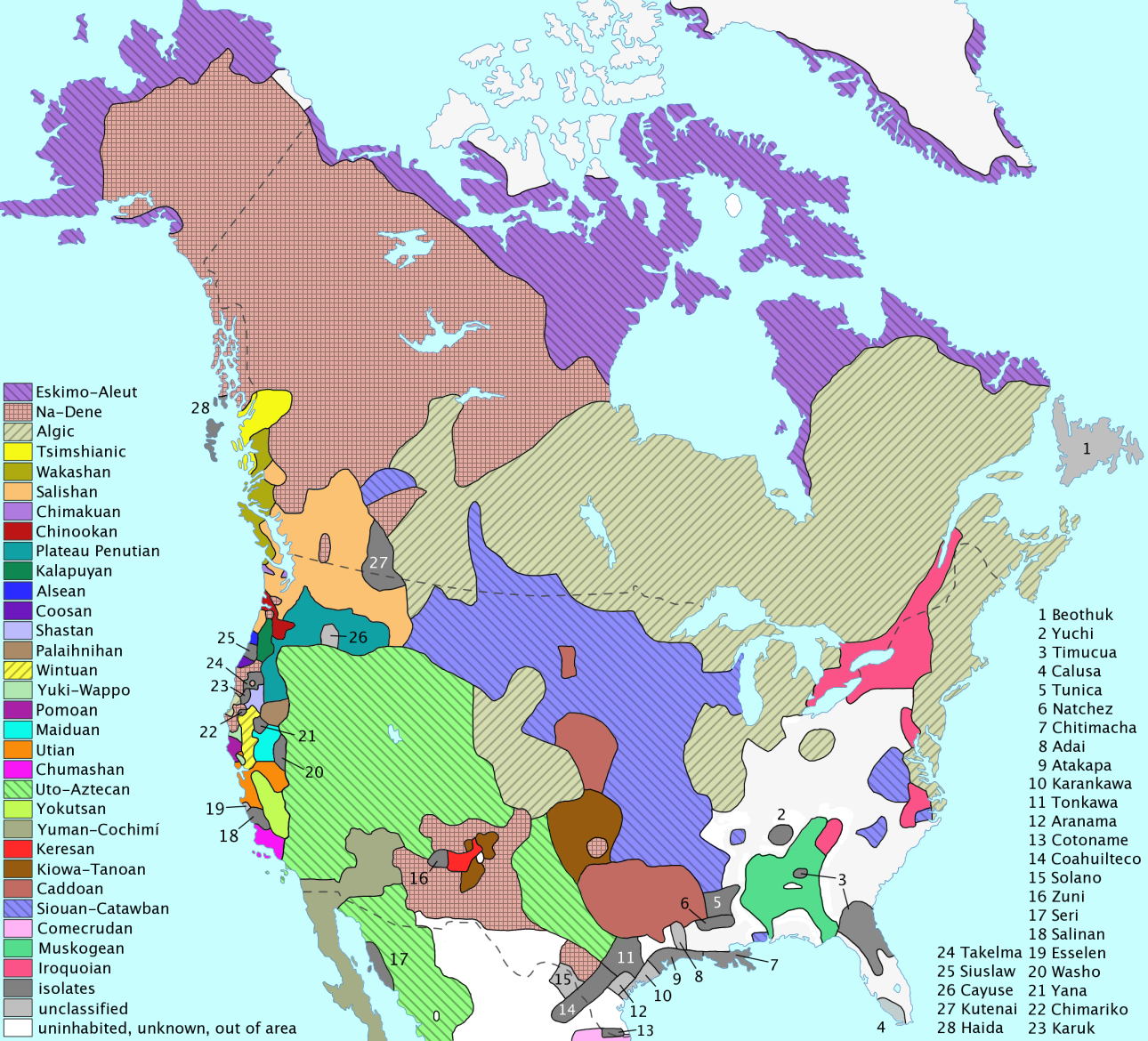
The Na-Dené, Algic, and Uto-Aztecan language families are the largest by number of languages. Uto-Aztecan has the most speakers (2 million) if the languages in Mexico are considered; Na-Dené comes second with approximately 200,000 speakers, and Algic third with about 180,000 speakers. Na-Dené and Algic have the widest geographic distributions: Algic spans from northeast Canada across much of the continent down to northeast Mexico with two outliers in California (Yurok and Wiyot); Na-Dené spans from Alaska and west Canada through Washington, Oregon, and California to the U.S. Southwest and northern Mexico. Several families consist of only 2 languages. Demonstrating genetic relationships has proved difficult due to the linguistic diversity present in North America. Two large (super-) family proposals, Penutian and Hokan have potential.
Words used in English have been derived from Native American languages.
Language education
To counteract a shift to English, some Native American tribes have initiated language immersion schools for children, where an Indigenous American language is the medium of instruction. The Cherokee Nation initiated a 10-year language preservation plan that involved raising new fluent speakers of the Cherokee language from childhood up through school immersion programs, as well as community effort to continue to use the language at home. This plan was part of a goal that, in 50 years, will result in 80% or more of the Cherokee being fluent. The Cherokee Preservation Foundation has invested $3 million in opening schools, training teachers, and developing curricula for language education, as well as initiating community gatherings where the language can be actively used. Formed in 2006, the Kituwah Preservation & Education Program (KPEP) on the Qualla Boundary focuses on language immersion programs for children from birth to fifth grade, developing cultural resources for the public and community language programs to foster the Cherokee language among adults.
There is a Cherokee language immersion school in Tahlequah, Oklahoma, that educates students from pre-school through eighth grade. Because Oklahoma's official language is English, Cherokee immersion students are hindered when taking state-mandated tests because they can have little competence in English. The Department of Education of Oklahoma said that in 2012 state tests: 11% of the school's sixth-graders showed proficiency in math, and 25% in reading; 31% of the seventh-graders showed proficiency in math, and 87% in reading; 50% of eighth-graders showed proficiency in math, and 78% in reading. The Department of Education listed the charter school as a Targeted Intervention school, meaning it was identified as a low-performing school. Ultimately, the school made a C, or a 2.33 grade point average on the state's A-F report card system. The report card shows the school getting an F in mathematics achievement and mathematics growth, a C in social studies achievement, a D in reading achievement, and an A in reading growth and student attendance. "The C we made is tremendous", said school principal Holly Davis, "[t]here is no English instruction in our school's younger grades, and we gave them this test in English." She had anticipated the low grade because it was the school's first year as a state-funded charter school, and many had difficulty with English. Eighth graders who graduate from the Tahlequah immersion school are fluent speakers of the language, and they usually go on to attend Sequoyah High School where classes are taught in English and Cherokee.
Indigenous foodways
Historical diets of Native Americans differed dramatically from region to region. Different peoples might have relied more heavily on agriculture, horticulture, hunting, fishing, or gathering wild plants and fungi. Tribes developed diets best suited to their environments.
Iñupiat, Yupiit, Unangan, and fellow Alaska Natives fished, hunted, and harvested wild plants, but did not rely on agriculture. Coastal peoples relied more heavily on sea mammals, fish, and fish eggs, while inland peoples hunted caribou and moose. Alaskan Natives prepared and preserved dried and smoked meat and fish.

Pacific Northwest tribes crafted seafaring dugout canoes 40 – long for fishing. In the Eastern Woodlands, early peoples independently invented agricultural and by 1800 BCE developed the crops of the Eastern Agricultural Complex, which include squash (Cucurbita pepo ssp. ovifera), sunflower (Helianthus annuus var. macrocarpus), goosefoot (Chenopodium berlandieri), and marsh elder (Iva annua var. macrocarpa).
The Sonoran Desert region including parts of Arizona and California, part of a region known as Aridoamerica, relied on the tepary bean as a staple crop. This and other desert crops, mesquite bead pods, tunas (prickly pear fruit), cholla buds, saguaro cactus fruit, and acorns are actively promoted by Tohono O'odham Community Action. In the Southwest, some communities developed irrigation techniques while others, such as the Hopi dry-farmed. They filled storehouses with grain as protection against the area's frequent droughts.
Maize or corn, first cultivated in what is now Mexico, was traded north into Aridoamerica and Oasisamerica, southwest. Maize cultivation spread throughout the Great Plains and Eastern Woodlands by 200 CE. Native farmers practiced polycropping maize, beans, and squash; these crops are known as the Three Sisters. The beans would replace the nitrogen, which the maize leached from the ground, as well as using corn stalks for support for climbing. The deficiencies of a diet dependent on maize were mitigated by the practice of converting maize kernels into hominy in a process called Nixtamalization.
The agriculture gender roles of the Native Americans varied from region to region. In the Southwest area, men prepared the soil with hoes. The women were in charge of planting, weeding, and harvesting. In most other regions, the women were in charge of most agriculture, including clearing the land, which was an immense chore, as they rotated fields. Europeans in the eastern part of the continent observed that Native Americans cleared large areas for cropland. Their fields in New England sometimes covered hundreds of acres. Colonists in Virginia noted thousands of acres under cultivation by Native Americans.
Early farmers commonly used tools such as the hoe, maul, and dibber. The hoe was the main tool used to till the land and prepare it for planting; then it was used for weeding. The first versions were made out of wood and stone. When the settlers brought iron, Native Americans switched to iron hoes and hatchets. The dibber was a digging stick, used to plant the seed. Once the plants were harvested, women prepared the produce for eating. They used the maul to grind the corn into a mash. It was cooked and eaten that way or baked as cornbread.
Religion
Main article: Native American religions
Native American religious practices and beliefs, differ widely across tribes. These spiritualities, practices, beliefs, may accompany adherence to another faith or can represent a person's primary religious, faith, spiritual or philosophical identity. Much Native American spirituality exists in a tribal-cultural continuum, so cannot be easily separated from tribal identity itself.
Some tribes include the use of sacred leaves and herbs such as tobacco, sweetgrass or sage. Many Plains tribes have sweatlodge ceremonies, though the specifics vary among tribes. Fasting, singing, prayer, and drumming are common.
The Midewiwin Lodge is a medicine society inspired by the oral history and prophesies of the Ojibwa (Chippewa) and related tribes.
Another significant religious body among Native peoples is known as the Native American Church. It is a syncretistic church incorporating elements of Native spiritual practice from different tribes as well as symbolic elements from Christianity. Its main rite is the peyote ceremony. Prior to 1890, traditional religious beliefs included Wakan Tanka. In the American Southwest, especially New Mexico, a syncretism between the Catholicism brought by Spanish missionaries and the native religion is common; the religious drums, chants, and dances of the Pueblo people are regularly part of Masses at Santa Fe's Saint Francis Cathedral. Native American-Catholic syncretism is also found elsewhere in the US. Some Native American tribes who practice Christianity, including the Lumbee, organized denominations, such as the Lumber River Conference of the Holiness Methodist Church.
The eagle feather law stipulates that only individuals of certifiable Native American ancestry, enrolled in a federally recognized tribe, are legally authorized to obtain eagle feathers for religious or spiritual use. The law does not allow Native Americans to give eagle feathers to non-Native Americans.
Gender roles
Main article: Gender roles among the Indigenous peoples of North America, Clan Mother (disambiguation){{!}}Clan Mother, Matriarchy, Matrilineality, Two-Spirit
Gender roles are differentiated in many Native American tribes. Many Natives have retained traditional expectations of sexuality and gender and continue to do so in contemporary life despite ongoing colonial pressures.
Whether a particular tribe is predominantly matrilineal or patrilineal, often both sexes have some degree of decision-making power within the tribe. Many Nations, such as the Haudenosaunee Five Nations and the Southeast Muskogean tribes, have matrilineal or Clan Mother systems, in which property and hereditary leadership are controlled by and passed through the maternal lines. In these Nations, the children are considered to belong to the mother's clan. In Cherokee culture, women own the family property. When traditional young women marry, their husbands may join them in their mother's household.
Matrilineal structures enable young women to have assistance in childbirth and rearing and protect them in case of conflicts between the couple. If a couple separates or the man dies, the woman has her family to assist her. In matrilineal cultures the mother's brothers are usually the leading male figures in her children's lives; fathers have no standing in their wife and children's clan, as they still belong to their mother's clan. Hereditary clan chief positions pass through the mother's line and chiefs have historically been selected on the recommendations of women elders, who could also disapprove of a chief.

In the patrilineal tribes, such as the Omaha, Osage, Ponca, and Lakota, hereditary leadership passes through the male line, and children are considered to belong to the father and his clan. In patrilineal tribes, if a woman marries a non-Native, she is no longer considered part of the tribe, and her children are considered to share the ethnicity and culture of their father.
In patriarchal tribes, gender roles tend to be rigid. Men have historically hunted, traded and made war while women have primary responsibility for the survival and welfare of the families (and future of the tribe). Women usually gather and cultivate plants, use plants and herbs to treat illnesses, care for the young and the elderly, make clothing and instruments, and process and cure meat and skins from the game. Some mothers use cradleboards to carry an infant while working or traveling. In matriarchal and egalitarian nations, the gender roles are usually not so clear-cut and even less so in the modern era. Several dozen tribes allowed polygyny to sisters, with procedural and economic limits.
Lakota, Dakota, and Nakota girls are encouraged to learn to ride, hunt and fight. Though fighting in war has mostly been left to the boys and men, occasionally women have fought, in battles and defense of the home, especially if the tribe was severely threatened.
Modern education
90% of Native American school-aged children attend public schools operated by school districts. Tribally-operated schools under contracts/grants with the Bureau of Indian Education (BIE) and direct BIE-operated schools take about 8% of Native American students, including students who live in very rural remote areas.
In 1978, 215,000 (78%) of Native Americans attended school district-operated public schools, 47,000 (17%) attended schools directly operated by the BIA, 2,500 (1%) attended tribal or other schools that contracted with the BIA, and the remaining 9,000 (3%) attended missionary schools for Native American children or other private schools.
Sports
Native American leisure time led to competitive individual and team sports. Jim Thorpe, Lewis Tewanima, Joe Hipp, Notah Begay III, Chris Wondolowski, Jacoby Ellsbury, Joba Chamberlain, Kyle Lohse, Sam Bradford, Jack Brisco, Tommy Morrison, Billy Mills, Angel Goodrich, Shoni Schimmel, and Kyrie Irving are well known professional athletes.
Team sports
Native American ball sports, sometimes referred to as lacrosse, stickball, or baggataway, were often used to settle disputes, rather than war, as a civil way to settle conflict. The Choctaw called it isitoboli ("Little Brother of War"); the Onondaga name was dehuntshigwa'es ("men hit a rounded object"). There are three basic versions, classified as Great Lakes, Iroquoian, and Southern.
The game is played with one or two rackets or sticks and one ball. The object is to land the ball in the opposing team's goal (either a single post or net) and prevent the opposing team from scoring. The game involves 20 or as many as 300 players with no height or weight restrictions, or protective gear. The goals could be from around 200 ft apart to about 2 mi; in lacrosse the field is 110 yd.
Individual sports
Chunkey was a game that consisted of a stone-shaped disk about 1–2 inches in diameter. The disk was thrown down a 200 ft corridor so it could roll past the players at great speed. Players would throw wooden shafts at the moving disk. The object of the game was to strike the disk or prevent your opponents from hitting it.
U.S. Olympics
Jim Thorpe, a Sauk and Fox Native American, was an all-around athlete playing football and baseball in the early 20th century. Future President Dwight Eisenhower injured his knee while trying to tackle the young Thorpe. In a 1961 speech, Eisenhower recalled Thorpe: "Here and there, there are some people who are supremely endowed. My memory goes back to Jim Thorpe. He never practiced in his life, and he could do anything better than any other football player I ever saw."
In the 1912 Olympics, Thorpe ran the 100-yard dash in 10 seconds flat, the 220 in 21.8 seconds, the 440 in 51.8 seconds, the 880 in 1:57, the mile in 4:35, the 120-yard high hurdles in 15 seconds, and the 220-yard low hurdles in 24 seconds. He long jumped 23 ft 6 in and high-jumped 6 ft 5 in. He pole vaulted 11 ft, put the shot 47 ft, throw the javelin 163 ft, and the discus 136 ft. Thorpe entered the U.S. Olympic trials for the pentathlon and the decathlon.
Louis Tewanima, Hopi people, was an American two-time Olympic distance runner and silver medalist in the 10,000-meters in 1912. He ran for the Carlisle Indian School where he was a teammate of Thorpe. His silver in 1912 remained the best US achievement in this event until another Indian, Billy Mills, won gold in 1964. Tewanima competed at the 1908 Olympics, where he finished 9th in the marathon.
Ellison Brown, of the Narragansett people from Rhode Island, won two Boston Marathons (1936, 1939) and competed in the 1936 Olympics in Berlin, but did not finish due to injury. He qualified for the 1940 Olympic Games in Helsinki, but the games were canceled due to the outbreak of World War II.
Billy Mills, a Lakota and USMC officer, won gold in the 10,000-meters at the 1964 Tokyo Olympics. He was the only American ever to win the gold in this event.
Billy Kidd, part Abenaki from Vermont, became the first American man to medal in alpine skiing in the Olympics, taking silver in the slalom in the 1964 Winter Olympics at Innsbruck, Austria. Six years later at the 1970 World Championships, Kidd won gold in the combined event and bronze in the slalom.
Ashton Locklear (Lumbee), an uneven bars specialist, was an alternate for the 2016 Summer Olympics U.S. gymnastics team, the Final Five. In 2016, Kyrie Irving (Sioux) also helped Team USA win gold at the 2016 Summer Olympics. He became the 4th member of Team USA to capture the NBA championship and Olympic gold in the same year, joining LeBron James, Michael Jordan, and Scottie Pippen.
Literature
Main article: Native American literature
Native American literature, composed of oral and written literature, has a long history. It is considered a series of literatures reflecting the varied traditions and histories of different tribes. Modern authors cover a range of genres and include Tommy Orange, Joy Harjo, Louise Erdrich, Stephen Graham Jones, Rebecca Roanhorse, Tommy Pico, and many more.
Music
Main article: Native American music
Traditional Native American music is almost entirely monophonic, but there are exceptions. It often includes drums, rattles, or other percussion, but little other instrumentation. Flutes and whistles made of wood, cane, or bone are also played, generally by individuals, but in former times also by large ensembles, as noted by conquistador de Soto. The tuning of modern flutes is typically pentatonic.
Performers with Native American parentage have occasionally appeared in American popular music such as Rita Coolidge, Wayne Newton, Gene Clark, Blackfoot, and Redbone. Some, such as John Trudell, have used music to comment on life in Native America. Others such as R. Carlos Nakai, Joanne Shenandoah and Robert "Tree" Cody integrate traditional sounds with modern, in instrumental recordings, whereas music by Charles Littleleaf is derived from ancestral heritage as well as nature. Recording companies offer an abundance of music by contemporary Native American performers young and old, ranging from pow-wow drum music to rock-and-roll and rap. In the ballet dancing Maria Tallchief was considered America's first major prima ballerina, and the first of Native American descent to hold the rank. Along with her sister Marjorie Tallchief both became star ballerinas.
The most widely practiced public musical form among Native Americans is that of the pow-wow. At pow-wows, such as the annual Gathering of Nations in Albuquerque, New Mexico, members of drum groups sit in a circle around a large drum. Drum groups play in unison while they sing and dancers in colorful regalia dance clockwise around the drum groups. Familiar pow-wow songs include honor songs, intertribal songs, crow-hops, sneak-up songs, grass-dances, two-steps, welcome songs, going-home songs, and war songs. Most Indigenous communities maintain traditional songs and ceremonies, some of which are shared and practiced exclusively within the community.
Art
The Iroquois, living around the Great Lakes and extending east and north, used strings or belts called wampum that served a dual function: the knots and beaded designs mnemonically chronicled tribal stories and legends, and served as a medium of exchange and unit of measure. The keepers of the articles were seen as tribal dignitaries.
Pueblo peoples crafted impressive items associated with their religious ceremonies. Kachina dancers wore elaborately painted and decorated masks as they ritually impersonated ancestral spirits. Pueblo people are noted for high-quality pottery, often with geometric designs and floral, animal and bird motifs. Carved stone and wood fetishes were made for religious use. Superior weaving, embroidered decorations, and rich dyes characterized their textile arts. Turquoise and shell jewelry were created, as were formalized pictorial arts.
Navajo spirituality focused on the maintenance of a harmonious relationship with the spirit world, often achieved by ceremonial acts, usually incorporating sandpainting. For the Navajo, sand painting is not just a representational object, but a spiritual entity with a life of its own, which helped the patient at the center of the ceremony re-establish a connection with the life force. These sand creations were erased at the end of the healing ceremony.
It has been estimated that the Native American arts and crafts industry brings in a billion USD in gross sales annually. Native American art comprises a major category in the world art collection. Native American contributions include pottery, paintings, jewellery, weavings, sculpture, basketry, and carvings. The integrity of certain Native American artworks is protected by the Indian Arts and Crafts Act of 1990, which prohibits the representation of art as Native American when it is not the product of an enrolled Native American artist. Gail Sheffield and others claim this has had "the unintended consequence of sanctioning discrimination against Native Americans whose tribal affiliation was not officially recognized". Artists such as Jeanne Rorex Bridges (Echota Cherokee), who was not enrolled, ran the risk of fines or imprisonment if they sold their art while affirming their heritage.
Notable Native American artists include Franklin Gritts, a Cherokee artist who taught students from many tribes at Haskell Institute (now Haskell Indian Nations University) in the 1940s, the Golden Age of Native American painters.
Interracial relations
Main article: Interracial relations among Native Americans in the United States
_of_Lillian_Gross,_Niece_of_Susan_Sanders_(Mixed_Blood)_1906.jpg)
Interracial relations between Native Americans, Europeans, and Africans is a complex issue that has been mostly neglected with "few in-depth studies on interracial relationships". Native Americans are more likely than any other racial group to practice interracial or intertribal marriage among the different tribes and non-Natives, resulting in an ever-declining proportion of Indigenous blood among those who claim a Native American identity (tribes often count only the Indian blood from their own tribal background in the enrollment process, disregarding intertribal heritages).
Assimilation
European impact was immediate, widespread, and profound already during the early years of colonization and the creation of the countries which currently exist in the Americas. Europeans living among Native Americans were often called "white indians". They "lived in native communities for years, learned native languages fluently, attended native councils, and often fought alongside their native companions".
Early contact was often charged with tension and emotion, but also had moments of friendship, cooperation, and intimacy. Marriages took place in English, French, Russian and Spanish colonies between Native Americans and Europeans though Native American women were also the victims of rape.
There was fear on both sides, as the different peoples realized how different their societies were. Many whites regarded Native people as "savages" because the Native people were not Protestant or Roman Catholic and therefore the Native people were not considered to be human beings. The Native American author, Andrew J. Blackbird, wrote in his History of the Ottawa and Chippewa Indians of Michigan (1897), that white settlers introduced some immoralities into Native American tribes. Many Native Americans suffered because the Europeans introduced alcohol. Many Native people do not break down alcohol in the same way as people of Eurasian background. Many Native people were learning what their body could tolerate of this new substance and died as a result of imbibing too much.
Blackbird wrote:
The U.S. government had two purposes when making land agreements with Native Americans: to open up more land for white settlement, and to "ease tensions" (in other words assimilate Native people to Eurasian social ways) between whites and Native Americans by forcing the Native Americans to use the land in the same way as did the whites—for subsistence farms. The government used a variety of strategies to achieve these goals; many treaties required Native Americans to become farmers in order to keep their land. Government officials often did not translate the documents which Native Americans were forced to sign, and native chiefs often had little or no idea what they were signing.
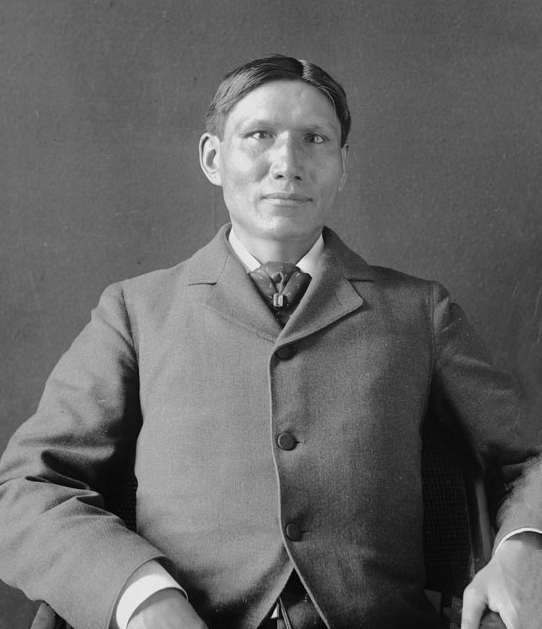
For a Native American man to marry a white woman, he had to get consent of her parents, as long as "he can prove to support her as a white woman in a good home". In the early 19th century, the Shawnee Tecumseh and blonde hair, blue-eyed Rebecca Galloway had an interracial affair. In the late 19th century, three European American middle-class women teachers at Hampton Institute married Native American men whom they had met as students.
As European American women started working independently at missions and Indian schools in the western states, there were more opportunities for their meeting and developing relationships with Native American men. For instance, Charles Eastman, a man of European and Lakota origin whose father sent both his sons to Dartmouth College, got his medical degree at Boston University and returned to the West to practice. He married Elaine Goodale, whom he met in South Dakota. He was the grandson of Seth Eastman, a military officer from Maine, and a chief's daughter. Goodale was a young European American teacher from Massachusetts and a reformer, who was appointed as the U.S. superintendent of Native American education for the reservations in the Dakota Territory. They had six children together.
European enslavement
Main article: Slavery among Native Americans in the United States, Slavery among Indigenous peoples of the Americas
The majority of Native American tribes did practice some form of slavery before the European introduction of African slavery into North America, but none exploited slave labor on a large scale. Most Native American tribes did not barter captives in the pre-colonial era, although they sometimes exchanged enslaved individuals with other tribes in peace gestures or in exchange for their own members. When Europeans arrived as colonists in North America, Native Americans changed their practice of slavery dramatically. Native Americans began selling war captives to Europeans rather than integrating them into their own societies as they had done before. As the demand for labor in the West Indies grew with the cultivation of sugar cane, Europeans enslaved Native Americans for the Thirteen Colonies, and some were exported to the "sugar islands". The British settlers, especially those in the southern colonies, purchased or captured Native Americans to use as forced labor in cultivating tobacco, rice, and indigo. Accurate records of the numbers enslaved do not exist because vital statistics and census reports were at best infrequent. Scholars estimate tens to hundreds of thousands of Native Americans may have been enslaved by the Europeans, being sold by Native Americans themselves or Europeans.
In Colonial America, slavery soon became racialized, with those enslaved by the institution consisting of ethnic groups (non-Christian Native Americans and Africans) who were foreign to the Christian, European colonists. The House of Burgesses define the terms of slavery in Virginia in 1705:
The slave trade of Native Americans lasted only until around 1750. It gave rise to a series of devastating wars among the tribes, including the Yamasee War. The Indian Wars of the early 18th century, combined with the increasing importation of African slaves, effectively ended the Native American slave trade by 1750. Colonists found that Native American slaves could easily escape, as they knew the country. The wars cost the lives of numerous colonial slave traders and disrupted their early societies. The remaining Native American groups banded together to face the Europeans from a position of strength. Many surviving Native American peoples of the southeast strengthened their loose coalitions of language groups and joined confederacies such as the Choctaw, the Creek, and the Catawba for protection. Even after the Indian Slave Trade ended in 1750, the enslavement of Native Americans continued (mostly through kidnappings) in the west and in the Southern states. Both Native American and African enslaved women suffered rape and sexual harassment by male slaveholders and other white men.
Race, ethnicity, and citizenship
Main article: Native American identity, Native Americans in United States elections
Native American identity is determined by the tribal community that the individual or group is seeking to identify with. While it is common for non-Natives to consider it a racial or ethnic identity, it is considered by Native Americans in the United States to be a political identity, based on citizenship and immediate family relationships. As culture can vary widely between the 574 extant federally recognized tribes in the United States, the idea of a single unified "Native American" racial identity is a European construct that does not have an equivalent in tribal thought.
Historically, numerous Native Americans assimilated into colonial and later American society, e.g. through adopting English and converting to Christianity. In many cases, this process occurred through forced assimilation of children sent off to American Indian boarding schools far from their families. Those who could eventually pass for white gained the advantage of white privilege, yet often paid for it with the loss of community connections. With the enforcement of blood quantum laws, Indian blood could be diluted over generations through intermarrying with non-Native populations, as well as intermarrying with members of tribes that also required high blood-quantum, solely from one tribe. "Kill the Indian, save the man" was a mantra of nineteenth-century U.S. assimilation policies.
Tribal enrollment
Requirements for tribal citizenship vary by tribe, but are generally based on who one's parents and grandparents are, as known and documented by community members and tribal records. Among the tribal nations, qualification for enrolling those who were not logged at birth by their parents may be based upon a required percentage of Native American "blood" (or the "blood quantum") of an individual, or upon documented lineal descent from an ancestor on a specific census or register.
Tribal rules regarding the recognition of members who have heritage from multiple tribes also vary, but most do not allow citizenship in multiple tribes at once. For those that do, usually citizens consider one of their citizenships primary, and their other heritage to be "descent". Federally recognized tribes do not accept genetic ethnicity percentages results as appropriate evidence of Native American identity, as they cannot indicate specific tribe, or even whether or not someone is Native American. Unless requested for a paternity test, they do not advise applicants to submit such things.
Increased self-identification
In the 2010 Census, nearly 3 million people indicated that their "race" was Native American (including Alaska Native). Of these, more than 27% specifically indicated "Cherokee" as their ethnic origin. This phenomenon has been dubbed the "Cherokee Syndrome". Across the US, numerous individuals cultivate an opportunistic ethnic identity as Native American, sometimes through Cherokee heritage groups or Indian Wedding Blessings.
Since the 2000 census, people may identify as being of more than one race. Since the 1960s, the number of people claiming Native American ancestry has grown significantly and, by the 2000 census, the number had more than doubled. Sociologists attribute this dramatic change to "ethnic shifting" or "ethnic shopping"; they believe that it reflects a willingness of people to question their birth identities and adopt new ethnicities which they find more compatible.
The author Jack Hitt writes:
Journalist Mary Annette Pember (Ojibwe) writes that non-Natives identifying with Native American identity may be a result of a person's increased interest in genealogy, the romanticization of what they believe the cultures to be, and family lore of Native American ancestors in the distant past. However, there are different issues if a person wants to pursue enrollment as a citizen of a tribal nation. Different tribes have different requirements for citizenship. Often those who live as non-Natives, yet claim distant heritage, say they are simply reluctant to enroll, arguing that it is a method of control initiated by the federal government. However, it is the tribes that set their own enrollment criteria, and "the various enrollment requirements are often a hurdle that ethnic shoppers are unable to clear." Says Grayson Noley, (Choctaw), of the University of Oklahoma, "If you have to search for proof of your heritage, it probably isn't there." In other cases, there are some individuals who are 100% Native American but, if all of their recent ancestors are from different tribes, blood quantum laws could result in them not meeting the citizenship criteria for any one of those individual tribes. Pember concludes:
DNA
Main article: Genetic history of the Indigenous peoples of the Americas
The genetic history of Indigenous peoples of the Americas primarily focuses on human Y-chromosome DNA haplogroups and human mitochondrial DNA haplogroups. "Y-DNA" is passed solely along the patrilineal line, from father to son, while "mtDNA" is passed down the matrilineal line, from mother to offspring of both sexes. Neither recombines, and thus Y-DNA and mtDNA change only by chance mutation at each generation with no intermixture between parents' genetic material. Autosomal "atDNA" markers are also used, but differ from mtDNA or Y-DNA in that they overlap significantly. Autosomal DNA is generally used to measure the average continent-of-ancestry genetic admixture in the entire human genome and related isolated populations. Within mtDNA, genetic scientists have found specific nucleotide sequences that they have classified as "Native American markers" because the sequences are understood to have been inherited through the generations of genetic females within populations first found in the "New World". There are five primary Native American mtDNA haplogroups in which there are clusters of closely linked markers inherited together. All five haplogroups have been identified by researchers as "prehistoric Native North American samples", and it is commonly asserted that the majority of living Native Americans possess one of the common five mtDNA haplogroup markers.
The genetic pattern indicates Indigenous Americans experienced two very distinctive genetic episodes; first with the initial-peopling of the Americas, and secondly with European colonization of the Americas. The former is the determinant factor for the number of gene lineages, zygosity mutations and founding haplotypes present in today's Indigenous American populations.
The most popular theory is that human settlement of the Americas occurred in stages from the Bering sea coast line, with an initial 15,000 to 20,000-year layover on Beringia for the small founding population. The micro-satellite diversity and distributions of the Y lineage specific to South America indicates that certain Amerindian populations have been isolated since the initial colonization of the region. The Na-Dené, Inuit and Indigenous Alaskan populations exhibit haplogroup Q-M242 (Y-DNA) mutations, however, that are distinct from other Indigenous Amerindians, and that have various mtDNA and atDNA mutations. This suggests that the paleo-Indian migrants into the northern extremes of North America and Greenland were descended from a later, independent migrant population.
Genetic analyses of HLA I and HLA II genes as well as HLA-A, -B, and -DRB1 gene frequencies links the Ainu people of northern Japan and southeastern Russia to some Indigenous peoples of the Americas, especially to populations on the Pacific Northwest Coast such as Tlingit. Scientists suggest that the main ancestor of the Ainu and of some Native American groups can be traced back to Paleolithic groups in Southern Siberia.
References
References
- (August 12, 2021). "Race and Ethnicity in the United States". [[United States Census Bureau]].
- Siebens, J & T Julian. ''Native North American Languages Spoken at Home in the United States and Puerto Rico: 2006–2010''. United States Census Bureau. December 2011.
- Barry Pritzker, ''A Native American Encyclopedia: History, Culture, and Peoples'' (Oxford University Press, 2000), 331.
- Barry Pritzker, ''A Native American Encyclopedia: History, Culture, and Peoples'' (Oxford University Press, 2000), 335.
- "About the Topic of Race". United States Census Bureau.
- "U.S. Census Bureau History: American Indians and Alaska Natives". United States Census Bureau.
- Alibek, Ken. (2004). "Smallpox: a disease and a weapon". Elsevier BV.
- [[Colonial Williamsburg]], ''CW Journal'' (Spring 2004), [https://research.colonialwilliamsburg.org/Foundation/journal/Spring04/warfare.cfm "Colonial Germ Warfare"]
- (2001). "Pox Americana: The Great Smallpox Epidemic of 1775–82". Hill and Wang.
- (March 2000). "Biological Warfare in Eighteenth-Century North America: Beyond Jeffrey Amherst". Journal of American History.
- (2001). "Rotting Face: Smallpox and the American Indian". University of Nebraska Press.
- (December 1, 2006). "Settler colonialism and the elimination of the native". Journal of Genocide Research.
- (December 5, 2013). "American Settler Colonialism: A History". Springer.
- (2019). "North American Genocides: Indigenous Nations, Settler Colonialism, and International Law". Cambridge University Press.
- (14 November 2018). ""Civil Rights Act of 1968" full text". U.S. Government Publishing Office.
- (2023-12-03). "A Look at the Largest American Indian and Alaska Native Tribes and Villages in the Nation, Tribal Areas and States".
- (August 13, 2021). "2020 Census: Native population increased by 86.5 percent". ICT News.
- Calloway, Colin G. [http://www.americanheritage.com/content/native-americans-first-view-whites-shore "Native Americans First View Whites from the Shore"]. ''American Heritage'', Spring 2009. Retrieved December 29, 2011
- Mann, Charles C.. (March 2002). "1491".
- Denevan, William M. (1992). "The Pristine Myth: The Landscape of the Americas in 1492". ''Annals of the Association of American Geographers''. 82 (3): 369–385. doi:10.1111/j.1467-8306.1992.tb01965.x.
- Ostler, Jeffrey (2019). ''Surviving Genocide: Native Nations and the United States from the American Revolution to Bleeding Kansas''. New Haven: Yale University Press.
- Perdue, Theda. (2003). "Mixed Blood Indians: Racial Construction in the Early South". The University of Georgia Press.
- Remini, Robert. (1998). "Andrew Jackson". History Book Club.
- Miller, Eric. (1994). "George Washington and Indians, Washington and the Northwest War, Part One". Eric Miller.
- Jewett, Tom. (1996–2009). "Thomas Jefferson's Views Concerning Native Americans". Archiving America.
- (July 15, 1830). "An Indian Candidate for Congress". Christian Mirror and N.H. Observer, Shirley, Hyde & Co..
- Kappler, Charles. (1904). "Indian Affairs: Laws and Treaties Vol. II, Treaties". Government Printing Office.
- (2000). "Out West". University of Nebraska Press.
- "Facebook labels declaration of independence as 'hate speech'". The Guardian.
- [[Albert Boime
- ''Congressional Globe'', April 28, 1836, p. 1316.
- "Plains Humanities: Wounded Knee Massacre". University of Nebraska–Lincoln.
- [https://www.bia.gov/frequently-asked-questions U.S. Department of the Interior, Indian Affairs], Native American Faculty and Staff Association News. University of California, Davis. Accessed October 25, 2011.
- [http://nafsa.ucdavis.edu/NAFSA%20News.html "FNX: First Nations Experience Television"], Native American Faculty and Staff Association News. University of California, Davis. Accessed October 25, 2011.
- (2001). "Read "America Becoming: Racial Trends and Their Consequences: Volume I" at NAP.edu". National Academies Press.
- "Reporter's Indigenous Terminology Guide". Native American Journalists Association.
- Communications Branch Indian and Northern Affairs Canada. ''An Evolving Terminology Relating to Aboriginal Peoples in Canada''. Government of Canada, Oct. 2002, [https://publications.gc.ca/collections/Collection/R2-236-2002E.pdf publications.gc.ca/collections/Collection/R2-236-2002E.pdf]. Accessed 30 Dec. 2025.
- "P1 RACE". U.S. Census.
- (January 2012). "The American Indian and Alaska Native Population: 2010". U.S. Census.
- United States Census Bureau. "About the Topic of Race".
- "Grid View: Table B02017 - Census Reporter".
- "Grid View: Table B03002 - Census Reporter".
- "Grid View: Table B02017 - Census Reporter".
- "Grid View: Table B02019 - Census Reporter".
- Hitt, Jack. (August 21, 2005). "The Newest Indians". The New York Times Magazine.
- Rosenthal, Jack. (1971-10-20). "1970 Census Finds Indian No Longer the Vanishing American". The New York Times.
- "Historical Census Statistics on Population Totals By Race, 1790 to 1990, and By Hispanic Origin, 1970 to 1990, For The United States, Regions, Divisions, and States".
- "The American Indian and Alaska Native Population: 2000".
- (February 20, 2013). "State and County QuickFacts".
- (August 12, 2021). "Race and Ethnicity in the United States: 2010 Census and 2020 Census".
- (1894). "Report on Indians taxed and Indians not taxed in the United States (except Alaska)". Government Printing Office.
- Rogers, George W.. (2011). "The Future of Alaska: Economic Consequences of Statehood". RFF Press.
- "Sex, General Nativity, And Color".
- (1886). "Annual report of the Board of Regents of the Smithsonian Institution". Government Printing Office.
- Yurth, Cindy. (January 26, 2012). "Census: Native count jumps by 27 percent". The Navajo Times.
- Williams, Timothy. (April 13, 2013). "Quietly, Indians Reshape Cities and Reservations". The New York Times.
- "Table 7. American Indian and Alaska Native Population by Selected Tribal Groupings: 2010".
- "American Indian and Alaska Native Tribes in the United States and Puerto Rico: 2010".
- "Paiute" is a problematic cover term for non-contiguous and historically, ethnographically, and linguistically distinct tribes: [[Northern Paiute]], [[Southern Paiute]], and [[Mono people. Owens Valley Paiute]]. The 2000 U.S. Census lumps these distinct groups into one term. Generally, the word "Paiute" was used in the 19th century for any Great Basin Native American who wasn't [[Shoshone people. Shoshoni]].
- "Indian Entities Recognized by and Eligible To Receive Services From the United States Bureau of Indian Affairs".
- "Frequently Asked Questions, Bureau of Indian Affairs". Department of the Interior.
- "The U.S. Relationship To American Indian and Alaska Native Tribes".
- Robertson, Lindsay. (June 2001). "Native Americans and the Law: Native Americans Under Current United States Law".
- (1928). "Bureau of Indian affairs". Science.
- "The Muwekman Ohlone".
- "Washington GOP plank to terminate tribes ignites firestorm".
- (July 7, 2007). "National Congress of American Indians Opposes Bill to Terminate the Cherokee Nation". Wisdom Keepers, Inc..
- Leland, Charles G. & Cook, Michael W. ''Passamaquoddy Legends (Annotated Edition)'': extracted from ''Algonquin Legends of New England; or Myths and Folklore of the Micmac, Passamaquoddy, and Penobscot Tribes.'' (USA: Independently published. 2021).
- "The black-and-white world of Walter Ashby Plecker".
- (October 23, 2009). "Virginia tribes take another step on road to federal recognition". Richmond Times-Dispatch.
- Gould, L. Scott. (May 2001). "Mixing Bodies and Beliefs: The Predicament of Tribes". Columbia Law Review.
- "The Genocide and Relocation of the Dine'h (Navajo)".
- "Big Mountain Update 1 February 1997".
- (October 28, 2011). "Legacy of Jim Crow for Southern Native Americans".
- (January 1, 2010). "Lumbee Indians in the Jim Crow South: Race, Identity, and the Making of a Nation". Univ of North Carolina Press.
- (1991). "Jim Crow, Indian Style: The Disenfranchisement of Native Americans". American Indian Law Review.
- (August 8, 2014). "NAACP v. Jim Crow".
- [http://www.crmvet.org/tim/timhis54.htm#1954bvbe ''Brown v Board of Education'' Decision] ~ Civil Rights Movement Archive
- (February 13, 2014). "Dr. King spoke out against the genocide of Native Americans".
- (April 2, 2017). "Street Smarts: MLK Jr. visited 'Papago' reservation near Tucson, was fascinated".
- (January 16, 2017). "Dr. Martin Luther King Jr: Our Nation was Born in Genocide".
- (January 11, 2018). "Dr. Martin Luther King, Jr., Black People and Indigenous People: How We Cash This Damn Check".
- Cobb, Daniel M.(2008). ''Native Activism In Cold War America: The Struggle for Sovereignty'', University Press of Kansas, Kansas. {{ISBN. 978-0-7006-1597-1.{{page needed. (March 2021)
- (January 21, 2016). "Navajos and locals in Gallup celebrate Martin Luther King Jr. Day".
- (December 1, 2014). "The American Indian Civil Rights Movement: A case study in Civil Society Protest". Yesterday and Today.
- (January 18, 2019). "Nationwide Racial Equity Groups Organize in Support of Racial Healing Groups Support NDORH with Prayer Vigil and Tele Town Hall".
- "Challenges to Health and Well-Being of Native American Communities".
- (September 2004). "Broken Promises: Evaluating the Native American Health Care System".
- (2014). "Trends and Disparities in Stroke Mortality by Region for American Indians and Alaska Natives". American Journal of Public Health.
- (2016). "Sleep Duration and Diabetes Risk in American Indian and Alaska Native Participants of a Lifestyle Intervention Project". Sleep.
- [https://mic.com/articles/121671/native-americans-have-nothing-to-celebrate-on-july-4#.Qst75mbCL "Millions of Americans Have Nothing to Celebrate on the Fourth of July"]. Mic. Retrieved August 23, 2017.
- (2020). "The American Steppes". Cambridge University Press.
- "How American Racism Influenced Hitler".
- "Walking a Mile: A Qualitative Study Exploring How Indians and Non-Indians Think About Each Other".
- "[Executive Order 11246]--Equal employment opportunity". The Federal Register.
- "Office of Federal Contract Compliance Programs (OFCCP)". U.S. Department of Labor.
- (March 2016). "American Indian Poverty in the Contemporary United States". Sociological Forum.
- (October 19, 2007). "Final Guidance on Maintaining, Collecting, and Reporting Racial and Ethnic Data to the U.S. Department of Education". U.S. Department of Education.
- Neconie, Bridget. (Spring 2012). "Removing Educational Barriers for Native American Citizens of Federally- Recognized Tribes". The American Indian Graduate.
- Deer, Sarah. (2015). "The Beginning and End of Rape: Confronting Sexual Violence in Native America". University of Minnesota Press.
- "Florida State University thanks Seminoles for historic vote of support". Florida State University.
- Teaching Tolerance. "Native American Mascots Big Issue in College Sports".
- Zirin, Dave. (January 7, 2014). "The Florida State Seminoles: The Champions of Racist Mascots".
- (October 2013). "ENDING THE LEGACY OF RACISM IN SPORTS & THE ERA OF HARMFUL "INDIAN" SPORTS MASCOTS". National Congress of American Indians.
- (December 24, 2012). "Native American Mascot Controversy Takes Center Stage at the National Museum of the American Indian". Smithsonian Institution.
- Beres, Tom. (April 9, 2015). "Wahoo Protesters: A century of 'Indians' is enough". WKYC-TV.
- (February 18, 2019). "CHIEF WAHOO".
- Bastian, Jordan. (January 29, 2018). "Indians to stop using Wahoo logo starting in '19". [[MLB Advanced Media.
- Waldstein, David. (January 29, 2018). "Cleveland Indians Will Abandon Chief Wahoo Logo Next Year". [[The New York Times]].
- Siemaszko, Corky. (January 29, 2018). "Cleveland Indians will remove Chief Wahoo logo in 2019". [[NBC News]].
- (December 14, 2020). "Cleveland's Baseball Team Will Drop Its Indians Team Name". The New York Times.
- Bell, Mandy. (July 23, 2021). "New for '22: Meet the Cleveland Guardians". [[MLB Advanced Media]].
- Hoynes, Paul. (July 23, 2021). "Cleveland Indians choose Guardians as new team name". [[The Plain Dealer]].
- Shohat, Ella, and Stam, Robert. ''Unthinking Eurocentrism: Multiculturalism and the Media''. New York: Routledge, 1994.
- Boedeker, Hal. (July 7, 1996). "TNT'S 'CRAZY HORSE' IS A DUD OF A TRIBUTE".
- Kaufman, Amy. (June 21, 2018). "As Sitting Bull in 'Woman Walks Ahead,' Michael Greyeyes continues to educate through Native roles". Los Angeles Times.
- (September 25, 2018). "Cast and crew of Smoke Signals reunites for 20th anniversary". Indianz.com.
- (November 30, 2017). "Chris Eyre".
- "About the Project: We Shall Remain".
- (2001). "American Indians: Answers to Today's Questions". University of Oklahoma Press.
- (2019). "Lord Cornwallis Is Dead: The Struggle for Democracy in the United States and India". Harvard University Press.
- (1852). "Memorial to Congress". Madison.
- (October 22, 1902). "Americanists in dispute". [[The New York Times]].
- [http://www.survivalinternational.org/info/terminology "Terminology."] {{Webarchive. link. (December 9, 2012 ''Survival International.'' Retrieved 30 March 2012. [http://lema.rae.es/drae/?val=aborigen "Aborigen"] ''Diccionario de la Real Academia Española''. Retrieved 8 February 2012.)
- Reid, Basil. "Tracing Our Amerindian Heritage".
- Guide, Barbados.org Travel. "The Abbreviated History of Barbados".
- Unique Media Design Limited. "diGJamaica :: Amerindian Jamaica".
- Murray, Paul T.. (1987). "Who Is an Indian? Who Is a Negro? Virginia Indians in the World War II Draft". The Virginia Magazine of History and Biography.
- "Properties".
- "Preference for Racial or Ethnic Terminology".
- Russell Means: "I am an American Indian, not a native American!" (Treaty Productions, 1996); citation given here [http://www.learnnc.org/lp/editions/nc-american-indians/5526] {{Webarchive. link. (January 11, 2012 and here [https://web.archive.org/web/20080119075859/http://www.pbs.org/wgbh/roadshow/fts/bismarck_200504A16.html])
- "''American Indian'' versus ''Native American''".
- (2003). "Diversity in Human Interactions: The Tapestry of America". Oxford University Press.
- Bacon, J.M.. (2018). "Settler Colonialism as Eco-Social Structure and the Production of Colonial Ecological Violence". Environmental Sociology.
- Gilio-Whitaker, Dina. (2019). "As Long as Grass Grows: The Indigenous Fight for Environmental Justice, from Colonization to Standing Rock". S.L. Beacon.
- Norgaard, Kari Marie. (2019). "Salmon and Acorns Feed Our People: Colonialism, Nature, and Social Action". New Brunswick, Rutgers University Press.
- Whyte, Kyle. (November 2016). "Is It Colonial Déjà Vu? Indigenous Peoples and Climate Injustice". Humanities for the Environment: Integrating Knowledges, Forging New Constellations of Practice.
- Ostler, Jeffrey. (2019). "Surviving Genocide: Native Nations and the United States from the American Revolution to Bleeding Kansas". New Haven Yale University Press.
- "Miami Tribe Relations".
- (July 6, 2011). "Gaming Tribe Report". National Indian Gaming Commission.
- (2011). "NIGC Tribal Gaming Revenues". National Indian Gaming Commission.
- (March 2016). "Online Sovereignty: The Law and Economics of Tribal Electronic Commerce". Vanderbilt Journal of Entertainment & Technology Law.
- Perry, Steven W.. (December 2004). "A BJS Statistical Profile, 1992–2002 American Indians and Crime". U.S. Department of Justice Office of Justice Programs.
- Washburn, Kevin K.. (February 2006). "American Indians, Crime, and the Law". Michigan Law Review.
- Riley, Michael. (November 11, 2007). "1885 law at root of jurisdictional jumble". The Denver Post.
- [http://www.denverpost.com/frontpage/ci_15373276? "Expansion of tribal courts' authority passes Senate"] {{webarchive. link. (March 4, 2016 article by Michael Riley in ''[[The Denver Post]]'' Posted: 25 June 2010 01:00:00 AM MDT Updated: 25 June 2010 02:13:47 AM MDT Accessed June 25, 2010.)
- [http://www.denverpost.com/ci_15636761 "President Obama signs tribal-justice changes"] {{webarchive. link. (March 4, 2016 article by Michael Riley in ''[[The Denver Post]]'', Posted: 30 July 2010 01:00:00 AM MDT, Updated: 30 July 2010 06:00:20 AM MDT, accessed July 30, 2010.)
- [http://www.denverpost.com/lawlesslands "Lawless Lands"] {{webarchive. link. (March 4, 2016 a 4-part series in ''[[The Denver Post]]'' last updated November 21, 2007)
- Williams, Timothy. (November 12, 2012). "Washington Steps Back From Policing Indian Lands, Even as Crime Rises". The New York Times.
- [http://www.ojp.usdoj.gov/nij/pubs-sum/209839.htm "Public Law 280 and Law Enforcement in Indian Country – Research Priorities December 2005"], accessed August 12, 2010.
- "[https://www.nytimes.com/2009/12/14/us/14gangs.html?_r=1 Indian Gangs Grow, Bringing Fear and Violence to Reservation]". ''The New York Times''. December 13, 2009
- "[https://www.npr.org/templates/story/story.php?storyId=112200614 Gang Violence On The Rise On Indian Reservations]". NPR: National Public Radio. August 25, 2009.
- Williams, Timonthy. (May 22, 2012). "For Native American Women, Scourge of Rape, Rare Justice". The New York Times.
- Childress, Sarah. (February 4, 2013). "Will the Violence Against Women Act Close a Tribal Justice "Loophole"?". [[PBS]].
- N. Bruce Duthu. (August 10, 2008). "Broken Justice in Indian Country". The New York Times.
- Weisman, Jonathan. (February 10, 2013). "Measure to Protect Women Stuck on Tribal Land Issue". The New York Times.
- "NIGA: Indian Gaming Facts".
- "Number of U.S. Minority Owned Businesses Increasing".
- "What Can Tribes Do? Strategies and Institutions in American Indian Economic Development".
- (Winter 1998). "An Assessment of Native American Economic Development: Putting Culture and Sovereignty back in the Models". Studies in Comparative International Development.
- "Native Entrepreneurship: Challenges and opportunities for rural communities — CFED, Northwest Area Foundation December 2004".
- (2012). "The Failure of State-Led Economic Development on American Indian Reservations". The Independent Review.
- (Fall 2013). "Community Development in Native Communities". Federal Reserve Bank of San Francisco.
- Van Winkle, Tony N.. (Fall 2018). "American Indian Landowners, Leasemen, and Bureaucrats: Property, Paper, and the Poli-Technics of Dispossession in Southwestern Oklahoma". American Indian Quarterly.
- Riley, Naomi Schaefer. (July 30, 2016). "Here's One Way to Help Native Americans: Property Rights".
- "The Project Gutenberg eBook of The Indian Question, by Francis A. Walker.".
- d'Errico, Peter. (1999). "Native Americans in America: A Theoretical and Historical Overview". Wíčazo Ša Review.
- Colbourne, Rick. (April 2017). "An Understanding of Native American Entrepreneurship". Small Enterprise Research.
- Crepelle, Adam. (2018). "Tribal Lending and Tribal Sovereignty". Drake Law Review.
- Myhra, L. L. (2011). "It runs in the family": Intergenerational Transmission of Historical Trauma Among Urban American Indians and Alaska Natives in Culturally Specific Sobriety Maintenance Programs. American Indian and Alaska Native Mental Health Research, 18(2). 17–40. National Center for American Indian and Alaska Native Mental Health Research.
- Weaver, H., & Congress, E. (2010). The Ongoing Impact of Colonization: Man-made Trauma and Native Americans. In A. Kalayjian & D. Eugene (Eds.), Mass Trauma and Emotional Healing Around the World: Rituals and Practices for Resilience and Meaning-Making (pp. 211–226). Santa Barbara, CA: Praeger.
- Braveheart-Jordan, M., & DeBruyn, L. (1995). So She May Walk in Balance: Integrating the Impact of Historical Trauma in the Treatment of Native American Indian Women. In J. Adleman & G. M. Enguidanos (Eds.), Racism in the Lives of Women: Testimony, Theory, and Guides to Antiracist Practice (pp. 345–366). Binghamton, New York: Harrington Park Press.
- (2017). "Exploring the Impact of Substance Abuse, Culture, and Trauma on American Indian Adolescents". Journal of Applied Rehabilitation Counseling.
- (2014). "Psychological Trauma Among American Indian Families: A Two-Generation Study". Journal of Loss and Trauma.
- Cole, N. (2006). Trauma and the American Indian. In T. M. Witko (Ed.), Mental Health Care for Urban Indians: Clinical Insights from Native Practitioners (pp. 115–130). Washington, DC: American Psychological Association.
- (2008). "The Native American Healing Experience". Substance Use & Misuse.
- (2015). "Understanding and Healing Historical Trauma: The Perspectives of Native American Elders". Journal of Mental Health Counseling.
- (2008). "Measuring the Extent, Depth, and Severity of Food Insecurity: An Application to American Indians in the USA". Journal of Population Economics.
- (2016). "Food Insecurity among American Indians and Alaska Natives: A National Profile using the Current Population Survey–Food Security Supplement". Journal of Hunger & Environmental Nutrition.
- (May 25, 2023). "Native American | History, Art, Culture, & Facts".
- Morgan, Lewis H.. (1907). "Ancient Society". Charles H. Kerr & Company.
- (2010). "The Columbian Exchange: A History of Disease, Food, and Ideas". [[Journal of Economic Perspectives]].
- (2003). "The myth of early globalization: the Atlantic economy, 1500–1800". European Review.
- "Encyclopedia of the Great Plains – HORSE".
- (2008). "Native Now: Language: Cherokee".
- (2014). "Cherokee Language Revitalization".
- Kituwah Preservation & Education Program Powerpoint, by Renissa Walker (2012)'. 2012. Print.{{page needed. (March 2021)
- Chavez, Will. (April 5, 2012). "Immersion students win trophies at language fair". Cherokeephoenix.org.
- (February 4, 2013). "Cherokee Immersion School Strives to Save Tribal Language". Youth On Race.
- (December 1997). "Mercury study report to Congress". US EPA.
- (April 21, 2009). "Initial formation of an indigenous crop complex in eastern North America at 3800 B.P". Proceedings of the National Academy of Sciences of the United States of America.
- "Illinois Agriculture – People – Native American Settlement".
- (September 17, 2014). "Tohono O'odham Community Action (TOCA), Sells AZ".
- (2019). "The Experimental Identification of Nixtamalized Maize though Starch Spherulites". Journal of Archaeological Science.
- Krech III, Shepard. (1999). "The ecological Indian: myth and history". W. W. Norton & Company, Inc..
- "American Indian Agriculture".
- "Native American Music".
- [http://www.csp.org/communities/docs/fikes-nac_history.html A Brief History of the Native American Church] {{Webarchive. link. (August 21, 2007 by Jay Fikes. Retrieved February 22, 2006.)
- (2003). "Encyclopedia of American Religions". [[Gale (publisher).
- (1993). "Proposed Amendments to the American Indian Religious Freedom Act: March 8, 1993, Minneapolis, MN". U.S. Government Printing Office.
- (January 1, 2011). "Two Spirits, Nádleeh, and LGBTQ2 Navajo Gaze". American Indian Culture and Research Journal.
- Thomas, Katsithawi. "Gender Roles among the Iroquois".
- [http://www.usgennet.org/usa/ne/topic/resources/OLLibrary/collections/vol19/v19p064.htm Melvin Randolph Gilmore, "The True Logan Fontenelle"], ''Publications of the Nebraska State Historical Society'', Vol. 19, edited by Albert Watkins, Nebraska State Historical Society, 1919, p. 64, at GenNet, accessed August 25, 2011
- [https://web.archive.org/web/20030302141755/http://college.hmco.com/history/readerscomp/naind/html/na_013100_gender.htm Beatrice Medicine], "Gender", ''Encyclopedia of North American Indians'', February 9, 2006.
- Zinn, Howard (2005). ''A People's History of the United States: 1492–present'', Harper Perennial Modern Classics. {{ISBN. 0-06-083865-5.
- "Women in Battle".
- Woods, Alden. (August 6, 2020). "The Federal Government Gives Native Students an Inadequate Education, and Gets Away With It". [[ProPublica]].
- Woods, Alden. (September 28, 2020). "Feds promised Native American students computers and internet. Many are still waiting". [[The Arizona Republic]].
- (1991). "American Indians: Social Justice and Public Policy". [[University of Wisconsin System]] Institute on Race and Ethnicity.
- (2006). "Choctaw Indians".
- Vennum, Thomas Jr.. (2002–2005). "History of Native American Lacrosse".
- Botelho, Greg. [http://www.cnn.com/2004/WORLD/europe/07/09/jim.thorpe/ Roller-coaster life of Indian icon, sports' first star], CNN.com, July 14, 2004. Retrieved April 23, 2007.
- [https://www.nytimes.com/1953/03/29/archives/jim-thorpe-is-dead-on-west-coast-at-64-jim-thorpe-dead-on-the-coast.html Jim Thorpe Is Dead on West Coast at 64], ''[[The New York Times]]'', March 29, 1953. Retrieved April 23, 2007.
- (July 10, 2016). "Simone Biles, Gabby Douglas, Aly Raisman Lead Olympic Women's Gymnastics Team". United States Olympic Committee.
- (August 22, 2016). "Kyrie Irving helps Team USA win gold medal at 2016 Olympics, joins elite company".
- Weiss, Hedy. (April 12, 2013). "American prima ballerina Maria Tallchief dies at 88". Chicago Sun Times.
- Chua-Eoan, Howard. (April 12, 2013). "The Silent Song of Maria Tallchief: America's Prima Ballerina (1925–2013)".
- Bierhosrt, John. (March 2021). "A Cry from the Earth: Music of North American Indians". Ancient City Press.
- Sultzmann, Leo. "Iroquois History".
- "Kachina".
- "Pueblo Pottery".
- (August 4, 2015). "What Are the Arts and Crafts of the Pueblo Indians?".
- "Navajo Sandpaintings".
- (March 15, 2018). "Biggest Fake Native American Art Conspiracy Revealed". [[National Geographic]].
- Gail Sheffield, ''The Arbitrary Indian: The Indian Arts and Crafts Act of 1990''. University of Oklahoma Press, 1997.
- James J. Kilpatrick, "[http://articles.sun-sentinel.com/1992-12-13/news/9203060467_1_indian-tribe-indian-arts-indian-blood A Cozy Little Restraint Of Trade Rules Indian Arts And Crafts] {{Webarchive. link. (March 3, 2016". Broward & Palm Beach ''Sun-Sentinel'', December 13, 1992.)
- Sam Blackwell, "[https://news.google.com/newspapers?nid=1893&dat=20001006&id=QMdKAAAAIBAJ&sjid=-ccMAAAAIBAJ&pg=1871,5684721 Playing Politics with Native American Art]." ''The Southeast Missourian'', October 6, 2000.
- (May 8, 2019). "Judge rejects state's effort to restrict Native art". [[Tahlequah Daily Press.
- Dempsey, Mary A.. (1996). "The Indian connection". American Visions.
- Ellinghaus, Katherine. (2006). "Taking assimilation to heart". University of Nebraska Press.
- Adams, Paul. (July 10, 2011). "Blood affects US Indian identity". BBC News.
- "Native Americans: Early Contact". Students on Site.
- Browne-Marshall, Gloria J.. (2009). ""The Realities of Enslaved Female Africans in America", excerpted from ''Failing Our Black Children: Statutory Rape Laws, Moral Reform and the Hypocrisy of Denial''". University of Daytona.
- "Indian Achievement Award". Ipl.org.
- "Charles A. Eastman". Answers.com.
- "Virginia Magazine of History and Biography". Virginia Historical Society.
- (1913). "Indian Slavery in Colonial Times Within the Present Limits of the United States Chapter 1: Enslavement by the Indians Themselves". [[Columbia University]].
- Lauber (1913), "The Number of Indian Slaves" [Ch. IV], in ''Indian Slavery'', pp. 105–117.
- Gallay, Alan. (2002) ''The Indian Slave Trade: The Rise of the English Empire in the American South 1670–171''. New York: Yale University Press. {{ISBN. 0-300-10193-7.
- Reséndez, Andrés. (2016). "The other slavery: The uncovered story of Indian enslavement in America". Houghton Mifflin Harcourt.
- (2009). "The Terrible Transformation:From Indentured Servitude to Racial Slavery". PBS.
- Yarbrough, Fay A.. (2008). "Race and the Cherokee Nation". University of Pennsylvania Press.
- Castillo, E.D. 1998. [http://www.ceres.ca.gov/nahc/califindian.html "Short Overview of California Indian History"] {{webarchive. link. (December 14, 2006, California Native American Heritage Commission, 1998. Retrieved October 24, 2007.)
- Kimberly TallBear. (2003). "DNA, Blood, and Racializing the Tribe". University of Minnesota Press.
- (May 22, 2023). "Review of genealogies, other records fails to support local leaders' claims of Abenaki ancestry". New Hampshire Public Radio.
- Hitt, Jack. (August 21, 2005). "The Newest Indians". The New York Times.
- (June 10, 2010). "Blood_Quantum_II".
- TallBear, Kim. (September 1, 2013). "Native American DNA". University of Minnesota Press.
- United States Census Bureau. "U.S. Census website".
- "Why Do So Many People Claim They Have Cherokee In Their Blood? – Nerve".
- Smithers, Gregory D.. (October 1, 2015). "Why Do So Many Americans Think They Have Cherokee Blood?". Slate.
- (February 10, 2011). "The Cherokee Syndrome – Daily Yonder".
- (January 25, 2007). "Ethnic Fraud".
- (2002). "A Nomenclature System for the Tree of Human Y-Chromosomal Binary Haplogroups". Genome Research.
- Griffiths, Anthony J. F.. (1999). "An Introduction to genetic analysis". W.H. Freeman.
- (2002). "The Journey of Man — A Genetic Odyssey". Random House.
- Wendy Tymchuk. (2008). "Learn about Y-DNA Haplogroup Q. Genebase Tutorials". Genebase Systems.
- Orgel L. (2004). "Prebiotic chemistry and the origin of the RNA world". Crit Rev Biochem Mol Biol.
- (March 13, 2012). "First Americans Endured 20,000-Year Layover — Jennifer Viegas, Discovery News". [[Discovery Channel]].
- Than, Ker. (2008). "New World Settlers Took 20,000-Year Pit Stop". National Geographic Society.
- (2009). "Summary of knowledge on the subclades of Haplogroup Q". Genebase Systems.
- Ruhlen M. (1998). "The origin of the Na-Dene". Proceedings of the National Academy of Sciences of the United States of America.
- (2004). "High-resolution SNPs and microsatellite haplotypes point to a single, recent entry of Native American Y chromosomes into the Americas". Molecular Biology and Evolution.
- (2000). "mtDNA Variation among Greenland Eskimos. The Edge of the Beringian Expansion". The American Journal of Human Genetics.
- (2004). "The peopling of the New World — Perspectives from Molecular Anthropology". Annual Review of Anthropology.
- A. Torroni. (1992). "Native American Mitochondrial DNA Analysis Indicates That the Amerind and the Nadene Populations Were Founded by Two Independent Migrations". Genetics.
- (September 2001). "Genetic link between Asians and native Americans: evidence from HLA genes and haplotypes". Human Immunology.

This article was imported from Wikipedia and is available under the Creative Commons Attribution-ShareAlike 4.0 License. Content has been adapted to SurfDoc format. Original contributors can be found on the article history page.
Ask Mako anything about Native Americans in the United States — get instant answers, deeper analysis, and related topics.
Research with MakoFree with your Surf account
Create a free account to save articles, ask Mako questions, and organize your research.
Sign up freeThis content may have been generated or modified by AI. CloudSurf Software LLC is not responsible for the accuracy, completeness, or reliability of AI-generated content. Always verify important information from primary sources.
Report