From Surf Wiki (app.surf) — the open knowledge base
Native American disease and epidemics
none
none
| Field | Value |
|---|---|
| image | FlorentineCodex BK12 F54 smallpox.jpg |
| image_size | 300 |
| caption | Drawing in Book XII of the 16th-century *Florentine Codex* (compiled 1540–1585) of Nahua suffering from smallpox |
| disease | herpes, leptospirosis, hepatitis, smallpox, typhus, influenza, diphtheria, trichinosis, dysentery, syphilis, Cocoliztli epidemics, scarlet fever, bubonic plague, chickenpox, cholera, typhoid, pertussis, malaria, zika, yellow fever, Mumps, and measles |
| location | Americas |
| dates | 1520–1837 |
| deaths | 10 - 100 million |
The history of Native American disease and epidemics is fundamentally composed of two elements: indigenous diseases and those brought by settlers to the Americas from the Old World (Africa, Asia, and Europe), which transmitted far beyond the initial points of contact, such as trade networks, warfare, and enslavement. The contacts during European colonization of the Americas were blamed as the catalyst for the huge spread of Old World plagues that decimated the indigenous population.
Epidemics of smallpox, typhus, influenza, diphtheria and measles swept the Americas subsequent to European contact, killing between 10 million and 100 million people, up to 95% of the indigenous population of the Americas.
Background
Although a variety of infectious diseases existed in the Americas in pre-Columbian times, the limited size of the populations, smaller number of domesticated animals with zoonotic diseases, and limited interactions between those populations (as compared to areas of Eurasia and Africa) hampered the transmission of communicable diseases.
Most Old World diseases of known origin can be traced to Africa and Asia and were introduced to Europe over time. Smallpox originated in Africa or Asia, plague in Asia, cholera in Asia, influenza in Asia, malaria in Africa and Asia, measles from Asian rinderpest, tuberculosis in Asia, yellow fever in Africa, typhoid in Africa, herpes in Africa, zika in Africa, and mumps. Furthermore, a form of tuberculosis has also been identified in pre-Columbian populations, by bacterial genome sequences collected from human remains in Peru, and was probably transmitted to humans through seal hunting.
One notable infectious disease that may be of American origin is syphilis, which originated in the Americas before 1492. However, another journal titled History of Syphilis recorded that this disease was also originated from Africa.
In 1493, the first recorded influenza epidemic to strike the Americas occurred on the island of Hispaniola in the northern Spanish settlement of Isabela. The virus was introduced to the Isle of Santo Domingo by the Cristóbal Cólon, which docked at La Isabela on 10 December 1493, carrying about 2,000 Spanish passengers. Despite the general poor health of the colony, Columbus returned in 1494 and found that the Native American population had been affected by disease even more catastrophically than Isabela's first settlers were. By 1506, only a third of the native population remained.
Another epidemic disease which is believed by modern era experts to be indigenous was Cocoliztli epidemics, which is suspected to have been caused by climate change. Cocoliztli epidemics usually occurred within two years of a major drought. The epidemic in 1576 occurred after a drought stretching from Venezuela to Canada. Proponents of this epidemic’s outbreak suggest the relationship between drought and outbreak which is reflected by the increased numbers of rodents carrying viral hemorrhagic fever during the rains that followed the drought. At least 12 epidemics are attributed to cocoliztli, with the largest occurring in 1545, 1576, 1736, and 1813. Soto et al. have hypothesized that a sizeable hemorrhagic fever outbreak could have contributed to the earlier collapse of the Classic Mayan civilization (AD 750–950). However, most experts believe other factors, including climate change, played a larger role.
The only disease which the native Americans have historically shown high immunity against is scarlet fever.
The arrival and settlement of Europeans in the Americas resulted in what is known as the Columbian exchange. Europeans also took plants and goods back to the Old World. Potatoes and tomatoes from the Americas became integral to European and Asian cuisines, for instance.
But Europeans also unintentionally brought new infectious diseases, including among others smallpox, bubonic plague, chickenpox, cholera, the common cold, diphtheria, influenza, malaria, measles, scarlet fever, sexually transmitted diseases (with the possible exception of syphilis), typhoid, typhus, tuberculosis (although a form of this infection existed in South America prior to contact),{{cite journal| last1=Bos |first1=Kirsten I. |last2=Harkins|first2=Kelly M.|last3=Herbig|first3=Alexander|last4=Coscolla|first4=Mireia|last5=Weber|first5=Nico|last6=Comas|first6=Iñaki|last7=Forrest|first7=Stephen A.|last8=Bryant|first8=Josephine M.|last9=Harris|first9=Simon R.|last10=Schuenemann|first10=Verena J.|last11=Campbell|first11=Tessa J.|last12=Majander|first12=Kerrtu|last13=Wilbur|first13=Alicia K.|last14=Guichon|first14=Ricardo A.|last15=Steadman|first15=Dawnie L. Wolfe|last16=Cook|first16=Della Collins|last17=Niemann|first17=Stefan|last18=Behr|first18=Marcel A.|last19=Zumarraga|first19=Martin|last20=Bastida|first20=Ricardo|last21=Huson|first21=Daniel|last22=Nieselt|first22=Kay|last23=Young|first23=Douglas|last24=Parkhill|first24=Julian|last25=Buikstra|first25=Jane E.|last26=Gagneux|first26=Sebastien|last27=Stone|first27=Anne C.|last28=Krause|first28=Johannes|title=Pre-Columbian mycobacterial genomes reveal seals as a source of New World human tuberculosis|journal=Nature|doi=10.1038/nature13591|display-authors=4|date=20 August 2014|pmid=25141181|volume=514|issue=7523|pages=494–7|pmc=4550673|bibcode=2014Natur.514..494B}} and pertussis. Each of these resulted in sweeping epidemics among Native Americans, who had disability, illness, and a high mortality rate. The Europeans infected with such diseases typically carried them in a dormant state, were actively infected but asymptomatic, or had only mild symptoms, because Europe had been subject for centuries to a selective process by these diseases. The explorers and colonists often unknowingly passed the diseases to natives. Historians agreed that when colonists settled for the very first time at Jamestown, it was one of the coldest periods for the last 1000 years, while the area of Roanoke suffered the largest drought of the past 800 years. The shortage of foods led the colonists to came into conflict with the indigenous population. Such conflicts and cold weather contributed much to the spread of diseases; as colder weather helped the parasite cells of malaria which carried by those European settler hosts, who further transmitted by local mosquitoes to develop faster. Those malaria spread into Native Americans, causing many deaths among them.
The introduction of African slaves and the use of commercial trade routes also contributed to the spread of disease. Waves of enslaved Africans were brought to replace the dwindling Indigenous populations, solidifying the position of disease in triangular trade.
Since there were numerous outbreaks and all were not equally recorded, historical accounts of epidemics are often vague or contradictory in describing how victims were affected. A rash accompanied by a fever might be smallpox, measles, scarlet fever, or varicella, and many epidemics overlapped with multiple infections striking the same population at once, therefore it is often impossible to know the exact causes of mortality (although ancient DNA studies can often determine the presence of certain microbes). Smallpox was the disease brought by Europeans that was most destructive to the Native Americans, both in terms of morbidity and mortality. The first well-documented smallpox epidemic in the Americas began in Hispaniola in late 1518 and soon spread to Mexico.
Reactions of the Native Americans
Native Americans initially believed that illness primarily resulted from being out of balance, in relation to their religious beliefs. Typically, Native Americans held that disease was caused by either a lack of magical protection, the intrusion of an object into the body by means of sorcery, or the absence of the free soul from the body. Disease was understood to enter the body as a natural occurrence if a person was not protected by spirits, or less commonly as a result of malign human or supernatural intervention. For examples, Cherokee spiritual beliefs attribute disease to revenge imposed by animals for killing them. The Mapuche in Araucanía regarded the epidemic as a magic brought by Francisco de Villagra to exterminate them because he could not defeat them in the Arauco War.
In some cases, disease was seen as a punishment for disregarding tribal traditions or disobeying tribal rituals. Spiritual powers were called on to cure diseases through the practice of shamanism. Most Native American tribes also used a wide variety of medicinal plants and other substances in the treatment of disease.
Forced settlements and disease spread
in Florida, Spanish settlers forced indigenous groups into strictly controlled settlements. Since the early 16th century, these people were exposed to new diseases brought by Europeans, including smallpox, measles and typhus. A mix of involuntarily relocations and European-imposed changes to agriculture and resolution patterns also created ideal conditions for the spread of infectious diseases, leading to catastrophic declines in the number of the population.
The Trail of Tears was the forced relocation of Native American tribes in the 1830s from Eastern Woodlands to the west of the Mississippi River. This relocation ordered by the government primarily targeted "the Cherokee, Choctaw, Chickasaw, Creek, and Seminole" nations Approximately 100,000 native Americans were removed from their families and 15,000 died during the removal and journey west. The journey west consisted of 5,045 miles across nine states. Many people lost their lives on this rigorous forced journey. Cholera was one of the reasons for the deaths of Native Americans during the Trail of Tears. Traveling by steamboat was a common way to travel and cholera was present in the waterways used by the steamboats. It is estimated that 5,000 Native Americans died of cholera on this journey to areas west of the Mississippi.
Effects
On population
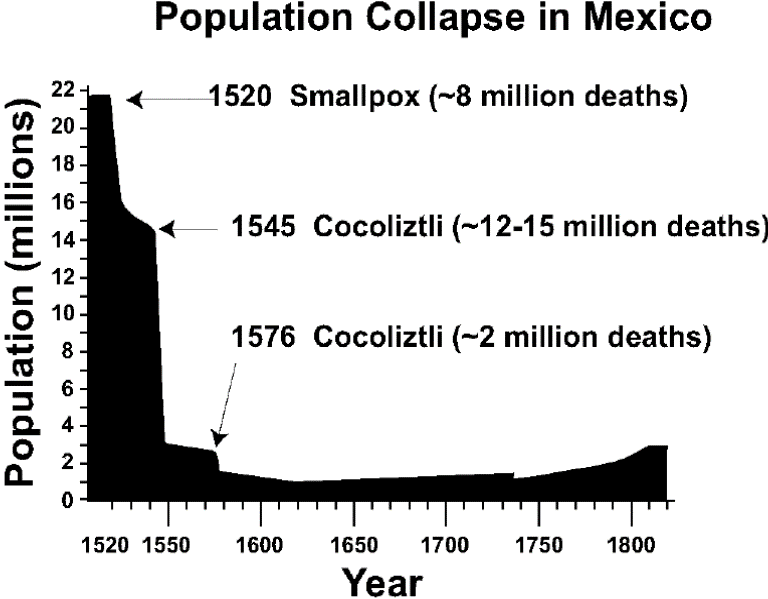
Many Native American tribes suffered high mortality and depopulation, averaging 25–50% of the tribes' members dead from disease. Additionally, some smaller tribes are threatened with extinction after facing a severely destructive spread of disease.
Epidemics of smallpox (1518, 1521, 1525, 1558, 1589), typhus (1546), influenza (1558), diphtheria (1614) and measles (1618) swept the Americas subsequent to European contact, killing between 10 million and 100 million people, up to 95% of the indigenous population of the Americas. Estimates of mortality range from one-quarter to one-half of the population of central Mexico.
One of earliest examples was what followed Cortés' invasion of Mexico. Before his arrival, the Mexican population is estimated to have been around 25 to 30 million. Fifty years later, the Mexican population was reduced to 3 million(one source stated lower number with only 1.5 million survivors left), mainly by infectious disease. A 2018 study by Koch, Brierley, Maslin and Lewis concluded that an estimated "55 million indigenous people died following the European conquest of the Americas beginning in 1492." Estimates for the entire number of human lives lost during the Cocoliztli epidemics in New Spain have ranged from 5 to 15 million people, making it one of the most deadly disease outbreaks of all time. By 1700, fewer than 5,000 Native Americans remained in the southeastern coastal region of the United States. Even after the two largest empires of the America continent, the Inca and the Aztecs, were devastated by the virus, smallpox continued to spread further In 1561; The epidemic reached Chile by sea, when a ship carrying the new governor Francisco de Villagra landed at La Serena. Chile had previously been isolated by the Atacama Desert and Andes Mountains from Peru, but at the end of 1561 and in early 1562, it ravaged the Chilean natives. Modern time estimates by experts put the number that the Chilean natives lost its 20-25 percent of their population. The Spanish historian Marmolejo said that gold mines had to shut down when all their native laborers died.
During the Inca Civil War, it was estimated that the smallpox which transmitted by the Spaniard under Francisco Pizarro killed at least 200,000.{{Cite journal |last=Crosby |first=Alfred W. |date=1967 |title=Conquistador y Pestilencia: The First New World Pandemic and the Fall of the Great Indian Empires |url=https://www.jstor.org/stable/2511023?searchText=incan+civil+war&searchUri=/action/doBasicSearch?Query=incan+civil+war&so=rel&ab_segments=0/basic_search_gsv2/control&refreqid=fastly-default:da67cdc39a0993c41d2c33c8e53f5a7f&seq=12 |journal=The Hispanic American Historical Review |volume=47 |issue=3 |pages=321–337 |doi=10.2307/2511023 |issn=0018-2168|url-access=subscription |author-link=Alfred W. Crosby
In Florida alone, an estimated 700,000 Native Americans lived there in 1520, but by 1700, the number decreased to only around 2,000 people.
Another notable example was the incident of the so-called The Great Dying in New England around the years of 1616-1619, where the epidemics which carried by European settlers including trichinosis, chickenpox, Influenza, HBD/HDV, Typhus, smallpox, plague, and leptospirosis, resulted in a catastrophic demographic collapse which estimated to of up to 95% casualties of the indigenous population.
The population of Mohawk people also hit by smallpox epidemics around 1630s; causing their population to decrease by 63%, from 7,740 to 2,830, as they had no immunity to the new disease.{{cite book |archive-url=https://web.archive.org/web/20161231192859/https://books.google.com/books?id=1tbXzVpHtMsC |archive-date=2016-12-31 |url-status=live}} At some point by 1633, smallpox infected the entire tribes and left the Mohawks unable to care for each other or bury their dead.
In summer 1639, a smallpox epidemic struck the Huron natives in the St. Lawrence and Great Lakes regions. The disease had reached the Huron tribes through French colonial traders from Québec who remained in the region throughout the winter. When the epidemic was over, the Huron population had been reduced to roughly 9,000 people, about half of what it had been before 1634. The Iroquois people, generally south of the Great Lakes, faced similar losses after encounters with French, Dutch and English colonists.
During the 1770s, smallpox killed at least 30% (tens of thousands) of the Northwestern Native Americans.
The smallpox epidemic of 1780–1782 brought devastation and drastic depopulation among the Plains Indians, as the natives in the area contracted the disease from the 'Snake Indians' on the Mississippi. From there it spread eastward and northward to the Saskatchewan River. Its first case was found among the fur traders in October 15, 1781. A week later, reports were made to William Walker and William Tomison, who were in charge of the Hudson and Cumberland Hudson's Bay Company posts. By February, the disease spread as far as the Basquia Tribe. After reading Tomison's journals, Houston and Houston calculated that, of the Indians who traded at the Hudson and Cumberland houses, 95% died of smallpox. Paul Hackett adds to the mortality numbers suggesting that perhaps up to one-half to three-quarters of the Ojibway situated west of the Grand Portage died from the disease. The Cree also suffered a casualty rate of approximately 75% with similar effects found in the Lowland Cree.
By 1832, the federal government of the United States established a smallpox vaccination program for Native Americans. The Commissioner of Indian Affairs in 1839 reported on the casualties of the 1837 Great Plains smallpox epidemic: "No attempt has been made to count the victims, nor is it possible to reckon them in any of these tribes with accuracy; it is believed that if [the number 17,200 for the upper Missouri River Indians] was doubled, the aggregate would not be too large for those who have fallen east of the Rocky Mountains."
On environment and society
Some 21st-century climate scientists have suggested that a severe reduction of the indigenous population in the Americas and the accompanying reduction in cultivated lands during the 16th, 17th and 18th centuries may have contributed to a global cooling event known as the Little Ice Age.
The loss of population was so high that it was partially responsible for the myth of the Americas as "virgin wilderness". By the time significant European colonization was underway, native populations had already been reduced by 90%. This resulted in settlements vanishing and cultivated fields being abandoned. Since forests were recovering, the colonists had an impression of a land that was an untamed wilderness.
The virgin soil effect encompass the psychological phenomenan in the aftermath of the population decimation by the plague, whete severe disruption of the Native American societies.
Disease had both direct and indirect effects on deaths. High mortality meant that there were fewer people to plant crops, hunt game, and otherwise support the group. Loss of cultural knowledge transfer also affected the community as vital agricultural and food-gathering skills were not passed on to survivors. Missing the right time to hunt or plant crops affected the food supply, thus further weakening the community and making it more vulnerable to the next epidemic. Communities under such crisis were often unable to care for people who were disabled, elderly, or young.
The material and societal realities of disability for Native American communities were tangible. Scarlet fever could result in blindness or deafness, and sometimes both. Smallpox epidemics led to blindness and depigmented scars. Many Native American tribes took pride in their own appearance, and the resulting skin disfigurement of smallpox deeply affected them psychologically. Unable to cope with this condition, tribe members were said to have committed suicide.
Biological weapon theory
Historian David Stannard asserts that by "focusing almost entirely on disease ... contemporary authors increasingly have created the impression that the eradication of those tens of millions of people was inadvertent—a sad, but both inevitable and 'unintended consequence' of human migration and progress." He says that their destruction "was neither inadvertent nor inevitable", but the result of microbial pestilence and purposeful genocide working in tandem. Historian Andrés Reséndez says that evidence suggests "among these human factors, slavery has emerged as a major killer" of the indigenous populations of the Caribbean between 1492 and 1550, rather than diseases such as smallpox, influenza and malaria. The second European explanation was a perceived divine approval, in which God removed the Indigenous peoples as part of His "divine plan" to make way for a new Christian civilization. In following centuries, accusations and discussions of biological warfare were common. Well-documented accounts of incidents involving both threats and acts of deliberate infection are very rare.
Fur trader James McDougall was quoted as threatening some local chiefs that he would use his water bottle infected with smallpox if they did not comply with his demands. another fur trader threatened Pawnee Indians that if they didn't agree to certain conditions, he would use a bottle containing smallpox against their people. The Reverend Isaac McCoy was quoted in his History of Baptist Indian Missions as saying that the settlers deliberately spread smallpox among the natives of the southwest, including the Pawnee tribe, which devastating result was made reported to General Clark and the Secretary of War. Artist and writer George Catlin observed that Native Americans were also suspicious of vaccination. The Mandan chief Four Bears even denounced some settlers whom he had previously treated as his own kins, under the accusation of deliberately bringing the disease to his people.
Smallpox
A single soldier arriving in Mexico in 1520 was carrying smallpox and initiated the devastating plagues that swept through the native populations of the Americas.
According to one source introduction of smallpox among the Aztecs has been attributed to an African slave named Francisco Eguía. However, this has been disputed by the record that from May to September, smallpox already spread slowly to Tepeaca and Tlaxcala, and to Tenochtitlán by the fall of 1520. At this time, Cortes was returning to conquer the city after his previous defeat in the battle of Noche Triste.
After its introduction to Mexico, the disease spread across South America, devastating indigenous populations in what are now Colombia, Peru and Chile during the sixteenth century. The disease was slow to spread northward due to the sparse population of the northern Mexico desert region. It was introduced to eastern North America separately by colonists arriving in 1633 to Plymouth, Massachusetts, and local Native American communities were soon struck by the virus. It reached the Mohawk nation in 1634, the Lake Ontario area in 1636, and the lands of other Iroquois tribes by 1679. Between 1613 and 1690 the Iroquois tribes living in Quebec suffered twenty-four epidemics, almost all of them caused by smallpox. By 1698 the virus had crossed the Mississippi, causing an epidemic that nearly obliterated the Quapaw Indians of Arkansas.
By the mid-eighteenth century the disease was affecting populations severely enough to interrupt trade and negotiations. Thomas Hutchins, in his August 1762 journal entry while at Ohio's Fort Miami, named for the Mineamie people, wrote:
On June 24, 1763, during the siege of Fort Pitt, as recorded in his journal by fur trader and militia captain William Trent, dignitaries from the Delaware tribe met with British officials at the fort, warned them of "great numbers of Indians" coming to attack the fort, and pleaded with them to leave the fort while there was still time. The commander of the fort, Simeon Ecuyear, refused to abandon the fort. Instead, Ecuyear gave as gifts two blankets, one silk handkerchief and one piece of linen that were believed to have been in contact with smallpox-infected individuals, to the two Delaware emissaries Turtleheart and Mamaltee, allegedly in the hope of spreading the deadly disease to nearby tribes, as attested in Trent's journal. The dignitaries were met again later and they seemingly hadn't contracted smallpox. The effectiveness of the biological warfare itself remains unknown, and the method used is inefficient compared to airborne transmission.
21st-century scientists such as V. Barras and G. Greub have examined such reports. They say that smallpox is spread by respiratory droplets in personal interaction, not by contact with fomites, such objects as were described by Trent. The results of such attempts to spread the disease through objects are difficult to differentiate from naturally occurring epidemics.
Gershom Hicks, who was held captive by the Ohio Country Shawnee and Delaware between May 1763 and April 1764, reported to Captain William Grant of the 42nd Regiment that the smallpox has killed 30 or 40 Mingoes, and approximately similar with the Delawares and Shawneese.
19th century
In 1832 President Andrew Jackson signed Congressional authorization and funding to set up a smallpox vaccination program for Indian tribes. The goal was to eliminate the deadly threat of smallpox to a population with little or no immunity, and at the same time exhibit the benefits of cooperation with the government. In practice there were severe obstacles. The tribal medicine men launched a strong opposition, warning of white trickery and offering an alternative explanation and system of cure. Some taught that the affliction could best be cured by a sweat bath followed by a rapid plunge into cold water. Furthermore the vaccines often lost their potency when transported and stored over long distances with primitive storage facilities. It was too little and too late to avoid the great smallpox epidemic of 1837 to 1840 that swept across North America west of the Mississippi, all the way to Canada and Alaska. Deaths have been estimated in the range of 100,000 to 300,000, with entire tribes wiped out. Over 90 percent of the Mandans died.
In the mid to late nineteenth century, at a time of increasing European-American travel and settlement in the West, at least four different epidemics broke out among the Plains Indians tribes from 1837 to 1870. The Indians traded with the white people regardless spread disease to their villages. In the late 19th century, the Lakota Indians of the Plains called the disease the "rotting face sickness".
The 1862 Pacific Northwest smallpox epidemic, which was brought from San Francisco to Victoria, devastated the indigenous peoples of the Pacific Northwest Coast, with a death rate of over 50% for the entire coast from Puget Sound to Southeast Alaska. In some areas the native population fell by as much as 90%. Some historians have described the epidemic as a deliberate genocide because the Colony of Vancouver Island and the Colony of British Columbia could have prevented the epidemic but chose not to, and in some ways facilitated it.
References
References
- (January 2002). "Health conditions before Columbus: paleopathology of native North Americans". Western Journal of Medicine.
- (2016-08-12). "History of Smallpox and Its Spread in Human Populations". Microbiology Spectrum.
- (1999-11-23). "Yersinia pestis, the cause of plague, is a recently emerged clone of Yersinia pseudotuberculosis". Proceedings of the National Academy of Sciences of the United States of America.
- (2016). "'Add, stir and reduce': Yersinia spp. as model bacteria for pathogen evolution". Nature Reviews. Microbiology.
- (2016). "Cholera". Microbiology Spectrum.
- "Cholera - WHO Fact sheets".
- (2010-12-15). "Pandemic influenza's 500th anniversary". Clinical Infectious Diseases.
- (2005). "The Story of Influenza". National Academies Press (US).
- (2011). "Plasmodium knowlesi: reservoir hosts and tracking the emergence in humans and macaques". PLOS Pathogens.
- (2014). "African origin of the malaria parasite Plasmodium vivax". Nature Communications.
- (2010). "Origin of the human malaria parasite Plasmodium falciparum in gorillas". Nature.
- Berche, Patrick. (2022-09-01). "History of measles". La Presse Médicale.
- (2013-08-05). "Rinderpest: the veterinary perspective on eradication". Philosophical Transactions of the Royal Society B: Biological Sciences.
- (2017). "Rinderpest experience". Revue Scientifique et Technique (International Office of Epizootics).
- (2017). "The history of tuberculosis: from the first historical records to the isolation of Koch's bacillus". Journal of Preventive Medicine and Hygiene.
- (2020). "The paleopathological evidence on the origins of human tuberculosis: a review". Journal of Preventive Medicine and Hygiene.
- (2022). "Yellow Fever: Origin, Epidemiology, Preventive Strategies and Future Prospects". Vaccines.
- (2006-11-24). "Evolutionary History of Salmonella Typhi". Science.
- (2014). "Evolutionary Origins of Human Herpes Simplex Viruses 1 and 2". Molecular Biology and Evolution.
- "Zika virus".
- ''The First Horseman: Disease in Human History''; John Aberth; Pearson-Prentice Hall (2007); pp. 47–75 (51)
- (20 August 2014). "Seals brought TB to Americas". Nature.
- Mann, Charles C.. (2005). "1491: New revelations of the Americas before Columbus". Knopf.
- (2002). "Health conditions before Columbus: paleopathology of native North Americans". Western Journal of Medicine.
- Rothschild, B. M.. (2005-05-15). "History of Syphilis". Clinical Infectious Diseases.
- (1986). "Kipu". Ediciones ABYA-YALA.
- Guerra, Francisco. (Autumn 1988). "The Earliest American Epidemic: The Influenza of 1493". Social Science History.
- Martin, Manuela. (September 26, 1985). "La gripe, peor que la espada". El País.
- Hardman, Lizabeth. (January 18, 2011). "Influenza Pandemics". Greenhaven Publishing LLC.
- (21 August 2012). "Classic Period collapse of the Central Maya Lowlands: Insights about human-environment relationships for sustainability". Proceedings of the National Academy of Sciences.
- (14 March 2003). "Climate and the Collapse of Maya Civilization". Science.
- "Cocoliztli y Matlazahuatl". www.zocalo.com.mx.
- (27 April 2012). ""Huey cocoliztli" en el México del siglo XVI: ¿una enfermedad emergente del pasado?". www.madrimasd.org.
- "Fiebres hemorrágicas causa de muerte en las culturas originarias". www.ciudadania-express.com.
- (January 2005). "Drought, epidemic disease, and the fall of classic period cultures in Mesoamerica (AD 750–950). Hemorrhagic fevers as a cause of massive population loss". Medical Hypotheses.
- (21 August 2012). "Classic Period collapse of the Central Maya Lowlands: Insights about human-environment relationships for sustainability". Proceedings of the National Academy of Sciences.
- (14 March 2003). "Climate and the Collapse of Maya Civilization". Science.
- (1926). "Studies on the Dick Test and Natural Immunity to Scarlet Fever Among the American Indians". The Journal of Immunology.
- Francis, John M.. (2005). "Iberia and the Americas culture, politics, and history: A Multidisciplinary Encyclopedia". ABC-CLIO.
- Rossi, Ann. (2006). "Two Cultures Meet: Native American and European". National Geographic Society.
- Feinstein, Stephen. (2006). "''God, Greed, and Genocide: The Holocaust Through the Centuries,'' by Arthur Grenke". Canadian Journal of History.
- Wolfe, Brendan. (7 December 2020). "Little Ice Age and Colonial Virginia".
- Rodrigo Barquera. (May 9, 2020). "Slavery entailed the spread of epidemics". Max-Planck-Gesellschaft.
- "The Trans-Atlantic Slave Trade and the Introduction of Human Diseases: The Case of Schistosomiasis - Africa Atlanta 2014 Publications".
- (2010). "The Columbian Exchange: A History of Disease, Food, and Ideas". [[Journal of Economic Perspectives]].
- (2011). "1493". Alfred A. Knopf.
- Austin Alchon, Suzanne. (2003). "A Pest in the Land: New World Epidemics in a Global Perspective". University of New Mexico Press.
- [https://books.google.com/books?id=KDQN-Rj8yioC Vogel, Virgil J. ''American Indian Medicine.'' University of Oklahoma Press, 1970.]
- [https://books.google.com/books?id=K-vvSAAACAAJ John Phillip. ''A law of blood; the primitive law of the Cherokee nation.'' New York: Northern Illinois University Press, 1970.]
- Alonso de Góngora Marmolejo [http://www.cervantesvirtual.com/servlet/SirveObras/bameric/02582741011358306311291/p0000003.htm#I_34_ Historia de Chile desde su descubrimiento hasta el año 1575] {{Webarchive. link. (2015-09-24 . Cervantesvirtual.com. Retrieved on 2011-12-06.)
- Lyon, William S.. (1998). "Encyclopedia of Native American Healing". W. W. Norton and Company.
- Moerman, Daniel E.. (July 16, 1998). "Native American Ethnobotany". Timber Press.
- Grob, Gerald. (2006). "The Deadly Truth: A History of Disease in America".
- (2023-09-26). "Trail of Tears: Definition, Date & Cherokee Nation".
- (2018). "Western Adventurers and Male Nurses: Indians, Cholera, and Masculinity in Overland Trail Narratives". Western Historical Quarterly.
- "American Indian Epidemics".
- "Smallpox: Eradicating the Scourge".
- Mann, Charles C.. (2005). "1491: New Revelations of the Americas Before Columbus". Knopf.
- "The Story Of... Smallpox". Pbs.org.
- [https://books.google.com/books?id=GyE8Qt-kS1kC Hays, J. N.. ''Epidemics and Pandemics: Their Impacts on Human History.'' United Kingdom: ABC-CLIO, 2005.]
- Gunderman, Richard. (19 February 2019). "How smallpox devastated the Aztecs – and helped Spain conquer an American civilization 500 years ago".
- (2004). "When half of the population died: the epidemic of hemorrhagic fevers of 1576 in Mexico". FEMS Microbiology Letters.
- (April 2002). "Megadrought and megadeath in 16th century Mexico.". Emerging Infectious Diseases.
- [http://www.cervantesvirtual.com/servlet/SirveObras/01715307659037196322257/not0002.htm#N_87_ Diego Barros Arana, Historia general de Chile, Tomo Segundo], p. 51 note 87, pp. 231–232.
- Mann, Charles C.. (2005). "1491: New Revelations of the Americas Before Columbus".
- Bragdon, Kathleen J.. (1996). "Native People of Southern New England, 1500–1650".
- Calloway, Colin G.. (1991). "Dawnland Encounters: Indians and Europeans in Northern New England".
- Gookin, Daniel. (1792). "Historical Collections of the Indians in New England".
- Cronon, William. (1983). "Changes in the Land: Indians, Colonists, and the Ecology of New England".
- Snow, Dean R.. (1980). "The Archaeology of New England".
- (2008). "Encyclopedia of Pestilence, Pandemics, and Plagues [2 Volumes]". Greenwood Press.
- Bruce Trigger. ''Natives and Newcomers: Canada's "Heroic Age" Reconsidered.'' (Kingston: McGill-Queen's University Press, 1985), 588–589.
- link. (2008-06-10 . Historyink.com. Retrieved on 2011-12-06.)
- [https://web.archive.org/web/20050506200021/http://www.thecanadianencyclopedia.com/index.cfm?PgNm=TCE&Params=A1ARTA0007462 Smallpox], ''[[The Canadian Encyclopedia]]''
- (1952). "Cumberland House Journals and Inland Journals 1775–82". The Hudson's Bay Record Society.
- Rich EE. (1967). "The Fur Trade and the Northwest to 1875". McClelland and Stewart Limited.
- (2000). "The first smallpox epidemic on the Canadian Plains: In the fur-traders' words". Can J Infect Dis.
- Paul Hackett. (2002). "A Very Remarkable Sickness". University of Manitoba Press.
- (2003). "Lewis Cass and the Politics of Disease: The Indian Vaccination Act of 1832". Wíčazo Ša Review.
- ''The Effect of Smallpox on the Destiny of the Amerindian''; Esther Wagner Stearn, Allen Edwin Stearn; University of Minnesota; 1945; Pgs. 13-20, 73-94, 97
- (2019). "Earth system impacts of the European arrival and Great Dying in the Americas after 1492". [[Quaternary Science Reviews]].
- (2019). "Did Colonialism Cause Global Cooling? Revisiting an Old Controversy".
- {{Cite Q. Q106515792
- (2003). "The Anthropogenic Greenhouse Era Began Thousands of Years Ago". [[Climatic Change (journal).
- (2006). "Evidence for the Postconquest Demographic Collapse of the Americas in Historical CO2 Levels". [[Earth Interactions]].
- Richard J. Nevle ''et al''., "Ecological-hydrological effects of reduced biomass burning in the neotropics after A.D. 1500," ''Geological Society of America Meeting'', Minneapolis MN, 11 October 2011. [http://gsa.confex.com/gsa/2011AM/finalprogram/abstract_196092.htm abstract] {{Webarchive. link. (15 August 2019 . Popular summary: "[http://www.sciencenews.org/view/generic/id/335168/title/Columbus_arrival_linked_to_carbon_dioxide_drop Columbus' arrival linked to carbon dioxide drop: Depopulation of Americas may have cooled climate] {{Webarchive). link. (13 July 2012 ," ''Science News,'' 5 November 2011. (access date 2 January 2012).)
- Denevan, William M.. (1992). "The pristine myth: the landscape of the Americas in 1492". Annals of the Association of American Geographers.
- Crosby, Alfred W.. (1976). "Virgin Soil Epidemics as a Factor in the Aboriginal Depopulation in America". Omohundro Institute of Early American History and Culture.
- Nielsen, Kim. (2012). "A Disability History of the United States". Beacon Press.
- Watts, Sheldon. (1999). "Epidemics and History: Disease, Power and Imperialism". Yale University Press.
- David E. Stannard. (1993-11-18). "American Holocaust: The Conquest of the New World". [[Oxford University Press]], USA.
- Reséndez, Andrés. (2016). "The Other Slavery: The Uncovered Story of Indian Enslavement in America". [[Houghton Mifflin Harcourt]].
- (1991). "The Legacy of Introduced Disease: The Southern Coast Salish". American Indian Culture and Research Journal.
- ''Empire of Fortune''; Francis Jennings; W. W. Norton & Company; 1988; pp. 200, 447–48
- ''The Effect of Smallpox on the Destiny of the Amerindian''; Esther Wagner Stearn, Allen Edwin Stearn; University of Minnesota; 1945; pp. 13–20, 73–94, 97
- ''Chardon's Journal at Fort Clark, 1834–1839''; Annie Heloise Abel; Books for Libraries Press; 1932; pp. 319, 394
- ''Princes and Peasants: Smallpox in History''; Donald R. Hopkins; University of Chicago Press; 1983; pp. 270–71
- Robert Blaisdell ed., ''Great Speeches by Native Americans'', p. 116.
- ''Rotting Face: Smallpox and the American Indian''; R. G. Robertson; Caxton Press; 2001 pp. 80–83; 298–312
- ''Encyclopedia of Plague and Pestilence: From Ancient Times to the Present''; George C. Kohn; pp. 252–53
- McCaa, Robert. "Spanish and Nahuatl Views on Smallpox and Demographic Catastrophe in the Conquest of Mexico.".
- [http://www.paulkeeslerbooks.com/Chap5Iroquois.html#DutchChildren Dutch Children's Disease Kills Thousands of Mohawks] {{webarchive. link. (2007-12-17 . Paulkeeslerbooks.com)
- (1951). "Smallpox and the Indians in the American Colonies". Bulletin of the History of Medicine.
- (1987). "Vectors of Death: The Archaeology of European Contact". University of New Mexico Press.
- Hanna, Charles A.: [https://archive.org/details/wildernesstrailo02hann ''The wilderness trail: or, the ventures and adventures of the Pennsylvania traders on the Allegheny path, with some new annals of the old West, and the records of some strong men and some bad ones'' (1911)] pg.366
- Ewald, Paul W.. (2000). "Plague Time: How Stealth Infections Cause Cancer, Heart Disease, and Other Deadly Ailments". Free.
- Ecuyer, Simeon: ''Fort Pitt and letters from the frontier'' (1892). [https://archive.org/stream/fortpittlettersf00darl#page/n103/mode/2up/search/pox Captain Simeon Ecuyer's Journal: Entry of June 24,1763]
- (2000). "Biological Warfare in Eighteenth-Century North America: Beyond Jeffery Amherst". The Journal of American History.
- (17 February 2011). "Silent Weapon: Smallpox and Biological Warfare". BBC.
- "Tribes - Native Voices".
- (2000). "The British, the Indians, and smallpox: what actually happened at Fort Pitt in 1763?". Pennsylvania History.
- (June 2014). "History of biological warfare and bioterrorism". Clinical Microbiology and Infection.
- (2016). "Blood and Land: The Story of Native North America". Penguin UK.
- (June 2014). "History of biological warfare and bioterrorism". Clinical Microbiology and Infection.
- (2007). "Medical Aspects of Biological Warfare". Government Printing Office.
- Burke, James P.. (May 2009). "Pioneers of Second Fork". AuthorHouse.
- E. Wagner Stearn, and Allen E. Stearn, "Smallpox Immunization of the Amerindian." ''Bulletin of the History of Medicine'' 13.5 (1943): 601-613.
- Donald R. Hopkins, ''The Greatest Killer: Smallpox in History'' (U of Chicago Press, 2002), p. 271.
- Paul Kelton, "Avoiding the Smallpox Spirits: Colonial Epidemics and Southeastern Indian Survival," ''Ethnohistory'' 51:1 (winter 2004) pp. 45-71.
- Kristine B. Patterson, and Thomas Runge, "Smallpox and the native American." ''American journal of the medical sciences'' 323.4 (2002): 216-222. [https://www.amjmedsci.org/article/S0002-9629(15)34481-5/abstract online]
- (1977). "The High Plains Smallpox Epidemic of 1837-38". The Western Historical Quarterly.
- Elizabeth A. Fenn, ''Encounters at the Heart of the World: A History of the Mandan People'' (2015) ch. 14.
- Waldman, Carl. (2009). "Atlas of the North American Indian". Checkmark Books.
- 0870044974
- Marshall, Joseph. (2005). "The Journey of Crazy Horse, A Lakota History".
- Lange, Greg. "Smallpox Epidemic of 1862 among Northwest Coast and Puget Sound Indians". HistoryLink.
- Ostroff, Joshua. (August 2017). "How a smallpox epidemic forged modern British Columbia". Maclean's.
- (1999). "The Coming of the Spirit of Pestilence: Introduced Infectious Diseases and Population Decline Among Northwest Coast Indians, 1774–1874". University of British Columbia Press.
- Swanky, Tom. (2013). "The True Story of Canada's "War" of Extermination on the Pacific – Plus the Tsilhqot'in and other First Nations Resistance". Dragon Heart Enterprises.
This article was imported from Wikipedia and is available under the Creative Commons Attribution-ShareAlike 4.0 License. Content has been adapted to SurfDoc format. Original contributors can be found on the article history page.
Ask Mako anything about Native American disease and epidemics — get instant answers, deeper analysis, and related topics.
Research with MakoFree with your Surf account
Create a free account to save articles, ask Mako questions, and organize your research.
Sign up freeThis content may have been generated or modified by AI. CloudSurf Software LLC is not responsible for the accuracy, completeness, or reliability of AI-generated content. Always verify important information from primary sources.
Report