From Surf Wiki (app.surf) — the open knowledge base
National Iranian Oil Company
Oil and gas company of Iran

Oil and gas company of Iran
| Field | Value | |
|---|---|---|
| name | National Iranian Oil Company | |
| logo | National Iranian Oil Company logo.svg | |
| logo_size | 100px | |
| image | [[File:National Iranian Oil Company headquarters 1.jpg | 250px]] |
| image_caption | National Iranian Oil Company headquarters | |
| type | State-owned enterprise | |
| area_served | Worldwide | |
| key_people | Mohsen Paknejad | |
| (Chairman) | ||
| Hamid Bovard | ||
| (CEO) | ||
| industry | Oil and gas | |
| products | Petrochemicals | |
| revenue | Oil and gas | |
| US$53 billion (2023)<ref name | "EIA2023"}} | |
| assets | US$200 [billion](1000000000-number) (2023) | |
| owner | Iranian government (100%) | |
| parent | Ministry of Petroleum | |
| num_employees | 87,500 (2018) | |
| subsid | NISOC | |
| IOOC | ||
| ICOFC | ||
| NIDC | ||
| NICO | ||
| NITCO | ||
| predecessor | Anglo-Persian Oil Company | |
| foundation | [](nationalization-of-the-iranian-oil-industry) | |
| founder | Government of Iran: | |
| location | Taleghani Street, Tehran, Iran | |
| homepage |
(Chairman) Hamid Bovard (CEO) US$53 billion (2023) IOOC ICOFC NIDC NICO NITCO
- The Majles
- Mohammad Mosaddegh (later Prime Minister) The National Iranian Oil Company (NIOC; ) is a government-owned national oil and natural gas producer and distributor under the direction of the Ministry of Petroleum of Iran. NIOC was established in 1951 and restructured under The Consortium Agreement of 1954. NIOC ranks as the world's second largest oil company, after Saudi Arabia's state-owned Aramco.
The NIOC is exclusively responsible for the exploration, drilling, production, distribution and export of crude oil, as well as exploration, extraction and sales of natural gas and liquefied natural gas (LNG). NIOC exports its surplus production according to commercial considerations determined by the OPEC and at the prices prevalent in the international markets. In early 2015 NIOC's recoverable liquid hydrocarbon reserves was 156.53 Goilbbl (10% of world's total) and recoverable gas reserves were 33.79 m3 (15% of world's total). As of 2012, the NIOC production capacity included over 4 Moilbbl of crude oil and in excess of 750 million cubic meters of natural gas per day.
History
Background: 1901–1951
Main article: William Knox D'Arcy, Anglo-Persian Oil Company
In May 1901, William Knox D'Arcy was granted a concession by Mozaffar ad-Din Shah Qajar to search for oil, which he discovered in May 1908. This was the first commercially significant find in the Middle East. In 1923, Burmah Oil employed future Prime Minister, Winston Churchill as a paid consultant; to lobby the British government to allow the Anglo-Persian Oil Company (APOC) to have exclusive rights to Persian oil resources, which were successfully granted.
In 1935, Rezā Shāh requested the international community to refer to Persia as 'Iran', which was reflected in the name change of the Anglo-Persian Oil Company (APOC) to the Anglo-Iranian Oil Company (AIOC). Following World War II, Iranian nationalism was on the rise, especially surrounding the Iranian natural resources being exploited by the foreign companies without adequately compensating Iranian taxpayers. AIOC and the pro western Iranian government led by Prime Minister Ali Razmara, initially resisted nationalist pressure to revise AIOC's concession terms still further in Iran's favour. In March 1951, Ali Razmara was assassinated; and Mohammed Mossadeq, a nationalist, was elected as the new prime minister by the Majlis of Iran.
NIOC: 1951–1979

In April 1951, the Majlis nationalized the Iranian oil industry by a unanimous vote, and the National Iranian Oil Company (NIOC) was formed, displacing the AIOC. The AIOC withdrew its management from Iran and organised an effective worldwide embargo of Iranian oil. The British government, which owned the AIOC, contested the nationalization at the International Court of Justice at The Hague, but its complaint was dismissed.
By the spring of 1953, incoming US President Dwight D. Eisenhower authorised the Central Intelligence Agency (CIA), to organise a coup against the Mossadeq government, the 1953 Iranian coup d'état. In August 1953, the coup brought pro-Western general Fazlollah Zahedi to power as the new PM, along with the return to Iran of the Shah Mohammad Reza Pahlavi from his brief exile in Italy. The anti-Mossadeq plan was orchestrated by the CIA under the code-name Operation Ajax, and by the British SIS (MI6) as Operation Boot.
In 1954, the AIOC became British Petroleum. The return of the shah had not meant that British Petroleum was able to monopolise Iranian oil as before. Under pressure from United States, British Petroleum reluctantly accepted membership in a consortium of companies, founded in October 1954, to bring back Iranian oil to the international market. It was incorporated in London as a holding company called Iranian Oil Participants (IOP). The founding members of IOP included British Petroleum (40%), Gulf (later Chevron, 8%), Royal Dutch Shell (14%), and Compagnie Française des Pétroles (later Total, 6%). The four Aramco partners – Standard Oil of California (SoCal, later Chevron) – Standard Oil of New Jersey (later Exxon, then ExxonMobil) – Standard Oil Co. of New York (later Mobil, then ExxonMobil) – Texaco (later Chevron) – each held an 8% stake in the holding company.
All IOP members acknowledged that NIOC owned the oil and facilities in Iran, and IOP's role was to operate and manage them on behalf of NIOC. To facilitate that, IOP established two operating entities incorporated in the Netherlands, and both were delegated to NIOC. Similar to the Saudi-Aramco "50/50" agreement of 1950, the IOP consortium agreed to share profits on a 50–50 basis with Iran, "but not to open its books to Iranian auditors or to allow Iranians onto its board of directors". The negotiations leading to the creation of the consortium, during 1954–55, were considered a feat of skillful diplomacy.
In Iran, IOP continued to operate until the Islamic Revolution in 1979. The new regime of Ayatollah Khomeini confiscated all of the company's assets in Iran. According to the IOP's Web site: The victory of the Islamic revolution annulled the Consortium Agreement of 1954 and all regulations pertaining to it. The revolution led to the withdrawal or expulsion of virtually all foreign employees from the oil industry with the new Iranian government assuming full control of its affairs.
NIOC's Oil Reserves
Main article: NIOC's Oil Reserves


According to OPEC, NIOC recoverable liquid hydrocarbon reserves at the end of 2006 was 1384 Goilbbl.
NIOC oil reserves at the beginning of 2001 was reported to be about 99 Goilbbl, however in 2002 the result of NIOC's study showed huge reserves upgrade adding about 317 Goilbbl of recoverable reserves to the Iranian oil reserves.
After 2003 Iran made some significant discoveries which led to addition of another 7.7 Goilbbl of oil to the recoverable reserves of Iran.
The vast majority of Iran's crude oil reserves are located in giant onshore fields in the south-western Khuzestan region near the Iraqi border. Overall, Iran has 40 producing fields – 27 onshore and 13 offshore. Iran's crude oil is generally medium in sulfur and in the 28°-35 °API range.
As of 2012, 98 rigs are in operation in onshore fields, 24 in offshore fields and a single rig is in operation in the Caspian Sea. Iran plans to increase the number of its drilling rigs operating in its onshore and offshore oilfields by 36 units to reach 134 units by March 2014.
Table 1- The biggest NIOC oil fields;
| Rank | Field Name | Formation | Oil in Place | |||
|---|---|---|---|---|---|---|
| (Billion Barrels) | Recoverable Reserves | |||||
| (Billion Barrels) | Production | |||||
| Thousand barrels per day | ||||||
| 1 | ||||||
| 2 | ||||||
| 3 | ||||||
| 4 | ||||||
| 5 | ||||||
| 6 | ||||||
| 7 | ||||||
| 8 | ||||||
| 9 | ||||||
| 10 |
| Field's Name | Thousand | |||
|---|---|---|---|---|
| barrels per day | Thousand | |||
| cubic meters per day | (onshore) | (offshore) | ||
| Ahvaz Field | 750 oilbbl | |||
| Marun Field | 520 oilbbl | |||
| Gachsaran Field | 480 oilbbl | |||
| Aghajari Field | 300 oilbbl | |||
| Karanj Oil Field | 200 oilbbl | |||
| Rag Safid Oil Field | 180 oilbbl | |||
| Bibi Hakimeh Oil Field | 130 oilbbl | |||
| Darquin Oil Field | 100 oilbbl | |||
| Pazanan Oil Field | 70 oilbbl | |||
| Dorood Oil Field | 130 oilbbl | |||
| Salman Field | 130 oilbbl | |||
| Abuzar Oil Field | 125 oilbbl | |||
| Sirri Oil Field | 95 oilbbl | |||
| Soroush Field | 60 oilbbl |
Strategic petroleum reserves
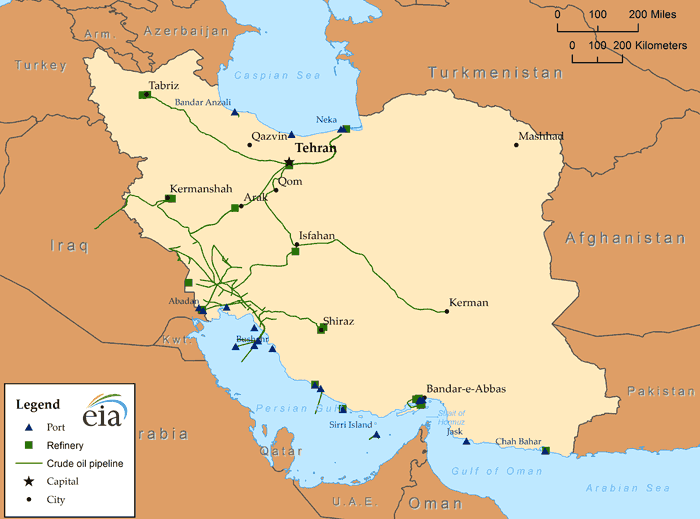
Iran began in 2006 with plans to create a global strategic petroleum reserve with the construction of 15 crude oil storage tanks with a planned capacity of 10 Moilbbl. The storage capacity of oil products in the country is around 11.5 billion liters (2011), but it will reach 16.7 billion liters by the end of the Fifth Five Year Development Plan (2010–2015). As of 2012, Iran is capable of storing crude oil in the Persian Gulf for a period of 10–12 days. The figure should hit 30–40 days after the construction of new storage facilities are completed.
Gas reserves
Main article: Iran Natural Gas Reserves, Gas Exporting Countries Forum
NIOC holds about 1000 Tcuft of proven Natural gas reserves of which 36% are as associated gas and 64% is in non-associated gas fields. It stands for world's second largest reserves after Russia.
NIOC's ten biggest Non-Associated Gas Fields;
| Field's Name | Gas in Place Tcf | Recoverable Reserve Tcf | |
|---|---|---|---|
| South Pars | 500 | 322 | |
| North Pars | 60 | 47 | |
| url=https://web.archive.org/web/20080612114854/http://www.nioc.ir/news/In%20Accoompany%20with%20National%20Iranian%20Oil%20Company/files/2.htm | date=12 June 2008 }} | 60 | 45 |
| Golshan Gas Field | 55 | 25–45 | |
| Tabnak Gas Field | NA | 21,2 | |
| Kangan Gas Field | NA | 20,1 | |
| Khangiran Gas Field | NA | 16,8 | |
| Nar Gas Field | NA | 13 | |
| Aghar Gas Field | NA | 11,6 | |
| Farsi Field | NA | 11–22 |
Recent discoveries
Main article: NIOC Recent Discoveries
Since 1995, National Iranian Oil Company (NIOC) has made significant oil and gas discoveries, standing for some 84 Goilbbl of oil in place and at least 175 Tcuft of gas in place, which are listed below.
| Field's name | Oil in Place | Recoverable oil | Discovery year | ||||||||
|---|---|---|---|---|---|---|---|---|---|---|---|
| Billion Barrel | Billion Barrel | ||||||||||
| Azadegan Oil Field | 33.2 | 5.2 | |||||||||
| Yadavaran Oil Field | 17 | 3 | |||||||||
| Ramin Oil Field | 7.398 | 1.11 | 2007 | ||||||||
| South Pars Oil Layer | 6 | NA | |||||||||
| Band-E-Karkeh Oil Field | 4.5 | NA | 2007 | ||||||||
| MansourAbad Oil Field | 4.45 | NA | 2007 | ||||||||
| last=SHANA | date=2007-10-15 | title=NIOC Official News Agency,(www.Sahan.ir),October 15, 2007 | url=http://www.shana.ir/116542-en.html | url-status=dead | archive-url=https://web.archive.org/web/20120309074304/http://www.shana.ir/116542-en.html | archive-date=9 March 2012 | access-date=2012-02-07 | publisher=Shana.ir}} | 2.7 | NA | |
| url=https://web.archive.org/web/20080612114854/http://www.nioc.ir/news/In%20Accoompany%20with%20National%20Iranian%20Oil%20Company/files/2.htm | date=12 June 2008 }} | 2.07 | NA | 2007 | |||||||
| Paranj Oil Field | 1.6 | NA | 2007 | ||||||||
| Balaroud Oil Field | 1.1 | 0.233 | 2007 | ||||||||
| Binalood Oil Field | 0.776 | 0.099 | 2008 | ||||||||
| Mansouri Oil Field | 0.760 | NA | |||||||||
| Jofeyr Oil Field | 0.750 | NA | 2008 | ||||||||
| Asaluyeh Oil Field | 0.525 | NA | 2008 | ||||||||
| Arvand Oil Field | 0.500 | NA | 2008 | ||||||||
| Tusan Oil Field | 0.470 | NA | 2006 | ||||||||
| Arash Gas Field | 0.168 | NA | |||||||||
| Total | 83.967 | NA |
| Field's name | Gas in place | Recoverable gas reserve | Trillion cubic feet | Billion cubic meters | Trillion cubic feet | Billion cubic meters |
|---|---|---|---|---|---|---|
| Kish Gas Field | 59 cuft | 47 cuft | ||||
| Tabnak Gas Field | 30 cuft | NA | ||||
| Farsi Gas Field | NA | 11–23 | 310–650 | |||
| Sefid Zakhur Gas Field | 11.4 cuft | 8.5 cuft | ||||
| Yadavaran Field | 9.75 cuft | NA | ||||
| Lavan Gas Field | 9.1 cuft | NA | ||||
| Balal Gas Field | 8.8 cuft | NA | ||||
| Homa Gas Field | 7.6 cuft | NA | ||||
| Marun Field | 6.2 cuft | NA | ||||
| Gardan Gas Field | 5.7 cuft | NA | ||||
| Day Gas Field | 4.4 cuft | NA | ||||
| Binak Field | 3.5 cuft | NA | ||||
| Karanj Gas Field | 2.9 cuft | NA | ||||
| Bibi Hakime Oil Field | 2.4 cuft | NA | ||||
| Zireh Gas Field | 1 cuft | NA | ||||
| Masjed Soleiman Field | 1 cuft | 0.739 cuft | ||||
| Arash Gas Field | 0.79 cuft | NA | ||||
| KheyrAbad Gas Field | 0.17 cuft | NA | ||||
| Total | 170 cuft | NA |
Organizational structure
The company is completely owned by Iranian government. NIOC's General Assembly (GA) consists of:
- The President
- Vice President
- Director General of the Management and Planning Organization
- Minister of Petroleum
- Minister of Energy
- Minister of Industries and Mines
- Minister of Labor and Social Affairs
- Minister of Economy and Finance
Members of the board
| Name | Position | Board's Position | ||||||
|---|---|---|---|---|---|---|---|---|
| Javad Owji | Minister of Petroleum | Chairman | ||||||
| Mohsen Khojastemehr | CEO | Vice Chairman | ||||||
| Ahmad Mohammadi | CEO of NISOC | Member of the board | ||||||
| Karim Zobeidi | Manager of Integrated Planning | Member of the board | ||||||
| title=National Iranian Oil Co/ | url=https://en.nioc.ir/portal/home/?generaltext/81026/81171/81826/ | access-date=2021-10-14 | website=en.nioc.ir | archive-date=31 July 2021 | archive-url=https://web.archive.org/web/20210731153458/https://en.nioc.ir/portal/home/?generaltext%2F81026%2F81171%2F81826%2F | url-status=dead }} | Manager of International Affairs | Member of the board |
| Mohammad Bilkar | Director of Finance | Member of the board | ||||||
| Seyyed Saleh Hendi | Exploration Manager | Member of the board |
Subsidiary companies
The NIOC's subsidiaries are as follows:
| Company name | date=2007-09-28 | title=Atieh Bahar | url=http://www.atiehbahar.com/Resources/Oil&Gas.htm | url-status=dead | archive-url=https://web.archive.org/web/20070928000413/http://www.atiehbahar.com/Resources/Oil%26Gas.htm | archive-date=28 September 2007 | access-date=2012-02-07}} |
|---|---|---|---|---|---|---|---|
| Iranian Offshore Oil Company (IOOC) | in charge of offshore oil fields in the Persian Gulf offshore oil and gas fields with the exception of South Pars. It focuses mainly on production platforms, ancillary facilities, and installations. Massive corruption in the lease of offshore platforms reported by the Iranian media in 2015. | ||||||
| Iranian Central Oil Fields Company (ICOFC) | supervises all upstream activities in the central oil and gas regions of the country, i.e. everything, excluding the oil-rich southern Khuzestan province, Caspian and offshore. As of 2015, it is the largest natural gas producer in Iran. | ||||||
| National Iranian Gas Export Co. (NIGEC) | in charge of gas exports for the National Iranian Gas Company. Until May 2010, NIGEC was under the control of the NIOC, but the Petroleum Ministry transferred NIGEC, incorporating it under NIGC in an attempt to broaden responsibility for new natural gas projects. See also: Persian pipeline and Peace pipeline. | ||||||
| National Iranian South Oil Company (NISOC) | in charge of onshore oilfields in southern Iran. Focuses on onshore upstream activity in the province of Khuzestan. As Khuzestan is the main oil and gas-producing province, this entity is among the most significant in the NIOC family. It produces approximately 80 percent of all crude oil produced in Iran. | ||||||
| Khazar Oil Exploration and Production Company | in charge of Iran's Caspian Sea sector (onshore and offshore) | ||||||
| Karoon Oil and Gas Production Company (KOGPC) | Operating in Khouzestan, the company operates 538 wells and delivers natural gas to NIGC. | ||||||
| Petroleum Engineering and Development Company (PEDEC) | is the most important NIOC offshoot company. The responsibility for all buy-back projects under operation, study or negotiation has been given to PEDEC. This company enjoys full authority to manage the projects. Further information: Foreign Direct Investment in Iran | ||||||
| Pars Oil and Gas Company (POGC) | National Iranian Gas Company does not play a role in awarding upstream gas projects; that task remains in the hands of the National Iranian Oil Company. Pars Oil and Gas Co. is in charge of the offshore North and South Pars gas fields and responsible for awarding the contracts for the different phases. Since 2010, it has been raising capital on the domestic and international markets in order to finance its projects. | ||||||
| South Pars Company | date=2023-03-15 | title=South Pars cumulative production reaches 241 bcm | url=https://www.tehrantimes.com/news/482951/South-Pars-cumulative-production-reaches-241-bcm | access-date=2023-03-26 | website=Tehran Times}} | ||
| Pars Special Economic Energy Zone Co. | handles and organizes all activities in the Pars Special Economic-Energy Zone, located near the South Pars gas field (a subsidiary of Pars Oil & Gas Co.) | ||||||
| Iranian Oil Terminals Company | has four transport hubs including facilities on the three islands of Kharg, Lavan and Sirri consisting of 17 jetties capable of berthing tankers of all sizes to lift and export its crude oil that load more than 2,000 oil tankers per year. 2,000 of them dock in Bandar Abbas Port, 1,000 in Khark Island. Iran earned nearly $2 billion in 2009 from bunkering ships in the Persian Gulf (25% market share). Projected bunkering sites by 2015: Bandar Abbas (two sites), Kish, Qeshm, Bushehr, Mahshahr, Assalouyeh, Khark and Chabahar. Fujairah bunkering hub, UAE is Iran's main competitor in the Persian Gulf. The country's terminal storage capacity should soar to 100 million barrels by 2015 from the current 24 million barrels. | ||||||
| National Iranian Drilling Company (NIDC) | title=Irandaily – No. 4207 – Domestic Economy – Page 4 | url=http://www.iran-daily.com/1391/1/24/MainPaper/4207/Page/4/Index.htm# | access-date=13 January 2018 | website=www.iran-daily.com}} As at 2012, 123 drilling rigs are in operation in Iran's offshore and onshore. | |||
| Ahwaz Pipe Mills Company | manufacturing oil and gas pipes and has a capacity of up to 420,000 tons per year. It operates three plants. | ||||||
| Iranian Fuel Conservation Organization | regimenting the fuel consumption in different sectors through review and survey of the current trend of consumption and executing conservation measures nationwide. See also: [2007 Gasoline Rationing Plan in Iran](2007-gasoline-rationing-plan-in-iran) | ||||||
| National Iranian Tanker Company | controls the second largest fleet of tankers in OPEC. Despite having domestic manufacturing capacity, NITC purchases many VLCC abroad (e.g. China) for unknown reasons. | ||||||
| Exploration Service Company (ESC) | responsible for providing operational services in all facets of exploration and production activities within NIOC onshore regions. | ||||||
| Kala Naft (London) Ltd. | in charge of carrying out the procurement needs of the NIOC that cannot be met domestically. However, NIOC organizations can in theory also purchase directly from suppliers. | ||||||
| Kala Naft (Canada) Ltd. | in charge of carrying out the procurement needs of the NIOC that cannot be met domestically | ||||||
| Naftiran Intertrade Co. (NICO) (Switzerland) | handles trading & swaps operations on behalf of NIOC. Iran has swap arrangements with Azerbaijan, Turkmenistan, and Kazakhstan, under which it ships crude from the Central Asian producers to its Caspian ports in Neka. In exchange Iran delivers the equivalent barrels of crude on behalf of the three Central Asian producers to their customers in the Persian Gulf. In October 2010, Iran asked for the terms of the contract to be re-negotiated because it claims it has lost money because of it. On 2 July 2011, NIOC resumed oil swaps with Caspian states. NaftIran also buys the vast majority of Iran's gasoline imports. Naftiran is a key player in Iran's energy sector. | ||||||
| Petropars | General contractor for the oil & gas industry (a subsidiary of Naftiran Intertrade Co.) | ||||||
| Petroiran Development Company (aka PetroIran or PEDCO) | General offshore contractor (a subsidiary of Naftiran Intertrade Co.). PetroIran was initially formed to be the Iranian partner of foreign contractors with a 10% share in each buy-back contract. | ||||||
| Iranian Oil Company (UK) | in charge of Rhum gasfield (a subsidiary of Naftiran Intertrade Co.) | ||||||
| Iranian Offshore Engineering and Construction Company (IOEC) | First Iranian general contractor to the oil and gas industries. Joint venture with IDRO | ||||||
| Arvandan Oil & Gas Company (AOGC) | responsible for the development of the Arvandan oil & gas fields. AOGC was established in 2004 working as the main operator in oil and gas production from Azadegan, Yadavaran, Darquain, Jufeyr, Moshtagh, Khorramshahr, Arvand, Susangerd, Band-e-Karkheh, Omid and other fields which are located in west of Karun River. | ||||||
| Research Institute of Petroleum Industry (RIPI) | title=دسترسی غیر مجاز | url=http://iran-daily.com/newspaper/page/4851/4/15434/0 | access-date=13 January 2018 | website=iran-daily.com}} As of 2019, NIOC was conducting 25 major research projects worth nearly 700 billion rials (about $16 million). As of 2019, 300 knowledge-based companies were active in the field of oil industry in Iran. See also: Science and technology in Iran and Petroleum University of Technology. |
Production costs and investments
The cost of producing each barrel will rise to $30 or more from $7 in 2012.
Iran currently allocates $20 billion a year to develop fields and $10 billion on maintaining output. In the next decade, maintaining production will cost $50 billion, with a similar sum required for development. This does not include development and investment costs in related fields such as Petrochemicals.
NIOC's major domestic contractors
Although usually neglected and overlooked, Iran also has a number of very active private companies in the oil sector. The growing private sector activity is mainly active in projects involving the construction of oil field units, refinery equipment, tanks and pipelines, as well as engineering. Iranian manufacturers will supply oil industry with $10 billion worth of domestically made goods and equipment in 2012.
NIOC produces 60–70% of its industrial equipment domestically including towers, reactors, various turbines, refineries, oil tankers, oil rigs, offshore platforms, valves, pipelines, generators and exploration instruments. Iran is also cooperating with foreign companies to transfer technology to Iranian oil industry. The objective is to become self-sufficient by 85% before 2015. The strategic goods include onshore and offshore drilling rigs, pumps, turbines and precision tools. Domestic production of 52 petrochemical catalysts will be started in 2013.
In 2019, the government sub-contracted projects worth 6.2 billion to domestic contractors. Pending projects include domestication of wellhead equipment, desalinating packages, anti-corrosions, sulfur recovery catalysts, wellhead control panels, among others. According to NIOC in 2019, Iran was manufacturing 12,000 components and complicated equipment of the petroleum industry.
In 2021, Iran announced that 820 domestic firms, including 182 knowledge-based, have manufactured 85% of the parts or equipments needed by the oil and gas sector, worth some $5 billion. The companies have generated some 80,000 and 250,000 jobs directly and indirectly, respectively.
Participations in foreign gas fields
- Iran owns 50% of the offshore gas field of Rhum in the North Sea, which is Britain's largest untapped gas field. It is a joint-venture with BP worth $1 million a day at 15 June 2010 spot prices.
- Iran has another 10% joint-venture participation with BP and other foreign oil companies in Azerbaijani Shah Deniz gas field, producing 8 billion cubic meters of gas per year, worth up to a reported $2.4 billion per year. The Iranian entity with which BP has partnered in these ventures is the Swiss-based Naftiran Intertrade, a subsidiary of NIOC.
Environmental record
According to geographer Richard Heede, is third on the list of companies with the highest level of emissions globally with 739 e6t in 2013, amounting to more than 3.1% of worldwide anthropogenic emissions.
References
References
- (October 2024). "Country Analysis Brief: Iran".
- (7 November 2018). "The Future of Iran's Oil And Gas Sector". Radio Farda.
- Katzarov, Konstantin. (2012). "The Theory of Nationalisation". Springer Science & Business Media.
- [http://www.irantradelaw.com/wp-content/uploads/2010/03/Irans-Foreign-Trade-Regime-Report.pdf Iran's foreign trade report] {{webarchive. link. (10 March 2013 Iran Trade)
- "PIW Ranks The World's Top Oil Companies".
- "Darcy William Knox". Australian Dictionary of Biography.
- Myers, Kevin. (3 September 2009). "The greatest 20th century beneficiary of popular mythology has been the cad Churchill". Irish Independent.
- Yousof Mazandi, United Press, and Edwin Muller, Government by Assassination (Reader's Digest September 1951).
- "Britain Fights Oil Nationalism". [[New York Times]].
- (20 August 1953). "New York Times article, 1953". The New York Times.
- "How a Plot Convulsed Iran in '53 (and in '79)". The New York Times.
- [https://www.nytimes.com/library/world/mideast/041600iran-cia-chapter1.html The C.I.A. in Iran: Britain Fights Oil Nationalism] ''The New York Times''
- link. (13 October 2017)
- "OPEC Annual Statistical Bulletin 2006".
- [[NIOC Recent Discoveries]]
- (November 2011). "Country Analysis Briefs – Iran".
- [http://tehrantimes.com/economy-and-business/98946-iran-heading-toward-self-sufficiency-in-building-onshore-drilling-rigs Iran heading toward self-sufficiency in building onshore drilling rigs] {{webarchive. link. (4 September 2014 ''[[Tehran Times]]'')
- "Archived copy".
- "U.S. Energy Information Administration (EIA)".
- "کتاب نفت و توسعه".
- "کتاب نفت و توسعه".
- "POGC Website". Pogc.ir.
- [http://www.nioc.ir/news/In%20Accoompany%20with%20National%20Iranian%20Oil%20Company/files/2.htm NIOC Website] {{webarchive. link. (12 June 2008)
- "POGC Website". Pogc.ir.
- "کتاب نفت و توسعه".
- "کتاب نفت و توسعه".
- SHANA. (2005-04-23). "NIOC Official News Agency,(www.Shana.ir),April 23, 2005". Shana.ir.
- SHANA. "NIOC Official News Agency,(www.Shana.ir),25/4/2009". Shana.ir.
- SHANA. (2009-04-25). "NIOC Official News Agency,(www.Shana.ir),25/4/2009". Shana.ir.
- SHANA. (2007-10-15). "NIOC Official News Agency,(www.Sahan.ir),October 15, 2007". Shana.ir.
- [http://www.nioc.ir/news/In%20Accoompany%20with%20National%20Iranian%20Oil%20Company/files/2.htm NIOC Official Web Site,(www.NIOC.ir)] {{webarchive. link. (12 June 2008)
- SHANA. "NIOC Official News Agency". Shana.ir.
- SHANA. "NIOC Official News Agency". Shana.ir.
- SHANA. "NIOC Official News Agency". Shana.ir.
- SHANA. "NIOC Official News Agency,(www.Shana.ir),July 02, 2008". Shana.ir.
- SHANA. "NIOC Official News Agency". Shana.ir.
- SHANA. "NIOC Official News Agency". Shana.ir.
- "کتاب نفت و توسعه".
- IHS International Oil Letter, Vol 24 issue 6, published 15 February 2008 [http://energy.ihs.com/News/WW-News/news-2008/ONGC-huge-offshore-gas-reserves-confirmed-Iran.htm]
- SHANA. "Shana.ir, 2008 April 17". Shana.ir.
- "National Iranian Oil Co/".
- (2007-09-28). "Atieh Bahar".
- Manuchehr Lenziran. (5 July 2015). "Member of Majlis reveal existing corruption in buying oil platform by ministry of oil !".
- Manuchehr Lenziran. (30 June 2015). "Follow up of billion Euros stolen off shore oil platform !".
- "International – U.S. Energy Information Administration (EIA)".
- "Iran – U.S. Energy Information Administration (EIA)".
- [http://www.atiehbahar.com/Resources/Oil&Gas.htm Atieh Bahar: Oil & Gas in Iran (brief Study)] {{webarchive. link. (28 September 2007 Retrieved 4 May 2008)
- (2023-03-15). "South Pars cumulative production reaches 241 bcm".
- (2009-09-21). "Iran's oil terminals move to private hands". UPI.com.
- "Join Zawya Business Development & Solutions, Latest Intelligence on Industry". Zawya.
- "No. 3810 | Domestic Economy | Page 4". Irandaily.
- "Fars News Agency :: Iran to Boost Oil Terminal Capacity".
- "Irandaily – No. 4207 – Domestic Economy – Page 4".
- "Clouds on Iran's Caspian Horizon". Payvand.com.
- Calabresi, Massimo. (2010-06-16). "Sleeping with the Enemy: BP's Deals with Iran". TIME.
- SHANA. (2010-12-13). "AOGC Plans Increasing Oil Production to 550 Thousand B/D". Shana.ir.
- "دسترسی غیر مجاز".
- (14 August 2019). "NIOC research directorate to conduct 25 major projects".
- "Iran's Oil-Output Costs to Quadruple in Coming Years, Paper Says". Bloomberg.
- "IPS-M-190-2: 4 Line Pipe Standard Similar to API 5L". HYSP Steel Pipe.
- "Domestically-made equipment worth $10b in Iran oil industry - Tehran Times".
- [http://www.nitc.co.ir/iran-daily/1387/3265/html/economy.htm#s343302] {{webarchive. link. (29 March 2011)
- (2008-06-12). "Iran Daily – Domestic Economy – 04/29/07".
- (2010-07-14). "::.. NIORDC – National Iranian Oil Refining & Distribution Company ..". Niordc.ir.
- SHANA. (2010-07-18). "Share of domestically made equipments on the rise". Shana.ir.
- "Iran signs EUR 2 billion oil deal with Spanish firm".
- "Official: Sanctions make Iran oil sector 85% self-sufficient by 2015 - Tehran Times".
- "Iran seeking self-sufficiency in strategic oil industry goods - Tehran Times".
- (10 July 2019). "Iran completely self-sufficient in upstream oil equipment".
- "Official: 12,000 Oil Industry Components Manufactured in Iran - Economy news - Tasnim News Agency".
- (18 January 2021). "Iran able to manufacture over 85% of oil industry equipment".
- "Rick Heede Biography".
- Douglas Starr. (25 August 2016). "Just 90 companies are to blame for most climate change, this 'carbon accountant' says". Science Magazine.
- [[#RefJerzy1984. Sztucki, Jerzy; Interim measures in the Hague Court. Brill Archive.]] (1984). . p. 43. {{ISBN. 978-90-6544-093-8.
- [[#RefStephen2003. Kinzer, ''All the Shah's Men'']], (2003), pp. 195–6.
- [[#RefRoger2007. Ends of British Imperialism: The Scramble for Empire, Suez, and Decolonization]]. I.B.Tauris. 2007. pp. 775
- [[#RefLauterpacht1973. Lauterpacht, E. International Law Reports]]. p. 375.
- [[#RefVassiliou2009. Marius Vassiliou]], Historical Dictionary of the Petroleum Industry : Volume 3]]. p. 269.
- [[#RefChristine2008. Strategies, Markets and Governance: Exploring Commercial and Regulatory Agendas]]. p. 235.
- [[#RefWilliam1991. The Cambridge History of Iran, Volume 7. Cambridge University Press]]. p. 665.
This article was imported from Wikipedia and is available under the Creative Commons Attribution-ShareAlike 4.0 License. Content has been adapted to SurfDoc format. Original contributors can be found on the article history page.
Ask Mako anything about National Iranian Oil Company — get instant answers, deeper analysis, and related topics.
Research with MakoFree with your Surf account
Create a free account to save articles, ask Mako questions, and organize your research.
Sign up freeThis content may have been generated or modified by AI. CloudSurf Software LLC is not responsible for the accuracy, completeness, or reliability of AI-generated content. Always verify important information from primary sources.
Report