From Surf Wiki (app.surf) — the open knowledge base
Nasdaq
American stock exchange

American stock exchange
| Field | Value | ||
|---|---|---|---|
| name | Nasdaq Stock Market | ||
| logo | [[File:NASDAQ Logo.svg | frameless | class=skin-invert]] |
| type | Stock exchange | ||
| city | New York City | ||
| country | U.S. | ||
| coordinates | |||
| foundation | |||
| owner | Nasdaq, Inc. | ||
| listings | 4,025 (January 2026) | ||
| currency | United States dollar | ||
| mcap | $42.2 trillion (December 2025) | ||
| homepage | |||
| indexes |
the stock exchange
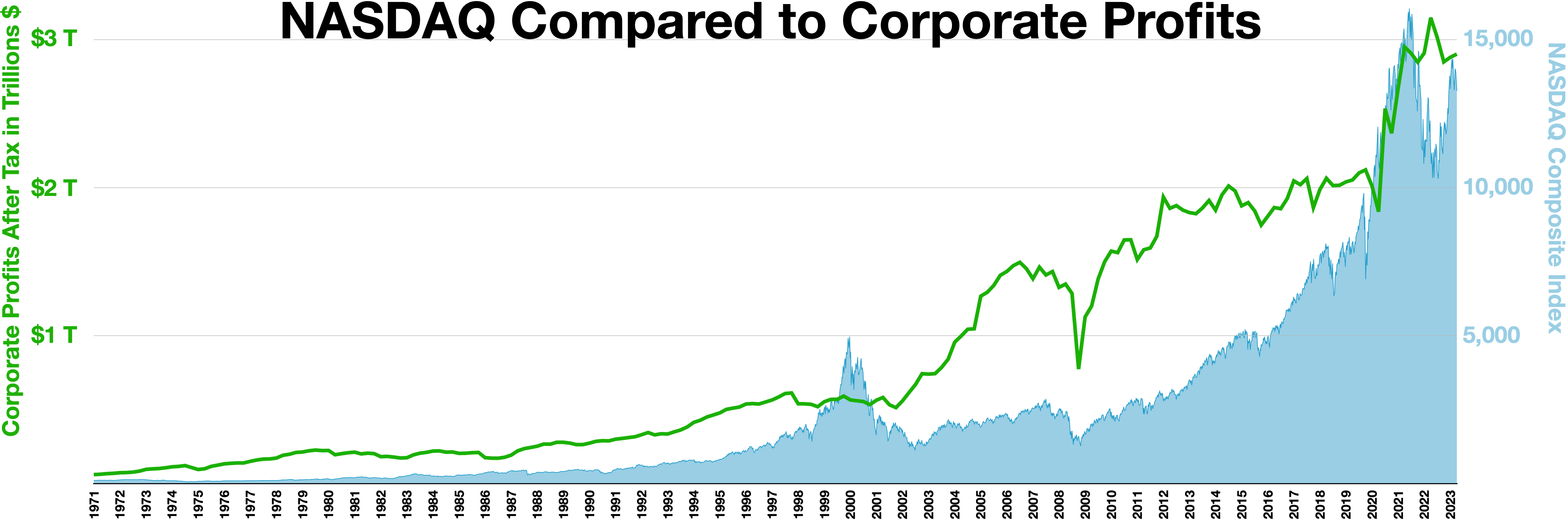
]]
Nasdaq Stock Market (National Association of Securities Dealers Automated Quotations) is an American stock exchange, the second-largest by market cap on the list of stock exchanges, and the first fully electronic stock market. The exchange is based in Manhattan, New York City, and is the most active stock trading venue by volume in the United States.
The exchange platform is owned by Nasdaq, Inc., which also owns the Nasdaq Nordic stock market network and several U.S.-based stock and options exchanges. The exchange is the primary listing for many technology companies and also trades stock in many foreign firms, with China and Israel being the largest foreign sources.
As of December 31, 2024, 4,075 companies listed securities on Nasdaq, including 1,383 listings on The Nasdaq Global Select Market, 1,366 on The Nasdaq Global Market, and 1,326 on The Nasdaq Capital Market.
The Nasdaq Composite, Nasdaq-100, Nasdaq Financial-100 stock market indices are made up only of stocks listed on the Nasdaq.
History
1972–2000
Founding and Origins

Nasdaq, Inc. was founded in 1971 by the National Association of Securities Dealers (NASD), now known as the Financial Industry Regulatory Authority (FINRA). "Nasdaq" (originally and still commonly spelled with all-capital letters as "NASDAQ") is an acronym for "National Association of Securities Dealers Automated Quotations". On February 8, 1971, the Nasdaq Stock Market commenced operations as the world's first fully electronic stock market. Initially, Nasdaq served as a "quotation system" rather than a platform for electronic trading. Intel Corporation was one of the first major corporations to list its shares on Nasdaq; other major companies that have been listed on Nasdaq since its early years include Comcast and Applied Materials.
Market Growth
Since the launch of Nasdaq, many major companies trading on the over-the-counter (OTC) market began switching to Nasdaq. As late as 1987, the Nasdaq exchange was still commonly referred to as "OTC" in media reports and also in the monthly Stock Guides issued by Standard & Poor's Corporation. Over the years, it became more of a stock market with the addition of trade and volume reporting and automated trading systems. In 1981, Nasdaq traded 37% of the U.S. securities markets' total of 21 billion shares. By 1991, Nasdaq's share had grown to 46%. In 1992, the Nasdaq Stock Market joined with the London Stock Exchange to form the first intercontinental linkage of capital markets.
In 1996, the SEC issued a report alleging that Nasdaq market makers fixed prices by avoiding "odd-eighths" quotes (at the time, stock prices were quoted in increments of an eighth of a dollar) to artificially widen spreads. The report was followed by a new set of rules for how Nasdaq handled orders.
Online Trading
In 1998, it became the first stock market in the United States to trade online, using the slogan "the stock market for the next hundred years". The Nasdaq Stock Market attracted many companies during the dot-com bubble.
2000–2020
Public listing and market change
In a series of sales in 2000 and 2001, FINRA sold its stake in the Nasdaq. On July 2, 2002, Nasdaq, Inc. became a public company via an initial public offering, listing its own shares on the exchange (traded under the ticker symbol NDAQ). In 2006, the status of the Nasdaq Stock Market was changed from a stock market to a licensed national securities exchange. In 2007, it merged with OMX, a leading exchange operator in the Nordic countries, expanded its global footprint, and changed its name to the Nasdaq OMX Group.
To qualify for listing on the exchange, a company must be registered with the United States Securities and Exchange Commission (SEC), must have at least three market makers (financial firms that act as brokers or dealers for specific securities) and must meet minimum requirements for assets, capital, public shares, and shareholders.
In 2011, after an announced merger of NYSE Euronext with Deutsche Börse, Nasdaq partnered with Intercontinental Exchange to launch a rival bid, but the bid was withdrawn on regulatory concerns.
Acquisitions
In December 2005, Nasdaq acquired Instinet for $1.9 billion, retaining the Inet ECN and subsequently selling the agency brokerage business to Silver Lake Partners and Instinet management.
The European Association of Securities Dealers Automatic Quotation System (EASDAQ) was founded as a European equivalent to the Nasdaq Stock Market. It was purchased by Nasdaq in 2001 and became Nasdaq Europe. In 2003, operations were shut down as a result of the burst of the dot-com bubble. In 2007, Nasdaq Europe was revived first as Equiduct and was acquired by Börse Berlin later that year.
On November 7, 2007, Nasdaq acquired the Philadelphia Stock Exchange, the oldest stock exchange in the U.S.
Sustainability and leadership milestones
On June 18, 2012, Nasdaq OMX became a founding member of the United Nations Sustainable Stock Exchanges Initiative on the eve of the United Nations Conference on Sustainable Development (Rio+20).
In November 2016, chief operating officer Adena Friedman was promoted to chief executive officer, becoming the first woman to run a major exchange in the U.S.
In 2016, Nasdaq earned $272 million in listings-related revenues.
In October 2018, the SEC blocked the New York Stock Exchange (NYSE) and Nasdaq from raising certain market-data prices. This was the first time the commission rejected increases for the exchanges' stock market data feeds.
In December 2020, Nasdaq announced that it would remove shares of four Chinese companies from indexes it maintains in accordance with Executive Order 13959.
2021–present
In September 2024, the European Commission said it had carried out an unannounced inspection at the offices of Nasdaq over potential anti-competitive practices.
In October 2024, Nasdaq added artificial intelligence capabilities to its Calypso platform with the launch of XVA Accelerator, a tool for portfolio risk calculations. Calypso is used by banks and insurers for capital markets access and regulatory reporting.
In March 2025, pending approval by the U.S. Securities and Exchange Commission, Nasdaq announced plans to introduce 24-hour 5-day a week trading on its United States exchange during the second half of 2026 in response to increased global demand for U.S. equities.
In May 2025, Nasdaq and Amazon Web Services (AWS) expanded their partnership with the launch of Nasdaq Eqlipse Trading, a cloud-based platform emphasizing data sovereignty and flexible deployment. Early adopters include Johannesburg Stock Exchange, Mexico's Grupo BMV, and the Philippine Stock Exchange.
Quote availability
A quote is the price of a stock as listed on an exchange. Quotes consist of bids, the price buyers are willing to pay, and offers, the price sellers will accept. Nasdaq quotes are available at three levels:
- Level 1 shows the highest bid and lowest ask—inside quote.
- Level 2 shows all public quotes of market makers together with information of market dealers wishing to buy or sell stock and recently executed orders.
- Level 3 is used by the market makers and allows them to enter their quotes and execute orders.
Trading schedule
Nasdaq sessions in Eastern Time Zone are:
4:00 a.m. to 9:30 a.m.: extended-hours trading session (premarket)
9:30 a.m. to 4:00 p.m.: normal trading session
4:00 p.m. to 8:00 p.m.: extended-hours trading session (postmarket)
The Nasdaq Stock Market averages about 253 trading days per year.
Market tiers
Within the Nasdaq Composite Index, the Nasdaq exchange has three different market tiers for listed companies:
- Capital Market (NASDAQ-CM small cap) is an equity market for companies that have relatively small levels of market capitalization. Listing requirements for such "small cap" companies are less stringent than for other Nasdaq markets that list larger companies with significantly higher market capitalization.
- Global Market (NASDAQ-GM mid cap) is made up of stocks that represent the Nasdaq Global Market. The Global Market consists of 1,450 stocks that meet Nasdaq's strict financial and liquidity requirements, and corporate governance standards. The Global Market is less exclusive than the Global Select Market.
- Global Select Market (NASDAQ-GS large cap) is a market capitalization-weighted index made up of US-based and international stocks that represent the Nasdaq Global Select Market Composite (NQGS). This includes companies with the largest market capitalization within the Nasdaq Composite. The Global Select Market consists of 1,200 stocks that meet Nasdaq's strict financial and liquidity requirements and corporate governance standards. The Global Select Market is more exclusive than the Global Market. Every October, the Nasdaq Listing Qualifications Department reviews the Global Market Composite to determine if any of its stocks have become eligible for listing on the Global Select Market.
Difference between NYSE and Nasdaq
Nasdaq is the second largest stock exchange in the United States. In addition to age and market capitalization, there are other key differences between the two exchanges:
- Trading Volume. Nasdaq has a greater trading volume than the NYSE with approximately 1.8 billion trades per day.
- Exchange systems. Before the COVID-19 pandemic, the NYSE maintained both an electronic trading system and a trading floor system staffed by live professionals who help conduct auctions. Nasdaq has been an all-electronic exchange since its inception.
- Market structure. The NYSE traces its origins to the Buttonwood Agreement of 1792, when brokers met in person to trade securities using open outcry. Nasdaq began in 1971 as the first exclusively electronic quotation system for over-the-counter securities, displaying bid and ask prices from competing market makers on cathode-ray terminals, however trades were still executed by telephone until electronic execution was introduced in 1984. In 2002–2003, Nasdaq launched Supermontage, integrating a public limit order book with market maker quotations and allowing any participant to post orders. The NYSE adopted a similar electronic central limit order book system in 2006, which today handles the majority of their trading volume; however, the NYSE retains its physical trading floor where designated market makers facilitate opening, closing, and reopening auctions and are obligated to provide liquidity for the public (institutions, hedge funds, broker/dealers) during periods of volatility.
- Listing fees. Listing fees on the Nasdaq vary based on market. For the Capital Market, the fee range is $53,000-$86,000; the Global and Global Select Markets range is $56,000-$193,000; and there is an $81,000-$85,000 listing fee for acquisition companies.
- Sectors. Investors typically view the NYSE as an exchange for older, more established companies. Nasdaq tends to be home to newer companies focused on technology and innovation.
References
References
- "Nasdaq Companies".
- (December 2025). "Nasdaq - trading hours". [[Status Market]].
- "Monthly Reports". [[World Federation of Exchanges]].
- "U.S. Equities Market Volume Summary".
- "Fact Sheet U.S. – Israel Economic Relationship".
- (February 21, 2025). "Nasdaq, Inc. 2024 Form 10-K Annual Report". [[U.S. Securities and Exchange Commission]].
- Terrell, Ellen. (October 2012). "History of the American and Nasdaq Stock Exchanges". [[Library of Congress]].
- [http://www.nasdaq.com/help/helpfaq.stm Frequently Asked Questions. NASDAQ.com. NASDAQ, n.d. Web. December 23, 2001.] {{webarchive. link. (April 29, 2010)
- Kennon, Joshua. (March 26, 2019). "What Is the NASDAQ?".
- (2024-07-19). "Exploring Nasdaq: The Digital Stock Market Powerhouse". Business Insider.
- Gilpin, Kenneth N.. (July 3, 1987). "Company News: An Erratic Quarter for Stock Markets". [[The New York Times]].
- Salinger, Lawrence M.. (June 14, 2013). "Encyclopedia of White-Collar and Corporate Crime". SAGE Publications.
- Widder, Pat. (May 24, 1992). "NASDAQ Has Eye On Next 100 Years". [[Chicago Tribune]].
- Odekon, Mehmet. (March 17, 2015). "Booms and Busts: ''An Encyclopedia of Economic History'' from the First Stock Market Crash of 1792 to the Current Global Economic Crisis: An Encyclopedia of Economic History from the First Stock Market Crash of 1792 to the Current Global Economic Crisis". [[Routledge]].
- Patterson, Scott. (2012). "Dark Pools: High-Speed Traders, A.I. Bandits, and the Threat to the Global Financial System". Crown Publishing.
- "Feb 8, 1971 CE: 'Stock Market for the Next 100 Years' Opens". [[National Geographic]].
- "INVESTOR FAQS". Nasdaq.
- Walsh, Michelle. "Nasdaq Stock Market Becomes A National Securities Exchange; Changes Market Designations".
- (May 26, 2007). "Nasdaq Lands OMX for $5.7 Billion; Are More Merger Deals on the Way?". [[The Wall Street Journal]].
- Pisani, Bob. (May 16, 2011). "Market Is for Sale, and Nasdaq Withdraws Bid for NYSE". [[CNBC]].
- (December 8, 2005). "NASDAQ Completes Acquisition of Inet". Nasdaq.
- Authers, John. (December 8, 2005). "Nasdaq completes purchase of Instinet exchange". [[Financial Times]].
- (April 22, 2005). "Nasdaq to Acquire Instinet in $1.9 Billion Deal". [[The New York Times]].
- (2025-02-23). "NASDAQ - Explained".
- (August 11, 2003). "Nasdaq Might Shut Down German Exchange". [[Deutsche Welle]].
- "Easdaq Makes A Comeback As Equiduct".
- Terrell, Ellen. "Research Guides: Wall Street and the Stock Exchanges: Historical Resources: Stock Exchanges".
- (June 18, 2012). "Sustainable Stock Exchanges Initiative: Exchanges Listing Over 4,600 Companies Commit to Promoting Sustainability". [[GlobeNewswire]].
- Jungcurt, Stefan. (June 29, 2012). "Five Stock Exchanges Commit to Promoting Sustainability". [[International Institute for Sustainable Development]].
- (November 15, 2016). "Nasdaq's New CEO Attributes Her Success to an 'Eclectic' Career Path".
- Osipovich, Alexander. (October 26, 2017). "Startup Exchange Cleared to Take on NYSE, Nasdaq for Stock Listings". [[The Wall Street Journal]].
- (October 16, 2018). "SEC Ruling Takes Aim at Stock-Exchange Profits". [[The Wall Street Journal]].
- (October 16, 2018). "SEC rules NYSE and Nasdaq did not justify data fee increases". [[Financial Times]].
- Michaels, Dave. (October 19, 2018). "NYSE, Nasdaq Take It on the Chin in Washington". [[The Wall Street Journal]].
- (December 12, 2020). "Nasdaq to remove four Chinese companies' shares from indexes after U.S. order". [[Reuters]].
- Asgari, Nikou. (2024-09-24). "Nasdaq and Deutsche Börse raided in EU antitrust investigation". Financial Times.
- Nikolova, Maria. (2024-10-17). "Nasdaq integrates AI into Calypso platform to accelerate risk calculations".
- Saini, Manya. (March 7, 2025). "Nasdaq plans 24-hour trading as global appetite for US stocks grows". Reuters.
- Rice, Sophie. (2025-04-25). "Nasdaq & AWS Unveil Fintech Blueprint for Cloud Markets".
- Preece, Claudia. (2025-05-22). "Philippine Stock Exchange adopts Nasdaq Eqlipse Trading".
- "Stock Quotes {{!}} Investor.gov".
- "Order Book, Level 2 Market Data, and Depth of Market".
- "Nasdaq Level III Quote".
- "NASDAQ".
- "Nasdaq Trading Schedule".
- "Stock Performance in Recessions". The Motley Fool.
- "Nasdaq Capital Market".
- "Definition of 'Nasdaq SmallCap Market', now known as Nasdaq Capital Market". [[Investopedia]].
- "Definition of 'Nasdaq Global Market Composite'". [[Investopedia]].
- (August 17, 2009). "Exemption from Qualification Requirements for Nasdaq Global Market and Nasdaq Capital Market Securities Under Corporations Code Section 25100(o)". State of California Business, Transportation and Housing Agency Department of Corporations California's Investment and Financing Authority.
- "Nasdaq Global Select Market".
- "Definition of 'Nasdaq Global Select Market Composite'". [[Investopedia]].
- (2010). "Equity Asset Valuation". [[John Wiley & Sons]].
- "The New York Stock Exchange (NYSE)". www.forbes.com.
- "10 Largest Stock Exchanges in the World". www.analyticssteps.com.
- "Getting to Know the Stock Exchanges". www.investopedia.com.
- "What is NASDAQ?". www.businessnewsdaily.com.
- "The History of NYSE". www.nyse.com.
- "What Is The NYSE?". www.wallstrank.com.
- "The History of NYSE".
- (February 11, 2021). "Nasdaq: 50 Years of Market Innovation".
- "Transformation & Regulation: Equities Market Structure, 1934 to 2018".
- (August 29, 2002). "Order with Respect to the Implementation of Nasdaq's SuperMontage Facility".
- (February 6, 2003). "NASDAQ Proposal to Expand Access to SuperMontage Is Approved by SEC". Nasdaq, Inc..
- (March 22, 2006). "SEC Approves NYSE Hybrid Market Proposal".
- "NYSE Equities". New York Stock Exchange.
- (November 21, 2024). "Nasdaq amends All-Inclusive Annual Listing Fees for 2025".
- (July 6, 2022). "Nyse Vs Nasdaq: Whats The Difference". www.newyorkdaily.net.
- "Nasdaq 100 forecast: The US100 rebounds ahead of Fed meeting in December". capital.com.
This article was imported from Wikipedia and is available under the Creative Commons Attribution-ShareAlike 4.0 License. Content has been adapted to SurfDoc format. Original contributors can be found on the article history page.
Ask Mako anything about Nasdaq — get instant answers, deeper analysis, and related topics.
Research with MakoFree with your Surf account
Create a free account to save articles, ask Mako questions, and organize your research.
Sign up freeThis content may have been generated or modified by AI. CloudSurf Software LLC is not responsible for the accuracy, completeness, or reliability of AI-generated content. Always verify important information from primary sources.
Report