From Surf Wiki (app.surf) — the open knowledge base
NASA Docking System
Spacecraft docking mechanism
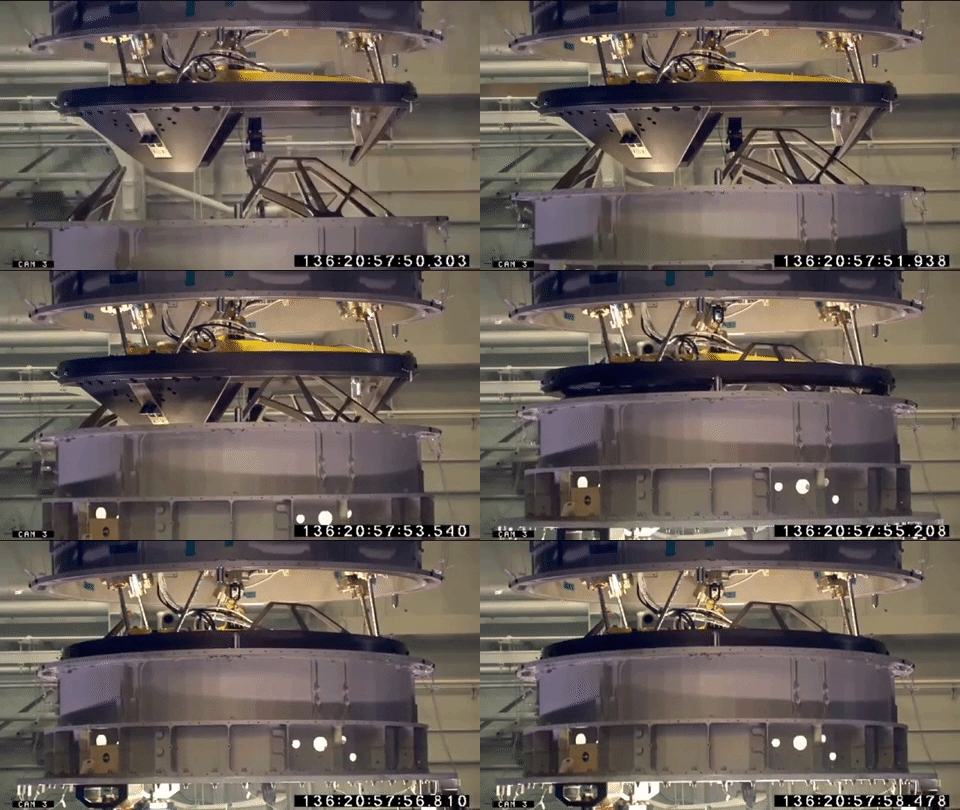
Spacecraft docking mechanism

The NASA Docking System is NASA's implementation of the International Docking System Standard (IDSS), an international spacecraft docking standard promulgated by the International Space Station Multilateral Coordination Board. NDS is a spacecraft docking and berthing mechanism used on the International Space Station (ISS) and the Boeing Starliner and planned to be used on the Orion spacecraft. The international Low Impact Docking System (iLIDS) was the precursor to the NDS. NDS Block 1 was designed, built, and tested by The Boeing Company in Huntsville Alabama. Design qualification testing took place through January 2017.
Using NDS, NASA developed the International Docking Adapter (IDA) to provide two IDSS-compliant docking ports on the ISS. The IDAs were delivered to the ISS starting in 2016. Each of two existing Pressurized Mating Adapters has an IDA permanently attached, so the former PMA function is no longer available for visiting spacecraft. Since 2019, visiting spacecraft that implement IDSS dock to the NDS ports on the IDAs. These include Crew Dragon, Cargo Dragon 2, and Boeing Starliner.
Design
NDS supports both autonomous and piloted dockings and includes pyrotechnics for contingency undocking. Once mated the NDS interface can transfer power, data, and air; future implementations will be able to transfer water, fuel, oxidizer and pressurant as well. | url-status=dead
In form and function NDS resembles the Shuttle/Soyuz APAS-95 mechanism already in use for the docking ports and pressurized mating adapters on the International Space Station. There is no compatibility with the larger common berthing mechanism used on the US segment of the ISS, the Japanese H-II Transfer Vehicle, the original SpaceX Dragon, and Orbital Sciences' Cygnus spacecraft. NDS is compatible with the IDSS implementation on SpaceX Dragon 2, both Crew Dragon and Cargo Dragon.
History

In 1996, Johnson Space Center (JSC) began development of the Advanced Docking Berthing System, which would later be called the X-38 Low-Impact Docking System. After the X-38 was canceled in 2002, development of the mating system continued, but its future was unknown.
The Hubble Space Telescope received the Soft-Capture Mechanism (SCM) on STS-125. The SCM is meant for unpressurized docking, but uses the LIDS interface to reserve the possibility of an Orion docked mission. The docking ring is mounted on Hubble's aft bulkhead. It may be used for safely de-orbiting Hubble at the end of its service lifetime.

In February 2010, the LIDS program became modified to be compliant with the IDSS and became known as the international Low Impact Docking System (iLIDS) or simply the NASA Docking System (NDS). In May 2011, the NDS critical design review was completed and qualification was expected to be completed by late 2013. | url-status=dead
In April 2012, NASA funded a study to determine if a less complex docking system could be used as the NASA Docking System that both met the international community's desire for a narrower soft capture system ring width, as well as providing the ISS a simpler active docking system compared to the then-planned design. Boeing's proposal was the Soft Impact Mating and Attenuation Concept (SIMAC), a design originally conceived in 2003 for the Orbital Space Plane (OSP) Program.
A leaked NASA internal memo from November 2012, stated that SIMAC had been chosen to replace the previous design and that the majority of the work on the NASA Docking System would be shifted from NASA JSC to Boeing.{{cite web | archive-url=https://archive.today/20130202171003/http://www.spaceref.com/news/viewsr.html?pid=42614 | url-status=dead | archive-date=February 2, 2013 IDA-1 is planned to be delivered on SpaceX CRS-7 and IDA-2 on SpaceX CRS-9. The NDS on the IDAs is passive.
During the summer of 2011, news had been made available that Bigelow Aerospace was considering to use NDS on their modules.
IDA-1 was part of the payload on SpaceX CRS-7 in June 2015, but was destroyed when the Falcon 9 rocket exploded during ascent.
IDA-2 was delivered successfully on SpaceX's CRS-9 mission in July 2016, and then installed on PMA-2 in August of that year during a spacewalk by Jeffrey Williams and Kathleen Rubins as part of Expedition 48. Crew Dragon Demo-1 was the first spacecraft to dock at this port on 2 March 2019.
IDA-3 was launched on the SpaceX CRS-18 mission in July 2019. IDA-3 is constructed mostly from spare parts to speed construction. It was attached and connected to PMA-3 during a spacewalk on 21 August 2019.
References
- James L. Lewis, Advanced Docking Berthing System. NASA technical publication. Johnson Space Center.
- James L. Lewis, Monty B. Carroll. Prototype Low Impact Docking System. NASA technical publication. Johnson Space Center.
References
- [https://ntrs.nasa.gov/search.jsp?R=20090007783&hterms=Advanced+Docking+Berthing+System&qs=Ntx%3Dmode%2520matchall%26Ntk%3DAll%26Ns%3DLoaded-Date%7C1%26N%3D0%26Ntt%3D%22Advanced%2520Docking%2520Berthing%2520System%22&sms_ss=google&at_xt=4d7d15e9f654dfcb%2C0 Low Impact Docking System (2009-02)]
- [http://gltrs.grc.nasa.gov/reports/2005/CP-2005-213655-VOL1/15Robertson.pdf Advanced Docking/Berthing System - NASA Seal Workshop (2004-11-04)] {{webarchive. link. (2011-09-22)
- [http://universityaffairs.jsc.nasa.gov/PDF/Eng-3.pdf Advanced Docking Berthing System] {{webarchive. link. (2009-02-26)
- Wilson, Jim. "NASA - NASA's Exploration Systems Architecture Study -- Final Report".
- NASA. (2008). "The Soft Capture and Rendezvous System". NASA.
- (February 15, 2013). "NASA Docking System (NDS) Technical Integration Meeting".
- Pejmun Motaghedi and Siamak Ghofranian. (14 July 2014). "Feasibility of the SIMAC for the NASA Docking System". Boeing.
- (28 August 2014). "Boeing Continues Progress on Improved Space Station Docking System". Boeing.
- John Cook, Valery Aksamentov, Thomas Hoffman, and Wes Bruner. (2011-09-02). "ISS Interface Mechanisms and their Heritage". The Boeing Company.
- Graham, William. (27 June 2015). "SpaceX's Falcon 9 fails during launch following second stage failure". nasaspaceflight.com.
- (20 August 2016). "New 'front porch' added to International Space Station".
- Pietrobon, Steven. (August 20, 2018). "United States Commercial ELV Launch Manifest".
- Stephen Clark. (1 May 2016). "Boeing borrows from inventory to speed docking adapter delivery". Spaceflight Now.
- (21 August 2019). "Spacewalkers Complete Installation of Second Commercial Docking Port – Space Station".
- {{Cite patent. US. 6354540
This article was imported from Wikipedia and is available under the Creative Commons Attribution-ShareAlike 4.0 License. Content has been adapted to SurfDoc format. Original contributors can be found on the article history page.
Ask Mako anything about NASA Docking System — get instant answers, deeper analysis, and related topics.
Research with MakoFree with your Surf account
Create a free account to save articles, ask Mako questions, and organize your research.
Sign up freeThis content may have been generated or modified by AI. CloudSurf Software LLC is not responsible for the accuracy, completeness, or reliability of AI-generated content. Always verify important information from primary sources.
Report