From Surf Wiki (app.surf) — the open knowledge base
Naqsh-e Rostam
Ancient necropolis in Fars province, Iran
Ancient necropolis in Fars province, Iran
| Field | Value | |||||
|---|---|---|---|---|---|---|
| native_name | ||||||
| native_name_lang | fa | |||||
| image | Naqsh-e Rustam necropolis in Iran.jpg | |||||
| map | {{Maplink | frame=yes | plain=yes | zoom=11 | frame-lat=29.9920 | frame-long=52.8729 |
| type | shape | id=Q648705 | title=City map interactive | |||
| type2 | point | id2=Q648705 | stroke-width=3 | title2=zones | marker=city | |
| map_type | Iran | |||||
| altitude_m | ||||||
| relief | yes | |||||
| coordinates | ||||||
| map_dot_label | Naqsh-e Rostam | |||||
| location | Marvdasht, Fars province | |||||
| region | Iran | |||||
| type | Necropolis | |||||
| epochs | Achaemenian, Sassanian | |||||
| cultures | Persian | |||||
| management | Cultural Heritage, Handicrafts and Tourism Organization of Iran | |||||
| architectural_styles | Persian |
Naqsh-e Rostam (, ) is an ancient archeological site and necropolis located about 13 km northwest of Persepolis, in Fars province, Iran. A collection of ancient Iranian rock reliefs are cut into the face of the mountain and the mountain contains the final resting place of four Achaemenid kings, notably king Darius the Great and his son, Xerxes. This site is of great significance to the history of Iran and to Iranians, as it contains various archeological sites carved into the rock wall through time for more than a millennium from the Elamites and Achaemenids to the Sasanians. It lies a few hundred meters from Naqsh-e Rajab, with a further four Sasanian rock reliefs, three celebrating kings and one a high priest.
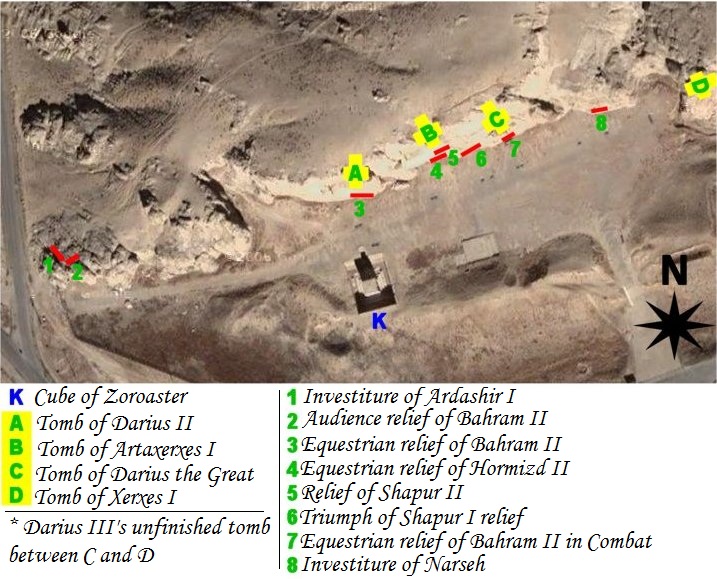
Naqsh-e Rostam is the necropolis of the Achaemenid dynasty ( 550–330 BC), with four large tombs cut high into the cliff face. These have mainly architectural decoration, but the facades include large panels over the doorways, each very similar in content, with figures of the king being invested by a god, above a zone with rows of smaller figures bearing tribute, with soldiers and officials. The three classes of figures are sharply differentiated in size. The entrance to each tomb is at the center of each cross, which opens onto a small chamber, where the king lay in a sarcophagus.
Well below the Achaemenid tombs, near ground level, are rock reliefs with large figures of Sasanian kings, some meeting gods, others in combat. The most famous shows the Sasanian king Shapur I on horseback, with the Roman Emperor Valerian bowing to him in submission, and Philip the Arab (an earlier emperor who paid Shapur tribute) holding Shapur's horse, while the dead Emperor Gordian III, killed in battle, lies beneath it (other identifications have been suggested). This commemorates the Battle of Edessa in AD 260, when Valerian became the only Roman Emperor who was captured as a prisoner of war, a lasting humiliation for the Romans. The placing of these reliefs clearly suggests the Sassanid intention to link themselves with the glories of the earlier Achaemenid Empire.
Monuments
.jpg)
Elamite rock relief
Main article: Elamite rock relief in Naqsh-e Rostam
The oldest relief at Naqsh-e Rostam dates back to c. 1000BC. Though it is severely damaged, it depicts a faint image of a man with unusual headgear, and is thought to be Elamite in origin.
Achaemenid tombs
Four tombs belonging to Achaemenid kings are carved out of the rock face at a considerable height above the ground.
Tomb of Darius the Great
Main article: Tomb of Darius the Great
One of the tombs is explicitly identified, by an accompanying inscription ("parsa parsahya puthra ariya ariyachitra", meaning, "a Parsi, the son of a Parsi, an Aryan, of Aryan family), as the tomb of Darius I (c. 522–486 BC).
Other tombs
The other three tombs are believed to be those of Xerxes I (c. 486–465 BC), Artaxerxes I (c. 465–424 BC), and Darius II (c. 423–404 BC) respectively. The order of the tombs in Naqsh-e Rostam follows (left to right): Darius II, Artaxerxes I, Darius I, Xerxes I. The matching of the other kings to tombs is somewhat speculative; the relief figures are not intended as individualized portraits.
Darius I inscription
Main article: DNa inscription

An inscription by Darius I, from 490 BCE, generally referred to as the "DNa inscription" in scholarly works, appears in the top left corner of the facade of his tomb. It mentions the conquests of Darius I and his various achievements during his life. Its exact date is not known, but it can be assumed to be from the last decade of his reign. Like several other inscriptions by Darius, the territories controlled by the Achaemenid Empire are specifically listed, which formed the largest empire during antiquity. His empire encompassed Macedon and Thrace in Europe, Egypt in North Africa, Babylon and Assyria in Mesopotamia, the steppes of Eurasia, Bactria in Central Asia, up to Gandhara and the Indus in the Indian Subcontinent which were annexed during the Achaemenid conquest of the Indus Valley.
| English translation | Original |
|---|---|
| DNa inscription of Darius I.}} |
DNf inscription. There are various and contradictory reports about how this inscription was discovered. According to Mrs. Khadija Totunchi, she took a photo of this inscription in 2017. But she did not find a suitable person to translate and read the inscription. Also, according to Ebrahim Rustaei, in 2018, in cooperation with Abdul Majid Arfai, he presented an article about the inscription to the International Conference on History and Culture of Southern Iran (Historical Persia), in which a reading of the inscription was presented. However, this reading is very basic and has many flaws. But finally, the DNf petroglyph, which had been hidden in the shade and under algae and sediments for 2500 years, was officially and scientifically recorded by Mojtaba Doroodi and Soheil Delshad in February 2019.https://www.isna.ir/news/97111407664/%D8%B1%D9%88%D8%A7%DB%8C%D8%AA%DB%8C-%D9%85%D8%AA%D9%81%D8%A7%D9%88%D8%AA-%D8%A7%D8%B2-%DA%A9%D9%88%DA%86%DA%A9-%D8%AA%D8%B1%DB%8C%D9%86-%DA%A9%D8%AA%DB%8C%D8%A8%D9%87-%D9%88-%D8%A2%D8%AE%D8%B1%DB%8C%D9%86-%DA%A9%D8%B4%D9%81-%D9%86%D9%82%D8%B4-%D8%B1%D8%B3%D8%AA%D9%85
Babylonian Transliteration: 1- [mx-x-x(-x) LÚ
pa-id-di-iš-ḫu]-ri-iš ˹a˺-˹na˺ m da-a-ri-i̭a-˹muš˺ LUGAL i-GA-ir-ra-bi
Translation (based on the Babylonian version): [Personal Name, Pati]schorian, invokes blessing upon Darius the King.
Ka'ba-ye Zartosht
Main article: Ka'ba-ye Zartosht
Ka'ba-ye Zartosht (meaning the "Cube of Zoroaster") is a 5th-century B.C Achaemenid square tower. The structure is a copy of a sister building at Pasargadae, the "Prison of Solomon" (Zendān-e Solaymān).
Several theories exist regarding the purpose of the Ka'ba-ye Zartosht structure.
Sasanian reliefs
Seven over-life sized rock reliefs at Naqsh-e Rostam depict monarchs of the Sasanian era.

Investiture relief of [[Ardashir I]], c. 226–242
Main article: Ahura Mazda and Ardashir I
The founder of the Sassanid Empire is seen being handed the ring of kingship by Ohrmazd.
Triumph of [[Shapur I]], c. 241–272
Main article: Shapur I's victory relief at Naqsh-e Rostam
The most famous of the Sassanid rock reliefs, and depicts the victory of Shapur I over two Roman emperors, Valerian and Philip the Arab. Behind the king stands Kirtir, the mūbadān mūbad ('high priest'), the most powerful of the Zoroastrian Magi during the history of Iran.
In an inscription, Shapur I claims possession of the territory of the Kushans (Kūšān šahr) as far as "Purushapura" (Peshawar), suggesting he controlled Bactria and areas as far as the Hindu-Kush or even south of it:
"Grandee" relief of [[Bahram II]], c. 276–293

On each side of the king, who is depicted with an oversized sword, figures face the king.
Two equestrian reliefs of [[Bahram II]], c. 276–293
The first equestrian relief, located immediately below the fourth tomb (perhaps that of Darius II), depicts the king battling a mounted Roman enemy. The second equestrian relief, located immediately below the tomb of Darius I, is divided into two registers, an upper and a lower one. In the upper register, the king appears to be forcing a Roman enemy, probably Roman emperor Carus from his horse. In the lower register, the king is again battling a mounted enemy wearing a headgear shaped as an animal's head, thought to be the vanquished Indo-Sassanian ruler Hormizd I Kushanshah. File:Naqsh-e Rostam III (3291730501).jpg|First equestrian relief. File:Naghsh-e rostam, Irán, 2016-09-24, DD 10.jpg|The two-panel equestrian relief. File:Hormizd I Kushanshah on the Naqsh-e Rustam Bahram II panel.jpg|Hormizd I Kushanshah on the lower panel.
Investiture of [[Narseh]], c. 293–303

In this relief, the king is depicted as receiving the ring of kingship from a female figure that is frequently assumed to be the divinity Aredvi Sura Anahita.
Equestrian relief of [[Hormizd II]], c 303–309

This relief is below tomb 3 (perhaps that of Artaxerxes I) and depicts Hormizd forcing an enemy (perhaps Papak of Armenia) from his horse.
Archaeology
In 1923, the German archaeologist Ernst Herzfeld made casts of the inscriptions on the tomb of Darius the Great. Since 1946, these casts have been held in the archives of the Freer Gallery of Art and the Arthur M. Sackler Gallery, Smithsonian Institution, in Washington, DC.
Naqsh-e Rostam was excavated for several seasons between 1936 and 1939 by a team from the Oriental Institute of the University of Chicago, led by Erich Schmidt.
Notes
References
- Canepa, Matthew P., "Topographies of Power, Theorizing the Visual, Spatial and Ritual Contexts of Rock Reliefs in Ancient Iran", in Harmanşah (2014), google books
- Cotterell, Arthur (ed), The Penguin Encyclopedia of Classical Civilizations, 1993, Penguin,
References
- Cotterell, 162; Canepa, 57–59, 65–68
- Herrmann and Curtis; Canepa, 62, 65–68
- Khanipoor, Morteza. (2017). "The reliefs of Naqš-e Rostam and a reflection on a forgotten relief". Historia i Świat.
- "I am Darius".
- (1974). "Orientalia Lovaniensia Periodica". Instituut voor Oriëntalistiek..
- (2002). "From Cyrus to Alexander: A History of the Persian Empire". Eisenbrauns.
- (1893). "A guide to the Old Persian inscriptions". New York, Cincinnati [etc.] American book company.
- "DNa - Livius".
- (2001). "Empires: Perspectives from Archaeology and History". Cambridge University Press.
- The Achaemenid Empire in South Asia and Recent Excavations in Akra in Northwest Pakistan Peter Magee, Cameron Petrie, Robert Knox, Farid Khan, Ken Thomas [https://repository.brynmawr.edu/cgi/viewcontent.cgi?article=1082&context=arch_pubs p.713-714]
- "NAQŠ-E ROSTAM – Encyclopaedia Iranica".
- Delshad, Soheil. "کتیبهای در سایه (کتیبه نویافته هخامنشی موسوم به DNf)". ویژه نامه فرهنگستان – زبانها و گویشهای ایرانی.
- Delshad, Soheil. (5 March 2019). "DNf : A New Inscription Emerges from the Shadow". Arta.
- "Welcome to Encyclopaedia Iranica".
- Rome in the East: The Transformation of an Empire. Warwick Ball. page 120. Psychology Press, 16 January 2001.
- (2021). "From the Kushans to the Western Turks". King of the Seven Climes.
- Encyclopedia Iranica [http://www.iranicaonline.org/articles/hormozd-kusansah HORMOZD KUŠĀNŠĀH article]
- [http://oi.uchicago.edu/pdf/oip70.pdf] {{Webarchive. link. (2011-02-05 E. F. Schmidt, Persepolis III: The Royal Tombs and Other Monuments, Oriental Institute Publications 70, University of Chicago Press, 1970, {{ISBN). 0-226-62170-7
This article was imported from Wikipedia and is available under the Creative Commons Attribution-ShareAlike 4.0 License. Content has been adapted to SurfDoc format. Original contributors can be found on the article history page.
Ask Mako anything about Naqsh-e Rostam — get instant answers, deeper analysis, and related topics.
Research with MakoFree with your Surf account
Create a free account to save articles, ask Mako questions, and organize your research.
Sign up freeThis content may have been generated or modified by AI. CloudSurf Software LLC is not responsible for the accuracy, completeness, or reliability of AI-generated content. Always verify important information from primary sources.
Report