From Surf Wiki (app.surf) — the open knowledge base
Musth
Condition in male elephants
Condition in male elephants
.jpeg)
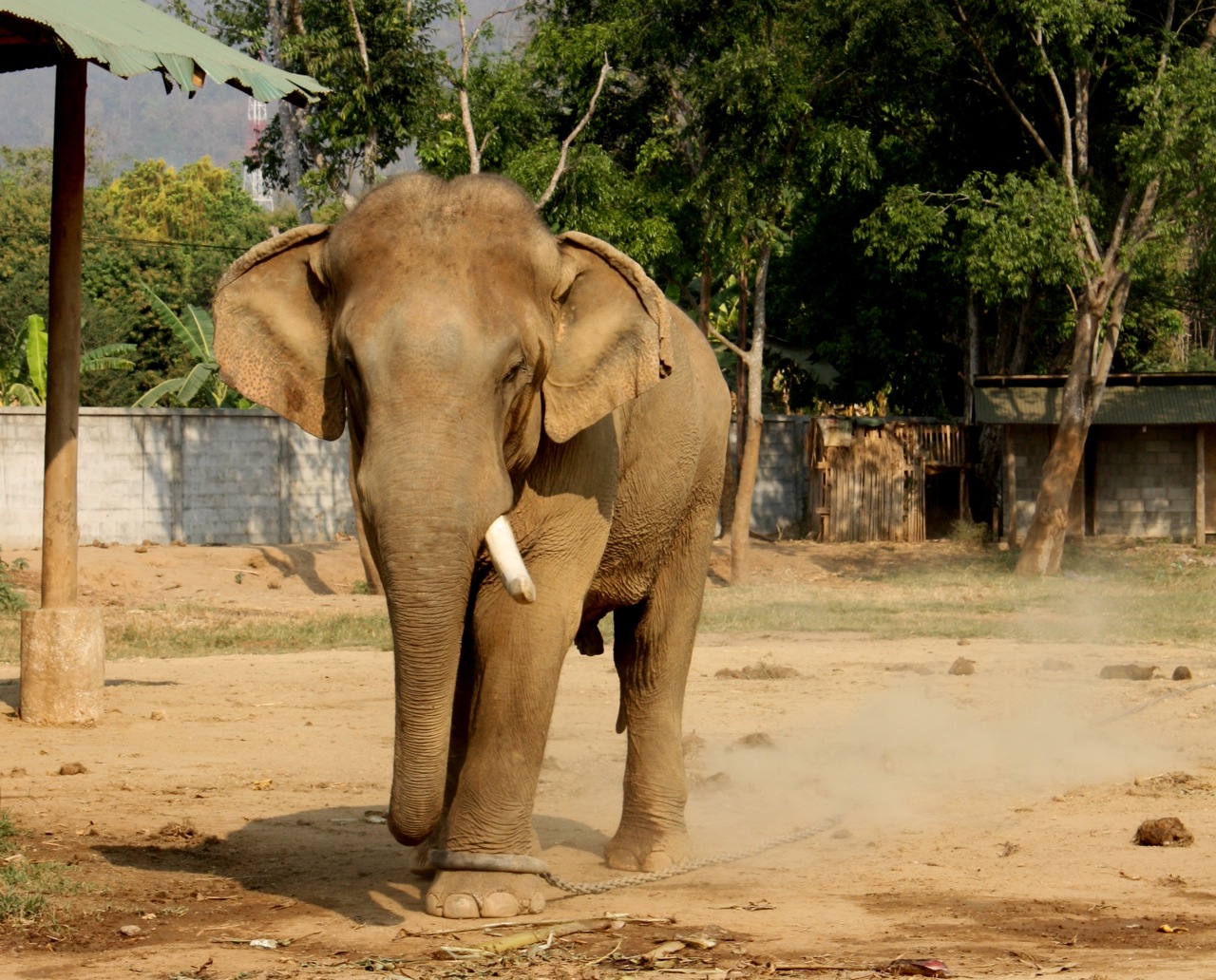
Musth or must is a periodic condition in bull (male) elephants characterized by aggressive behavior and accompanied by a large rise in reproductive hormones. It has been known in Asian elephants for 3,000 years but was only described in African elephants in 1981. Evidence indicates that similar behaviour occurred in extinct proboscideans like gomphotheres and mastodons.
Elephants often discharge a thick, tar-like secretion called temporin from the temporal gland during musth. Behavioral management for captive bull elephants in musth includes physical restraint and a starvation diet for several days to a week.
Etymology
Musth comes from an Urdu term for intoxication;
Biology
Musth has been known in Asian elephants for 3000 years (described in the Rigveda 1500–1000 B.C.) but was recognized in African elephants only in the late twentieth century.
In 1975, scientists Joyce Poole and Cynthia Moss were working in Amboseli National Park, Kenya. Poole noticed a period of heightened reproductive activity and aggression in male African elephants. She began documenting and describing the physical and behavioral characteristics and temporal (time-related) dynamics among individual males. This led to scientifically identifying musth in African elephants.
Musth is also suggested to have occurred in mammoths, given the testosterone histories from their tusks. Musth-like behaviour is also suggested to have occurred in South American gomphotheres and North American mastodons.
Musth differs from rut in that musth most often takes place in winter, whereas the female elephant's estrus cycle is not seasonally linked.
Physical characteristics
Elephants in musth often discharge a thick tar-like secretion called temporin from the temporal gland located on the temporal sides of the head. Temporin contains proteins, lipids (including cholesterol), phenol and 4-methyl phenol, cresols and sesquiterpenes (notably farnesol and its derivatives). Secretions and urine collected from zoo elephants have been shown to contain elevated levels of various highly odorous ketones and aldehydes.
Testosterone levels in an elephant in musth average 60 times greater than in the same elephant at other times, and in some individuals can increase by as much as 140 times.
Behavioral characteristics
Musth is believed to be linked to sexual arousal or establishing dominance.
Bull elephants in musth, especially but not only in the wild, are extremely dangerous and have killed keepers/mahouts, livestock, other species, and other bull elephants, female elephants, and calves (the last usually inadvertently or accidentally in what is often called "herd infighting").
During the 1990s, young bull rogue elephants killed 63 rhinos of both sexes (58 endangered white rhinos and 5 rare black rhinos) in two South African national parks (Hluhluwe–Imfolozi and Pilanesberg). This was ultimately attributed to an aberrant form of musth. After being rebuffed by older female elephants, the young bulls went after rhinos, killing them. Three young elephant bulls were shot, temporarily ending the killings. Some scientists opined that this was an example of young male elephants permanently changed by the trauma of witnessing their breeding herds culled due to overcrowding in other South African parks. These young bulls had been spared due to their age and size, although herd culls are properly done in entirety, i.e., leaving no survivors to suffer the equivalents of PTSD, survivor guilt, and other disorders or traumas later in life which could then create or exacerbate human-elephant conflicts or other forms of violence, according to Ron Thomson, a late 20th-century Zimbabwe game warden and Parks Board veteran. South African ecologist and ranger Gus van Dyk, who thought of the idea of reintroducing older males into Pilanesberg to prevent younger males from entering musth, noted that no further rhinoceros killings were observed.
In the absence of older males, whose presence inhibits musth in smaller younger bulls, these adolescent bulls had reached puberty (musth) prematurely, which reduced their control and resulted in the "warped behavior of animals who have lost their elders, and who are now flailing in a diminished, disarranged world." It is established that functionally important decision-making abilities may be significantly altered by disruption of the natural structure of kin-based social relationships and that violent disruption "appears capable of driving aberrant behaviours in social animals that are akin to the post-traumatic stress disorder experienced by humans following extremely traumatic events" due to the pachyderms' intelligence, strong emotional family attachments, and prodigious memories. Another interrelated but more generalized theory of why the young elephants went wild was that, owing to culls and herd fragmentation, there were no older elephants to teach and discipline them.
Management

In Sri Lanka and India, domesticated Asian elephants in musth are traditionally tied to a strong tree and denied food and water for a week or so which shortens the duration of the musth, typically to five to eight days. Sedatives, like xylazine, are also sometimes used. Zoos keeping adult male elephants need strong, purpose-built enclosures to isolate males during their musth.
Cultural depictions
-
Valmiki, in Sundara Kanda of the Ramayana (7th to 4th centuries BCE), made reference to the Mahendra mountain shedding water like an elephant's rut juice upon being pressed by Hanuman.
-
In the Matanga Lila (300 BCE to 300 CE) musth is described: "Excitement, swiftness, odor, love passion, complete florescence of the body, wrath, prowess, and fearlessness are declared to be the eight excellences of musth."
-
Sangam poetry (300 BCE to 300 CE) describes musth. Kummatoor Kannanaar in Pathitrupatthu 12 describes it as follows: and swaying walks have musth flowing from their cheek glands and elephant mothers with calves wave wild jasmine twigs, chasing striped bees that swarm on the sweet musth.}}
-
References to elephants in musth (whose temporin secretion is often referred to as "ichor") are for example in the Raghuvaṃśa (4th–5th century CE), where Kalidasa wrote that the king's elephants drip ichor in seven streams to match the scent put forth by the seven-leaved 'sapta-cchada' (= "seven-leaf") tree (perhaps Alstonia scholaris).
-
In Jules Verne's Around the World in Eighty Days (1872), Phileas Fogg buys an elephant which was being fed sugar and butter so it would go into musth for combat purposes; however, the animal had been on this regimen for only a relatively short time so the condition had not yet presented.
-
Shooting an Elephant is an essay by George Orwell written in 1936, in which he describes how an elephant in Burma had an attack of musth and killed an Indian, which in turn led to the narrator shooting the elephant.
-
In his James Bond novel The Man With the Golden Gun (1965), Ian Fleming wrote that the villain Francisco Scaramanga was driven to become a cold-blooded assassin after authorities shot an elephant that he had ridden in his circus act because the elephant went on a rampage while in musth.
-
In Barry B. Longyear's 1982 novel Elephant Song, the survivors of the circus starship City of Baraboo have to face the fact that because of the circus rule that male elephants cannot troupe with the show because they might go into musth with no warning, the elephants who survived to land on Momus are doomed to extinction.
-
The Tamil movie Kumki (2012), which revolves around a mahout and his trained elephant, shows the elephant in musth toward the climax. Captive elephants are trained either for duties in temples and cultural festivals or as kumki elephants, which confront wild elephants and prevent them from entering villages. Elephants trained for temple duties are of a gentle nature and cannot face wild elephants. In the movie, a tribal village wants to hire a kumki elephant to chase away wild elephants that enter the village every harvest season. The mahout, who needs money, takes his temple-trained elephant to do the job in the vain hope that wild elephants will not enter. But wild elephants start attacking the village on the harvest day. The temple-trained elephant enters musth and thus fights with the wild elephants, killing the most notorious among the herd but dying from injuries sustained during the fight.
References
References
- Smith, Gregory James. (February 2020). "Extinction of North American Cuvieronius (Mammalia: Proboscidea: Gomphotheriidae) driven by dietary resource competition with sympatric mammoths and mastodons". Paleobiology.
- El Adli, Joseph J.. (July 2017). "First analysis of life history and season of death of a South American gomphothere". Quaternary International.
- Schultz, Isaac. (2023-05-03). "30,000-Year-Old Tusk Reveals Male Mammoths' Horny Aggression".
- Timmons, Jeanne. (2023-05-03). "Testosterone in tusks: Hormones in mammoth fossils excite paleontologists".
- {{rp. 101 in Persian it means {{lit
- Sukumar, R. (2003). "The living elephants: evolutionary ecology, behavior, and conservation". Oxford University Press.
- (August 1981). "Musth in the African elephant, Loxodonta africana". Nature.
- (2023-05-18). "Testosterone histories from tusks reveal woolly mammoth musth episodes". Nature.
- (July 2017). "First analysis of life history and season of death of a South American gomphothere". Quaternary International.
- (2022-06-21). "Male mastodon landscape use changed with maturation (late Pleistocene, North America)". Proceedings of the National Academy of Sciences.
- (9 November 2016). "Musth of the elephant bulls – Upali.ch".
- Physiological Correlates of Musth: Lipid Metabolites and Chemical Composition of Exudates. L.E.L Rasmussen and Thomas E Perrin, Physiology & Behavior, October 1999, Volume 67, Issue 4, pp. 539–549, {{doi. 10.1016/S0031-9384(99)00114-6
- Musth in elephants. Deepa Ananth, Zoo's print journal, 15(5), pages 259–262 ([http://www.zoosprint.org/ZooPrintJournal/2000/May/259-262.pdf article] {{Webarchive. link. (2018-06-04 ))
- (1 March 1984). "Testosterone and Dihydrotestosterone Concentrations in Elephant Serum and Temporal Gland Secretions". Biology of Reproduction.
- Siebert, Charles. (2006-10-08). "An Elephant Crackup?".
- (2010-04-28). "Elephant kills 12 females over spurned advances". ABC News.
- [https://archive.seattletimes.com/archive/19941023/1937416/a-murder-mystery-why-were-elephants-slaughtering-rhinos----lack-of-adult-role-models-gets-the-blame A Murder Mystery: Why Were Elephants Slaughtering Rhinos?], seattletimes.com. Accessed 5 November 2024.
- [https://africageographic.com/stories/kruger-cull-88-elephants-says-hunter-ron-thomson/ Kruger should cull 88% of its elephants, says hunter Ron Thomson], africageographic.com. Accessed 5 November 2024.
- [https://frontiersinzoology.biomedcentral.com/articles/10.1186/1742-9994-10-62#:~:text=However%2C%20extremely%20disruptive%20events%2C%20including,individual's%20close%20social%20bonds%20and Effects of social disruption in elephants persist decades after culling], frontiersinzoology.biomedcentral.com. 23 October 2013. Accessed 5 September 2024.
- [https://www.nytimes.com/2006/10/08/magazine/08elephant.html "An Elephant Crackup?"], nytimes.com. 8 October 2006. Accessed 5 November 2024.
- [https://www.smithsonianmag.com/smart-news/elephants-never-forget-when-you-slaughter-their-family-180947583/ "Elephants Never Forget When You Slaughter Their Family"], smithsonianmag.com. November 6, 2013.
- [https://www.cbsnews.com/news/the-delinquents/ "60 Minutes II: The Delinquents"], cbsnews.com, August 22, 2000. Accessed September 5, 2024.
- Bruce Page, Joyce Poole, Adam Klocke, Gus van Dyk, and Rob Slotow. [https://www.academia.edu/1382885/Older_bull_elephants_control_young_males "Older Bull Elephants Control Young Males"] {{Webarchive. link. (2021-05-25 ''Nature'' 408 (23 November 2000). Accessed 19 July 2019.)
- "Teenage elephants need a father figure". BBC.
- (June 1996). "The Dangers of Elephant Relocation". The New Republic.
- [https://frontiersinzoology.biomedcentral.com/articles/10.1186/1742-9994-10-62#:~:text=However%2C%20extremely%20disruptive%20events%2C%20including,individual's%20close%20social%20bonds%20and Effects of social disruption in elephants persist decades after culling], frontiersinzoology.biomedcentral.com. 23 October 2013. Accessed September 5, 2024.
- [https://www.nytimes.com/2006/10/08/magazine/08elephant.html "An Elephant Crackup?"], nytimes.com. October 8, 2006. Accessed September 5, 2024.
- [https://www.smithsonianmag.com/smart-news/elephants-never-forget-when-you-slaughter-their-family-180947583/ "Elephants Never Forget When You Slaughter Their Family"], smithsonianmag.com. 6 November 2013.
- [https://www.cbsnews.com/news/the-delinquents/ "60 Minutes II: The Delinquents"], cbsnews.com, 22 August 2000. Accessed 5 November 2024.
- [https://www.npr.org/sections/krulwich/2013/12/16/251672253/why-we-need-grandpas-and-grandmas-part-1#:~:text=The%20New%20York%20Times%20reported,on%20people%20in%20safari%20vehicles.%22 "Why we need grandpas and grandmas, part I], npr.org. Accessed 5 September 2024.
- [https://www.researchgate.net/publication/274501896_Musth_in_Elephants Musth in Elephants], by Deepa Ananth; published April 2000 in ''Zoos' Print Journal'' 15(5):259-262; DOI:10.11609/JoTT.ZPJ.15.5.259-62
- Parag Nigam, Samir Sinha, Pradeep Malik, and Sushant Chowdhary [https://www.zoosprint.zooreach.org/index.php/zpj/article/view/6522/5937 Managing Elephant in Musth: a Case Report], ''Zoos' Print Journal'' 21(5): 2265-2266 (May 2006).
- Ramayana, Valmiki. (August 2008). "Sundara kaanda reference to Musth".
- [https://learnsangamtamil.com/pathitrupathu/ Pathitrupatthu 12], learnsangamtamil.com. Accessed 3 December 2017.
- "Vikram Prabhu: Kumki climax is the same". The Times of India.
- Rangarajan, Malathi. (15 December 2012). "Kumki: Close encounters". The Hindu.
This article was imported from Wikipedia and is available under the Creative Commons Attribution-ShareAlike 4.0 License. Content has been adapted to SurfDoc format. Original contributors can be found on the article history page.
Ask Mako anything about Musth — get instant answers, deeper analysis, and related topics.
Research with MakoFree with your Surf account
Create a free account to save articles, ask Mako questions, and organize your research.
Sign up freeThis content may have been generated or modified by AI. CloudSurf Software LLC is not responsible for the accuracy, completeness, or reliability of AI-generated content. Always verify important information from primary sources.
Report