From Surf Wiki (app.surf) — the open knowledge base
Monserrat, Buenos Aires
| Field | Value | ||
|---|---|---|---|
| name | Monserrat | ||
| native_name_lang | spa | ||
| type | Barrio | ||
| image_skyline | Monserrat montage.jpg | ||
| image_caption | Clockwise from top: the Plaza de Mayo, the Cabildo, South Diagonal and Casa Rosada. | ||
| image_map | {{Maplink | ||
| frame | yes | ||
| stroke-width | 1 | ||
| plain | yes | ||
| zoom | 13 | ||
| type | shape | id=Q1027282 | title=Monserrat |
| map_caption | Location of Montserrat in Buenos Aires | ||
| mapsize | 150px | ||
| image_blank_emblem | Monserrat emblem.png | ||
| blank_emblem_size | 100px | ||
| blank_emblem_type | Emblem | ||
| pushpin_map | |||
| subdivision_type | Country | ||
| subdivision_name | Argentina | ||
| subdivision_type1 | Autonomous City | ||
| subdivision_name1 | Buenos Aires | ||
| subdivision_type2 | *Comuna* | ||
| subdivision_name2 | C1 | ||
| parts_type | Important sites | ||
| parts_style | para | ||
| p1 | City Hall | ||
| City Legislature | |||
| Buenos Aires Cabildo | |||
| Café Tortoni | |||
| Casa Rosada | |||
| Colegio Nacional de Buenos Aires | |||
| Jesuit Temple of St. Ignatius and college | |||
| Plaza de Mayo | |||
| Equestrian monument to General Manuel Belgrano | |||
| area_total_km2 | 2.2 | ||
| population_total | 43560 | ||
| population_density_km2 | auto | ||
| timezone1 | ART | ||
| utc_offset1 | -3 |
|stroke-width=1 |frame-width= City Legislature Buenos Aires Cabildo Café Tortoni Casa Rosada Colegio Nacional de Buenos Aires Jesuit Temple of St. Ignatius and college Plaza de Mayo Equestrian monument to General Manuel Belgrano Monserrat or Montserrat () is a neighbourhood in the east of the Buenos Aires CBD. The district features some of the most important public buildings in Buenos Aires, including city hall, the city legislature, Casa Rosada, the Colegio Nacional de Buenos Aires and the Libertador Building (Ministry of Defense), among others.
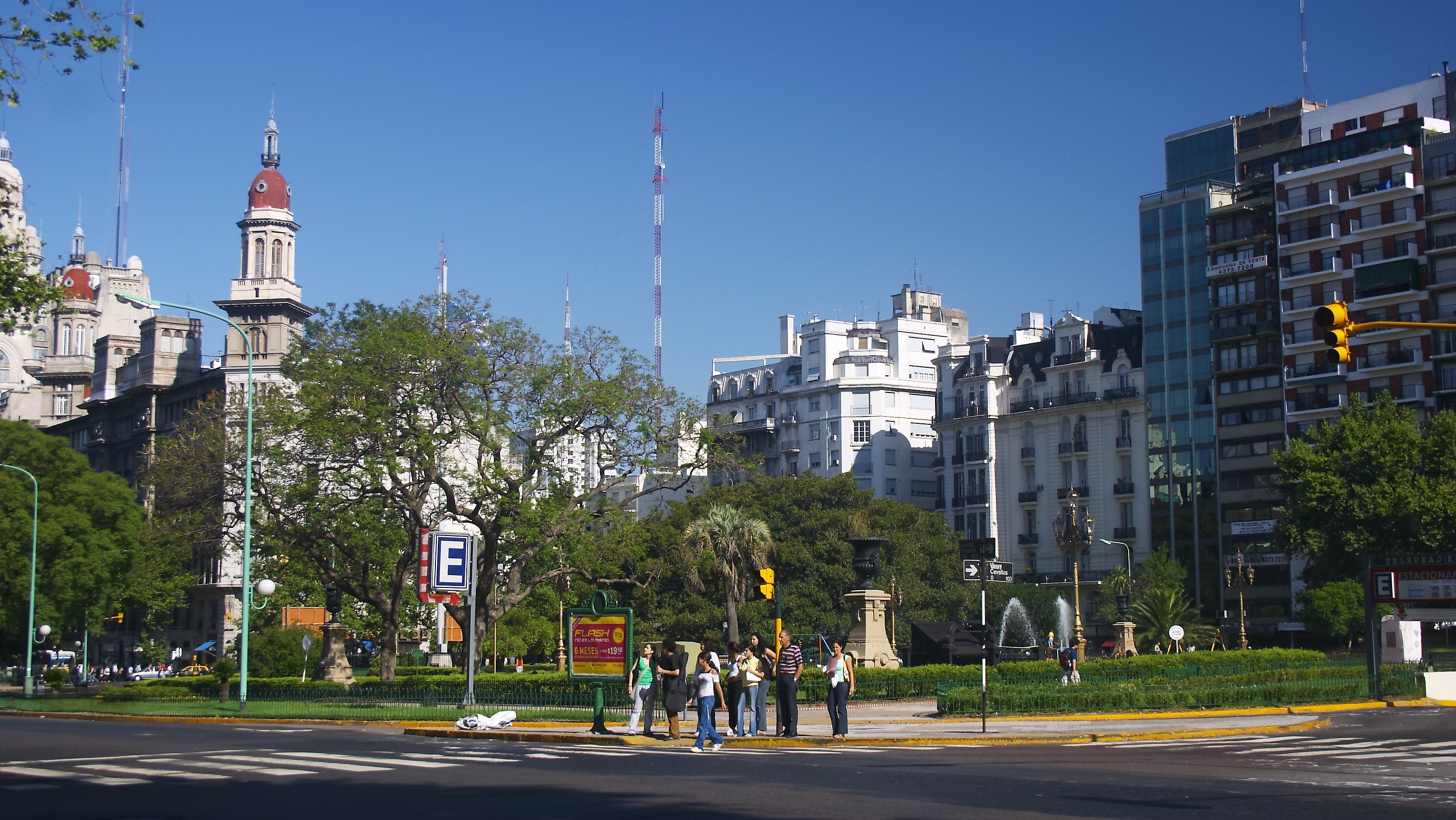
.jpg)
Avenida de Mayo runs through the Monserrat district, connecting Plaza de Mayo and the Plaza de los Dos Congresos (Congressional Plaza).
A block, or two, south of the Plaza de Mayo, the older section of Monserrat begins. This is Buenos Aires' oldest neighborhood and even today, very little of the cityscape there is less than a hundred years old (except along Belgrano Avenue), thereby making a nearly seamless transition to the likewise historic San Telmo district, to the south.
History
The Monserrat area traces its origins to the foundation of Buenos Aires itself, when, in 1580, Spanish Adelantado Juan de Garay disembarked on the area's shores. The Fort of Juan Baltazar of Austria, the marginal settlement's first, was built in 1594 and, in 1608, newly arrived Jesuits were granted a 2-hectare (5 acre) lot, nearby. The Jesuits began work on the Saint Ignatius Church in 1686. Consecrated in 1734, it is the oldest existing church in Buenos Aires. Possessing the finest school and library at the time and offering colonial Buenos Aires' only truly classical education there, their property became popularly known as the "Illuminated Block." The small city's growing population led to the introduction of a number of other religious orders in this area, notably the Catalan Brotherhood of the Virgin of Montserrat, whose chapel became the neighborhood namesake in 1769. The Cabildo (City hall) became the scene of the 1810 pronouncements in favor of autonomy that later led to independence and, to commemorate the fact, in 1811 the iconic May Pyramid was placed in what later became the Plaza de Mayo.
Little changed over the next seventy years, Monserrat's muddy shore and typically colonial grid of cobblestone streets came under a rapid modernization following Argentina's sudden economic development after 1875. Land reclamation and the creation of docks parallel to the area led to the construction of Paseo Colón (still a major thoroughfare) along Monserrat's eastern edge. The area's two adjoining squares became the Plaza de Mayo in 1884, a milestone joined by the completion of the presidential executive building, the Casa Rosada. This was followed by the massive razing of colonial architecture (including part of the Cabildo) to make way for the Avenida de Mayo, opened in 1894 and Congressional Plaza, in 1910. The avenue became home to the Buenos Aires Metro's first stations, in 1913.
The area's led central location and its presence therein of much of Argentina's governmental structure led to monumental construction over the next twenty years, notable among which are the Buenos Aires City Legislature, the Customs building, the offices of La Prensa (today the Buenos Aires House of Culture), the art-deco NH City Hotel (off the Plaza de Mayo), the Ministry of Defense and South Diagonal Avenue. Monserrat's western half was partitioned from the rest by the southward expansion of the massive Nueve de Julio Avenue around 1950 and, partial to trendy high-rises, much of Monserrat's middle class and commercial office space market left, afterwards. The area became a largely bohemian quarter popular with tango performers and artists, as well as many who preferred the area's close proximity to the growing financial district to the north and its relatively low rent scale. Its rich architectural history and quaint, narrow streets have, as in neighboring San Telmo, helped lead to renewed interest in Monserrat since around 1990, a change highlighted by the 1993 opening of the high-rise InterContinental Hotel. The area's numerous Spanish restaurants and social clubs belonging to Buenos Aires' large Spaniard community have long associated Monserrat with local Spanish tradition, helping make it attractive to tourism for cultural reasons, as well as those of ambiance.
Among its historic buildings is the house where Viceroy Santiago Liniers lived. This historical site is known by the name of Casa de Liniers, and is located on the street Venezuela 469. Another of the historical sites is the Iglesia Presbiteriana San Andrés, a Presbyterian church located on Belgrano Avenue.
Gallery
File:Buenos Aires Subte station Peru.jpg|Vintage entrance to subte Line A of the Buenos Aires Metro on Avenida de Mayo; behind it, City Hall File:Buenos Aires - Monserrat - Avenida de Mayo entre Piedras y Chacabuco - 200807a.jpg|Architectural contrasts on the Avenida de Mayo File:Sin ochava en Monserrat, Chacabuco e Hipólito Yrigoyen.jpg|Typical vintage corner in Monserrat File:Plaza de Mayo Casa Rosada fuentes pirámide palmera.jpg|Eastward view of the Plaza de Mayo and Casa Rosada File:Manzana_de_las_Luces_vista_desde_arriba.jpg|The Jesuit Temple of St. Ignatius and the colonial Illuminated Block File:Edificio-libertador.JPG|The Ministry of Defense, the Libertador Building File:FachadaMCBA.JPG|City Historical Museum File:Buenos_Aires_-Mausoleo_de_Belgrano-Convento_de_Santo_Domingo-_20051212.jpg|Tomb of Argentine patriot Manuel Belgrano at the Santo Domingo Convent File:Palacio Barolo.JPG|Palacio Barolo File:Diagonal Sur.jpg|Corner of South Diagonal and Belgrano Avenues File:Buenos Aires - Monumento a Mariano Moreno.jpg|Monument to Mariano Moreno File:Buenos Aires - Monserrat - Edificio Otto Wulf - 200604.jpg|Otto Wulff Building, Belgrano Avenue File:Perú y Rivadavia esq SO.jpg|Corner of Florida Street and Rivadavia Avenue File:Cuartel de Policía - Buenos Aires.JPG|Buenos Aires Police Headquarters File:Buenos Aires - Avenida de Mayo - Teatro Avenida.jpg|Avenida Theatre
Notes
References
References
- Spanish]]) by [http://ambito.com ámbito.com] August 29, 2011
- "Map of Monserrat – City Government of Buenos Aires".
- "Montserrat".
- (22 April 2014). "Venezuela 469 (Casa del Virrey Liniers)". Centro de Arqueología Urbana.
- (18 September 2018). "Mil y una curiosidades de Buenos Aires". Diego Zigiotto.

This article was imported from Wikipedia and is available under the Creative Commons Attribution-ShareAlike 4.0 License. Content has been adapted to SurfDoc format. Original contributors can be found on the article history page.
Ask Mako anything about Monserrat, Buenos Aires — get instant answers, deeper analysis, and related topics.
Research with MakoFree with your Surf account
Create a free account to save articles, ask Mako questions, and organize your research.
Sign up freeThis content may have been generated or modified by AI. CloudSurf Software LLC is not responsible for the accuracy, completeness, or reliability of AI-generated content. Always verify important information from primary sources.
Report