From Surf Wiki (app.surf) — the open knowledge base
Monoamine neurotransmitter
Monoamine that acts as a neurotransmitter or neuromodulator
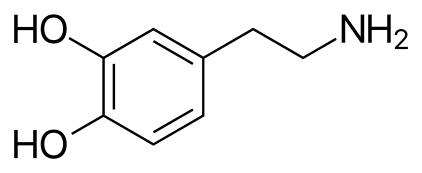
Monoamine that acts as a neurotransmitter or neuromodulator


Monoamine neurotransmitters are neurotransmitters and neuromodulators that contain one amino group connected to an aromatic ring by a two-carbon chain (such as -CH2-CH2-). Examples are dopamine, norepinephrine and serotonin.
All monoamines are derived from aromatic amino acids like phenylalanine, tyrosine, and tryptophan by the action of aromatic amino acid decarboxylase enzymes. They are deactivated in the body by the enzymes known as monoamine oxidases which clip off the amine group.
Monoaminergic systems, i.e., the networks of neurons that use monoamine neurotransmitters, are involved in the regulation of processes such as emotion, arousal, and certain types of memory. It has also been found that monoamine neurotransmitters play an important role in the secretion and production of neurotrophin-3 by astrocytes, a chemical which maintains neuron integrity and provides neurons with trophic support.
Drugs used to increase or reduce the effect of monoamine neurotransmitters are used to treat patients with psychiatric and neurological disorders, including depression, anxiety, schizophrenia and Parkinson's disease.
Examples
;Classical monoamines
- Imidazoleamines:
- Histamine
- Catecholamines:
- Adrenaline (Ad; Epinephrine, Epi)
- Dopamine (DA)
- Noradrenaline (NAd; Norepinephrine, NE)
- Indolamines:
- Serotonin (5-HT)
- Melatonin (MT)
;Trace amines:
Specific transporter proteins called monoamine transporters that transport monoamines in or out of a cell exist. These are the dopamine transporter (DAT), serotonin transporter (SERT), and the norepinephrine transporter (NET) in the outer cell membrane and the vesicular monoamine transporter (VMAT1 and VMAT2) in the membrane of intracellular vesicles.
After release into the synaptic cleft, monoamine neurotransmitter action is ended by reuptake into the presynaptic terminal. There, they can be repackaged into synaptic vesicles or degraded by the enzyme monoamine oxidase (MAO), which is a target of monoamine oxidase inhibitors, a class of antidepressants.
Evolution

Monoamine neurotransmitter systems occur in virtually all vertebrates, where the evolvability of these systems has served to promote the adaptability of vertebrate species to different environments.{{cite journal | vauthors = Vincent JD, Cardinaud B, Vernier P | title = [Evolution of monoamine receptors and the origin of motivational and emotional systems in vertebrates] | language = fr | journal = Bulletin de l'Académie Nationale de Médecine | volume = 182 | issue = 7 | pages = 1505–14; discussion 1515–6 | year = 1998 | pmid = 9916344 | quote = These data suggest that a D1/beta receptor gene duplication was required to elaborate novel catecholamine psychomotor adaptive responses and that a noradrenergic system specifically emerged at the origin of vertebrate evolution.
A recent computational investigation of genetic origins shows that the earliest development of monoamines occurred 650 million years ago and that the appearance of these chemicals, necessary for active or participatory awareness and engagement with the environment, coincides with the emergence of bilaterian or "mirror" body in the midst of (or perhaps in some sense catalytic of?) the Cambrian Explosion.
References
References
- (2010). "Regulatory role of monoamine neurotransmitters in astrocytic NT-3 synthesis". International Journal of Developmental Neuroscience.
- (2011). "The monoamine neurotransmitter disorders: An expanding range of neurological syndromes". The Lancet Neurology.
- (November 2008). "A glial variant of the vesicular monoamine transporter is required to store histamine in the Drosophila visual system". PLOS Genet..
- (2003). "Evolution and cell biology of dopamine receptors in vertebrates". Biology of the Cell.
- (2023-06-06). "The monoaminergic system is a bilaterian innovation". Nature Communications.
This article was imported from Wikipedia and is available under the Creative Commons Attribution-ShareAlike 4.0 License. Content has been adapted to SurfDoc format. Original contributors can be found on the article history page.
Ask Mako anything about Monoamine neurotransmitter — get instant answers, deeper analysis, and related topics.
Research with MakoFree with your Surf account
Create a free account to save articles, ask Mako questions, and organize your research.
Sign up freeThis content may have been generated or modified by AI. CloudSurf Software LLC is not responsible for the accuracy, completeness, or reliability of AI-generated content. Always verify important information from primary sources.
Report