From Surf Wiki (app.surf) — the open knowledge base
Mongolian barbecue
Stir-fried dish
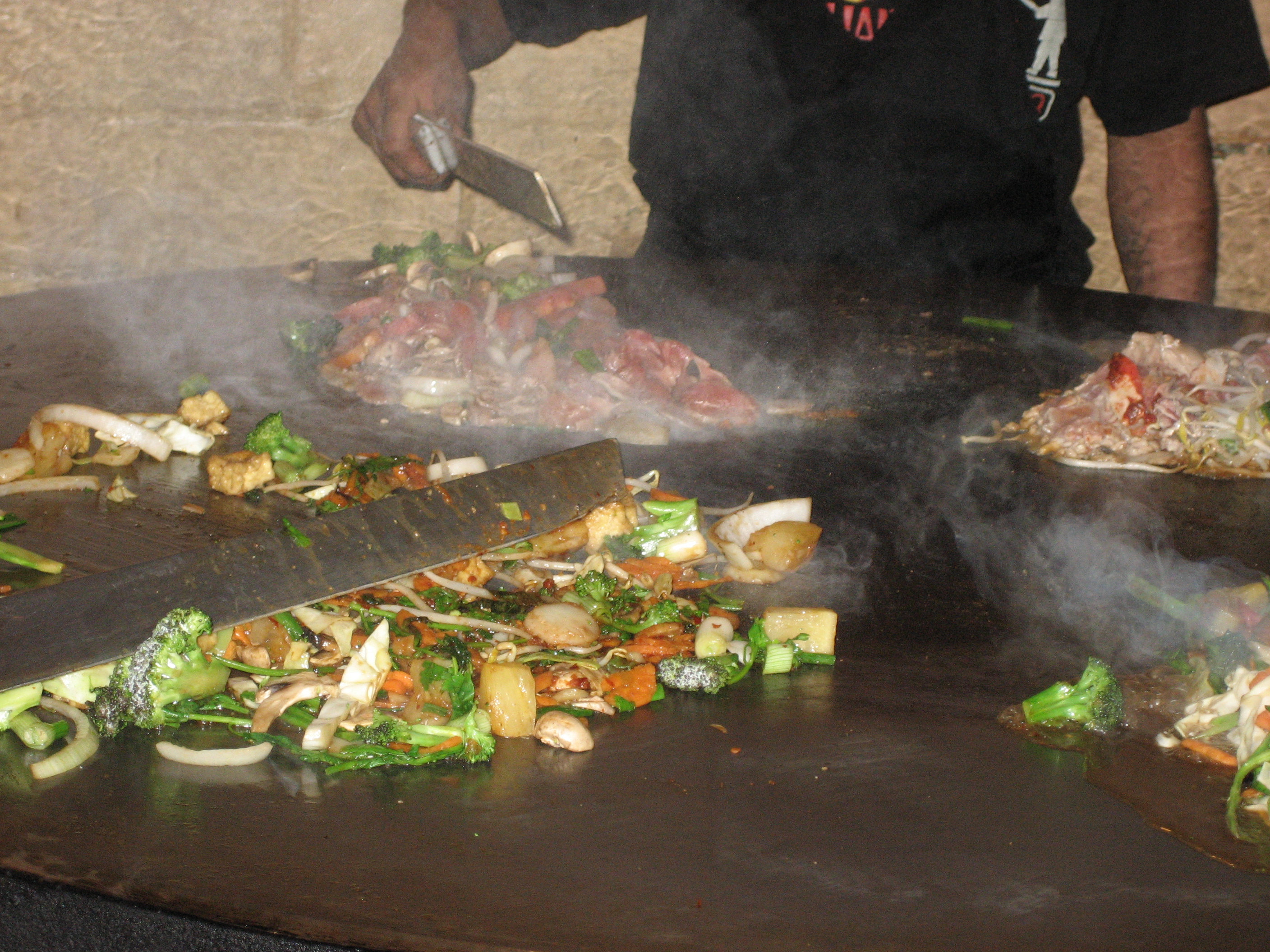
Stir-fried dish
Mongolian barbecue () is a method of preparing stir-fried noodle dishes. and an upside-down wok was, in 1979, used to cook the dish in Taiwanese establishments. It has more in common with Teppanyaki.
Origin
.png)
Mongolian barbecue was created by Wu Zhaonan, a Taiwanese comedian and restaurateur originally from Beijing, who fled to Taiwan after the outbreak of the Chinese Civil War, and opened a street food stall in , Downtown Taipei in 1951. While he initially wished to name the dish "Peking barbecue" after his hometown, due to political sensitivity associated with the city which had been recently designated as the capital of the People's Republic of China, the name "Mongolian barbecue" was chosen instead.
Wu's food stall attracted a wide clientele including diplomats and wealthy businesspeople despite serving a relatively cheap and unsophisticated dish; however, it was later destroyed by flooding originating from a typhoon during which Wu almost drowned. He was later able to develop a highly successful career as a comedian and left the restaurant business. Numerous imitators emerged to capitalize on the popularity of the dish he created, including Genghis Khan, Tang Palace, Great Khan, and Heavenly Khan. The dish was later successfully introduced outside Taiwan.
Preparation
Typically, diners select a variety of raw ingredients from a display of sliced meat (such as beef, pork, lamb, turkey, chicken, and shrimp) and vegetables (such as cabbage, tofu, onion, broccoli, and mushrooms). The bowl of ingredients is handed to the chef who then adds the diner's choice of sauce and is transferred to a grill.
The circular shape of the grill allows two or more chefs to cook food simultaneously and quickly and the food is typically prepared as the grill is revolved around. Oil or water may be added while the ingredients are stir-fried continuously over the high heat with the food items remaining intact.
Some American chains place the food on different parts of the round grill separated by a special wedge shaper. Each dish is stirred in its turn, as the operator walks around the outside of the grill and turns each individual's food in succession.
When cooking is complete, each finished dish is scooped into a bowl and handed to the diner. Many Mongolian barbecue restaurants follow an all-you-can-eat buffet format, allowing multiple visits to the grill.
References
References
- Calta, Marialisa. (March 2025}} The kind of grill used to cook it is in the shape of a circle,{{Cite news). "AT THE NATION'S TABLE; Appleton, Wis.". The New York Times.
- Schwabe, Calvin W.. (1979). "Unmentionable Cuisine". University of Virginia Press.
- Chang, Eddy. (2018-11-01). "Ceremony to be held honoring late crosstalk master Wu Zhao-nan". Taipei Times.
- (24 July 2014). "Restaurant review: Genghis Khan Mongolian Bar-B-Q". Taipei Times.
- Liang Fengrong 梁峰榮. (13 December 2012). "呷台灣/吳兆南發明的蒙古烤肉 蒙古吃不到".
This article was imported from Wikipedia and is available under the Creative Commons Attribution-ShareAlike 4.0 License. Content has been adapted to SurfDoc format. Original contributors can be found on the article history page.
Ask Mako anything about Mongolian barbecue — get instant answers, deeper analysis, and related topics.
Research with MakoFree with your Surf account
Create a free account to save articles, ask Mako questions, and organize your research.
Sign up freeThis content may have been generated or modified by AI. CloudSurf Software LLC is not responsible for the accuracy, completeness, or reliability of AI-generated content. Always verify important information from primary sources.
Report