From Surf Wiki (app.surf) — the open knowledge base
Military budget of the United States
Yearly spending of the United States military
Yearly spending of the United States military
The military budget of the United States is the largest portion of the discretionary federal budget allocated to the Department of Defense (DoD), or more broadly, the portion of the budget that goes to any military-related expenditures. It pays the salaries, training, and health care of uniformed and civilian personnel, maintains arms, equipment and facilities, funds operations, and develops and buys new items. The budget funds six branches of the US military: the Army, Navy, Marine Corps, Coast Guard, Air Force, and Space Force. Critics contend that recent U.S. defense budgets have disproportionately invested in long-term developmental programs instead of producing weapons systems needed in the near term.
Budget for FY2026
As of May 2, 2025, the U.S. Department of Defense's (DoD) fiscal year 2026 (FY2026) budget request was $892.6 billion, maintaining near-flat nominal growth compared to FY2025 levels.
On 11 June 2025, the House Armed Services Committee advanced the FY2026 National Defense Authorization Act (NDAA), proposing a total authorization of $925 billion, including $878.7 billion specifically for the Department of Defense. Debate in Congress focused on aligning resources to counter rising threats, particularly in the Indo-Pacific region, while balancing domestic fiscal pressures.
The overall budget requested by the US military department was $961.6 billion, which included $197.4 billion for the Department of the Army, $292.2 billion for the Department of the Navy, $301.1 billion for the Department of the Air Force and $170.9 billion for defence wide expenditure. Furthermore, the budget was divided into the various military agencies — (values in $billion) (values in $billion)
Budget for FY2025
fy2025BudgetRequest As of 11 March 2024 the US Department of Defense fiscal year 2025 (FY2025) budget request was $849.8billion. On 20 December 2024 the House approved a Continuing Resolution to fund DoD and DoE operations at the FY2024 levels until 14 March 2025, at which time the Appropriations process for the NDAA is to be revisited by the 119th Congress. On 21 December 2024 the Senate approved the Continuing Resolution for President Biden's signature into law.
Budget for FY2024
fy2024BudgetRequest As of 10 March 2023 the fiscal year 2024 (FY2024) presidential budget request was $842billion. In January 2023 Treasury Secretary Janet Yellen announced the US government would hit its $31.4trillion debt ceiling on 19 January 2023; the date on which the US government would no longer be able to use extraordinary measures such as issuance of Treasury securities is estimated to be in June 2023.Victor Reklaitis (17 January 2023) U.S. to hit debt limit Thursday: Here's what that means
- Committee for a Responsible Federal Budget (28 Oct 2022) Q&A: Everything You Should Know About the Debt Ceiling
- Stephen Collinson (18 Jan 2023) Russia's war in Ukraine reaches a critical moment in power projection in light of the 2022 Russian invasion of Ukraine On 3 June 2023, the debt ceiling was suspended until 2025. The $886billion National Defense Authorization Act is facing reconciliation of the House and Senate bills after passing both houses 27 July 2023; the conferees have to be chosen, next. As of September 2023, a Continuing resolution is needed to prevent a Government shutdown.Bryant Harris (13 Sep 2023) Freedom Caucus derails Pentagon spending bill, foreshadowing shutdown 30 Sep 2023 is looming date for shutdown.
- Sahil Kapur (18 Sep 2023) Far-right Republicans drafted a short-term funding bill with GOP centrists. It’s now at risk of collapse. A shutdown was avoided on 30 September for 45 days (until 17 November 2023), with passage of the NDAA on 14 December 2023. The Senate will next undertake negotiations on supplemental spending for 2024. A government shutdown was averted on 23 March 2024 with the signing of a $1.2 trillion bill to cover FY2024.
Budget for FY2023
fy2023BudgetRequest , the defense department was operating under a continuing resolution, which constrains spending even though DoD has to respond to world events, such as the 2022 Russian invasion of Ukraine; the FY2023 defense budget request will exceed $773billion, according to the chairman of the House Armed Services Committee. By 9 March 2022 a bipartisan agreement on a $782billion defense budget had been reached (as part of an overall $1.5trillion budget for FY2022thus avoiding a government shutdown).
As of 4 April 2022 the FY2023 presidential budget request of $773billion included $177.5billion for the Army, $194billion for the Air Force and Space Force, and $230.8billion for the Navy and Marine Corps (up 4.1% from FY2022 request). As of 12 December 2022 the House and Senate versions of the FY2023 National Defense Authorization Act (FY2023 NDAA) were to be $839billion, and $847billion, for the HASC, and SASC respectively, for a compromise $857.9billion top line. By 16 December 2022 the current budget extension resolution will have expired. The President signed the FY2023 Appropriations bill on 23 December 2022.
US military spending in 2021 reached $801billion per year according to the Stockholm International Peace Research Institute.
Budget for FY2022
In May 2021, the President's defense budget request for FY2022 was $715billion, up $10billion from the $705billion FY2021 request. The total FY2022 defense budget request, including the Department of Energy, was $753billion, up $12billion from FY2021's request. On 22 July 2021 the Senate Armed Services Committee approved a budget $25billion greater than the President's request. The National Defense Authorization Act, budgeting $740billion for defense, was signed 27 December 2021.
By military department, the Army's portion of the budget request, $173billion, dropped $3.6billion from the enacted FY2021 budget; the Department of the Navy's portion of the budget request, $211.7billion, rose 1.8% from the enacted FY2021 budget, largely due to a 6% increase for the Marine Corps' restructuring into a littoral combat force (Navy request: $163.9billion, or just 0.6% over FY2021, Marine Corps request: $47.9billion, a 6.2% increase over FY2021); the Air Force's $156.3billion request for FY2022 is a 2.3% increase over FY2021 enacted budget; the Space Force budget of $17.4billion is a 13.1% increase over FY2021 enacted budget. Overseas contingency operations (OCOs) are now replaced by "direct war and enduring costs", which are now migrated into the budget. After the release of the FY2022 budget requests to Congress, the military departments also posted their Unfunded priorities/requirements lists for the Congressional Armed Services Committees.
Budget for FY2021
For FY2021, the Department of Defense's discretionary budget authority was approximately $705.39billion ($705,390,000,000). Mandatory spending of $10.77billion, the Department of Energy and defense-related spending of $37.335billion added up to the total FY2021 Defense budget of $753.5billion. FY2021 was the last year for OCOs as shown by the troop withdrawal from Afghanistan. Research, Development, Test, and Evaluation (RDT&E) investments for the future are offset by the OCO cuts, and by reduced procurement of legacy materiel.(June 27, 2014) FY 2015 DoD Overseas Contingency Operations (OCO) Budget Amendment
- (Mar 2015) OCO 2016
- (Feb 2016) OCO 2017
- (May 2017) OCO 2018
Budget summary for FY2021 with projections for FY2022–2025
(Expenditures listed in millions of dollars)
| Function and subfunction | FY2019 total | FY2020 | FY2021 | FY2022 total | FY2023 total | FY2024 total | FY2025 total | Base | OCO | Emergency | Total | Base | OCO | Total |
|---|---|---|---|---|---|---|---|---|---|---|---|---|---|---|
| **051 - DoD discretionary** | ||||||||||||||
| Military personnel (no MERHFC) | 141,851 | 142,446 | 4,486 | 146,932 | 150,524 | 4,603 | 155,126 | 158,117 | 162,796 | 167,495 | 171,897 | |||
| Operation and maintenance | 281,801 | 234,885 | 53,735 | 977 | 289,597 | 230,352 | 58,569 | 288,921 | 279,501 | 282,530 | 296,585 | 301,993 | ||
| Procurement | 146,533 | 131,734 | 11,590 | 431 | 143,754 | 131,756 | 5,128 | 136,884 | 137,746 | 149,108 | 157,060 | 161,930 | ||
| RDT&E | 95,304 | 103,520 | 834 | 130 | 104,485 | 106,225 | 331 | 106,555 | 104,839 | 101,821 | 100,254 | 99,961 | ||
| Revolving and management funds | 1,873 | 1,564 | 20 | 234 | 1,818 | 1,349 | 20 | 1,369 | 1,347 | 1,358 | 1,381 | 1,410 | ||
| DoD bill (no MERHFC) | 667,362 | 614,149 | 70,665 | 1,772 | 686,586 | 620,206 | 68,651 | 688,855 | 681,550 | 697,613 | 722,775 | 737,191 | ||
| Medicare-eligible retiree health fund contribution (MERHFC) | 7,533 | 7,817 | 7,817 | 8,373 | 8,373 | 8,819 | 9,270 | 9,752 | 10,255 | |||||
| DoD bill with MERHFC | 674,895 | 621,966 | 70,665 | 1,772 | 694,403 | 628,579 | 68,651 | 697,228 | 690,369 | 706,883 | 732,527 | 747,446 | ||
| Military construction | 11,332 | 9,850 | 645 | 6,229 | 16,723 | 6,462 | 350 | 6,812 | 10,036 | 8,623 | 8,379 | 9,233 | ||
| Family housing | 1,565 | 1,465 | 1,465 | 1,351 | 1,351 | 1,497 | 1,556 | 1,649 | 1,655 | |||||
| Military construction bill | 12,897 | 11,315 | 645 | 6,229 | 18,188 | 7,813 | 350 | 8,163 | 11,533 | 10,179 | 10,028 | 10,888 | ||
| Allowances | 38 | |||||||||||||
| Outyears placeholder for OCO | 20,000 | 20,000 | 10,000 | 10,000 | ||||||||||
| **051 - Total DoD discretionary (DoD record)** | **687,830** | **633,281** | **71,310** | **8,000** | **712,591** | **636,392** | **69,000** | **705,392** | **721,902** | **737,063** | **752,555** | **768,334** | ||
| Scoring and rounding | 22 | 5 | ||||||||||||
| **051 - Total DoD discretionary (OMB record)** | **687,852** | **712,596** | **705,392** | **721,902** | **737,063** | **752,555** | **768,334** | |||||||
| **051 - DoD mandatory** | ||||||||||||||
| Military personnel | 7,909 | 8,505 | 10,605 | 10,898 | 11,136 | 11,389 | 11,628 | |||||||
| Operation and maintenance | 1,328 | 997 | 1,368 | 1,184 | 1,154 | 1,173 | 1,193 | |||||||
| Procurement | 266 | 252 | 289 | |||||||||||
| RDT&E | 230 | 240 | 153 | |||||||||||
| Revolving and management funds | 16,742 | |||||||||||||
| DoD bill | 26,475 | 9,994 | 12,415 | 12,082 | 12,290 | 12,562 | 12,821 | |||||||
| Military construction | ||||||||||||||
| Family housing | 39 | 36 | ||||||||||||
| Military construction bill | 39 | 36 | ||||||||||||
| Trust funds | 442 | 755 | 484 | 530 | 615 | 230 | 229 | |||||||
| Offsetting receipts | -2,194 | -1,753 | -2,043 | -1,922 | -1,892 | -1,912 | -1,933 | |||||||
| Interfund transactions | -46 | -91 | -86 | -83 | -79 | -77 | -74 | |||||||
| **051 - Total DoD mandatory (DoD record)** | **24,716** | **8,941** | **10,770** | **10,608** | **10,934** | **10,804** | **11,044** | |||||||
| Scoring and rounding | 2 | 7 | 5 | 309 | 200 | 115 | 41 | |||||||
| **051 - Total DoD mandatory (OMB record)** | **24,718** | **8,948** | **10,775** | **10,917** | **11,134** | **10,919** | **11,085** |
Budget for FY2020
For fiscal year 2020 (FY2020), the Department of Defense's budget authority was approximately $721.5billion ($721,531,000,000). Approximately $712.6billion is discretionary spending with approximately $8.9billion in mandatory spending. The Department of Defense estimates that $689.6billion ($689,585,000,000) will actually be spent (outlays). Both central right-wing and right-wing commentators have advocated for the cutting of military spending.
Budget for FY2019
For FY2019, the Department of Defense's budget authority was $693,058,000,000 (including discretionary and mandatory budget authority).
Budget request for FY2019
In February 2018, the Pentagon requested $686billion for FY2019.
The John S. McCain National Defense Authorization Act authorized Department of Defense appropriations for 2019 and established policies, but it did not contain the budget itself. On 26 July, this bill passed in the House of Representatives by 359–54. On 1 August, the US Senate passed it by 87–10. The bill was presented to President Trump two days later. He signed it on 13 August.
On 28 September 2018, Trump signed the Department of Defense appropriations bill. The approved 2019 Department of Defense discretionary budget was $686.1billion. It has also been described as "$617billion for the base budget and another $69billion for war funding."
Total overview
| (Discretionary budget authority) + OCO + emergency (combined) | FY2019 | DoD total | $693,058 |
|---|---|---|---|
| Military personnel (without MERHFC) | $143,198 | ||
| Operations and maintenance | $278,803 | ||
| Procurement | $147,287 | ||
| Research, Development, Test, and Evaluation | $95,253 | ||
| Revolving and management funds | $1,656 | ||
| **Defense bill (without MERHFC)** | **$666,197** | ||
| Medicare-eligible retiree health fund contribution (MERHFC) | $7,533 | ||
| **Department of Defense bill + MERHFC** | **$673,730** | ||
| Military construction | $9,688 | ||
| Family housing | $1,565 | ||
| **Military construction bill** | $11,253 | ||
| **Total base + OCO + emergency (DoD record)** | **$684,985** | ||
| **Total DoD mandatory (DoD record)** | $8,073 |
For personnel payment and benefits
Personnel payment and benefits take up approximately 39.14% of the total budget of $686,074,048,000.
| Pay and benefits funding | FY2019 |
|---|---|
| Military personnel appropriations | $140.7 |
| Medicare-eligible retiree health care accruals | $7.5 |
| Defense health program | $34.2 |
| DoD Education Activity | $3.4 |
| Family housing | $1.6 |
| Commissary subsidy | $1.3 |
| Other benefit programs | $3.4 |
| **Military pay and benefits** | **$192.0** |
| **Civilian pay and benefits** | **$76.4** |
| **Total pay and benefits** | **$268.5** |
By overseas contingency operation
Overseas contingency operations (OCO) funds are sometimes called war funds.
| Operation/activity | FY2019 |
|---|---|
| Operation Freedom's Sentinel (OFS) and related missions | $46.3 |
| Operation Inherent Resolve (OIR) and related missions | $15.3 |
| European Deterrence Initiative (EDI) | $6.5 |
| Security cooperation | $0.9 |
| **Grand total** | **$69.0** |
By military department
| Discretionary budget authority | FY2019 |
|---|---|
| Department of the Army | $182 |
| Department of the Navy (including Marines) | $194.1 |
| Department of the Air Force | $194.2 |
| Defense-wide | $115.8 |
Military health care funding
| Program | FY2019 |
|---|---|
| Defense health (DHP) | $33.7 |
| Military personnel | $8.9 |
| Military construction | $0.4 |
| Health care accrual | $7.5 |
| **Unified medical budget** | **$50.6** |
| *Treasury receipts for current Medicare-eligible retirees* | *$11.1* |
The MHS offers, but does not always provide, a health care benefit to 9.5 million eligible beneficiaries, which includes active military members and their families, military retirees and their families, dependent survivors, and certain eligible reserve component members and their families. The unified medical budget (UMB), which comprises the funding and personnel needed to support the MHS' mission, consumes nearly 9% of the department's topline budget authority. Thus, it is a significant line item in the department's financial portfolio.
Budgeting terms
Budget authority: the authority to legally incur binding obligations (like signing contracts and placing orders), that will result in current and future outlays. When "military budget" is mentioned, people generally are referring to discretionary budget authority.
Outlays: Also known as expenditures or disbursements, it is the liquidation of obligations and general represent cash payments.
Total obligational authority: DoD financial term expressing the value of the direct defense program for a given fiscal year, exclusive of the obligation authority from other sources (such as reimbursable orders accepted)
Discretionary: Annually appropriated by Congress, subject to budget caps.
Mandatory: budget authority authorized by permanent law.
Previous budgets
As of 2013, the Department of Defense was the third largest executive branch department and utilized 20% of the federal budget.
For the 2011 fiscal year, the president's base budget for the Department of Defense and spending on overseas contingency operations totaled $664.84billion.
When the budget was signed into law on 28 October 2009, the final size of the Department of Defense's budget was $680billion, $16billion more than President Obama had requested. An additional $37billion supplemental bill to support the wars in Iraq and Afghanistan was expected to pass in the spring of 2010, but has been delayed by the House of Representatives after passing the Senate.
Emergency and supplemental spending
The military operations in Iraq and Afghanistan were largely funded through supplementary spending bills that supplemented the annual military budget requests for each fiscal year. However, the wars in Iraq and Afghanistan were categorized as overseas contingency operations beginning in fiscal year 2010, and the budget is included in the federal budget.
By the end of 2008, the US had spent approximately $900billion in direct costs on the wars in Iraq and Afghanistan. The government also incurred indirect costs, which include interests on additional debt and incremental costs, financed by the Veterans Affairs Department, of caring for more than 33,000 wounded. Some experts estimate the indirect costs will eventually exceed the direct costs. As of June 2011, the total cost of the wars was approximately $1.3trillion.
By title

The federally budgeted (see below) military expenditure of the Department of Defense for fiscal year 2013 is as follows. While data is provided from the 2015 budget, data for 2014 and 2015 is estimated, and thus data is shown for the last year for which definite data exists (2013).
| Components | Funding | Change, 2012 to 2013 |
|---|---|---|
| Operations and maintenance | $258.277billion | −9.9% |
| Military personnel | $153.531billion | −3.0% |
| Procurement | $97.757billion | −17.4% |
| Research, Development, Testing & Evaluation | $63.347billion | −12.1% |
| Military construction | $8.069billion | −29.0% |
| Family housing | $1.483billion | −12.2% |
| Other miscellaneous costs | $2.775billion | −59.5% |
| Atomic energy defense activities | $17.424billion | −4.8% |
| Defense-related activities | $7.433billion | −3.8% |
| **Total spending** | **$610.096billion** | **−10.5%** |
By entity
| Entity | 2010 budget request | Percentage | Notes |
|---|---|---|---|
| Army | $244.8billion | 31.8% | |
| Navy | $142.2billion | 23.4% | Excluding Marine Corps |
| Air Force | $170.6billion | 22% | |
| Defense-wide joint activities | $118.7billion | 15.5% | |
| Marine Corps | $11.0 billion | 4% | Total budget allotted from the Department of the Navy |
| Defense Intelligence | $80.1billion | 3.3% | *Because of its classified nature, this budget item is an estimate and may not be the actual figure* |
Programs spending more than $1.5 billion
The Department of Defense's FY2011 $137.5billion procurement and $77.2billion RDT&E budget requests included several programs worth more than $1.5billion.
| Program | url=https://web.archive.org/web/20120121002254/http://comptroller.defense.gov/defbudget/fy2012/FY2012_Weapons.pdf | date=21 January 2012}} | Change, 2010 to 2011 |
|---|---|---|---|
| F-35 Joint Strike Fighter | $11.4billion | +2.1% | |
| Missile Defense Agency (THAAD, Aegis, GMD, PAC-3) | $9.9billion | +7.3% | |
| Virginia class submarine | $5.4billion | +28.0% | |
| Brigade combat team Modernization | $3.2billion | +21.8% | |
| DDG 51 Burke-class Aegis destroyer | $3.0billion | +19.6% | |
| P–8A Poseidon | $2.9billion | −1.6% | |
| V-22 Osprey | $2.8billion | −6.5% | |
| Carrier replacement program | $2.7billion | +95.8% | |
| F/A-18E/F Hornet | $2.0billion | +17.4% | |
| Predator and Reaper unmanned aerial system | $1.9billion | +57.8% | |
| Littoral combat ship | $1.8billion | +12.5% | |
| CVN Refueling and Complex Overhaul | $1.7billion | −6.0% | |
| Chemical demilitarization | $1.6billion | −7.0% | |
| RQ-4 Global Hawk | $1.5billion | +6.7% | |
| Space-Based Infrared System | $1.5billion | +54.0% |
Other military-related expenditures
This does not include many military-related items that are outside of the Defense Department budget, such as nuclear weapons research, maintenance, cleanup, and production, which are in the Atomic Energy Defense Activities section, Veterans Affairs, the Treasury Department's payments in pensions to military retirees and widows and their families, interest on debt incurred in past wars, or State Department financing of foreign arms sales and militarily-related development assistance. Neither does it include defense spending that is domestic rather than international in nature, such as the Department of Homeland Security, counter-terrorism spending by the Federal Bureau of Investigation, and intelligence-gathering spending by NSA, although these programs contain certain weapons, military and security components.
Accounting for non DoD military-related expenditure gives a total budget in excess of $1.4 trillion.
Budget request for FY2018
On 16 March 2017 President Trump submitted his request to Congress for $639billion in military spending (an increase of $54billion, 10% for FY2018, as well as $30billion for FY2017, which ends in September). With a total federal budget of $3.9trillion for FY2018, the increase in military spending would result in deep cuts to many other federal agencies and domestic programs, as well as the State Department. Trump had pledged to "rebuild" the military as part of his 2016 presidential campaign.
In April 2017, journalist Scot J. Paltrow raised concerns about the increase in spending with the Pentagon's history of "faulty accounting".
On 14 July, the National Defense Authorization Act 2018 was passed by the US House of Representatives 34481, with 8 not voting. 60% of Democrats voted for the bill, which represented an 18% increase in defense spending. Congress increased the budget to total $696billion.
Budget request for FY2017

The currently available budget request for 2017 was filed on 9 February 2016, under then-President Barack Obama.
The press release of the proposal specifies the structure and goals for the FY2017 budget:
The FY2017 budget reflects recent strategic threats and changes that have taken place in Asia, the Middle East and Europe. Russian aggression, terrorism by the Islamic State of Iraq and the Levant (ISIL) and others, and China's island building and claims of sovereignty in international waters all necessitate changes in our strategic outlook and in our operational commitments. Threats and actions originating in Iran and North Korea negatively affect our interests and our allies. These challenges have sharpened the focus of our planning and budgeting.
The proposal also includes a comparison of the 2016 and the proposed 2017 request amounts, a summary of acquisitions requested for 2017 and enacted in 2016, and provides in detail a breakdown of specific programs to be funded.
Investments
| FY2016 enacted | FY2017 request | Change |
|---|---|---|
| Aircraft and related systems | 50.6 | 45.3 |
| C4I systems | 7.1 | 7.4 |
| Ground systems | 9.9 | 9.8 |
| Missile defense programs | 9.1 | 8.5 |
| Missiles and munitions | 12.7 | 13.9 |
| Mission support | 52.9 | 52.4 |
| Science & technology (S&T) | 13.0 | 12.5 |
| Shipbuilding and maritime systems | 27.5 | 27.0 |
| Space-based systems | 7.0 | 7.1 |
| Rescissions | −1.8 | - |
| Total | 188 | 183.9 |
Amounts are in billions of dollars.
Major acquisition programs
These are the top 25 DoD weapon programs described in detail. Quantity refers to the number of items requested:
| FY2016 | FY2017 |
|---|---|
| Quantity | |
| Aircraft | |
| F-35 | Joint Strike Fighter |
| KC-46A | Tanker |
| P-8A | Poseidon |
| V-22 | Osprey |
| E-2D AHE | Advanced Hawkeye |
| AH-64E | Apache helicopter |
| C/HC/MC-130J | Hercules |
| UH-60 | Black Hawk helicopter |
| CH-53K | King Stallion helicopter |
| MQ-4C | Triton |
| H-1 Upgrades | Bell helicopter |
| NGJ | Next Generation Jammer increment 1 |
| CH-47F | Chinook helicopter |
| Missile defense/missiles | |
| BMDS | Ballistic missile defense |
| Trident II | Trident II missile modifications |
| AMRAAM | Advanced Medium Range Air to Air Missile |
| Ships | |
| SSN 774 | Virginia submarine |
| DDG 51 | Aegis destroyer |
| CVN 78 | Ford aircraft carrier |
| ORR | Ohio replacement |
| LHA-6 | Amphibious assault ship |
| LCS | Littoral combat ship |
| Space | |
| AEHF | Advanced Extremely High Frequency satellite |
| EELV | Evolved Expendable Launch Vehicle |
| Trucks | |
| JLTV | Joint Light Tactical Vehicle |
Science and technology program
This program's purpose is to "invest in and develop capabilities that advance the technical superiority of the US military to counter new and emerging threats." It has a budget of $12.5billion, but is separate from the overall Research, Development, Test, and Evaluation portfolio, which comprises $71.8billion. Efforts funded apply to the Obama administration's refocusing of the US military to Asia, identifying investments to "sustain and advance [the] DoD's military dominance for the 21st century", counter the "technological advances of US foes", and support Manufacturing Initiative institutes. A breakdown of the amounts provided, by tier of research, is provided:
| Program | FY2016 request | FY2016 enacted | FY2017 request | Change (FY16 enacted − FY17 request) |
|---|---|---|---|---|
| Basic research | 2.1 | 2.3 | 2.1 | −0.2 |
| Applied research | 4.7 | 5.0 | 4.8 | −0.2 |
| Advanced technology development | 5.5 | 5.7 | 5.6 | −0.1 |
| **Total** | **12.3** | **13.0** | **12.5** | **-0.5** |
Total budget by department
| Total budget | FY2016 enacted | FY2017 request | Change |
|---|---|---|---|
| Army | 146,928,044 | 148,033,950 | +1,105,906 |
| Navy | 168,786,798 | 164,861,078 | -3,925,720 |
| Air Force | 161,783,330 | 166,879,239 | +5,095,909 |
| Defense-wide | 102,801,512 | 102,927,320 | +125,808 |
| **Total** | **580,299,684** | **582,701,587** | **+2,401,903** |
Amounts in thousands of dollars
Total budget by component
| Total budget | FY2016 enacted | FY2017 request | Change |
|---|---|---|---|
| Military personnel | 138,552,886 | 138,831,498 | +278,612 |
| Operation and maintenance | 244,434,932 | 250,894,310 | +6,459,378 |
| Procurement | 118,866,320 | 112,081,088 | -6,785,232 |
| Research, Development, Test, and Evaluation | 69,009,764 | 71,765,940 | +2,756,176 |
| Revolving and management funds | 1,264,782 | 1,512,246 | +247,464 |
| Military construction | 6,909,712 | 6,296,653 | -613,059 |
| Family housing | 1,261,288 | 1,319,852 | +58,564 |
| **Total** | **580,299,684** | **582,701,587** | **+2,401,903** |
Amounts in thousands of dollars
Funding of payments and benefits
This portion of the military budget comprises roughly one third to one half of the total defense budget, considering only military personnel or additionally including civilian personnel, respectively. These expenditures will typically be, the single largest expense category for the department. Since 2001, military pay and benefits have increased by 85%, but remained roughly one third of the total budget due to an overall increased budget. Military pay remains at about the 70th percentile compared to the private sector to attract sufficient amounts of qualified personnel.
| Military pay and benefits funding | FY2016 enacted | FY2017 request |
|---|---|---|
| Military personnel appropriations | 128.7 | 128.9 |
| Medicare-eligible retiree health care accruals | 6.6 | 6.4 |
| Defense health program | 32.9 | 33.8 |
| DoD Education Activity | 3.1 | 2.9 |
| Family housing | 1.3 | 1.3 |
| Commissary subsidy | 1.4 | 1.2 |
| Other benefit programs | 3.5 | 3.4 |
| Military pay and benefits funding | 177.5 | 177.9 |
| Civilian pay and benefits funding | 71.8 | 72.9 |
| **Total pay and benefits funding** | **249.3** | **250.8** |
| DoD base budget authority | 521.7 | 523.9 |
| Military pay and benefits as % of budget | 34.0% | 34.0% |
| **Total pay and benefits as % of budget** | **47.8%** | **47.9%** |
Funding the military health system
The request for 2017 amounts to $48.8billion. The system has 9.4 million beneficiaries, including active, retired, and eligible reserve component military personnel and their families, and dependent survivors.
| Program | FY2017 request |
|---|---|
| Defense health (DHP) | 33.5 |
| Military personnel | 8.6 |
| Military construction | 0.3 |
| Health care accrual | 6.4 |
| **Unified medical budget** | **48.8** |
Budget for 2016
On 9 February 2016, the Department of Defense under President Obama released a statement outlining the proposed 2016 and 2017 defense spending budgets that "[reflect] the priorities necessary for our force today and in the future to best serve and protect our nation in a rapidly changing security environment."
| Components | Dollars in billions |
|---|---|
| Military personnel | 138.6 |
| Operation and maintenance | 244.4 |
| Procurement | 118.9 |
| RDT&E | 69.0 |
| Revolving and management funds | 1.3 |
| Military construction | 6.9 |
| Family housing | 1.3 |
| **Total** | **580.3** |
| Departments | Dollars in billions |
|---|---|
| Army | 146.9 |
| Navy | 168.8 |
| Air Force | 161.8 |
| Defense-wide | 102.8 |
| **Total** | **580.3** |
Audit of 2011 budget
Again in 2011, the Government Accountability Office (GAO) could not "render an opinion on the 2011 consolidated financial statements of the federal government", with a major obstacle again being "serious financial management problems at the Department of Defense (DOD) that made its financial statements unauditable".
In December 2011, the GAO found that "neither the Navy nor the Marine Corps have implemented effective processes for reconciling their FBWT." According to the GAO, "An agency's FBWT account is similar in concept to a corporate bank account. The difference is that instead of a cash balance, FBWT represents unexpended spending authority in appropriations." In addition, "As of April 2011, there were more than $22billion unmatched disbursements and collections affecting more than 10,000 lines of accounting."
Audit of implementation of budget for 2010
The GAO was unable to provide an audit opinion on the 2010 financial statements of the US Government due to "widespread material internal control weaknesses, significant uncertainties, and other limitations." The GAO cited as the principal obstacle to its provision of an audit opinion "serious financial management problems at the Department of Defense that made its financial statements unauditable".
In FY2010, six out of thirty-three DoD reporting entities received unqualified audit opinions.
Robert F. Hale, Chief Financial Officer and Under Secretary of Defense, acknowledged enterprise-wide problems with systems and processes, while the DoD's Inspector General reported "material internal control weaknesses... that affect the safeguarding of assets, proper use of funds, and impair the prevention and identification of fraud, waste, and abuse". Further management discussion in the FY2010 DoD Financial Report states "it is not feasible to deploy a vast number of accountants to manually reconcile our books" and concludes that "although the financial statements are not auditable for FY2010, the Department's financial managers are meeting warfighter needs".
Budget by year
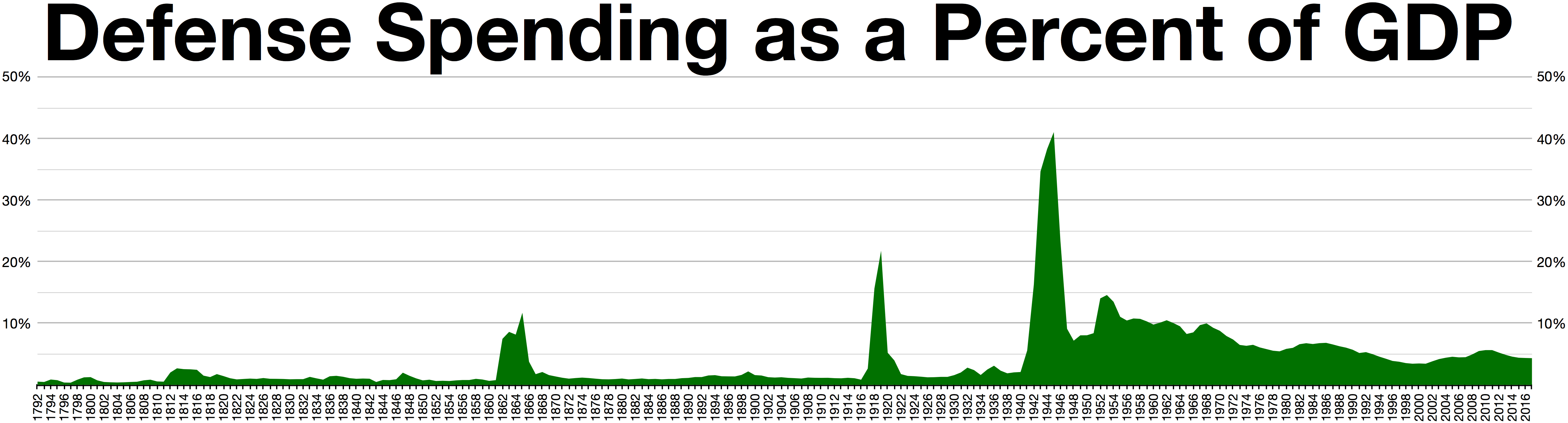

The accompanying graphs show that US military spending as a percent of gross domestic product (GDP) peaked during World War II.
The table shows historical spending on defense from 1993 to 2025. The defense budget is shown in billions of dollars and total budget in trillions of dollars. The percentage of the total US federal budget spent on defense is indicated in the third row, and change in defense spending from the previous year in the final row.
| Historical defense spending 1993–2025 | Year | Defense budget (billions) | Total budget (trillions) | Defense budget % | Defense spending % change |
|---|---|---|---|---|---|
| 2025 | $962 | $7.00 | 13.7 | +0.8 | |
| 2024 | $910 | $7.05 | 12.9 | -0.8 | |
| 2023 | $905 | $6.56 | 13.7 | +1.0 | |
| 2022 | $838 | $6.58 | 12.7 | +2.1 | |
| 2021 | $759 | $7.14 | 10.6 | +0.6 | |
| 2020 | $774 | $7.73 | 10.0 | -5.8 | |
| 2019 | $745 | $4.70 | 15.8 | -0.4 | |
| 2018 | $726 | $4.46 | 16.2 | +0.4 | |
| 2017 | $656 | $4.15 | 15.8 | -0.7 | |
| 2016 | $624 | $3.97 | 16.5 | +0.7 | |
| 2015 | $598 | $3.77 | 15.8 | -1.4 | |
| 2014 | $622 | $3.61 | 17.2 | -0.3 | |
| 2013 | $610 | $3.48 | 17.5 | −1.6 | |
| 2012 | $681 | $3.58 | 19.1 | −1.3 | |
| 2011 | $717 | $3.51 | 20.4 | −0.3 | |
| 2010 | $721 | $3.48 | 20.7 | +3.6 | |
| 2009 | $698 | $4.08 | 17.1 | -3.8 | |
| 2008 | $696 | $3.32 | 20.9 | +1.0 | |
| 2007 | $625 | $2.86 | 21.9 | +1.9 | |
| 2006 | $556 | $2.78 | 20.0 | +0.4 | |
| 2005 | $506 | $2.58 | 19.6 | -0.8 | |
| 2004 | $491 | $2.41 | 20.4 | +0.3 | |
| 2003 | $456 | $2.27 | 20.1 | +2.8 | |
| 2002 | $362 | $2.09 | 17.3 | +0.2 | |
| 2001 | $335 | $1.96 | 17.1 | +0.4 | |
| 2000 | $304 | $1.82 | 16.7 | +0.3 | |
| 1999 | $292 | $1.78 | 16.4 | +0.4 | |
| 1998 | $271 | $1.69 | 16.0 | -0.5 | |
| 1997 | $270 | $1.64 | 16.5 | -0.3 | |
| 1996 | $266 | $1.58 | 16.8 | −3.5 | |
| 1995 | $272 | $1.34 | 20.3 | +0.5 | |
| 1994 | $308 | $1.55 | 19.8 | -0.5 | |
| 1993 | $316 | $1.55 | 20.3 | 0.0 |
Support service contractors
Main article: Defense contractor
The role of support service contractors has increased since 2001 and in 2007 payments for contractor services exceeded investments in equipment for the armed forces for the first time. In the 2010 budget, the support service contractors will be reduced from the current 39 percent of the workforce down to the pre-2001 level of 26 percent. In a Pentagon review of January 2011, service contractors were found to be "increasingly unaffordable."
Military budget and total federal spending

The Department of Defense budget accounted in FY2017 for about 14.8% of federal budgeted expenditures. According to the Congressional Budget Office, defense spending grew 9% annually on average in fiscal years 2000–2009.
Because of constitutional limitations, military funding is appropriated in a discretionary spending account. (Such accounts permit government planners to have more flexibility to change spending each year, as opposed to mandatory spending accounts that mandate spending on programs in accordance with the law, outside of the budgetary process.) In recent years, discretionary spending as a whole has amounted to about one-third of total federal outlays. Department of Defense spending's share of discretionary spending was 50.5% in 2003, and has risen to between 53% and 54% in recent years.
For FY2017, Department of Defense spending amounts to 3.42% of GDP. Because the US GDP has grown over time, the military budget can rise in absolute terms while shrinking as a percentage of the GDP. For example, the Department of Defense budget was slated to be $664billion in 2010 (including the cost of operations in Iraq and Afghanistan previously funded through supplementary budget legislation), higher than at any other point in American history, but still 1.1–1.4% lower as a percentage of GDP than the amount spent on military during the peak of Cold-War military spending in the late 1980s. Admiral Mike Mullen, former Chairman of the Joint Chiefs of Staff, has called four percent an "absolute floor". This calculation does not take into account some other military-related non-DoD spending, such as Veterans Affairs, Homeland Security, and interest paid on debt incurred in past wars, which has increased even as a percentage of the national GDP.
In 2015, Pentagon and related spending totaled $598billion.
In addition, the US will spend at least $179billion over the fiscal years of 2010–2018 on its nuclear arsenal, averaging $20billion per year. Despite President Barack Obama's attempts in the media to reduce the scope of the current nuclear arms race, the US intends to spend an additional $1trillion over the next 30 years modernizing its nuclear arsenal.
In September 2017 the Senate followed President Donald Trump's plan to expand military spending, which will boost spending to $700billion, about 91.4% of which will be spent on maintaining the armed forces and primary Pentagon costs. Military spending is increasing regularly and more money is being spent every year on employee pay, operation and maintenance, and benefits including health benefits. Methods to counteract rapidly increasing spending include shutting down bases, but that was banned by the Bipartisan Budget Act of 2013.
Independent analysis of military budget as part of federal spending
War Resisters League (WRL) has been publishing yearly (since 2001 or earlier) federal budget breakdowns which show that military-related spending is a much larger part of the US federal budget than typically reported by official sources. For example, for FY2024, WRL claims that military-related spending makes up 43% of the US budget.
Federal waste
As of September 2014, the Department of Defense was estimated to have "$857 million in excess parts and supplies". This figure has risen over the past years, and of the Pentagon waste that has been calculated, two figures are especially worth mentioning: the expenditure of "$150 million on private villas for a handful of Pentagon employees in Afghanistan and the procurement of the JLENS air-defense balloon" which, throughout the program's development over the past two decades, is estimated to have cost $2.7billion.
Comparison with other countries

The US spends more on national defense than China, India, Russia, Saudi Arabia, France, Germany, United Kingdom, Japan, South Korea, and Brazil combined. The 2018 US military budget accounts for approximately 36% of global arms spending (for comparison, US GDP is only 24% of global GDP). The 2018 budget is approximately 2.5 times larger than the $250billion military budget of China. The US and its close allies are responsible for two-thirds to three-quarters of the world's military spending (of which, in turn, the US is responsible for the majority). The US also maintains the largest number of military bases on foreign soil in the world. While there are no freestanding foreign bases permanently located in the US, there are now around 800 US bases in foreign countries. Military spending makes up nearly 16% of entire federal spending and approximately half of discretionary spending. In a general sense discretionary spending (defense and non-defense spending) makes up one-third of the annual federal budget.
In 2016, the US spent 3.29% of its GDP on its military (considering only basic Department of Defense budget spending), more than France's 2.26% and less than Saudi Arabia's 9.85%. This is historically low for the US since it peaked in 1944 at 37.8% of GDP (it reached the lowest point of 3.0% in 1999–2001). Even during the peak of the Vietnam War the percentage reached a high of 9.4% in 1968.
In 2018, the US spent 3.2% of its GDP on its military, while Saudi Arabia spent 8.8%, Israel spent 4.3%, Pakistan spent 4.0%, Russia spent 3.9%, South Korea spent 2.6%, China spent 1.9%, United Kingdom spent 1.8%, and Germany spent 1.2% of its GDP on defense.
The US military's budget has plateaued in 2009, but is still considerably larger than any other military power.
Past commentary on military budget
In 2009 Robert Gates, then Secretary of Defense, wrote that the US should adjust its priorities and spending to address the changing nature of threats in the world: "What all these potential adversaries—from terrorist cells to rogue nations to rising powers—have in common is that they have learned that it is unwise to confront the United States directly on conventional military terms. The United States cannot take its current dominance for granted and needs to invest in the programs, platforms, and personnel that will ensure that dominance's persistence. But it is also important to keep some perspective. As much as the US Navy has shrunk since the end of the Cold War, for example, in terms of tonnage, its battle fleet is still larger than the next 13 navies combined—and 11 of those 13 navies are US allies or partners." Secretary Gates announced some of his budget recommendations in April 2009.
According to a 2009 Congressional Research Service report there was a discrepancy between a budget that is declining as a percentage of GDP while the responsibilities of the DoD have not decreased and additional pressures on the military budget have arisen due to broader missions in the post-9/11 world, dramatic increases in personnel and operating costs, and new requirements resulting from wartime lessons in the Iraq War and Operation Enduring Freedom.
Expenses for fiscal years 2001 through 2010 were analyzed by Russell Rumbaugh, a retired Army officer and ex-CIA military analyst, in a report for the Stimson Center. Rumbaugh wrote: "Between 1981 and 1990, the Air Force bought 2,063 fighters. In contrast, between 2001 and 2010, it bought only 220. Yet between 2001 and 2010 the Air Force spent $38B of procurement funding just on fighter aircraft in inflation-adjusted dollars, compared with the $68B it spent between 1981 and 1990. In other words, the Air Force spent 55 percent as much money to get 10 percent as many fighters." As Adam Weinstein explained one of the report's findings: "Of the roughly $1trillion spent on gadgetry since 9/11, 22 percent of it came from supplemental war fundingannual outlays that are voted on separately from the regular defense budget."
Most of the $5billion in budget cuts for 2013 that were mandated by Congress in 2012 really only shifted expenses from the general military budget to the Afghanistan war budget. Declaring that nearly 65,000 troops were temporary rather than part of the permanent forces resulted in the reallocation of $4billion in existing expenses to this different budget.

In May 2012, as part of Obama's East Asia "pivot", his 2013 national military request moved funding from the Army and Marines to favor the Navy, but Congress has resisted this.
Reports emerged in February 2014 that Secretary of Defense Chuck Hagel was planning to trim the defense budget by billions of dollars. The secretary in his first defense budget planned to limit pay rises, increase fees for healthcare benefits, freeze the pay of senior officers, reduce military housing allowances, and reduce the size of the force.
In July 2014, American Enterprise Institute scholar Michael Auslin opined in the National Review that the Air Force needs to be fully funded as a priority, due to the air superiority, global airlift, and long-range strike capabilities it provides.
In January 2015, the Defense Department published its internal study on how to save $125billion on its military budget from 2016 to 2020 by renegotiating vendor contracts and pushing for stronger deals, and by offering workers early retirement and retraining.
2012 fiscal cliff
On 5 December 2012, the Department of Defense announced it was planning for automatic spending cuts, which include $500billion and an additional $487billion due to the 2011 Budget Control Act, due to the fiscal cliff. According to Politico, the Department of Defense declined to explain to the House of Representatives Appropriations Committee, which controls federal spending, what its plans were regarding the fiscal cliff planning.
This was after half a dozen members of Congress very experienced in military matters either resigned from Congress or lost their reelection fights, including Joe Lieberman (I-CT).
Lawrence Korb has noted that given recent trends military entitlements and personnel costs will take up the entire defense budget by 2039.
GAO audits
The GAO was unable to provide an audit opinion on the 2010 financial statements of the US government due to "widespread material internal control weaknesses, significant uncertainties, and other limitations." The GAO cited as the principal obstacle to its provision of an audit opinion "serious financial management problems at the Department of Defense that made its financial statements unauditable."
In FY2011, seven out of 33 DoD reporting entities received unqualified audit opinions. Under Secretary of Defense Robert F. Hale acknowledged enterprise-wide weaknesses with controls and systems. Further management discussion in the FY2011 DoD Financial Report states "we are not able to deploy the vast numbers of accountants that would be required to reconcile our books manually". Congress has established a deadline of FY2017 for the DoD to achieve audit readiness.
For FYs 1998–2010 the Department of Defense's financial statements were either unauditable or such that no audit opinion could be expressed. Several years behind other government agencies, the first results from an army of about 2,400 contracted DoD auditors were expected on 15 November 2018.
Post–World War II overview and reform
Post–World War II
The conclusion of World War II and the start of the Cold War prompted the rapid expansion of an arms race. Subsequently, the reallocation of budgets, prompted by several wars and proxy wars forced the Department of Defense to increase research and development of new military systems and equipment to proliferate on a mass scale to compete with, at the time, the Soviet Union. On 17 January 1961, then-President Dwight D. Eisenhower in a farewell address to the US warned the people and government about the creation of a "military-industrial complex". As prompted by President Eisenhower, the war had arguably become an industry. It was also speculated by Eisenhower that the arms industry would bring war-like industrial influence into the various sectors of government. He stated: "In the councils of government, we must guard against the acquisition of unwarranted influence, whether sought or unsought, by the military-industrial complex. The potential for the disastrous rise of misplaced power exists and will persist."
Following the departure of President Eisenhower, the expenditures and budgets of the US military grew exponentially. The Cold War (19471991) developed the largest proliferation of a nuclear arsenal to date. New defense contractors stood up to supply the demand for the military and its various conflicts across the globe. In addition, the Vietnam War was the largest expenditure during the Cold War at approximately $168billion or about $1trillion in today's inflated costs.
In a statement of 6 January 2011, Defense Secretary Robert M. Gates stated: "This department simply cannot risk continuing down the same pathwhere our investment priorities, bureaucratic habits and lax attitude towards costs are increasingly divorced from the real threats of today, the growing perils of tomorrow and the nation's grim financial outlook." Gates has proposed a budget that, if approved by Congress, would reduce the costs of many DoD programs and policies, including reports, the IT infrastructure, fuel, weapon programs, DoD bureaucracies, and personnel.
The 2015 expenditure for Army research, development and acquisition changed from $32billion projected in 2012 for FY2015, to $21billion for FY2015 expected in 2014.
In 2018, it was announced that the Department of Defense was the subject of a comprehensive budgetary audit. This review was conducted by private, third-party accounting consultants. The audit ended and was deemed incomplete due to deficient accounting practices in the department.
In FY2022, the US had the largest defense budget and expenditures of any other country in the world totaling around $777.1billion. The rise in the military budget over the last decade can be traced to the production of new technologies such as a 5th generation fighter aircraft to meet the increase in demand for new combat capabilities. Many of these costs were the result of R&D, or research and development. Research and development is one of the US's primary focuses in the defense budget.
Opponents of growing military spending budgets have long argued that the US should refocus and reallocate the military budgets to promote social welfare. However, the projections for the near future are that the defense budget and its expenditures are only going to continue to grow exponentially. In the published FY2022 budget report, the authority has been given to increase the defense budget by about $17billion ($535billion of which is a part of contract obligations) from FY2021. In addition, the Biden administration has proposed another increase of the FY2023 budget to $737billion. On the contrary, proponents of increasing the US Defense budgets have long argued that factors such as China and other adversaries of the US must be kept in check (from a military standpoint).
References
Notes
Citations
References
- (2025-10-21). "Stuck in the Cul-de-Sac: How U.S. Defense Spending Prioritizes Innvoation Over Deterrence". CNAS.
- (2025-10-21). "Stuck in the Cul-de-Sac: How U.S. Defense Spending Prioritizes Innovation over Deterrence". CNAS.
- "2026 NDAA Executive Summary".
- "Defense budget overview".
- US Department of Defense [https://www.war.gov/News/Releases/Release/Article/3703410/department-of-defense-releases-the-presidents-fiscal-year-2025-defense-budget/ (11 March 2024) Department of Defense Releases the President's Fiscal Year 2025 Defense Budget]
- DoD Comptroller [https://comptroller.war.gov/Budget-Materials/Budget2025/ (March 2024) Mar 2024 Budget]
- C. Todd Lopez, DOD News [https://www.war.gov/News/Releases/Release/Article/3703410/department-of-defense-releases-the-presidents-fiscal-year-2025-defense-budget/ (8 May 2024) Austin: FY 2025 Budget Includes 'Tough, But Responsible' Decisions]
- United States House of Representatives In Congress Assembled [https://docs.house.gov/billsthisweek/20241216/CR.pdf (17 December 2024) Continuing Resolution] Further Continuing Appropriations and Disaster Relief Supplemental Appropriations Act, 2025
- Katie Lobosco and Tami Luhby, CNN [https://us.cnn.com/2024/12/18/politics/government-funding-bill-congress-explainer/index.html (21 Dec 2024) Here’s what’s in and out of the government funding agreement]
- Ashley Roque [https://breakingdefense.com/2023/03/white-house-requests-842-billion-to-fund-pentagon-in-2024/ (10 March 2023) White House requests $842 billion to fund Pentagon in 2024] PPBE "request to Congress includes $6{{nbspbillion to support Ukraine, NATO, and other European partner states, and $9.1{{nbspbillion for DoD's Pacific Deterrence Initiative".
- Marcus Weisgerber [https://www.defenseone.com/policy/2023/03/heres-everything-we-know-about-pentagons-2024-budget-proposal/383892/ (13 Mar 2023) The Pentagon's 2024 Budget Proposal, In Short] "The spending plan includes $315{{nbspbillion to develop and buy new weapons". "$300 million in security assistance" for Ukraine.
- Marcus Weisgerber [https://www.defenseone.com/policy/2023/03/bidens-842b-pentagon-budget-proposal-would-boost-new-weapons/383820/ (9 March 2023) Biden's $842B Pentagon Budget Proposal Would Boost New Weapons]
- Justin Katz [https://breakingdefense.com/2023/03/us-indo-pacific-command-seeks-15-3-billion-in-new-independent-budget-request/ (9 March 2023) US Indo-Pacific Command seeks $15.3 billion in new, independent budget request] $4{{nbspbillion more than FY23 request
- Courtney Albon [https://www.defensenews.com/pentagon/2023/03/11/white-house-asks-for-11-billion-more-for-navy-marine-corps-spending/ (11 March 2023) White House asks for $11 billion more for Navy, Marine Corps spending]
- Department of the Air Force [https://www.saffm.hq.af.mil/FM-Resources/Budget/Air-Force-Presidents-Budget-FY24/ (April 2023) Air Force President's Budget FY24] request is $215.1{{nbspbillion dollars, a $9.3B or 4.5% increase over the FY23 enacted amount
- Jen Judson [https://www.defensenews.com/land/2023/04/19/army-warns-it-could-lose-53-billion-if-congress-fails-to-pass-budget/ (19 Apr 2023) Army warns it could lose $5.3 billion if Congress fails to pass budget] before a Continuing Resolution occurs
- Jim Tankersley, Catie Edmondson and Luke Broadwater ''[[The New York Times]]'' [https://www.nytimes.com/2023/05/27/us/politics/debt-ceiling-deal.html (27 May 2023) White House and G.O.P. Strike Debt Limit Deal to Avert Default]
- Nicola Slawson [https://www.theguardian.com/us-news/2023/jun/02/first-thing-us-debt-ceiling-deal-passes-senate-averting-catastrophic-federal-default (2 Jun 2023) First Thing: US debt ceiling deal passes Senate, averting catastrophic federal default ]
- (2023-01-20). "U.S. hits debt ceiling as partisan standoff sparks economic worries". Reuters.
- Dorn, Sara. "Biden Signs Debt Ceiling Bill Into Law—Lifts Borrowing Limit Until 2025".
- Katz, Justin. (2023-07-28). "Ducking the culture wars, Senate passes NDAA 86-11".
- (2023-07-02). "The Pentagon policy bill's next big stumbling block: Kevin McCarthy".
- Harris, Bryant. (2023-06-23). "Senate defense bill pushes for spending over debt ceiling cap".
- Reuters [https://www.reuters.com/world/us/us-house-republicans-look-restart-spending-agenda-with-defense-vote-2023-09-21/ (21 Sep 2023) Shutdown looms as US House Republicans again block own spending bill]
- Reuters [https://www.reuters.com/world/us/us-house-republicans-look-restart-spending-agenda-with-defense-vote-2023-09-21/ (21 Sep 2023) US government shutdown: What closes, what stays open?] See [[Government shutdowns in the United States]]
- Alexandra Hutzler and Nadine El-Bawab [https://abcnews.go.com/Politics/live-updates/government-shutdown-live-updates/?id=103597144 (30 Sep 2023) Government shutdown live updates: House passes 45-day stopgap spending bill]
- Clare Foran, Haley Talbot, Morgan Rimmer, Annie Grayer, Lauren Fox and Melanie Zanona, CNN [https://www.cnn.com/2023/09/30/politics/us-government-shutdown-latest/index.html (30 Sep 2023) Congress passes stopgap bill to avert shutdown ahead of midnight deadline]
- Rebecca Kheel [https://www.military.com/daily-news/2023/11/15/congress-has-plan-avert-shutdown-its-about-make-pentagon-budgeting-even-more-complicated.html (15 Nov 2023) Congress Has Plan to Avert Shutdown, But It's About to Make Pentagon Budgeting Even More Complicated]
- Leo Shane III [https://www.militarytimes.com/news/pentagon-congress/2023/12/04/defense-authorization-deal-expected-this-week/ (3 Dec 2023) Defense authorization deal expected this week]
- Patricia Zengerle [https://www.reuters.com/world/us/us-lawmakers-introduce-sweeping-defense-bill-drop-most-culture-war-issues-2023-12-07/ (7 Dec 2023) US lawmakers introduce sweeping defense bill, drop most 'culture war' issues]; Patricia Zengerle [https://www.reuters.com/world/us/majority-us-senate-backs-mammoth-defense-policy-bill-voting-continues-2023-12-14/ (13 Dec 2023) US Senate passes mammoth defense policy bill, next up vote in House] Bill is nearly 3100 pages, for $886 billion NDAA passed Senate 87-13 ; Bryant Harris [https://www.defensenews.com/congress/2023/12/14/congress-passed-the-fy24-defense-policy-bill-heres-whats-inside/ (14 Dec 2023) Congress passed the FY24 defense policy bill: Here's what's inside] passed House 310-118;
- BURGESS EVERETT, ANTHONY ADRAGNA and JENNIFER HABERKORN [https://www.politico.com/news/2023/12/14/schumer-sinema-ukraine-border-deal-00131838 (14 Dec 2024) Sinema 'can see the deal' on Ukraine-border as Schumer cuts recess]
- Sumanti Sen [https://www.hindustantimes.com/world-news/us-news/us-government-shutdown-congressional-leaders-sign-1-66-trillion-government-funding-deal-101704687727129.html (8 Jan 2024) US government shutdown: Congressional leaders sign $1.66 trillion government funding deal] $1,659 billion= $886.3 billion for defense, $772.7 billion for non-defense
- Clare Foran [https://www.cnn.com/2024/03/23/politics/biden-government-funding-bill-congress/index.html (23 Mar 2024) Biden signs government funding bill]
- Carl Hulse [https://www.nytimes.com/2024/01/18/us/politics/senate-spending-bill.html (18 Jan 2024) Congress Clears Stopgap Spending Bill for Biden, Moving to Avert Shutdown]
- Zhou, Li. (2022-02-17). "Congress's short-term funding bills are a terrible way to govern".
- (2022-03-02). "The Ukraine invasion shows why America needs to get its defense budget in order".
- Gould, Joe. (2023-03-03). "Army to seek multiyear munitions buys in next budget".
- Skove, Sam. (2023-03-03). "A Lack of Machine Tools Is Holding Back Ammo Production, Army Says".
- Jacqueline Feldscher and Marcus Weisgerber [https://www.defenseone.com/policy/2022/03/russias-invasion-will-boost-2023-defense-budget-top-democrat-says/362737/ (3 Mar 2022) Russia's Invasion Will Boost 2023 Defense Budget, Top Democrat Says; Rep. Adam Smith: Putin's war "fundamentally altered what our national security posture" needs to be.] The president's FY2023 budget request will be in excess of $773{{nbspbillion
- Fram, Alan. (2022-03-09). "Top lawmakers reach deal on Ukraine aid, $1.5T spending".
- (28 March 2022). "Army releases fiscal year 2023 presidential budget request".
- Eversden, Andrew. (2022-03-28). "Army's $177.5B budget request will 'maintain' momentum on modernization, but cuts vehicle buys".
- (2022-03-28). "Department of the Air Force budget proposal focuses on transformation, modernization".
- (2022-03-28). "Navy Officials Hold a Press Briefing on FY23 Navy Budget, March 28, 2022".
- Mehta, Aaron. (2022-12-07). "Compromise NDAA released with $857.9 billion topline".
- III, Leo Shane. (2022-11-28). "SecDef tells Congress to get a military budget done already".
- Hadley, Greg. (2022-12-24). "Just in Time for Christmas, Congress OKs $858B Defense Bill".
- Maucione, Scott. (2021-05-28). "DoD budget largely flat, cuts legacy systems for modernization".
- [https://comptroller.war.gov/Portals/45/Documents/defbudget/fy2021/FY21_Green_Book.pdf Office of the Under Secretary of Defense (Comptroller) comptroller.defense.gov National Defense Budget Estimates for FY 2021] Green book, 308 pp., cf. Table 1-1 National Defense Budget{{SndLong Range Forecast
- Clark, Colin. (2021-07-22). "SASC Adds $25 Billion To NDAA In Bipartisan Vote".
- Greenwalt, Bill. (2021-12-13). "New defense budget commission could be last hope for fixing DoD spending".
- Brendan W. McGarry, CRS [https://crsreports.congress.gov/product/pdf/R/R47178/3 (11 Jul 2022) DOD Planning, Programming, Budgeting, and Execution (PPBE): Overview and Selected Issues for Congress] R47178 —describes PPBE's role in DoD Acquisition
- Losey, Stephen. (2021-12-27). "Biden signs $740B defense policy bill to overhaul sexual assault prosecutions, review Afghan war".
- McLeary, Paul. (2021-05-28). "Biden's Budget Cuts Ships, Planes, But Huge Boost in R&D".
- Gould, Joe. (2021-06-03). "Eyeing China, Biden defense budget boosts research and cuts procurement".
- Eversden, Andrew. (2021-05-28). "Pentagon wants to spend big on joint war-fighting systems".
- Jr, Sydney J. Freedberg. (2021-05-28). "Army Modernization Budget Drops $4.2B; Budget Drops $3.6B Overall".
- Judson, Jen. (2021-07-23). "Senate authorizers want to fund the Army's entire wish list".
- [https://www.asafm.army.mil/Portals/72/Documents/BudgetMaterial/2021/pbr/Overview%20and%20Highlights/Army_FY_2021_Budget_Overview.pdf MG Paul A Chamberlain (10 Feb 2020) Army FY2021 Budget Overview]
- Eckstein, Megan. (2021-06-01). "US Navy FY22 budget request prioritizes readiness over procurement".
- "Department of the Air Force President's Budget".
- [https://news.yahoo.com/us-army-5-5b-wish-004905392.html Jen Judson (2 Jun 2021) US Army's $5.5B wish list seeks to restore cuts made to protect force modernization]
- Eckstein, Megan. (2021-06-03). "If Congress can find the money, the US Navy would like another new destroyer this year".
- Eckstein, Megan. (2021-06-03). "US Marines request more missiles, radars in FY22 wish list".
- Insinna, Valerie. (2021-06-02). "US Air Force wish list includes more F-15EX jets but no F-35s".
- Strout, Nathan. (2021-06-11). "Space Command asks Congress for $67 million to achieve full operational capability".
- "National Defense Budget Estimates for FY 2021".
- (July 16, 2020). "Defund the Pentagon: The Liberal Case".
- (July 16, 2020). "Defund the Pentagon: The Conservative Case".
- (2021-03-18). "The Pentagon is using China as an excuse for huge new budgets". [[The Washington Post]].
- [https://warontherocks.com/2021/09/accounting-for-the-costs-of-military-personnel/ Seamus Daniels (22 Sep 2021) ACCOUNTING FOR THE COSTS OF MILITARY PERSONNEL] FY1952 to FY2020 diffs when adjusted for inflation
- (May 2019). "Table 1-1: National Defense Budget - Long Range Forecast (Dollars in Millions)". Officer of the Under Secretary of Defense (Comptroller).
- (12 February 2018). "Pentagon asks for major budget increase amid threats from Russia, China and North Korea". CNN.
- "John S. McCain National Defense Authorization Act For Fiscal Year 2019 Conference Report To Accompany H.R. 5515". US Congress.
- "Roll Call Vote 115th Congress - 2nd Session". US Senate.
- (2018-08-13). "H.R.5515". US Congress.
- "DoD Topline: FY 2001 - FY 2019". Department of Defense.
- (4 October 2018). "The High Times May Be Ending For U.S. Defense Spending".
- [https://comptroller.war.gov/Portals/45/Documents/defbudget/fy2020/FY20_Green_Book.pdf defense.gov] {{PD-notice
- "Overseas Contingency Operations: The Pentagon Slush Fund".
- [https://www.whitehouse.gov/omb/budget/fy2010/assets/summary.pdf Updated Summary Tables, Budget of the United States Government Fiscal Year 2010 (Table S.12)] {{webarchive. link. (2 November 2009)
- "Department of Defense".
- (2009-10-23). "Senate OKs defense bill, 68-29". The Hill.
- [https://www.nytimes.com/2009/11/05/world/05military.html ''The New York Times'', "Pentagon Expected to Request More War Funding"]
- [http://thehill.com/business-a-lobbying/103719-gates-concerned-about-delayed-war-supplemental-, "Gates 'concerned' about delayed war supplemental"] {{webarchive. link. (22 June 2011)
- David Isenberg, [http://www.independent.org/pdf/policy_reports/2007-01-30-budgeting.pdf ''Budgeting for Empire: The effect of Iraq and Afghanistan on Military Forces, Budgets and Plans'']
- "Center for Strategic and Budgetary Assessments-Cost of the Iraq & Afghanistan Wars Through 2008".
- Trotta, Daniel. (29 June 2011). "Cost of war at least $1.3 trillion and counting". Reuters.
- (2015). "Historical Tables, Budget of the United States Government, Fiscal Year 2015". [[United States Government Publishing Office]].
- "Death and Taxes". wallstats.com.
- "U.S. Intelligence Budget Data". Fas.org.
- [http://comptroller.defense.gov/defbudget/fy2012/FY2012_Weapons.pdf Defense Comptroller, ''FY 2011 Program Acquisition Costs by Weapon System''] {{webarchive. link. (21 January 2012)
- [https://obamawhitehouse.archives.gov/sites/default/files/omb/budget/fy2013/assets/hist.pdf www.whitehouse.gov]
- "Getting the defense budget right: A (real) grand total, over $1.4 trillion {{!}} Responsible Statecraft".
- Cohen, Zachary. (26 March 2017). "Trump proposes $54 billion defense spending hike". CNN.
- Taylor, Andrew. (16 March 2017). "Trump budget would slash domestic programs to boost military". [[The Boston Globe]].
- (16 March 2017). "Trump's budget seeks to boost military, slash other federal agencies". [[Reuters]].
- Taylor, Andrew. (16 March 2017). "Trump budget would slash domestic programs to boost military". [[The Boston Globe]].
- Tiefer, Charles. "President Trump Is Likely To Boost U.S. Military Spending By $500 Billion To $1 Trillion". Forbes.
- [[Scot J. Paltrow]]. (13 April 2017). "As Trump seeks defense-spending boost, watchdogs cite faulty Pentagon accounting". Reuters.
- (2017-07-14). "Final Vote Results for Roll Call 378".
- (2016). "United States Department of Defense Fiscal Year 2017 Budget Request". Office of the Under Secretary of Defense.
- "Department of Defense (DoD) Releases Fiscal Year 2017 President's Budget". U.S. Department of Defense.
- (16 November 2011). "Significant Financial Management and Fiscal Challenges Reflected in the U.S. Government's 2011 Financial Report". US Government Accountability Office.
- (2011-12-20). "DOD Financial Management: Ongoing Challenges with Reconciling Navy and Marine Corps Fund Balance with Treasury". US Government Accountability Office.
- (12 November 2010). "US Government's 2010 Financial Report Shows Significant Financial Management and Fiscal Challenges". US Government Accountability Office.
- "FY 2010 DoD Agencywide Agency Financial Report (''vid.'')". US Department of Defense.
- "FY 2010 DoD Agencywide Agency Financial Report (''vid.'' p.18)". US Department of Defense.
- "FY 2010 DoD Agencywide Agency Financial Report (''vid.'' p.32)". US Department of Defense.
- "FY 2010 DoD Agencywide Agency Financial Report (''vid.'' pp. 20, 28)". US Department of Defense.
- (13 March 2023). "Budget FY 2024 - Table 5.1 - Budget Authority by Function and Subfunction: 1976-2028".
- Sandra I. Erwin. (June 2007). "More Services, Less Hardware Define Current Military Buildup". [[National Defense Industrial Association]].
- "Secretary of Defense Testimony: Defense Budget Recommendation Statement (Arlington, VA)". United States Department of Defense.
- Liebelson, Dana. [http://pogoblog.typepad.com/pogo/2012/01/nyt-misses-elephant-in-the-room-defense-service-contractors-.html "NYT Misses Elephant in the Room: Defense Service Contractors."] ''POGO'', 3 January 2012.
- "Monthly Budget Review". Congressional Budget Office.
- [http://www.house.gov/jec/fiscal/budget/restrain/update/update.htm Congressional Appropriations: An Updated Analysis]
- "Fiscal Year 2002 Budget". [[Center for Defense Information]].
- Mike Carney. (22 October 2007). "Bush submits $42.3B Iraq war supplemental funding bill". USA Today.
- Cole. (5 February 2008). "Bush's Successor to Confront Tough Decisions on Defense". Wall Street Journal.
- [https://obamawhitehouse.archives.gov/sites/default/files/omb/budget/fy2013/assets/budget.pdf The President's FY 2010 Budget] {{webarchive. link. (16 February 2017)
- (22 October 2007). "Joint Chiefs Chairman Looks Beyond Current Wars (Published 2007)". The New York Times.
- (2017-09-19). "Senate backs massive increase in military spending". Reuters.
- "Here's the $250 Billion in Hidden Military Spending". The Balance.
- [https://web.archive.org/web/20010219114830/http://www.warresisters.org/piechart.htm WRL 2001 Pie Chart Archive]
- [https://www.warresisters.org/catalog/federal-budget-pie-charts WRL Where Your Income Tax Money Really Goes]
- [https://www.warresisters.org/store/where-your-income-tax-money-really-goes-fy2024 WRL FY2024 Pie Chart]
- Hartung, William. (2016). "Don't Get Fooled Again: Pentagon Waste and Congressional Oversight". Center for International Policy.
- "Military expenditure (% of GDP). Stockholm International Peace Research Institute ( SIPRI ), Yearbook: Armaments, Disarmament and International Security.".
- "U.S. Defense Spending Compared to Other Countries".
- "US GDP as % of World GDP: 24.08% for 2017".
- (30 June 2013). "World Military Spending". globalissues.org.
- (2006). "World Wide Military Expenditures". GlobalSecurity.org.
- "The FY 2009 Pentagon Spending Request – Global Military Spending". Center for Arms Control and Non-proliferation.
- (9 January 2011). "Tomgram: Nick Turse, The Pentagon's Planet of Bases". tomdispatch.com.
- (3 May 2017). "The United States spends roughly 16 percent of all federal spending and almost half of discretional spending".
- [[CIA World Factbook]]. "Rank Order – Military expenditures percent of GDP".
- "Relative Size of US Military Spending from 1940 to 2003". TruthAndPolitics.org.
- (29 April 2019). "The Biggest Military Budgets As A Share Of GDP In 2018 [Infographic]". Forbes.
- (28 April 2019). "Trends in World Military Expenditure, 2018". [[Stockholm International Peace Research Institute]].
- Schoen, John W.. (2017-05-02). "Here's how US defense spending stacks up against the rest of the world". CNBC.
- "Speech". United States Department of Defense.
- (2009-04-06). "Robert Gates follows through on his promises to reform the Pentagon". Slate Magazine.
- link. (31 July 2009)
- (31 October 2011). "What We Bought: Defense Procurement from FY01 to FY10 (Oct. 31, 2011)". Stimson Center.
- (2 November 2011). "Report: Military Blew $1 Trillion on Weapons Since 9/11". Mother Jones.
- Bender, Bryan. [https://archive.today/20120708074757/http://articles.boston.com/2012-03-03/news/31119978_1_budget-cuts-war-budget-war-funding "Pentagon accused of end run on budget cuts."] ''Boston Globe''. 3 March 2012.
- Pellerin, Cheryl. [http://www.globalsecurity.org/military/library/news/2012/05/mil-120530-afps04.htm "Carter: DOD Puts Strategy Before Budget for Future Force."] ''American Forces Press Service'', 30 May 2012.
- (2014-07-24). "National Review". National Review Online.
- Cooper, Helene. (6 December 2016). "Pentagon Denies Suppressing Study on Ways to Save $125 Billion". The New York Times.
- Wright, Robert. (7 December 2012). "Why Not Push the Pentagon off the Fiscal Cliff?".
- Martinez, Luis. (5 December 2012 ). "Pentagon Begins Planning for $500B in 'Fiscal Cliff' Cuts". ABC.
- Mount, Mike. (5 December 2012). "Pentagon told to start planning for fiscal cliff cuts". CNN.
- (6 December 2012). "After months of delay, Pentagon told to plan for 'fiscal cliff'". Indian Express.
- Alexander, David. (5 December 2012). "UPDATE 2-After months of delay, Pentagon told to plan for 'fiscal cliff'". United Kingdom Reuters.
- (6 December 2012). "W.H. to House GOP: We're not moving". Politico.
- (9 December 2012). "Many old-time defense hawks take flight". Politico.
- "Pentagon faces a rebel yell over pensions". Financial Times.
- "FY 2011 DoD Agency Financial Report (''vid.'' pp. 25–29)". [[Under Secretary of Defense (Comptroller).
- "FY 2011 DoD Agencywide Agency Financial Report (''vid.'' p.45)". [[Under Secretary of Defense (Comptroller).
- "Financial Improvement and Audit Readiness (FIAR) Plan Status Report". [[Under Secretary of Defense (Comptroller).
- "DoD Agency Financial Report for FY 2011 (''vid.'' p.46)". [[Under Secretary of Defense (Comptroller).
- "DoD Agency Financial Report for FY 2010 (''vid.'' p.44)". [[Under Secretary of Defense (Comptroller).
- "DoD Agency Financial Report for FY 2009 (''vid.'' p.23)". Office of the Under Secretary of Defense (Comptroller).
- "FY 2008 Agency Financial Report (''vid.'' p.21)". Office of the Under Secretary of Defense (Comptroller).
- "DoD Agency Financial Report FY 2007 (''vid.'' p.17)". Office of the Under Secretary of Defense (Comptroller).
- "DoD Performance and Accountability Report FY 2006 (''vid.'' p.74)". Office of the Under Secretary of Defense (Comptroller).
- "DoD Performance and Accountability Report FY 2005 (''vid.'' p.137)". Office of the Under Secretary of Defense (Comptroller).
- "FY 2004, FY 2003, FY 2002 Component Financial Statements". Office of the Under Secretary of Defense (Comptroller).
- "DoD Agency-Wide Financial Statements Audit Opinion FY 2001". Office of the Under Secretary of Defense (Comptroller).
- "DoD Agency-Wide Financial Statements Audit Opinion FY 2000". Office of the Under Secretary of Defense (Comptroller).
- "DoD Agency-Wide Financial Statements Audit Opinion FY 1999". Office of the Under Secretary of Defense (Comptroller).
- "DoD Agency-Wide Financial Statements Audit Opinion FY 1998". Office of the Under Secretary of Defense (Comptroller).
- [https://www.npr.org/sections/thetwo-way/2017/12/08/569394885/pentagon-announces-first-ever-audit-of-the-department-of-defense Pentagon Announces First-Ever Audit Of The Department Of Defense]
- (2021-09-29). "President Dwight D. Eisenhower's Farewell Address (1961)".
- (1986). "U.S. Defense Spending and the Soviet Estimate". The American Political Science Review.
- "Gates Reveals Budget Efficiencies, Reinvestment Possibilities". US Department of Defense.
- Drwiega, Andrew. "[http://www.aviationtoday.com/rw/services/finance-and-insurance/Missions-Solutions-Summit-Army-Leaders-Warn-of-Rough-Ride-Ahead_82218.html Missions Solutions Summit: Army Leaders Warn of Rough Ride Ahead] {{Webarchive. link. (14 July 2014 " ''Rotor&Wing'', 4 June 2014. Accessed: 8 June 2014.)
- "FY22 Defense budget breakdown".
This article was imported from Wikipedia and is available under the Creative Commons Attribution-ShareAlike 4.0 License. Content has been adapted to SurfDoc format. Original contributors can be found on the article history page.
Ask Mako anything about Military budget of the United States — get instant answers, deeper analysis, and related topics.
Research with MakoFree with your Surf account
Create a free account to save articles, ask Mako questions, and organize your research.
Sign up freeThis content may have been generated or modified by AI. CloudSurf Software LLC is not responsible for the accuracy, completeness, or reliability of AI-generated content. Always verify important information from primary sources.
Report