From Surf Wiki (app.surf) — the open knowledge base
Middle Pleistocene
Stage of the Pleistocene Epoch
Stage of the Pleistocene Epoch
| Field | Value |
|---|---|
| name | Chibanian (Middle Pleistocene) |
| color | Chibanian |
| time_start | 0.7741 |
| time_end | 0.129 |
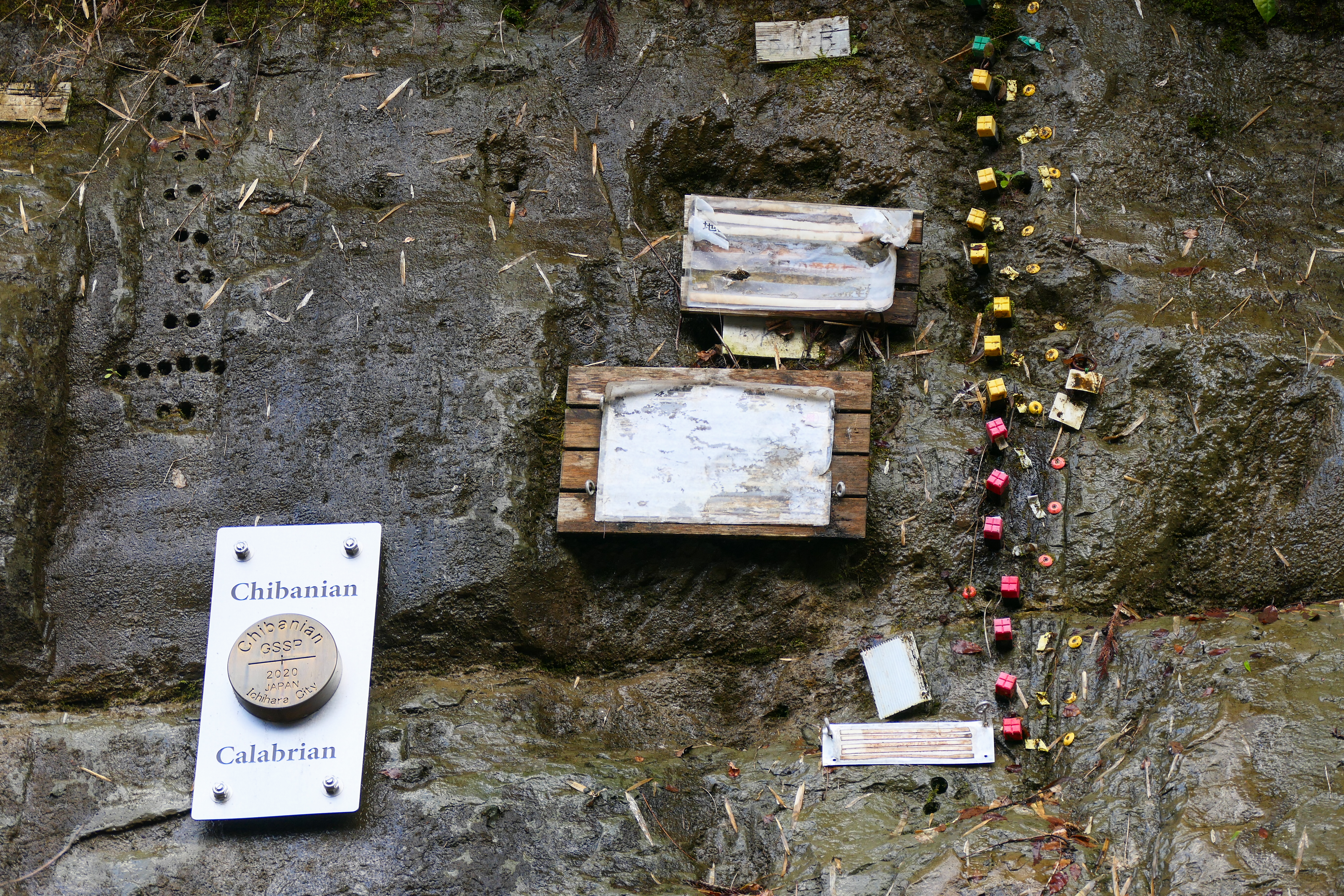
| image_outcrop | File:Chibanian Strata.jpg |
| caption_outcrop | The Chibanian Stratum, located at the Yoro River near Ichihara City, Japan |
| timeline | Quaternary |
| name_formality | Formal |
| name_accept_date | January 2020 |
| synonym1 | Middle Pleistocene |
| synonym2 | Ionian |
| celestial_body | earth |
| usage | Global (ICS) |
| timescales_used | ICS Time Scale |
| chrono_unit | Age |
| strat_unit | Stage |
| timespan_formality | Formal |
| lower_boundary_def | 1.1 m below the directional midpoint of the Brunhes-Matuyama magnetic reversal |
| lower_gssp_location | Chiba, Japan |
| lower_gssp_coords | |
| lower_gssp_accept_date | January 2020 |
| upper_boundary_def | Not formally defined |
| upper_def_candidates | Marine Isotope Substage 5e |
| upper_gssp_candidates | None |
The Middle Pleistocene, also known by its ICS official name of Chibanian, is an age in the international geologic timescale or a stage in chronostratigraphy, being a division of the Pleistocene Epoch within the ongoing Quaternary Period. The Chibanian name was officially ratified in January 2020. It is currently estimated to span the time between 0.7741 Ma (774,100 years ago) and 0.129 Ma (129,000 years ago), also expressed as 774.1–129 ka. It includes the transition in palaeoanthropology from the Lower to the Middle Paleolithic over 300 ka.
The Chibanian is preceded by the Calabrian and succeeded by the Late Pleistocene. The beginning of the Chibanian is the Brunhes–Matuyama reversal, when the Earth's magnetic field last underwent reversal. Its end roughly coincides with the termination of the Penultimate Glacial Period and the onset of the Last Interglacial period (corresponding to the beginning of Marine Isotope Stage 5).
The term Middle Pleistocene was in use as a provisional or "quasi-formal" designation by the International Union of Geological Sciences (IUGS). While the three lowest ages of the Pleistocene, the Gelasian, Calabrian and Chibanian have been officially defined, the Late Pleistocene has yet to be formally defined.
Definition process
The International Union of Geological Sciences (IUGS) had previously proposed replacement of the Middle Pleistocene by an Ionian Age based on strata found in Italy. In November 2017, however, the Chibanian (based on strata at a site in Chiba Prefecture, Japan) replaced the Ionian as the Subcommission on Quaternary Stratigraphy's preferred GSSP proposal for the age that should replace the Middle Pleistocene sub-epoch. The "Chibanian" name was ratified by the IUGS in January 2020.
Climate
By early Middle Pleistocene, the Mid-Pleistocene Transition had changed the glacial cycles from an average 41,000 year periodicity present during most of the Early Pleistocene to a 100,000 year periodicity, with the glacial cycles becoming asymmetric, having long glacial periods punctuated by short warm interglacial periods. Millennial-scale climatic variability continued to be highly sensitive to precession and obliquity cycles.
In central Italy, the climate became noticeably more arid from 600 ka to 400 ka.
The late Middle Pleistocene was a time of regional aridification in the Levant, with a shallow lake covering what is now the Shishan Marsh drying and developing into a marsh.
Eastern Africa's hydroclimate was governed primarily by orbital precession, although modulated significantly by the 100 kyr eccentricity cycle.
Along the northwestern Australian coast, the intensification of the Leeuwin Current resulted in an expansion of reefs coincident with the Great Barrier Reef's formation.
Events
The Early-Middle Pleistocene boundary saw the migration of true horses out of North America and into Eurasia. Also around this time, the European mammoth species Mammuthus meridionalis became extinct and was replaced by the Asian species Mammuthus trogontherii (the steppe mammoth). This was coincident with the migration of the elephant genus Palaeoloxodon out of Africa and into Eurasia, including the first appearance of species like the European straight-tusked elephant (Palaeoloxodon antiquus). With the extinction of Sinomastodon in East Asia at the Early-Middle Pleistocene boundary, gomphotheres became completely extinct in Afro-Eurasia, but continued to persist in the Americas into the Late Pleistocene. There was a major extinction of carnivorous mammals in Europe around the Early-Middle Pleistocene transition, including the giant hyena Pachycrocuta. The mid-late Middle Pleistocene saw the emergence of the woolly mammoth (Mammuthus primigenius), and its replacement of Mammuthus trogontherii, with the replacement of M. trogontherii in Europe by woolly mammoths being complete by around 200,000 years ago. The last member of the notoungulate family Mesotheriidae, Mesotherium, has its last records around 220,000 years ago, leaving Toxodontidae as the sole family of notoungulates to persist into the Late Pleistocene. During the late Middle Pleistocene, around 195,000–135,000 years ago, the steppe bison (the ancestor of the modern American bison) migrated across the Bering land bridge into North America, marking the beginning of the Rancholabrean faunal stage. Around 500,000 years ago, the last members of the largely European aquatic frog genus Palaeobatrachus and by extension the family Palaeobatrachidae became extinct.
Palaeoanthropology
The Chibanian includes the transition in palaeoanthropology from the Lower to the Middle Paleolithic: i.e., the emergence of Homo sapiens sapiens between 300 ka and 400 ka. The oldest known human DNA dates to the Middle Pleistocene, around 430,000 years ago. This is the oldest found, .
After analyzing 2,496 remains of Castor fiber (Eurasian beaver) and Trogontherium cuvieri found at Bilzingsleben in Germany, a team of scientists concluded that, around 400 ka, hominids in the area hunted and exploited beavers. They may have been targeted for their meat (based on cut marks on the bones) and skin.
Chronology
| Age | paleoclimate | glaciation | palaeoanthropology |
|---|---|---|---|
| 790–761 ka | MIS 19 | Günz (Elbe) glaciation | Peking Man (Homo erectus) |
| 761–712 ka | MIS 18 | ||
| 712–676 ka | MIS 17 | ||
| 676–621 ka | MIS 16 | ||
| 621–563 ka | MIS 15 | Gunz-Haslach interglacial | Heidelberg Man (Homo heidelbergensis), Bodo cranium |
| 563–524 ka | MIS 14 | ||
| 524–474 ka | MIS 13 | end of Cromerian (Günz-Mindel) interglacial | Boxgrove Man (Homo heidelbergensis) |
| 474–424 ka | MIS 12 | Anglian Stage in Britain; Haslach glaciation | Tautavel Man (Homo erectus) |
| 424–374 ka | MIS 11 | Hoxnian (Britain), Yarmouthian (North America) | Swanscombe Man (Homo heidelbergensis) |
| 374–337 ka | MIS 10 | Mindel glaciation, Elster glaciation, Riss glaciation | |
| 337–300 ka | MIS 9 | Purfleet Interglacial in Britain | Mousterian |
| 300–243 ka | MIS 8 | Irhoud 1 (Homo sapiens); Middle Paleolithic; Haplogroup A (Y-DNA) | |
| 243–191 ka | MIS 7 | Aveley Interglacial in Britain | Galilee Man; Haua Fteah |
| 191–130 ka | MIS 6 | Illinoian Stage | Herto Man (Homo sapiens); Macro-haplogroup L (mtDNA); Mousterian |
| 130–123 ka | MIS 5e | peak of Eemian interglacial sub-stage, or Ipswichian in Britain | Klasies River Caves; Sangoan |
References
References
- "Global Boundary Stratotype Section and Point". International Commission of Stratigraphy.
- Hornyak, Tim. (30 January 2020). "Japan Puts Its Mark on Geologic Time with the Chibanian Age". [[American Geophysical Union]].
- "Global Boundary Stratotype Section and Points".
- (2004). "A Geological Time Scale 2004". Cambridge University Press.
- D. Dahl-Jensen & others. (2013). "Eemian interglacial reconstructed from a Greenland folded ice core". Nature.
- P. L. Gibbard. (17 April 2015). "The Quaternary System/Period and its major sub-divisions". Elsevier BV.
- (14 November 2017). "Japan-based name 'Chibanian' set to represent geologic age of last magnetic shift". The Japan Times.
- (June 2021). "On the Cause of the Mid-Pleistocene Transition". Reviews of Geophysics.
- (2017-12-12). "Causes of ice age intensification across the Mid-Pleistocene Transition". Proceedings of the National Academy of Sciences.
- (1 November 2021). "Persistent orbital influence on millennial climate variability through the Pleistocene". [[Nature Geoscience]].
- (10 May 2022). "Middle Pleistocene paleoclimate and paleoenvironment of central Italy and their relationship with hominin migrations and evolution". [[Quaternary International]].
- (1 June 2022). "The Middle to Late Pleistocene transition in the Azraq Oasis, Jordan: A phytolith-based reconstruction of wetland palaeoecology". [[Palaeogeography, Palaeoclimatology, Palaeoecology]].
- (24 February 2022). "Orbital controls on eastern African hydroclimate in the Pleistocene". [[Scientific Reports]].
- (November 2014). "Seismic and stratigraphic evidence for reef expansion and onset of aridity on the Northwest Shelf of Australia during the Pleistocene". [[Marine and Petroleum Geology]].
- (December 2021). "Ancient horse genomes reveal the timing and extent of dispersals across the Bering Land Bridge". Molecular Ecology.
- Lister, Adrian M.. (2004). "Human Paleoecology in the Levantine Corridor". Oxbow Books.
- (August 2014). "New remains of Sinomastodon yangziensis (Proboscidea, Gomphotheriidae) from Sanhe karst Cave, with discussion on the evolution of Pleistocene Sinomastodon in South China". Quaternary International.
- (1 July 2021). "The rise and fall of proboscidean ecological diversity". Nature Ecology & Evolution.
- (March 2008). "Carnivora dispersal in Western Mediterranean during the last 2.6Ma". Quaternary International.
- Lister, Adrian M.. (October 2022). "Mammoth evolution in the late Middle Pleistocene: The Mammuthus trogontherii-primigenius transition in Europe". Quaternary Science Reviews.
- (February 2023). "The last record of the last typotherid (Notoungulata, Mesotheriidae, Mesotherium cristatum) for the middle Pleistocene of the western Pampean region, Córdoba Province, Argentina, and its biostratigraphic implications". Quaternary Science Reviews.
- (2017-03-28). "Fossil and genomic evidence constrains the timing of bison arrival in North America". Proceedings of the National Academy of Sciences.
- (September 2012). "Generic diversity and distributional dynamics of the Palaeobatrachidae (Amphibia: Anura)". Palaeobiodiversity and Palaeoenvironments.
- D. Richter & others. (8 June 2017). "The Age of Hominin Fossils from Jebel Irhoud, Morocco, and the origins of the Middle Stone Age". Nature.
- Crew, Bec. (15 March 2016). "The Oldest Human Genome Ever Has Been Sequenced, And It Could Rewrite Our History". ScienceAlert.
- (2023-11-13). "Beaver exploitation, 400,000 years ago, testifies to prey choice diversity of Middle Pleistocene hominins". Scientific Reports.
This article was imported from Wikipedia and is available under the Creative Commons Attribution-ShareAlike 4.0 License. Content has been adapted to SurfDoc format. Original contributors can be found on the article history page.
Ask Mako anything about Middle Pleistocene — get instant answers, deeper analysis, and related topics.
Research with MakoFree with your Surf account
Create a free account to save articles, ask Mako questions, and organize your research.
Sign up freeThis content may have been generated or modified by AI. CloudSurf Software LLC is not responsible for the accuracy, completeness, or reliability of AI-generated content. Always verify important information from primary sources.
Report