From Surf Wiki (app.surf) — the open knowledge base
Methylthiomethyl ether
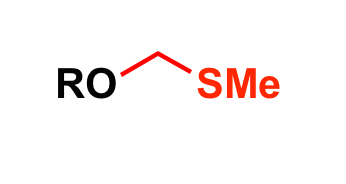
In organic chemistry a methylthiomethyl (MTM) ether is a protective group for hydroxyl groups. Hydroxyl groups are present in many chemical compounds and they must be protected during oxidation, acylation, halogenation, dehydration and other reactions to which they are susceptible.
Many kinds of protective groups for hydroxyl groups have been developed and used in organic chemistry, but the number of protective groups for tertiary hydroxyl groups, which are susceptible to acid-catalyzed dehydration, is still small because of their poor reactiveness. They can be easily protected with MTM ethers and recovered in good yield.
To introduce an MTM ether to a hydroxyl group, two methods are mainly used. One is a typical Williamson ether synthesis using an MTM halide as an MTM resource and sodium hydride (NaH) as a base. The other is a special method, in which dimethyl sulfoxide (DMSO) and acetic anhydride (Ac2O) are used. In this case, the reaction proceeds with Pummerer rearrangement:
MTM ethers have another advantage. They are removed by neutral (but toxic) mercuric chloride, to which most other ethers are stable. As a result, the selective deprotection of polyfunctional molecules becomes possible using MTM ethers as the protective groups for their hydroxyl groups.
Alcohol protection
Methylthiomethyl (MTM) group is used as a protecting group for alcohols in organic synthesis. This type of alcohol protecting group is robust under mild acidic reaction conditions.
Most common protection methods
- Treatment of alcohol with sodium hydride and methylthiomethyl halide
- Dimethyl sulfoxide (DMSO) and acetic acid (AcOH) in acetic anhydride (Ac2O) at ambient temperature
Most common deprotection methods
- Mercury (II) chloride (HgCl2); calcium carbonate (CaCO3) is used as an acid scavenger for acid sensitive substrates

- Iodomethane (MeI) in presence of sodium bicarbonate (NaHCO3) at elevated temperatures (this type of reaction is generally carried out in acetone/H2O solution)
- Magnesium iodide (MgI2) and acetic anhydride (Ac2O) in ether at ambient temperature
References
References
- Corey, E. J.. (1975-01-01). "Protection of primary hydroxyl groups as methylthiomethyl ethers". Tetrahedron Letters.
- Wuts, Peter G. M.. (2006). "Greene's Protective Groups in Organic Synthesis, Fourth Edition - Wuts - Wiley Online Library".
This article was imported from Wikipedia and is available under the Creative Commons Attribution-ShareAlike 4.0 License. Content has been adapted to SurfDoc format. Original contributors can be found on the article history page.
Ask Mako anything about Methylthiomethyl ether — get instant answers, deeper analysis, and related topics.
Research with MakoFree with your Surf account
Create a free account to save articles, ask Mako questions, and organize your research.
Sign up freeThis content may have been generated or modified by AI. CloudSurf Software LLC is not responsible for the accuracy, completeness, or reliability of AI-generated content. Always verify important information from primary sources.
Report