From Surf Wiki (app.surf) — the open knowledge base
Metallicity
Relative abundance of heavy elements in a star or other astronomical object
Relative abundance of heavy elements in a star or other astronomical object
In astronomy, metallicity is the abundance of elements present in an object that are heavier than hydrogen and helium. Most of the normal currently detectable (i.e. non-dark) matter in the universe is either hydrogen or helium, and astronomers use the word metals as convenient shorthand for all elements except hydrogen and helium. This word-use is distinct from the conventional chemical or physical definition of a metal as an electrically conducting element. Stars and nebulae with relatively high abundances of heavier elements are called metal-rich when discussing metallicity, even though many of those elements are called nonmetals in chemistry.
Metals in early spectroscopy
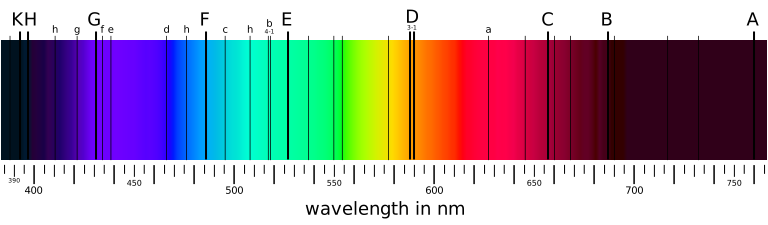
In 1802, William Hyde Wollaston noted the appearance of a number of dark features in the solar spectrum. In 1814, Joseph von Fraunhofer independently rediscovered the lines and began to systematically study and measure their wavelengths, and they are now called Fraunhofer lines. He mapped over 570 lines, designating the most prominent with the letters A through K and weaker lines with other letters.{{Cite book
About 45 years later, Gustav Kirchhoff and Robert BunsenSee:
- Gustav Kirchhoff (1859) die Fraunhofer'schen Linien" (On Fraunhofer's lines), Monatsbericht der Königlichen Preussische Akademie der Wissenschaften zu Berlin (Monthly report of the Royal Prussian Academy of Sciences in Berlin), 662–665.
- Gustav Kirchhoff (1859) "Ueber das Sonnenspektrum" (On the sun's spectrum), Verhandlungen des naturhistorisch-medizinischen Vereins zu Heidelberg (Proceedings of the Natural History / Medical Association in Heidelberg), 1 (7) : 251–255. noticed that several Fraunhofer lines coincide with characteristic emission lines identified in the spectra of heated chemical elements.{{cite journal |trans-title=On the relation between the emissive power and the absorptive power of bodies towards heat and light
Origin of metallic elements
The presence of heavier elements results from stellar nucleosynthesis, where the majority of elements heavier than hydrogen and helium in the Universe (metals, hereafter) are formed in the cores of stars as they evolve. Over time, stellar winds and supernovae deposit the metals into the surrounding environment, enriching the interstellar medium and providing recycling materials for the birth of new stars. It follows that older generations of stars, which formed in the metal-poor early Universe, generally have lower metallicities than those of younger generations, which formed in a more metal-rich Universe.
Stellar populations
Observed changes in the chemical abundances of different types of stars, based on the spectral peculiarities that were later attributed to metallicity, led astronomer Walter Baade in 1944 to propose the existence of two different populations of stars. |doi-access=free These became commonly known as (metal-rich) and (metal-poor) stars. A third, earliest stellar population was hypothesized in 1978, known as stars. These "extremely metal-poor" (XMP) stars are theorized to have been the "first-born" stars created in the Universe.
Common methods of calculation
Astronomers use several different methods to describe and approximate metal abundances, depending on the available tools and the object of interest. Some methods include determining the fraction of mass that is attributed to gas versus metals, or measuring the ratios of the number of atoms of two different elements as compared to the ratios found in the Sun.
Mass fraction
Stellar composition is often simply defined by the parameters X, Y, and Z. Here X represents the mass fraction of hydrogen, Y is the mass fraction of helium, and Z is the mass fraction of all the remaining chemical elements. Thus
X + Y + Z = 1
In most stars, nebulae, H II regions, and other astronomical sources, hydrogen and helium are the two dominant elements. The hydrogen mass fraction is generally expressed as \ X \equiv \tfrac{m_\ce{H}}{M}\ , where M is the total mass of the system, and \ m_\ce{H}\ is the mass of the hydrogen it contains. Similarly, the helium mass fraction is denoted as \ Y \equiv \tfrac{m_\ce{He}}{M} ~. The remainder of the elements are collectively referred to as "metals", and the mass fraction of metals is calculated as
Z = \sum_{e \ce{He}} \tfrac{m_e}{M} = 1 - X - Y ~.
For the surface of the Sun (symbol \odot), these parameters are measured to have the following values:
| Description | Solar value |
|---|---|
| Hydrogen mass fraction | \ X_\odot = 0.7381\ |
| Helium mass fraction | \ Y_\odot = 0.2485\ |
| Metal mass fraction | \ Z_\odot = 0.0134\ |
Due to the effects of stellar evolution, neither the initial composition nor the present day bulk composition of the Sun is the same as its present-day surface composition.
Chemical abundance ratios
The overall stellar metallicity is conventionally defined using the total hydrogen content, since its abundance is considered to be relatively constant in the Universe, or the iron content of the star, which has an abundance that is generally linearly increasing in time in the Universe. Hence, iron can be used as a chronological indicator of nucleosynthesis. Iron is relatively easy to measure with spectral observations in the star's spectrum given the large number of iron lines in the star's spectra (even though oxygen is the most abundant heavy element – see metallicities in H II regions below). The abundance ratio is the common logarithm of the ratio of a star's iron abundance compared to that of the Sun and is calculated thus:
\left[ \frac{ \ce{Fe} }{ \ce{H} } \right] = \log_{10}{\left( \frac{N_{\ce{Fe}}}{N_{\ce{H}} } \right)\star } -~ \log{10}{\left(\frac{N_{ \ce{Fe}} }{ N_{\ce{H}} } \right)_\odot}\ ,
where \ N_{\ce{Fe}}\ and \ N_{\ce{H}}\ are the number of iron and hydrogen atoms per unit of volume respectively, \odot is the standard symbol for the Sun, and \star for a star (often omitted below). The unit often used for metallicity is the dex, contraction of "decimal exponent".{{cite book
Young population I stars have significantly higher iron-to-hydrogen ratios than older population II stars. Primordial population III stars are estimated to have metallicity less than −6, a millionth of the abundance of iron in the Sun. |display-authors=6 |access-date=17 June 2015 The same notation is used to express variations in abundances between other individual elements as compared to solar proportions. For example, the notation \ \left[\tfrac{ \ce{O} }{ \ce{Fe} } \right]\ represents the difference in the logarithm of the star's oxygen abundance versus its iron content compared to that of the Sun. In general, a given stellar nucleosynthetic process alters the proportions of only a few elements or isotopes, so a star or gas sample with certain \ \left[\tfrac{ \ce{?} }{ \ce{Fe} } \right]_\star\ values may well be indicative of an associated, studied nuclear process.
Photometric colors
Astronomers can estimate metallicities through measured and calibrated systems that correlate photometric measurements and spectroscopic measurements (see also Spectrophotometry). For example, the Johnson UVB filters can be used to detect an ultraviolet (UV) excess in stars, where a smaller UV excess indicates a larger presence of metals that absorb the UV radiation, thereby making the star appear "redder". |doi-access=free The UV excess, δ(U−B), is defined as the difference between a star's U and B band magnitudes, compared to the difference between U and B band magnitudes of metal-rich stars in the Hyades cluster. |doi-access=free Unfortunately, δ(U−B) is sensitive to both metallicity and temperature: If two stars are equally metal-rich, but one is cooler than the other, they will likely have different δ(U−B) values (see also Blanketing effect |doi-access=free ). To help mitigate this degeneracy, a star's B−V color index can be used as an indicator for temperature. Furthermore, the UV excess and B−V index can be corrected to relate the δ(U−B) value to iron abundances. |doi-access=free |doi-access=free
Other photometric systems that can be used to determine metallicities of certain astrophysical objects include the Strӧmgren system, |editor-last=Strand |editor-first=Kaj Aage
- 1980 reprint edition: ,
- 1988 reprint edition: the Geneva system, the Washington system, and the DDO system. |doi-access=free
Metallicities in various astrophysical objects
Stars
At a given mass and age, a metal-poor star will be slightly warmer. metallicities are roughly to of the Sun's \left(\ \left[ \tfrac{ \ce{Fe} }{ \ce{H} } \right]\ = {-3.0}\ ...\ {-1.0}\ \right)\ , but the group appears cooler than overall, as heavy population II stars have long since died. Above 40 solar masses, metallicity influences how a star will die: Outside the pair-instability window, lower metallicity stars will collapse directly to a black hole, while higher metallicity stars undergo a type Ib/c supernova and may leave a neutron star.
Relationship between stellar metallicity and planets
A star's metallicity measurement is one parameter that helps determine whether a star may have a giant planet, as there is a direct correlation between metallicity and the presence of a giant planet. Measurements have demonstrated the connection between a star's metallicity and gas giant planets, like Jupiter and Saturn. The more metals in a star and thus its planetary system and protoplanetary disk, the more likely the system may have gas giant planets. Current models show that the metallicity along with the correct planetary system temperature and distance from the star are key to planet and planetesimal formation. For two stars that have equal age and mass but different metallicity, the less metallic star is bluer. Among stars of the same color, less metallic stars emit more ultraviolet radiation. The Sun, with eight planets and nine consensus dwarf planets, is used as the reference, with a \ \left[\tfrac{ \ce{Fe} }{ \ce{H} } \right]\ of 0.00.{{cite web |access-date=2016-09-28 |archive-date=2017-07-13 |archive-url=https://web.archive.org/web/20170713073323/http://www.astro.caltech.edu/~jwang/Project4.html |url-status=dead
|archive-url=https://web.archive.org/web/20210507132606/https://www.astrobio.net/news-exclusive/when-stellar-metallicity-sparks-planet-formation/ |archive-date=2021-05-07 |book-title=From Lithium to Uranium: Elemental tracers of early cosmic evolution :Missing article's page numbers are imbedded in: |publication-date=February 2006 |book-title=From Lithium to Uranium: Elemental tracers of early cosmic evolution |doi-access=free
H II regions
Young, massive and hot stars (typically of spectral types O and B) in H II regions emit UV photons that ionize ground-state hydrogen atoms, knocking electrons free; this process is known as photoionization. The free electrons can strike other atoms nearby, exciting bound metallic electrons into a metastable state, which eventually decay back into a ground state, emitting photons with energies that correspond to forbidden lines. Through these transitions, astronomers have developed several observational methods to estimate metal abundances in H II regions, where the stronger the forbidden lines in spectroscopic observations, the higher the metallicity. These methods are dependent on one or more of the following: the variety of asymmetrical densities inside H II regions, the varied temperatures of the embedded stars, and/or the electron density within the ionized region.
Theoretically, to determine the total abundance of a single element in an H II region, all transition lines should be observed and summed. However, this can be observationally difficult due to variation in line strength. Some of the most common forbidden lines used to determine metal abundances in H II regions are from oxygen (e.g. [O] λ = (3727, 7318, 7324) Å, and [O] λ = (4363, 4959, 5007) Å), nitrogen (e.g. [N] λ = (5755, 6548, 6584) Å), and sulfur (e.g. [S] λ = (6717, 6731) Å and [S] λ = (6312, 9069, 9531) Å) in the optical spectrum, and the [O] λ = (52, 88) μm and [N] λ = 57 μm lines in the infrared spectrum. Oxygen has some of the stronger, more abundant lines in H II regions, making it a main target for metallicity estimates within these objects. To calculate metal abundances in H II regions using oxygen flux measurements, astronomers often use the R23 method, in which
R_{23} = \frac{\ \left[\ \ce{O}^\ce{II} \right]{3727~\AA} + \left[\ \ce{O}^\ce{III} \right]{4959~\AA + 5007~\AA}\ }{\left[\ \ce{ H}\ce{\beta} \right]{4861 ~\AA} }\ ,
where \ \left[\ \ce{O}^\ce{II} \right]{3727~\AA} + \left[\ \ce{O}^\ce{III} \right]{4959~\AA + 5007~\AA}\ is the sum of the fluxes from oxygen emission lines measured at the rest frame λ = (3727, 4959 and 5007) Å wavelengths, divided by the flux from the Balmer series H emission line at the rest frame λ = 4861 Å wavelength. This ratio is well defined through models and observational studies, but caution should be taken, as the ratio is often degenerate, providing both a low and high metallicity solution, which can be broken with additional line measurements. Similarly, other strong forbidden line ratios can be used, e.g. for sulfur, where
S_{23} = \frac{\ \left[\ \ce{S}^\ce{II} \right]{6716~\AA + 6731~\AA} + \left[\ \ce{S}^\ce{III} \right]{9069~\AA + 9532~\AA}\ }{\left[\ \ce{H}\ce{\beta} \right]{4861 ~\AA} } ~.
Metal abundances within H II regions are typically less than 1%, with the percentage decreasing on average with distance from the Galactic Center.
References
- {{cite journal
- {{cite journal
References
- Melvyn C. Usselman: [http://www.britannica.com/EBchecked/topic/646649/William-Hyde-Wollaston William Hyde Wollaston] Encyclopædia Britannica, retrieved 31 March 2013
- William Hyde Wollaston (1802) [http://rstl.royalsocietypublishing.org/content/92/365.full.pdf+html "A method of examining refractive and dispersive powers, by prismatic reflection,"] ''Philosophical Transactions of the Royal Society'', '''92''': 365–380; see especially p. 378.
- Hearnshaw, J.B.. (1986). "The analysis of starlight". [[Cambridge University Press]].
- Joseph Fraunhofer (1814 - 1815) [https://books.google.com/books?id=2-AAAAAAYAAJ&pg=PA203 "Bestimmung des Brechungs- und des Farben-Zerstreuungs - Vermögens verschiedener Glasarten, in Bezug auf die Vervollkommnung achromatischer Fernröhre"] (Determination of the refractive and color-dispersing power of different types of glass, in relation to the improvement of achromatic telescopes), ''Denkschriften der Königlichen Akademie der Wissenschaften zu München'' (Memoirs of the Royal Academy of Sciences in Munich), '''5''': 193–226; see especially pages 202–205 and the plate following page 226.
- "Kirchhoff and Bunsen on Spectroscopy".
- (1872). "Spectrum analysis in its application to terrestrial substances and the physical constitution of the heavenly bodies : familiarly explained / by H. Schellen ...".
- Meadows, A. J. (Arthur Jack). (1970). "Early solar physics". Oxford, New York, Pergamon Press.
- (September 1989). "Abundance Ratios as a Function of Metallicity". Annual Review of Astronomy and Astrophysics.
- (September 2002). "Using strong lines to estimate abundances in extragalactic H II regions and starburst galaxies". The Astrophysical Journal Supplement Series.
- (2006-09-12). "Gas metallicity diagnostics in star-forming galaxies". [[Astronomy & Astrophysics]].
- Peimbert, Manuel. (December 1967). "Temperature determinations of H II regions". [[The Astrophysical Journal]].
- Pagel, B.E.J.. (1986). "Nebulae and abundances in galaxies". [[Publications of the Astronomical Society of the Pacific]].
- (August 1999). "The distribution of heavy elements in spiral and elliptical galaxies". [[Publications of the Astronomical Society of the Pacific]].
- (April 1999). "On measuring nebular chemical abundances in distant galaxies using global emission-line spectra". [[The Astrophysical Journal]].
- Grazyna, Stasinska. (2004). "Cosmochemistry: The melting pot of the elements". Cambridge University Press.
- (December 2005). "Chemical composition of two H II regions in NGC 6822 based on VLT spectroscopy". [[The Astrophysical Journal]].
- (1979-11-01). "On the composition of H II regions in southern galaxies – I. NGC 300 and 1365". [[Monthly Notices of the Royal Astronomical Society]].
- (August 1986). "Theoretical models for H II regions. II - The extragalactic H II region abundance sequence". The Astrophysical Journal.
- McGaugh, Stacy S.. (October 1991). "H II region abundances - Model oxygen line ratios". [[The Astrophysical Journal]].
- Pilyugin, L.S.. (April 2001). "On the oxygen abundance determination in H II regions". [[Astronomy & Astrophysics]].
- (1999-01-20). "Chemical Properties of Star-forming Emission-Line Galaxies atz=0.1–0.5". [[The Astrophysical Journal]].
- (2000-02-11). "An empirical calibration of nebular abundances based on the sulphur emission lines". [[Monthly Notices of the Royal Astronomical Society]].
- (1983-09-01). "The galactic abundance gradient". [[Monthly Notices of the Royal Astronomical Society]].
- (1997-03-20). "Galactic abundance gradients from infrared fine-structure lines in compact H II regions". [[The Astrophysical Journal]].
- (1997). "Nucleosynthesis and Chemical Evolution of Galaxies". Cambridge University Press.
- (2011-08-10). "H II region metallicity distribution in the Milky Way disk". [[The Astrophysical Journal]].
This article was imported from Wikipedia and is available under the Creative Commons Attribution-ShareAlike 4.0 License. Content has been adapted to SurfDoc format. Original contributors can be found on the article history page.
Ask Mako anything about Metallicity — get instant answers, deeper analysis, and related topics.
Research with MakoFree with your Surf account
Create a free account to save articles, ask Mako questions, and organize your research.
Sign up freeThis content may have been generated or modified by AI. CloudSurf Software LLC is not responsible for the accuracy, completeness, or reliability of AI-generated content. Always verify important information from primary sources.
Report