From Surf Wiki (app.surf) — the open knowledge base
Metabotropic glutamate receptor
Type of glutamate receptor

Type of glutamate receptor
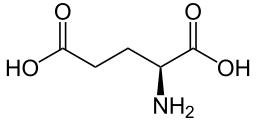
The metabotropic glutamate receptors, or mGluRs, are a type of glutamate receptor that are active through an indirect metabotropic process. They are members of the group C family of G-protein-coupled receptors, or GPCRs. Like all glutamate receptors, mGluRs bind with glutamate, an amino acid that functions as an excitatory neurotransmitter.
Function and structure
The mGluRs perform a variety of functions in the central and peripheral nervous systems: For example, they are involved in learning, memory, anxiety, and the perception of pain. They are found in pre- and postsynaptic neurons in synapses of the hippocampus, cerebellum, and the cerebral cortex, as well as other parts of the brain and in peripheral tissues.
Like other metabotropic receptors, mGluRs have seven transmembrane domains that span the cell membrane. Unlike ionotropic receptors, metabotropic glutamate receptors are not ion channels. Instead, they activate biochemical cascades, leading to the modification of other proteins, such as ion channels. This can lead to changes in the synapse's excitability, for example by presynaptic inhibition of neurotransmission, or modulation and even induction of postsynaptic responses.
A dimeric organization of mGluRs is required for signaling induced by agonists.
Classification
Eight different types of mGluRs, labeled mGluR1 to mGluR8 ( to ), are divided into groups I, II, and III. Receptor types are grouped based on receptor structure and physiological activity. The mGluRs are further divided into subtypes, such as mGluR7a and mGluR7b.
Overview
| Family | vauthors = Swanson CJ, Bures M, Johnson MP, Linden AM, Monn JA, Schoepp DD | title = Metabotropic glutamate receptors as novel targets for anxiety and stress disorders | journal = Nature Reviews. Drug Discovery | volume = 4 | issue = 2 | pages = 131–44 | date = February 2005 | pmid = 15665858 | doi = 10.1038/nrd1630 | s2cid = 15037387 }} | Gene | Mechanism | Function | Agonists & Activators | Antagonists | Synapse site | Group I | Group II | Group III |
|---|---|---|---|---|---|---|---|---|---|---|---|---|---|---|---|---|---|---|---|
| mGluR1 | GRM1 | Gq, ↑Na+, ↑K+, ↓glutamate | mainly **post**synaptic | ||||||||||||||||
| mGluR5 | GRM5 | Gq, ↑Na+, ↑K+, ↓glutamate | |||||||||||||||||
| mGluR2 | GRM2 | Gi/G0 | mainly **pre**synaptic | ||||||||||||||||
| mGluR3 | GRM3 | Gi/G0 | |||||||||||||||||
| mGluR4 | GRM4 | Gi/G0 | mainly **pre**synaptic | ||||||||||||||||
| mGluR6 | GRM6 | Gi/G0 | |||||||||||||||||
| mGluR7 | GRM7 | Gi/G0 | |||||||||||||||||
| mGluR8 | GRM8 | Gi/G0 |
Group I

The mGluRs in group I, including mGluR1 and mGluR5, are stimulated most strongly by the excitatory amino acid analog L-quisqualic acid. Stimulating the receptors causes the associated enzyme phospholipase C to hydrolyze phosphoinositide phospholipids in the cell's plasma membrane. This leads to the formation of inositol 1,4,5-trisphosphate (IP3) and diacyl glycerol. Due to its hydrophilic character, IP3 can travel to the endoplasmic reticulum, where it induces, via fixation on its receptor, the opening of calcium channels increasing in this way the cytosolic calcium concentrations. The lipophilic diacylglycerol remains in the membrane, acting as a cofactor for the activation of protein kinase C.
These receptors are also associated with Na+ and K+ channels. Their action can be excitatory, increasing conductance, causing more glutamate to be released from the presynaptic cell, but they also increase inhibitory postsynaptic potentials, or IPSPs. They can also inhibit glutamate release and can modulate voltage-dependent calcium channels.
Group I mGluRs, but not other groups, are activated by 3,5-dihydroxyphenylglycine (DHPG), a fact that is useful to experimenters because it allows them to isolate and identify them.
Group II and Group III
The receptors in group II, including mGluRs 2 and 3, and group III, including mGluRs 4, 6, 7, and 8, (with some exceptions) prevent the formation of cyclic adenosine monophosphate, or cAMP, by activating a G protein that inhibits the enzyme adenylyl cyclase, which forms cAMP from ATP. These receptors are involved in presynaptic inhibition, and do not appear to affect postsynaptic membrane potential by themselves. Receptors in groups II and III reduce the activity of postsynaptic potentials, both excitatory and inhibitory, in the cortex.
The chemicals 2-(2,3-dicarboxycyclopropyl)glycine (DCG-IV) and eglumegad activate only group II mGluRs, while 2-amino-4-phosphonobutyrate (L-AP4) activates only group III mGluRs. Several subtype-selective positive allosteric modulators that activate only the mGlu2 subtype, such as Biphenylindanone A, have also now been developed.
LY-341,495 and MGS-0039 are drugs that act as a selective antagonist blocking both of the group II metabotropic glutamate receptors, mGluR2 and mGluR3. RO4491533 acts as a negative allosteric modulator of mGluR2 and mGluR3.
Localization
Different types of mGluRs are distributed differently in cells. For example, one study found that Group I mGluRs are located mostly on postsynaptic parts of cells, while groups II and III are mostly located on presynaptic elements, though they have been found on both pre- and postsynaptic membranes.
Also, different mGluR subtypes are found predominantly in different parts of the body. For example, mGluR4 is located only in the brain, in locations such as the thalamus, hypothalamus and caudate nucleus. All mGluRs except mGluR6 are thought to exist in the hippocampus and entorhinal cortex.
Roles
It is thought that mGluRs play a role in a variety of different functions.
Modulation of other receptors
Metabotropic glutamate receptors are known to act as modulators of (affect the activity of) other receptors. For example, group I mGluRs are known to increase the activity of N-methyl-D-aspartate receptors (NMDARs), a type of ion channel-linked receptor that is central in a neurotoxic process called excitotoxicity. Proteins called PDZ proteins frequently anchor mGluRs near enough to NMDARs to modulate their activity.
It has been suggested that mGluRs may act as regulators of neurons' vulnerability to excitotoxicity (a deadly neurochemical process involving glutamate receptor overactivation) through their modulation of NMDARs, the receptor most involved in that process. Excessive amounts of N-methyl-D-aspartate (NMDA), the selective specific agonist of NMDARs, has been found to cause more damage to neurons in the presence of group I mGluR agonists. On the other hand, agonists of group II and III mGluRs reduce NMDAR activity.
Group II and III mGluRs tend to protect neurons from excitotoxicity, possibly by reducing the activity of NMDARs.
Metabotropic glutamate receptors are also thought to affect dopaminergic and adrenergic neurotransmission.
Role in plasticity
Like other glutamate receptors, mGluRs have been shown to be involved in synaptic plasticity and in neurotoxicity and neuroprotection.
They participate in long term potentiation and long term depression, and they are removed from the synaptic membrane in response to agonist binding.
Roles in disease
Since metabotropic glutamate receptors are involved in a variety of functions, abnormalities in their expression can contribute to disease. For example, studies with mutant mice have suggested that mutations in expression of mGluR1 may be involved in the development of certain types of cancer. In addition, manipulating mGluRs can be useful in treating some conditions. For example, clinical trial suggested that an mGlu2/3 agonist, LY354740, was effective in the treatment of generalized anxiety disorder. Also, some researchers have suggested that activation of mGluR4 could be used as a treatment for Parkinson's disease. Most recently, Group I mGluRs, have been implicated in the pathogenesis of Fragile X, a type of autism, and a number of studies are currently testing the therapeutic potential of drugs that modify these receptors. There is also growing evidence that group II metabotropic glutamate receptor agonists may play a role in the treatment of schizophrenia. Schizophrenia is associated with deficits in cortical inhibitory interneurons that release GABA and synaptic abnormalities associated with deficits in NMDA receptor function. These inhibitory deficits may impair cortical function via cortical disinhibition and asynchrony. The drug LY354740 (also known as Eglumegad, an mGlu2/3 agonist) was shown to attenuate physiologic and cognitive abnormalities in animal and human studies of NMDA receptor antagonist and serotonergic hallucinogen effects, supporting the subsequent clinical evidence of efficacy for an mGluR2/3 agonist in the treatment of schizophrenia. The same drug has been shown to interfere in the hypothalamic–pituitary–adrenal axis, with chronic oral administration of this drug leading to markedly reduced baseline cortisol levels in bonnet macaques (Macaca radiata); acute infusion of LY354740 resulted in a marked diminution of yohimbine-induced stress response in those animals. LY354740 has also been demonstrated to act on the metabotropic glutamate receptor 3 (GRM3) of human adrenocortical cells, downregulating aldosterone synthase, CYP11B1, and the production of adrenal steroids (i.e. aldosterone and cortisol).
History
The first demonstration that glutamate could induce the formation of molecules belonging to a major second messenger system was in 1985, when it was shown that it could stimulate the formation of inositol phosphates. This finding allowed in 1987 to yield an explanation for oscillatory ionic glutamate responses and to provide further evidence for the existence of metabotropic glutamate receptors. In 1991 the first metabotropic glutamate receptor of the seven transmembrane domain family was cloned. More recent reports on ionotropic glutamate receptors able to couple to metabotropic transduction systems suggest that metabotropic responses of glutamate might not be limited to seven transmembrane domain metabotropic glutamate receptors.
References
References
- (2005). "Modulatory action of metabotropic glutamate receptor (mGluR) 5 on mGluR1 function in striatal cholinergic interneurons". Neuropharmacology.
- (2002). "A novel binding assay for metabotropic glutamate receptors using [3H] L-quisqualic acid and recombinant receptors". Zeitschrift für Naturforschung C.
- (March 2001). "Characterization with [3H]quisqualate of group I metabotropic glutamate receptor subtype in rat central and peripheral excitable tissues". Neurochemistry International.
- (October 2000). "Quisqualate induces an inward current via mGluR activation in neocortical pyramidal neurons". Brain Research.
- (March 2007). "The role of glutamate in central nervous system health and disease--a review". Veterinary Journal.
- (September 2012). "The acid-sensitive, anesthetic-activated potassium leak channel, KCNK3, is regulated by 14-3-3β-dependent, protein kinase C (PKC)-mediated endocytic trafficking". The Journal of Biological Chemistry.
- Sladeczek F., Momiyama A.,Takahashi T. (1992). "Presynaptic inhibitory action of metabotropic glutamate receptor agonist on excitatory transmission in visual cortical neurons". Proc. Roy. Soc. Lond. B 1993 253, 297-303.
- (October 2004). "Characterization of modulatory effects of postsynaptic metabotropic glutamate receptors on calcium currents in rat nucleus tractus solitarius". Brain Research.
- (October 2012). "Distinct roles of metabotropic glutamate receptor dimerization in agonist activation and G-protein coupling". Proceedings of the National Academy of Sciences of the United States of America.
- If not otherwise specified in table:[http://www.nature.com/nrd/journal/v4/n2/fig_tab/nrd1630_T1.html#figure-title TABLE 1 Classification of the metabotropic glutamate (mGlu) receptors] From the following article:
- (February 2005). "Metabotropic glutamate receptors as novel targets for anxiety and stress disorders". Nature Reviews. Drug Discovery.
- (December 2002). "Characterization of mGluR5R, a novel, metabotropic glutamate receptor 5-related gene". Brain Research. Molecular Brain Research.
- (October 1997). "Differential presynaptic localization of metabotropic glutamate receptor subtypes in the rat hippocampus". The Journal of Neuroscience.
- MRC (Medical Research Council), [http://www.bris.ac.uk/Depts/Synaptic/info/glutamate.html Glutamate receptors: Structures and functions.] {{webarchive. link. (2007-09-15 , University of Bristol Centre for Synaptic Plasticity (2003). Retrieved January 20, 2008.)
- (December 2011). "Involvement of the mammalian target of rapamycin signaling in the antidepressant-like effect of group II metabotropic glutamate receptor antagonists". Neuropharmacology.
- (December 2011). "Characterization of an mGluR2/3 negative allosteric modulator in rodent models of depression". Journal of Neurogenetics.
- InterPro. [http://www.ebi.ac.uk/interpro/IEntry?ac=IPR001786 InterPro: IPR001786 Metabotropic glutamate receptor 4.] Retrieved on January 20, 2008.
- (June 2001). "mGluR1-mediated potentiation of NMDA receptors involves a rise in intracellular calcium and activation of protein kinase C". Neuropharmacology.
- (September 2002). "Neuronal and glial mGluR5 modulation prevents stretch-induced enhancement of NMDA receptor current". Pharmacology Biochemistry and Behavior.
- (July 1999). "Coupling of mGluR/Homer and PSD-95 complexes by the Shank family of postsynaptic density proteins". Neuron.
- (March 2005). "Understanding regulation of nerve cell death by mGluRs as a method for development of successful neuroprotective strategies". Journal of the Neurological Sciences.
- (August 1995). "Activation of metabotropic glutamate receptors coupled to inositol phospholipid hydrolysis amplifies NMDA-induced neuronal degeneration in cultured cortical cells". Neuropharmacology.
- (January 1996). "DCG-IV selectively attenuates rapidly triggered NMDA-induced neurotoxicity in cortical neurons". The European Journal of Neuroscience.
- (May 1995). "Metabotropic glutamate receptors negatively coupled to adenylate cyclase inhibit N-methyl-D-aspartate receptor activity and prevent neurotoxicity in mesencephalic neurons in vitro". Molecular Pharmacology.
- (September 1995). "Activation of class II or III metabotropic glutamate receptors protects cultured cortical neurons against excitotoxic degeneration". The European Journal of Neuroscience.
- (July 1999). "Group II metabotropic glutamate receptor activation attenuates traumatic neuronal injury and improves neurological recovery after traumatic brain injury". The Journal of Pharmacology and Experimental Therapeutics.
- (December 1997). "Neuroprotective effects of group III mGluR in traumatic neuronal injury". Journal of Neurotrauma.
- (2007). "Development of metabotropic glutamate receptor ligands for neuroimaging". Current Medical Imaging Reviews.
- (August 1992). "Activation of the glutamate metabotropic receptor protects retina against N-methyl-D-aspartate toxicity". European Journal of Pharmacology.
- (August 2005). "Activation of neuroprotective pathways by metabotropic group I glutamate receptors: a potential target for drug discovery?". Annals of the New York Academy of Sciences.
- (March 2007). "Metabotropic glutamate receptor 1 and glutamate signaling in human melanoma". Cancer Research.
- (June 2008). "Efficacy and tolerability of an mGlu2/3 agonist in the treatment of generalized anxiety disorder". Neuropsychopharmacology.
- (November 2003). "Allosteric modulation of group III metabotropic glutamate receptor 4: a potential approach to Parkinson's disease treatment". Proceedings of the National Academy of Sciences of the United States of America.
- (December 2007). "Correction of fragile X syndrome in mice". Neuron.
- (July 2010). "Mechanism-based approaches to treating fragile X". Pharmacology & Therapeutics.
- (September 2003). "NMDA receptor antagonist effects, cortical glutamatergic function, and schizophrenia: toward a paradigm shift in medication development". Psychopharmacology.
- (July 2007). "Neural synchrony in schizophrenia: from networks to new treatments". Schizophrenia Bulletin.
- (April 2005). "Activation of metabotropic glutamate 2/3 receptors reverses the effects of NMDA receptor hypofunction on prefrontal cortex unit activity in awake rats". Journal of Neurophysiology.
- (August 1998). "Reversal of phencyclidine effects by a group II metabotropic glutamate receptor agonist in rats". Science.
- (April 2005). "Preliminary evidence of attenuation of the disruptive effects of the NMDA glutamate receptor antagonist, ketamine, on working memory by pretreatment with the group II metabotropic glutamate receptor agonist, LY354740, in healthy human subjects". Psychopharmacology.
- (March 2000). "Serotonin model of schizophrenia: emerging role of glutamate mechanisms". Brain Research. Brain Research Reviews.
- (September 2007). "Activation of mGlu2/3 receptors as a new approach to treat schizophrenia: a randomized Phase 2 clinical trial". Nature Medicine.
- (July 2001). "Effects of LY354740, a novel glutamatergic metabotropic agonist, on nonhuman primate hypothalamic-pituitary-adrenal axis and noradrenergic function". CNS Spectrums.
- (January 2014). "Glutamate receptors and the regulation of steroidogenesis in the human adrenal gland: the metabotropic pathway". Molecular and Cellular Endocrinology.
- (1985). "Glutamate stimulates inositol phosphate formation in striatal neurones". Nature.
- (1987). "A new type of glutamate receptor linked to inositol phospholipid metabolism". Nature.
- (February 1991). "Sequence and expression of a metabotropic glutamate receptor". Nature.
- (March 1999). "The glutamate receptor ion channels". Pharmacological Reviews.
- (October 1997). "AMPA receptor-mediated regulation of a Gi-protein in cortical neurons". Nature.
This article was imported from Wikipedia and is available under the Creative Commons Attribution-ShareAlike 4.0 License. Content has been adapted to SurfDoc format. Original contributors can be found on the article history page.
Ask Mako anything about Metabotropic glutamate receptor — get instant answers, deeper analysis, and related topics.
Research with MakoFree with your Surf account
Create a free account to save articles, ask Mako questions, and organize your research.
Sign up freeThis content may have been generated or modified by AI. CloudSurf Software LLC is not responsible for the accuracy, completeness, or reliability of AI-generated content. Always verify important information from primary sources.
Report