From Surf Wiki (app.surf) — the open knowledge base
Messier 87
Galaxy in the constellation Virgo
Galaxy in the constellation Virgo
| Field | Value |
|---|---|
| name | Messier 87 |
| image | File:Messier 87 Hubble WikiSky.jpg |
| caption | Messier 87, with the blue plasma jet of its galactic core clearly visible (composite image of observations by the Hubble Space Telescope in visible and infrared light) |
| alt | Visual wavelength image of Messier 87 with bright core, jet and globular clusters |
| epoch | J2000 |
| constellation name | Virgo |
| ra | |
| dec | |
| size_v | 7.2 × 6.8 arcmin |
| size | 40.55 kpc |
| (25.0 mag/arcsec2 B-band isophote) | |
| appmag_v | 8.6 |
| type | E+0-1 pec, NLRG Sy |
| h_radial_v | 1,284 ± 5 km/s |
| z | 0.00428 ± 0.00002 |
| dist_ly | 16.4 ± 0.5 Mpc |
| names | Virgo A, Virgo X-1, NGC 4486, UGC 7654, PGC 41361, VCC 1316, Arp 152, 3C 274, 3U 1228+12. |
(25.0 mag/arcsec2 B-band isophote)
Messier 87 (also known as Virgo A or NGC 4486, generally abbreviated to M87) is a supergiant elliptical galaxy in the constellation Virgo that contains several trillion stars. One of the largest and most massive galaxies in the local universe, it has a large population of globular clusters—about 15,000 compared with the 150–200 orbiting the Milky Way—and a jet of energetic plasma that originates at the core and extends at least 1500 pc, traveling at a relativistic speed. It is one of the brightest radio sources in the sky and a popular target for both amateur and professional astronomers.
The French astronomer Charles Messier discovered M87 in 1781, and cataloged it as a nebula. M87 is about 16.4 e6pc from Earth and is the second-brightest galaxy within the northern Virgo Cluster, having many satellite galaxies. Unlike a disk-shaped spiral galaxy, M87 has no distinctive dust lanes. Instead, it has an almost featureless, ellipsoidal shape typical of most giant elliptical galaxies, diminishing in luminosity with distance from the center. Forming around one-sixth of its mass, M87's stars have a nearly spherically symmetric distribution. Their population density decreases with increasing distance from the core. It has an active supermassive black hole at its core, which forms the primary component of an active galactic nucleus. The black hole was imaged using data collected in 2017 by the Event Horizon Telescope (EHT), with a final, processed image released on 10 April 2019. In March 2021, the EHT Collaboration presented, for the first time, a polarized-based image of the black hole which may help better reveal the forces giving rise to quasars.
The galaxy is a strong source of multi-wavelength radiation, particularly radio waves. It has an isophotal diameter of 40.55 kpc, with a diffuse galactic envelope that extends to a radius of about 150 kpc, where it is truncated—possibly by an encounter with another galaxy. Its interstellar medium consists of diffuse gas enriched by elements emitted from evolved stars.
Observation history
In 1781, the French astronomer Charles Messier published a catalogue of 103 objects that had a nebulous appearance as part of a list intended to identify objects that might otherwise be confused with comets. In subsequent use, each catalogue entry was prefixed with an "M". Thus, M87 was the eighty-seventh object listed in Messier's catalogue. During the 1880s, the object was included as NGC 4486 in the New General Catalogue of nebulae and star clusters assembled by the Danish-Irish astronomer John Dreyer, which he based primarily on the observations of the English astronomer John Herschel.
In 1918, the American astronomer Heber Curtis of Lick Observatory noted M87's lack of a spiral structure and observed a "curious straight ray ... apparently connected with the nucleus by a thin line of matter." The ray appeared brightest near the galactic center. In January 1922, Russian astronomer Innokentii A. Balanowski discovered supernova SN 1919A (type unknown, mag. 11.5) on a photographic plate of M87 that had been taken on 22 February 1919.
Identification as a galaxy
In 1922, the American astronomer Edwin Hubble categorized M87 as one of the brighter globular nebulae, as it lacked any spiral structure, but like spiral nebulae, appeared to belong to the family of non-galactic nebulae. In 1926, he produced a new categorization, distinguishing extragalactic from galactic nebulae, the former being independent star systems. M87 was classified as a type of elliptical extragalactic nebula with no apparent elongation (class E0).
In 1931, Hubble described M87 as a member of the Virgo Cluster, and gave a provisional estimate of 1.8 e6pc from Earth. It was then the only known elliptical nebula for which individual stars could be resolved, although it was pointed out that globular clusters would be indistinguishable from individual stars at such distances. In his 1936 The Realm of the Nebulae, Hubble examines the terminology of the day; some astronomers labeled extragalactic nebulae as external galaxies on the basis that they were stellar systems at far distances from our own galaxy, while others preferred the conventional term extragalactic nebulae, as galaxy was at that time a synonym for the Milky Way. M87 continued to be labelled as an extragalactic nebula at least until 1954.
Modern research
In 1947, a prominent radio source, Virgo A, was identified with errors in its measured position that overlapped the location of M87. The source was confirmed to be M87 by 1953, and the linear relativistic jet emerging from the core of the galaxy was suggested as the cause. This jet extended from the core at a position angle of 260° to an angular distance of 20″ with an angular width of 2″. In 1969–1970, a strong component of the radio emission was found to closely align with the optical source of the jet. In 1966, the United States Naval Research Laboratory's Aerobee 150 rocket identified Virgo X-1, the first X-ray source in Virgo. The Aerobee rocket launched from White Sands Missile Range on 7 July 1967 yielded further evidence that the source of Virgo X-1 was the radio galaxy M87. Subsequent X-ray observations by the HEAO 1 and Einstein Observatory showed a complex source that included the active galactic nucleus of M87. However, there is little central concentration of the X-ray emission.
M87 has been an important testing ground for techniques that measure the masses of central supermassive black holes in galaxies. In 1978, stellar-dynamical modeling of the mass distribution in M87 gave evidence for a central mass of five billion solar masses.
M87 was observed by the Event Horizon Telescope (EHT) during much of 2017. The event horizon of the black hole at the center was directly imaged by the EHT, then revealed in a press conference on the issue date stated, filtering out from this the first image of a black hole's shadow.
Visibility

M87 is near a high declination limit of the Virgo constellation, abutting Coma Berenices. It lies along the line between the stars Epsilon Virginis and Denebola (Beta Leonis). The galaxy can be observed using a small telescope with a 6 cm aperture, extending across an angular area of at a surface brightness of 12.9, with a very bright, 45 arcsecond core. Viewing the jet is a challenge without the aid of photography. Before 1991, the Ukrainian-American astronomer Otto Struve was the only person known to have seen the jet visually, using the 254 cm Hooker telescope. In more recent years it has been observed in larger amateur telescopes under excellent conditions.
Properties
In the modified Hubble sequence galaxy morphological classification scheme of the French astronomer Gérard de Vaucouleurs, M87 is categorized as an E0p galaxy. "E0" designates an elliptical galaxy that displays no flattening—that is, it appears spherical. A "p" suffix indicates a peculiar galaxy that does not fit cleanly into the classification scheme; in this case, the peculiarity is the presence of the jet emerging from the core. In the Yerkes (Morgan) scheme, M87 is classified as a type-cD galaxy. A D galaxy has an elliptical-like nucleus surrounded by an extensive, dustless, diffuse envelope. A D type supergiant is called a cD galaxy.
The distance to M87 has been estimated using several independent techniques. These include measurement of the luminosity of planetary nebulae, comparison with nearby galaxies whose distance is estimated using standard candles such as cepheid variables, the linear size distribution of globular clusters, and the tip of the red-giant branch method using individually resolved red giant stars. These measurements are consistent with each other, and their weighted average yields a distance estimate of 16.4 +/-.
| 50 | 6.0 |
|---|
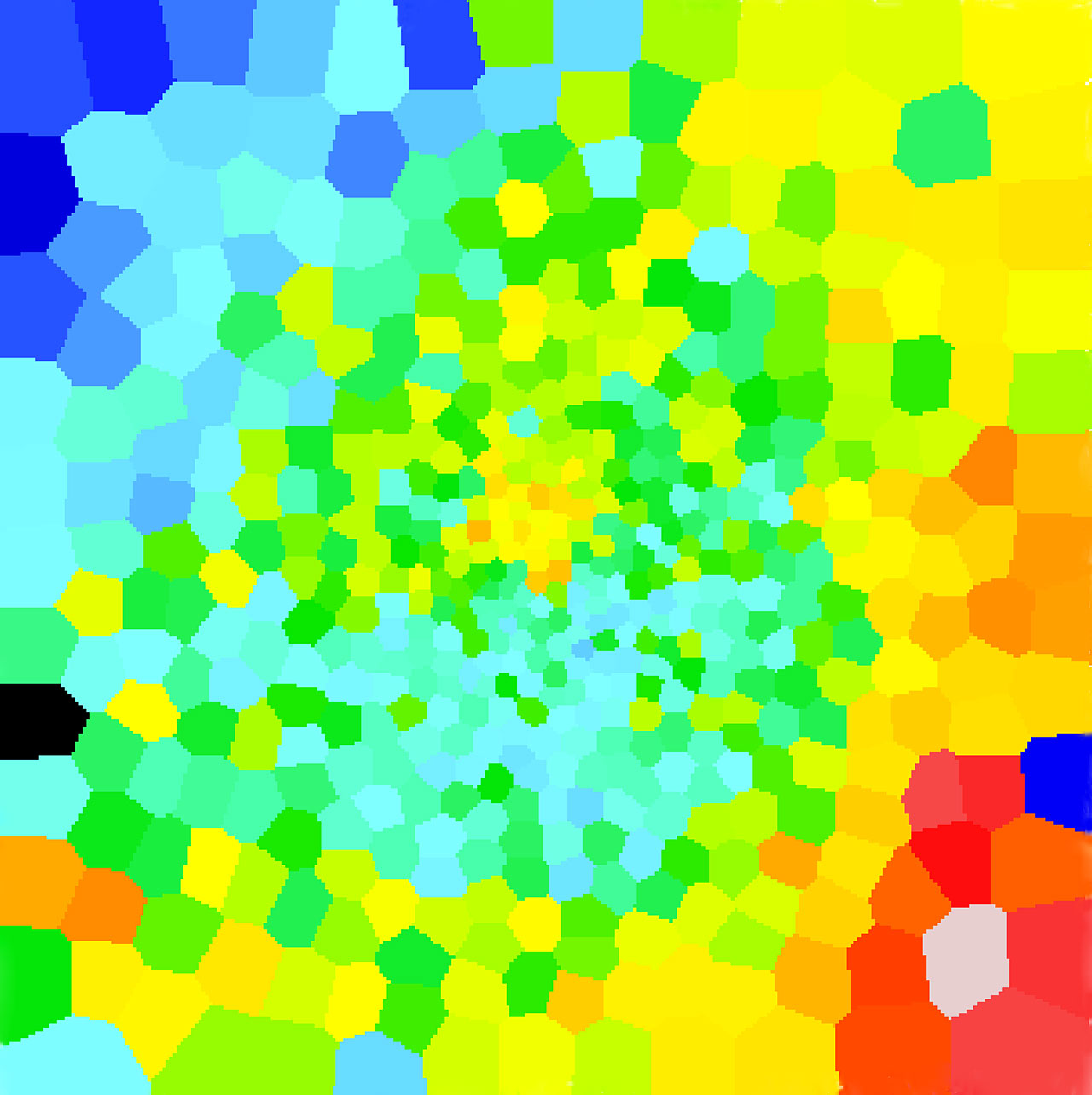
M87 is one of the most massive galaxies in the local Universe. Its diameter is estimated at 132,000 light-years, which is approximately 51% larger than that of the Milky Way. As an elliptical galaxy, the galaxy is a spheroid rather than a flattened disc, accounting for the substantially larger mass of M87. Within a radius of 32 kpc, the mass is times the mass of the Sun, which is double the mass of the Milky Way galaxy. As with other galaxies, only a fraction of this mass is in the form of stars: M87 has an estimated mass to luminosity ratio of 6.3 ± 0.8; that is, only about one part in six of the galaxy's mass is in the form of stars that radiate energy. This ratio varies from 5 to 30, approximately in proportion to r in the region of 9 - from the core. The total mass of M87 may be 200 times that of the Milky Way.
The galaxy experiences an infall of gas at the rate of two to three solar masses per year, most of which may be accreted onto the core region. The extended stellar envelope of this galaxy reaches a radius of about 150 kpc, compared with about 100 kpc for the Milky Way. Beyond that distance the outer edge of the galaxy has been truncated by some means; possibly by an earlier encounter with another galaxy. There is evidence of linear streams of stars to the northwest of the galaxy, which may have been created by tidal stripping of orbiting galaxies or by small satellite galaxies falling in toward M87. Moreover, a filament of hot, ionized gas in the northeastern outer part of the galaxy may be the remnant of a small, gas-rich galaxy that was disrupted by M87 and could be feeding its active nucleus. M87 is estimated to have at least 50 satellite galaxies, including NGC 4486B and NGC 4478.
The spectrum of the nuclear region of M87 shows the emission lines of various ions, including hydrogen (HI, HII), helium (HeI), oxygen (OI, OII, OIII), nitrogen (NI), magnesium (MgII), and sulfur (SII). The line intensities for weakly ionized atoms (such as neutral atomic oxygen, OI) are stronger than those of strongly ionized atoms (such as doubly ionized oxygen, OIII). A galactic nucleus with such spectral properties is termed a LINER, for "low-ionization nuclear emission-line region". The mechanism and source of weak-line-dominated ionization in LINERs and M87 are under debate. Possible causes include shock-induced excitation in the outer parts of the disk or photoionization in the inner region powered by the jet.
Elliptical galaxies such as M87 are believed to form as the result of one or more mergers of smaller galaxies. They generally contain relatively little cold interstellar gas (in comparison with spiral galaxies) and they are populated mostly by old stars, with little or no ongoing star formation. M87's elliptical shape is maintained by the random orbital motions of its constituent stars, in contrast to the more orderly rotational motions found in a spiral galaxy such as the Milky Way. Using the Very Large Telescope to study the motions of about 300 planetary nebulae, astronomers have determined that M87 absorbed a medium-sized star-forming spiral galaxy over the last billion years. This has resulted in the addition of some younger, bluer stars to M87. The distinctive spectral properties of the planetary nebulae allowed astronomers to discover a chevron-like structure in M87's halo which was produced by the incomplete phase-space mixing of a disrupted galaxy.
Components
Supermassive black hole M87*
The core of the galaxy contains a supermassive black hole (SMBH), designated M87*, whose mass is billions of times that of the Earth's Sun; estimates had ranged from to , surpassed by in 2016. In April 2019, the Event Horizon Telescope collaboration released measurements of the black hole's mass as (6.5 ± 0.2stat ± 0.7sys) × . This is one of the highest known masses for such an object. A rotating disk of ionized gas surrounds the black hole, and is roughly perpendicular to the relativistic jet. The disk rotates at velocities of up to roughly 1,000 km/s or the speed of light, and spans a maximum diameter of 25,000 AU. By comparison, Pluto averages 39 AU from the Sun. Gas accretes onto the black hole at an estimated rate of one solar mass every ten years (about 90 Earth masses per day). The Schwarzschild radius of the black hole is 120 AU. The diameter of the ring of emission, as seen from Earth, is 42 μas (microarcsecond). By comparison, the diameter of the core of M87 is 45" (as, arcsecond), and the size of M87 is 7.2' x 6.8' (am, arcminute).
A 2010 paper suggested that the black hole may be displaced from the galactic center by about 7 pc.
Imaging
This black hole was the first to be imaged. Data to produce the image was taken in April 2017, the image was produced in 2018 and was published on 10 April 2019. surrounded by an asymmetric emission ring with a diameter of 690 AU. The shadow radius is 2.6 times that of the black hole's Schwarzschild radius. The asymmetry in the brightness of the ring is due to relativistic beaming, whereby material moving towards the observer at relativistic velocities appears brighter. The visible material around the black hole rotates mostly clockwise with respect to the observer, which due to the direction of the axis of rotation causes the bottom part of the emission region to have a component of velocity toward the observer. The rotation parameter was estimated at a=0.9 \pm 0.1, corresponding to a rotation speed This is consistent with the value of a=1.00 \pm 0.15 obtained with the outflow method.
After the black hole had been imaged, it was named Pōwehi, a Hawaiian word meaning "the adorned fathomless dark creation", taken from the ancient creation chant Kumulipo.
On 24 March 2021, the Event Horizon Telescope collaboration revealed an unprecedented unique view of the M87 black hole shadow: how it looks in polarized light. Polarization is a powerful tool which allows astronomers to probe physics behind the image in more detail. Light polarization informs us about the strength and orientation of magnetic fields in the ring of light around the black hole shadow. Knowing those is essential to understand how M87's supermassive black hole is launching jets of magnetized plasma, which expand at relativistic speeds beyond the M87 galaxy.

In April 2023, a team developed a new principal-component interferometric modeling (PRIMO) technique to produce sharper image reconstructions from EHT data. They applied this to the original EHT observations of the M87 black hole, yielding a crisper final image and allowing closer testing of the alignment of observations to theory.
Jet
The relativistic jet of matter emerging from the core extends at least 1.5 kpc from the nucleus and consists of matter ejected from a supermassive black hole. The jet is highly collimated, appearing constrained to an angle of 60° within 0.8 pc of the core, to about 16° at 2 pc, and to 6–7° at 12 pc. Its base has the diameter of and is probably powered by a prograde accretion disk around the spinning supermassive black hole. The German-American astronomer Walter Baade found that light from the jet was plane polarized, which suggests that the energy is generated by the acceleration of electrons moving at relativistic velocities in a magnetic field. The total energy of these electrons is estimated at ergs ( or ). This is roughly times the energy produced in the entire Milky Way in one second, which is estimated at The jet is surrounded by a lower-velocity non-relativistic component. There is evidence of a counter jet, but it remains unseen from the Earth due to relativistic beaming. The jet is precessing, causing the outflow to form a helical pattern out to 1.6 pc. Lobes of expelled matter extend out to 80 kpc.
In pictures taken by the Hubble Space Telescope in 1999, the motion of M87's jet was measured at four to six times the speed of light. This phenomenon, called superluminal motion, is an illusion caused by the relativistic velocity of the jet. The time interval between any two light pulses emitted by the jet is, as registered by the observer, less than the actual interval due to the relativistic speed of the jet moving in the direction of the observer. This results in perceived faster-than-light speeds, though the jet itself has a velocity of only 80–85% the speed of light. Detection of such motion is used to support the theory that quasars, BL Lacertae objects and radio galaxies may all be the same phenomenon, known as active galaxies, viewed from different perspectives. It is proposed that the nucleus of M87 is a BL Lacertae object (of lower luminosity than its surrounds) seen from a relatively large angle. Flux variations, characteristic of the BL Lacertae objects, have been observed in M87.
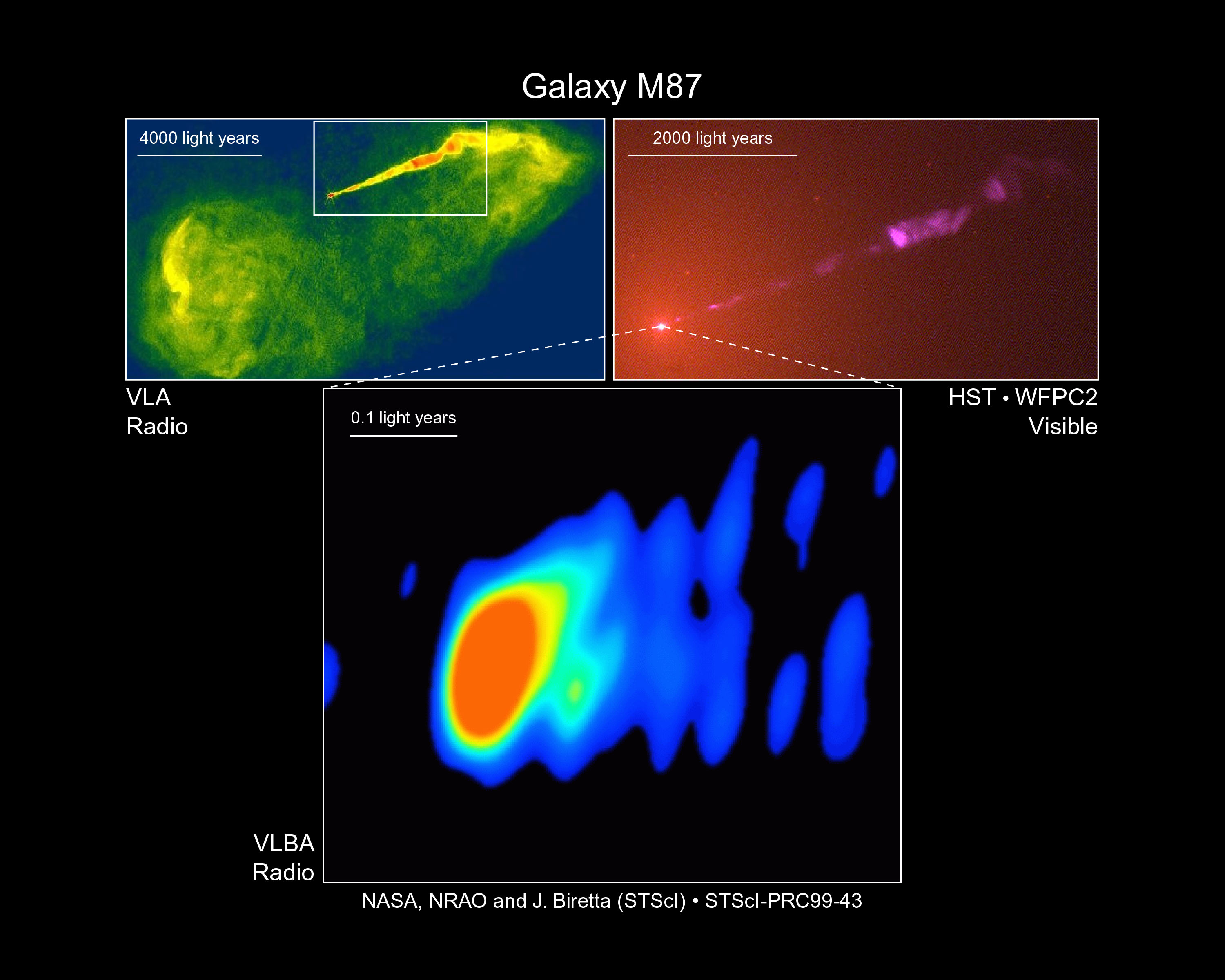
Observations indicate that the rate at which material is ejected from the supermassive black hole is variable. These variations produce pressure waves in the hot gas surrounding M87. The Chandra X-ray Observatory has detected loops and rings in the gas. Their distribution suggests that minor eruptions occur every few million years. One of the rings, caused by a major eruption, is a shock wave 26 kpc in diameter around the black hole. Other features observed include narrow X-ray-emitting filaments up to 31 kpc long, and a large cavity in the hot gas caused by a major eruption 70 million years ago. The regular eruptions prevent a huge reservoir of gas from cooling and forming stars, implying that M87's evolution may have been seriously affected, preventing it from becoming a large spiral galaxy.
M87 is a very strong source of gamma rays, the most energetic rays of the electromagnetic spectrum. Gamma rays emitted by M87 have been observed since the late 1990s. In 2006, using the High Energy Stereoscopic System Cherenkov telescopes, scientists measured the variations of the gamma ray flux coming from M87, and found that the flux changes over a matter of days. This short period indicates that the most likely source of the gamma rays is a supermassive black hole. In general, the smaller the diameter of the emission source, the faster the variation in flux.
A knot of matter in the jet (designated HST-1), about 65 pc from the core, has been tracked by the Hubble Space Telescope and the Chandra X-ray Observatory. By 2006, the X-ray intensity of this knot had increased by a factor of 50 over a four-year period, while the X-ray emission has since been decaying in a variable manner.
The interaction of relativistic jets of plasma emanating from the core with the surrounding medium gives rise to radio lobes in active galaxies. The lobes occur in pairs and are often symmetrical. The two radio lobes of M87 together span about 80 kiloparsecs; the inner parts, extending up to 2 kiloparsecs, emit strongly at radio wavelengths. Two flows of material emerge from this region, one aligned with the jet itself and the other in the opposite direction. The flows are asymmetrical and deformed, implying that they encounter a dense intra-cluster medium. At greater distances, both flows diffuse into two lobes. The lobes are surrounded by a fainter halo of radio-emitting gas.
Interstellar medium
The space between the stars in M87 is filled with a diffuse interstellar medium of gas that has been chemically enriched by the elements ejected from stars as they passed beyond their main sequence lifetime. Carbon and nitrogen are continuously supplied by stars of intermediate mass as they pass through the asymptotic giant branch. The heavier elements from oxygen to iron are produced largely by supernova explosions within the galaxy. Of the heavy elements, about 60% were produced by core-collapse supernovae, while the remainder came from type Ia supernovae.
The distribution of oxygen is roughly uniform throughout, at about half of the solar value (i.e., oxygen abundance in the Sun), while iron distribution peaks near the center where it approaches the solar iron value. Since oxygen is produced mainly by core-collapse supernovae, which occur during the early stages of galaxies, and mostly in outer star-forming regions, the distribution of these elements suggests an early enrichment of the interstellar medium from core-collapse supernovae and a continuous contribution from type Ia supernovae throughout the history of M87. The contribution of elements from these sources was much lower than in the Milky Way.
| Fe | 0.95 ± 0.03 |
|---|
Examination of M87 at far infrared wavelengths shows an excess emission at wavelengths longer than 25 μm. Normally, this may be an indication of thermal emission by warm dust. In the case of M87, the emission can be fully explained by synchrotron radiation from the jet; within the galaxy, silicate grains are expected to survive for no more than 46 million years because of the X-ray emission from the core. This dust may be destroyed by the hostile environment or expelled from the galaxy. The combined mass of dust in M87 is no more than 70,000 times the mass of the Sun. By comparison, the Milky Way's dust equals about a hundred million () solar masses.
Although M87 is an elliptical galaxy and therefore lacks the dust lanes of a spiral galaxy, optical filaments have been observed in it, which arise from gas falling towards the core. Emission probably comes from shock-induced excitation as the falling gas streams encounter X-rays from the core region. These filaments have an estimated mass of about 10,000 . Surrounding the galaxy is an extended corona with hot, low-density gas.
Globular clusters
M87 has an abnormally large population of globular clusters. A 2006 survey out to an angular distance of 25′ from the core estimates that there are clusters in orbit around M87, compared with 150–200 in and around the Milky Way. The clusters are similar in size distribution to those of the Milky Way, most having an effective radius of 1 to 6 parsecs. The size of the M87 clusters gradually increases with distance from the galactic center. Within a 4 kpc radius of the core, the cluster metallicity—the abundance of elements other than hydrogen and helium—is about half the abundance in the Sun. Outside this radius, metallicity steadily declines as the cluster distance from the core increases. Clusters with low metallicity are somewhat larger than metal-rich clusters. In 2014, HVGC-1, the first hypervelocity globular cluster, was discovered escaping from M87 at 2,300 km/s. The escape of the cluster with such a high velocity was speculated to have been the result of a close encounter with, and subsequent gravitational kick from, a supermassive black hole binary.
Almost a hundred ultra-compact dwarfs have been identified in M87. They resemble globular clusters but have a diameter of 10 pc or more, much larger than the 3 pc maximum of globular clusters. It is unclear whether they are dwarf galaxies captured by M87 or a new class of massive globular cluster.
Environment
Main article: Virgo Cluster

M87 is near (or at) the center of the Virgo Cluster, a closely compacted structure of about 2,000 galaxies. This forms the core of the larger Virgo Supercluster, of which the Local Group (including the Milky Way) is an outlying member. It is organized into at least three distinct subsystems associated with the three large galaxies—M87, M49 and M86—with the core subgroup including M87 (Virgo A) and M49 (Virgo B). There is a preponderance of elliptical and S0 galaxies around M87. A chain of elliptical galaxies roughly aligns with the jet. In terms of mass, M87 is likely to be the largest, and coupled with centrality appears to be moving very little relative to the cluster as a whole. It is defined in one study as the cluster center. The cluster has a sparse gaseous medium that emits X-rays, lower in temperature toward the middle. The combined mass of the cluster is estimated to be 0.15 to
Measurements of the motion of those intracluster starburst ("planetary") nebulae between M87 and M86 suggest that the two galaxies are moving toward each other and that this may be their first encounter. M87 may have interacted with M84, as evidenced by the truncation of M87's outer halo by tidal interactions. The truncated halo may also have been caused by contraction due to an unseen mass falling into M87 from the rest of the cluster, which may be the hypothesized dark matter. A third possibility is that the halo's formation was truncated by early feedback from the active galactic nucleus.
Notes
References
--
. The dimensions of 7′.2 x 6′.8 refer to the size of the halo as visible in amateur astronomy. "The galaxy is up to 4′ diameter in 25 cm. The 45″ core is of very high surface brightness."
The authors give a metallicity of: :\begin{smallmatrix}\left[\frac{Fe}{H}\right]\ =\ -0.3\end{smallmatrix} within a 3-kiloparsec radius of the galactic core.
References
- (1991). "Third Reference Catalogue of Bright Galaxies".
- "Messier 87".
- Overbye, Dennis. (24 March 2021). "The most intimate portrait yet of a black hole – Two years of analyzing the polarized light from a galaxy's giant black hole has given scientists a glimpse at how quasars might arise". [[The New York Times]].
- (11 May 2013). "Multicolour–metallicity relations from globular clusters in NGC 4486 (M87)". Monthly Notices of the Royal Astronomical Society.
- CAS. (7 July 2023). "Black Hole Unmasked: Astronomers Capture First Image of Accretion Ring and Relativistic Jet". [[SciTech (magazine).
- Lu, Donna. (12 April 2019). "How do you name a black hole? It is actually pretty complicated".
- Overbye, Dennis. (24 January 2024). "That Famous Black Hole Gets a Second Look - Repeated studies of the supermassive black hole in the galaxy Messier 87 confirm that it continues to act as Einstein's theory predicted it would.". [[The New York Times]].
- (2018). "The photocentre-AGN displacement: Is M87 actually harbouring a displaced supermassive black hole?". Monthly Notices of the Royal Astronomical Society.
- (2000-01-01). "Viewing the shadow of the black hole at the galactic center". The Astrophysical Journal.
- (Nov 2019). "Black Hole Spin and Accretion Disk Magnetic Field Strength Estimates for More Than 750 Active Galactic Nuclei and Multiple Galactic Black Holes". The Astrophysical Journal.
- "Telescopes unite in unprecedented observations of famous black hole". [[Atacama Large Millimeter Array]].
- Mele, Christopher. (13 April 2019). "That first black hole seen in an image is now called Pōwehi, at least in Hawaii". [[The New York Times]].
- (2021). "First M87 Event Horizon Telescope results. VII. Polarization of the ring". The Astrophysical Journal.
- (2021). "First M87 Event Horizon Telescope results. VIII. Magnetic field structure near the event horizon". The Astrophysical Journal.
- (14 April 2021). "Telescopes unite in unprecedented observations of famous black hole". [[NASA]].
- (2023-04-13). "The 1st-ever photo of a supermassive black hole just got an AI 'makeover' and it looks absolutely amazing".
- (April 2023). "The Image of the M87 Black Hole Reconstructed with PRIMO". The Astrophysical Journal Letters.
- (January 2009). "On radio source selection to define a stable celestial frame". [[Astronomy and Astrophysics]].
- (11 May 2011). "The ATLAS3D project – I. A volume-limited sample of 260 nearby early-type galaxies: science goals and selection criteria". Monthly Notices of the Royal Astronomical Society.
- Ferrarese, L.. (June 2006). "The ACS Virgo Cluster Survey. VI. Isophotal Analysis and the Structure of Early-Type Galaxies". [[The Astrophysical Journal Supplement Series]].
- Baade, W.. (January 1954). "On the Identification of Radio Sources". The Astrophysical Journal.
- Binggeli, B.. (August 1987). "Studies of the Virgo cluster. VI – Morphological and kinematical structure of the Virgo cluster". The Astronomical Journal.
- Wu, X.. (2006). "Deriving the Mass Distribution of M87 from Globular Clusters". The Astrophysical Journal.
- Tamura, N.. (2006). "A Subaru/Suprime-Cam wide-field survey of globular cluster populations around M87 – I. Observation, data analysis and luminosity function". Monthly Notices of the Royal Astronomical Society.
- Biretta, J.A.. (August 1999). "Hubble Space Telescope Observations of Superluminal Motion in the M87 Jet". The Astrophysical Journal.
- Biretta, J.. (6 January 1999). "Hubble detects faster-than-light motion in Galaxy M87". Space Telescope Science Institute.
- Wirsing, B.. (26 October 2006). "Discovery of Gamma Rays from the Edge of a Black Hole". Max Planck Society.
- Doherty, M.. (August 2009). "The edge of the M87 halo and the kinematics of the diffuse light in the Virgo cluster core". Astronomy and Astrophysics.
- Klotz, I.. (8 June 2009). "Galaxy's outer halo lopped off".
- Basu, B.. (2010). "An Introduction to Astrophysics". PHI Learning Pvt. Ltd..
- Dreyer, J. L. E.. (1888). "A New General Catalogue of Nebulae and Clusters of Stars, being the Catalogue of the late Sir John F.W. Herschel, Bart., revised, corrected, and enlarged". Memoirs of the Royal Astronomical Society.
- Curtis, H. D.. (1918). "Descriptions of 762 Nebulae and Clusters Photographed with the Crossley Reflector". Publications of the Lick Observatory.
- Hubble, E. P.. (October 1922). "A general study of diffuse galactic nebulae". [[The Astrophysical Journal]].
- Hubble, E. P.. (December 1926). "Extragalactic nebulae". The Astrophysical Journal.
- Hubble, E.. (October 1923). "Messier 87 and Belanowsky's Nova". [[Publications of the Astronomical Society of the Pacific]].
- Shklovskii, I. S.. (August 1980). "Supernovae in Multiple Systems". [[Soviet Astronomy]].
- Hubble, E.. (July 1931). "The Velocity-Distance Relation among Extra-Galactic Nebulae". The Astrophysical Journal.
- Stanley, G. J.. (June 1950). "Galactic Radiation at Radio Frequencies. II. The Discrete Sources". Australian Journal of Scientific Research A.
- Baldwin, J. E.. (August 1956). "Radio emission from the extragalactic nebula M87". [[The Observatory (journal).
- Burns, J. O.. (1981). "A search for neutral hydrogen in D and cD galaxies". The Astronomical Journal.
- Park, K. S.. (June 1987). "Dynamical Structure of NGC 4486". Journal of Astronomy and Space Science.
- Jones, M. H.. (2004). "An introduction to galaxies and cosmology". Cambridge University Press.
- Kundu, A.. (2001). "New Insights from HST Studies of Globular Cluster Systems. I. Colors, Distances, and Specific Frequencies of 28 Elliptical Galaxies". The Astronomical Journal.
- Oemler, A. Jr.. (November 1976). "The structure of elliptical and cD galaxies". The Astrophysical Journal.
- Whitmore, B. C.. (15–17 May 1989). "Effect of the Cluster Environment on Galaxies". Cambridge University Press.
- Clark, R. N.. (1990). "Visual astronomy of the deep sky". Cambridge University Press.
- Charles, P. A.. (1995). "Exploring the X-ray universe". Cambridge University Press.
- Bradt, H.. (June 1968). "Celestial Positions of X-ray Sources in Sagittarius". The Astrophysical Journal.
- Lea, S. M.. (November 1982). "Einstein Observatory solid state spectrometer observations of M87 and the Virgo cluster". Astrophysical Journal, Part 1.
- Turland, B. D.. (February 1975). "Observations of M87 at 5 GHz with the 5-km telescope". [[Monthly Notices of the Royal Astronomical Society]].
- Cohen, J. G.. (September 1997). "The Dynamics of the M87 Globular Cluster System". The Astrophysical Journal.
- Janowiecki, S.. (June 2010). "Diffuse Tidal Structures in the Halos of Virgo Ellipticals". The Astrophysical Journal.
- (2006). "The Outburst of HST-1 in the M87 Jet". The Astrophysical Journal.
- (July 2009). "Variability time scales in the M87 Jet: Signatures of E squared losses, discovery of a quasi-period in HST-1, and the site of TeV flaring". The Astrophysical Journal.
- Chakrabarty, D.. (2007). "Mass modelling with minimum kinematic information". Monthly Notices of the Royal Astronomical Society.
- Merritt, D.. (December 1993). "The distribution of dark matter in the halo of M87". The Astronomical Journal.
- Werner, N.. (November 2006). "XMM-Newton high-resolution spectroscopy reveals the chemical evolution of M87". Astronomy and Astrophysics.
- Werner, N.. (February 2008). "Observations of metals in the intra-cluster medium". [[Space Science Reviews]].
- Finoguenov, A.. (January 2002). "X-ray evidence for spectroscopic diversity of type Ia supernovae: XMM observation of the elemental abundance pattern in M87". Astronomy and Astrophysics.
- Battaglia, G.. (December 2005). "The radial velocity dispersion profile of the Galactic halo: Constraining the density profile of the dark halo of the Milky Way". Monthly Notices of the Royal Astronomical Society.
- Leverington, D.. (2000). "New Cosmic Horizons: Space astronomy from the V2 to the Hubble Space Telescope". Cambridge University Press.
- Macchetto, F.. (November 1997). "The Supermassive Black Hole of M87 and the Kinematics of Its Associated Gaseous Disk". The Astrophysical Journal.
- (2003). "Accretion onto the supermassive black hole in M87". The Astrophysical Journal.
- Walsh, J.L.. (June 2013). "The M87 black hole mass from gas-dynamical models of Space Telescope Imaging Spectrograph observations". The Astrophysical Journal.
- (9 June 2010). "Black hole shoved aside, along with 'central' dogma".
- Batcheldor, D.. (July 2010). "A Displaced Supermassive Black Hole in M87". The Astrophysical Journal Letters.
- Gebhardt, K.. (2009). "The black hole mass, stellar mass-to-light ratio, and dark halo in M87". The Astrophysical Journal.
- Klein, Uli. (15–19 September 1997). "The large-scale structure of Virgo A". Springer.
- "Visual observations of the M87 jet". Astronomy-Mall.
- Madrid, J.P.. (2009). "Structural Parameters of the Messier 87 Globular Clusters". The Astrophysical Journal.
- (July 2010). "The Herschel Virgo Cluster Survey. VI. The far-infrared view of M87". Astronomy and Astrophysics.
- Bird, S.. (December 2010). "The inner halo of M87: A first direct view of the red-giant population". Astronomy and Astrophysics.
- Côté, P.. (July 2004). "The ACS Virgo Cluster Survey. I. Introduction to the survey". [[The Astrophysical Journal Supplement Series]].
- Kovalev, Y.Y.. (October 2007). "The inner jet of the radio galaxy M87". The Astrophysical Journal.
- Burbidge, G.R.. (September 1956). "On synchrotron radiation from Messier 87". The Astrophysical Journal.
- Sparks, W.B.. (February 1992). "A counterjet in the elliptical galaxy M87". [[Nature (journal).
- Cooke, A.. (2005). "Visual Astronomy Under Dark Skies: A new approach to observing deep space". Springer-Verlag.
- Clemens, M. S.. (July 2010). "The Herschel Virgo Cluster Survey. III. A constraint on dust grain lifetime in early-type galaxies". Astronomy and Astrophysics.
- Jones, M. H.. (2004). "An introduction to galaxies and cosmology". Cambridge University Press.
- Dehnen, Walter. (15–19 September 1997). "M 87 as a Galaxy". Springer.
- Steinicke, W.. (2007). "Galaxies and how to observe them". Springer.
- Gebhardt, K.. (March 2011). "The Black-Hole Mass in M87 from Gemini/NIFS Adaptive Optics Observations". The Astrophysical Journal.
- Drake, S. A.. "A Brief History of High-Energy Astronomy: 1965–1969".
- Murphy, J. D.. (March 2011). "Galaxy Kinematics with VIRUS-P: The Dark Matter Halo of M87". The Astrophysical Journal.
- Matveyenko, L. I.. (March 2011). "Fine core-jet structure of the galaxy M87". [[Astronomy Letters]].
- Shi, Y.. (2007). "Thermal and Nonthermal Infrared Emission from M87". The Astrophysical Journal.
- Gavazzi, G.. (September 2000). "The filament of ionized gas in the outskirt of M87". Astronomy & Astrophysics.
- Reimer, A.. (July 2003). "M87 as a Misaligned Synchrotron-Proton Blazar". Proceedings of the 28th International Cosmic Ray Conference.
- Tsvetanov, Z.I.. (February 1998). "M87: A misaligned BL Lacertae object?". The Astrophysical Journal.
- "Hubble follows spiral flow of black-hole-powered jet". [[European Space Agency]] / Hubble [[Space Telescope Science Institute]].
- Hubble, E.P.. (1936). "The Realm of the Nebulae". [[Yale University Press]].
- (May 1978). "Dynamical evidence for a central mass concentration in the galaxy M87". The Astrophysical Journal.
- (November 1994). "HST FOS spectroscopy of M87: Evidence for a disk of ionized gas around a massive black hole". [[The Astrophysical Journal Letters]].
- (25 June 2015). "Giant galaxy is still growing".
- "Galactic chromodynamics".
- (November 2014). "A kinematically distinct core and minor-axis rotation: The MUSE perspective on M87". Monthly Notices of the Royal Astronomical Society.
- (October 2016). "Is there substructure around M87?". Monthly Notices of the Royal Astronomical Society.
- (1998). "Hubble Revisited: New images from the discovery machine". Copernicus New York.
- (July 2015). "The build-up of the cD halo of M87 – evidence for accretion in the last Gyr". Astronomy and Astrophysics.
- (May 2014). "A globular cluster toward M87 with a radial velocity < −1000 km/s: The first hypervelocity cluster". The Astrophysical Journal Letters.
- (March 2015). "The Next Generation Virgo Cluster Survey. VI. The kinematics of ultra-compact dwarfs and globular clusters in M87". The Astrophysical Journal.
- (October 2012). "Jet-Launching Structure Resolved Near the Supermassive Black Hole in M87". Science.
- van den Bergh, S.. (September 1999). "The local group of galaxies". [[The Astronomy and Astrophysics Review]].
- "Virgo cluster". [[NASA]].
- (November 2000). "M87 at 90 centimeters: A different picture". The Astrophysical Journal.
- "M87–Giant Elliptical Galaxy". Caltech.
- Schneider, P.. (2006). "Extragalactic Astronomy and Cosmology: An introduction". Springer-Verlag.
- Dopita, M.A.. (November 1997). "The LINER nucleus of M87: A shock-excited dissipative accretion disk". The Astrophysical Journal.
- Sabra, B.M.. (February 2003). "Emission and Absorption in the M87 LINER". The Astrophysical Journal.
- "The Local Universe". University of Leiden.
- Courtois, H.M.. (August 2013). "Cosmography of the local universe". [[The Astronomical Journal]].
- "Local Universe". University of Wisconsin-Madison.
- (October 1979). "The system of filaments in M87 – Evidence for matter falling into an active nucleus". Astrophysical Journal Supplement Series.
- Peterson, B.M.. (26–30 June 2000). "Variability of active galactic nuclei". [[World Scientific]].
- The Event Horizon Telescope Collaboration. (2019). "First M87 Event Horizon Telescope results. IV. Imaging the central supermassive black hole". The Astrophysical Journal.
- Jeffrey, K.. (10 April 2019). "These are the first pictures of a black hole – And that's a big, even supermassive, deal".
- (November 2019). "Measurement of the spin of the M87 black hole from its observed twisted light". Monthly Notices of the Royal Astronomical Society Letters.
- (10 April 2019). "First M87 Event Horizon Telescope results". The Astrophysical Journal Letters.
- Overbye, Dennis. (10 April 2019). "Black hole picture revealed for the first time". [[The New York Times]].
- The Event Horizon Telescope Collaboration. (10 April 2019). "First M87 Event Horizon Telescope results. I. The shadow of the supermassive black hole". [[The Astrophysical Journal Letters]].
- Landau, Elizabeth. (10 April 2019). "Black Hole Image Makes History". [[NASA]].
- Akiyama, Kazunori. (July 2015). "230 GHz VLBI observations of M87: Event-horizon-scale structure during an enhanced very-high-energy γ-ray state in 2012". The Astrophysical Journal.
- (10 April 2019). "First M87 Event Horizon Telescope results. VI. The shadow and mass of the central black hole". The Astrophysical Journal.
- (1922). "Ein merkwürdiger veränderlicher oder Neuer Stern". Astronomische Nachrichten.
- "SN{{nbsp}}1919A". [[International Astronomical Union.
This article was imported from Wikipedia and is available under the Creative Commons Attribution-ShareAlike 4.0 License. Content has been adapted to SurfDoc format. Original contributors can be found on the article history page.
Ask Mako anything about Messier 87 — get instant answers, deeper analysis, and related topics.
Research with MakoFree with your Surf account
Create a free account to save articles, ask Mako questions, and organize your research.
Sign up freeThis content may have been generated or modified by AI. CloudSurf Software LLC is not responsible for the accuracy, completeness, or reliability of AI-generated content. Always verify important information from primary sources.
Report