From Surf Wiki (app.surf) — the open knowledge base
Messier 2
Globular cluster in the constellation Aquarius

Globular cluster in the constellation Aquarius
| Field | Value | |
|---|---|---|
| name | Messier 2 | |
| image | [[Image:Messier2 - HST - Potw1913a.jpg | 250px]] |
| caption | Messier 2 by Hubble Space Telescope; 2.5 view | |
| epoch | J2000 | |
| class | II | |
| constellation | Aquarius | |
| ra | ||
| dec | ||
| dist_ly | 55000 ly | |
| appmag_v | 6.5 | |
| size_v | 16.0 | |
| mass_msol | ||
| radius_ly | 87.3 ly | |
| metal_fe | –1.65 | |
| age | 12.5 Gyr | |
| names | NGC 7089 |
Messier 2 or M2 (also designated NGC 7089) is a globular cluster in the constellation Aquarius, five degrees north of the star Beta Aquarii. It was discovered by Jean-Dominique Maraldi in 1746, and is one of the largest known globular clusters.
Discovery and visibility
M2 was discovered by the French astronomer Jean-Dominique Maraldi in 1746 Charles Messier rediscovered it in 1760, but thought that it is a nebula without any stars associated with it. William Herschel, in 1783, was the first to resolve individual stars in the cluster.
M2 is, under extremely good conditions, just visible to the naked eye. Binoculars or a small telescope will identify this cluster as non-stellar, while larger telescopes will resolve individual stars, of which the brightest is of apparent magnitude 12.
Characteristics
M2 is about 55,000 light-years distant from Earth. At 175 light-years in diameter, it is one of the larger globular clusters known. The cluster is rich, compact, and significantly elliptical. It is 12.5 billion years old and one of the older globular clusters associated with the Milky Way galaxy.
M2 contains about 150,000 stars, including 21 known variable stars. Its brightest stars are red and yellow giant stars. The overall spectral type is F4. M2 is part of the Gaia Sausage, the hypothesized remains of a merged dwarf galaxy.
Data from Gaia has led to the discovery of an extended tidal stellar stream, about 45 degrees long and 300 light-years (100 pc) wide, that is likely associated with M2. It was possibly perturbed due to the presence of the Large Magellanic Cloud.
Messier 2 is located within our Milky Way galaxy, and is one of the oldest clusters of stars designated to the Milky Way. Like most globular clusters, M2 is found within the galactic halo, specifically in the southern galactic cap. This places it right below the southern pole of the Milky Way.
Oosterhoff classification
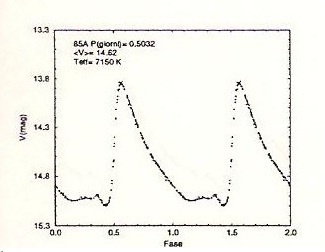
M2 is defined as an Oosterhoff type II globular cluster. Oosterhoff type is a classification system of globular clusters originally observed by Pieter Oosterhoff in where globular clusters are generally separated into two types. Oosterhoff type is determined by metallicity, age, and average pulsation period of type ab RR Lyrae variable stars of the cluster. A cluster metallicity below −1.6, an age above 13 billion years, and an average RRab Lyrae pulsation period around .64 days indicates a type II cluster. This .64 day value, coupled with a metallicity of −1.65, provides evidence that M2 follows the Oosterhoff Gap phenomena. This is an observed gap in the grouping of type I and type II clusters in the Milky Way on a metallicity vs average RRab pulsation period plot.
M2 is a bit of an anomaly in reference to Oosterhoff type. While it satisfies the metallicity and RRab Lyrae pulsation period conditions, it actually has an age of 12.5 Gyr, well below the cutoff age of 13 Gyr normal for a Oosterhoff type II cluster. This is unexpected because age of a cluster is generally determined from metallicity. However, this abnormality is explained in an article by Marín-Franch.
References
References
- "Messier 2".
- distance × sin( diameter_angle / 2 ) = 87.3 ly. radius
- "THE GLOBULAR CLUSTER M2 – Astronomy Magazine – Interactive Star Charts, Planets, Meteors, Comets, Telescopes".
- admin. (2015-01-17). "Messier 2".
- "M2, NGC 7089".
- (2013-10-01). "RR Lyrae in the LMC: Insights Into the Oosterhoff Phenomenon".
- (2025-07-01). "Structural parameters of the globular cluster M 2 determined by ellipse fitting of its stellar density". Physica Scripta.
- (1987). "Astrometry and Photometry in the Globular Cluster System M2". The Astronomical Journal.
- (2022). "The Extended Tidal Tails of NGC 7089 (M2)". The Astrophysical Journal.
- (2018). "The Sausage Globular Clusters". The Astrophysical Journal.
- Stephen James O'Meara. (7 April 2014). "Deep-Sky Companions: The Messier Objects". Cambridge University Press.
- (2018). "Gaia Data Release 2: Kinematics of globular clusters and dwarf galaxies around the Milky Way". Astronomy and Astrophysics.
- (1971). "On the Difference Between the Oosterhoff Types i and II Globular Clusters". The Astrophysical Journal.
- (2009). "The ACS Survey of Galactic Globular Clusters. VII. Relative Ages". The Astrophysical Journal.
- van den Bergh, Sidney. (2011). "Some Systematics of Galactic Globular Clusters". Publications of the Astronomical Society of the Pacific.
- (December 2010). "The ACS Survey of Galactic Globular Clusters. X. New Determinations of Centers for 65 Clusters". The Astronomical Journal.
- (August 1927). "A Classification of Globular Clusters". Harvard College Observatory Bulletin.
- (November 2007). "A 1.4 GHz Arecibo Survey for Pulsars in Globular Clusters". The Astrophysical Journal.
- (November 2011). "Young Radio Pulsars in Galactic Globular Clusters". The Astrophysical Journal.
- "M 2".
This article was imported from Wikipedia and is available under the Creative Commons Attribution-ShareAlike 4.0 License. Content has been adapted to SurfDoc format. Original contributors can be found on the article history page.
Ask Mako anything about Messier 2 — get instant answers, deeper analysis, and related topics.
Research with MakoFree with your Surf account
Create a free account to save articles, ask Mako questions, and organize your research.
Sign up freeThis content may have been generated or modified by AI. CloudSurf Software LLC is not responsible for the accuracy, completeness, or reliability of AI-generated content. Always verify important information from primary sources.
Report