From Surf Wiki (app.surf) — the open knowledge base
Mercury(II) thiocyanate
Mercuric sulfocyanate slightly soluble in alcohol, ether | NFPA-H = 3 | NFPA-F = 1 | NFPA-R = 1
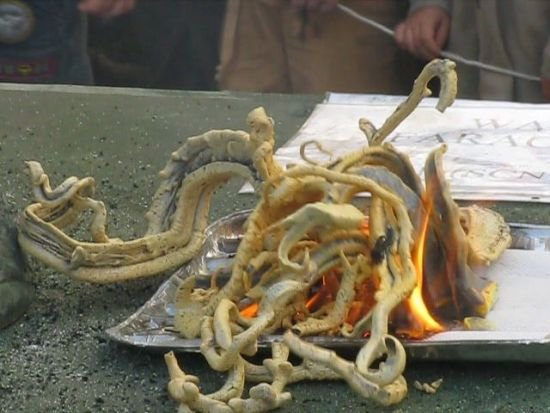
Mercury(II) thiocyanate () is an inorganic chemical compound, the coordination complex of and the thiocyanate anion. It is a white powder. It will produce a large, winding "snake" when ignited, an effect known as the Pharaoh's serpent.
Synthesis and structure
The first synthesis of mercury thiocyanate was probably completed in 1821 by Jöns Jacob Berzelius: :
Evidence for the first pure sample was presented in 1866 prepared by a chemist named Otto Hermes. Most syntheses are achieved by precipitation:
:
The compound adopts a polymeric structure with centres linearly coordinated to two S atoms with a distance of . Four weak interactions are indicated with distances of .
Reactions
Mercury thiocyanate has a few uses in chemical synthesis.
It is the precursor to other thiocyanate complexes such as potassium tris(thiocyanato)mercurate(II) () and caesium tris(thiocyanato)mercurate(II) (). The ion can also exist independently and is easily generated from the compounds above, amongst others.
Organic halides attack to give a mercuric halide and a mixture of the corresponding thiocyanate and isothiocyanate.
Mercuric thiocyanate catalyzes HSCN or BrSCN addition (either reagent formed in situ) to alkynes.
Use in chloride analysis
Mercury thiocyanate improves detection limits of chloride ions in water by UV-visible spectroscopy. The method involves the addition of mercury thiocyanate to a solution with an unknown concentration of chloride ions and iron as a reagent. The chloride ions cause the mercury thiocyanate salt to dissociate and the thiocyanate ion to bind Fe(III), which absorbs intensely at . This absorption allows for the measurement of the concentration of the iron complex. This value allows one to calculate the concentration of chloride. This technique was a standard method for the determination of chloride ions in laboratories worldwide.
Pharaoh's serpent
Main article: Black snake (firework)
Mercury thiocyanate was formerly used in pyrotechnics causing an effect known as the Pharaoh's serpent or Pharaoh's snake. The fireworks versions were a mixture with a small amount of potassium nitrate and gum arabic as a binder. This use ceased in most countries in the early 20th century due to the toxicity of mercury, and the existence of a superior alternatives.
Chemistry of the reaction
When heated, mercury(II) thiocyanate decomposes in an exothermic reaction that produces a large mass of coiling, serpent-like solids. The resulting solid can range from dark graphite gray to light tan in colour with the inside generally much darker than the outside. This was found to be due to decomposition of the produced β-HgS (black mercury sulfide) and vaporization of the resulting mercury from the outermost and hottest layers of the solid.
The decomposition of is exothermic on its own, and the produced ignites easily and burns off. The product is a simplification; the actual product contains 0.5% hydrogen and is likely to consist of sheets of triazine rings linked by and groups similar to and was found to contain nano-particles of β-HgS (black mercury sulfide).
The number of resonance structures of heptazine and triazine, varying molecular weights of samples, and the fluorescense of the product made acquiring spectra difficult even by relatively exotic methods of NMR (with one spectrum acquisition being run for 12 days straight to get a mostly clean reading). Because of this, a heptazine-based structure similar to Liebig's melon, a compound initially prepared around the same time that the pharoah's snake reaction was discovered, was not ruled out by the authors as a partial component of the solid material. The generalized reaction is as follows:
- (not all mercury sulfide decomposes)
References
References
- "Mercuric thiocyanate (Compound)".
- Davis, T. L.. (1940). "Pyrotechnic Snakes". Journal of Chemical Education.
- (1970). "Studies of the Liquid-Liquid Partition systems. VIII. The Solvent Extraction of Mercury (II) Chloride, Bromide, Iodide and Thiocyanate with Some Organic Solvents". Bulletin of the Chemical Society of Japan.
- (1 April 1972). "Structure cristalline et moléculaire du thiocyanate mercurique". Canadian Journal of Chemistry.
- (1998). "Solid-State 199Hg MAS NMR Studies of Mercury(II) Thiocyanate Complexes and Related Compounds. Crystal Structure of Hg(SeCN)2". Inorganic Chemistry.
- (1990). "Photolysis of Vinyl Halides. Reaction of Photogenerated Vinyl Cations with Cyanate and Thiocyanate Ions". Journal of Organic Chemistry.
- (2001). "Mercury(II) Thiocyanate".
- (1995). "Determination of chloride ions by reaction with mercury thiocyanate in the absence of iron(III) using a UV-photometric, flow injection method". Analyst.
- (1947). "Pyrotechnics". Chemical Pub. Co.
- (17 November 2017). "Pharaoh's Serpents: New Insights into a Classic Carbon Nitride Material". Zeitschrift für Anorganische und Allgemeine Chemie.
This article was imported from Wikipedia and is available under the Creative Commons Attribution-ShareAlike 4.0 License. Content has been adapted to SurfDoc format. Original contributors can be found on the article history page.
Ask Mako anything about Mercury(II) thiocyanate — get instant answers, deeper analysis, and related topics.
Research with MakoFree with your Surf account
Create a free account to save articles, ask Mako questions, and organize your research.
Sign up freeThis content may have been generated or modified by AI. CloudSurf Software LLC is not responsible for the accuracy, completeness, or reliability of AI-generated content. Always verify important information from primary sources.
Report