From Surf Wiki (app.surf) — the open knowledge base
Measles vaccine
Vaccine used to prevent measles

Vaccine used to prevent measles
| Field | Value |
|---|---|
| Verifiedfields | changed |
| verifiedrevid | 446097921 |
| image | File:Providing vaccinations to protect against disease after Typhoon Haiyan (11352296333).jpg |
| caption | A child is given a measles vaccine. |
| type | vaccine |
| target | Measles virus |
| vaccine_type | attenuated |
| Drugs.com | |
| MedlinePlus | a601176 |
| pregnancy_AU | |
| legal_AU | |
| legal_CA | |
| legal_UK | POM |
| legal_US | Rx-only |
| ChemSpiderID_Ref | |
| ChemSpiderID | none |
| CAS_number_Ref | |
| CAS_number | 1704515-59-2 |
| ATC_prefix | J07 |
| ATC_suffix | BD01 |
| DrugBank_Ref | |
| KEGG | D04866 |
| Drugs.com = Measles vaccine protects against becoming infected with measles.
The vaccine is generally safe, even for those infected by HIV. Most children do not experience any side effects; those that do occur are usually mild (such as fever, rash, pain at the site of injection, and joint stiffness) and short-lived.
The vaccine is available both by itself and in combinations such as the MMR vaccine (a combination with the rubella vaccine and mumps vaccine) The measles vaccine is equally effective for preventing measles in all formulations, but side effects vary for different combinations. The World Health Organization (WHO) recommends measles vaccine be given at nine months of age in areas of the world where the disease is common, or at twelve months where the disease is not common. Measles vaccine is based on a live but weakened strain of measles. It comes as a dried powder that is mixed with a specific liquid before being injected either just under the skin or into a muscle. Verification that the vaccine was effective can be determined by blood tests.
The measles vaccine was first introduced in 1963. In that year, the Edmonston-B strain of measles virus was turned into a vaccine by John Enders and colleagues and licensed in the United States. About 86% of children globally had received at least one dose of the vaccine as of 2018. In 2021, at least 183 countries provided two doses in their routine immunization schedule. It is on the World Health Organization's List of Essential Medicines. As outbreaks easily occur in under-vaccinated populations, non-prevalence of disease is seen as a test of sufficient vaccination within a population.
Effectiveness


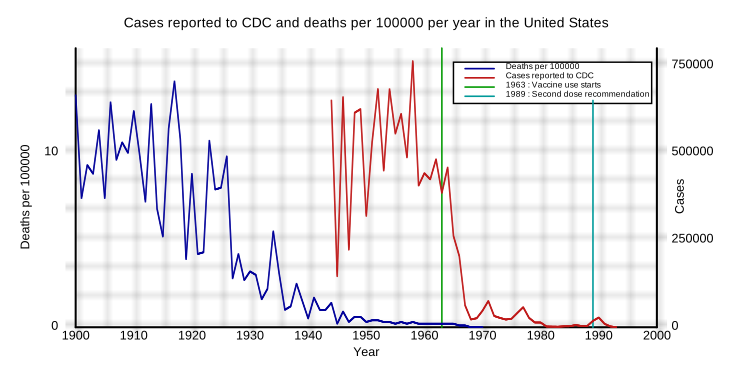
One dose is about 93% effective while two doses of the vaccine are about 97% effective at preventing measles. In the United States, reported cases of measles fell from 3 to 4 million with 400 to 500 deaths to tens of thousands of cases per year following introduction of two measles vaccines in 1963 (both an inactivated and a live attenuated vaccine (Edmonston B strain) were licensed for use, see chart at right). Increasing uptake of the vaccine following outbreaks in 1971 and 1977 brought this down to thousands of cases per year in the 1980s. An outbreak of almost 30,000 cases in 1990 led to a renewed push for vaccination and the addition of a second vaccine to the recommended schedule. No more than 220 cases were reported in any year from 1997 to 2013, and the disease was believed no longer endemic in the United States. In 2014, 667 cases were reported.
The benefits of measles vaccination in preventing illness, disability, and death have been well documented. Within the first 20 years of being licensed in the U.S., measles vaccination prevented an estimated 52 million cases of the disease, 17,400 cases of intellectual disability, and 5,200 deaths. From 1999 to 2004 a strategy led by the WHO and UNICEF led to improvements in measles vaccination coverage that averted an estimated 1.4 million measles deaths worldwide. The vaccine for measles led to the near-complete elimination of the disease in the United States and other developed countries.
Measles vaccination averted 57 million deaths between 2000 and 2022, as per World Health Organization report.
Measles is common worldwide. Although it was declared eliminated from the U.S. in 2000, high rates of vaccination and excellent communication with those who refuse vaccination are needed to prevent outbreaks and sustain the elimination of measles. This individual returned to a community with many unvaccinated children. The resulting outbreak infected 34 people, mostly children and virtually all unvaccinated; three of them were hospitalized. The public health response required making almost 5,000 phone calls as part of contact tracing, arranging and performing testing as needed, and arranging emergency vaccination for at-risk people who had had contact with this person. Taxpayers and local healthcare organizations likely paid more than US$167,000 in direct costs to contain this one outbreak. A major epidemic was averted due to high rates of vaccination in the surrounding communities.
When addressing the major U.S. measles outbreak in 2019, the Centers for Disease Control and Prevention stated that outbreaks are more likely in areas with pockets of unvaccinated residents. However, during the U.S. outbreak beginning in February 2025, the agency declined to publicize their updated expert assessment and forecasting model supporting this conclusion, thereby choosing not to alert clinicians and the public of being at specific risk in areas with low immunization rates.
The vaccine has nonspecific effects such as preventing respiratory infections, that may be greater than those of measles prevention alone.
The immune response to the measles vaccine can be impaired by the presence of parasitic infections such as helminthiasis.
Schedule
The World Health Organization (WHO) recommends two doses of vaccine for all children. In countries with a high risk of disease the first dose should be given around nine months of age. Otherwise it can be given at twelve months of age. The second dose should be given at least one month after the first dose. This is often done at age 15 to 18 months. After one dose at the age of nine months 85% are immune, while a dose at twelve months results in 95% immunity.
In the United States, the Centers for Disease Control and Prevention (CDC) recommends that children aged six to eleven months traveling outside the United States receive their first dose of MMR vaccine before departure and then receive two more doses; one at 12–15 months (12 months for children in high-risk areas) and the second as early as four weeks later. Otherwise the first dose is typically given at 12–15 months and the second at 4–6 years.
In the UK, the National Health Service (NHS) recommendation is for a first dose at around 13 months of age and the second at three years and four months old.
In Canada, Health Canada recommends that children traveling outside North America should receive an MMR vaccine if they are aged six to 12 months. However, after the child is 12 months old they should receive two additional doses to ensure long-lasting protection.
Adverse effects
Adverse effects associated with the MMR vaccine include fever, rash, injection site pain, and, in rare cases, red or purple discolorations on the skin known as thrombocytopenic purpura, or seizures related to fever (febrile seizure).
False claims about autism
Main article: MMR vaccine and autism
In 1998, Andrew Wakefield et al. published a now retracted and fraudulent The Lancet paper linking the MMR vaccine to autism, leading to a decline in vaccination rates. Wakefield was later found to have been "dishonest" by the General Medical Council and barred from practicing medicine in the UK. Numerous subsequent studies and reviews by organizations such as the US Centers for Disease Control and Prevention, Institute of Medicine, NHS and the Cochrane Library have found no evidence of a link between the MMR vaccine and autism. The controversy surrounding Wakefield's publication led to decreased MMR vaccination rates and a subsequent increase in measles cases in the UK. In Japan, where the MMR vaccine is not used as a combined vaccine, autism rates have remained unaffected, further disproving Wakefield's hypothesis.
According to a 2019 Los Angeles Times article, concerns were raised about unvaccinated students contributing to the large number of measles outbreaks.
While Robert F. Kennedy JrUnited States Secretary of Health and Human Services publicly supported Wakefield's disproven theory that vaccines cause autism, and was the founder of the anti-vaccine Children's Health Defense, on 28 February, during the 2025 Southwest US measles outbreak, he announced that he would be sending 2,000 doses of the MMR vaccine to Texas along with other resources. A New York Times article reporting on the death of a child in Texas from measlesthe first in ten years in the United States, said that vaccine hesitancy had been rising for many years.
Contraindications
Some people shouldn't receive the measles or MMR vaccine, including cases of:
- Pregnancy: MMR vaccine and its components should not be given to pregnant women. Women of childbearing age should check with their doctor about getting vaccinated prior to getting pregnant.
- HIV-infected children, who may receive measles vaccines if their CD4+ lymphocyte count is greater than 15%.
- Weakened immune system due to HIV/AIDS or certain medical treatments
- Having a parent or sibling with a history of immune problems
- Condition that makes a patient bruise or bleed easily
- Recent transfusion of blood or blood products
- Tuberculosis
- Receiving other vaccines in the past 4 weeks
- Moderate or severe illness. However, mild illness (e.g., common cold) is usually not contraindicated.
History

John Franklin Enders, who had shared the 1954 Nobel Prize in Medicine for work on the polio virus, sent Thomas C. Peebles to Fay School in Massachusetts, where an outbreak of measles was underway. Peebles was able to isolate the virus from blood samples and throat swabs. He later successfully cultivated the virus and showed that the disease could be passed on to monkeys inoculated with the material he had collected. Enders used the cultivated virus to develop a measles vaccine in 1963 by attenuation through cultured chicken embryo fibroblasts of the material isolated by Peebles.
In the late 1950s and early 1960s, nearly twice as many children died from measles as from polio. The vaccine Enders developed was based on the Edmonston strain of attenuated live measles virus, which was named for 11-year-old David Edmonston, the Fay student from whom Peebles had taken the culture that led to the virus's cultivation.
In the mid-20th century, measles was particularly devastating in West Africa, where child mortality rate was 50 percent before age five, and the children were struck with the type of rash and other symptoms common prior to 1900 in England and other countries. The first trial of a live attenuated measles vaccine was undertaken in 1960 by the British paediatrician David Morley in a village near Ilesha, Nigeria; in case he could be accused of exploiting the Nigerian population, Morley included his own four children in the study. The encouraging results led to a second study of about 450 children in the village and at the Wesley Guild Hospital in Ilesha.
Following another epidemic, a larger trial was undertaken in September and October 1962, in New York City with the assistance of the WHO: 131 children received the live Enders-attenuated Edmonston B strain plus gamma globulin, 130 children received a "further attenuated" vaccine without gamma globulin, and 173 children acted as control subjects for both groups. As also shown in the Nigerian trial, the trial confirmed that the "further attenuated" vaccine was superior to the Edmonston B vaccine, and caused significantly fewer instances of fever and diarrhea. 2,000 children in the area were vaccinated with the further-attenuated vaccine.
Maurice Hilleman at Merck & Co., a pioneer in the development of vaccinations, developed an improved version of the measles vaccine in 1968 and subsequently the MMR vaccine in 1971, which vaccinates against measles, mumps and rubella in a single shot followed by a booster. One form is called "Attenuvax". The measles component of the MMR vaccine uses Attenuvax, which is grown in a chick embryo cell culture using the Enders' attenuated Edmonston strain. Following ACIP recommendations, Merck decided not to resume production of Attenuvax as standalone vaccine on 21 October 2009.
A 2022 study in the American Economic Journal found that the measles vaccine uptake led to increases in income of 1.1 percent and positive effects on employment due to greater productivity by those who were vaccinated.
Types
Measles is seldom given as an individual vaccine and is often given in combination with rubella, mumps, or varicella (chickenpox) vaccines. Below is the list of measles-containing vaccines:
- Measles vaccine (standalone vaccine)
- Measles and rubella combined vaccine (MR vaccine)
- Mumps, measles and rubella combined vaccine (MMR vaccine)
- Mumps, measles, rubella and varicella combined vaccine (MMRV vaccine)
Society and culture
Most health insurance plans in the United States cover the cost of vaccines, and Vaccines for Children Program may be able to help those who do not have coverage. State law requires vaccinations for school children, but offer exemptions for medical reasons and sometimes for religious or philosophical reasons. All fifty states require two doses of the MMR vaccine at the appropriate age. A different vaccine distribution within a single territory by age or social class may define different general perceptions of vaccination efficacy.
References
References
- "Measles Vaccination and Infection: Questions and Misconceptions".
- (April 2017). "Measles vaccines: WHO position paper – April 2017". Weekly Epidemiological Record.
- (20 July 2017). "Summary of the WHO position on Measles Vaccine- April 2017".
- "Measles".
- CDC. (2 August 2019). "Measles and the Vaccine (Shot)".
- (5 April 2021). "Measles, Mumps, and Rubella (MMR) Vaccination {{!}} CDC".
- (26 September 2019). "ProQuad- measles, mumps, rubella and varicella virus vaccine live injection, powder, lyophilized, for suspension".
- "MEASLES VACCINE - Essential drugs".
- Centers for Disease Control and Prevention. (2014). "CDC health information for international travel 2014 the yellow book". Oxford University Press.
- CDC. (5 November 2020). "History of Measles".
- (20 November 2014). "Vaccine History: Developments by Year". The Children's Hospital of Philadelphia.
- (5 February 2018). "Measles History".
- (20 March 2023). "Measles Fact Sheet - WHO".
- (14 July 2022). "Immunization Coverage - WHO".
- (2025). "The selection and use of essential medicines, 2025: WHO Model List of Essential Medicines, 24th list". World Health Organization.
- "Measles".
- (2025). "Vaccine, Vaccination, and Immunization Law, Third Edition". [[Bloomberg Law]].
- (September 1954). "Modern measles". The American Journal of the Medical Sciences.
- "Measles Prevention: Recommendations of the Immunization Practices Advisory Committee (ACIP)".
- Centers for Disease Control and Prevention (CDC). (1994). "Summary of notifiable diseases, United States, 1993". MMWR. Morbidity and Mortality Weekly Report.
- Centers for Disease Control and Prevention (CDC). (July 2007). "Summary of notifiable diseases, United States, 2007". MMWR. Morbidity and Mortality Weekly Report.
- (2015). "Epidemiology and Prevention of Vaccine-Preventable Diseases". Public Health Foundation.
- "Measles Cases and Outbreaks".
- (October 1985). "Health impact of measles vaccination in the United States". Pediatrics.
- Centers for Disease Control and Prevention (CDC). (March 2006). "Progress in reducing global measles deaths, 1999-2004". MMWR. Morbidity and Mortality Weekly Report.
- (30 August 1999). "The Man Who Saved Your Life - Maurice R. Hilleman - Developer of Vaccines for Mumps and Pandemic Flu". [[The Philadelphia Inquirer]].
- "Measles".
- Centers for Disease Control and Prevention (CDC). (December 2006). "Measles--United States, 2005". MMWR. Morbidity and Mortality Weekly Report.
- (August 2006). "Implications of a 2005 measles outbreak in Indiana for sustained elimination of measles in the United States". The New England Journal of Medicine.
- Centers for Disease Control and Prevention. (15 May 2021). "Measles cases and outbreaks".
- Callahan, Patricia. (28 March 2025). "The CDC buried a measles forecast that stressed the need for vaccinations".
- (June 2017). "Measles, immune suppression and vaccination: direct and indirect nonspecific vaccine benefits". The Journal of Infection.
- (November 2019). "Effect of measles vaccination in infants younger than 9 months on the immune response to subsequent measles vaccine doses: a systematic review and meta-analysis". The Lancet. Infectious Diseases.
- (September 2022). "The effect of helminth infection on vaccine responses in humans and animal models: A systematic review and meta-analysis". Parasite Immunology.
- (2 August 2019). "Vaccine (Shot) for Measles". [[Centers for Disease Control and Prevention]] (CDC).
- (5 February 2019). "Birth-18 Years Immunization Schedule".
- (20 October 2017). "Measles".
- (8 October 2019). "MMR vaccine overview".
- (18 July 2007). "Measles vaccine: Canadian immunization guide".
- (May 2014). "Information Sheet: Observed Rate of Vaccine Reactions: Measles, Mumps and Rubella Vaccines". [[World Health Organization]] (WHO).
- (November 2021). "Vaccines for measles, mumps, rubella, and varicella in children". The Cochrane Database of Systematic Reviews.
- (February 1998). "Ileal-lymphoid-nodular hyperplasia, non-specific colitis, and pervasive developmental disorder in children". Lancet.
- ((The Editors of The Lancet)). (February 2010). "Retraction—Ileal-lymphoid-nodular hyperplasia, non-specific colitis, and pervasive developmental disorder in children". Lancet.
- (2 February 2010). "Lancet accepts MMR study 'false'".
- (29 January 2010). "GMC brands Dr Andrew Wakefield 'dishonest, irresponsible and callous'". The Telegraph.
- (November 2021). "Vaccines for measles, mumps, rubella, and varicella in children". The Cochrane Database of Systematic Reviews.
- (24 August 2018). "Measles, Mumps, Rubella (MMR) Vaccine". U.S. [[Centers for Disease Control and Prevention]] (CDC).
- (24 August 2018). "Autism and Vaccines - Vaccine Safety". U.S. [[Centers for Disease Control and Prevention]] (CDC).
- (2010). "Paranoia strikes deep: MMR vaccine and autism". Psychiatric Times.
- (June 2005). "No effect of MMR withdrawal on the incidence of autism: a total population study". Journal of Child Psychology and Psychiatry, and Allied Disciplines.
- (23 April 2019). "Measles' next target in Los Angeles: Unvaccinated college students". [[Los Angeles Times]].
- (29 January 2025). "Autism community fears RFK Jr. would set back decades of progress". NBC News.
- (1 March 2025). "Kennedy Jr backtracks and says US measles outbreak is now a 'top priority' for health department". The Guardian.
- (August 2016). "Guidelines for Vaccinating Pregnant Women". Centers for Disease Control and Prevention.
- (24 December 2019). "MMR Vaccination {{!}} What You Should Know {{!}} Measles, Mumps, Rubella {{!}} CDC".
- (23 April 2020). "Vaccine Recommendations and Guidelines of the ACIP". Centers for Disease Control and Prevention.
- "Over a hundred million infants receive measles vaccines annually, protecting them and communities against a deadly disease".
- (4 August 2010). "Dr. Thomas C. Peebles, Who Identified Measles Virus, Dies at 89". [[The New York Times]].
- (22 March 1963). "Work by Enders Brings Measles Vaccine License". [[The Hartford Courant]].
- (March 2018). "Measles Vaccine". Viral Immunol.
- (28 March 1963). "The Measles Vaccine". The New York Times.
- (July 1992). "Past, present, and future of measles, mumps, and rubella virus vaccines". Pediatrics.
- Beautysays. (27 September 2009). "David Morley - a career of service that started in Nigeria".
- (1964). "Measles and Measles Vaccination in an African Village". Bulletin of the World Health Organization.
- (13 November 1997). "Obituary: Dr C. A. Pearson". The Independent.
- (13 April 2005). "Maurice R. Hilleman Dies; Created Vaccines (washingtonpost.com)". [[The Washington Post]].
- (February 2005). "Identification of HLA-DRB1-bound self-peptides following measles virus infection". Journal of Immunological Methods.
- (24 September 2019). "M-M-R II- measles, mumps, and rubella virus vaccine live injection, powder, lyophilized, for suspension".
- (26 October 2009). "Q&As about Monovalent M-M-R Vaccines".
- (2022). "The Long-Term Effects of Measles Vaccination on Earnings and Employment". American Economic Journal: Economic Policy.
- (17 September 2018). "M-M-RVaxPro EPAR".
- (14 January 2020). "Priorix - Summary of Product Characteristics (SmPC)".
- (2 April 2019). "VFC {{!}} Home {{!}} Vaccines for Children Program {{!}} CDC".
- (11 March 2019). "State Vaccination Requirements {{!}} CDC".
- "MMR Vaccine Mandates for Child Care and K-12".
- (2021). "Modelling and assessing public health policies to counteract Italian measles outbreaks". International Journal of Simulation and Process Modelling.
This article was imported from Wikipedia and is available under the Creative Commons Attribution-ShareAlike 4.0 License. Content has been adapted to SurfDoc format. Original contributors can be found on the article history page.
Ask Mako anything about Measles vaccine — get instant answers, deeper analysis, and related topics.
Research with MakoFree with your Surf account
Create a free account to save articles, ask Mako questions, and organize your research.
Sign up freeThis content may have been generated or modified by AI. CloudSurf Software LLC is not responsible for the accuracy, completeness, or reliability of AI-generated content. Always verify important information from primary sources.
Report