From Surf Wiki (app.surf) — the open knowledge base
MDAI
Chemical compound
Chemical compound
| Field | Value | |||
|---|---|---|---|---|
| image | MDAI.svg | |||
| image_class | skin-invert-image | |||
| width | 250px | |||
| image2 | MDAI 3D ball.png | |||
| image_class2 | bg-transparent | |||
| width2 | 250px | |||
| routes_of_administration | Oral | |||
| class | Serotonin–norepinephrine releasing agent; Entactogen | |||
| ATC_prefix | None | |||
| legal_AU | ||||
| legal_BR | F2 | |||
| legal_BR_comment | ||||
| legal_CA | ||||
| legal_DE | NpSG | |||
| legal_UK | PSA | |||
| legal_US | ||||
| legal_status | Illegal in China | |||
| duration_of_action | 2–6 hours | |||
| CAS_number | 132741-81-2 | |||
| PubChem | 125558 | |||
| ChemSpiderID_Ref | ||||
| ChemSpiderID | 111694 | |||
| UNII | 0DMJ6G3XBF | |||
| ChEBI | 189818 | |||
| ChEMBL | 162375 | |||
| synonyms | 5,6-Methylenedioxy-2-aminoindane; 5,6-Methylenedioxy-2-aminoindan; Methylenedioxyaminoindane; Methylenedioxyaminoindan | |||
| IUPAC_name | 6,7-Dihydro-5H-cyclopenta[f] [1,3]benzodioxol-6-amine | |||
| C | 10 | H=11 | N=1 | O=2 |
| SMILES | C1C(CC2=CC3=C(C=C21)OCO3)N | |||
| StdInChI_Ref | ||||
| StdInChI | 1S/C10H11NO2/c11-8-1-6-3-9-10(13-5-12-9)4-7(6)2-8/h3-4,8H,1-2,5,11H2 | |||
| StdInChIKey_Ref | ||||
| StdInChIKey | FQDRMHHCWZAXJM-UHFFFAOYSA-N |
| elimination_half-life =
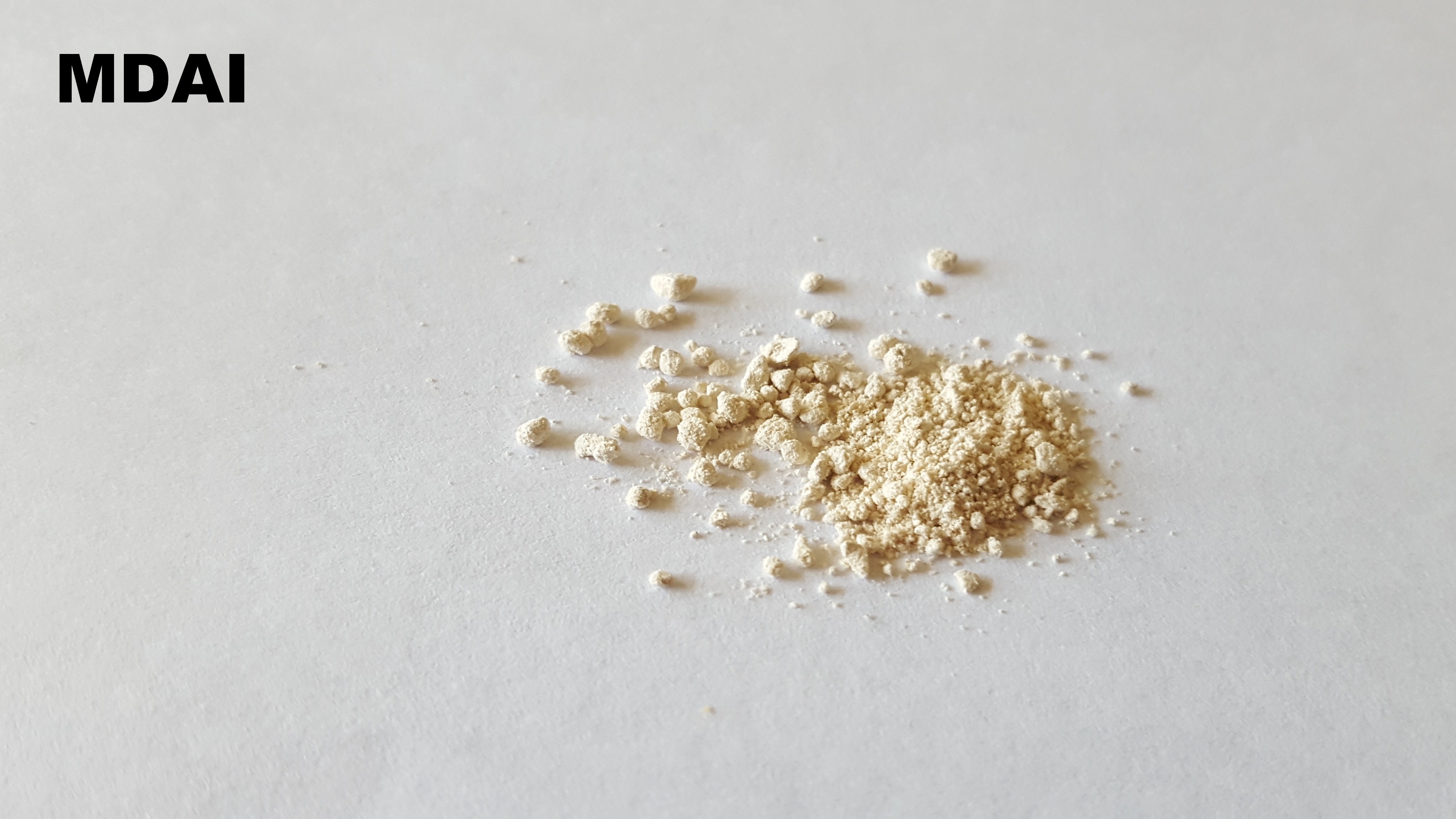
MDAI, also known as 5,6-methylenedioxy-2-aminoindane, is an entactogen of the 2-aminoindane family which is related to MDMA and produces similar subjective effects.
It acts as a selective serotonin and norepinephrine releasing agent (SNRA). The drug shows greatly reduced serotonergic neurotoxicity in comparison to MDMA in animals, although it still shows weak capacity for neurotoxicity with chronic use or in combination with amphetamine.
MDAI was developed in the 1990s by a team led by David E. Nichols at Purdue University. It has been encountered as a designer drug and has been used recreationally with reported street names such as "sparkle" and "mindy". In addition to its recreational use, there has been interest in MDAI for potential use in medicine, for instance in drug-assisted psychotherapy.
Use and effects
A 2024 study compared the effects of MDAI and MDMA in humans. It found that MDAI produced comparable and very similar subjective effects to those of MDMA. This included pleasurable drug effects, drug liking, stimulation, happiness, openness, trust, and closeness. In addition, it included sense of well-being, emotional excitation, and extroversion, but not general activity or concentration, a profile of effects described as similar to that of MDMA. Other effects included a blissful state, experience of unity, and changed meaning of percepts, also described as comparable to MDMA. The effects of MDAI were slightly greater than those of 75mg MDMA and slightly lower than those of 125mg MDMA. At the employed dose of 3.0mg/kg, with 125mg MDMA corresponding to 1.9mg/kg, it was estimated that MDAI had about 60% of MDMA's potency in producing comparable psychoactive effects (hence, roughly 200mg MDAI would be similar to 125mg MDMA). Aside from subjective effects, MDAI also increased blood pressure, cortisol levels, and prolactin levels similarly to MDMA. Conversely, it did not increase heart rate or body temperature.
Toxicity
Very high doses can be fatal in rats with a 50% fatality rate for those subcutaneously injected with 28 mg/kg of MDAI. This is a result of the way serotonin release interferes with thermoregulation.
MDAI is only non-neurotoxic in isolation but may become neurotoxic when mixed with other drugs. Three deaths were linked to MDAI use in the United Kingdom during 2011 and 2012, all involving symptoms consistent with serotonin syndrome. Two of these also involved other drugs while one death appeared to be from MDAI alone.
Interactions
Pharmacology
Pharmacodynamics
MDAI acts as a selective and well-balanced serotonin and norepinephrine releasing agent (SNRA) with much less (~10-fold lower) effect on dopamine release. In addition to inducing the release of the monoamine neurotransmitters, MDAI also inhibits their reuptake. For comparison to MDAI, MDA and MDMA are well-balanced releasing agents of serotonin, norepinephrine, and dopamine (SNDRAs). Conversely, the profile of monoamine release with MDAI is very similar to that of (R)-MDMA (levo-MDMA), which like MDAI is also a well-balanced SNRA with about 10-fold reduced impact on dopamine release, though MDAI is several-fold more potent than (R)-MDMA in vitro.
In contrast to MDMA, MDAI shows no affinity for any of the serotonin receptors (Ki = all 10μM). This notably includes the serotonin 5-HT2A receptor, which is implicated in producing psychedelic effects, and the serotonin 5-HT2B receptor, which is implicated in causing cardiac valvulopathy. However, MDAI shows significant affinity for all three of the α2-adrenergic receptors (Ki = 322 to 1121nM).
| Compound | Monoamine release (, nM) | Serotonin | Norepinephrine | Dopamine |
|---|---|---|---|---|
| 2-AI | 10,000 | 86 | 439 | |
| MDAI | 114 | 117 | 1,334 | |
| MMAI | 31 | 3,101 | 10,000 | |
| MEAI | 134 | 861 | 2,646 | |
| d-Amphetamine | 698–1,765 | 6.6–7.2 | 5.8–24.8 | |
| d-Methamphetamine | 736–1,292 | 12.3–13.8 | 8.5–24.5 | |
| MDA | 160 | 108 | 190 | |
| MDMA | 49.6–72 | 54.1–110 | 51.2–278 | |
| (R)-MDMA (l-MDMA) | 340 | 560 | 3,700 | |
| MDEA | 47 | 2,608 | 622 | |
| MBDB | 540 | 3,300 | 100,000 | |
| Notes: The smaller the value, the more strongly the compound produces the effect. See also Monoamine releasing agent § Activity profiles for a larger table with more compounds. Refs: |
The family of drugs typified by MDMA produce their effects through multiple mechanisms of action in the body, and consequently produce three distinct cues which animals can be trained to respond to: a stimulant cue typified by drugs such as methamphetamine, a psychedelic cue typified by drugs such as LSD and DOM, and an "entactogen-like" cue which is produced by drugs such as MDAI and MBDB. These drugs cause drug-appropriate responses in animals trained to recognize the effects of MDMA, but do not produce responses in animals trained selectively to respond to stimulants or hallucinogens. Because these compounds selectively release serotonin in the brain but have little effect on dopamine or noradrenaline levels, they can produce empathogenic effects but without any stimulant action, instead being somewhat sedating.
MDAI shows substantially lower serotonergic neurotoxicity than MDMA in animals and has been described as a "non-neurotoxic" analogue of MDMA. However, MDAI still shows weak serotonergic neurotoxicity both alone and particularly in combination with amphetamine in animals. As such, MDAI does not appear to be a fully non-neurotoxic alternative to MDMA.
Pharmacokinetics
The duration of MDAI in humans appears to be similar to that of MDMA at 2 to 5hours or up to around 6hours.
Chemistry
MDAI is a substituted 2-aminoindane. The chemical structure of MDAI is indirectly derived from that of the illicit drug MDA, but the α-methyl group of the alkyl amino amphetamine side chain has been bound back to the benzene nucleus to form an indane ring system, which changes its pharmacological properties substantially.
Synthesis
MDAI can be produced from 3-(3,4-methylenedioxyphenyl)propionic acid which is converted to the acid chloride and then heated to produce 5,6-methylenedioxy-1-indanone. Treatment of the indanone with amyl nitrite in methanol with HCl afforded the hydroxyimino ketone. This is reduced to the 2-aminoindan following a modification of Nichols' earlier method from a paper discussing DOM analogues, using a Pd/C catalyst in glacial acetic acid with catalytic H2SO4.
Analogues
Analogues of MDAI include 2-aminoindane (2-AI), NM-2-AI, MDMAI, MEAI (5-MeO-2-AI), MMAI, and 5-IAI, among others.
History
MDAI was first described in the scientific literature by David E. Nichols and colleagues at Purdue University in 1989.
Society and culture
Recreational use
MDAI has been advertised as a designer drug. It started to be sold online from around 2007, but reached peak popularity between about 2010 to 2012, after bans on mephedrone came into effect in various countries. Many internet-sourced products claimed to be MDAI have been shown to contain mephedrone or other cathinones, while generally containing no MDAI. The number of internet searches for MDAI has been considerably higher in the United Kingdom compared to Germany and the United States.
Legal status
Canada
MDAI is not a controlled substance in Canada as of 2025.
China
As of October 2015 MDAI is a controlled substance in China.
Denmark
MDAI is illegal in Denmark as of September 2015.
Finland
Scheduled in the "government decree on psychoactive substances banned from the consumer market".
Switzerland
As of December 2011 MDAI is a controlled substance in Switzerland.
Research
MDAI and other similar drugs have been widely used in scientific research, as they are able to replicate many of the effects of MDMA, but without causing the serotonergic neurotoxicity associated with MDMA and certain related drugs. No tests have been performed on cardiovascular toxicity.
References
References
- Anvisa. (2023-07-24). "RDC Nº 804 - Listas de Substâncias Entorpecentes, Psicotrópicas, Precursoras e Outras sob Controle Especial". [[Diário Oficial da União]].
- (17 November 2017). "Synthetic Aminoindanes: A Summary of Existing Knowledge". Frontiers Media SA.
- (2011). "Aminoindanes--the next wave of 'legal highs'?". Wiley.
- (May 2021). "Beyond ecstasy: Alternative entactogens to 3,4-methylenedioxymethamphetamine with potential applications in psychotherapy". SAGE Publications.
- (September 2024). "Acute psychotropic, autonomic, and endocrine effects of 5,6-methylenedioxy-2-aminoindane (MDAI) compared with 3,4-methylenedioxymethamphetamine (MDMA) in human volunteers: A self-administration study". Drug Test Anal.
- (August 2016). "Emerging toxicity of 5,6-methylenedioxy-2-aminoindane (MDAI): Pharmacokinetics, behaviour, thermoregulation and LD50 in rats". Progress in Neuro-Psychopharmacology & Biological Psychiatry.
- (July 2010). "Second generation mephedrone. The confusing case of NRG-1". BMJ.
- (July 2013). "MDAI (5,6-methylenedioxy-2-aminoindane; 6,7-dihydro-5H-cyclopenta[f][1,3]benzodioxol-6-amine; 'sparkle'; 'mindy') toxicity: a brief overview and update". Human Psychopharmacology.
- (July 1991). "[3H]monoamine releasing and uptake inhibition properties of 3,4-methylenedioxymethamphetamine and p-chloroamphetamine analogues". European Journal of Pharmacology.
- (February 2018). "(±)-MDMA and its enantiomers: potential therapeutic advantages of R(-)-MDMA". Psychopharmacology.
- (October 2018). "Dark Classics in Chemical Neuroscience: 3,4-Methylenedioxymethamphetamine". ACS Chem Neurosci.
- (March 2019). "2-Aminoindan and its ring-substituted derivatives interact with plasma membrane monoamine transporters and α2-adrenergic receptors". Psychopharmacology (Berl).
- (2006). "Therapeutic potential of monoamine transporter substrates". Current Topics in Medicinal Chemistry.
- (June 2003). "3,4-methylenedioxymethamphetamine (MDMA, "Ecstasy") induces fenfluramine-like proliferative actions on human cardiac valvular interstitial cells in vitro". Molecular Pharmacology.
- (January 2001). "Amphetamine-type central nervous system stimulants release norepinephrine more potently than they release dopamine and serotonin". Synapse.
- (April 2012). "Studies of the biogenic amine transporters. 14. Identification of low-efficacy "partial" substrates for the biogenic amine transporters". The Journal of Pharmacology and Experimental Therapeutics.
- (February 2016). "The new psychoactive substances 5-(2-aminopropyl)indole (5-IT) and 6-(2-aminopropyl)indole (6-IT) interact with monoamine transporters in brain tissue". Neuropharmacology.
- (March 2007). "The effects of non-medically used psychoactive drugs on monoamine neurotransmission in rat brain". European Journal of Pharmacology.
- (July 1987). "Stereochemical effects of 3,4-methylenedioxymethamphetamine (MDMA) and related amphetamine derivatives on inhibition of uptake of [3H]monoamines into synaptosomes from different regions of rat brain". Biochemical Pharmacology.
- (1988). "Drug discrimination studies with MDMA and amphetamine". Psychopharmacology.
- (1986). "Differences between the mechanism of action of MDMA, MBDB, and the classic hallucinogens. Identification of a new therapeutic class: entactogens". Journal of Psychoactive Drugs.
- (December 1990). "(+)-N-methyl-1-(1,3-benzodioxol-5-yl)-2-butanamine as a discriminative stimulus in studies of 3,4-methylenedioxy-methamphetamine-like behavioral activity". The Journal of Pharmacology and Experimental Therapeutics.
- (March 1991). "Structural variation and (+)-amphetamine-like discriminative stimulus properties". Pharmacology, Biochemistry, and Behavior.
- (June 1994). "Behavioral effects of the highly selective serotonin releasing agent 5-methoxy-6-methyl-2-aminoindan". European Journal of Pharmacology.
- (July 1998). "Chemistry and pharmacology of hallucinogens, entactogens and stimulants". Pharmacopsychiatry.
- (1993). "Novel serotonergic agents". Drug des Discov.
- (December 1991). "Serotonin neurotoxicity in rats after combined treatment with a dopaminergic agent followed by a nonneurotoxic 3,4-methylenedioxymethamphetamine (MDMA) analogue". Pharmacol Biochem Behav.
- (February 1990). "Nonneurotoxic tetralin and indan analogues of 3,4-(methylenedioxy)amphetamine (MDA)". Journal of Medicinal Chemistry.
- (February 1974). "Potential psychotomimetics. 2. Rigid analogs of 2,5-dimethoxy-4-methylphenylisopropylamine (DOM, STP)". Journal of Medicinal Chemistry.
- (1989). "Structure-activity relationships of MDMA-like substances". NIDA Research Monograph.
- (March 2012). "5,6-Methylenedioxy-2-aminoindane: from laboratory curiosity to 'legal high'". Human Psychopharmacology.
- "Controlled Drugs and Substances Act".
- (27 September 2015). "关于印发《非药用类麻醉药品和精神药品列管办法》的通知". China Food and Drug Administration.
- (September 2015). "Lists of euphoriant substances subject to control in Denmark". The Danish Medicines Agency.
- [https://finlex.fi/fi/lainsaadanto/2014/1130 finlex.fi]
- (December 2011). "812.121.11". Das Eidgenössische Departement des Innern (EDI).
- (January 1991). "5-Iodo-2-aminoindan, a nonneurotoxic analogue of p-iodoamphetamine". Pharmacology, Biochemistry, and Behavior.
- (May 1991). "Synthesis and pharmacological examination of 1-(3-methoxy-4-methylphenyl)-2-aminopropane and 5-methoxy-6-methyl-2-aminoindan: similarities to 3,4-(methylenedioxy)methamphetamine (MDMA)". Journal of Medicinal Chemistry.
- (December 1991). "Serotonin neurotoxicity in rats after combined treatment with a dopaminergic agent followed by a nonneurotoxic 3,4-methylenedioxymethamphetamine (MDMA) analogue". Pharmacology, Biochemistry, and Behavior.
- (1993). "Novel serotonergic agents". Drug Design and Discovery.
- (October 1996). "Studies on the mechanism of p-chloroamphetamine neurotoxicity". Biochemical Pharmacology.
- (March 1998). "Indan analogs of fenfluramine and norfenfluramine have reduced neurotoxic potential". Pharmacology, Biochemistry, and Behavior.
This article was imported from Wikipedia and is available under the Creative Commons Attribution-ShareAlike 4.0 License. Content has been adapted to SurfDoc format. Original contributors can be found on the article history page.
Ask Mako anything about MDAI — get instant answers, deeper analysis, and related topics.
Research with MakoFree with your Surf account
Create a free account to save articles, ask Mako questions, and organize your research.
Sign up freeThis content may have been generated or modified by AI. CloudSurf Software LLC is not responsible for the accuracy, completeness, or reliability of AI-generated content. Always verify important information from primary sources.
Report