From Surf Wiki (app.surf) — the open knowledge base
Mazanderani language
Northwestern Iranian language
Northwestern Iranian language
| Field | Value | |
|---|---|---|
| name | Mazandarani | |
| ethnicity | million Mazanderanis (2023) | |
| speakers | million | |
| date | 2023 | |
| ref | ||
| nativename | مازِرونی | |
| تَبَری | ||
| states | Iran (Province of Mazandaran and parts of the provinces of Alborz, Tehran, Qazvin, Semnan and Golestan) | |
| region | South coast of the Caspian Sea | |
| familycolor | Indo-European | |
| fam2 | Indo-Iranian | |
| fam3 | Iranian | |
| fam4 | Western Iranian | |
| fam5 | Northwestern | |
| fam6 | Caspian | |
| dia1 | Gorgani-Mazandarani (East) | |
| dia2 | Katuli-Mazandarani (East) | |
| dia3 | Tabari-Mazandarani (Center) | |
| dia4 | Kojuri-Mazandarani (West) | |
| dia5 | Kelarestaqi-Mazandarani (West) | |
| dia6 | Gilaki-Mazandarani (West) | |
| dia7 | Galeshi-Mazandarani (South) | |
| dia8 | Taleqani-Mazandarani (South) | |
| dia9 | Shahmirzadi (South) | |
| dia10 | Ilikaei (South) | |
| dia11 | Qasrani (South) | |
| script | Persian alphabet | |
| agency | None | |
| the Linguistic faculty of Mazandaran University officially gathers materials and resources about the language | ||
| lc1 | mzn | |
| ld1 | Mazandarani | |
| lc2 | srz | |
| ld2 | Shahmirzadi | |
| glotto | maza1305 | |
| glottoname | Mazanderani–Shahmirzadi | |
| ELP | 9250 | |
| ELPname | Shahmirzadi | |
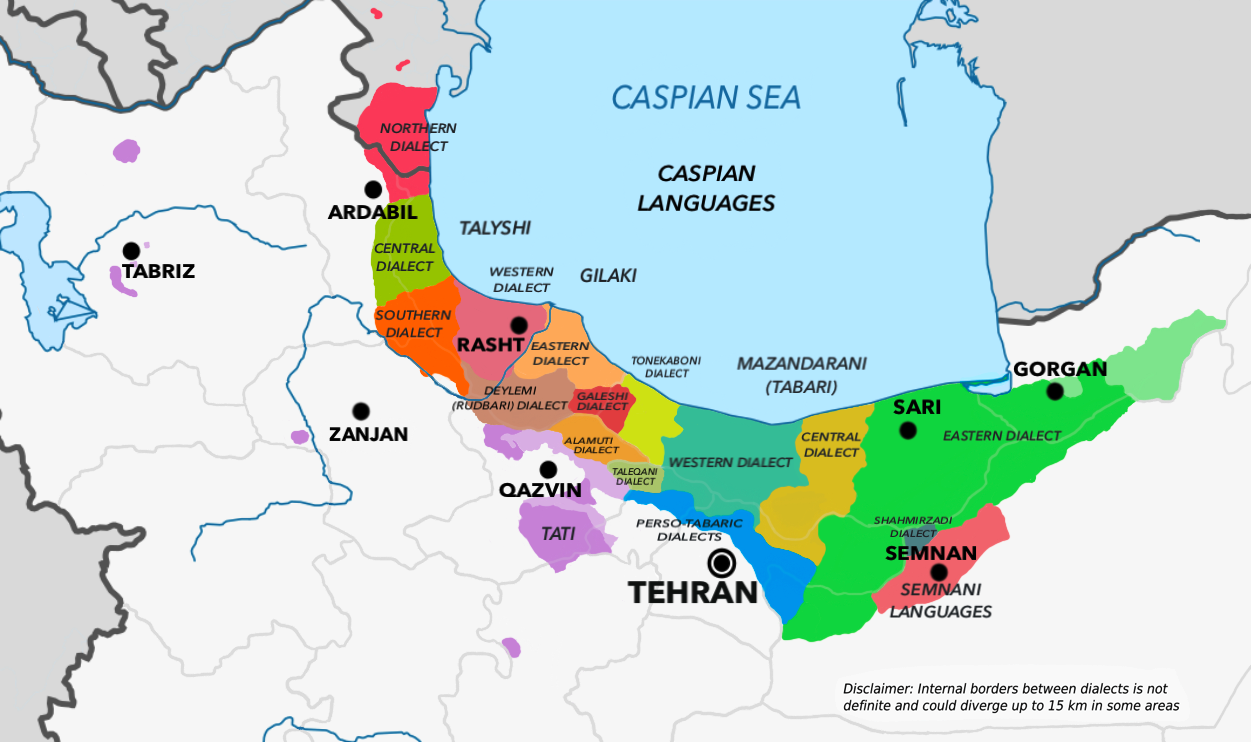
| map | Mazandarani Language Map.PNG | |
| mapcaption | Areas where Mazandarani is spoken as the mother tongue | |
| notice | IPA | |
| image | [[File:Mazanderani in Nastaliq.png | 200px]] |
| imagecaption | Mazanderani (Mazeruni) written in Nastaliq script. (مازِرونی) |
تَبَری the Linguistic faculty of Mazandaran University officially gathers materials and resources about the language Mazandarani (Mazanderani: مازِرونی, Mazeruni; also called Mazani (مازنی) or Tabari (تبری); also called Taveri, Mazeruni, Tati, Geleki and Galeshi) is an Iranian language of the Northwestern branch spoken by the Mazanderani people. , there were 1.35 million native speakers. The language appears to be decreasing, as it is threatened, and due to the majority of its speakers shifting to Iranian Persian. As a member of the Northwestern branch (the northern branch of Western Iranian), etymologically speaking, it is rather closely related to Gilaki and also related to Persian, which belongs to the Southwestern branch. Though the Mazani and Persian languages have both influenced each other to a great extent, both are independent languages with different origins in the Iranian plateau.
Mazandarani is closely related to Gilaki, and the two languages have similar vocabularies. The Gilaki and Mazandarani languages (but not other Iranian languages) share certain typological features with Caucasian languages (specifically the non-Indo-European South Caucasian languages), reflecting the history, ethnic identity, and close relatedness to the Caucasus region and Caucasian peoples of Mazandaranis and Gilak people.
Etymology
The name Mazanderani (and variants of it) derives from the name of the province of Mazandaran (Mazerun in Mazanderani), which was part of the historical region of Tapuria. People traditionally call their language Tabari, as the Tabari themselves do.
The name Tapuri / Tabari (which was the name of an ancient language spoken somewhere in former Tapuria) is now used in preference to the name Mazandarani by the young.
However, both Gilan and Mazanderan formed part of the region known as Tapuria.
The earliest references to the language of Mazandaran, called Tabari, are to be found in the works of the early Muslim geographers. Al-Muqaddasī (or Moqaisi, 10th century), for example, notes: "The languages of Komish and Gurgan are similar, they use hā, as in hā-dih and hāk-un, and they are sweet [to the ear], related to them is the language of Tabaristan, [similar] save for its speediness."
History
Among the living Iranian languages, Mazanderani has one of the longest written traditions, from the tenth to the fifteenth century. This status was achieved during the long reign of the independent and semi-independent rulers of Mazandaran in the centuries after the Arab invasion.
The rich literature of this language includes books such as Marzban Nameh (later translated into Persian) and the poetry of Amir Pazevari. Use of Mazanderani, however, has been in decline for some time. Its literary and administrative prominence had begun to diminish in favor of Persian by the time of the integration of Mazandaran into the national administration in the early seventeenth century.
Classification
The Mazanderani language is closely related to Gilaki and the two languages have similar vocabularies. In 1993, according to Ethnologue, there were three million native Mazanderani speakers.
The dialects of Mazanderani are as following:
-
Saravi: Spoken in Sari County, which includes Chahardangeh District and highlands of Dodangeh District, Miandorud Plains, plains on the west bank of Tajan river, extending west to Juybar.
-
Amoli: Encompasses mountainous areas west of Bandpey, as well as Chelav Rural District, Larijan District, Namarestaq and Kelarestaq of Amol, plains of Amol County, Mahmudabad County, foothills and plains of Chamestan region between Amol and Nur.
-
Baboli: Spoken in plains of Babol County, Babolsar County, and Fereydunkenar County, highlands of Bandpey extending to Chelav Rural District in west and Alasht to east. Foothills of Babol Kenar and Ganj Afrouz are also included.
-
Ghaemshahri: Spoken in plains between Kiakola in west and Juybar in east, villages of Bisheh Sar Rural District, and mountainous areas of Savadkuh and Firuzkuh.
-
Chaloos and East Tonekabon: Spoken in Kelar and Langa regions, some villages in foothills of Birun Bashm, coastal plains of Chalus County, Abbasabad County and Nashtarud.
-
Nur and Nowshahr: Spoken in Kojur District, Baladeh District, parts of Birun Bashm, and coastal plains between Sorkhrud and Chalus River.
-
Shahsavari: Spoken in most of Tonekabon County, which includes Do Hezar, Seh Hezar, Khorramabad District, and plains between Nashtarud and Shirud. In Ramsar County both Mazandarani and Gilaki languages are common.
-
Behshahri: Spoken in Plains of Behshahr County, Galugah County and Neka County east of Nekarud, as well as highlands of the mentioned counties (east of Kiasar).
-
Kordkuy : Includes Eastern part of Hezar Jarib Region, villages of Ziarat, Shahkuh-e Sofla, Shahkuh-e Olya, Radkan and their neighboring villages, villages from Galugah city in west to Zangian, Golestan in east(excluding settlements populated by Turkmens).
-
Katouli: Spoken in rural mountainous areas north of Shahvar peak, villages in the plains of Aliabad-e Katul County, and eastern part of Gorgan County not populated by Turkmens. Aliabad-e Katul, Pichak Mahalleh and Fazelabad, Golestan are among these settlements.
-
Ghasrani: Mountains of northern parts of Tehran Province, and west of Jajrud River. Which includes Rudbar-e Qasran District, Fasham, Shemshak, Dizin.
-
Damavandi: Spoken in mountainous areas of Damavand County, Rudehen District, and Bumahen District, extending eastward towards Firuzkuh.
-
Shahmirzadi
The native people of Aliabad-e Katul, Gorgan, Kordkuy and Bandar-e Gaz in Golestan province are Mazandarani and speak the mazandarani language. The native people of Shemiranat, Damavand and Firuzkuh in Tehran province are Mazandarani and speak the mazandarani language. The native people of north of Karaj and Taleqan in Alborz province are Mazandarani and speak the mazandarani language. The people of east of Alamut in Qazvin province are Mazandarani and speak the mazandarani language. The native of people of Aradan, Garmsar, Shahmirzad and north of Damghan in Semnan province are Mazandarani and speak the mazandarani language. The native people of Galugah, Behshahr, Neka, Sari, Shahi, Babol, Amol, Nowshahr, Chalus, Kelardasht, Abbasabad and Tonekabon in Mazandaran province are Mazanderani people and speak the Mazanderani language. 300px|right|Mazandaranis in Iran
Grammar

Mazanderani is an inflected and genderless language. It is SOV, but in some tenses it may be SVO, depending on the particular dialect involved.
Typology
Morphology
Just as in other modern Iranian languages, there is no distinction between the dative and accusative cases, and the nominative in the sentence takes almost no indicators but may be inferred from word order (depending on dialect it may end in a/o/e). Since Mazanderani lacks articles, there is no inflection for nouns in the sentence (no modifications for nouns). For definition, nouns take the suffix e (me dətere meaning The daughter of mine while me dəter means my daughter). The indefinite article for single nouns is a-tā with tā for determination of number (a-tā kijā meaning a girl). There exist some remnants of old Mazanderani indicating that, in the nominative case, female nouns used to end in a, while male nouns ended in e (as in jənā meaning the woman and mərdē meaning the man). Grammatical gender is still present in certain modern languages closely related to Mazandarani such as Semnani, Sangesari and Zaza.
Pronouns
In the Mazandarani language, independent personal pronouns have three cases: active, passive and possessive.{{cite journal |title= The Mazandarani Dialect of Kalijān Rostāq |journal=Iranian Studies |date=2019 |volume=52 |issue=3–4 |url= https://www.academia.edu/38367668 |pages=555 |doi= 10.1080/00210862.2019.1611371|access-date= |language=en |last1=Borjian |first1=Habib }}
| Identification | Singular 1 | Singular 2 | Singular 3 | Plural 1 | Plural 2 | Plural 3 |
|---|---|---|---|---|---|---|
| Subject (Sari dialect) | mən | tə | və | əmâ | šəmâ | vəšún |
| Object (Sari dialect) | məre | təre | vəre | əmâre | šəmâre | vəšúnre |
| Possessive (Sari dialect) | me | te | ve | ame | šeme | vešúne |
Conjugation
Conjugation (hākārden) "to work" in Mazandarani language (Sari dialect).{{cite journal |title= The Mazandarani Dialect of Kalijān Rostāq |journal=Iranian Studies |date=2019 |volume=52 |issue=3–4 |url= https://www.academia.edu/38367668 |pages=561 |doi= 10.1080/00210862.2019.1611371|access-date= |language=en |last1=Borjian |first1=Habib }}
| Tense/person | Sg1 | Sg2 | Sg3 | Pl1 | Pl2 | Pl3 |
|---|---|---|---|---|---|---|
| Preterit | hâkârdeme | hâkârdi | hâkârde | hâkârdemi | hâkârdeni | hâkârdene |
| Pluperfect | hâkârde-bime | hâkârde-bi | hâkârde-bie | hâkârde-bimi | hâkârde-bini | hâkârde-bine |
| Past subjunctive | hâkârde-buem | hâkârde-bui | hâkârde-bue | hâkârde-buim | hâkârde-buin | hâkârde-buen |
| Pluperfect subjunctive | hâkârde-bai-buem | hâkârde-bai-bui | hâkârde-bai-bue | hâkârde-bai-buim | hâkârde-bai-buin | hâkârde-bai-buen |
| Imperfect (type 1) | kârdeme | kârdi | kârde | kârdemi | kârdeni | kârdene |
| Imperfect (type 2) | kândesseme | kândessi | kândesse | kândessemi | kândesseni | kândessene |
| Past progressive (type1) | dai(me)-kârdeme | dai(i)-kârdi | dai(e)-kârde | dai(mi)-kârdemi | dai(ni)-kârdeni | dai(ne)-kârdene |
| Past progressive (type 2) | dai(me)-kândesseme | dai(i)-kândessi | dai(e)-kândesse | dai(mi)-kândessemi | dai(ni)-kândesseni | dai(ne)-kândessene |
| Present | kâmbe/kândeme | kândi | kânde | kâmbi/kândemi | kândeni | kândene |
| Present progressive | dar(eme)-kâmbe | dar(i)-kândi | dar(e)-kânde | dar(emi)-kâmbi | dar(eni)-kândeni | dar(ene)-kândene |
| Subjunctive | hâkânem | hâkâni | hâkâne | hâkânim | hâkânin | hâkânen |
| Future | xâmbe hâkânem | xâni hâkâni | xâne hâkâne | xâmbi hâkânim | xânni hâkânin | xânne hâkânen |
Usage
Function cases
| Case | Position | Meaning |
|---|---|---|
| Sere -(a/o/e) | Nominative | The Home |
| Sere re | Accusative | (Action) the Home |
| Sere -(o/e) | Vocative | Home! |
| Sere şe | Genitive | Home's |
| Sere re | Dative | To the Home |
| Sere ye jä | Ablative/Instrumental | By the Home |
Adjectives
| Adjective | Position | Meaning |
|---|---|---|
| And-e Sere | Applicative | |
| Gat-e Sere | Comparative | Great Home |
| Untä Sere | Determinative | That Home |
Notable postpositions
Adpositions in Mazanderani are after words, while most of other languages including English and Persian have preposition systems in general. The only common postpositions that sometimes become preposition are Še and tā. Frequently used postpositions are:
| postposition | meaning |
|---|---|
| dəle | in |
| re | of / to |
| je | from / by |
| vəse | for |
| tā | to |
| həmrā / jā | with |
| səri | on / above |
| bəne | under / below |
| pəli | near / about |
| vāri/ tarā | like |
| derū | among / inside |
Suffixes
The list below is a sample list obtained from the Online Mazanderani-Persian dictionary.
Locatives
| Suffix | Example | Meaning |
|---|---|---|
| -kash | Kharkash | Good place |
| -kel | Tutkel | Mulberry limit |
| -ij | Yoshij | Yoshian |
| -bon | Chenarbon | At the plantain |
| -ja | Səreja | Relating to home |
| -sar | Bənesar | Underneath |
Subjectives
| Suffix | Example | Meaning |
|---|---|---|
| -chaf | Auchhaf | Water-sucker |
| -rush | Halikrush | Berry-seller |
| -su | Vərgsu | Wolf-hunter |
| -kaf | Ukaf | One who performs actions in water |
| -vej | Galvej | Mouse-finder |
| -yel | Vəngyel | Bandmaster |
Phonology
Vowels
| Front | Central | Back | Close | Mid | Open |
|---|
// may also range to near-open [] or a more back []. Allophones of // are heard as []. // can also be heard as [] or [].
Consonants
| Labial | Dental/ | |||||||||||||
|---|---|---|---|---|---|---|---|---|---|---|---|---|---|---|
| Alveolar | (Palato-) | |||||||||||||
| alveolar | Velar | Uvular | Glottal | Nasal | Stop/ | |||||||||
| Affricate | voiceless | voiced | Fricative | voiceless | voiced | Approximant | Tap/Flap | |||||||
| () | ||||||||||||||
| () | ||||||||||||||
| ~() |
// appears as an allophone of // in word-final position. // may appear as a voiceless trill in word-final position []. An occasional glottal stop // or voiceless uvular fricative // or voiced plosive // may also be heard, depending on the dialect.
Orthography
Mazanderani is commonly written in the Perso-Arabic script. However, some use the Roman alphabet, for example in SMS messages.
Vocabulary
Spoken in a territory sheltered by the high Alborz mountains, Mazanderani preserves many ancient Indo-European words no longer in common use in modern Iranian languages such as Persian. Listed below are a few common Mazanderani words of archaic, Indo-European provenance with Vedic cognates.
| English | Mazanderani | Persian | Vedic | Proto-Indo-European | Example of |
|---|---|---|---|---|---|
| new | neo | no / now | návas | *néwos | **adjective** |
| great | gat | bozorg, gozorg, gonde, got | **adjective** | ||
| better | better | behtar | **adverb** | ||
| been | bine | budeh | **auxiliary verb** | ||
| being | bien | budan | bhū- | *bʰuH- | **infinitive of verb** |
| father | piar | pedar | **noun** | ||
| mother | mâr | mâdar | **noun** | ||
| brother | berar | barâdar | **noun** | ||
| daughter | deter | dokhtar | dúhitā | *dʰugh₂tḗr | **noun** |
| grandpa | gatepa | pedar bozorg / pedar gozorg | **noun** | ||
| moon | moong / mong | mâh | mā́s | *mḗh₁n̥s | **noun** |
| cow | go / gu / guw | gâv | gáuṣ | *gʷṓws | **noun** |
| wolf | verg | gorg | **noun** | ||
| my | me / mi (before the noun) | am (after the noun), om | máma | *méne | **verb** |
| gab | gab | gap | **verb** | ||
| right | rast | râst | **adjective** | ||
| damage | damej | âsib | **noun** |
Mazandarani is rich in synonyms, some such nouns also retaining the gender they possessed in Indo-European times: for instance the words miš, gal, gerz all have the meaning of mouse, although they are not all of the same gender. While many Indo-Iranian languages use a masculine noun taking such related forms as muš or muska or mušk, in Mazandarani the most commonly used name for the mouse is the feminine noun gal.
Another example relates to the cow, the most important animal in the symbolism of Indo-European culture: in Mazanderani there are more than 1000 recognized words used for different types of cow. The table below lists some specimens of this rich vocabulary. In Mazandaran there are even contests held to determine those with the greatest knowledge of this bovine nomenclature.
| Mazanderani name | Meaning | Mazanderani name | Meaning |
|---|---|---|---|
| ahl | Bull subdued | nū dūş | Young plough bull used for the first time |
| āhy | Black-eyed cow | paei varzā | Single bull used for ploughing |
| alaşt | Miner's tool, ending in two wooden arcs | parū | Cattle for ploughing |
| baKhte bāri | Bullock and traces | raji | A cow that is ready to mate |
| bāreng | Reddish-brown cow | raş go | Crimson cow with black spots |
| batkoniye | Castrated male bovine cattle to eliminate it from washing down | raş jūnkā | Young bull with red and black streaks |
| būr gele | Yellow / red cow | raş kamer | Brown-and-white cow |
| būr şāx | Sharp, red points of a cow's horns | sārū | Bull with a white forehead |
| būrek | Light yellow bull | sārū | Bull with a white forehead |
| būreng | Blonde cow | şelāb beze gozūr | The new wide calf rain caused a sharp volley crumbled |
| būrmango | Fawn cow | selnāz | Cow streaked with white from nose to tail |
| das kare | Place where bull fights held | sembe band | Ox bearing a wooden yoke |
| de jet | Rust-coloured cow killed by two bulls | serxe sel | Red cow with a white stripe from neck to tail |
| demes mār | Cow with a two-year-old calf | setāre | Black-and-white-spotted cow |
| demis mār | Two-year-old bull calf | seyā bare | Black cow with a white forehead. |
| dūşt hākerden | Provoke a bull to attack | seyā kachal | Black cow with black spots on the tail end of the frontal |
| elā elā şāğ | Cow with horns growing in opposite directions | seyā sel | Black cow with a white line running along its spine to its tail |
| elā kal | Cow with large open horns | seyel | White-bellied cow |
| elā şiro | Cow with spreading horns | şir vej | Gelded calf or bull |
| elāşāx | A bull that has large open horns | şirū | A cow with a white head and tail |
| emūj | Ox that once trained for ploughing | şūkā | Pale yellow cow |
| eşte | Pair of cows for work | tā şū | Miner's cow, only to be closed |
| ezāli | Cow that is bred to plough | tağr in | Pair of four-year-old cows inseminated naturally |
| fal | Cow ready for mating | tal go | A cow that is ready for ploughing |
| fares | Ox that has not been taught to portage | tāle mār | Cow with bells hung around his neck |
| ğalfer | Bovine of a yellowish colour | tarise | Cow whose first calf is female and has reached two years of age |
| jandek | Bull bison that used for mating | tersekā | Two-and-a-half-year-old cow that is ready to mate |
| jānekā | Strong, young bull left ungelded for the purposes of breeding or combat | teş kūle | A young bull |
| jinekā | Young bull | teşk | Young bull that is not yet ready for ploughing |
| jonde kā sare | Place where young bulls and breeding cattle are raised | teşkel | Small bull |
| jone kā kole | Bullock less than two years old that has done no work | titāppeli mango | Black and white cow |
| jūndekā | Bullock more than two years old that has done no work | tolom | Young cow – heifer |
| jūnekkā | Young bulls | tūz kel | bull |
| jūnekkā jang | Quarrel between young bulls | varzā | Bullock |
| Khāmod | Ox plough | xāl dār | Bovine with bicoloured coat |
| lāch kal | Cow with open horns | xes xesi go | A cow that lies down on the ground while working |
| lachchi | Open cow horns that grow in opposite directions | xetūr | Alarmed cow |
| lase sar gū | Cow that goes to everyone | xik chaf | A cow that refuses to give milk to calves or its owner |
| lūş beni | Bridegroom's gift cow | zām borde | Cow missed after giving birth |
| māgū | A cow | zanā gū | Cow fighting with its horns |
| mango | Relating to lactating cows | zar xāl | Black cow with yellow spots |
| mārşan | Young cow | zargele | Yellow cow |
| mārū | Cow with a white forehead | zemessūni kar | Cow that leans due to food shortages in the winter |
| merem | Lovely young cow | zingāl | Black cow with white legs |
Influences exerted by Mazanderani
Modern-day of Iran
In Iran, there are some popular companies and products, like Rika (boy) or Kija (girl), which take their name from Mazanderani words.
In non-Iranian languages
There are some Mazanderani loanwords in the Turkmen language.
Examples
The following verses are in an eastern Mazandarani dialect spoken in the Caspian littoral in northern Iran. They were transcribed and translated by Maryam Borjian and Habib Borjian.
bεlbεl xavεr biārdε nо̄bεhār ε dār-e čel-ču-rε bāur ánde nέnāle batεrkessέ dεl dā́rmo qam-e yār-ε|I was sitting [on] the heights, on the lofty nefār; The nightingale brought the news that it is early spring. Tell the tree branches not to lament so much, I have a blasted heart for the care of the beloved.}}
vέne sar ništ bío Āl-e Mohammεd har ki mεn o tέrε bázunε tomεt vεšúnnε bákuše Darviš Mohammεd|The lofty balcony, the long mat; On its top had sat the Dynasty of Muhammad. Whoever lay the blame on you and me, May Dervish Muhammad kill him (lit. 'them')!}}
References
In dates given below, A.P. denotes the Iranian calendar, the solar calendar (365 days per year) which is official in Iran and Afghanistan.
References
- {{e28. mzm
- {{e28. mzn
- {{e28. mzn
- {{e28. mzn
- "Considerations about the dialect of Alamut district from the northern dialects of Iran". پرتال جامع علوم انسانی.
- "Iranian Languages and Dialects Past and Present".
- (16 July 2018). "کاهش توجه به زبان مازندرانی در قرن بیستم". [[Islamic Republic News Agency]].
- "ساری {{!}} مرکز دائرةالمعارف بزرگ اسلامی".
- {{e28. mzn
- {{e28. mzn
- Coon, "Iran:Demography and Ethnography" in Encyclopedia of Islam, Volume IV, E.J. Brill, pp. 10,8. Excerpt: "The Lurs speak an aberrant form of Archaic Persian" See maps also on page 10 for distribution of Persian languages and dialect
- Kathryn M. Coughlin, "Muslim cultures today: a reference guide," Greenwood Publishing Group, 2006. p. 89: "...Iranians speak Persian or a Persian dialect such as Gilaki or Mazandarani"
- Dalb, Andrew. (1998). "Dictionary of Languages: The Definitive Reference to More Than 400 Languages". Columbia University Press.
- (2006). "Concomitant Replacement of Language and mtDNA in South Caspian Populations of Iran". Current Biology.
- Academic American Encyclopedia By Grolier Incorporated, page 294
- Stilo, Donald L.. (1981). "The Tati Language Group in the Sociolinguistic Context of Northwestern Iran and Transcaucasia". Iranian Studies.
- "Bilingualism in Mazandaran: Peaceful Coexistence with Persian".
- Borjian, Habib. (2004). "Māzandarān: Language and People". [[Brill Publishers.
- Windfuhr, G. L. 1989. New Iranian languages: Overview. In Rüdiger Schmitt, ed., ''Compendium linguarum Iranicarum''. Wiesbaden: L. Reichert. pp. 246–249.
- Borjian, Maryam. 2005. [http://www.tc.columbia.edu/students/sie/LCEjr05/pdfs/Borjian.pdf Bilingualism in Mazandaran: Peaceful Coexistence With Persian] {{webarchive. link. (September 21, 2006 . ''Language, Communities and Education''. ''Languages, Communities & Education: A Volume of Graduate Student Research''. New York: [http://www.tc.edu/students/sie/LCEjr05/home.htm Society for International Education] {{webarchive). link. (2011-07-27 , Teachers College, [[Columbia University]]. pp. 65–73.)
- {{e18. mzn
- (1998). "The Grand Tabari Glossary". Khane Sabz.
- "Spoken L1 Language: Mazanderani".
- Windfuhr, G. L.. (1989). "Compendium linguarum Iranicarum". L. Reichert.
- Fakhr-Rohani, Muhammad-Reza. 2004. She means only her 'husband': politeness strategies amongst Mazanderani-speaking [[rural women]]. (Conference abstract) CLPG Conference, University of Helsinki, Finland, [http://www.nord.helsinki.fi/clpg/CLPG/Muhammed-Reza%20Fakhr-Rohani.pdf PDF]
- Johanson, Lars. [https://books.google.com/books?id=YB1UWaDMCKcC&dq=mazanderani&pg=PA310 Turkic-Iranian Contact Areas Historical and Linguistic Aspects.] Wiesbaden: Harrassowitz, 2006.
- Csató, Éva Ágnes, Bo Isaksson, and Carina Jahani. [https://books.google.com/books?id=OjWoG6XDKNIC&q=verb&pg=PT41 Linguistic Convergence and Areal Diffusion: Case Studies from Iranian, Semitic and Turkic.] London: RoutledgeCurzon, 2005.
- Yoshie, Satoko. 1996. ''Sārī Dialect''. Tokyo: Institute for the Study of Languages and Cultures of Asia and Africa. Series: Iranian Studies; 10.
- (2013). "When Tradition Meets Modernity: Five Life Stories from the Galesh Community in Ziarat, Golestan, Iran". Uppsala Universitet.
- Borjian, Habib. (2019). "The Mazandarani Dialect of Kalijān Rostāq". Iranian Studies.
- "language-keyboard.com – language-keyboard Resources and Information.".
- بهشهر, شهرداری. "شهرداری بهشهر".
- Nasri-Ashrafi, Jahangir-e (ed.). ''Farhang-e vāžegān-e Tabarī'' [A Dictionary of Tabari]. v. 5, p. 5, Tehran: Eḥyā’-ketāb”: 2002/1381 A.P. A comparative glossary containing lexical units from almost all major urban and rural centers of the region of the three provinces of [[Gilan]], [[Mazandaran]], and [[Golestan Province. Golestan]]. Reviewed in ''Iran and the Caucasus'', 2006, 10(2). Volume 4 contains a Persian-Mazanderani index of approximately 190 pp. Volume 5 includes a grammar of the Mazanderani language.
- (2007). "Mysterious Memories of a Woman: Ethno-Linguistic Materials from Rural Mazandaran". Iran and the Caucasus.
This article was imported from Wikipedia and is available under the Creative Commons Attribution-ShareAlike 4.0 License. Content has been adapted to SurfDoc format. Original contributors can be found on the article history page.
Ask Mako anything about Mazanderani language — get instant answers, deeper analysis, and related topics.
Research with MakoFree with your Surf account
Create a free account to save articles, ask Mako questions, and organize your research.
Sign up freeThis content may have been generated or modified by AI. CloudSurf Software LLC is not responsible for the accuracy, completeness, or reliability of AI-generated content. Always verify important information from primary sources.
Report