From Surf Wiki (app.surf) — the open knowledge base
Mayonnaise
Thick cold sauce
Thick cold sauce
| Field | Value |
|---|---|
| name | Mayonnaise |
| image | Mayonnaise (1).jpg |
| caption | A jar of Mayonnaise. |
| alternate_name | Mayo |
| type | Condiment |
| country | France & Spain |
| main_ingredient | Oil, egg yolk, and vinegar or lemon juice |
Mayonnaise (), colloquially referred to as "mayo" (), is a thick, creamy sauce with a rich and tangy taste that is commonly used on sandwiches, hamburgers, bound salads, and French fries. It also forms the base for various other sauces, such as tartar sauce, fry sauce, remoulade, salsa golf, ranch dressing, and rouille.
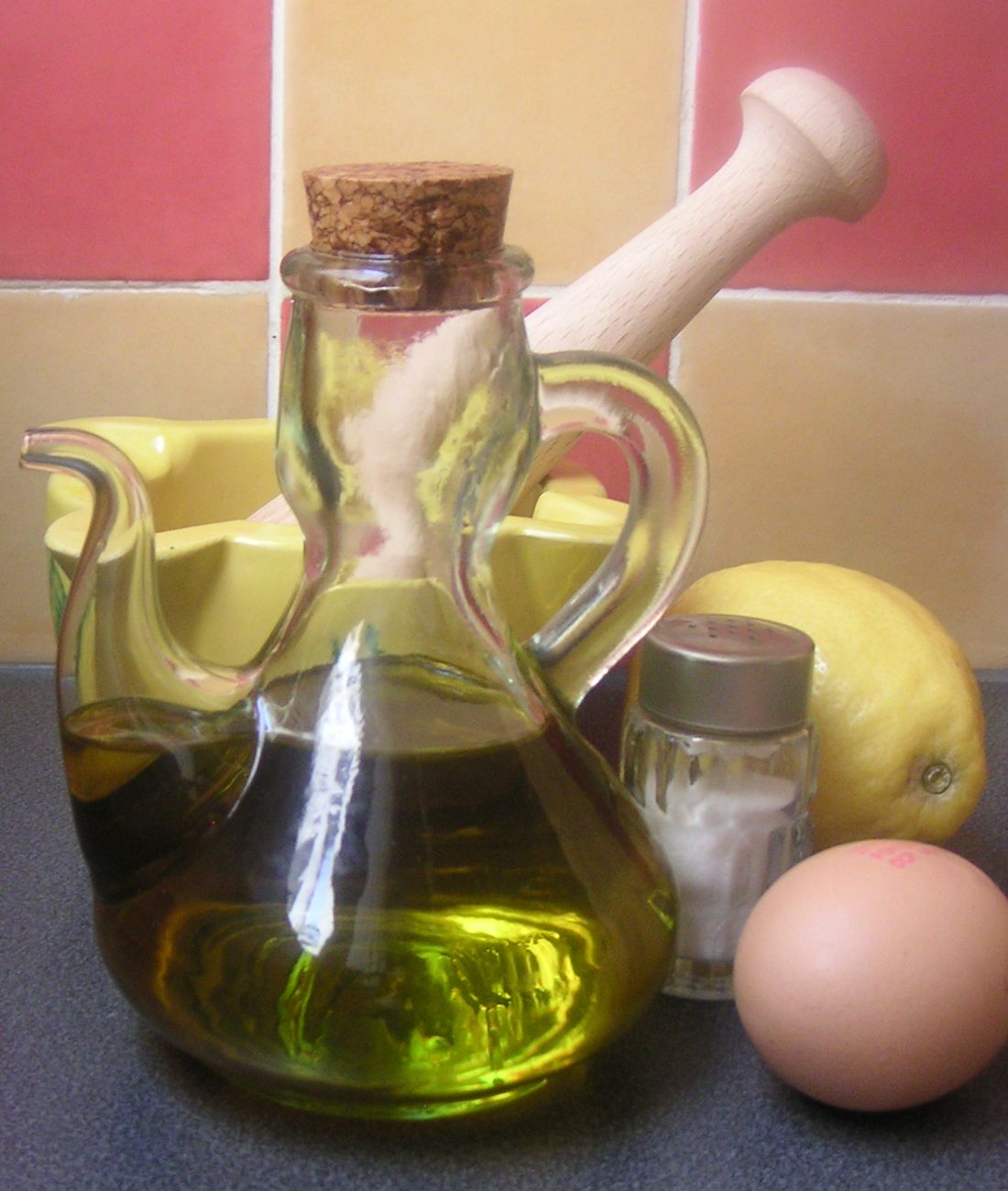
Mayonnaise is an emulsion of oil, egg yolk, and an acid, either vinegar or lemon juice; there are many variants using additional flavorings. The color varies from near-white to pale yellow, and its texture from a light cream to a thick gel.
Commercial eggless versions are made for those who avoid chicken eggs because of egg allergies, to limit dietary cholesterol, or because they adhere to a vegetarian or vegan diet.
History
Mayonnaise is a French cuisine appellation that seems to have appeared for the first time in 1806. The hypotheses invoked over time as to the origin(s) of mayonnaise have been numerous and contradictory. Most hypotheses do however agree on the geographical origin of the sauce, Mahón, in Menorca, Spain during the occupation by French troops in the Seven Years' War. Other theories have been dismissed by some authors as being somewhat a retrospective invention aiming to credit the sauce as an invention of south-western France, when most likely, its origin can be found in the port city of Menorca.
Mayonnaise sauce may have its origins in the ancient remoulade. Another hypothesis is that mayonnaise is derived from aioli. Finally, the process of emulsifying egg yolk was known for a long time to pharmacists, who used it to prepare ointments and salves. Some have pointed out that it would make sense that mayonnaise originated in Spain given its requirement of olive oil, a liquid produced and consumed mostly there at the time. This hypothesis is similar to another that places the origins of French fries in Spain using the same rationale.
In 1750, Francesc Roger Gomila, a Valencian friar, published a recipe for a sauce similar to mayonnaise in Art de la Cuina ('The Art of Cooking'). He calls the sauce aioli bo. If he does not describe precisely the recipe—suggesting that it was known by everyone on the island—the way it is used, the preparations for which it is used as a base and the dishes with which it is associated are most often inconceivable with an aioli. Earlier recipes of similar emulsified sauces, usually containing garlic, appear in a number of Spanish recipe books dating back to the 14th-century **, where it is called all-i-oli, literally 'garlic and oil' in Catalan. This sauce had clearly spread throughout the Crown of Aragon, for Juan de Altamiras gives a recipe for it in his celebrated 1745 recipe book Nuevo Arte de Cocina ('New Art of Cooking').

On April 18, 1756, the Duke of Richelieu invaded Menorca and took the port of Mahon. A theory states that the aioli bo sauce was thereafter adopted by the cook of the Duke of Richelieu, who upon his return to France made the sauce famous in the French court. which would have been known as mahonnaise. A number of legends arose relating how the Duke of Richelieu first tried the sauce, including his discovery of the sauce in a local inn of Mahon where he would have allegedly asked the innkeeper to make him some dinner during the siege of Mahon, and even that he invented it himself as a quick garnish.
Another version is Grimod de La Reynière's 1808 bayonnaise sauce which is a sort of aspic: "But if one wants to make from this cold chicken, a dish of distinction, one composes a bayonnaise, whose green jelly, of a good consistency, forms the most worthy ornament of poultry and fish salads."
In 1806, André Viard, in Le Cuisinier Impérial, transformed this recipe for remoulade by replacing the roux with egg yolk. In another recipe, an Indian remoulade, without mustard, he specifies that the binding is facilitated by incorporating the oil little by little. This is the first modern mention of a stable cold emulsified sauce.
It is only in 1815 that Antonin Carême mentions a cold "magnonaise" emulsified with egg yolk. The word "mayonnaise" is attested in English in 1815. Auguste Escoffier wrote that mayonnaise was a French mother sauce of cold sauces.
Etymology
A common theory is that it is named for Port Mahon (Maó in Catalan), itself named after its founder Mago Barca, in Menorca, in honor of the 3rd Duke of Richelieu's victory over the British in 1756, and in fact the name mahonnaise is used by some authors. But the name is only attested several decades after that event. One version of this theory says that it was originally known as salsa mahonesa in Spanish, but that spelling too is only attested later.
Alexandre Balthazar Laurent Grimod de La Reynière, a lawyer by qualification who acquired fame during the reign of Napoleon for his sensual and public gastronomic lifestyle, rejected the name mayonnaise because the word "is not French". He also rejected the name mahonnaise because Port Mahon "is not known for good food", and thus he preferred bayonnaise, after the city of Bayonne, which "has many innovative gourmands and... produces the best hams in Europe." Indeed, the city of Bayonne (sauce à la Bayonnaise) could also have given its name to this type of sauce, by spelling deformation. This form would seem to be confirmed by the fact that there is no written record of the sauce à la mayonnaise before the beginning of the 19th century, long after the capture of the city of Mahón.
Another hypothesis is based, according to Marie-Antoine Carême, a famous contemporary French chef, on a derivative of magnonaise (from the verb magner, or manier) or, according to Prosper Montagné, of moyeunaise (or moyennaise), based on moyeu(x) (or moyen) which means 'egg yolk', in Old French. It has also been suggested that the word be linked to the old verb mailler, meaning 'to beat'.
Joseph Favre, for his part, states in his memoirs that mayonnaise is an alteration of the word magnonnaise, derived from Magnon (Lot-et-Garonne), and that a cook from Magnon would have popularized it first in the South of France; he notes that this sauce has been variously named mahonnaise, bayonnaise and mayonnaise.
Preparation
Recipes for mayonnaise date to the early nineteenth century. In 1815, Louis Eustache Ude wrote:
No 58.—Mayonnaise. Take three spoonfuls of Allemande, six ditto of aspic, and two of oil. Add a little tarragon vinegar, that has not boiled, some pepper and salt, and minced ravigotte, or merely some parsley. Then put in the members of fowl, or fillets of soles, &c. Your mayonnaise must be put to ice; neither are you to put the members into your sauce till it begins to freeze. Next dish your meat or fish, mask with the sauce before it be quite frozen, and garnish your dish with whatever you think proper, as beet root, jelly, nasturtiums, &c.
In an 1820 work, Viard describes something like the more familiar emulsified version:
This sauce is made to "take" in many ways: with raw egg yolks, with gelatine, with veal or veal brain glaze. The most common method is to take a raw egg yolk in a small terrine, with a little salt and lemon juice: take a wooden spoon, turn it while letting a trickle of oil fall and stirring constantly; as your sauce thickens, add a little vinegar; put in too a pound of good oil: serve your sauce with good salt: serve it white or green, adding green of ravigote or green of spinach. This sauce is used for cold fish entrees, or salad of vegetables cooked in salt water.In February 1856, the Huddersfield [Chronicle](https://www.britishnewspaperarchive.co.uk/titles/huddersfield-chronicle) and West Yorkshire Advertiser published a recipe for homemade mayonnaise in a segment entitled "The Housewife's Corner." This recipe included six egg yolks, half a bottle of olive oil (volume not otherwise defined) and one-half teaspoon of vinegar. The serving suggestion was to pour this over roast chicken or turkey, with garnish of lettuce and hard eggs. Modern mayonnaise can be made by hand with a whisk, a fork, or with the aid of an electric mixer or blender. It is made by slowly adding oil to an egg yolk, while whisking vigorously to disperse the oil. The oil and the water in the yolk form a base of the emulsion, while lecithin and protein from the yolk is the emulsifier that stabilizes it. A combination of van der Waals interactions and electrostatic repulsion determine the bond strength among oil droplets. The high viscosity of mayonnaise is attributed to the total strength created by these two intermolecular forces. Addition of mustard contributes to the taste and further stabilizes the emulsion, as mustard contains small amounts of lecithin. If vinegar is added directly to the yolk, it can emulsify more oil, thus making more mayonnaise. For large-scale preparation of mayonnaise where mixing equipment is being employed, the process typically begins with the dispersal of eggs, either powdered or liquid, into water. Once emulsified, the remaining ingredients are then added and vigorously mixed until completely hydrated and evenly dispersed. Oil is then added as rapidly as it can be absorbed. Though only a small part of the total, ingredients other than the oil are critical to proper formulation. These must be totally hydrated and dispersed within a small liquid volume, which can cause difficulties including emulsion breakdown during the oil-adding phase. Often, a long agitation process is required to achieve proper dispersal/emulsification, presenting one of the trickiest phases of the production process. As food technology advances processing has been shortened drastically, allowing about 1000 liters to be produced in 10 minutes.Mayonnaise alternativesImitations === Imitations === Miracle Whip was developed as a less expensive imitation of mayonnaise. Lacking sufficient oil, it does not meet the legal definition of mayonnaise, and so is marketed as salad dressing. Egg-free imitations of mayonnaise are available for vegans and others who avoid eggs or cholesterol, or who have egg allergies. In the U.S., these imitations cannot be labelled as "mayonnaise" because the definition of mayonnaise requires egg. Egg-free imitations generally contain soya or pea protein as the emulsifying agent to stabilize oil droplets in water. Well-known brands include Nasoya's Nayonaise, Vegenaise and Just Mayo in North America, and Plamil Egg Free in the United Kingdom. ==Uses== Mayonnaise is used commonly around the world, and is also a base for many other chilled sauces and salad dressings. For example, *sauce rémoulade*, in classic French cuisine, is a mix of mayonnaise and mustard, gherkins, capers, parsley, chervil, tarragon, and possibly anchovy essence. Chile is the world's third major per capita consumer of mayonnaise and first in Latin America. Commercial mayonnaise became widely accessible in the 1980s. Guidelines issued in September 1991 by Europe's Federation of the Condiment Sauce Industries recommend that mayonnaise should contain at least 70% oil and 5% liquid egg yolk. The Netherlands incorporated this guideline in 1998 into the law *Warenwetbesluit Gereserveerde aanduidingen* in article 4. Most available brands easily exceed these targets. In countries influenced by French culture, mustard is also a common ingredient that acts as an additional emulsifier.[[File:2016 0529 Kewpie mayonnaise NL.jpg|thumb|Kewpie mayonnaise]] Japanese mayonnaise is typically made with rice vinegar, which gives it a flavor different from mayonnaise made from distilled vinegar. Apart from salads, it is popular with dishes such as *okonomiyaki, takoyaki* and *yakisoba* and may also accompany *katsu* and *karaage*. It is most often sold in soft plastic squeeze bottles. Its texture is thicker than most Western commercial mayonnaise. Kewpie (Q.P.) is the most popular brand of Japanese mayonnaise, advertised with a Kewpie doll logo. The vinegar is a proprietary blend containing apple and malt vinegars. The Kewpie company was started in 1925 by Tochiro Nakashima, whose goal was to create a condiment that made eating vegetables more enjoyable. Mayonnaise is very popular in Russia, where it is made with sunflower oil and soybean oil. A 2004 study showed that Russia is the only market in Europe where more mayonnaise than ketchup is sold. It is used as a sauce in the most popular salads in Russia, such as Olivier salad (also known as Russian salad), dressed herring, and many others. Leading brands are Calvé (marketed by Unilever) and Sloboda (marketed by Efko). Commercial mayonnaise marketed in jars originated in Philadelphia in 1907 when Amelia Schlorer began marketing a mayonnaise recipe originally used in salads sold in her family's grocery store. Mrs. Schlorer's mayonnaise was an instant success with local customers and eventually grew into the Schlorer Delicatessen Company. Around the same time in New York City, a family from Vetschau, Germany, at Richard Hellmann's delicatessen on Columbus Avenue, featured his wife's homemade recipe in salads sold in their delicatessen. The condiment quickly became so popular that Hellmann began selling it in "wooden boats" that were used for weighing butter. In 1912, Mrs. Hellmann's mayonnaise was mass-marketed and was trademarked in 1926 as Hellmann's Blue Ribbon Mayonnaise. After numerous corporate iterations, it is sold as Hellmann's in the Eastern United States and as Best Foods Mayonnaise in the Western United States. Mayonnaise sales are about US$1.3 billion per year in the U.S. ==Nutritional information== A typical formulation for commercially made mayonnaise (not low fat) can contain as much as 80% vegetable oil, typically soybean, rapeseed, sunflower, or corn oil, depending on region of production, but, in specialty products, sometimes olive or avocado oil. Water makes up about 7% to 8% and egg yolks about 6%. Some formulas use whole eggs instead of just yolks. The remaining ingredients include vinegar (4%), salt (1%), and sugar (1%). Low-fat formulas will typically decrease oil content to just 50% and increase water content to about 35%. Egg content is reduced to 4% and vinegar to 3%. Sugar is increased to 1.5% and salt lowered to 0.7%. Gums or thickeners (4%) are added to increase viscosity, improve texture, and ensure a stable emulsion. Mayonnaise is prepared using several methods, but on average it contains around 700 kcal per 100 grams, or 94 kilocalories (Cal) per tablespoon. This makes mayonnaise a calorically dense food. Mayonnaise, both commercially processed and home-made, has been associated with illnesses from *Salmonella* globally. The source of the *Salmonella* has been confirmed to be raw eggs. Several outbreaks with fatal cases have been recorded, with a few major incidents. In a 1955 outbreak in Denmark, 10,000 people were affected by *Salmonella* from contaminated mayonnaise made by a large kitchen. The pH of the mayonnaise was found to be 5.1, with *Salmonella* counts of 180,000 CFU/g. The second outbreak, also in Denmark, caused 41 infections with two fatalities. The pH of the contaminated mayonnaise was 6.0, with *Salmonella* counts of 6 million CFU/g. In 1976 there were serious salmonellosis outbreaks on four flights to and from Spain which caused 500 cases and six fatalities. In 1984 in the US, 404 people became ill and nine died in a New York City hospital due to hospital-prepared mayonnaise. In all salmonellosis cases, the major reason was inadequate acidification of the mayonnaise, with a pH higher than the recommended upper limit of 4.1, with acetic acid as the main acidifying agent. Some brands use pasteurized eggs which would reduce this risk factor. ==See also== * Fritessaus * Joppiesaus * Peri-peri, added to mayo to make *perinaise* * Salad cream * List of condiments * List of common dips * List of mayonnaises * List of sauces ==References== ==External links== * * * [Science Channel's *The Making* Series: #2 Making of Mayonnaise](http://sc-smn.jst.go.jp/playprg/index/2048) (video in Japanese) * [NPR's Report on the 250th Birthday of Mayonnaise and its history](https://www.npr.org/templates/story/story.php?storyId=5639903) [[Category:Condiments]] [[Category:Sauces]] [[Category:Mother sauces]] [[Category:French cuisine]] [[Category:Spanish cuisine]] [[Category:Japanese condiments]] [[Category:Mayonnaise| ]] [[Category:Creamy dishes]]
References
- "mayonnaise".
- {{cite Merriam-Webster. mayo
- Holly Herrick, ''The French Cook: Sauces'', 2013, {{isbn. 1423632397
- (2004). "On Food and Cooking: The Science and Lore of the Kitchen". Scribner.
- (2012). "Main Street Vegan: Everything You Need to Know to Eat Healthfully and Live Compassionately in the Real World". Penguin.
- (2013). "Unbored: The Essential Field Guide to Serious Fun". Bloomsbury Publishing Plc.
- (2009). "La sauce des tropes dans le lexique de la gastronomie française: approche sémantique et pragmatique". Neuphilologische Mitteilungen.
- (1971). "Éloge des Délices de la Table". Revue des Deux Mondes (1829–1971).
- (2021). "European Language Matters: English in Its European Context". Cambridge University Press.
- (2006). "Salsa Mayonesa". Litoral.
- Rupp, Rebecca. (8 January 2015). "Are French Fries Truly French?".
- Ilegems, Paul. (1993). "De Frietkotcultuur". Loempia.
- Swalec, Andrea. (28 July 2010). "In Belgium, frites aren't small potatoes". Reuters.
- Pelfort, Pep. (2019-11-24). "La Vertadera Història de la Salsa Maonesa Altrament Dita Aioli BO".
- Martín Mazas, Eduardo. (2008). "Teodoro Bardají Mas, el precursor de la cocina moderna en España". Ciudad de edición.
- Anónimo. (1979). "Llibre de Sent Soví". Ed. Barcino.
- Juan de Altamiras. (1745). "Nuevo Arte de Cocina". Ed. La Val de Onsera.
- (2001). "Madame de Pompadour". NYRB Classics.
- Bardají Mas, Teodoro. (1928). "La salsa mahonesa". Impr. Julián Peña.
- Pisa Villarroya, José M.ª. (1999). "La salsa mahonesa antes y después de Teodoro Bardají". La Val de Onsera.
- Dr. Thebussem. (1998). "Segunda ristra de ajos". La Val de Onsera.
- Lorenzo Lafuente Vanrell. (June 1914). "La salsa mayonesa".
- (1808). "Manuel des amphitryons". Capelle et Renand.
- Viard, André. (1806). "Le cuisinier impérial, ou L'art de faire la cuisine et la pâtisserie pour toutes les fortunes, avec différentes recettes d'office et de fruits confits et la manière de servir une table depuis vingt jusqu'à soixante couverts / par A. Viard,...".
- "Maho, magno, bayo ou mayo ? – 1re partie".
- {{OED. mayonnaise
- Escoffier, Auguste. (1912). "Le guide culinaire: aide-mémoire de cuisine pratique (3e édition) / par A. Escoffier; avec la collaboration de MM. Philéas Gilbert et Émile Fétu".
- "Magon Barca".
- Estallo, Ignasi Garces. (1999). "Historia antigua de Hispania". Edicions Universitat Barcelona.
- ''[[Trésor de la langue française]]'', ''[http://www.cnrtl.fr/definition/mayonnaise s.v.] {{Webarchive. link. (21 June 2018 '')
- (October 2005). "mayonesa". [[Real Academia Española]].
- (2008). "Culinaria Spain". H.F. Ullmann.
- ''[[Oxford English Dictionary]]'', 3rd. ed, ''[http://www.oed.com/view/Entry/115319 s.v.] {{Webarchive. link. (22 December 2022 '')
- (1808). "Manuel des amphitryons". Capelle et Renand.
- Jean Vitaux, « Le nom des plats dans l'Histoire », chronique ''Histoire et gastronomie'', sur Canal Académie, 4 novembre 2012
- ''Le Grand Robert'', t. 4, Paris, 2001, s.v. « Mayonnaise », p. 1280.
- Joseph Favre, ''Dictionnaire universel de cuisine. Encyclopédie illustrée d'hygiène alimentaire'',
- Ude, Louis Eustache. (1815). "The French Cook, Or, The Art of Cookery: Developed in All Its Branches". author.
- (1820). "Le cuisinier royal". J.-N. Barba.
- "The Huddersfield Chronicle and West Yorkshire Advertiser".
- "Science of Cooking: Science of Eggs". Exploratorium.edu.
- (2012). "Eggs: Nutrition, Consumption, and Health". Nova Science Publishers.
- (2001-05-01). "Physical and flavor stability of mayonnaise". Trends in Food Science & Technology.
- "Good Eats Season 4 Episode 10 – EA1D10:The Mayo Clinic". Good Eats Fan Page.
- (2010). "Kitchen Mysteries: Revealing the Science of Cooking". Columbia University Press.
- "Mayonnaise Manufacture". Silverson Mixers.
- "IKA – 1000 liters Mayonnaise in only 10 minutes!". Ikaprocess.com.
- Andrew F. Smith. (2007). "The Oxford Companion to American Food and Drink". Oxford University Press, USA.
- [[Melissa Clark]], "Miracle Whip vs. Mayonnaise", ''Real Simple'', [https://www.realsimple.com/food-recipes/shopping-storing/food/miracle-whip-mayonnaise July 30, 2004] {{Webarchive. link. (28 February 2019)
- "CFR – Code of Federal Regulations Title 21". Accessdata.fda.gov.
- (20 August 2015). "Hampton Creek Foods 8/12/15". Fda.gov.
- (2015-08-26). "Encyclopedia of Food and Health". Academic Press.
- (2012). "Main Street Vegan: Everything You Need to Know to Eat Healthfully and Live Compassionately in the Real World". Penguin Publishing Group.
- Goldstein, Katherine. (27 December 2013). "Vegenaise vs. Mayonnaise: Why Vegan-substitute mayo is better than regular mayonanaise". Slate.
- "Plamil: Egg Free Mayonnaise". Plamilfoods.co.uk.
- (2009). "Larousse Gastronomique". Hamlyn.
- (2005-11-26). "Chile – Consumo de mayonesa | Latin American Markets".
- (24 March 1998). "Wet- en regelgeving – Warenwetbesluit Gereserveerde aanduidingen – BWBR0009499". wetten.nl.
- (29 April 2004). "Mayonnaise sales in Europe". Foodanddrinkeurope.com.
- (1 October 2010). "Making an Emulsion". Science Project Ideas.
- (2012). "Japanese Farm Food". Andrews McMeel Pub..
- (25 April 2012). "Kewpie mayo wins the condiment game". Food Republic.
- Okonomiyaki World. (2015-11-04). "Ingredients – Okonomiyaki World – Recipes, Information, History & Ingredients for this unique Japanese Food". Okonomiyaki World.
- (31 July 2012). "What Is Japanese Mayonnaise and How Is It Different from American Mayo? | POGOGI Japanese Food". Pogogi.com.
- Itoh, Makiko. (2013-03-22). "Why not just add a dollop of mayonnaise?". The Japan Times.
- (December 2012}}{{psc). "おいしさロングラン製法|キユーピー". Kewpie.co.jp.
- "What is Japanese Mayo?". japanesemayo.com.
- (14 June 2004). "Moscow's particular taste in sauces". FoodNavigator.com.
- (June 2023). "The Milwaukee Journal".
- (2007). "The Oxford Companion to American Food and Drink". Oxford University Press.
- (2011-09-17). "Hellmann's mayonnaise America's best-selling condiment". New York Post.
- (2022). "Plant-based mayonnaise: Trending ingredients for innovative products". International Journal of Gastronomy and Food Science.
- (26 February 2014). "10 Healthy Substitutes For Mayonnaise". HuffPost.
- Garcia, Jose Santos. (2009-04-01). "Microbiologically Safe Foods". John Wiley & Sons.
- "MAYONNAISE MALAISE?". The Washington Post.
- (1999-12-31). "Microbiological Safety and Quality of Food". Springer US.
- (1995-06-06). "Food Safety 1995". CRC Press.
- (2016-11-18). "A Review of Temperature, pH, and Other Factors that Influence the Survival of Salmonella in Mayonnaise and Other Raw Egg Products". Pathogens (Basel, Switzerland).
This article was imported from Wikipedia and is available under the Creative Commons Attribution-ShareAlike 4.0 License. Content has been adapted to SurfDoc format. Original contributors can be found on the article history page.
Ask Mako anything about Mayonnaise — get instant answers, deeper analysis, and related topics.
Research with MakoFree with your Surf account
Create a free account to save articles, ask Mako questions, and organize your research.
Sign up freeThis content may have been generated or modified by AI. CloudSurf Software LLC is not responsible for the accuracy, completeness, or reliability of AI-generated content. Always verify important information from primary sources.
Report