From Surf Wiki (app.surf) — the open knowledge base
Matsu Islands
Offshore archipelago governed by Taiwan

Offshore archipelago governed by Taiwan
| Field | Value | |
|---|---|---|
| name | Lienchiang County | |
| official_name | ||
| native_name | 連江縣 | |
| other_name | Matsu Islands, Ma-tsu | |
| settlement_type | County | |
| *disputed Township* | ||
| image_skyline | Matsu Montage.png | |
| image_caption | Top: Magan Tianhou Temple in Nangan, Bottom right: Matsu display monument in Nangan, Bottom upper left: Lin Moniang Tomb in Mazu Temple, Bottom lower left: Dongyong Lighthouse | |
| image_flag | Flag of Lienchiang County.svg | |
| image_seal | Emblem of Lienchiang County.svg | |
| seal_type | Emblem | |
| image_map | Taiwan ROC political division map Lienchiang County.svg | |
| image_map1 | ||
| image_blank_emblem | File:LIENCHIANG COUNTY GOVERNMENT.png | |
| blank_emblem_type | Logo | |
| coordinates | ||
| subdivision_type | Claimed by | |
| subdivision_name | ||
| subdivision_type1 | Country (*de jure*) | |
| subdivision_name1 | People's Republic of China | |
| subdivision_type2 | • Province • Prefecture • County | |
| subdivision_name2 | FujianFuzhouLianjiang | |
| subdivision_type3 | Administered by | |
| subdivision_name3 | ||
| subdivision_type4 | Country (*de facto*) | |
| subdivision_name4 | Republic of China (Taiwan) | |
| subdivision_type5 | • Province • County | |
| subdivision_name5 | Fuchien *(nominal)* Lienchiang County | |
| iso_code | TW-LIE | |
| seat_type | Seat | |
| seat | Nangan Township (Nankan) | |
| seat1_type | Largest city | |
| parts | 4 rural townships | |
| 22 rural villages | ||
| parts_type | Divisions | |
| governing_body | {{unbulleted list | |
| leader_title | County Magistrate | |
| leader_name | Wang Chung-ming | |
| leader_party | KMT | |
| area_total_km2 | 29.60 | |
| area_footnotes | ||
| area_rank | 22 of 22 | |
| population_total | 12716 | |
| population_as_of | June 2016 | |
| population_footnotes | ||
| population_rank | 22 of 22 | |
| population_density_km2 | auto | |
| timezone | NST | |
| utc_offset | +08:00 | |
| website | ||
| module | {{Infobox place symbols | embedded=yes |
| flower | Hairy bougainvillea (*Bougainvillea glabra*) | |
| tree | Australian laurel (Pittosporum tobira) | |
| bird | Chinese crested tern (*Sterna bernsteini*) | |
| {{Infobox islands | embed | yes |
| coastline_km | 133 | |
| coastline_footnotes | ||
| population_demonym | Matsunese |
disputed Township 22 rural villages |Lienchiang County Government |Lienchiang County Council}}
ㄌㄧㄝˋ ㄉㄠˇ
The Matsu Islands ( or ) are an archipelago of 36 islands and islets in the East China Sea. They are situated alongside the southeastern coast of mainland China. The archipelago forms Lienchiang County (), the smallest county in the Taiwan Area by area and population, as well as one of two counties that is a part of the nominal Fuchien Province that is administered by the Republic of China.
The current Lienchiang County of the ROC was once part of an intact Lienchiang County of Fujian before its effective partition in 1949 following the Chinese Civil War, which resulted in the mainland portion of the county being controlled by the People's Republic of China (PRC), while the offshore islands of Matsu remained under ROC control. The circumstance has made the county the only former geographical unit with the same name that is now divided between the administrations of the ROC and the PRC.
Name
Lienchiang County, Taiwan (R.O.C.) uses the traditional Chinese characters name (連江縣) and the romanized name Lienchiang which is derived from the Wade-Giles romanization (Lien²-chiang¹) of the Mandarin pronunciation for those Chinese characters that also refer to Lianjiang County, Fuzhou, Fujian in mainland China. Lienchiang has also been written as Lien-chiang and Lienkiang{{cite book |author-first1=Gwillim |author-last1=Law
The Matsu Islands are named after the main island, Nangan (Nankan). Nangan is also named Matsu Island because of a temple on the island which is supposed to be the burial site of the similarly named goddess Mazu (媽祖). Matsu is the Wade-Giles-derived romanization of the Mandarin pronunciation (Ma³-tsu³) for the Chinese character name (馬祖) of the islands. The Matsu Islands are also known by other Chinese-language names including and 馬祖島; Foochow Romanized: Mā-cū dō̤).
In April 2003, the Lienchiang County government considered changing the name of the county to Matsu County in order to avoid confusion with the nearby Lianjiang County on the mainland. Then-Magistrate Chen Hsueh-sheng said some local people opposed the name change because they felt it reflected the pro-independence viewpoint of the Democratic Progressive Party.
History
Yuan dynasty
Chinese from Fukien and Chekiang started migrating to the islands during the Yuan dynasty. Most of the people on Matsu came from Houguan (侯官) (today Changle, Fujian). The popular net fishing industry established the base for development of Fuao settlement and industrial development of the region over several hundred years.
Ming dynasty
Some crewmen of Zheng He temporarily stayed on the islands.
Qing dynasty
During the early Qing dynasty, pirates gathered here and the residents left temporarily. In contrast with Taiwan and Penghu, the Matsu Islands were not ceded to the Empire of Japan via the Treaty of Shimonoseki in 1895. Due to its strategic location along the only route for the spice traffic, the British established the Dongyong Lighthouse in Dongyin Island in 1912 to facilitate ships navigation.
Republic of China
In 1911, the Qing dynasty was toppled after the Xinhai Revolution on 10 October 1911 and the Republic of China (ROC) was established on 1 January 1912. Matsu Islands were subsequently governed under the administration of Fukien Province of the ROC. On 1 August 1927, the Nanchang Uprising broke out between the ruling Nationalist Party of China (KMT) and Chinese Communist Party (CCP) which marked the beginning of Chinese Civil War.
Sheng-Chang Lin, a graduate student writing for the University of Nottingham Taiwan Studies Programme, noted that in the pre-1949 period, the Matsu Islands did not have a significant relationship with Taiwan, which at the time was a colony of the Empire of Japan. Additionally, he stated that the islands at the time had separate identities and did not have a collective identity as the Matsu Islands. Previous groups of islanders perceived themselves as Fujianese.
On 10 September 1937, Japan occupied Beigan and Nangan via the Collaborationist Chinese Army, making the islands the first in Fujian to fall to Japan. The islands were not occupied by Japanese troops during World War II because they were not important militarily. The Lienchiang County seat was moved to Danyang Township on 19 April 1941 until the Japanese surrender on August 15, 1945.
As a result of the Chinese Civil War, in 1949 the Chinese Communist Party (CCP) took over mainland China from the Chinese Nationalist Party (Kuomintang, KMT). The CCP established the People's Republic of China (PRC) on 1 October 1949, which included administration of today's Lianjiang County of Fujian. The KMT retreated from mainland China to Taiwan at the end of 1949, but retained some of the offshore parts of Lienchiang County (namely, the Matsu Islands), and also most of Kinmen County (Quemoy). On 15 December 1950, the Matsu Administrative Office () of Fujian Province, Republic of China, was established, including modern-day Lienchiang County (the Matsu Islands), as well as several islands in present-day Haidao Township (Xiapu County) and Taishan (台山) (Fuding County) which were lost to the PRC in 1950 and 1951.
In early July 1953, Chinese Nationalist guerillas retreated from islands in the Xiyang Island (Chihchutao) area of present-day Haidao Township (PRC), and the area came under the control of the PRC. In June 1955, the PRC undertook considerable road and military construction around Haitan Island, Pingtan County, Fuzhou, Fujian, China, including roads leading to possible artillery positions on the mainland. Those positions might have been used to protect the Haitan Strait, which was considered a favorable staging area for amphibious operations against the Matsu Islands. In July 1958, the PRC began massing forces opposite Kinmen (Quemoy) and Matsu (Lienchiang) and began bombarding them on 23 August, triggering the Second Taiwan Strait Crisis. On 4 September 1958, the PRC announced the extension of its territorial waters by 20 km to include the two islands. However, later that month, after talks between the United States and the PRC in Warsaw, Poland, a ceasefire was agreed and the status quo reaffirmed.
The phrase "Quemoy and Matsu" became part of American political language in the 1960 U.S. presidential election. During the debates, both candidates, Vice President Richard Nixon and Senator John F. Kennedy, pledged to use American forces if necessary to protect Taiwan from invasion by the PRC, which the United States did not recognize as the legitimate government of China. However, in the second debate on 7 October 1960, the two candidates stated different opinions about whether American forces should also be used to protect Taiwan's forward positions, Quemoy and Matsu. Senator Kennedy stated that these islands — as little as 9 km off the coast of China and as much as 170 km from Taiwan — were strategically indefensible and were not essential to the defense of Taiwan. Vice President Nixon maintained that, since Quemoy and Matsu were in the "area of freedom", they should not, as a matter of principle, be surrendered to the Communists.
Earlier in the debate, Nixon said:
Later in the debate, Edward P. Morgan asked Senator Kennedy:

Kennedy's response was:
Vice President Nixon retorted: I remember in the period immediately before the Korean War, South Korea was supposed to be indefensible as well. Generals testified to that, and Secretary Acheson made a very famous speech at the Press Club early in the year that the Korean War started, indicating in effect that South Korea was beyond the defense zone of the United States. I suppose it was hoped when he made that speech that we wouldn't get into a war, but it didn't mean that. We had to go in when they came in. Now I think as far as Quemoy and Matsu are concerned, that the question is not these two little pieces of real estate- they are unimportant. It isn't the few people who live on them- they are not too important. It's the principle involved. These two islands are in the area of freedom. The Nationalists have these two islands. We should not force our Nationalist allies to get off of them and give them to the Communists. If we do that, we start a chain reaction, because the Communists aren't after Quemoy and Matsu, they're after Formosa. In my opinion, this is the same kind of woolly thinking that led to disaster for America in Korea, I'm against it, I would never tolerate it as President of the United States, and I will hope that Senator Kennedy will change his mind if he should be elected.}}
After the third debate on 13 October 1960, Kennedy's advisers spoke with then Secretary of State Herter and said that Kennedy was willing to revise his position on the Quemoy and Matsu issue so as not to give the Communists the impression that the United States would not stand united against aggression. Nixon pointed out the change in Kennedy's position but decided not to press the point due to the importance of the United States' role in what was an extremely tense situation. Polls of Republicans and Democrats showed overwhelming support for Nixon's position.
Sheng-Chang Lin stated that the Matsu Islands gained a collective identity during the Cold War period. Additionally, the islands gained significant relationships to Taiwan, now sharing a government with them. By 2021, younger people identified as being from the Matsu Islands specifically.
Self-governance of the county resumed in 1992, after the cessation of political warfare with the mainland and the abolition of Battle Field Administration on 7 November 1992. Afterwards, local construction picked up pace. In 1999, the islands were designated as the Matsu National Scenic Area Administration. In January 2001, direct cargo and passenger shipping started between Matsu and Fujian Province of the PRC. After 1 January 2015, tourists from mainland China could directly apply the Exit and Entry Permit upon arrival in Matsu Islands. That privilege also applied to Penghu and Kinmen, as a means to boost tourism in the outlying islands of Taiwan. In December 2015, the Huangqi-Matsu ship route was introduced as part of the Mini Three Links.
In 2020, rampant illegal sand mining by Chinese ships in the waters around the Matsu Islands caused concern in the islands and in the Executive Yuan about damage to the marine environment, possible damage to underwater telecommunications cables, and the potential for coastal erosion. Auctioning impounded ships was seen as an easy way for the dredging companies to get their ships back via intermediaries, hence sinking the impounded ships was under consideration.
In 2021, it was reported that hundreds of Chinese squid fishing boats surrounded Matsu, and the lights from the boats to attract the squid lit up the local sky in green at night.
In February 2023, two submarine cables between Matsu and Taiwan island were completely cut, causing Matsu residents' communication services to be affected.
Geography

The Matsu Islands comprise 19 islands and islets, which include five major islands, which are Nangan, Dongju and Xiju (both in Juguang Township), Beigan and Dongyin. Minor islands include Liang Island, Gaodeng Island, Daqiu Island and Xiaoqiu, which are part of Beigan Township. The shortest distance between Huangqi, Lianjiang County and the Matsu Islands is also the shortest distance between China (PRC) administered territory and territory in the ROC (Taiwan)-administered Matsu Islands.
Dongyin is the northernmost and Dongju is the southernmost.
- Dongyin is 100 nmi from Keelung, Taiwan, 180 to the Penghu islands, and slightly over 10 nmi from mainland China.
- The soil is not ideal for farming.
- The highest point is on Beigan, 298 m.
Areas:
- Nangan: 10.43 km2
- Beigan: 8.86 km2
- Dongyin: 4.35 km2
- Juguang islands: see Juguang
Geology
The islands are predominantly composed of Jurassic and Cretaceous intrusive (emplaced ≈160 Ma, ≈130 Ma and ≈94 Ma) granite and diabase.
Climate
Average annual temperature is 18.6 °C, with the average low being at 13 °C and average high at 29 °C. The daily temperature varies greatly during day and night. The region experiences subtropical maritime climate (Cfa according to the Köppen climate classification), which is influenced by monsoon and ocean currents and its geographic location. Matsu has four seasons: during winter it is cold, cloudy, and wet, during summer and spring it is foggy, and during autumn the weather is generally stable.
|Jan record high C = 24.2 |Jan record low C = 0.3 |Feb record high C = 25.7 |Feb record low C = 2.1 |Mar record high C = 28.1 |Mar record low C = 1.5 |Apr record high C = 29.4 |Apr record low C = 7.3 |May record high C = 32.7 |May record low C = 12.0 |Jun record high C = 34.1 |Jun record low C = 16.4 |Jul record high C = 35.1 |Jul record low C = 21.0 |Aug record high C = 36.3 |Aug record low C = 22.0 |Sep record high C = 36.6 |Sep record low C = 18.3 |Oct record high C = 32.4 |Oct record low C = 13.7 |Nov record high C = 28.9 |Nov record low C = 8.9 |Dec record high C = 24.1 |Dec record low C = 3.2 |archive-url = https://web.archive.org/web/20240319234416/https://www.cwa.gov.tw/V8/E/D/publication.html?key=13 |script-title=zh:94年–109年氣候資料年報-地面資料 : 467990 馬祖 |archive-date = 19 March 2024 |access-date = 20 March 2024}}{{cite web |access-date = 9 February 2023}}{{cite web |access-date = 9 February 2023}}{{cite web |access-date = 9 February 2023}}{{cite web |access-date = 20 March 2024}}
Politics and government
.svg)
连江县政府_-_Lianjiang_County_(R.O.C.)_Govenment_-_2014.04_-_panoramio.jpg)
.jpg)
The Matsu Islands are administered as Lienchiang County under the Fujian Provincial Government. Nangan Township is the county seat which houses the Lienchiang County Government and Lienchiang County Council. The county is headed by a magistrate, elected every four years in the ROC local elections. The incumbent magistrate is Wang Chung-ming of Kuomintang. The Lienchiang County Council seat is dominated by Kuomintang legislators.
Administrative divisions
Lienchiang County is divided into four rural townships. It is further divided into 22 villages and 137 neighborhoods (鄰). Lienchiang County is the only county in Taiwan which does not have a city or an urban township. The county seat is Nangan Township (Nankan).
| Name | Chinese | Wade–Giles | Pinyin | Foochow Romanized |
|---|---|---|---|---|
| **Rural townships** | ||||
| Beigan Township | Pei³-kan¹ Hsiang¹ | Běigān Xiāng | Báe̤k-găng Hiŏng | |
| Dongyin Township | Tung¹-yin³ Hsiang¹ | Dōngyǐn Xiāng | Dĕ̤ng-īng Hiŏng | |
| Juguang Township | Chü³-kuang¹ Hsiang¹ | Jǔguāng Xiāng | Gṳ̄-guŏng Hiŏng | |
| Nangan Township | Nan²-kan¹ Hsiang¹ | Nángān Xiāng | Nàng-găng Hiŏng |
All the townships administer more than one island.
Magistrates
Before 1993, county magistrates were appointed.
- Elected magistrates
- Tsao Chang-Shun (曹常順) (1993–1997) (KMT)
- Liu Li-Chun (劉立群) (1997–2001) (KMT)
- Chen Hsueh-sheng, also the current national representative of Matsu. (2001–2009) (PFP, later KMT)
- Yang Sui-sheng (2009–2014) (KMT)
- Liu Cheng-ying (2014–2022) (KMT)
- Wang Chung-ming (2022–present) (KMT)
Military
The Matsu Islands are protected by the .
Politics
Lienchang County voted one Kuomintang legislator out of one seat to be in the Legislative Yuan during the 2016 Republic of China legislative election. While the Democratic Progressive Party have had difficulty winning a county-level election in this area, most of the competitions are among local strategies. In 2018, a Green Party member, attempted to run for magistrate but failed.
Cross-Strait relations
The PRC claims the three northern townships of the Matsu Islands as Matsu Township (; Mā-cū hiŏng) and the Juguang Islands (the southernmost islands, formerly named the Baiquan Islands) as part of Changle District.
Vessels from the Taiwan's Coast Guard Administration (CGA) have confronted sand dredging by Chinese vessels near the Matsu Islands. This dredging activity began in 2018. Since March 2019, the Lienchiang Cross-Strait Matters Forum started as an official forum between Lienchiang County of the Republic of China (Taiwan) and Lianjiang County of the People's Republic of China to discuss matters regarding the two sides.
Demographics and culture

Population
The majority of native Matsu Islands residents originated in Northern Fujian. Several of the islands of Matsu are not inhabited permanently. Some of these are garrisoned by soldiers from the Republic of China Armed Forces stationed in the county since the end of the Chinese Civil War in 1949 and during the First and Second Taiwan Strait Crisis in 1954 and 1958 respectively. Due to that high military demand large numbers of military personnel stationed on the islands produced unprecedented population growth in the county. The population reached its peak in 1971 with a total of 17,088 people. After those periods of high growth the population decreased year after year due to the poor economic growth which resulted in mass youth emigration due to lack of employment opportunities. In recent years the population in the county has gradually increased because of immigration. The population has stabilized due to the improved transportation between Taiwan Island and Matsu Islands as well as mass construction projects.
Languages
The native language spoken by Matsu residents is the Matsu dialect, a subdialect of the Fuzhou dialect, which is one of the statutory languages for public transport announcements in the Matsu Islands. Mandarin Chinese is one of the official languages of Lienchiang County.
Previously the Eastern Min varieties in the Matsu Islands were seen as a part of general Fujian varieties. The establishment of the People's Republic of China in 1949 severed the Matsu Islands from the rest of Fujian province, and as communications were cut off between the Republic of China (now including Taiwan and without mainland China) and the PRC, the identity of the Matsu Islands specifically became established. Additionally, the varieties of Eastern Min on the Matsu Islands became seen as a Matsu dialect.
Name
Chen (陳) is the most common surname, then Lin (林), Wang (王), Tsao (曹) and Liu (劉).
Belief
Matsu, though named after the goddess Matsu, is written with a different character that has a different tone. But the Matsu Islands are not the birthplace of the goddess as the human Lin Muoniang - Meizhou Island is — but her death place (on a seaport named after her on Nangan Island).
The Matsu Nangan Tianhou Temple (馬祖南竿天后宮), a temple dedicated to the goddess, contains the sarcophagus of Lin Muoniang. It is, however, not as popular as the Meizhou temple.
Most Taiwanese pilgrims to Meizhou start off their journey in the Matsu Islands because they are the closest ROC-controlled territory to Meizhou, which is controlled by the PRC.
Economy
Due to its geographically remote location, the manufacturing business of Matsu has never been fully developed. Among them, the wine making industry of Matsu Distillery is the most distinguished feature. Tourism has become a highly important feature of the economy.
However, most of its commercial trading focuses on retail businesses and restaurants for stationed military consumption. Farm products of Matsu include rice, sugar cane, tea plant, oranges. Sea animals, such as fish, clams, and jellyfish, are also popular exports due to its nature as the major traditional industry in Matsu. However, the flourishing fishing ground is almost exhausted by arbitrary fish bombing by mainland China fishing boats, while the fish population is decreasing as well.
In July 2012, Matsu residents voted in favor of the establishment of casinos, which led to the prospect of gaming industries in the county and the passing of the Gaming Act ().
Infrastructure

Power generation
On 1 July 1975, the Matsu Power Company was founded to operate all of the power plants in the county. On 1 July 1986, the company was incorporated into Taiwan Power Company. The county is powered up by its fuel-fired (diesel) Zhushan Power Plant located in Cingshuei Village of Nangan Township with a capacity of 15.4 MW commissioned on 22 March 2010. The other power plants are Dongyin Power Plant in Dongyin Township and Dongju Power Plant in Dongju Island and Xiju Power Plant in Xiju Island of Juguang Township. The county is also powered up by its photovoltaic system with a capacity of 0.074 MW.
Telecommunication
For telecommucation, Matsu Islands is connected via three submarine communications cables named Taima Cables (). To Taiwan Island, the Taima Cable No. 2 connects Dongyin Township in the county to Tamsui District in New Taipei and Taima Cable No. 3 connects Nangan Township to Taoyuan City. As of 2023, the fourth cable is under construction with expected completion date in 2025. The first cable is no longer in use.
Pollution
Generally, the environment of Matsu Islands is still well-preserved. The major source of pollution is from family and military household waste. There are, however, concerns that the continued lack of modern sewage facilities results in household waste seeping into groundwater.
Tourism
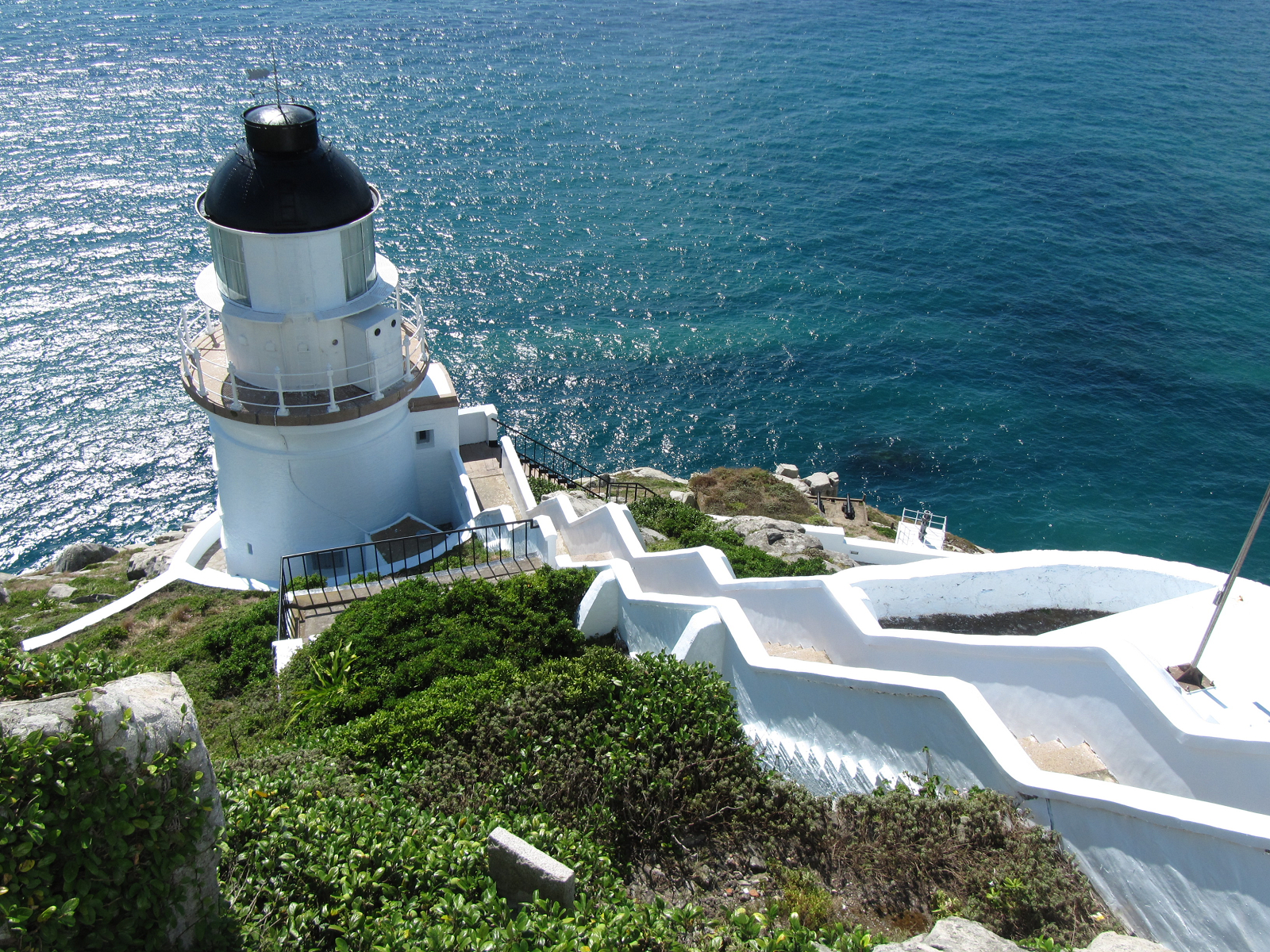
Tourism has become a critical sector in the local economy. Lienchiang County Government is making an effort to attract more visitors to the Matsu Islands, especially among foreigners. Dongyin Visitor Center is the main visitor center of the township.
Nangan is the capital of Matsu and it is noted for its granite tunnel and the Iron Fort. It has two interconnected main roads.
The Beihai Tunnels are manmade granite tunnels. Both tunnels were remarkable for their time, and they took great effort to construct. The tunnel in Nangan was built in 1968. The completion of Beihai Tunnel took the effort of thousands of men. The 700 m tunnel has a width of 10 m and a height of 16 m. It was completed in 820 days with shovels, spades and explosives; the tunnel also took the life of a platoon of soldiers. The tunnel was considered a military location and was not opened to the public until 1990.
The Iron Fort is located on the Southwest side of Nangan island. Located by a small cliff, it is a vulnerable spot for outside attacks or illegal smuggling of materials. With that in mind, the fort was built for defence. It is equipped with multiple machinegun rooms and rudimentary living facilities. It is now open to the public, and although most of the equipment has been removed from the site, the site itself brings back a vivid image of what it was like for soldiers at that time.
Museums in Matsu including the Matsu Blue Tears Ecological Museum, Matsu Folk Culture Museum, Ching-kuo Memorial Hall and War and Peace Memorial Park Exhibition Center.
Nature
Since 1990, the county manages the , which spreads across eight islands and islets in Nangan, Beigan and Tongyin Townships. It contains 30 species in 15 orders, mostly gulls and terns. In 2000, four pairs of the critically endangered Chinese crested tern, previously thought to be extinct, were discovered nesting on the Matsu Islands, giving them global conservation importance.
There are also mosses and ferns rare or absent elsewhere in the ROC.
Cetacean species that have become rare along Chinese coasts are still present here such as false killer whales and finless porpoises, providing opportunistic observations at times. Finless porpoises in this areas are generally smaller than other subspecies, and it is unique that two subspecies inhabit in this region where Matsu region is the northern limit for one of them.
Transportation


Air
Both Nangan and Beigan have airports which are the Matsu Nangan Airport and Matsu Beigan Airport respectively. Dongyin and Juguang (in Xiju Island) house heliports which only operate during winter time and priority is given to local residents to travel to Nangan.
Sea
Due to the main airport being located in Nangan, boats are the main form of transportation between the islands in the county.
Being part of Taiwan the main boat rides depart from Keelung and arrive in Nangan.
There are two ferry rides to mainland China. One arrives at Mawei District of Fuzhou and departs from Fuao Harbor at Nangan Township in which the journey normally takes 90 minutes while in Nangan. Another arrives at Huangqi (黄岐镇) of Lianjiang and departs from Beigan Township in which the journey takes only 20 minutes. Dongyin Township houses the Zhongzhu Harbor.
Road
Due to their size, travelling by motorized scooter is an ideal way to get around the main islands such as Nangan and Beigan, despite the steep hills. Both Islands have regular buses, and taxis are also economical. In October 2019, mainland China announced 'initial plans' to build a bridge linking Fuzhou to the Matsu Islands. Taiwan's Mainland Affairs Council (MAC) said that the plans were made unilaterally by Mainland's Fujian as part of its schemes to absorb Taiwan and divide Taiwanese society and that they see no need for bridges linking either Matsu or Kinmen to mainland China. Legislators representing Matsu have said that their thinking is different from the Mainland Affairs Council, and that they were optimistic about the idea of a bridge.
Notable persons
- Chen Pao-yu, Chief of Staff of the Republic of China Army (2019-)
Notes
References
References
- link. (9 January 2017). zh-tw. 馬祖-連江縣政府 LIENCHIANG COUNTY GOVERNMENT. zh-tw. 終於讓專家學者在經過2年研究後,發現了全新品種的雌光螢,命名為北竿雌光螢和分布於東莒島的黃緣雌光螢,這對於總面積僅29.6平方公里的馬祖來說,是極為珍貴的物產。
- link
- link. zh-tw. 總計:2768戶,12716人,男性7244人,女性5472人。. (14 July 2016)
- (2008). "Longman Pronunciation Dictionary". Pearson Education ESL.
- "Lienchiang County".
- (16 June 2011). link. Online Translation System of Geographic Name, [[Ministry of Interior of the Republic of China. Ministry of Interior]]
- "Local governments".
- (March 2005). "Country Profile: Taiwan". [[Federal Research Division]], [[Library of Congress]].
- (1904). "Index to the Postal Working Map". Inspectorate General of Customs.
- (2 November 1953). "Chinese Communist Highway Construction and Repair". [[CIA]].
- (7 February 1956). "Current Intelligence Bulletin". [[CIA]].
- (December 1842). "Topography of Fukien; situation and boundaries of the province; its area and population; subdivisions, mountains, rivers, harbors &c.". [[The Chinese Repository]].
- (1981). "A Pictorial History of the Republic of China : Its Founding and Development". Modern China Press.
- (1938). "A Gazetteer of Chinese Geographical Names".
- "About Matsu".
- (19 January 2019). "History and Customs".
- (16 March 1955). "FOREIGN RELATIONS OF THE UNITED STATES, 1955–1957, CHINA".
- (26 December 2015). "Further options open for Straits travel".
- "Matsu Island".
- link. zh. 馬祖資訊網
- (April 6, 2003). "Cases of mistaken identity perplexing Lienchiang County". [[Taipei Times]].
- "福建省政府".
- Lin, Sheng-Chang. (2021-09-13). "At the Edge of State Control: The Creation of the "Matsu Islands"". [[University of Nottingham]] Taiwan Studies Programme.
- link. zh-tw. 馬祖資訊網. zh-tw. 二十六年
九月十日
北竿、南竿被日軍侵占,成為福建最早淪陷的島嶼。 - {{lang. zh-tw. 林金炎. zh-tw. 0910 日軍透過偽軍侵佔馬祖列島的南、北竿島,成為福建最早淪陷的島嶼。《連江縣志,大事紀P.34,連江縣地方志編纂委員會,2000.6,方志出版社。》. (15 September 2014). 財團法人台北市道元社會福利慈善事業基金會出版
- link. {{lang. zh-tw. 林金炎. (24 June 2011). zh-tw. 12月15日、福建省政府成立「馬祖行政公署」,行政區以島為單位,改設馬祖為八區,即「南竿」、「北竿」、「白肯」、「東湧」、「四礵」、「岱山(台山)」、「西洋」、「浮鷹」區,
- link. (25 June 2008). zh-tw. 馬祖資訊網. zh-tw. 鄉政沿革
39年12月15日,「馬祖行政公署」成立於南竿,將原設之區署及鄉公所撤銷,行政區域改以島為單位,改設南竿、北竿、白肯、東湧、四霜、西洋、浮鷹、岱山等8區,各區設區公所,區下設村、伍,為地方基層行政組織。 - (2006)
- (16 September 1953). "Chinese Communist Treatment of Coastal Islanders, Fukien". [[Central Intelligence Agency.
- (30 June 1955). "Current Intelligence Weekly Summary". [[CIA]].
- (1997). "A Study of Crisis".
- (November 2010). "A Historical Footnote Revisited". [[UNC-CH]].
- Norris, Robert B.. (November 29, 2010). "Quemoy and Matsu: a historical footnote revisited". American Diplomacy.
- "OCTOBER 7, 1960 Presidential Candidates Debate".
- "John F. Kennedy vs Richard Nixon - Second Presidential Debate 1960".
- "TELEVISION DEBATES: TRANSCRIPT: SECOND DEBATE".
- (1961). "The Joint Appearances of Senator John F. Kennedy and Vice President Richard M. Nixon and Other 1960 Campaign Presentations". [[US Government Printing Office]].
- (October 2013). "Chris Matthews Complete Library". Simon and Schuster.
- (October 7, 1960). "Presidential Debate in Washington, DC".
- (1978). "RN: The Memoirs of Richard Nixon". Simon & Schuster.
- (1963). "J.F.K. : the man and the myth".
- "Lienchiang County Council - Introduction to Matsu". mtcc.gov.tw.
- "Matsu tourism heralds new dawn for Lienchiang County - Taiwan Today".
- "Headline_Taiwan Affairs Office of the State Council PRC".
- (30 December 2014). "Annual ridership on Kinmen-Fujian ferry services tops 1.5 million".
- link. (24 December 2015). Chen Chien-Yu {{lang. zh-tw. 陳建瑜
- (16 December 2019). "Huangqi-Matsu route sees increasing traffic".
- "Taiwan coastguard 'drives away' Chinese vessels including sand dredger".
- Wen Lii. (12 August 2020). "From Taiwan to the Philippines, Chinese Illegal Dredging Ships Wreak Environmental Havoc".
- (2021-10-15). "Green sky at night over Taiwan's islands heralds a different kind of squid game". The Washington Post.
- (2023-03-09). "Internet outage has Taiwan worried about threat from Chinese sabotage". The Washington Post.
- (2023-03-07). "Remote Corner of Taiwan Confronts Wartime Scenario: Life With No Internet". The Wall Street Journal.
- "The Matsu Islands".
- link. [[:zh:內政部地政司. Department of Land Administration]]. (16 May 2012). zh-tw. 地政事務所名稱(代碼) 連江(ZA) 鄉鎮市區名稱(代碼) 北竿鄉(02) 段 小段 代碼 備註{...}大坵 0020 無名島 0021 高登 0022 峭頭 0023 進嶼 0024 亮島 0035 調整 浪岩 0036 調整 三連嶼 0039 中島 0040 調整 白廟 0041 調整 老鼠 0042 調整
- link. (13 June 2019). zh-hans. '''对台优势。'''黄岐镇与马祖列岛一衣带水,两岸最近处仅距离8000米,素有"里山"、"外山"之称,是祖国大陆离马祖最近的地方,也是环马祖澳旅游区的核心区域。. zh-hans. 福州市连江县政府
- link. XZQH.org. (13 November 2008). zh-hans. 南与马祖列岛隔海相望(两岸最近处仅距离8000米,是祖国大陆离马祖岛最近的地区),
- (December 2017). "Ages and petrogenesis of Jurassic and Cretaceous intrusive rocks in the Matsu Islands: Implications for lower crust modification beneath southeastern China". Journal of Asian Earth Sciences.
- (January 2010). "Climate, Flora and Fauna - Matsu National Scenic Area".
- "Introduction to Matsu".
- (16 June 2011). link. Online Translation System of Geographic Name, [[Ministry of Interior of the Republic of China. Ministry of Interior]]
- "2016 the 14th Presidential and Vice Presidential Election and the 9th Legislator Election".
- {{cite map. link
- link. [[National Bureau of Statistics of the People's Republic of China]]. (2018). zh-hans. 统计用区划代码 名称{...}350122400000 马祖乡
- link. zh-hans. 福州市连江县政府. (10 May 2005). zh-hans. 全县总面积428平方公里(包括待统一的马祖列岛)。
- link. XZQH.org. (16 June 2015). zh-hans. 1949年划为敖江、丹阳、东澳、琯头、筱定、黄苔6镇和荷山、浦洋、镜山、荻壶、潘溪、小沧、朱蓼、所南、象厦、官塘、竿塘、西洋12乡,后又并为8个区,31个乡(镇),其中马祖乡尚待统一。{...}2000年第五次人口普查,连江县常住总人口599962人,{...}(不含马祖乡)2003年末,连江县户籍人口61.31万人,其中非农业人口10.63万人。2004年,全县辖22个乡镇(不含马祖乡),268个村(居),总人口62万人。2007年末,连江县总面积1190.7平方千米(含马祖列岛23.5平方千米)。总人口为613354人(不含马祖列岛),其中城镇人口128298人。
- link. (28 March 2012). zh-hans. 福州市长乐区人民政府. zh-hans. 全境陆地面积723平方公里,海岸线长103公里。有大小岛屿30余个,其中以白犬列岛最大。
- (28 October 2020). "Chinese sand dredging vessels dispersed near Matsu". 中央通訊社.
- (6 March 2019). "Lienchiang Cross-Strait Matters Forum focuses on sea transportation". Focus Taiwan.
- [[:s:zh:大眾運輸工具播音語言平等保障法. 大眾運輸工具播音語言平等保障法]]{{Circular reference. (May 2024)
- (January 2010). "History and customs". Matsu National Scenic Area.
- (3 June 2013). "Taiwan's small islands turn to tourism to stay afloat".
- (8 July 2012). "Matsu votes to allow building of casino".
- (7 September 2020). "Hsieh-ho Power Plant - Zhushan Branch Power Plant".
- (23 March 2020). "Overview of the Development of Renewable Energy".
- Hioe, Brian. (17 February 2023). "Cut Submarine Cables between Taiwan and Matsu Raise Concerns about Chinese Interference".
- (10 February 2023). "Damaged cables shut off Matsu Internet". Taipei Times.
- (March 3, 2010). "Matsu Island opens doors to tourists". Taiwan Today.
- (August 29, 2010). "Matsu islands aim to attract more overseas tourists". Taipei Times.
- (January 2010). "Climate, Flora and fauna". Matsu National Scenic Area.
- "A natural aquatic menagerie". [[Lienchiang County Government]].
- (2014). link. The Midwest News
- (2011). "Revision of the taxonomy of finless porpoises (genus Neophocaena): The existence of two species". The Oceanographic Environmental Research Society.
- (January 2010). "Island to Island Transport - Matsu National Scenic Area".
- (January 2010). "Three Mini-Links - Matsu National Scenic Area".
- (11 May 2015). "New Matsu-Fujian ferry route to be launched in July: Official".
- (14 October 2019). "China announces 'initial plans' to build bridges to Taiwan's outlying islands Matsu, Kinmen". Taiwan News.
- Thomson, Jono. (2023-09-15). "China says its ready to build rail link to Taiwan".
This article was imported from Wikipedia and is available under the Creative Commons Attribution-ShareAlike 4.0 License. Content has been adapted to SurfDoc format. Original contributors can be found on the article history page.
Ask Mako anything about Matsu Islands — get instant answers, deeper analysis, and related topics.
Research with MakoFree with your Surf account
Create a free account to save articles, ask Mako questions, and organize your research.
Sign up freeThis content may have been generated or modified by AI. CloudSurf Software LLC is not responsible for the accuracy, completeness, or reliability of AI-generated content. Always verify important information from primary sources.
Report