From Surf Wiki (app.surf) — the open knowledge base
Mathematics of paper folding
none
none
The discipline of origami or paper folding has received a considerable amount of mathematical study. Fields of interest include a given paper model's flat-foldability (whether the model can be flattened without damaging it), and the use of paper folds to solve mathematical equations up to the third order.
Computational origami is a recent branch of computer science that is concerned with studying algorithms that solve paper-folding problems. The field of computational origami has also grown significantly since its inception in the 1990s with Robert Lang's TreeMaker algorithm to assist in the precise folding of bases. Computational origami results either address origami design or origami foldability. In origami design problems, the goal is to design an object that can be folded out of paper given a specific target configuration. In origami foldability problems, the goal is to fold something using the creases of an initial configuration. Results in origami design problems have been more accessible than in origami foldability problems.
History
In 1893, Indian civil servant T. Sundara Row published Geometric Exercises in Paper Folding which used paper folding to demonstrate proofs of geometrical constructions. This work was inspired by the use of origami in the kindergarten system. Row demonstrated an approximate trisection of angles and implied that the construction of a cube root was impossible.
In 1922, Harry Houdini published "Houdini's Paper Magic," which described origami techniques that drew informally from mathematical approaches that were later formalized.

In 1936 Margharita P. Beloch showed that use of the 'Beloch fold', later used in the sixth of the Huzita–Hatori axioms, allowed the general cubic equation to be solved using origami.{{cite journal
In 1949, R C Yeates' book "Geometric Methods" described three allowed constructions corresponding to the first, second, and fifth of the Huzita–Hatori axioms.
The Yoshizawa–Randlett system of instruction by diagram was introduced in 1961.
In 1980 a construction was reported which enabled an angle to be trisected. Trisections are impossible under Euclidean rules.
Also in 1980, Kōryō Miura and Masamori Sakamaki demonstrated a novel map-folding technique whereby the folds are made in a prescribed parallelogram pattern, which allows the map to be expandable without any right-angle folds in the conventional manner. Their pattern allows the fold lines to be interdependent, and hence the map can be unpacked in one motion by pulling on its opposite ends, and likewise folded by pushing the two ends together. No unduly complicated series of movements are required, and folded Miura-ori can be packed into a very compact shape. In 1985 Miura reported a method of packaging and deployment of large membranes in outer space,{{cite report

In 1986, Messer reported a construction by which one could double the cube, which is impossible with Euclidean constructions.
The first complete statement of the seven axioms of origami by French folder and mathematician Jacques Justin was written in 1986, but were overlooked until the first six were rediscovered by Humiaki Huzita in 1989. The first International Meeting of Origami Science and Technology (now known as the International Conference on Origami in Science, Math, and Education) was held in 1989 in Ferrara, Italy. At this meeting, a construction was given by Scimemi for the regular heptagon.
Around 1990, Robert J. Lang and others first attempted to write computer code that would solve origami problems.

In 1996, Marshall Bern and Barry Hayes showed that the problem of assigning a crease pattern of mountain and valley folds in order to produce a flat origami structure starting from a flat sheet of paper is NP-complete.
In 1999, a theorem due to Haga provided constructions used to divide the side of a square into rational fractions.
In 2002, sarah-marie belcastro and Tom Hull brought to the theoretical origami the language of affine transformations, with an extension from R2 to R3 in only the case of single-vertex construction.
In 2002, Alperin solved Alhazen's problem of spherical optics. In the same paper, Alperin showed a construction for a regular heptagon. Bisections and trisections were used by Alperin in 2005 for the same construction.
In 2005, principles and concepts from mathematical and computational origami were applied to solve Countdown, a game popularized in British television in which competitors used a list of source numbers to build an arithmetic expression as close to the target number as possible.
In 2009, Alperin and Lang extended the theoretical origami to rational equations of arbitrary degree, with the concept of manifold creases. This work was a formal extension of Lang's unpublished 2004 demonstration of angle quintisection.
Pure origami
Flat folding


The construction of origami models is sometimes shown as crease patterns. The major question about such crease patterns is whether a given crease pattern can be folded to a flat model, and if so, how to fold them; this is an NP-complete problem.{{cite book |year=2002 |publisher=AK Peters |isbn=978-1-56881-181-9
- Maekawa's theorem: at any vertex the number of valley and mountain folds always differ by two.
- : It follows from this that every vertex has an even number of creases, and therefore also the regions between the creases can be colored with two colors.
- Kawasaki's theorem or Kawasaki-Justin theorem: at any vertex, the sum of all the odd angles (see image) adds up to 180 degrees, as do the even.
- A sheet can never penetrate a fold.
Paper exhibits zero Gaussian curvature at all points on its surface, and only folds naturally along lines of zero curvature. Curved surfaces that can't be flattened can be produced using a non-folded crease in the paper, as is easily done with wet paper or a fingernail.
Assigning a crease pattern mountain and valley folds in order to produce a flat model has been proven by Marshall Bern and Barry Hayes to be NP-complete.{{cite conference | contribution-url = http://dl.acm.org/citation.cfm?id=313918
Huzita–Justin axioms
Main article: Huzita–Hatori axioms
Some classical construction problems of geometry — namely trisecting an arbitrary angle or doubling the cube — are proven to be unsolvable using compass and straightedge, but can be solved using only a few paper folds. Paper fold strips can be constructed to solve equations up to degree 4. The Huzita–Justin axioms or Huzita–Hatori axioms are an important contribution to this field of study. These describe what can be constructed using a sequence of creases with at most two point or line alignments at once. Complete methods for solving all equations up to degree 4 by applying methods satisfying these axioms are discussed in detail in Geometric Origami. |title-link= Geometric Origami
Constructions
As a result of origami study through the application of geometric principles, methods such as Haga's theorem have allowed paperfolders to accurately fold the side of a square into thirds, fifths, sevenths, and ninths. Other theorems and methods have allowed paperfolders to get other shapes from a square, such as equilateral triangles, pentagons, hexagons, and special rectangles such as the golden rectangle and the silver rectangle. Methods for folding most regular polygons up to and including the regular have been developed. A regular n-gon can be constructed by paper folding if and only if n is a product of distinct Pierpont primes, powers of two, and powers of three.
Haga's theorems

The side of a square can be divided at an arbitrary rational fraction in a variety of ways. Haga's theorems say that a particular set of constructions can be used for such divisions.{{cite web
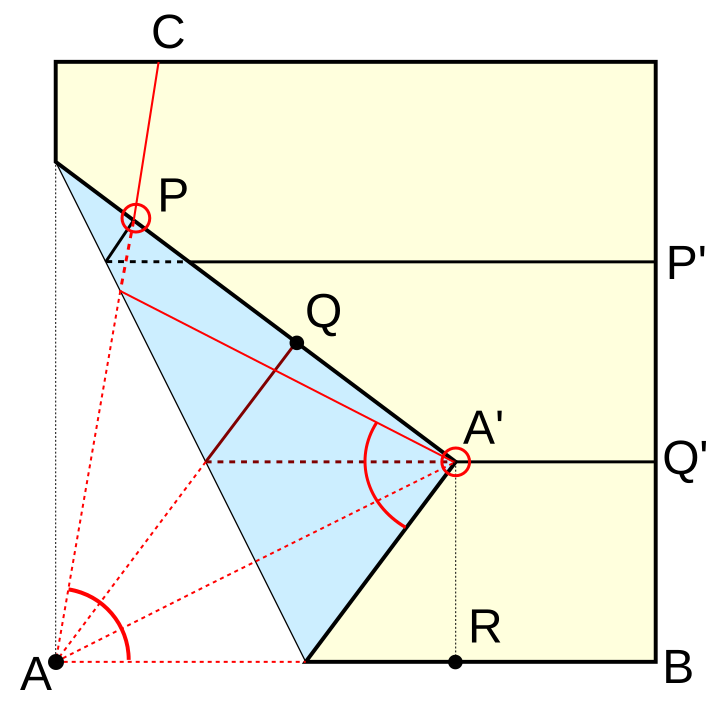
The accompanying diagram shows Haga's first theorem:
:BQ = \frac{2 AP}{1 + AP}.
The function changing the length AP to QC is self inverse. Let x be AP then a number of other lengths are also rational functions of x. For example:
| AP | BQ | QC | AR | PQ |
|---|---|---|---|---|
| x | \frac{2 x}{1+x} | \frac{1-x}{1+x} | \frac{1-x^2}{2} | \frac{1+x^2}{1+x} |
A generalization of Haga's theorems
Haga's theorems are generalized as follows: :\frac{BQ}{CQ} = \frac{2 AP}{BP}. Therefore, BQ:CQ=k:1 implies AP:BP=k:2 for a positive real number k. Also,
Each side is 1 PB=1-AP AP=1/2 By triangle congruence, AR~PB BQ=(AP/AR)(PB) =(2AP/(1-AP^2))*(1-AP)
Doubling the cube

The classical problem of doubling the cube can be solved using origami. This construction is due to Peter Messer: A square of paper is first creased into three equal strips as shown in the diagram. Then the bottom edge is positioned so the corner point P is on the top edge and the crease mark on the edge meets the other crease mark Q. The length PB will then be the cube root of 2 times the length of AP.
The edge with the crease mark is considered a marked straightedge, something which is not allowed in compass and straightedge constructions. Using a marked straightedge in this way is called a neusis construction in geometry.
Trisecting an angle
Angle trisection is another of the classical problems that cannot be solved using a compass and unmarked ruler but can be solved using origami. This construction, which was reported in 1980, is due to Hisashi Abe.
Computational origami
Computational origami is a branch of computer science that is concerned with studying algorithms for solving paper-folding problems. In the early 1990s, origamists participated in a series of origami contests called the Bug Wars in which artists attempted to out-compete their peers by adding complexity to their origami bugs. Most competitors in the contest belonged to the Origami Detectives, a group of acclaimed Japanese artists. Robert Lang, a research-scientist from Stanford University and the California Institute of Technology, also participated in the contest. The contest helped initialize a collective interest in developing universal models and tools to aid in origami design and foldability.
Research
Paper-folding problems are classified as either origami design or origami foldability problems. There are predominantly three current categories of computational origami research: universality results, efficient decision algorithms, and computational intractability results. A universality result defines the bounds of possibility given a particular model of folding. For example, a large enough piece of paper can be folded into any tree-shaped origami base, polygonal silhouette, and polyhedral surface. When universality results are not attainable, efficient decision algorithms can be used to test whether an object is foldable in polynomial time. Certain paper-folding problems do not have efficient algorithms. Computational intractability results show that there are no such polynomial-time algorithms that currently exist to solve certain folding problems. For example, it is NP-hard to evaluate whether a given crease pattern folds into any flat origami.
In 2017, Erik Demaine of the Massachusetts Institute of Technology and Tomohiro Tachi of the University of Tokyo published a new universal algorithm that generates practical paper-folding patterns to produce any 3-D structure. The new algorithm built upon work that they presented in their paper in 1999 that first introduced a universal algorithm for folding origami shapes that guarantees a minimum number of seams. The algorithm will be included in Origamizer, a free software for generating origami crease patterns that was first released by Tachi in 2008.
Software & tools
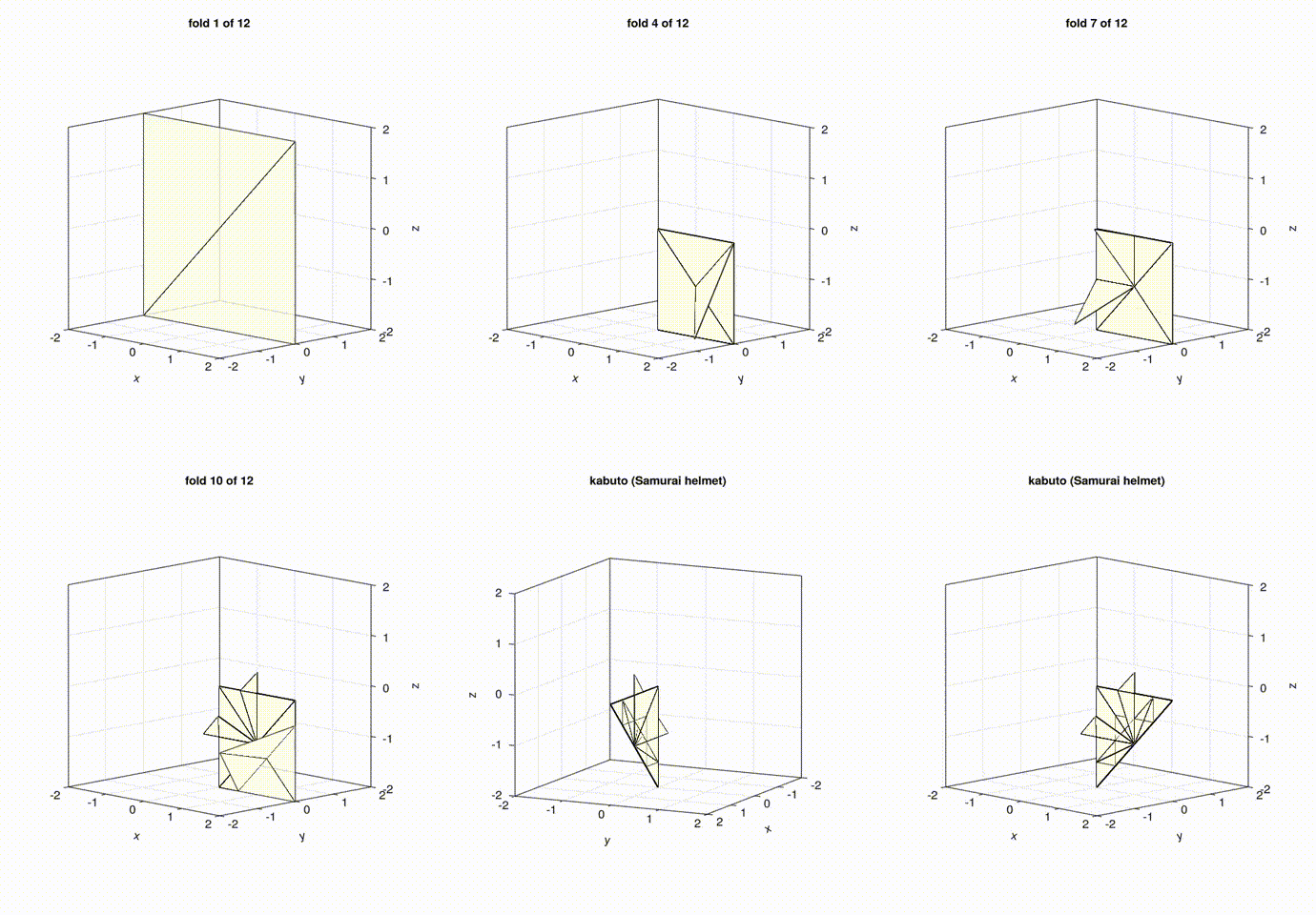
There are several software design tools that are used for origami design. Users specify the desired shape or functionality and the software tool constructs the fold pattern and/or 2D or 3D model of the result. Researchers at the Massachusetts Institute of Technology, Georgia Tech, University of California Irvine, University of Tsukuba, and University of Tokyo have developed and posted publicly available tools in computational origami. TreeMaker, ReferenceFinder, OrigamiDraw, and Origamizer are among the tools that have been used in origami design.
There are other software solutions associated with building computational origami models using non-paper materials such as Cadnano in DNA origami.
Applications
Computational origami has contributed to applications in robotics, engineering, biotechnology & medicine, industrial design. Applications for origami have also been developed in the study of programming languages and programming paradigms, particular in the setting of functional programming.
Robert Lang participated in a project with researchers at EASi Engineering in Germany to develop automotive airbag folding designs. In the mid-2000s, Lang worked with researchers at the Lawrence Livermore National Laboratory to develop a solution for the James Webb Space Telescope, particularly its large mirrors, to fit into a rocket using principles and algorithms from computational origami.
In 2014, researchers at the Massachusetts Institute of Technology, Harvard University, and the Wyss Institute for Biologically Inspired Engineering published a method for building self-folding machines and credited advances in computational origami for the project's success. Their origami-inspired robot was reported to fold itself in 4 minutes and walk away without human intervention, which demonstrated the potential for autonomous self-controlled assembly in robotics.
Other applications include DNA origami and RNA origami, folding of manufacturing instruments, and surgery by tiny origami robots.
Applications of computational origami have been featured by various production companies and commercials. Lang famously worked with Toyota Avalon to feature an animated origami sequence, Mitsubishi Endeavor to create a world entirely out of origami figures, and McDonald's to form numerous origami figures from cheeseburger wrappers.
References
- "origami - History of origami {{!}} Britannica". Encyclopedia Britannica.
- "Lecture: Recent Results in Computational Origami". ''Origami USA: We are the American national society devoted to origami, the art of paperfolding''. Retrieved 2022-05-08.
- T. Sundara Row. (1917). "Geometric Exercises in Paper Folding". [[The Open Court Publishing Company]].
- Houdini, Harry. "Houdini's Paper Magic".
- George Edward Martin. (1997). "Geometric constructions". Springer.
- Robert Carl Yeates. (1949). "Geometric Tools". Louisiana State University.
- Nick Robinson. (2004). "The Origami Bible". Chrysalis Books.
- Bain, Ian. (1980). "The Miura-Ori map". [[New Scientist]].
- "2D Array". Japan Aerospace Exploration Agency.
- Nishiyama, Yutaka. (2012). "Miura folding: Applying origami to space exploration". International Journal of Pure and Applied Mathematics.
- Justin, Jacques, "Resolution par le pliage de l'equation du troisieme degre et applications geometriques", reprinted in ''Proceedings of the First International Meeting of Origami Science and Technology'', H. Huzita ed. (1989), pp. 251–261.
- Benedetto Scimemi, Regular Heptagon by Folding, Proceedings of Origami, Science and Technology, ed. H. Huzita., Ferrara, Italy, 1990
- (1 December 2009). "The power of origami". University of Cambridge.
- (2002). "Modelling the folding of paper into three dimensions using affine transformations". Linear Algebra and Its Applications.
- (2002). "Mathematical Origami: Another View of Alhazen's Optical Problem".
- (2006). "Automated Deduction in Geometry".
- (2005). "Trisections and Totally Real Origami". [[The American Mathematical Monthly]].
- (September 2005). "Countdown: A case study in origami programming". Journal of Functional Programming.
- (2009). "Origami 4". Origami4: Fourth International Meeting of Origami Science, Mathematics, and Education.
- "The Mathematics of Origami". Carleton College.
- (2004). "Angle Quintisection".
- "Robert Lang folds way-new origami".
- Tom Hull. "Origami and Geometric Constructions".
- K. Haga, Origamics, Part 1, Nippon Hyoron Sha, 1999 (in Japanese)
- Lang, Robert J. (2008). "From Flapping Birds to Space Telescopes: The Modern Science of Origami". Usenix Conference, Boston, MA.
- Peter Messer. (1986). "Problem 1054". [[Crux Mathematicorum]].
- Dancso, Zsuzsanna. (December 12, 2014). "Numberphile: How to Trisect an Angle with Origami".
- (2011). "Origami 5". CRC Press.
- (1997). "a comparison between straight edge and compass constructions and origami".
- "Siggraph: "Curved Origami"".
- (25 November 2015). "Folding Paper in Half". Teachers of India.
- "Folding".
- Hull, Thomas. (2002). "In search of a practical map fold". Math Horizons.
- (2007-02-12). "The Origami Lab".
- Demaine, Erik (2001). "Recent Results in Computational Origami" (PDF).
- Lang, Robert. "A Computational Algorithm for Origami Design".
- Schneider, Jonathan (December 10, 2004). "Flat-Foldability of Origami Crease Patterns" (PDF).
- (22 June 2017). "Origami anything".
- (31 March 2024). "Julia and Projective Geometric Algebra".
- TASON. "Computational Origami".
- "Cadnano".
- "How Origami Is Revolutionizing Industrial Design".
- Gibbons, Jeremy. (2003). "Origami Programming".
- TASON. "Airbag Folding".
- "Webb and Origami - Webb Telescope/NASA".
- (2014-08-08). "A method for building self-folding machines". Science.
- Brewin, Bob. (2004-05-10). "Computational Origami".
- "The Origami Resolution".
This article was imported from Wikipedia and is available under the Creative Commons Attribution-ShareAlike 4.0 License. Content has been adapted to SurfDoc format. Original contributors can be found on the article history page.
Ask Mako anything about Mathematics of paper folding — get instant answers, deeper analysis, and related topics.
Research with MakoFree with your Surf account
Create a free account to save articles, ask Mako questions, and organize your research.
Sign up freeThis content may have been generated or modified by AI. CloudSurf Software LLC is not responsible for the accuracy, completeness, or reliability of AI-generated content. Always verify important information from primary sources.
Report