From Surf Wiki (app.surf) — the open knowledge base
Markush structure
Chemical structure representation
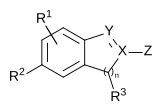
Chemical structure representation
A Markush structure, Markush group, or a Markush claim is a visual representation used to indicate a group of related chemical compounds. They are commonly used in chemistry texts and in patent claims. Markush structures are depicted with multiple independently variable groups, such as R groups in which a side chain can have varying structure. This more general depiction of the molecule, versus detailing every atom in the molecule, is used to protect intellectual property. The company which applies for a patent makes a general claim for the usage of the molecule without revealing to their competitors the exact molecule for which they are declaring a useful application.
History
Markush structures are named after Eugene A. Markush, founder of the Pharma Chemical Corporation in New Jersey. He was involved in a legal case that set a precedent for generic chemical structure patent filing, Ex parte Markush, 1925 Dec. Comm'r Pat. 126, 127 (1924). The patent filing was US Application 611,637, filed January 9, 1923. Markush was awarded a patent from the US Patent Office for “Pyrazolone Dye and Process of Making the Same” on August 26, 1924.
Use in patents
In describing a chemical, a Markush structure allows the patent-holder to list several active/effective structural formulas.
United States
In the United States, Markush structures are frequently used to claim alternative components. The correct format for a Markush structure is "closed." In other words, the claim language defined by the Markush structure requires selection from a closed group. One way of claiming a Markush structure follows the format: “a chemical selected from the group consisting of A, B, and C” where A, B, and C are alternative chemicals.
A claimed Markush structure may be improper if (1) the members of the Markush structure do not share a "single structural similarity," or (2) if the members of the Markush structure do not share a common use.
References
References
- Barnard, John M.. (28 Oct 2009). "Markush Structure Searching".
- "Pyrazolone dye and process of making the same".
This article was imported from Wikipedia and is available under the Creative Commons Attribution-ShareAlike 4.0 License. Content has been adapted to SurfDoc format. Original contributors can be found on the article history page.
Ask Mako anything about Markush structure — get instant answers, deeper analysis, and related topics.
Research with MakoFree with your Surf account
Create a free account to save articles, ask Mako questions, and organize your research.
Sign up freeThis content may have been generated or modified by AI. CloudSurf Software LLC is not responsible for the accuracy, completeness, or reliability of AI-generated content. Always verify important information from primary sources.
Report