From Surf Wiki (app.surf) — the open knowledge base
Markup rule
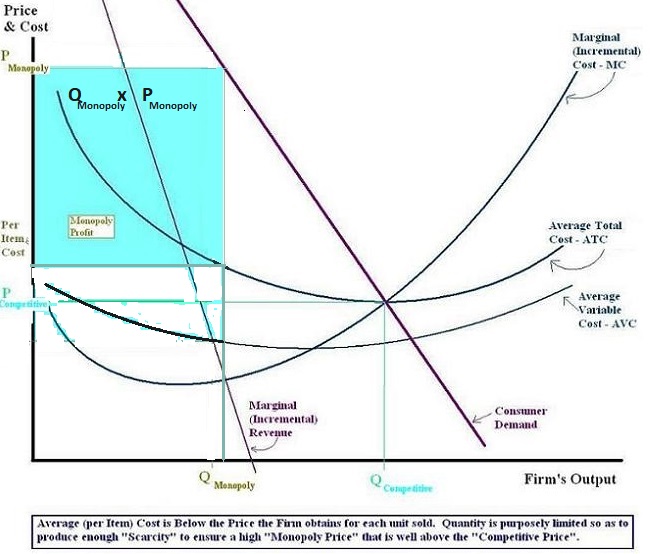
A markup rule is the pricing practice of a producer with market power, where a firm charges a fixed mark-up over its marginal cost.
Derivation of the markup rule
Mathematically, the markup rule can be derived for a firm with price-setting power by maximizing the following expression for profit: : \pi = P(Q)\cdot Q - C(Q) :where :Q = quantity sold, :P(Q) = inverse demand function, and thereby the price at which Q can be sold given the existing demand :C(Q) = total cost of producing Q. : \pi = economic profit
Profit maximization means that the derivative of \pi with respect to Q is set equal to 0:
:P'(Q)\cdot Q+P-C'(Q)=0 : where
:P'(Q) = the derivative of the inverse demand function. :C'(Q) = marginal cost–the derivative of total cost with respect to output.
This yields: :P'(Q)\cdot Q + P = C'(Q)
or "marginal revenue" = "marginal cost".
:P\cdot(P'(Q)\cdot Q/P+1)=MC
By definition P'(Q)\cdot Q/P is the reciprocal of the price elasticity of demand (or 1/ \epsilon). Hence
:P\cdot(1+1/{\epsilon})=P\cdot\left(\frac{1+\epsilon}{\epsilon}\right)=MC
Letting \eta be the reciprocal of the price elasticity of demand,
:P=\left(\frac{1}{1+\eta}\right)\cdot MC
Thus a firm with market power chooses the output quantity at which the corresponding price satisfies this rule. Since for a price-setting firm \eta this means that a firm with market power will charge a price above marginal cost and thus earn a monopoly rent. On the other hand, a competitive firm by definition faces a perfectly elastic demand; hence it has \eta=0 which means that it sets the quantity such that marginal cost equals the price.
The rule also implies that, absent menu costs, a firm with market power will never choose a point on the inelastic portion of its demand curve (where \epsilon \ge -1 and \eta \le -1). Intuitively, this is because starting from such a point, a reduction in quantity and the associated increase in price along the demand curve would yield both an increase in revenues (because demand is inelastic at the starting point) and a decrease in costs (because output has decreased); thus the original point was not profit-maximizing.
References
References
- Roger LeRoy Miller, ''Intermediate Microeconomics Theory Issues Applications, Third Edition'', New York: McGraw-Hill, Inc, 1982.
- Tirole, Jean, "The Theory of Industrial Organization", Cambridge, Massachusetts: The MIT Press, 1988.
This article was imported from Wikipedia and is available under the Creative Commons Attribution-ShareAlike 4.0 License. Content has been adapted to SurfDoc format. Original contributors can be found on the article history page.
Ask Mako anything about Markup rule — get instant answers, deeper analysis, and related topics.
Research with MakoFree with your Surf account
Create a free account to save articles, ask Mako questions, and organize your research.
Sign up freeThis content may have been generated or modified by AI. CloudSurf Software LLC is not responsible for the accuracy, completeness, or reliability of AI-generated content. Always verify important information from primary sources.
Report