From Surf Wiki (app.surf) — the open knowledge base
Mariner 3
Failed NASA mission to Mars (1964)

Failed NASA mission to Mars (1964)
| Field | Value |
|---|---|
| name | Mariner 3 |
| image | Mariner 3 and 4.jpg |
| image_caption | Mariner 3 is identical in design with Mariner 4 |
| mission_type | Mars flyby |
| operator | NASA / JPL |
| mission_duration | Launch failure |
| COSPAR_ID | 1964-073A |
| SATCAT | 923 |
| spacecraft | Mariner C-2 |
| manufacturer | Jet Propulsion Laboratory |
| launch_mass | 260.8 kg |
| power | 310 watts (at Mars encounter) |
| launch_date | UTC |
| launch_rocket | Atlas LV-3 Agena-D |
| launch_site | Cape Canaveral LC-13 |
| launch_contractor | Convair |
| orbit_reference | Heliocentric |
| apsis | helion |
| programme | **Mariner program** |
| previous_mission | Mariner 2 |
| next_mission | Mariner 4 |
Mariner 3 (Mariner C-2, together with Mariner 4 known as Mariner-Mars 1964) was one of two identical deep-space probes designed and built by the Jet Propulsion Laboratory (JPL) for NASA's Mariner-Mars 1964 project that were intended to conduct close-up (flyby) scientific observations of the planet Mars and transmit information on interplanetary space and the space surrounding Mars, televised images of the Martian surface and radio occultation data of spacecraft signals as affected by the Martian atmosphere back to Earth.
Although the launch was initially successful, there was a separation issue and Mariner 3 stopped responding when its batteries ran out of power. It was the third of ten spacecraft within the Mariner program.
Background

Mariner 2 had been a modified Ranger lunar probe, however Mariner 3 used a new, larger bus with four solar panels, a TV camera, and additional instrumentation. Because of the greater mass, the new Agena D stage would be used instead of the Agena B. Mariner 3 also utilized a new, larger fiberglass payload fairing. Of the two Atlas-Agena pads at Cape Canaveral, LC-13 became available first following the launch of an Air Force Vela satellite in July 1964. Atlas vehicle 289D was erected on the pad on August 17, with the backup Mariner probe and booster (Atlas 288D) erected on LC-12 on September 28.
Launch failure
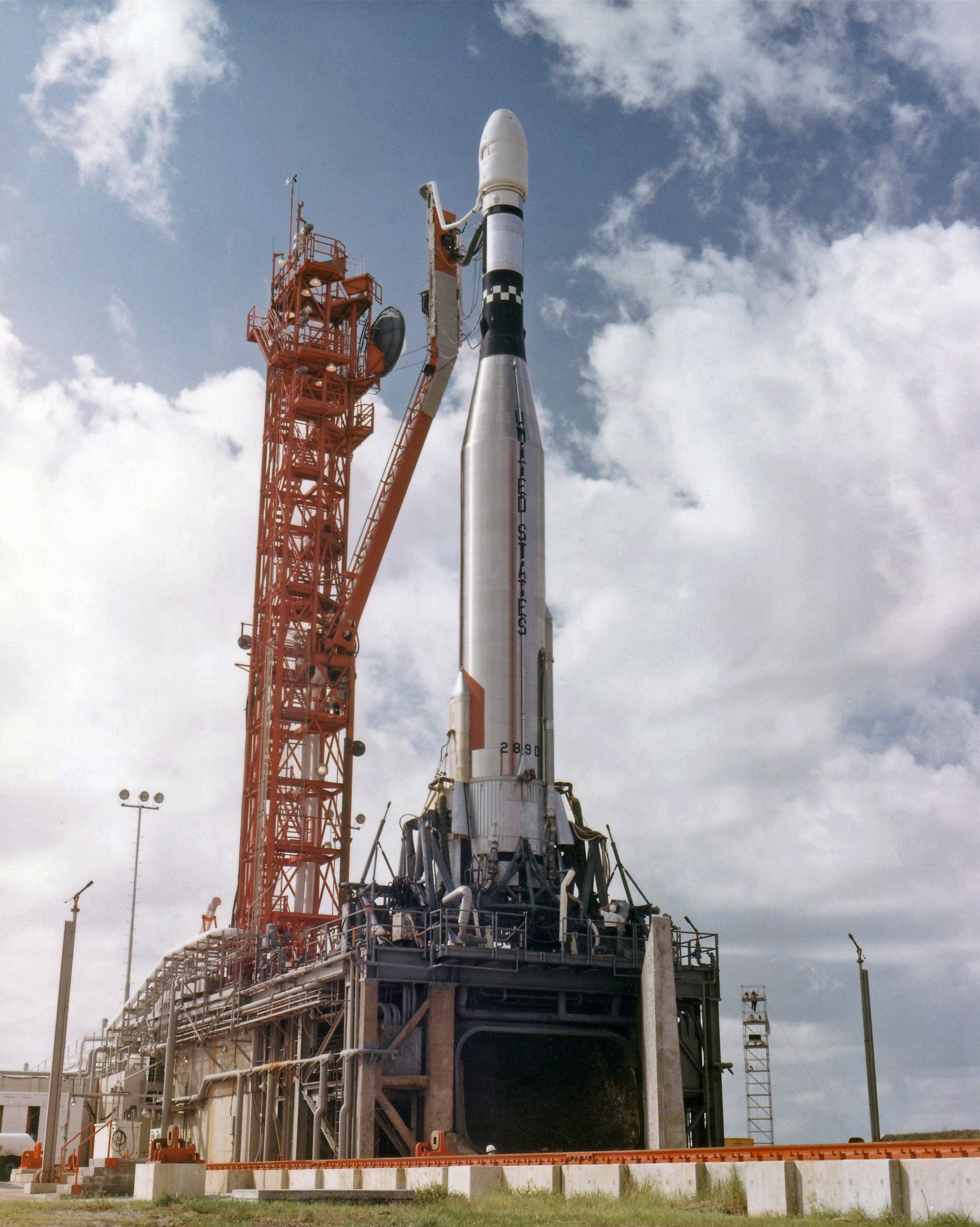
Mariner 3 was launched at 2:22 PM EST on November 5, 1964, from Cape Kennedy Air Force Station Launch Complex 13. After an uneventful boost phase, the Agena completed its burn to place the probe on a trajectory towards Mars. One hour after launch, the first telemetry transmissions from Mariner 3 were received, indicating that the scientific instruments were functioning correctly but there was no indication of any solar panel operation. Unsure of the exact problem, ground controllers issued a command to turn off the rate gyros to conserve power while they worked to figure out what had happened. Telemetry data suggested a separation failure of either the Agena or the payload fairing, but a below-normal velocity appeared to indicate that the fairing had not separated properly. A command was sent to manually jettison the payload shroud, but nothing happened. The ground controllers next considered firing Mariner 3's midcourse correction engine to blow off the shroud, but they ran out of time. Eight hours after launch, the batteries in the probe died and the mission was officially terminated. Even if the shroud could be removed, the mission would have failed, since the low velocity meant that Mariner 3 would miss Mars by several million miles.
Three weeks later, on November 28, 1964, Mariner 4 was launched successfully on a 7½-month voyage to Mars.
Instruments
The instruments on Mariner 3 included:
- Television camera
- Magnetometer
- Plasma probe
- Cosmic ray telescope
- Trapped radiation detector
- Cosmic ray ionization chamber
- Cosmic dust detector
References
| archive-url= https://web.archive.org/web/20100522071912/https://ntrs.nasa.gov/archive/nasa/casi.ntrs.nasa.gov/19660027080_1966027080.pdf | archive-date= 22 May 2010 | url-status= dead | access-date= 29 December 2011 }}
| access-date= 29 December 2011
| access-date= 3 November 2012 | archive-url= https://web.archive.org/web/20220413181531/https://ntrs.nasa.gov/api/citations/19650018349/downloads/19650018349.pdf | archive-date= 13 April 2022 | url-status= live
This article was imported from Wikipedia and is available under the Creative Commons Attribution-ShareAlike 4.0 License. Content has been adapted to SurfDoc format. Original contributors can be found on the article history page.
Ask Mako anything about Mariner 3 — get instant answers, deeper analysis, and related topics.
Research with MakoFree with your Surf account
Create a free account to save articles, ask Mako questions, and organize your research.
Sign up freeThis content may have been generated or modified by AI. CloudSurf Software LLC is not responsible for the accuracy, completeness, or reliability of AI-generated content. Always verify important information from primary sources.
Report