From Surf Wiki (app.surf) — the open knowledge base
Maranao language
Austronesian language spoken in the Philippines
Austronesian language spoken in the Philippines
| Field | Value | ||
|---|---|---|---|
| name | Maranao | ||
| nativename | Basa a Mëranaw | ||
| باسا أ مراناو | |||
| pronunciation | |||
| map | [[File:Maranao language map.png | 255px | class=skin-invert-image]] |
| mapcaption | Area where Maranao is spoken | ||
| states | Philippines | ||
| region | Lanao del Sur, Lanao del Norte, northwest Bukidnon, northwest Maguindanao del Norte, northwest Cotabato, Misamis Occidental, Misamis Oriental, Zamboanga, Davao, Cebu, Ilocos, Quiapo, Manila, and Sabah, Malaysia | ||
| ethnicity | Maranao | ||
| dia1 | Iranaon (People of the Lake) | ||
| dia2 | Iranun (Southern Lanao, Maguindanao del Norte, and Sabah) | ||
| dia3 | Mëragatën (Illana Bay) | ||
| dia4 | Bolokaon (Sultan Gumander) | ||
| speakers | ** Millions** | ||
| ref | |||
| familycolor | Austronesian | ||
| fam2 | Malayo-Polynesian | ||
| fam3 | Philippine | ||
| fam4 | Greater Central Philippine | ||
| fam5 | Danao | ||
| script | Latin; | ||
| Historically written in Jawi (Batang Arab) | |||
| nation | Regional language in the Philippines | ||
| agency | Komisyon sa Wikang Filipino | ||
| iso3 | mrw | ||
| glotto | mara1404 | ||
| glottorefname | Maranao |
باسا أ مراناو Historically written in Jawi (Batang Arab)
Maranao (; Jawi: باسا أ مراناو), sometimes spelled as Maranaw, Meranaw, or Mëranaw, is an Austronesian language spoken by the Maranao people in the provinces of Lanao del Sur and Lanao del Norte and their respective cities of Marawi and Iligan located in the Philippines, as well found also in Sabah, Malaysia. It is spoken among the Moros within the Bangsamoro Autonomous Region in Muslim Mindanao.
It is more closer to Iranun than to Maguindanao within the Danao subgroup.
Distribution
Maranao is spoken in the following provinces of:
- Entire Lanao del Sur and Lanao del Norte
- Northwestern municipalities of Maguindanao del Norte: Barira, Buldon, Parang, Matanog, Sultan Mastura, and Sultan Kudarat
- Northwestern municipalities of Cotabato: Alamada, Banisilan, Carmen, Libungan, and Pigcawayan
- Northwestern municipalities of Bukidnon: Talakag and Kalilangan
- Small parts in the coast of Zamboanga del Sur
All of which are located within the island of Mindanao in southern Philippines.
Writing system
Maranao was historically written in Perso-Arabic letters called Jawi, which were known as Batang-a-Arab or Batang Arab. It is now written with Latin letters. Though there is no officially proclaimed standard orthography, Maranao is more or less written as influenced by contemporary Filipino conventions. The following are the letters used in writing out native words:
A, B, D, E, G, H, I, K, L, M, N, NG, O, P, R, S, T, U, W, Y
In general, double vowels are pronounced separately, for example, kapaar is pronounced as .
The final sound in diphthongs and "w" were marked with "-o" in older orthographies, as in other Philippine languages, but both are nowadays spelled as "w". Also, "i" was used in older orthographies to transcribe , which is currently spelled as "Y".
"H" is only used for Malay loanwords, and "sh" (pronounced as ) is normally used for Arabic loanwords and names such as Ishak (Isaac).
"Di" or "j" are used to transcribe the sound, such as radia*/*raja (from the Sanskrit word for 'king', "Rāja") or the English name John.
In representing the mid central vowel (or schwa) , different authors have employed various means to represent this sound (e.g. "E" or "U"). In social media, speakers use either of the two letters or just leave it blank (e.g. saken can also be spelled sakn and sakun on the internet). Meanwhile, the Commission on the Filipino Language recommends spelling this sound using "Ë" for different Philippine languages in its 2013 Ortograpiyang Pambansa.
In a revised Maranao Dictionary by McKaughan and Macaraya in 1996, the digraph "'ae" was introduced and used to represent the supposed presence of the vowel . However, analysis by Lobel (2009, 2013) showed that this may actually be an allophone of after hard consonants. McKaughan and Macaraya also used "q" for the glottal stop regardless of position. Diphthongs such as were spelled as "ao, ai, oi".
The orthography used in the study by Lobel (2009) was the one developed by Aleem Abdulmajeed Ansano of Taraka (1943–2008), Senator Ahmad Domocao "Domie" Alonto of Ramain (1914– 2002), and Shaiekh Abdul Azis Guroalim Saromantang of Tugaya (1923–2003). In this orthography, the "hard consonants" are written as "ph, th, kh, z".
Phonology
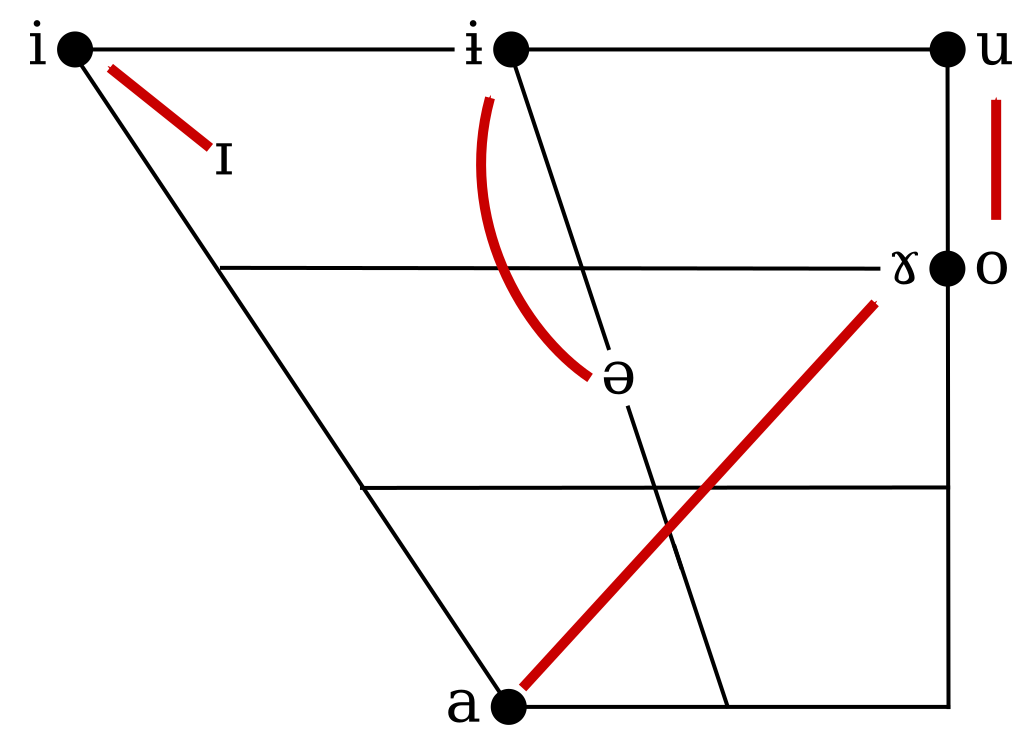
Below is the sound system of Maranao including underlying phonetic features.
Vowels
Maranao has four vowel phonemes that can become more close or higher when in certain environments (see hard consonants below). The vowel raising effects of hard consonants may have led earlier studies to Although previous studies have analyzed the sound as a separate phoneme (written with ae) instead of a raised allophone of .
| Front | Central | Back | Close | Mid | Open |
|---|---|---|---|---|---|
| // | |||||
| // | // | ||||
| // |
Vowel [e] only occurs in loanwords from Spanish through Tagalog or Cebuano and from Malay.
Consonants
According to Lobel (2013), Maranao has the following consonants:
| Bilabial | Dental | Alveolar | Palatal | Velar | Glottal | Nasal | Stop | Voiceless | Heavy | Voiced | Fricative | Voiceless | Heavy | Flap | Lateral | Approximant |
|---|---|---|---|---|---|---|---|---|---|---|---|---|---|---|---|---|
| () |
In Maranao, is not phonemic word-initially (similar to non-Philippine English). Hence, layok aken ('friend of mine') is smoothly pronounced .
Since the heavy consonants developed from consonant clusters, they are only found word-medially.
Orthography-wise, "r" is used for , "y" is used for , and "ng" is used for
Fricative [h]
According to Lobel (2013), only occurs in a few recent Malay loanwords:
-
tohan 'God'
-
tahon 'astrological sign'
-
hadapan 'in front (of God)' Earlier Arabic loanwords with "h" that entered Proto-Danao or earlier Maranao were realized as k.
-
kalal 'halal (anything permissible in Islam)'
-
karam 'haram (anything not permissible in Islam)',
-
kadî 'hadji (title for a man who has made the Hajj pilgrimage to Mecca)'
-
Kadis 'Hadith'
Consonant elongation
Consonants are also pronounced longer if preceded with a schwa . However, this process is not a form of gemination since consonant elongation in Maranao is not distinctive as seen in other Philippine languages such as Ilokano and Ibanag. Some of these are:
- tepad 'get off a vehicle'
- tekaw 'startled; surprised'
Hard consonants and vowel raising
Since 2009, it has been proposed that previous studies on the phonology of Maranao had overlooked the presence of "heavy" consonants, these four "heavy" consonants being . Vowels that follow these consonants are raised in position.
- Non-raising –
- Obligatory raising –
- Tohan is pronounced as instead of
- Optional raising –
- Evidenced by some younger speakers writing gagaan as gegaan.
- Transparent – – the raising from the consonant before it will "pass through" and affect the following vowel.
Similar vowel raising can be also found in Madurese.
Historical development
Consonant cluster homogenization occurred in earlier Danao and Subanon, where the articulations of the first consonant followed that of the second (Ex: *-gp- *-bp-).
A study by Allison noted that Proto-Danao *b, d, g were lost in modern Maranao when found before other consonants with the same place of articulation (Ex: *bp *p), but preserved elsewehere.
Lobel noted that this sound change actually resulted in two features of Maranao phonology: heavy consonants and raised vowels (* ). Aspirated consonants also developed in a similar way in Southern (Lapuyan) Subanon, but without the vowel-raising.
| Proto-Greater Central Philippine | Proto-Danao | Maguindanaon | Maranao |
|---|---|---|---|
| *-gp-, *-dp-, *-bp- | *-bp- | -bp- | -ph- |
| *-gt-, *-dt-, *-bt- | *-dt- | -dt- | -th- |
| *-gs-, *-ds-, *-bs- | *-ds- | -ds- | -z- [sʰ] |
| *-gk-, *-dk-, *-bk- | *-gk- | -gk- | -kh- |
Grammar
Case markers
In contrast to Tagalog which has three case markers (ang/ng/sa), and Iloko which has two (ti/iti), Maranao has four: (so/ko/o/sa).
| Common | Personal | Case | Indefinite | Definite | Singular | Plural |
|---|---|---|---|---|---|---|
| **Nominative** | so | i | si | siki | ||
| **Ergative** | sa | o | i | i kisi | ||
| **Oblique/Locative** | ko | ki | sa kisi |
Curiously, the sa is indefinite in Maranao, whereas it is definite/specific in Cebuano and Tagalog.
Pronouns
Maranao pronouns can be free or bound to the word/morpheme before it.
| Meaning | Nominative | Nominative | Genitive/Ergative | Oblique | |
|---|---|---|---|---|---|
| I | saken | (a)ko | aken | raken | |
| you (singular) | seka | ka | (ng)ka{{efn-la | May actually be eka, and assimilates with the vowel before it, as in batî ika 'your brother-in-law', and babô oka 'your aunt'. | reka |
| he/she/it | sekaniyan | sekaniyan | (n)iyan | rekaniyan | |
| we (dual) | sekta | ta | ta | rekta | |
| we (including you) | sektano | tano | tano | rektano | |
| we (excluding you) | sekami | kami | (a)mi | rekami | |
| you (plural) | sekano | kano | (n)iyo | rekano | |
| they | siran | siran | (i)ran | kiran |
Common words
Below are common words found in Maranao sentences, their translations in English, Cebuano, and Tagalog, and similar words in distant Philippine languages.
| Maranao | Cebuano | Tagalog | Other PH regional language or dialect | English |
|---|---|---|---|---|
| na | kay | ay | is | |
| na | dayon | tápos | ampa (Tausug) | then |
| a | nga | na | that is | |
| timan | buok | piraso | piece | |
| den | na | na | ren (Kinaray-a) | already |
| pen | pa | pa | will, soon | |
| di | dili | hindi | di' (Tausug) | won't, isn't |
| da | wala | hindi | wala' (Tausug) | didn't |
| da | wala | wala | way/waruun (Tausug) | nothing |
| aden | adunay | mayroon | awn (Tausug), adda (Ilocano) | there is... |
| ino | mao | iyo (Bikol-Naga) | it is such | |
| ago | ug | at | iban (Tausug) | and |
| atawa | kon, o | o | atawa (Tausug) | or |
| ogaid | apan, pero | ngunit, subalit, pero | sa'/sagawa'/saga'/ malayngkan (Tausug) | however, but |
| o di | dili pud, dili sab | hindi rin | bukun isab/bukun sab (Tausug) | nor (?) |
| langun | tanan | lahat | katān (Tausug) | all |
| imanto | karon | ngayon | bihaun (Tausug) | now |
| oway | oo | oo/opo | huun (Tausug) | yes |
| sabap | tungod, kay | dahil, kasi | sabab, kalna' or karna' (Tausug) | because |
| seda | isda | isda | ista' (Tausug) | fish |
| sapi' | baka | baka | sapi' (Maguindanaon & Tausug) | cow |
| pagari | igsuon | kapatid | langgung, taymanghud (Tausug) | sibling |
| bago | bag-o | bago | bagu (Tausug), baro (Ilocano) | new |
| tahon | tuig | taon | tahun (Tausug) | year |
| koda' | kabayo | kabayo | kura' (Tausug) | horse |
| sorab | suwab | talim | sulab (Tausug) | blade |
| doniya' | kalibotan | mundo | duniya' (Tausug) | world |
| dalendeg | dalugdog | kulog | dawgdug (Tausug) | thunder |
| sorga' | langit | langit | sulga' (Tausug) | heaven |
| narka', diyahanam | impyerno | impyerno | nalka'/narka', jahanam (Tausug) | hell |
| mataed | nindot, tsada | maganda | malingkat (Tausug) | nice, elegant |
| otin | utin, tintin | titi, uten | utin (Tausug) | male genitalia, penis |
| papanok | langgam | ibon | manuk-manuk (Tausug) | bird |
| diyandi' | kasabotan, saad | kasunduuan, pangako | janji' (Tausug) | agreement, promise |
| ngaran | ngalan | ngalan/pangalan | ngān (Tausug) | name |
Sample texts ==
Universal Declaration of Human Rights
Maranao: .
Cebuano: .
Tagalog: .
English: .
Noun phrases
These phrases were taken from Alonto's Maranao Drills.
Legend: , , , ,
| Maranao | Cebuano | English |
|---|
| Maranao | Cebuano | English |
|---|
| Maranao | Cebuano | English |
|---|
Time and Space
| Maranao | Cebuano | English |
|---|---|---|
| *(Literal)* | *(Literal)* | |
| Kanus-a ra ka mibalik og Marawi? *(Actual)* | When did you arrive here in Marawi? *(Actual)* | |
| *(Literal)* | *(Literal)* | |
| Unsang orasa ka miadto sa sinehán? *(Actual)* | What time did you go to the movies? *(Actual)* | |
| *(Literal)* | *(Literal)* | |
| Kanus-a ka mobalik og Amerika? *(Actual)* | When will you return to Amerika? *(Actual)* | |
| *(Literal)* | *(Literal)* | |
| Anus-a ra ka mibalik sa Amerika gikan og Saudi? *(Actual)* | When did you return to America from Saudi? *(Actual)* |
| Maranao | Cebuano | English |
|---|
Verbs and Time
| Maranao | Cebuano | English |
|---|
Negatives
| Type | Maranao | Cebuano | English |
|---|---|---|---|
| Present / Progressive | |||
| Past | |||
| Future | |||
| Possessions | ba | ||
| Qualities | besen? | ba |
Manga, A, Aden, Da
| Maranao | Cebuano | English |
|---|---|---|
| is a | ||
| (Literal) | (Literal) | |
| (Actual) | (Actual) | |
| (Literal) | (Literal) | |
| (Actual) | (Actual) |
Object-focus Sentences
| Tense | Maranao | Cebuano | English |
|---|---|---|---|
| Present | |||
| Past | |||
| Present | |||
| Past | |||
| Future (-en) | |||
| Future (-en) | The /e/ was assimilated as [a] due to -a from "kupiya." | ||
| Future (i-) | |||
| Future (i-) | |||
| Future (-an) | |||
| Future (-an) | |||
| Command (-a) | |||
| Command (-an) | |||
| Command (-i) |
References
References
- "2020 Census of Population and Housing, Report No. 2A - Demographic and Housing Characteristics (Non-Sample Variables)".
- "Maranao Language and Alphabet".
- Komisyon ng Wikang Filipino. (2013). "Ortograpiyang Pambansa".
- Ethnologue
- "Maranao Language and Alphabet".
- Rubino, Carl. "Maranao".
- McKaughan, Howard P.. (1967). "A Maranao Dictionary". University of Hawaii Press.
- Lobel, Jason William. (2009). "Maranao Revisited: An Overlooked Consonant Contrast and its Implications for Lexicography and Grammar". Oceanic Linguistics.
- Lobel, Jason William. (2013). "Philippine and North Bornean Languages: Issues in Description, Subgrouping, and Reconstruction". University of Hawaii at Manoa.
- Lobel, Jason William. (2011). "Maranao: A Preliminary Phonological Sketch With Supporting Audio". Language Documentation & Conservation.
- Allison, E. Joe. (1979). "Papers in Philippine Linguistics No. 10". The Australian National University.
- Alonto, Almahdi G.. (2009). "Maranao Dialogs and Drills". Dunwoody Press.
- Kaufman, Daniel. (2010). "Piakandatu Ami: Dr. Howard P. McKaughan". Linguistic Society of the Philippines and SIL Philippines.
This article was imported from Wikipedia and is available under the Creative Commons Attribution-ShareAlike 4.0 License. Content has been adapted to SurfDoc format. Original contributors can be found on the article history page.
Ask Mako anything about Maranao language — get instant answers, deeper analysis, and related topics.
Research with MakoFree with your Surf account
Create a free account to save articles, ask Mako questions, and organize your research.
Sign up freeThis content may have been generated or modified by AI. CloudSurf Software LLC is not responsible for the accuracy, completeness, or reliability of AI-generated content. Always verify important information from primary sources.
Report