From Surf Wiki (app.surf) — the open knowledge base
Maple syrup
Syrup made from the sap of maple trees

Syrup made from the sap of maple trees
| Field | Value |
|---|---|
| name | Maple syrup |
| image | Maple syrup.jpg |
| image_upright | yes |
| caption | Bottled maple syrup |
| place_of_origin | Canada |
| United States | |
| main_ingredient | Xylem sap (usually from sugar maple, red maple, or black maple) |
United States Maple syrup is a sweet syrup made from the sap of maple trees. In cold climates these trees store starch in their trunks and roots before winter; the starch is then converted to sugar that rises in the sap in late winter and early spring. Maple trees are tapped by drilling holes into their trunks and collecting the sap, which is heated to evaporate much of the water, leaving the concentrated syrup.
Maple syrup was first made by the Indigenous people of Northeastern North America. The practice was adopted by European settlers, who gradually changed production methods. Technological improvements in the 1970s further refined syrup processing. Almost all of the world's maple syrup is produced in Canada and the United States.
Maple syrup is graded based on its colour and taste. Sucrose is the most prevalent sugar in maple syrup. In Canada syrups must be made exclusively from maple sap to qualify as maple syrup and must also be at least 66 per cent sugar. Maple syrup is often used as a condiment for pancakes, waffles, French toast, oatmeal or porridge. It is also used as an ingredient in baking and as a sweetener or flavouring agent.
Sources
Three species of maple (Acer) trees are the main sources of maple syrup: the sugar maple (A. saccharum), the black maple (A. nigrum), and the red maple (A. rubrum), because their sap has a high sugar content, two to five per cent. The black maple is included as a subspecies or variety in a more broadly viewed concept of A. saccharum, the sugar maple, by some botanists. Of these, the red maple has a shorter season because it buds earlier than sugar and black maples, which alters the flavour of the sap.
A few other species of maple are also sometimes used as sources of sap for producing maple syrup, including the box elder or Manitoba maple (Acer negundo), the silver maple (A. saccharinum), and the bigleaf maple (A. macrophyllum). In the Southeastern United States Florida sugar maple (Acer floridanum) is occasionally used for maple syrup production.
Similar syrups may also be produced from walnut, birch, or palm trees, among other sources.
History
Indigenous peoples
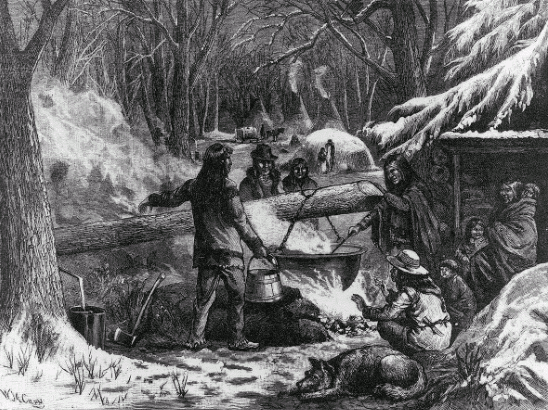
Indigenous peoples living in northeastern North America were the first groups known to have produced maple syrup and maple sugar. According to Indigenous oral traditions, as well as archaeological evidence, maple tree sap was being processed into syrup long before Europeans arrived in the region. There are no authenticated accounts of how maple syrup production and consumption began, but various legends exist; one of the most popular involves maple sap being used in place of water to cook venison served to a chief. Indigenous tribes developed rituals around syrup-making, celebrating the Sugar Moon (the first full moon of spring) with a Maple Dance. Many aboriginal dishes replaced the salt traditional in European cuisine with maple syrup.
The Algonquians recognized maple sap as a source of energy and nutrition. At the beginning of the spring thaw, they made V-shaped incisions in tree trunks; they then inserted reeds or concave pieces of bark to run the sap into clay buckets or tightly woven birch-bark baskets. The maple sap was concentrated first by leaving it exposed to the low temperatures overnight and disposing of the layer of ice that formed on top. Following that, the sap was transported by sled to large fires where it was boiled in clay pots to produce maple syrup. Often, multiple pots were used in conjunction, with the liquid being transferred between them as it grew more concentrated. Contrary to popular belief, syrup was not typically produced by dropping heated stones into wooden bowls, especially in northeast North America where Indigenous cultures had been using clay pots for thousands of years. However, modern and historic sources contain evidence that hot stones may have occasionally been used in the upper Midwest and Canada, where hollowed out logs and birchbark containers typically replaced clay pots.
Colonists
.jpg)
In the early stages of European colonization in northeastern North America, local Indigenous peoples showed the arriving colonists how to tap the trunks of certain types of maples during the spring thaw to harvest the sap. André Thevet, the "Royal Cosmographer of France", wrote about Jacques Cartier drinking maple sap during his Canadian voyages. By 1680, European settlers and fur traders were involved in harvesting maple products. However, rather than making incisions in the bark, the Europeans used the method of drilling tapholes in the trunks with augers. Prior to the 19th century, processed maple sap was used primarily as a source of concentrated sugar, in both liquid and crystallized-solid form, as cane sugar had to be imported from the West Indies.
Maple sugaring parties typically began to operate at the start of the spring thaw in regions of woodland with sufficiently large numbers of maples. Syrup makers first bored holes in the trunks, usually more than one hole per large tree; they then inserted wooden spouts into the holes and hung a wooden bucket from the protruding end of each spout to collect the sap. The buckets were commonly made by cutting cylindrical segments from a large tree trunk and then hollowing out each segment's core from one end of the cylinder, creating a seamless, watertight container. Sap filled the buckets, and was then either transferred to larger holding vessels (barrels, large pots, or hollowed-out wooden logs), often mounted on sledges or wagons pulled by draft animals, or carried in buckets or other convenient containers. The sap-collection buckets were returned to the spouts mounted on the trees, and the process was repeated for as long as the flow of sap remained "sweet". The specific weather conditions of the thaw period were, and still are, critical in determining the length of the sugaring season. As the weather continues to warm, a maple tree's normal early spring biological process eventually alters the taste of the sap, making it unpalatable, perhaps due to an increase in amino acids.
The boiling process was very time-consuming. The harvested sap was transported back to the party's base camp, where it was then poured into large vessels (usually made from metal) and boiled down to achieve the desired concentration. The sap was usually transported using large barrels pulled by horses or oxen to a central collection point, where it was processed either over a fire built out in the open or inside a shelter built for that purpose (the "sugar shack").
Since 1850
.jpg)
Around the time of the American Civil War (1861–1865), syrup makers started using large, flat sheet metal pans as they were more efficient for boiling than heavy, rounded iron kettles, because of a greater surface area for evaporation. Around this time, cane sugar replaced maple sugar as the dominant sweetener in the US; as a result, producers focused marketing efforts on maple syrup. The first evaporator, used to heat and concentrate sap, was patented in 1858. In 1872 an evaporator was developed that featured two pans and a metal arch or firebox, which greatly decreased boiling time. Around 1900, producers bent the tin that formed the bottom of a pan into a series of flues, which increased the heated surface area of the pan and again decreased boiling time. Some producers also added a finishing pan, a separate batch evaporator, as a final stage in the evaporation process.
Buckets began to be replaced with plastic bags, which allowed people to see at a distance how much sap had been collected. Syrup producers also began using tractors to haul vats of sap from the trees being tapped (the sugar bush) to the evaporator. Some producers adopted motor-powered tappers and metal tubing systems to convey sap from the tree to a central collection container, but these techniques were not widely used. Heating methods also diversified: modern producers use wood, oil, natural gas, propane, or steam to evaporate sap. Modern filtration methods were perfected to prevent contamination of the syrup.

A large number of technological changes took place during the 1970s. Plastic tubing systems that had been experimental since the early part of the century were perfected, allowing sap to flow directly from the tree to the evaporator house. Vacuum pumps were added to the tubing systems, and preheaters were developed to recycle heat lost in the steam. Producers developed reverse-osmosis machines to take a portion of water out of the sap before it was boiled, increasing processing efficiency.
Advancements have since been made in tubing and vacuum pumps, filtering techniques, high-efficiency preheaters, and storage containers. Ongoing research focuses on pest control and enhanced woodlot management. In 2009 researchers at the University of Vermont unveiled a new type of tap that prevents sap backflow into the tree, thereby reducing bacterial contamination and discouraging the tree from sealing the borehole. Experiments suggest that saplings could be used in plantations in place of mature trees, potentially boosting productivity per acre dramatically. Because saplings have smaller diameters, they require less extreme diurnal temperature changes to trigger freeze–thaw cycles. This enables sap production in warmer climates beyond northeastern North America.
Processing

Open pan evaporation methods have been streamlined since colonial days, but remain largely unchanged. Sap must first be collected and boiled down to obtain syrup. Maple syrup is made by boiling between 20 and 50 volumes of sap (depending on its concentration) over an open fire until 1 volume of syrup is obtained, usually at a temperature 4.1 °C-change over the boiling point of water. As the boiling point of water varies with changes in air pressure, the correct value for pure water is determined at the place where the syrup is being produced each time evaporation is begun and periodically throughout the day. Syrup can be boiled entirely over one heat source or can be drawn off into smaller batches and boiled at a more controlled temperature. Defoamers are often added during boiling.
Boiling the syrup is a tightly controlled process, which ensures appropriate sugar content. Syrup boiled too long will eventually crystallize, whereas under-boiled syrup will be watery, and will quickly spoil. The finished syrup has a density of 66° on the Brix scale (a hydrometric scale used to measure sugar solutions). The syrup is then filtered to remove precipitated "sugar sand", crystals made up largely of sugar and calcium malate. These crystals are not toxic, but create a "gritty" texture in the syrup if not filtered out.
The higher the sugar content of the sap, the smaller the volume of sap is needed to obtain the same amount of syrup. To yield 1 unit of syrup, sap at 1.5 per cent sugar content will require 57 units, while sap at 3.5 per cent sugar content only needs 25 units of sap. The sap's sugar content is highly variable and will fluctuate even within the same tree.
The filtered syrup is graded and packaged while still hot, usually at a temperature of 82 °C or greater. The containers are turned over after being sealed to sterilize the cap with the hot syrup. Packages can be made of metal, glass, or coated plastic, depending on volume and target market. The syrup can also be heated longer and further processed to create a variety of other maple products, including maple sugar, maple butter or cream, and maple candy or taffy.
Off-flavours
Off-flavours can occasionally develop during the production of maple syrup, caused by contaminants in the boiling apparatus (such as disinfectants), microorganisms, fermentation byproducts, metallic can leaching, or "buddy sap"—an off-flavour that occurs late in the syrup season when tree budding has begun. In some circumstances it is possible to remove off-flavours through processing.
Production

Maple syrup production is centred in northeastern North America; however, given the correct weather conditions, it can be made wherever suitable species of maple trees grow, such as New Zealand, where there are efforts to establish commercial production.
A maple syrup production farm is called a "sugarbush". Sap is often boiled in a "sugar shack" (also known as a "sugar house", "sugar cabin", "sugar shanty", or cabane à sucre)—a building louvred at the top to vent the steam from the boiling sap.
Maples are usually tapped beginning at 30 to 40 years of age. Each tree can support between one and three taps, depending on its trunk diameter. The average maple tree will produce 35 to of sap per season, up to 12 L per day. This is roughly equal to seven per cent of its total sap. Tap seasons typically happen during late winter and spring and usually last for four to eight weeks, though the exact dates depend on the weather, location, and climate.
During the day, sucrose stored in the roots for the winter rises through the trunk as sugary sap. A hole is bored into the trunk of the tree to allow the sap to flow out of a spile that is tapped in the hole. The taps are left in place for the season, and the sap flows during the day when the temperature is above freezing. Some producers also tap in autumn, though this practice is less common than spring tapping. Maples can continue to be tapped for sap until they are over 100 years old.
Climate change is dramatically impacting the production of maple syrup. Increased temperatures in late winter/early spring causes the season for maple sap collection to shift earlier in the year, with increased summer temperatures causing a decrease in sugar content in sap, and drought/heavy rainfall impacting forest ecosystems.
Commerce

Until the 1930s, the United States produced most of the world's maple syrup. Today, after rapid growth in the 1990s, Canada produces more than 80 per cent of the world's maple syrup, producing about 73 e6kg in 2016. In 2023 Canada exported $376million of maple syrup to the United States, $47.8million to Germany, $31.6million to France, and $30.2million to the UK, exporting to 68 countries in total.
, Quebec accounts for 91.6 per cent of maple syrup produced in Canada, followed by New Brunswick at 4.7 per cent and Ontario at 3.4 per cent. However, 96.8 per cent of exported Canadian maple syrup originated from Quebec, whereas 2.6 per cent of exported syrup originated from New Brunswick, and the remaining 0.6 per cent from all other provinces. Ontario holds the most maple syrup farms in Canada outside of Quebec, with 389 maple syrup producers in 2021. This is followed by New Brunswick, with 114 producers; and Nova Scotia, with 39 producers.
As of 2016, Quebec had some 7,300 producers working with 13,500 farmers, collectively making over 8 e6USgal of syrup. Production in Quebec is controlled through a supply management system, with producers receiving quota allotments from the government sanctioned Quebec Maple Syrup Producers (QMSP; ), which also maintains reserves of syrup, although there is a black-market trade in Quebec product. In 2017 the QMSP mandated increased output of maple syrup production, attempting to establish Quebec's dominance in the world market.
The Canadian provinces of Manitoba and Saskatchewan produce maple syrup using the sap of the box elder or Manitoba maple (Acer negundo). In 2011 there were 67 maple syrup producers in Manitoba and 24 in Saskatchewan. Manitoba maple syrup has a slightly different flavour from sugar-maple syrup, because it contains less sugar and the tree's sap flows more slowly. British Columbia is home to a growing maple sugar industry using sap from the bigleaf maple, which is native to the West Coast of the United States and Canada. In 2011 there were 82 maple syrup producers in British Columbia.
Vermont has long been the largest US producer, with a record 2.5 e6USgal produced in 2022. In 2019 it led with over 2.07 e6USgal, followed by New York with 820000 USgal and Maine with 580000 USgal. Wisconsin, Ohio, New Hampshire, Michigan, Pennsylvania, Massachusetts and Connecticut all produced marketable quantities of maple syrup.
Maple syrup has been produced on a small scale in some other countries, notably Japan and South Korea. However, in South Korea in particular, it is traditional to consume maple sap, called gorosoe, instead of processing it into syrup.
Markings
Under Canadian maple product regulations, containers of maple syrup must include the words "maple syrup", its grade name and net quantity in litres or millilitres, on the main display panel with a minimum font size of 1.6mm. If the maple syrup is of Canada Grade A level, the name of the colour class must appear on the label in both English and French. Also, the lot number or production code, and either: (1) the name and address of the sugar bush establishment, packing or shipper establishment, or (2) the first dealer and the registration number of the packing establishment, must be labelled on any display panel other than the bottom.
Grades
Following an effort from the International Maple Syrup Institute (IMSI) and many maple syrup producer associations, both Canada and the United States have altered their laws regarding the classification of maple syrup to be uniform. Whereas in the past each state or province had their own laws on the classification of maple syrup, now those laws define a unified grading system. This had been a work in progress for several years, and most of the finalization of the new grading system was made in 2014. The Canadian Food Inspection Agency (CFIA) announced in the Canada Gazette on 28 June 2014 that rules for the sale of maple syrup would be amended to include new descriptors, at the request of the IMSI.
As of 31 December 2014, the CFIA and as of 2 March 2015, the United States Department of Agriculture (USDA) Agricultural Marketing Service issued revised standards intended to harmonize Canadian and United States regulations on the classification of maple syrup as follows:
- Grade A
- Golden colour and delicate taste
- Amber colour and rich taste
- Dark colour and robust taste
- Very dark colour and strong taste
- Processing grade
- Substandard
As long as maple syrup does not have an off-flavour, is of a uniform colour, and is free from turbidity and sediment, it can be labelled as one of the A grades. If it exhibits any problems, it does not meet Grade A requirements, and then must be labelled as "processing grade" maple syrup and may not be sold in containers smaller than 20 L. If maple syrup does not meet the requirements of processing-grade maple syrup (including a fairly characteristic maple taste), it is classified as substandard.
This grading system was accepted and made law by most maple-producing states and provinces, and became compulsory in Canada as of 13 December 2016. Vermont, in an effort to "jump-start" the new grading regulations, adopted the new grading system as of 1 January 2014, after the grade changes passed the US Senate and House in 2013. Maine passed a bill to take effect as soon as both Canada and the United States adopted the new grades. In New York the new grade changes became law on 1 January 2015. New Hampshire did not require legislative approval and so the new grade laws became effective as of 16 December 2014, and producer compliance was required as of 1 January 2016.
Golden and amber grades typically have a milder flavour than dark and very dark, which are both dark and have an intense maple flavour. The darker grades of syrup are used primarily for cooking and baking, although some specialty dark syrups are produced for table use. Syrup harvested earlier in the season tends to yield a lighter colour. With the new grading system, the classification of maple syrup depends ultimately on its internal transmittance at 560nm wavelength through a 10mm sample. Golden must have 75 per cent or more transmittance, amber must have 50.0 to 74.9 per cent transmittance, dark must have 25.0 to 49.9 per cent transmittance, and very dark is any product having less than 25.0 per cent transmittance.
Old grading system

In Canada maple syrup was classified prior to 31 December 2014 by the Canadian Food Inspection Agency (CFIA) as one of three grades, each with several colour classes:
- Canada No. 1, including
- Extra light
- Light
- Medium
- No. 2 amber
- No. 3 dark or any other ungraded category
Producers in Ontario or Quebec may have followed either federal or provincial grading guidelines. Quebec's and Ontario's guidelines differed slightly from the federal:
- there were two "number" categories in Quebec
- Number 1, with four colour classes
- Number 2, with five colour classes
- As in Quebec, Ontario's producers had two "number" grades:
- Number 1, with three colour classes
- Number 2, with one colour class, which was typically referred to as "Ontario Amber" when produced and sold in that province only
A typical year's yield for a maple syrup producer will be about 25 to 30 per cent of each of the #1 colours, 10 per cent #2 amber, and 2 per cent #3 dark.
The United States used different grading standards – some states still do as they await state regulation. Maple syrup was divided into two major grades:
- Grade A
- Light amber (sometimes known as fancy)
- Medium amber
- Dark amber
- Grade B
In Massachusetts the Grade B was renamed "Grade A Very Dark, Strong Taste"
The Vermont Agency of Agriculture Food and Markets used a similar grading system of colour, and is roughly equivalent, especially for lighter syrups, but using letters: "AA", "A", etc. The Vermont grading system differed from the US system in maintaining a slightly higher standard of product density (measured on the Baumé scale). New Hampshire maintained a similar standard, but not a separate state grading scale. The Vermont-graded product had 0.9 per cent more sugar and less water in its composition than US-graded. One grade of syrup not for table use, called commercial or Grade C, was also produced under the Vermont system.
Packing regulations
In Canada the packing of maple syrup must follow the "Packing" conditions stated in the maple products regulations, or utilize the equivalent Canadian or imported grading system.
As stated in the maple products regulations, Canadian maple syrup can be classified as "Canadian Grade A" and "Canadian Processing Grade". Any maple syrup container under these classifications should be filled to at least 90% of the bottle size while still containing the net quantity of syrup product as stated on the label. Every container of maple syrup must be new if it has a capacity of 5 litres or less or is marked with a grade name. Every container of maple sugar must also be new if it has a capacity of less than 5kg or is either exported out of Canada or conveyed from one province to another.
Each maple syrup product must be verified clean if it follows a grade name or if it is exported out of the province in which it was originally manufactured.
Nutrition
The basic ingredient in maple syrup is the sap from the xylem of sugar maple or various other species of maple trees. It consists primarily of sucrose and water, with small amounts of the monosaccharides glucose and fructose from the inverted sugar created in the boiling process.
In a 100g amount maple syrup provides 260 calories and is composed of 32 per cent water by weight, 67 per cent carbohydrates (90 per cent of which are sugars), and no appreciable protein or fat (table). Maple syrup is generally low in overall micronutrient content, although manganese and riboflavin are at high levels along with moderate amounts of zinc and calcium (right table). It also contains trace amounts of amino acids which increase in content as sap flow occurs.
Maple syrup contains a wide variety of polyphenols and volatile organic compounds, including vanillin, hydroxybutanone, lignans, propionaldehyde, and numerous organic acids. It is not yet known exactly all compounds responsible for the distinctive flavour of maple syrup, although primary flavour-contributing compounds are maple furanone (5-ethyl-3-hydroxy-4-methyl-2(5H)-furanone), strawberry furanone, and maltol. New compounds have been identified in maple syrup, one of which is quebecol, created when the maple sap is boiled to create syrup. Its sweetness derives from a high content of sucrose (99% of total sugars). Its brown colour – a significant factor in the appeal and the quality grading of maple syrup – develops during thermal evaporation.
One author described maple syrup as "a unique ingredient, smooth- and silky-textured, with a sweet, distinctive flavourhints of caramel with overtones of toffee will not doand a rare colour, amber set alight. Maple flavour is, well, maple flavour, uniquely different from any other." Agriculture Canada has developed a "flavour wheel" that details 91 unique flavours that can be present in maple syrup. These flavours are divided into 13 families: vanilla, burnt, milky, fruity, floral, spicy, foreign (deterioration or fermentation), foreign (environment), maple, confectionery, plant (herbaceous), plant (forest, humus or cereals), and plant (ligneous). These flavours are evaluated using a procedure similar to wine tasting. Other culinary experts praise its unique flavour. Environmental factors, including weather and soil type, impact flavour.
Maple syrup and its various artificial imitations are widely used as toppings for pancakes, waffles, and French toast in North America. They also serve as flavouring for foods such as fritters, ice cream, porridge, fresh fruit, bacon, and sausages. It is also used as sweetener for granola, applesauce, baked beans, candied sweet potatoes, winter squash, cakes, pies, breads, tea, coffee, and hot toddies.
Imitations
In Canada maple syrup must be made entirely from maple sap, and syrup must have a density of 66° on the Brix scale to be marketed as maple syrup. In the United States maple syrup must be made almost entirely from maple sap, although small amounts of substances such as salt may be added. Labelling laws prohibit imitation syrups from having "maple" in their names unless the finished product contains 10 per cent or more of natural maple syrup.
Table syrup, also known as pancake syrup and waffle syrup, is often used as a substitute for maple syrup. Table syrups are mostly made using corn syrup and high-fructose corn syrup, giving them a less complex and more artificial flavour compared to maple syrup. In the United States consumers generally prefer imitation syrups, likely because of the significantly lower cost and sweeter flavour; they typically cost about 8 $/USgal, whereas authentic maple syrup costs 40 - as of 2015.
In 2016 maple syrup producers from nine US states petitioned the Food and Drug Administration (FDA) to regulate labelling of products containing maple syrup or using the word "maple" in manufactured products, indicating that imitation maple products contained insignificant amounts of natural maple syrup. In September 2016 the FDA published a consumer advisory to carefully inspect the ingredient list of products labelled as "maple".
Cultural significance
Maple products are considered emblematic of Canada, and are frequently sold in tourist shops and airports as souvenirs from Canada. The sugar maple's leaf has come to symbolize Canada, and is depicted on the country's flag. Several US states, including West Virginia, New York, Vermont, and Wisconsin, have the sugar maple as their state tree. A scene of sap collection is depicted on the Vermont state quarter, issued in 2001.
Maple syrup and maple sugar were used during the American Civil War and by abolitionists in the years before the war because most cane sugar and molasses were produced by enslaved people in the South. Because of food rationing during the Second World War, people in the northeastern United States were encouraged to stretch their sugar rations by sweetening foods with maple syrup and maple sugar, and recipe books were printed to help housewives employ this alternative source.
References
Cited works
References
- "Chapter 13 – Labelling of Maple Products". Canadian Food Inspection Agency.
- Brown, Amy Christine. (2010). "Understanding Food: Principles and Preparation". Cengage Learning.
- Grandtner, Miroslav M.. (2005). "Elsevier's Dictionary of Trees". Elsevier Science.
- "Acer saccharum Marshall – sugar maple". United States Department of Agriculture.
- "Acer nigrum Michx. f. – black maple". United States Department of Agriculture.
- "Acer rubrum L. – red maple". United States Department of Agriculture.
- {{GRIN. ''Acer saccharum'' subsp. ''nigrum''. 314801
- Randall, Jesse A. (February 2010). "Maple syrup production". Iowa State University.
- "Acer negundo L. – boxelder". United States Department of Agriculture.
- "Acer saccharinum L. – silver maple". United States Department of Agriculture.
- (1972). "Maple sirup production from bigleaf maple". US Department of Agriculture, Forest Service, Pacific Northwest Forest and Range Experiment Station.
- (1981). "''Acer barbatum'' Michx., Florida maple". US Department of Agriculture.
- Leung, Wency. (7 June 2011). "Why settle for maple when you could have birch syrup?". The Globe and Mail.
- (1989). "Utilization of tropical foods: trees : compendium on technological and nutritional aspects of processing and utilization of tropical foods, both animal and plant, for purposes of training and field reference". Food and Agriculture Organization of the United Nations.
- (2016). "Tapping Walnut Trees for a Novel and Delicious Syrup". Cornell University.
- "History". Michigan Maple Syrup Association.
- Chenevert, Brian. (3 March 2021). "Maple sugaring among the Abenaki and Wabanki peoples".
- Diemer-Eaton, Jessica. (2014). "Hot-Stone Boiling Maple Sap to Syrup: Theory, Basis, & Public Demonstrations". Woodland Indian Educational Programs.
- (1993). "Sweet maple". Chapters Publishing Ltd.
- (1996). "North American Maple Syrup Producers Manual". Ohio State University (OSU).
- (1996). "North American Maple Syrup Producers Manual". Ohio State University.
- (1996). "North American Maple Syrup Producers Manual". Ohio State University.
- (1996). "North American Maple Syrup Producers Manual". Ohio State University.
- Perkins, Timothy D. (October 2009). "Development and testing of the check-valve spout adapter". Maple Digest.
- Sorkin, Laura. (20 January 2014). "Maple Syrup Revolution: A New Discovery Could Change the Business Forever". Modern Farmer.
- (2020). "A two-dimensional heat transfer model for predicting freeze-thaw events in sugar maple trees". Agricultural and Forest Meteorology.
- (February 2020). "Identifying an Effective Defoamer for Certified Organic Maple Production". Maple Syrup Digest.
- (1993). "Income Opportunities in Special Forest Products: Self-help Suggestions for Rural Entrepreneurs". USDA Forest Products Laboratory.
- (2020-05-01). "Minimizing the energy requirements for the production of maple syrup". Journal of Food Engineering.
- Wagner, John E.. (2012). "Forestry Economics: A Managerial Approach". Routledge.
- Taylor, Fred H.. (March 1956). "Variation in Sugar Content of Maple Sap". University of Vermont and State Agricultural College.
- Hopkins, Kathy. (2016). "Maple Syrup Quality Control Manual". Cooperative Extension Publications, University of Maine.
- (2019). "Characterization and Removal of Buddy Off‐Flavor in Maple Syrup". Journal of Food Science.
- (October 2009). "Metabolism Off-Flavor in Maple Syrup". Maple Digest.
- (2018). "Feasibility of producing maple syrup in New Zealand".
- (1996). "North American Maple Syrup Producers Manual". Ohio State University.
- (2006). "North American Maple Syrup Producers Manual". Ohio State University.
- Elliot, Robert. (22 February 2022). "Sweetest Maple Sugar Shack Experiences in Ontario". Culinary Tourism Alliance.
- "Step-by-Step in the Production of Maple Syrup". Producteurs et productrices acéricoles du Québec.
- (1996). "North American Maple Syrup Producers Manual". Ohio State University.
- (1996). "North American Maple Syrup Producers Manual". Ohio State University.
- Werner, Leo H. (7 February 2006). "Maple Sugar Industry". Historica-Dominion Institute.
- Milideo, Lauren. (13 February 2024). "How Climate Change is Impacting the Maple Syrup Industry". UVM Today.
- (15 April 2024). "Midwest maple syrup producers adapt to uncertainty as climate changes". PBS Wisconsin.
- Dario, Kate. (13 March 2024). "Maple Month in a warm winter: How climate change is reshaping NH's syrup season". NHPR.
- Barrett, Rick. (1 April 2025). "Maple sugaring is a Wisconsin tradition, but could climate change put it at risk?". Milwaukee Journal Sentinel.
- "Background Information and Justification for Reintroducing the Maple Tapping Access Program Act as part of the new Federal Stimulus Package". Cornell University.
- Marowits, Ross. (20 February 2017). "Quebec increases maple syrup production amid internal revolt, foreign competition". CBC.
- Vaudeville, Joël. (30 May 2024). "Record Harvest: 239 Million Pounds of Maple Syrup". Producteurs et productrices acéricoles du Québec.
- (9 December 2024). "Maple syrup: Canada's gift to the world". Statistics Canada.
- (June 2023). "Statistical Overview of the Canadian Maple Industry 2022". Agriculture and Agri-Food Canada.
- Kuitenbrouwer, Peter. (11 February 2016). "Quebec's 'autocratic' control over maple syrup producers in need of major overhaul: provincial report". Financial Post.
- Kendrick, Jenny. "Tapping the Manitoba Maple". Statistics Canada.
- Norbury, Keith. (19 May 2010). "BC Bigleaf Maple Syrup Finding its Niche". The Globe and Mail.
- (10 June 2022). "Vermont maple producers again lead the nation". WCAX.
- "Maple Syrup Production". United States Department of Agriculture.
- Watanabe, Toshiyuki. (1962). "On the Sugar Composition of Maple Syrup". Tohoku Journal of Agricultural Research.
- Choe Sang-Hun. (5 March 2009). "In South Korea, drinks are on the maple tree". The New York Times.
- "Consolidated federal laws of Canada, Maple Products Regulations". Legislative Services Branch.
- (14 February 2014). "Labelling Requirements for Maple Products". Canadian Food Inspection Agency, Food Safety and Consumer Protection Directorate.
- (28 June 2014). "Regulations Amending the Maple Products Regulations". Canada Gazette.
- (31 December 2014). "Regulations Amending the Maple Products Regulations". Canadian Food Inspection Agency.
- (2 March 2015). "United States Standards for Grades of Maple Syrup". United States Department of Agriculture.
- (15 May 2018). "Colour Classes of Maple Syrup". Government of Canada.
- (29 January 2015). "United States Standards for Grades of Maple Syrup". International Maple Syrup Institute.
- McGee, Harold. (2004). "On food and cooking: the science and lore of the kitchen". Simon & Schuster.
- Thompson, Jennifer. (2003). "Very Maple Syrup". Celestial Arts.
- "Maple Syrup Grades". Fédération des producteurs acéricoles du Québec.
- "Maple Syrup Grades". Ontario Maple Syrup Producers Association.
- Urban, Cori. (22 March 2015). "New grading system in place for maple syrup". Mass Live.
- "Maple Syrup Grades Vermont". Vermont Maple Syrup.
- "Frequently Asked Questions". Cornell Sugar Maple Research & Extension Program.
- (December 2006). "Sugar Profiles of Maple Syrup Grades". Maple Syrup Digest.
- (1996). "North American Maple Syrup Producers Manual". Ohio State University.
- (2011-07-27). "Further investigation into maple syrup yields 3 new lignans, a new phenylpropanoid, and 26 other phytochemicals". Journal of Agricultural and Food Chemistry.
- (1996-04-01). "The chemical composition of 80 pure maple syrup samples produced in North America". Food Research International.
- (2017-05-31). "Isolation, Identification, and Biological Evaluation of Phenolic Compounds from a Traditional North American Confectionery, Maple Sugar". Journal of Agricultural and Food Chemistry.
- Ball, David. (10 October 2007). "The Chemical Composition of Maple Syrup". Journal of Chemical Education.
- Chartier, Francois. (30 March 2012). "Taste Buds and Molecules: The Art and Science of Food, Wine, and Flavor". Houghton Mifflin Harcourt.
- (2011). "Quebecol, a novel phenolic compound isolated from Canadian maple syrup". Journal of Functional Foods.
- (2019-06-01). "Effect of the new high vacuum technology on the chemical composition of maple sap and syrup". Heliyon.
- (2009). "Advances in Food and Nutrition Research".
- Evelyn Roehl. (1996). "Whole Food Facts: The Complete Reference Guide". Inner Traditions * Bear & Company.
- Alan Davidson. (1981). "Oxford Symposium 1981: National & Regional Styles of Cookery". Oxford Symposium.
- Figoni, Paula I. (October 2010). "How Baking Works: Exploring the Fundamentals of Baking Science". John Wiley & Sons.
- Greweling, Peter. (2013). "Chocolates & Confections: Formula, Theory, and Technique for the Artisan Confectioner". John Wiley & Sons.
- (21 September 2016). "Sweeteners and table sirups: Subpart B – Requirements for Specific Standardized Sweeteners and Table Sirups, Maple sirup". Code of Federal Regulations, Title 21, Food and Drug Administration.
- Calvo, Trisha. (25 March 2017). "5 Things You Need to Know About Maple Syrup". Consumer Reports.
- Appelbaum, Yoni. (1 November 2011). "Making the Grade: Why the Cheapest Maple Syrup Tastes Best". The Atlantic.
- Ingraham, Christopher. (27 March 2015). "Why Americans overwhelmingly prefer fake maple syrup". The Washington Post.
- (16 February 2016). "Maple syrup producers: Fake flavors nothing like the real thing". Chicago Tribune.
- (16 September 2016). "What's in a Name? What Every Consumer Should Know About Foods and Flavors". Food and Drug Administration.
- (17 November 2008). "The maple leaf". Canadian Heritage.
- (14 July 2010). "State Trees & State Flowers". United States National Arboretum.
- "The 50 State Quarters Program Summary Report".
- Gellmann, D. (2001). "Pirates, Sugar, Debtors, and Slaves: Political Economy and the case for Gradual Abolition in New York". Slavery & Abolition: A Journal of Slave and Post-Slave Studies.
- Driver, Elizabeth. (2008). "Culinary landmarks: a bibliography of Canadian cookbooks, 1825–1949". University of Toronto Press.
This article was imported from Wikipedia and is available under the Creative Commons Attribution-ShareAlike 4.0 License. Content has been adapted to SurfDoc format. Original contributors can be found on the article history page.
Ask Mako anything about Maple syrup — get instant answers, deeper analysis, and related topics.
Research with MakoFree with your Surf account
Create a free account to save articles, ask Mako questions, and organize your research.
Sign up freeThis content may have been generated or modified by AI. CloudSurf Software LLC is not responsible for the accuracy, completeness, or reliability of AI-generated content. Always verify important information from primary sources.
Report