From Surf Wiki (app.surf) — the open knowledge base
Manila
Capital of the Philippines
Capital of the Philippines
| Field | Value | |
|---|---|---|
| name | Manila | |
| native_name | fil | |
| settlement_type | Capital and [](cities-of-the-philippines-legal-classification) | |
| image_skyline | {{multiple image | |
| total_width | 300 | |
| border | infobox | |
| perrow | 1/3/2/2 | |
| caption_align | center | |
| image1 | Cityscape of Manila, 2025 (01).jpg | |
| alt1 | Manila skyline | |
| caption1 | Manila skyline viewed from Intramuros | |
| alt2 | Rizal Monument | |
| caption2 | Rizal Monument | |
| image3 | Gate of Fort Santiago - 38923-Manila (35201250583).jpg | |
| alt3 | Fort Santiago Gate | |
| caption3 | Fort Santiago | |
| alt4 | San Agustin Church (Manila) | |
| caption4 | San Agustin Church | |
| image5 | Intramuros, Manila, Philippines.jpg | |
| alt5 | Intramuros | |
| caption5 | Intramuros | |
| image6 | StJohnTheBaptistParishQuiapo.jpg | |
| alt6 | Quiapo Church | |
| caption6 | Quiapo Church | |
| alt7 | Malate Church | |
| caption7 | Malate Church | |
| alt8 | Central Post Office | |
| caption8 | Manila Central Post Office | |
| image_flag | ||
| flag_size | 120x80px | |
| image_seal | ||
| seal_size | 100x80px | |
| seal_link | Seal of Manila | |
| nicknames | Pearl of the Orient and others | |
| motto | Manila, God First | |
| Welcome Po Kayo sa Maynila | ||
| ("You are Welcome in Manila") | ||
| anthem | Awit ng Maynila | |
| ("Song of Manila") | ||
| image_map | ||
| map_caption | ||
| mapframe | yes | |
| mapframe-zoom | 11 | |
| pushpin_map | Luzon#Philippines#Southeast Asia#Asia | |
| pushpin_label_position | left | |
| pushpin_map_caption | Location within the | |
| coordinates | ||
| subdivision_type | Country | |
| subdivision_name | Philippines | |
| subdivision_type1 | Region | |
| subdivision_name1 | ||
| subdivision_type2 | Province | |
| subdivision_type3 | Legislative district | |
| subdivision_name3 | ||
| subdivision_type4 | Administrative district | |
| subdivision_name4 | 16 city districts | |
| established_title | Established | |
| established_date | 13th century or earlier | |
| established_title1 | Sultanate of Brunei (Maynila) | |
| established_date1 | 1500s | |
| established_title2 | Spanish Manila | |
| established_date2 | ||
| established_title3 | City charter | |
| established_date3 | ||
| established_title4 | Highly urbanized city | |
| established_date4 | ||
| parts_type | Barangays | |
| parts_style | para | |
| p1 | (see Barangays and districts) | |
| government_type | ||
| government_footnotes | ||
| leader_title | Mayor | |
| leader_name | Isko Moreno (Aksyon) | |
| leader_title1 | Vice Mayor | |
| leader_name1 | Chi Atienza (Aksyon) | |
| leader_title2 | Representatives | |
| leader_name2 | {{Collapsible list | |
| title | List | |
| frame_style | border:none; padding: 0; | |
| list_style | text-align:left;display:none;white-space: nowrap; overflow: hidden; text-overflow: ellipsis;font-size:95%; | |
| 10 | 1st LegDist | |
| 11 | Ernix Dionisio | |
| 20 | 2nd LegDist | |
| 21 | Rolando Valeriano | |
| 30 | 3rd LegDist | |
| 31 | Joel Chua | |
| 40 | 4th LegDist | |
| 41 | Edward Maceda | |
| 50 | 5th LegDist | |
| 51 | Irwin Tieng | |
| 60 | 6th LegDist | |
| 61 | Benny Abante | |
| leader_title3 | City Council | |
| leader_name3 | {{Collapsible list | |
| title | List | |
| frame_style | border:none; padding: 0; | |
| list_style | text-align:left;display:none; | |
| 1 | **1st district** | |
| 2 | • Martin "Marjun" V. Isidro, Jr. | |
| 3 | • Moises "Bobby" T. Lim | |
| 4 | • Erick Ian "Banzai" O. Nieva | |
| 5 | • Niño M. Dela Cruz | |
| 6 | • Irma C. Alfonso-Juson | |
| 7 | • Jesus "Taga" E. Fajardo, Jr. | |
| 8 | **2nd district** | |
| 9 | • Numero "Uno" G. Lim | |
| 10 | • Darwin "Awi" B. Sia | |
| 11 | • Macario "Macky" M. Lacson | |
| 12 | • Rodolfo "Ninong" N. Lacsamana | |
| 13 | • Roma Paula S. Robles-Daluz | |
| 14 | • Ruben "Dr. J" F. Buenaventura | |
| 15 | **3rd district** | |
| 16 | • Johanna Maureen "Apple" C. Nieto-Rodriguez | |
| 17 | • Pamela "Fa" G. Fugoso | |
| 18 | • Ernesto "Jong" C. Isip, Jr. | |
| 19 | • Arlene Maile I. Atienza | |
| 20 | • Terrence F. Alibarbar | |
| 21 | • Timothy Oliver "Tol" I. Zarcal | |
| 22 | **4th district** | |
| 23 | • Luisito "Louie" N. Chua | |
| 24 | • Krystle Marie "Krys" C. Bacani | |
| 25 | • Louisa Marie "Lady" J. Quintos-Tan | |
| 26 | • Science A. Reyes | |
| 27 | • Joel "JTV" T. Villanueva | |
| 28 | • Don Juan "DJ" A. Bagatsing | |
| 29 | **5th district** | |
| 30 | • Roberto "Bobby" S. Espiritu II | |
| 31 | • Raymundo "Mon" R. Yupangco | |
| 32 | • Laris T. Borromeo | |
| 33 | • Jaybee S. Hizon | |
| 34 | • Ricardo "Boy" A. Isip, Jr. | |
| 35 | • Charry R. Ortega | |
| 36 | **6th district** | |
| 37 | • Elmer M. Par | |
| 38 | • Salvador Philip H. Lacuna | |
| 39 | • Benny Fog T. Abante II | |
| 40 | • Carlos "Caloy" C. Castañeda | |
| 41 | • Luis "Joey" C. Uy | |
| 42 | • Luciano "Lou" M. Veloso | |
| 43 | ***Liga ng mga Barangay President*** | |
| 44 | Leilani Lacuna | |
| 45 | ***Sangguniang Kabataan President*** | |
| 46 | Juliana Rae Ibay | |
| leader_title4 | Electorate | |
| leader_name4 | voters (electorate_point_in_time}} | ) |
| total_type | City | |
| area_footnotes | ||
| area_total_km2 | 42.34 | |
| area_urban_km2 | 619.57 | |
| area_metro_km2 | 1873 | |
| elevation_m | ||
| elevation_max_m | 108 | |
| elevation_min_m | 0 | |
| elevation_footnotes | ||
| population_footnotes | ||
| population_total | ||
| population_as_of | ||
| population_density_km2 | ||
| population_urban | 13484482 | |
| population_density_urban_km2 | ||
| population_metro | 24922000 | |
| population_density_metro_km2 | ||
| population_demonym | English: Manileño, Manilan; | |
| , manileño (f. *-a*) | ||
| (f. *-a*), Manilenyo (f. *-a*), Taga-Maynila | ||
| population_blank1_title | Households | |
| population_blank1 | ||
| demographics_type1 | Economy | |
| demographics1_title1 | ||
| demographics1_info1 | ||
| demographics1_title2 | Poverty incidence | |
| demographics1_info2 | % () | |
| demographics1_title3 | HDI | |
| demographics1_info3 | 0.781 – high (2019) | |
| demographics1_title4 | Revenue | |
| demographics1_info4 | ||
| demographics1_title5 | Assets | |
| demographics1_info5 | ||
| demographics1_title6 | Assets rank | |
| demographics1_title7 | IRA | |
| demographics1_title8 | IRA rank | |
| demographics1_title9 | Expenditure | |
| demographics1_info9 | ||
| demographics1_title10 | Liabilities | |
| demographics1_info10 | ||
| demographics_type2 | Utilities | |
| demographics2_title1 | Electricity | |
| demographics2_info1 | ||
| demographics2_title2 | Water | |
| demographics2_info2 | • Maynilad (Majority) | |
| • Manila Water (Santa Ana and San Andres) | ||
| demographics2_title3 | Cable TV | |
| blank_name_sec1 | ||
| blank_info_sec1 | ||
| blank1_name_sec1 | Native languages | |
| blank1_info_sec1 | Filipino | |
| blank2_name_sec1 | Currency | |
| blank2_info_sec1 | Philippine peso (₱) | |
| blank3_name_sec1 | Inflation rate | |
| blank4_name_sec1 | Minimum wage rate (₱) | |
| blank5_name_sec1 | Crime index | |
| timezone | PST | |
| utc_offset | +8 | |
| postal_code_type | ZIP code | |
| postal_code | +900 – 1-096 | |
| postal2_code_type | ||
| postal2_code | ||
| area_code_type | ||
| area_code | ||
| website | ||
| footnotes | ||
| image_blank_emblem | Manila City logo.svg | |
| blank_emblem_type | Logo and wordmark | |
| official_name | City of Manila |
the city proper
Rizal Monument.jpg San Agustin Church 2024-05-19.jpg Iglesia de Nuestra Señora de los Remedios, Manila, Filipinas, 2023-08-27, DD 122.jpg Manila Central Post Office at night from across the Pasig River.jpg Welcome Po Kayo sa Maynila ("You are Welcome in Manila") ("Song of Manila") | mapframe-zoom = 11 , manileño (f. -a) (f. -a), Manilenyo (f. -a), Taga-Maynila • Manila Water (Santa Ana and San Andres)
Manila, officially the City of Manila, is the capital and second-most populous city of the Philippines after Quezon City. According to the 2024 census, it has a population of 1,902,590 people. Located on the eastern shore of Manila Bay on the island of Luzon, it is classified as a highly urbanized city. With 43,611.5 PD/km2, Manila is one of the world's most densely populated cities proper.
Manila was the first chartered city in the country, designated by Philippine Commission Act No. 183 on July 31, 1901. It became autonomous with the passage of Republic Act No. 409, "The Revised Charter of the City of Manila", on June 18, 1949. Manila is considered to be part of the world's original set of global cities because its commercial networks were the first to extend across the Pacific Ocean and connect Asia with the Spanish Americas through the galleon trade. This marked the first time an uninterrupted chain of trade routes circling the planet had been established.
By 1258, a Tagalog-fortified polity called Maynila existed on the site of modern Manila. On June 24, 1571, after the defeat of the polity's last indigenous ruler, Rajah Sulayman, in the Battle of Bangkusay, Spanish conquistador Miguel López de Legazpi began constructing the walled fortification of Intramuros on the ruins of an older settlement from whose name the Spanish and English name Manila derives. Manila was used as the capital of the captaincy general of the Spanish East Indies, which included the Marianas, Guam, and other islands, and was controlled and administered for the Spanish crown by Mexico City in the Viceroyalty of New Spain.
In modern times, the name "Manila" is commonly used to refer to the entire metropolitan area, the greater metropolitan area, and the city proper. Metro Manila, the officially defined metropolitan area, is the capital region of the Philippines, and includes the much larger Quezon City and the Makati Central Business District.
The Pasig River flows through the middle of Manila, dividing it into northern and southern sections. The city comprises 16 administrative districts and is divided into six political districts for the purposes of representation in the Congress of the Philippines and the election of city council members. In 2018, the Globalization and World Cities Research Network listed Manila as an "Alpha-" global city, and ranked it seventh in economic performance globally and second regionally, while the Global Financial Centres Index ranks Manila 79th in the world. Manila is also the world's second most natural disaster-exposed city after Tokyo.
Etymology
Maynilà, the Filipino name for the city, comes from either may-nilà, meaning "where indigo plant is abundant" or may-nilad "where nilad plant is abundant".
May-nilà
Nilà is derived from the Sanskrit word (), which refers to indigo dye and, by extension, to several plant species from which this natural dye can be extracted. The name Maynilà was probably bestowed because of the indigo-yielding plants that grew in the area surrounding the settlement rather than because it was known as a settlement that traded in indigo dye. Indigo dye extraction only became an important economic activity in the area in the 18th century, several hundred years after Maynila settlement was founded and named. Maynilà eventually underwent a process of Hispanicization and adopted the Spanish name Manila.
May-nilad
This etymology arose from the observation that, in Tagalog, nilad or nilar refers to a shrub-like tree (Scyphiphora hydrophyllacea; formerly Ixora manila Blanco) that grows in or near mangrove swamps. However, Baumgartner explained that it is unlikely that native Tagalog speakers would completely drop the final consonant /d/ in nilad to arrive at the present form Maynilà. Linguist Vic Romero contends that it's actually not impossible for final consonant /d/ to shift into a glottal stop such as in mapalad to pinagpalà and hangád to hangà.
The earliest known reference to this etymology was in the third volume of John Ray's Historia Plantarum in 1704 originally lifted from the Herbarium aliarumque Stirpium in Insula Luzone Philippinarum primaria nascentium... by Fr. Georg Josef Kamel and he mentioned that: :Nilad arbor mediocris, rarissimi recta, ligno folido, et compacto ut Molavin, ubi abundant Mangle, locum vocant Manglar, ita ubi nilad, Maynilad, unde corrupte Manila (Nilad is an average tree, very rare straight, leafy wood, and compact like Molavin, where Mangle abounds, the place is called Manglar, so where nilad (abounds), Maynilad, whence the corruption Manila).
Examples of popular adoption of this etymology include the name of a local utility company Maynilad Water Services and the name of an underpass close to Manila City Hall, Lagusnilad (meaning "Nilad Pass").
History
Main article: History of Manila
Early history
The earliest evidence of human life around present-day Manila is the nearby Angono Petroglyphs, which are dated to around 3000 BC. Negritos, the aboriginal inhabitants of the Philippines, lived across the island of Luzon, where Manila is located, before Malayo-Polynesians arrived and assimilated them.
Maynila, along with Tondo, were active trade partners with the Song and Yuan dynasties of China and flourished during the mid to later period of the Ming dynasty. According to a Japanese encyclopedia Wakan Sansai Zue, Luzon or Lusong (Maynila) was referred to as a "kingdom" south of Taiwan.
During the 12th century, then-Hindu Brunei called "Pon-i", as reported in the Chinese annals Nanhai zhi, invaded Malilu 麻裏蘆 (claimed by various scholars to be the present-day Manila) as it also administered Sarawak and Sabah, as well as the Philippine kingdoms of: Butuan, Sulu, Ma-i (Mindoro or Laguna), Shahuchong 沙胡重 (present-day Zamboanga), Yachen 啞陳 (Oton), and 文杜陵 Wenduling (present-day Mindanao, Bintulu or Mindoro). In the 13th century, Manila consisted of a fortified settlement and trading quarter on the shore of the Pasig River. Upon the conversion of Brunei from Hinduism to Islam, Manila also followed, as the Bruneian royal family also intermarried with Manila's royal family, as can be gleaned by the personage of Rajah Matanda who was simultaneously king of Manila while being a great-grandson of Sultan Bolkiah of Brunei.
Spanish era
Main article: History of the Philippines (1565–1898), Captaincy General of the Philippines, Spanish East Indies
On June 24, 1571, conquistador Miguel López de Legazpi arrived in Manila and declared it a territory of New Spain, establishing a city council in what is now Intramuros district. Inspired by the Reconquista, he took advantage of a territorial conflict between Hindu Tondo and Islamic Manila to justify expelling or converting Bruneian Muslim colonists who supported Manila while his Mexican grandson Juan de Salcedo had a romantic relationship with Kandarapa, a princess of Tondo. López de Legazpi had the local royalty executed or exiled after the failure of the Conspiracy of the Maharlikas, a plot in which an alliance of datus, rajahs, Japanese merchants, and the Sultanate of Brunei would band together to execute the Spaniards, along with their Latin American recruits and Visayan allies. The victorious Spaniards made Manila the capital of the Spanish East Indies and of the Philippines, which their empire would control for the next three centuries. In 1574, Manila was besieged by the Chinese pirate Lim Hong, who was thwarted by local inhabitants. Upon Spanish settlement, Manila was immediately made, by papal decree, a suffragan of the Archdiocese of Mexico. By royal decree of Philip II of Spain, Manila was put under the spiritual patronage of Saint Pudentiana and Our Lady of Guidance.
Manila became famous for its role in the Manila–Acapulco galleon trade, which lasted for more than two centuries and brought goods from Europe, Africa, and Hispanic America across the Pacific Islands to Southeast Asia, and vice versa. Silver that was mined in Mexico and Peru was exchanged for Chinese silk, Indian gems, and spices from Indonesia and Malaysia. Wine and olives grown in Europe and North Africa were shipped via Mexico to Manila. Because of the Ming ban on trade leveled against the Ashikaga shogunate in 1549, this resulted in the ban of all Japanese people from entering China and of Chinese ships from sailing to Japan. Manila became the only place where the Japanese and Chinese could openly trade.The "Indo-Pacific" Crossroads: The Asian Waters as Conduits of Knowledge, People, Cargoes, and Technologies Page 107 (Citing:"Wang 1953; Tanaka Takeo 1961.") In 1606, upon the Spanish conquest of the Sultanate of Ternate, one of monopolizers of the growing of spice, the Spanish deported the ruler Sultan Said Din Burkat of Ternate, along with his clan and his entourage to Manila, where they were initially enslaved and eventually converted to Christianity. About 200 families of mixed Spanish-Mexican-Filipino and Moluccan-Indonesian-Portuguese descent from Ternate and Tidor followed him there at a later date.
The city attained great wealth due to its location at the confluence of the Silk Road, the Spice Route, and the Silver Way. Significant is the role of Armenians, who acted as merchant intermediaries that made trade between Europe and Asia possible in this area. France was the first nation to try financing its Asian trade with a partnership in Manila through Armenian khojas. The largest trade volume was in iron, and 1,000 iron bars were traded in 1721. In 1762, the city was captured by Great Britain as part of the Seven Years' War, in which Spain had recently become involved. The British occupied the city for twenty months from 1762 to 1764 in their attempt to capture the Spanish East Indies but they were unable to extend their occupation past Manila proper. Frustrated by their inability to take the rest of the archipelago, the British withdrew in accordance with the Treaty of Paris signed in 1763, which brought an end to the war. An unknown number of Indian soldiers known as sepoys, who came with the British, deserted and settled in nearby Cainta, Rizal.
The Chinese minority were punished for supporting the British, and the fortress city Intramuros, which was initially populated by 1,200 pure Spanish families and garrisoned by 400 Spanish troops, kept its cannons pointed at Binondo, the world's oldest Chinatown. The population of native Spaniards was concentrated in the southern part of Manila and in 1787, La Pérouse recorded one regiment of 1,300 Mexicans garrisoned at Manila, and they were also at Cavite, where ships from Spain's American colonies docked at, and at Ermita, which was thus-named because of a Mexican hermit who lived there. The Hermit-Priest's name was Juan Fernandez de Leon who was a Hermit in Mexico before relocating to Manila. Priests weren't usually alone too since they often brought along Lay Brothers and Sisters. The years: 1603, 1636, 1644, 1654, 1655, 1670, and 1672; saw the deployment of 900, 446, 407, 821, 799, 708, and 667 Latin American soldiers from Mexico at Manila. The Philippines hosts the only Latin American established districts in Asia, with the Malate district hosting buildings mixing Mexican Baroque and Filipino Muslim Mudejar styles. The Spanish evacuated Ternate and settled Papuan refugees in Ternate, Cavite, which was named after their former homeland. In 1603, Manila was also home to 25,000 Chinese and housed 14,437 native (Malay-Filipino) families, as well as 3,528 mixed Spanish-Filipino families.
The rise of Spanish Manila marked the first time all hemispheres and continents were interconnected in a worldwide trade network, making Manila, alongside Mexico City and Madrid, the world's original set of global cities. A Spanish Jesuit priest commented due to the confluence of many foreign languages in Manila, the confessional in Manila was "the most difficult in the world". Juan de Cobo, another Spanish missionary of the 1600s, was so astonished by the commerce, cultural complexity, and ethnic diversity in Manila he wrote to his brethren in Mexico:
After Mexico gained independence from Spain in 1821, the Spanish crown began to directly govern Manila. Under direct Spanish rule, banking, industry, and education flourished more than they had in the previous two centuries. The opening of the Suez Canal in 1869 facilitated direct trade and communications with Spain. The city's growing wealth and education attracted indigenous peoples, Negritos, Malays, Africans, Chinese, Indians, Arabs, Europeans, Latinos and Papuans from the surrounding provinces, and facilitated the rise of an ilustrado class who espoused liberal ideas, which became the ideological foundations of the Philippine Revolution, which sought independence from Spain. A revolt by Andres Novales was inspired by the Latin American wars of independence but the revolt itself was led by demoted Latin-American military officers stationed in the city from the newly independent nations of Mexico, Colombia, Venezuela, Peru, Chile, Argentina, and Costa Rica. Following the Cavite Mutiny and the Propaganda Movement, the Philippine revolution began; Manila was among the first eight provinces to rebel and their role was commemorated on the Philippine Flag, on which Manila was represented by one of the eight rays of the symbolic sun.
American era
Main article: History of the Philippines (1898–1946)
After the 1898 Battle of Manila, Spain ceded the city to the United States. The First Philippine Republic based in nearby Bulacan fought against the Americans for control of the city. The Americans defeated the First Philippine Republic and captured its president Emilio Aguinaldo, who pledged allegiance to the U.S. on April 1, 1901. Upon drafting a new charter for Manila in June 1901, the U.S. officially recognized that the city of Manila consisted of Intramuros and the surrounding areas. The new charter proclaimed Manila was composed of eleven municipal districts: Binondo, Ermita, Intramuros, Malate, Paco, Pandacan, Sampaloc, San Miguel, Santa Ana, Santa Cruz, and Tondo. The Catholic Church recognized five parishes as parts of Manila; Gagalangin, Trozo, Balic-Balic, Santa Mesa, and Singalong; and Balut and San Andres were later added.
Under U.S. control, a new, civilian-oriented Insular Government headed by Governor-General William Howard Taft invited city planner Daniel Burnham to adapt Manila to modern needs. The 1905 Burnham Plan of Manila recommended improving the city's transit systems by creating diagonal arteries radiating from the new central civic district into areas at the outskirts of the city. It included the development of a road system, the use of waterways for transportation, and the beautification of Manila with waterfront improvements and construction of parks, parkways, and buildings.
The planned buildings included a government center occupying all of Wallace Field, which extends from Rizal Park to the present Taft Avenue. The Philippine capitol was to rise at the Taft Avenue end of the field, facing the sea. Along with buildings for government bureaus and departments, it would form a quadrangle with a central lagoon and a monument to José Rizal at the other end of the field. Of Burnham's proposed government centers in Luneta, only three units—the Legislative Building, and the buildings of the Finance and Agricultural Departments—were completed before World War II began.
File:Plaza Moraga Manila Philippines.jpg|Plaza Moraga in the early 1900s File:Central facade of the Legislative Building.jpg|The Old Legislative Building featuring a Neoclassical style architecture. File:Manilastreetcar.jpg|The tranvía running along Escolta Street during the American period File:Philippine Island - Manila - NARA - 68156635.jpg|Aerial view of Manila, 1936
Japanese occupation era
During the Japanese occupation of the Philippines, American soldiers were ordered to withdraw from Manila and all military installations were removed by December 24, 1941. Two days later, General Douglas MacArthur declared Manila an open city to prevent further death and destruction but Japanese warplanes continued bombing the city. Japanese forces occupied Manila on January 2, 1942.
From February 3 to March 3, 1945, Manila was the site of one of the bloodiest battles in the Pacific theater of World War II. Under orders of Japanese Rear Admiral Sanji Iwabuchi, retreating Japanese forces killed about 100,000 Filipino civilians and perpetrated the mass rape of women in February. At the end of the war, Manila had suffered from heavy bombardment and became the second-most-destroyed city of World War II. Manila was recaptured by American and Philippine troops.
The postwar and independence era
Main article: History of the Philippines (1946–1965)

After the war, reconstruction efforts started. Buildings like Manila City Hall, the Legislative Building (now the National Museum of Fine Arts), and Manila Post Office were rebuilt, and roads and other infrastructures were repaired. In 1948, President Elpidio Quirino moved the seat of government of the Philippines to Quezon City, a new capital in the suburbs and fields northeast of Manila, which was created in 1939 during the administration of President Manuel L. Quezon. The move ended any implementation of the Burnham Plan's intent for the government center to be at Luneta. When Arsenio Lacson became the first elected Mayor of Manila in 1952, before which all mayors were appointed, Manila underwent a "Golden Age", regaining its pre-war moniker "Pearl of the Orient". After Lacson's term in the 1950s, Manila was led by Antonio Villegas for most of the 1960s. Ramon Bagatsing was mayor from 1972 until the 1986 People Power Revolution.
During the administration of Ferdinand Marcos, Metro Manila was created as an integrated unit with the enactment of Presidential Decree No. 824 on November 7, 1975. The area encompassed four cities and thirteen adjoining towns as a separate regional unit of government. On June 24, 1976, the 405th anniversary of the city's founding, President Marcos reinstated Manila as the capital of the Philippines for its historical significance as the seat of government since the Spanish Period. At the same time, Marcos designated his wife Imelda Marcos as the first governor of Metro Manila. She started the rejuvenation of the city and re-branded Manila the "City of Man".
The Martial Law era
Main article: History of the Philippines (1965–1986)
Many of the key events of the historical period from the first major protests against the administration of Ferdinand Marcos in January 1970 until his ouster in February 1986 took place within the city of Manila. The first, the January 26, 1970, State of the Nation Address Protest which kicked off the "First Quarter Storm", took place at the Legislative Building (now the National Museum of Fine Arts) on Padre Burgos Avenue, and the very last saw the Marcos family flee Malacañang Palace into exile in the United States.
The beginning weeks of Ferdinand Marcos' second term as president was marked by the 1969 balance of payments crisis, which economists trace to his first term tactic of using foreign loans to fund massive government projects in an effort to curry votes. In protest, protest groups led mostly by students decided to picket Marcos' 1970 State of the Nation Address at the legislative building on January 26. The protesters were initially bickering amongst themselves because both moderate reformist and radical activist groups were present and fighting to gain control of the stage. But all of them, regardless of advocacy, were violently dispersed by the Philippine Constabulary. This was followed by six more major protests which were violently dispersed, from the end of January until March 17, 1970.
Instability continued the following year, with the most significant incident being the August 1971 Plaza Miranda bombing caused nine deaths and injured 95 others, including many prominent Liberal Party politicians including incumbent Senators Jovito Salonga, Eddie Ilarde, Eva Estrada-Kalaw, and Liberal Party president Gerardo Roxas, Sergio Osmeña Jr., Manila 2nd District Councilor Ambrosio "King" Lorenzo Jr., and Congressman Ramon Bagatsing who was the party's mayoral candidate for Manila.
Marcos reacted to the bombing by blaming the still nascent Communist Party of the Philippines and then suspending of the writ of Habeas Corpus. The suspension is noted for forcing many members of the moderate opposition, including figures like Edgar Jopson, to join the ranks of the radicals. In the aftermath of the bombing, Marcos lumped all of the opposition together and referred to them as communists, and many former moderates fled to the mountain encampments of the radical opposition to avoid being arrested by Marcos' forces. Those who became disenchanted with the excesses of the Marcos administration and wanted to join the opposition after 1971 often joined the ranks of the radicals, simply because they represented the only group vocally offering opposition to the Marcos government.
Marcos' declaration of martial law in September 1972 saw the immediate shutdown of all media not approved by Marcos, including Quezon City media outlets, including the Manila-based Manila Times, Philippines Free Press, The Manila Tribune and the Philippines Herald. At the same time, it saw the arrest of many students, journalists, academics, and politicians who were considered political threats to Marcos, many of them residents of the City of Manila. The first one was Ninoy Aquino who was arrested just before midnight on September 22 while at a hotel on UN Avenue preparing for a senate committee session the following morning.
About 400 prominent critics of the Marcos administration were jailed in the first few hours of September 23 alone, and eventually about 70,000 individuals became Political detainees under the Marcos dictatorship - most of them arrested without warrants, which is why they were called detainees rather than prisoners. At least 11,103 of them have since been officially recognized by the Philippine government as having been extensively tortured and abused. and in April 1973 Pamantasan ng Lungsod ng Maynila student journalist Liliosa Hilao became the first of these detainees to be killed while in prison - one of 3,257 known extrajudicial killings during the last 14 years of Marcos' presidency.
In 1975, Marcos formalized the creation of a region called Metropolitan Manila, incorporating the four cities of Manila, Quezon City, Caloocan, Pasay, and the thirteen municipalities of Las Piñas, Makati, Malabon, Mandaluyong, Marikina, Muntinlupa, Navotas, Parañaque, Pasig, Pateros, San Juan, Taguig, and Valenzuela. And then he appointed his wife Imelda Marcos, who had been angered by the revelation of his dalliances during the Dovie Beams scandal, Governor of Metro Manila.
Despite Marcos' declaration of martial law, poverty and other social issues persisted, so even with the military in his control, Marcos could not hold back the unrest. A major turning point was reached in Tondo in the form of the 1975 La Tondeña Distillery strike which was one of the first major open acts of resistance against the Marcos dictatorship which paved the way for similar protest actions elsewhere in the country. From then, Manila continued to be a center of resistance activity; youth and student demonstrators repeatedly clashed with the police and military.
Another major protest was the September 1984 Welcome Rotonda protest dispersal at the border of Manila and Quezon City, which came in the wake of the Aquino assassination the year before in 1983. International pressure had forced Marcos to give the press more freedom, so coverage exposed Filipinos to how opposition figures including 80-year-old former Senator Lorenzo Tañada and 71-year-old Manila Times founder Chino Roces were waterhosed despite their frailty and how student leader Fidel Nemenzo (later Chancellor of the University of the Philippines Diliman) was shot nearly to death.
The People Power revolution
In late 1985, in the face of escalating public discontent and under pressure from foreign allies, Marcos called a snap election with more than a year left in his term, selecting Arturo Tolentino as his running mate. The opposition to Marcos united behind Ninoy's widow Corazon Aquino and her running mate, Salvador Laurel. The elections were held on February 7, 1986, an exercise marred by widespread reports of violence and tampering of election results.
On February 16, 1986, Corazon Aquino held the "Tagumpay ng Bayan" (People's Victory) rally at Luneta Park, announcing a civil disobedience campaign and calling for her supporters to boycott publications and companies which were associated with Marcos or any of his cronies. The event was attended by a crowd of about two million people. Aquino's camp began making preparations for more rallies, and Aquino herself went to Cebu to rally more people to their cause.
In the aftermath of the election and the revelations of irregularities, Juan Ponce Enrile and the Reform the Armed Forces Movement (RAM) - a cabal of disgruntled officers of the Armed Forces of the Philippines (AFP) - set into motion a coup attempt against Ferdinand and Imelda Marcos. Enrile and RAM's coup was quickly uncovered, which prompted Enrile to ask for the support of Philippine Constabulary chief Fidel Ramos. Ramos agreed to join Enrile but even so, their combined forces were trapped in Camp Crame and Camp Aguinaldo, and were about to be overrun by Marcos loyalist forces.
Discovering what was happening, the forces which had been organizing Aquino's civil disobedience campaign went to the stretch of Efipanio De Los Santos Avenue (EDSA) between the two camps, beginning to form a human barricade to keep Marcos loyalist forces from attacking. The crowd grew even larger when Ramos telephoned Manila Cardinal Jaime Sin for help, and Sin went on Radyo Veritas to invite Catholics to join in protecting Enrile and Ramos. Seeing what was happening, multiple units of the Armed Forces of the Philippines defected Marcos, with air units under the command of General Antonio Sotelo and Colonel Charles Hotchkiss, even performed calculated operations which included strafing the grounds of Malacañang palace with bullets and disabling gunships at nearby Villamor Airbase.
The Reagan administration eventually decided to offer Marcos a chance to flee into exile. Shortly after midnight on February 26, 1986, the Marcos Family fled Malacañang and were taken to Clark Airbase, after which they went into exile in Honolulu along with some select followers including Fabian Ver and Danding Cojuangco. Because the victory had been won by the civilians on the streets rather than the military, the event was dubbed the People Power revolution. Ferdinand Marcos' 21 years as President - and his 14 years as authoritarian leader - of the Philippines was over.
Contemporary
Main article: History of the Philippines (1986–present)
From 1986 to 1992, Mel Lopez was mayor of Manila, first due to presidential designation, before being elected in 1988. In 1992, Alfredo Lim was elected mayor, the first Chinese-Filipino to hold the office. He was known for his anti-crime crusades. Lim was succeeded by Lito Atienza, who served as his vice mayor, and was known for his campaign and slogan "Buhayin ang Maynila" (Revive Manila), which saw the establishment of several parks, and the repair and rehabilitation of the city's deteriorating facilities. He was the city's mayor for nine years before being termed out of office. Lim once again ran for mayor and defeated Atienza's son Ali in the 2007 city election, and immediately reversed all of Atienza's projects, which he said made little contribution to the improvements of the city. The relationship of both parties turned bitter, with them both contesting the 2010 city elections, which Lim won. Lim was sued by councilor Dennis Alcoreza on 2008 over human rights, he was charged with graft over the rehabilitation of public schools.
In 2012, DMCI Homes began constructing Torre de Manila, which became controversial for ruining the sight line of Rizal Park. The tower became known as "Terror de Manila" and the "national photobomber", and became a sensationalized heritage issue. In 2017, the National Historical Commission of the Philippines erected a "comfort woman" statue on Roxas Boulevard, causing Japan to express regret about the statue's erection despite the healthy relationship between Japan and the Philippines.
.jpg)
In the 2013 election, former President Joseph Estrada succeeded Lim as the city's mayor. During his term, Estrada allegedly paid in city debts and increased the city's revenues. In 2015, in line with President Noynoy Aquino's administration progress, the city became the most-competitive city in the Philippines. In the 2016 elections, Estrada narrowly won over Lim. Throughout Estrada's term, numerous Filipino heritage sites were demolished, gutted, or approved for demolition; these include the post-war Santa Cruz Building, Capitol Theater, El Hogar, Magnolia Ice Cream Plant, and Rizal Memorial Stadium. Some of these sites were saved after the intervention of governmental cultural agencies and heritage advocate groups. In May 2019, Estrada said Manila was debt-free; two months later, however, the Commission on Audit said Manila was in debt.
Estrada, who was seeking for re-election for his third and final term, lost to Isko Moreno in the 2019 local elections. Moreno has served as the vice mayor under both Lim and Estrada. Estrada's defeat was seen as the end of their reign as a political clan, whose other family members run for national and local positions. After assuming office, Moreno initiated a city-wide cleanup of illegal vendors, signed an executive order promoting open governance, and vowed to stop bribery and corruption in the city. Under his administration, several ordinances were signed, giving additional perks and privileges to Manila's elderly people, and monthly allowances for Grade 12 Manileño students in all public schools in the city, including students of Universidad de Manila and the University of the City of Manila.
In 2022, Time Out ranked Manila in 34th position in its list of the 53 best cities in the world, citing it as "an underrated hub for art and culture, with unique customs and cuisine to boot". Manila was also voted the third-most-resilient and least-rude city for the year's index. In 2023, the search site Crossword Solm utilizing internet geotagging, showed that Manila is the world's most loving capital city.
.jpg)
In 2024, Manila, as the nation's seat of government, witnessed the launch of the Fourth Philippine Human Rights Plan, aimed at advancing social justice, inclusivity, and human rights protection in line with international standards.
Geography
Main article: Geography of Manila
The City of Manila is situated on the eastern shore of Manila Bay, on the western coast of Luzon, 1300 km from mainland Asia. The protected harbor on which Manila lies is regarded as the finest in Asia. The Pasig River flows through the middle of city, dividing it into north and south. The overall grade of the city's central, built-up areas is relatively consistent with the natural flatness of the natural geography, generally exhibiting only slight differentiation.
Almost all of Manila sits on top prehistoric alluvial deposits built by the waters of the Pasig River and on land reclaimed from Manila Bay. Manila's land has been substantially altered by human intervention; there has been considerable land reclamation along the waterfronts since the early-to-mid twentieth century. Some of the city's natural variations in topography have been leveled. , Manila had a total area of 42.88 km2.
In 2017, the City Government approved five reclamation projects; the New Manila Bay–City of Pearl (New Manila Bay International Community) (407.43 ha), Solar City (148 ha), Manila Harbour Center expansion (50 ha), Manila Waterfront City (318 ha), and Horizon Manila (419 ha). Of the five planned projects, only Horizon Manila was approved by the Philippine Reclamation Authority in December 2019 and was scheduled for construction in 2021.
Another reclamation project is possible and when built, it will include in-city housing relocation projects. Environmental activists and the Catholic Church have criticized the land reclamation projects, saying they are not sustainable and would put communities at risk of flooding. In line of the upcoming reclamation projects, the Philippines and the Netherlands agreed to a cooperation on the ₱250 million Manila Bay Sustainable Development Master Plan to oversee future decisions on projects on Manila Bay.
Barangays and districts
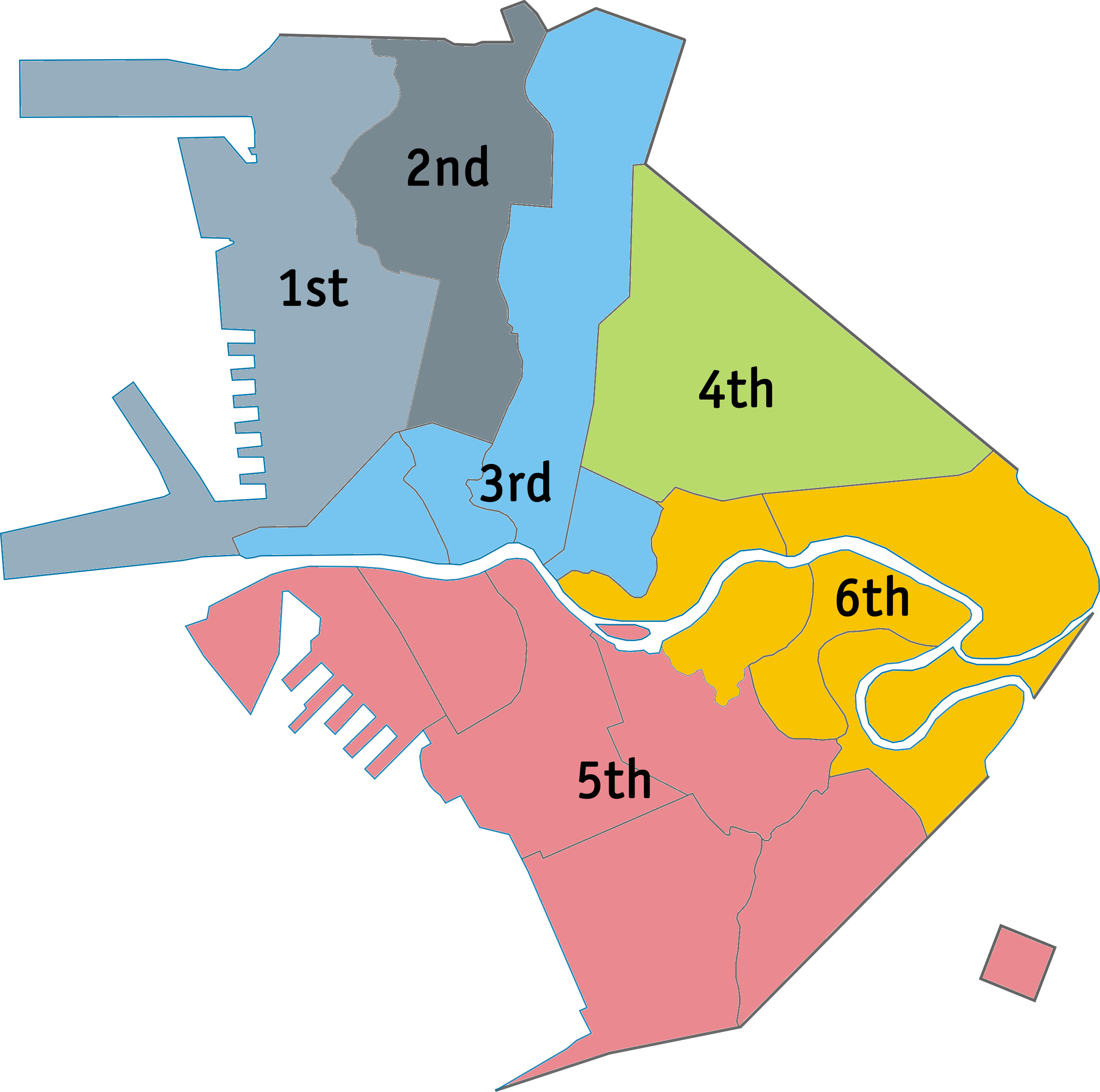
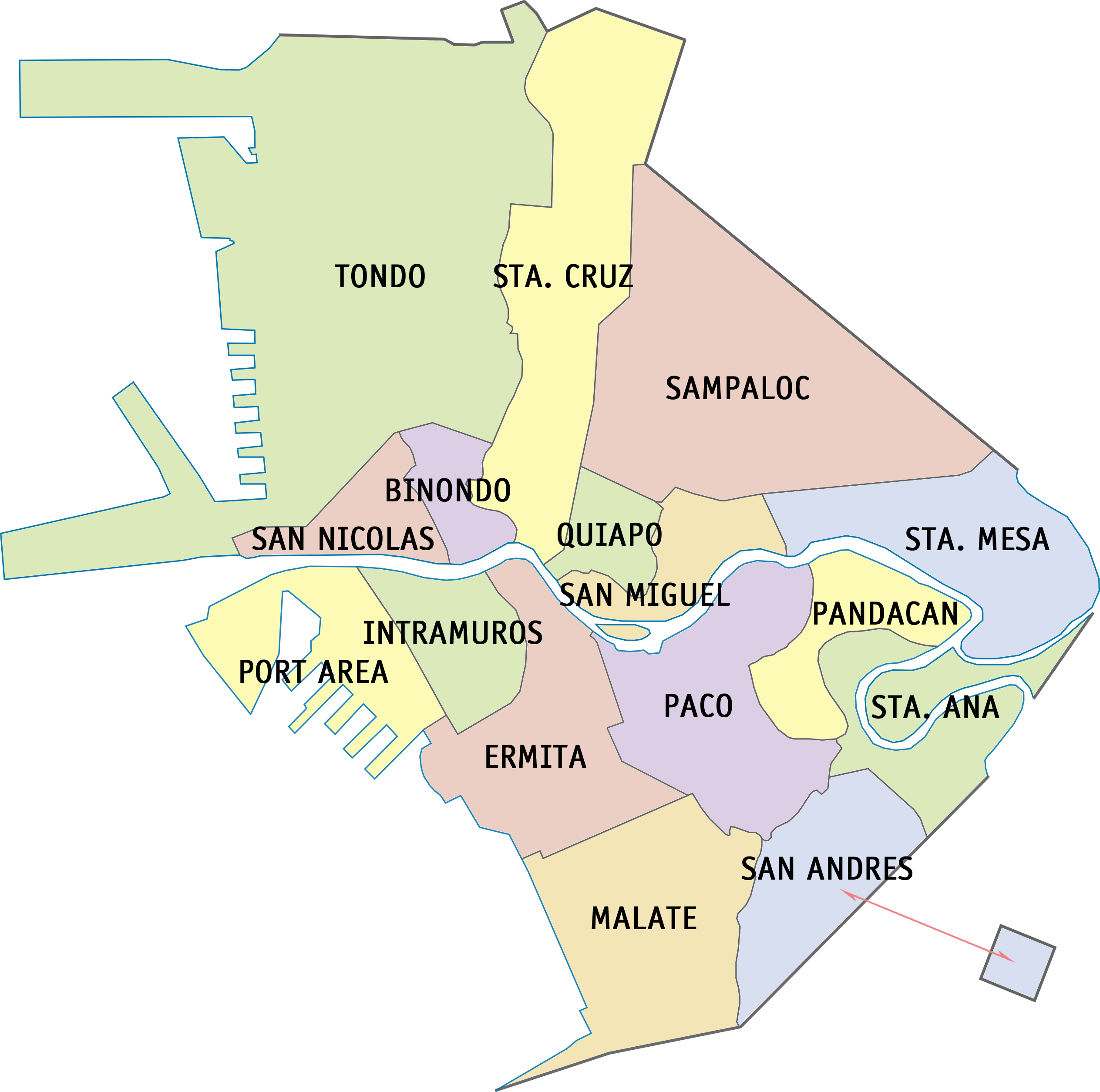
Manila is made up of 897 barangays, which are grouped into 100 zones for statistical convenience. Manila has the most barangays of any metropolis in the Philippines. Due to a failure to hold a plebiscite, attempts at reducing its number have not succeeded despite local legislation—Ordinance 7907, passed on April 23, 1996—reducing the number from 896 to 150 by merging existing barangays.
- District I (2020 population: 441,282) covers the western part of Tondo and is made up of 136 barangays. It is the most-densely populated congressional district and is also known as Tondo I. The district includes one of the biggest urban-poor communities; Smokey Mountain on Balut Island was once known as the country's largest landfill where thousands of impoverished people lived in slums. After the closure of the landfill in 1995, mid-rise housing was built on the site. This district also contains the Manila North Harbor Center, Manila North Harbor, and Manila International Container Terminal of the Port of Manila. The 1st District also covers Manila's borders with Navotas and a part of the southern enclave of Caloocan.
- District II (2020 population: 212,938) covers the eastern part of Tondo and contains 122 barangays. It is also referred to as Tondo II. It includes Gagalangin, a prominent place in Tondo, and Divisoria, a popular shopping area and the site of the Main Terminal Station of the Philippine National Railways. The 2nd District also covers the rest of Manila's border with Caloocan.
- District III (2020 population: 220,029) covers Binondo, Quiapo, San Nicolas and Santa Cruz. It contains 123 barangays and includes "Downtown Manila", the historic business district of the city, and the oldest Chinatown in the world. The 3rd District also covers a part of Manila's border with Quezon City.
- District IV (2020 population: 277,013) covers Sampaloc and some parts of Santa Mesa. It contains 192 barangays and has numerous colleges and universities, which are located along the city's "University Belt", a de facto sub-district. Included here is the University of Santo Tomas, the oldest-existing university in Asia, which was established in 1611. The institution was home to at least 30 Catholic saints. The 4th District also covers portions of Manila's borders with Quezon City and San Juan.
- District V (2020 population: 395,065) covers Ermita, Malate, Port Area, Intramuros, San Andres Bukid, and a portion of Paco. It is made up of 184 barangays and includes Manila City Hall, Rizal Park, the historic Walled City, along with Manila Cathedral and San Agustin Church, a UNESCO World Heritage Site. The 4th District also covers portions of Manila's borders with Makati and Pasay. This district also includes the Manila South Cemetery, an exclave surrounded by Makati City.
- District VI (2020 population: 300,186) covers Pandacan, San Miguel, Santa Ana, Santa Mesa, and the rest of Paco. It contains 139 barangays and includes Malacañang Palace, the residence and workplace of the President of the Philippines. Santa Ana district is known for its 18th century Santa Ana Church and historic ancestral houses. The 6th District also covers the rest of Manila's borders with Quezon City, San Juan, Makati and Pasay.
| District name | Legislative | ||||||||||||||||||||||||||
|---|---|---|---|---|---|---|---|---|---|---|---|---|---|---|---|---|---|---|---|---|---|---|---|---|---|---|---|
| District | |||||||||||||||||||||||||||
| number | Area | Population | |||||||||||||||||||||||||
| (2020) | Density | Barangays | km2 | sq mi | /km2 | /sq mi | Binondo | Ermita | Intramuros | Malate | Paco | Pandacan | Port Area | Quiapo | Sampaloc | San Andres | San Miguel | San Nicolas | Santa Ana | Santa Cruz | Santa Mesa | Tondo | |||||
| 3 | 0.6611 km2 | 20,491 | {{sigfig | 20491/0.6611 | 2}} PD/km2 | 10 | |||||||||||||||||||||
| 5 | 1.5891 km2 | 19,189 | {{sigfig | 19189/1.5891 | 2}} PD/km2 | 13 | |||||||||||||||||||||
| 5 | 0.6726 km2 | 6,103 | {{sigfig | 6103/0.6726 | 2}} PD/km2 | 5 | |||||||||||||||||||||
| 5 | 2.5958 km2 | 99,257 | {{sigfig | 99257/2.5958 | 2}} PD/km2 | 57 | |||||||||||||||||||||
| 5 & 6 | 2.7869 km2 | 79,839 | {{sigfig | 79839/2.7869 | 2}} PD/km2 | 43 | |||||||||||||||||||||
| 6 | 1.66 km2 | 84,769 | {{sigfig | 84769/1.66 | 2}} PD/km2 | 38 | |||||||||||||||||||||
| 5 | 3.1528 km2 | 72,605 | {{sigfig | 72605/3.1528 | 2}} PD/km2 | 5 | |||||||||||||||||||||
| 3 | 0.8469 km2 | 29,846 | {{sigfig | 29846/0.8469 | 2}} PD/km2 | 16 | |||||||||||||||||||||
| 4 | 5.1371 km2 | 388,305 | {{sigfig | 388305/5.1371 | 2}} PD/km2 | 192 | |||||||||||||||||||||
| 5 | 1.6802 km2 | 133,727 | 80,000 | 210,000 | 65 | ||||||||||||||||||||||
| 6 | 0.9137 km2 | 18,599 | {{sigfig | 18599/0.9137 | 2}} PD/km2 | 12 | |||||||||||||||||||||
| 3 | 1.6385 km2 | 42,957 | {{sigfig | 42957/1.6385 | 2}} PD/km2 | 15 | |||||||||||||||||||||
| 6 | 1.6942 km2 | 203,598 | {{sigfig | 203598/1.6942 | 2}} PD/km2 | 34 | |||||||||||||||||||||
| 3 | 3.0901 km2 | 126,735 | {{sigfig | 126735/3.0901 | 2}} PD/km2 | 82 | |||||||||||||||||||||
| 6 | 2.6101 km2 | 111,292 | 43,000 | 110,000 | 51 | ||||||||||||||||||||||
| 1 & 2 | 8.6513 km2 | 654,220 | {{sigfig | 654220/8.6513 | 2}} PD/km2 | 259 |
Climate
.svg)
Under the Köppen climate classification system, Manila has a tropical monsoon climate (Köppen Am), closely bordering on a tropical savanna climate (Köppen Aw). Together with the rest of the Philippines, Manila lies entirely within the tropics. Its proximity to the equator means temperatures are high year-round especially during the daytime, rarely going below 19 °C or above 39 °C. Temperature extremes have ranged from 14.5 °C on January 11, 1914, to 38.6 °C on May 7, 1915.
Humidity levels are usually very high all year round, making the air feel hotter than its actual temperature. Manila has a distinct dry season lasting from late December to early April. A relatively lengthy wet season that covers the remaining period, with slightly cooler daytime temperatures and slightly warmer nighttime temperatures. In the wet season, rain rarely falls all day, but rainfall is very heavy for short periods. Typhoons usually occur from June to September.
| Jan record high C = 36.5 | Feb record high C = 35.6 | Mar record high C = 36.8 | Apr record high C = 38.8 | May record high C = 38.6 | Jun record high C = 37.6 | Jul record high C = 37.0 | Aug record high C = 36.2 | Sep record high C = 35.3 | Oct record high C = 35.8 | Nov record high C = 35.6 | Dec record high C = 34.6 | year record high C = 38.8 | Jan record low C = 14.5 | Feb record low C = 15.6 | Mar record low C = 16.2 | Apr record low C = 17.2 | May record low C = 20.0 | Jun record low C = 20.1 | Jul record low C = 19.4 | Aug record low C = 18.0 | Sep record low C = 20.2 | Oct record low C = 19.5 | Nov record low C = 16.8 | Dec record low C = 15.7 | year record low C = 14.5
Natural hazards
Swiss Re ranked Manila as the second-riskiest capital city to live in, citing its exposure to natural hazards such as earthquakes, tsunamis, typhoons, floods, and landslides. The seismically active Marikina Valley Fault System poses a threat of a large-scale earthquake with an estimated magnitude of between 6 and 7, and as high as 7.6 to Metro Manila and nearby provinces. Manila has experienced several deadly earthquakes, notably those of 1645 and 1677, which destroyed the stone-and-brick medieval city. Architects during the Spanish colonial period used the Earthquake Baroque style to adapt to the region's frequent earthquakes. The Taal Volcano located to the south of Manila also poses a threat when it erupts.
Manila experiences between five and seven typhoons each year. In 2009, Typhoon Ketsana (Ondoy) struck the Philippines, leading to one of the worst floods in Metro Manila and several provinces in Luzon with an estimated damages worth ₱11 billion (), and caused 448 deaths in Metro Manila alone. Following the aftermath of Typhoon Ketsana, the city began to dredge its rivers and improve its drainage network.
Parks and green spaces

Metro Manila is situated in a variety of ecosystems including upland forests, mangrove forests, mudflats, sandy beaches, sea grass meadows and coral reefs. Metro Manila is home to urban parks, nature parks, plazas, nature reserves, and an arboretum. However, according to the Asian Green City Index, in 2007 Manila contained only an average of 4.5 sqm of green space per person, well below the index average of 39 sqm and below the World Health Organization (WHO) recommended minimum of 9 sqm per person.
The Arroceros Forest Park is a 2.2 ha nature park situated in the heart of downtown Manila along the south bank of the Pasig River. Considered as the "last lung of Manila", the park was professionally planned in 1993 with its secondary growth forest of 61 different native tree varieties and 8,000 ornamental plants providing a habitat for about 10 different bird species.
Pollution
Air pollution in Manila is due to industrial waste and automobiles. Swiss firm IQAir reported in December 2020 Manila experienced an average PM2.5 concentration of 6.1e-6 g/m3, which is classed as "Good" according to recommendations made by the World Health Organization.
According to a report in 2003, the Pasig River is one of the most-polluted rivers in the world in which 150 t of domestic waste and 75 t of industrial waste are dumped daily. The city is the second-biggest waste producing metropolis in the country with 1,151.79 tons (7,500.07 m3) per day, after Quezon City, which produces 1,386.84 tons (12,730.59 m3) per day. Both cities were cited as having poor management in garbage collection and disposal. A 2021 report by Oxford University's Our World in Data estimated eighty one percent of global ocean plastic comes from rivers in Asia and the Philippines itself contributes one third of that number, and the Pasig River is one of the main contributors.
Rehabilitation efforts have resulted in the creation of parks along the riverside and stricter pollution controls. In 2019, the Department of Environment and Natural Resources launched a rehabilitation program for Manila Bay that will be administered by different government agencies.
Cityscape
Manila is a planned city. In 1905, American architect and urban planner Daniel Burnham was commissioned to design the new capital. His design for the city was based on the City Beautiful movement, which favored broad streets and avenues radiating out from rectangles. Manila is made up of fourteen city districts, according to Republic Act No. 409—the Revised Charter of the City of Manila—the basis of which officially sets the present-day boundary of the city. The districts Santa Mesa, which was partitioned from Sampaloc, and San Andres, which was partitioned off from Santa Ana, were later created.
Manila's mix of architectural styles reflects its, and the Philippines', turbulent history. During World War II, Manila was razed to the ground by Japanese forces and the shelling of American forces. After the war ended, rebuilding began and most of the historical buildings were reconstructed. Many of the historic churches and buildings in Intramuros, Manila's historic core, however, had been damaged beyond repair. Manila's current urban landscape is one of modern and contemporary architecture. Manila's historic sites under the entry of The Walled City and Historic Monuments of Manila is currently being proposed to the tentative list for future UNESCO World Heritage Site inscription.
Architecture
Manila is known for its eclectic mix of architecture that includes a wide range of styles spanning the city's historical and cultural periods. Its architectural styles reflect American, Spanish, Chinese, and Malay influences. Prominent Filipino architects including Antonio Toledo, Felipe Roxas, Juan M. Arellano and Tomás Mapúa have designed significant buildings in Manila such as churches, government offices, theaters, mansions, schools, and universities.
Manila is known for its Art Deco theaters, some of which were designed by Juan Nakpil and Pablo Antonio. The historic Escolta Street in Binondo has many buildings of Neoclassical and Beaux-Arts architectural styles, many of which were designed by prominent Filipino architects during the American colonial period between the 1920s and the late 1930s. Many architects, artists, historians, and heritage advocacy groups are campaigning for the restoration of Escolta Street, which was once the premier street of the Philippines.
Almost all of Manila's pre-war and Spanish colonial architecture was destroyed during the 1945 Battle of Manila by intensive bombardment by the United States Air Force. Reconstruction took place afterward, replacing the destroyed historic Spanish-era buildings with modern ones, erasing much of the city's character. Some of the destroyed buildings, such as the Old Legislative Building (now the National Museum of Fine Arts), Ayuntamiento de Manila (now the Bureau of the Treasury), and the under-construction San Ignacio Church and Convent (as the Museo de Intramuros), have been reconstructed. There are plans to refurbish and restore several neglected historic buildings and places such as Plaza Del Carmen, San Sebastian Church, and the NCCA Metropolitan Theater. Spanish-era shops and houses in the districts of Binondo, Quiapo, and San Nicolas are also planned to be restored as a part of a movement to restore the city to its pre-war state.
Because Manila is prone to earthquakes, Spanish colonial architects invented a style called Earthquake Baroque, which churches and government buildings during the Spanish colonial period adopted. As a result, succeeding earthquakes of the 18th and 19th centuries barely affected Manila, although they periodically leveled the surrounding area. Modern buildings in and around Manila are designed or have been retrofitted to withstand an 8.2 magnitude quake in accordance with the country's building code.
Demographics

According to the 2020 Philippine census, Manila has a population of 1,846,513 people, making it the second-most-populous city in the Philippines. Manila is the most-densely populated city in the world, with 41,515 inhabitants per km in 2015. District 6 is listed as the densest with 68,266 inhabitants per km, followed by District 1 with 64,936 and District 2 with 64,710. District 5 is the least-densely populated area with 19,235.
Manila has been presumed to be the Philippines' largest city since the establishment of a permanent Spanish settlement, and eventually became the political, commercial, and ecclesiastical capital of the country. Since colonial times, Manila has been the destination of peoples whose origins are as wide-ranging as India and Latin America. Practicing forensic anthropology, while exhuming cranial bones in several Philippine cemeteries, researcher Matthew C. Go estimated that 7% of the mean amount, among the samples exhumed, have attribution to European descent. Research work published in the Journal of Forensic Anthropology, collating contemporary Anthropological data show that the percentage of Filipino bodies who were sampled from the University of the Philippines, that is phenotypically classified as Asian (East, South and Southeast Asian) is 72.7%, Hispanic (Spanish-Amerindian Mestizo, Latin American, and/or Spanish-Malay Mestizo) is at 12.7%, Indigenous American (Native American) at 7.3%, African at 4.5%, and European at 2.7%. However, this is only according to an interpretation of the data wherein the reference groups, which were cross checked to the Filipino samples; for the Hispanic category, were Mexican-Americans, and the reference groups for the: European, African, and Indigenous American, categories, were: White Americans, Black Americans, and Native Americans from the USA, while the Asian reference groups were sourced from Chinese, Japanese, and Vietnamese origins. In contrast, a different anthropology study using Morphoscopic ancestry estimates in Filipino crania using multivariate probit regression models by J. T. Hefner, while analyzing Historic and Modern samples of Philippine skeletons, paint a different picture, in that, when the reference group for "Asian" was Thailand (Southeast Asians) rather than Chinese, Japanese, and Vietnamese; the reference for "Africans" included West and East Africans, along with Black Americans; and the reference group for "Hispanic" was Colombians (South Americans) rather than Mexicans, the historical and modern sample results for Filipinos, yielded the following ratios: Asian at 48.6%, African at 32.9%, which is attributed to extensive admixture with Negritos since the initial peopling of the Filipino archipleago, and only a small portion classifying as either European at 12.9%, and finally for Hispanic at 5.7%.
Between the 1860s and 1890s, in urban areas of the Philippines – especially Manila – according to burial statistics, as much as 3.3% of the population were pure European Spaniards and pure Chinese composed 9.9% of the city's populace. The Spanish-Filipino and Chinese-Filipino Mestizo populations also fluctuated, with the mixed Spanish-Filipinos composing 19% of Manila's population. Eventually, these non-native categories diminished because they were assimilated into the majority Austronesian Filipino population. During the Philippine Revolution, the term "Filipino" included people of any race born in the Philippines.{{cite book
Philippine Hokkien, which is locally known as Lan-nang-oe, a variant of Southern Min, is mainly spoken by the city's Chinese-Filipino community. According to data provided by the Bureau of Immigration, 3.12 million Chinese citizens arrived in the Philippines from January 2016 to May 2018.
Crime
Crime in Manila is concentrated in areas that are associated with poverty, drug abuse, and gangs. Crime in the city is also directly related to its changing demographics and unique criminal justice system. The illegal drug trade is a major problem of the city; in Metro Manila alone, 92% of the barangays were affected by illegal drugs in February 2015.
From 2010 to 2015, Manila had the second-highest index crime rates in the Philippines, with 54,689 cases or an average of about 9,100 cases per year. By October 2017, Manila Police District (MPD) reported a 38.7% decrease in index crimes from 5,474 cases in 2016 to 3,393 in 2017. MPD's crime-solution efficiency also improved; six-to-seven of every ten crimes were solved by the city police force. MPD was cited as the Best Police District in Metro Manila in 2017 for registering the highest crime-solution efficiency.
Religion
Christianity
As a result of Spanish cultural influence, Manila is a predominantly Christian city. , 93.5% of the population were Roman Catholic, 1.9% were adherents of the Iglesia ni Cristo, 1.8% followed various Protestant, and 1.1% were Buddhists. Members of Islam and other religions make up the remaining 1.4% of the population.
Manila is the seat of prominent Catholic churches and institutions. There are 113 Catholic churches within the city limits; 63 of which are considered major shrines, basilicas, or cathedrals. Manila Cathedral, the country's oldest established church, is the seat of the Roman Catholic Archdiocese of Manila. There are another three basilicas in the city; Quiapo Church, Binondo Church, and the Minor Basilica of San Sebastián. San Agustín Church in Intramuros is a UNESCO World Heritage Site.
Several Mainline Protestant denominations are headquartered in the city. St. Stephen's Parish pro-cathedral in Santa Cruz district is the see of the Episcopal Church in the Philippines' Diocese of Central Philippines, while on Taft Avenue are the main cathedral and central offices of Iglesia Filipina Independiente (also called the Aglipayan Church), a nationalist church that is a product of the Philippine Revolution. The Church of Jesus Christ of Latter-day Saints (LDS Church) has a temple within Manila, one of two operating LDS temples in the Philippines.
The indigenous Iglesia ni Cristo has several locales (akin to parishes) in the city, including its first chapel, now a museum, in Punta, Santa Ana. Evangelical, Pentecostal and Seventh-day Adventist denominations also thrive. The headquarters of the Philippine Bible Society is in Manila. The main campus of the Cathedral of Praise is located on Taft Avenue. Jesus Is Lord Church Worldwide has several branches and campuses in Manila.
Religious groups such as Members Church of God International (MCGI), Iglesia ni Cristo, Jesus Is Lord Church Worldwide, and the El Shaddai movement celebrate their anniversaries at Quirino Grandstand, which is an open space in Rizal Park.
File:Allan Jay Quesada - Manila Cathedral 001.jpg|Manila Cathedral is the seat of Roman Catholic Archdiocese of Manila. File:San Sebastian Church, Quiapo, Manila, Dec 2023.jpg|The Minor Basilica of San Sebastián is the only all-steel church in Asia. File:San Agustin Church Intramuros 2023-05-28.jpg|San Agustín Church in Intramuros, a UNESCO World Heritage Site File:Binondo, Manila San Nicolas Heritage Centre 47.jpg|Binondo Church serves the Roman Catholic Chinese community. File:Quiapo Church 2024-05-31.jpg|Quiapo Church, home of the iconic Black Nazarene, whose Traslacion feast is celebrated every January 9 File:Iglesia Ni Cristo Lokal ng Tondo.jpg|The Iglesia ni Cristo (INC) Lokal ng Tondo, established on November 6, 1915, is one of the earliest congregations of the church. The current structure was completed in 1967. Image:Seng Guan Temple Tondo 10.jpg|Seng Guan Temple
Other faiths
Manila has many Taoist and Buddhist temples like Seng Guan Temple that serve the spiritual needs of the Chinese Filipino community. Quiapo has a "Muslim town" that includes the city's largest mosque Masjid Al-Dahab. Members of the Indian expatriate community can worship at the large Hindu temple in the city or at the Sikh gurdwara on United Nations Avenue. The Baháʼí Faith's governing body in the Philippines the National Spiritual Assembly is headquartered near Manila's eastern boundary with Makati.
Economy
Manila is a major center for commerce, banking and finance, retailing, transportation, tourism, real estate, new media, traditional media, advertising, legal services, accounting, insurance, theater, fashion, and the arts. Around 60,000 establishments operate in the city. In 2024, Manila is the 4th largest economy in the Philippines, with a 4.7% share to the national gross domestic product totaling ₱1.04 trillion.
The National Competitiveness Council of the Philippines, which annually publishes the Cities and Municipalities Competitiveness Index (CMCI), ranks the country's cities, municipalities, and provinces according to their economic dynamism, government efficiency, and infrastructure. According to the 2022 CMCI, Manila was the second-most-competitive highly urbanized city in the Philippines. Manila held the title of the country's most-competitive city in 2015, and since then has been in the top three, denoting Manila is consistently one of the best place to live in and do business. The city has an estimated GDP of ₱987.88 billion and is the 3rd largest economy of the National Capital Region, accounting for 15% of the region's total economy as of 2023.
Binondo, the oldest and one of the largest Chinatowns in the world, was the center of commerce and business activities in the city. Numerous residential and office skyscrapers occupy its medieval streets. As of 2013, plans by the city government of Manila to turn the Chinatown area into a business process outsourcing (BPO) hub were in progress; thirty unoccupied buildings had been already identified for conversion into BPO offices. Most of these buildings are on Escolta Street, Binondo.
The Port of Manila is the largest seaport in the Philippines and the main international shipping route into the country. The Philippine Ports Authority oversees the operation and management of the country's ports. International Container Terminal Services Inc., according to the Asian Development Bank, is one of the top-five major maritime terminal operators in the world, and has its headquarters and main operations at the Port of Manila. Another port operator, Asian Terminal Incorporated, has its corporate office and main operations at Manila South Harbor, and its container depository is in Santa Mesa. Manila is classified as a Medium-Port Megacity, using the Southampton system for port-city classification.
Manufacturers within the city produce industrial-related products such as chemicals, textiles, clothing, electronic goods, food, beverages, and tobacco products. Local businesses process primary commodities for export, including rope, plywood, refined sugar, copra, and coconut oil. The food-processing industry is one of the most-stable manufacturing sector in the city.
Pandacan oil depot houses the storage facilities and distribution terminals of Caltex Philippines, Pilipinas Shell, and Petron Corporation; the major players in the country's petroleum industry. The oil depot has been a subject of various concerns, including its environmental and health impact on the residents of Manila. The Supreme Court ordered the oil depot to be relocated outside the city by July 2015, but it failed to meet this deadline. Most of the oil depot facility inside the 33 ha compound were demolished, and plans have been made to convert it into a transport hub or food park.
Manila is a major publishing center of the Philippines. Manila Bulletin, the Philippines' largest broadsheet newspaper by circulation, is headquartered in Intramuros. Other major publishing companies in the country The Manila Times, The Philippine Star, and Manila Standard Today are headquartered in the Port Area. The Chinese Commercial News, the Philippines' oldest existing Chinese-language newspaper, and the country's third-oldest newspaper, is headquartered in Binondo. DWRK used to have its studio at the FEMS Tower 1 along Osmeña Highway in Malate before transferring to the MBC Building at the CCP Complex in 2008.
Manila serves as the headquarters of the Bangko Sentral ng Pilipinas, which is located on Roxas Boulevard. The Landbank of the Philippines and Philippine Trust Company also have their headquarters in Manila. Unilever Philippines used to have its corporate office on United Nations Avenue in Paco before transferring to Bonifacio Global City in 2016. Vehicle manufacturer Toyota also has its regional office on UN Avenue.
Tourism
Main article: Tourism in Metro Manila
Manila welcomes over one million tourists each year. Major tourist destinations include the historic Walled City of Intramuros, the Cultural Center of the Philippines Complex, Manila Ocean Park, Binondo (Chinatown), Ermita, Malate, Manila Zoo, the National Museum Complex, and Rizal Park. Both the historic Walled City of Intramuros and Rizal Park were designated as flagship destinations and as tourism enterprise zones in the Tourism Act of 2009.
Rizal Park, also known as Luneta Park, is a national park and the largest urban park in Asia. with an area of 58 ha, The park was constructed to honor of the country's national hero José Rizal, who was executed by the Spaniards on charges of subversion. The flagpole west of the Rizal Monument is the Kilometer Zero marker for distances to locations across the country. The park is managed by the National Parks and Development Committee.
The 0.67 km2 Walled City of Intramuros is the historic center of Manila. It is administered by the Intramuros Administration, an attached agency of the Department of Tourism. It contains Manila Cathedral and the 18th Century San Agustin Church, a UNESCO World Heritage Site. Kalesa is a popular mode of transportation for tourists in Intramuros and nearby places including Binondo, Ermita and Rizal Park. Binondo, the oldest Chinatown in the world, was established in 1521 and served as a hub of Chinese commerce before the Spaniards colonized the Philippines. Its main attractions are Binondo Church, Filipino-Chinese Friendship Arch, Seng Guan Buddhist Temple, and authentic Chinese restaurants.
Manila is designated as the country's leading destination for medical tourism, which is estimated to annually generate $1 billion in revenue. Lack of a progressive health system, inadequate infrastructure, and the unstable political environment are seen as hindrances to its growth.
Shopping
Manila is regarded as one of the best shopping destinations in Asia. Major shopping malls, department stores, markets, supermarkets, and bazaars are located within the city.
Divisoria in Tondo has been locally described as a "shopping mecca" of Manila. Shopping malls sell goods at bargain prices. Small vendors occupy several roads, causing pedestrian and vehicular traffic. A well-known landmark in Divisoria is the Tutuban Center, a large shopping mall that is a part of the Philippine National Railways' Main Station. It attracts 1 million people every month and is expected to add another 400,000 people upon the completion of the LRT Line 2 West Extension, making it Manila's busiest transfer station. Another "lifestyle mall" is Lucky Chinatown. There are almost 1 million shoppers in Divisoria according to the Manila Police District.
Binondo, the oldest Chinatown in the world, is the city's center of commerce and trade for all types of businesses run by Filipino-Chinese merchants, with a wide variety of shops and restaurants. Quiapo is referred to as the "Old Downtown", where tiangges, markets, boutique shops, music and electronics stores are common. Many department stores are on Recto Avenue.
Robinsons Place Manila is Manila's largest shopping mall. The mall was the second and the largest Robinsons Malls built. SM Supermalls operates the shopping malls SM City Manila and SM City San Lazaro. SM City Manila is located on the former site of YMCA Manila beside Manila City Hall in Ermita, while SM City San Lazaro is built on the site of the former San Lazaro Hippodrome in Santa Cruz. The building of the former Manila Royal Hotel in Quiapo, which is known for its revolving restaurant, is now the SM Clearance Center and was established in 1972. The site of the first SM Department Store is Carlos Palanca Sr. (formerly Echague) Street in San Miguel.
Culture
Museums
_(digitally_altered_to_remove_Torre_de_Manila).jpg)
As the cultural center of the Philippines, Manila has a number of museums. The National Museum Complex of the National Museum of the Philippines, located in Rizal Park, is composed of the National Museum of Fine Arts, the National Museum of Anthropology, the National Museum of Natural History, and the National Planetarium. Spoliarium, a famous painting by Juan Luna, can be found in the complex.
The city hosts the National Library of the Philippines, a repository of the country's printed and recorded cultural heritage, and other literary and information resources. The National Historical Commission of the Philippines maintains two history museums in the city, which are the Museo ni Apolinario Mabini – PUP and the Museo ni Jose Rizal – Fort Santiago. Museums established or run by the National Library and by educational institutions such asDLS-CSB Museum of Contemporary Art and Design, UST Museum of Arts and Sciences, and the UP Museum of a History of Ideas are located in the city.
Bahay Tsinoy, one of Manila's prominent museums, documents the lives of Chinese people and their contributions to the history of the Philippines. Intramuros Light and Sound Museum chronicles Filipinos' desire for freedom during the revolution under Rizal's leadership and other revolutionary leaders. The Metropolitan Museum of Manila houses modern and contemporary visual arts, and exhibits Filipino arts and culture.
Other museums in the city are the Museo Pambata, a children's museum; and Plaza San Luis, an outdoor heritage public museum that includes nine Spanish Bahay na Bato houses. Ecclesiastical museums located in the city are the Parish of the Our Lady of the Abandoned in Santa Ana; San Agustin Church Museum; and the Museo de Intramuros, which houses the ecclesiastical art collection of the Intramuros Administration in the reconstructed San Ignacio Church and Convent.
Sports
Sports in Manila have a long and distinguished history. The city's, and in general the country's, main sport is basketball. Most barangays have a basketball court or a makeshift one, and court markings are frequently drawn on the streets. Larger barangays have covered courts where inter-barangay leagues are held every April to May. Manila's major sports venues include Rizal Memorial Sports Complex and San Andres Gym, the base of the now-defunct Manila Metrostars.
Rizal Memorial Sports Complex houses a track and football stadium, a baseball stadium, tennis courts, Rizal Memorial Coliseum, and Ninoy Aquino Stadium; the latter two are indoor arenas. The Rizal complex had hosted several multi-sport events, such as the 1954 Asian Games and the 1934 Far Eastern Games. When the Philippines hosts the Southeast Asian Games, most of the events are held at the complex but in the 2005 Games, most events were held elsewhere. The 1960 ABC Championship and the 1973 ABC Championship, forerunners of the FIBA Asia Championship, were hosted at the memorial coliseum; the national basketball team won both tournaments. The 1978 FIBA World Championship was held at the coliseum although the latter stages were held in the Araneta Coliseum in Quezon City.
Manila has several other well-known sports facilities such as Enrique M. Razon Sports Center and the University of Santo Tomas Sports Complex, both of which are private venues owned by a university; collegiate sports are also held in the city; the University Athletic Association of the Philippines and the National Collegiate Athletic Association basketball games held at Rizal Memorial Coliseum and Ninoy Aquino Stadium, although basketball events have been transferred to San Juan's Filoil Flying V Arena and Araneta Coliseum in Quezon City.
Other collegiate sports are still held at Rizal Memorial Sports Complex. Professional basketball, which has been mostly organized by corporate teams, also used to play at the city but the Philippine Basketball Association now holds their games at Araneta Coliseum and Cuneta Astrodome at Pasay; the now-defunct Philippine Basketball League played some of their games, such as its 1995–96 Philippine Basketball League season, at Rizal Memorial Sports Complex.
Manila Metrostars participated in the Metropolitan Basketball Association. The Metrostars, named after the Metrostar Express – the brand name of the Metro Manila MRT-3, which does not have stations in the city – participated in its first three seasons and won the 1999 championship. The Metrostars later merged with the Batangas Blades and subsequently played in Lipa, Batangas. Almost twenty years later, Manila Stars participated in the Maharlika Pilipinas Basketball League, reaching the Northern Division Finals in 2019. Both teams played in the San Andres Sports Complex. Other teams that represented Manila but did not host games in the city are the Manila Jeepney F.C. and FC Meralco Manila. The city's government acknowledged Jeepney as Manila's representative in the United Football League. Meralco Manila played in the Philippines Football League and designated Rizal Memorial Stadium as their home ground.
Manila's rugby league team Manila Storm trains at Rizal Park and plays matches at Southern Plains Field, Calamba, Laguna. Baseball was previously a widely played sport in the city but in 2022, Manila had the Philippines' only sizable baseball stadium, Rizal Memorial Baseball Stadium, which hosted games of the now-defunct Baseball Philippines; Lou Gehrig and Babe Ruth were the first players to score a home run at the stadium during their tour of the country on December 2, 1934. Cue sports are also popular in Manila; billiard halls are present in most barangays. The 2010 World Cup of Pool was held at Robinsons Place Manila.
Rizal Memorial Track and Football Stadium hosted the first FIFA World Cup qualifier in decades when the Philippines hosted Sri Lanka in July 2011. The stadium, which was previously unfit for international matches, had been renovated before the match. The stadium also hosted its first rugby test for the 2012 Asian Five Nations Division I tournaments.
Festivals and holidays
Manila celebrates civic and national holidays. Because most of the city's residents are Roman Catholic, most of the festivals are religious in nature. Araw ng Maynila, which celebrates the city's founding on June 24, 1571 by the Spanish conquistador Miguel López de Legazpi, was first proclaimed by the city's vice mayor Herminio A. Astorga in June 1962. It has been annually commemorated under the patronage of John the Baptist, and has always been declared by the national government as a special, non-working holiday through presidential proclamations. Each of the city's 896 barangays have their own festivities, which are guided by their own patron saints.
Manila also hosts the procession of the Feast of the Black Nazarene (Traslacíon), which is held every January 9 and draws millions of Catholic followers. Other religious festivities held in Manila are the Feast of Santo Niño in Tondo and Pandacan, which is held on the third Sunday of January; the Feast of Nuestra Señora de los Desamparados de Manila (Our Lady of the Abandoned), the patron saint of Santa Ana, which is held every May 12; and the Flores de Mayo. Non-religious holidays include New Year's Day, National Heroes' Day, Bonifacio Day, and Rizal Day.
Government
Local government
Main article: Sangguniang Panglungsod
Manila, which is officially known as the City of Manila, is the national capital of the Philippines and is classified as a special city according to its income, and a highly urbanized city (HUC). The Mayor of Manila is the chief executive, and is assisted by the vice mayor and the 38-member City Council, who are elected as representatives of the six councilor districts within the city, and the municipal presidents of the Liga ng mga Barangay and Sangguniang Kabataan.
The city has no control over Intramuros and Manila North Harbor. The historic Walled City is administered by the Intramuros Administration while Manila North Harbor is managed by the Philippine Ports Authority. Both are national government agencies. The barangays that have jurisdictions over these places oversee the welfare of the city's constituents but cannot exercise their executive powers. Manila had a 12,971 personnel complement at the end of 2018. Under the proposed form of federalism in the Philippines, Manila may no longer be the capital and Metro Manila may no longer be the seat of government; the committee has not yet decided on the federal capital and states they are open to other proposals.
As of June 2025, the mayor is Isko Moreno, who is on his second mayoral stint. The vice mayor is Chi Atienza, daughter of former mayor Lito Atienza. The mayor and the vice mayor are limited to up-to three terms, each term lasting for three years. The city has an ordinance penalizing cat-calling since 2018, and is the second city in the Philippines to do so after Quezon City, which passed a similar ordinance in 2016. In 2017, the city government planned to revise the existing curfew ordinance since the Supreme Court declared it unconstitutional in August that year. Of the three cities reviewed by the Supreme Court; the City of Manila, Navotas, and Quezon City; only the curfew ordinance of Quezon City was approved.
National government
Manila, being the seat of political power in the Philippines, has the headquarters of several national government offices. Planning for the city's role as the center of government started during the early years of American colonization, when the U.S. envisioned a well-designed city outside the walls of Intramuros, and chose Bagumbayan, a former town that is now Jose Rizal Park to become the center of government. A design commission was given to Daniel Burnham to create a master plan for the city patterned after Washington, D.C. but the plans were abandoned under the Commonwealth Government of Manuel L. Quezon.
A new government center was to be built on the hills northeast of Manila, in what is now Quezon City. Several government agencies have set up their headquarters in Quezon City. Several key government offices are still based in Manila. Many of the plans were substantially altered after the devastation of Manila during World War II and by subsequent administrations.
As the nation's capital, Manila hosts the Office of the President and the President's official residence. It also houses important government agencies and institutions such as the Supreme Court, the Court of Appeals, the Bangko Sentral ng Pilipinas, the Departments of Budget and Management, Finance, Health, Justice, Labor and Employment, and Public Works and Highways. Manila also hosts important national institutions such as the National Library, National Archives, National Museum of the Philippines, and Philippine General Hospital. Other notable institutions based in Manila are the National Commission for Culture and the Arts, National Historical Commission, Film Development Council of the Philippines, and the Cultural Center of the Philippines.
Congress previously held office at the Old Congress Building. In 1972, due to declaration of martial law, Congress was dissolved; its successor, the unicameral Batasang Pambansa, held office at the new Batasang Pambansa Complex. When a new constitution restored the bicameral Congress, the House of Representatives stayed at the Batasang Pambansa Complex and the Senate remained at the Old Congress Building. In May 1997, the Senate transferred to a new building, which it shares with the Government Service Insurance System on reclaimed land at Pasay. The Supreme Court was due to transfer to its new campus at Bonifacio Global City, Taguig, in 2019 but the move was postponed to a later year.
In Congress, Manila has six representatives, one each from its six congressional districts.
Finance
In the 2019 Annual Audit Report published by the Commission on Audit, the revenue of the City of Manila was ₱16.534 billion. It is one of the cities with the highest tax collection and internal revenue allotment. For the 2019 fiscal year, the tax revenue collected by the city was ₱8.4 billion. The city's Internal Revenue Allotment (IRA) from the National Treasury was ₱2.94 billion, and the city's total assets were worth ₱63.4 billion in 2019. The City of Manila has the highest budget allocation for healthcare of all the cities and municipalities in the Philippines; the city maintains the six district hospitals, 59 health centers and lying-in clinics, and healthcare programs.
Infrastructure
Housing
Development of public housing in Manila began in the 1930s under U.S. rule. Americans had to deal with the problem of sanitation and concentration of settlers around business areas. Business codes and sanitation laws were implemented in the 1930s. During this period until the 1950s, new communities were opened for relocation. Among these were Projects 1–8 in Quezon City and the Vitas tenement houses in Tondo. In 1947, the government implemented a public housing policy that established the People's Homesite and Housing Corporation (PHHC). A few years later, it established a Slum Clearance Committee which, with the help of the PHHC, relocated thousands of families from Manila and Quezon City to Sapang Palay in San Jose del Monte, Bulacan in the 1960s.
In 2016, the national government completed several medium-rise houses for 300 Manila residents whose slum community was destroyed by a fire in 2011. As of 2019, the city government plans to retrofit dilapidated tenements within the city, and will construct new housing buildings for the city's informal settlers such as the 14-story Tondominium 1 and Tondomium 2 buildings, containing 42 m2, two-bedroom units. The construction of these new in-city vertical housing projects was funded by a loan from the Development Bank of the Philippines and the Land Bank of the Philippines.
Since 2019, the Manila City Government has initiated six housing projects: Tondominium 1 & 2, Binondominium, Basecommunity, San Lazaro Residences, Pedro Gil Residences, and San Sebastian Residences.
Transportation
Main article: Transportation in Metro Manila, Rail transportation in Metro Manila, Major roads in Metro Manila

One of the best-known modes of transportation in Manila is the jeepney, which were patterned after U.S. Army jeeps and have been in use since the mid-to-late 1940s. The Tamaraw FX, the third generation of the Toyota Kijang, once directly competed with jeepneys and followed fixed routes for a set price. They were replaced by the UV Express. All types of public road transportation in Manila are privately owned and operated under government-issued franchises.
On a for-hire basis, the city is served by taxicabs, "tricycles" – motorcycles with sidecars—the Philippine version of the auto rickshaw, and "trisikads", "sikads" or "kuligligs"; bicycles with sidecars, the Philippine version of pedicabs), which are popular In some areas, especially Divisoria. Spanish-era horse-drawn calesas are a popular tourist attraction and mode of transportation in Binondo and Intramuros. Manila will phase out all gasoline-run tricycles and pedicabs, and replace them with electric tricycles (e-trikes), and plans to distribute 10,000 e-trikes to qualified tricycle drivers from the city. By January 2018, the city has distributed e-trikes to a number of drivers and operators in Binondo, Ermita, Malate, and Santa Cruz.
Manila is serviced by LRT Line 1 (LRT-1) and Line 2 (LRT-2), which form the Manila Light Rail Transit System. Development of the light rail system began in the 1970s during the presidency of Ferdinand Marcos, when the LRT Line 1 was built, making it the first light-rail system in Southeast Asia. Despite its name, LRT-1 operates as a light metro, running on dedicated rights-of-way. LRT 2 operates as a full-metro, heavy rail system. As of 2015, these systems were undergoing a multi-billion-dollar expansion. The LRT runs along the length of Taft Avenue (N170/R-2) and Rizal Avenue (N150/R-9), while LRT-2 runs along Claro M. Recto Avenue (N145/C-1) and Ramon Magsaysay Boulevard (N180/R-6) from Santa Cruz, through Quezon City, and to Masinag in Antipolo, Rizal.
Tutuban station, the central terminal of the Philippine National Railways, lies within Manila. Within Metro Manila, one commuter railway is in operation. The line runs in a general north–south direction from Tutuban (Tondo) toward the province of Laguna. The Port of Manila, which is located in the western section of the city on Manila Bay, is the largest and chief seaport of the Philippines. The Pasig River Ferry Service is another form of transportation. The city is also served by Ninoy Aquino International Airport, the country's main international airport and domestic air hub.
Trolleys, hand-made human-powered metal handcarts operated by "trolley boys", transport people along sections of the PNR lines. This is a popular means of transportation because it is low-cost – roughly ₱10 or US$.20 per trip – and avoids traffic. Many trolley boys are homeless and live alongside the railroad line, which is actively used by passenger trains, making collisions with passenger trains a consistent danger, although casualties are rare. The trolley rides are unofficial and unregulated but tolerated by authorities.
Satellite navigation company TomTom ranked Manila as the second world's most-traffic-congested city in 2019. According to Waze's 2015 "Global Driver Satisfaction Index", Manila has the worst traffic worldwide. Manila is notorious for its frequent traffic jams and high densities. The government has undertaken several projects to alleviate the traffic in the city, some of which include the proposed construction of a new viaduct or underpass at the intersection of España Boulevard and Lacson Avenue; the construction of Skyway Stage 3, and NLEX Connector; the proposed LRT Line 2 West Extension Project from Recto Avenue to Pier 4 of Manila North Harbor; the construction of the North–South Commuter Railway (NSCR); the proposed construction of the PNR East–West line (MRT Line 8) through España Boulevard to Quezon City; and the expansion and widening of several national and local roads. These projects had yet to make any meaningful impact by 2014, and the traffic jams and congestion continue.
The government, under its 2014 Metro Manila Dream Plan aims to address these urban transport problems. The plan is a list of short-term priority projects and medium-to-long-term infrastructure projects that will last up to 2030.
Water and electricity
Water services used to be provided by the Metropolitan Waterworks and Sewerage System (MWSS), which served 30% of the city. Most other sewage was directly dumped into storm drains, septic tanks, and open canals. MWSS was privatized in 1997, which split the water concession into east and west zones. Maynilad Water Services took over the west zone, of which Manila is a part.
As of 2001, Maynilad Water Services provides the supply and delivery of potable water, and sewerage system in Manila. The southeastern part of the city, which belongs to the east zone, is served by Manila Water. Electricity services are provided by Meralco, the sole electricity distributor in Metro Manila.
Healthcare
_(2014).JPG)
Manila Health Department is responsible for the planning and implementation of healthcare programs provided by the city government. Manila Health Department operates 59 health centers and six city-run hospitals, which are free of charge for the city's constituents. The six public city-run hospitals are Ospital ng Maynila Medical Center, Ospital ng Sampaloc, Gat Andres Bonifacio Memorial Medical Center, Ospital ng Tondo, Santa Ana Hospital, and Justice Jose Abad Santos General Hospital. Philippine General Hospital, a tertiary state-owned hospital in Manila, is operated by the University of the Philippines Manila. The city is planning to build an education, research, and hospital facility for cleft lip and cleft palate patients, and to establish the first children's surgical hospital in Southeast Asia.
Private corporations also provide healthcare in Manila. Private hospitals that operate in the city are Manila Doctors Hospital, Chinese General Hospital and Medical Center, José R. Reyes Memorial Medical Center, Metropolitan Medical Center, Our Lady of Lourdes Hospital, and the University of Santo Tomas Hospital.
The Department of Health (DOH) has its main office in Manila and operates San Lazaro Hospital, a special referral tertiary hospital. DOH also operates Dr. Jose Fabella Memorial Hospital, Jose R. Reyes Memorial Medical Center, and Tondo Medical Center. Manila is the home to the headquarters of the World Health Organization's Regional Office for the Western Pacific and Country Office for the Philippines.
The city government provides free immunization programs for children, who are specifically targeted against hepatitis B, hemophilus influenza B pneumonia, diphtheria, tetanus, polio, measles, mumps, and rubella. As of 2016, 31,115 children aged one and below have been fully immunized. Manila Dialysis Center, which provides free services for the poor, has been cited by the United Nations Committee on Innovation, Competitiveness and Public-Private Partnerships as a model for public-private partnership (PPP) projects. The dialysis facility was named Flora V. Valisno de Siojo Dialysis Center in 2019, and was inaugurated as the largest free dialysis facility in the Philippines. It has 91 dialysis machines, which can be expanded up to 100, matching the capabilities of the National Kidney and Transplant Institute (NKTI).
Education
Main article: List of universities and colleges in Manila, Division of City Schools–Manila
Manila has been a center of education since the colonial period. The city has several Philippine universities and colleges, some of which are the county's oldest. The city's University Belt has a high concentration of colleges and universities, which are a short walking distance of each other. The University Belt is at the boundaries between San Miguel, Quiapo, and Sampaloc districts, while other clusters colleges lie along the southern bank of the Pasig River – mostly in Intramuros and Ermita districts; and at the southernmost part of Malate near the city limits.
The historic district Intramuros once housed the University of Santo Tomas (1611), Colegio de San Juan de Letran (1620), and Ateneo de Manila University (1859). Only Colegio de San Juan de Letran remains at Intramuros; the University of Santo Tomas transferred to a new campus at Sampaloc in 1927 and Ateneo de Manila University relocated to Loyola Heights, Quezon City, in 1952. In the 20th century, new non-sectarian schools were built; Mapúa University (1925), Lyceum of the Philippines University (1952), and Pamantasan ng Lungsod ng Maynila (1965) – which is owned and operated by the Manila city government. The four schools in the district formed the Intramuros Consortium.
Other notable universities in Manila include National University (1900), San Beda University (1901), the only Benedictine university in Asia, De La Salle University (1911), the largest of all De La Salle University System of schools, St. Paul University Manila (1912), one of the seven campuses comprising the St. Paul University System of schools, Far Eastern University (1928), and Adamson University (1939).
The University of the Philippines (1908), the country's main state university, was established in Ermita, Manila. It moved its central administrative offices from Manila to Diliman in 1949 and eventually made the original campus the University of the Philippines Manila, the oldest of the constituent universities of the University of the Philippines System, and the center of health-sciences education in the country. Manila is also the site of the main campus of the Polytechnic University of the Philippines, the largest university in the country in terms of student population.
The city's three-tier public education system, the Division of the City Schools of Manila, is a branch of the Department of Education. The division oversees 71 public elementary schools and 32 public high schools, all located within the city's territory, except for Rafael Palma Elementary School, which is situated in Barangay La Paz, Makati, near the border with Manila. The city also contains Manila Science High School, a pilot science high school.
Sister cities
Asia
- Astana Astana, Kazakhstan
- Flag of Bacoor, Cavite.png Bacoor, Cavite
- Bangkok Bangkok, Thailand
- PRC Beijing, People's Republic of China
- TLS Dili, East Timor
- PRC Guangzhou, Guangdong, People's Republic of China
- Haifa Haifa, Israel
- VIE Ho Chi Minh City, Vietnam
- Incheon Incheon, South Korea
- Jakarta Jakarta, Indonesia
- Nantan Nantan, Kyoto, Japan
- Osaka City Osaka, Japan (business partner)
- PRC Shanghai, People's Republic of China
- Taipei Taipei, Taiwan
- Takatsuki Takatsuki, Osaka, Japan
- Yokohama Yokohama, Kanagawa, Japan
Europe
- ROU Bucharest Flag.svg Bucharest, Romania
- Lisbon Lisbon, Portugal
- Warsaw Warsaw, Poland
- Bandera de la ciudad de Madrid.svg Madrid, Spain
- Flag of Málaga, Spain.svg Málaga, Spain
- Moscow Moscow, Russia
- Bandièra de Niça.svg Nice, France
The Americas
- Guerrero Acapulco, Guerrero, Mexico
- Buenos Aires Buenos Aires, Argentina
- Cali Cali, Colombia
- Cartagena Cartagena, Colombia
- Havana Havana, Cuba
- Lima Lima, Peru
- Mexico City Mexico City, Mexico
- URU Montevideo, Uruguay
- Montreal Montreal, Quebec, Canada
- New York City New York City, New York, United States (global partner)
- Panama City Panama City, Panama
- Sacramento Sacramento, California, United States
- San Francisco San Francisco, California, United States
- Flag of Santiago, Chile.svg Santiago, Chile
- Flag of Winnipeg.svg Winnipeg, Manitoba, Canada
Oceania
- Honolulu Honolulu, Hawaii, United States
- Maui County Maui County, Hawaii, United States
- NMI Saipan, Northern Mariana Islands
International relations
Manila hosts the foreign embassies of the United States and Vietnam. Honorary consulates of Belize, Burkina Faso, Jordan, Nepal, Poland, Iceland, Paraguay, Thailand, and Tunisia are based in the city.
Notable personalities
Main article: List of people from Manila, List of people from Metro Manila
Notes
References
Sources
- Moore, Charles (1921). "Daniel H. Burnham: Planner of Cities". Houghton Mifflin and Co., Boston and New York.
References
- (February 5, 1945). "'Pearl of Orient' Stripped of Food; Manila, Before Pearl Harbor, Had Been Prosperous—Its Harbor One, of Best Focus for Two Attacks Osmeña Succeeded Quezon".
- {{DILG detail
- "Manila". City Government of Manila.
- "Philippine Population Density (Based on the 2015 Census of Population)".
- The original form as used by [[José Rizal]] in {{lang. es. [[El filibusterismo]].
- Sub-national HDI. "Area Database – Global Data Lab".
- (17 July 2025). "2024 Census of Population (POPCEN) Population Counts Declared Official by the President". Philippine Statistics Authority.
- (2014). "Annual Audit Report: City of Manila".
- China and the Birth of Globalization in the 16th Century, by Dennis O. Flynn and Arturo Giráldez
- Frank, Andre G.. (1998). "ReOrient: Global Economy in the Asian Age". University of California Press.
- "GaWC – The World According to GaWC 2018".
- (November 30, 2001). "Brookings – Global Metro Monitor 2018".
- (March 2020). "The Global Financial Centres Index 27". Long Finance.
- Baumgartner, Joseph. (March 1975). "Manila – Maynilad or Maynila?". Philippine Quarterly of Culture and Society.
- (2025). "Maestra sa Maynila: Kalipunan ng mga Saliksik sa Araling Maynila at Aklat-Parangal Kay Dr. Celestina P. Boncan". Department of Social Sciences, University of the Philippines Manila.
- Chamberlain, Alexander F.. (1901). "Philippine Studies: V. The Origin of the Name Manila". The American Antiquarian and Oriental Journal.
- Thomas, Hugh. (August 11, 2015). "World Without End: Spain, Philip II, and the First Global Empire". Random House Publishing Group.
- "''Ixora manila'' Blanco".
- Merrill, Elmer Drew. (1903). "A Dictionary of the Plant Names of the Philippine Islands". Bureau of Public Printing.
- Mijares, Armand Salvador B. (2006). .[http://ejournal.anu.edu.au/index.php/bippa/article/viewFile/10/9 The Early Austronesian Migration To Luzon: Perspectives From The Peñablanca Cave Sites] {{webarchive. link. (July 7, 2014 . ''Bulletin of the Indo-Pacific Prehistory Association'' '''26''': 72–78.)
- Junker, Laura Lee. (2000). "Raiding, Trading, and Feasting: The Political Economy of Philippine Chiefdoms". Ateneo de Manila University Press.
- Wakan Sansai Zue, Pages 202-216
- [https://core.ac.uk/download/pdf/228735802.pdf Reading Song-Ming Records on the Pre-colonial History of the Philippines] By Wang Zhenping Page 256.
- Lopez, V.B.. (April 1, 1974). "Culture Contact and Ethnogenesis in Mindoro up to the End of the Spanish Rule". The Asian Center.
- Joaquin, Nick. (1990). "Manila, My Manila: A History for the Young". Anvil Publishing, Inc..
- Wright, Hamilton M. (1907). [https://archive.org/details/ahandbookphilip01wriggoog/page/n208 "A Handbook of the Philippines"], p. 143. A.C. McClurg & Co., Chicago.
- Kane, Herb Kawainui. (1996). "Hawai{{okina}}i Chronicles: Island History from the Pages of Honolulu Magazine". [[University of Hawaii Press]].
- Bartolome Juan Leonardy y de Argensola, Conquistas de las islas Molucas (Madrid: Alonso Martin, 1909) pp. 351-8; Cesar Majul, Muslims in the Philippines (Quezon City: University of the Philippines Press, 1973) pp. 119-20; Hal, History of Southeast Asia, pp. 249-50.
- Peter Borschberg. (2015). "''Journal, Memorials and Letters of Cornelis Matelieff de Jonge. Security, Diplomacy and Commerce in 17th-Century Southeast Asia''". NUS Press.
- Zamboangueño Chavacano: Philippine Spanish Creole or Filipinized Spanish Creole? By Tyron Judes D. Casumpang (Page 3)
- (April 8, 2017). "The Silver Way: China, Spanish America and the Birth of Globalisation, 1565-1815". Penguin Books.
- Bhattacharya, Bhaswati. (March 2008). "Making money at the blessed place of Manila: Armenians in the Madras–Manila trade in the eighteenth century*". Journal of Global History.
- "Manila (Philippines)".
- Backhouse, Thomas. (1765). "The Secretary at War to Mr. Secretary Conway". British Library.
- (2003). "When Britain Ruled The Philippines 1762–1764". 1stBooks.
- "Wars and Battles: Treaty of Paris (1763)". www.u-s-history.com.
- Barrows, David. (2014). "A History of the Philippines". Guttenburg Free Online E-books.
- Raitisoja, Geni [http://en.radio86.com/travel/travel-destinations/chinatown-manila-oldest-world " Chinatown Manila: Oldest in the world"] {{webarchive. link. (April 2, 2011 , ''Tradio86.com'', July 8, 2006, accessed March 19, 2011.)
- "In 1637 the military force maintained in the islands consisted of one thousand seven hundred and two Spaniards and one hundred and forty Indians." ~''Memorial de D. Juan Grau y Monfalcon, Procurador General de las Islas Filipinas, Docs. Inéditos del Archivo de Indias, vi, p. 425.'' "In 1787 the garrison at Manila consisted of one regiment of Mexicans comprising one thousand three hundred men, two artillery companies of eighty men each, three cavalry companies of fifty men each." ''La Pérouse, ii, p. 368.''
- Pérez, Marilola. (2015). "Cavite Chabacano Philippine Creole Spanish: Description and Typology". University of California, Berkeley.
- [https://archive.org/stream/in.ernet.dli.2015.530346/2015.530346.jesuits-in_djvu.txt "Jesuits In The Philippines (1581-1768)" Page 132] "In 1591 there arrived in Manila a secular priest named Juan Fernandez de Leon. He had led a hermit's life in Mexico and planned to continue it in the Philippines. For this purpose he built himself a retreat near a wayside shrine just outside the city walls which was dedicated to Our Lady of Guidance, Nuestra Sehora de Guia. His hermitage later gave its name to the entire district, which is called Ermita to this day."
- Mawson, Stephanie J.. (2016-08-01). "Convicts or Conquistadores ? Spanish Soldiers in the Seventeenth-Century Pacific". Past & Present.
- "West Coast of the Island Of Luzon {{pipe}} Tourist Attractions".
- Patricia Flannery, Kristie. (April 3, 2023). "Colonial Latin Asia? The case for incorporating the Philippines and the Spanish Pacific into colonial Latin American studies". Colonial Latin American Review.
- [https://books.google.com.ph/books?redir_esc=y&id=zjxFXwAACAAJ&focus=searchwithinvolume&q=Mexican+Baroque+Malate+Muslim Spanish Churches in the Philippines By Alice M. L. Coseteng UNESCO National Commission of the Philippines, 1972. (Page 59)]
- John. M. Lipski, with P. Mühlhaüsler and F. Duthin. (1996). "Atlas of Languages of Intercultural Communication in the Pacific, Asia, and the Americas: Texts, Volume 2". Walter de Gruyter.
- "ESTADISMO DE LAS ISLAS FILIPINAS TOMO PRIMERO By Joaquín Martínez de Zúñiga (Original Spanish)".
- The Age of Trade: The Manila Galleons and the Dawn of the Global Economy by Arturo Giraldez
- Robertson, James Alexander. (1906). "The Philippine Islands, 1493–1898".
- Bartolomé de Letona, La perfecta religiosa (Puebla, 1662), as quoted in Irving, Colonial Counterpoint, page 245
- "Connecting the Indies: the hispano-asian Pacific world in early Modern Global History".
- (1992). "Historia de la educación en España y América". Fundación Santa María.
- John Bowring, "Travels in the Philippines", p. 18, London, 1875
- Olsen, Rosalinda N.. "Semantics of Colonization and Revolution". www.bulatlat.com.
- "Filipinos In Mexico's History 4 (The Mexican Connection – The Cultural Cargo Of The Manila-Acapulco Galleons) By Carlos Quirino".
- (May 1, 1994). "The War of 1898 and U.S. Interventions, 1898T1934: An Encyclopedia". Routledge.
- (2003). "Blockade and siege of Manila". National Historical Institute.
- (December 14, 2015). "Imperialism and Expansionism in American History: A Social, Political, and Cultural Encyclopedia and Document Collection [4 volumes]: A Social, Political, and Cultural Encyclopedia and Document Collection". ABC-CLIO.
- Joaquin, Nick (1990). Manila My Manila. Vera-Reyes, Inc. p. 137, 178.
- Moore 1921, p. 162.
- Moore 1921, p. 162B.
- Moore 1921, p. 180.
- (2010). "The Americanization of Manila, 1898-1921". UP Press.
- (December 28, 1941). "Japanese Bombs Fire Open City Of Manila; Civilian Toll Heavy; Invaders Gain In Luzon". [[The New York Times]].
- (January 15, 2010). "World War II: The Pacific". The Rosen Publishing Group, Inc.
- (2010). "Japanese and U.S. World War II Plunder and Intrigue". Silverpeak Enterprises.
- White, Matthew. "Death Tolls for the Man-made Megadeaths of the 20th Century".
- (March 24, 2015). "Economies under Occupation: The hegemony of Nazi Germany and Imperial Japan in World War II". Routledge.
- (November 22, 2017). "Teacher Unions, Social Movements and the Politics of Education in Asia: South Korea, Taiwan and the Philippines". Routledge.
- link. (March 7, 2016 . Quezon City Official Website. Retrieved April 22, 2013.)
- {{Harvnb. Hancock. 2000
- (September 13, 2016). "Sikhs in Asia Pacific: Travels Among the Sikh Diaspora from Yangon to Kobe". Taylor & Francis.
- (2008). "Mega-urban Regions in Pacific Asia: Urban Dynamics in a Global Era". NUS Press.
- (1994). "Yearbook of Philippine Statistics". Philippines Bureau of the Census and Statistics.
- [http://www.chanrobles.com/presidentialdecrees/presidentialdecreeno940.html "Presidential Decree No. 940 June 24, 1976"]. Chan C. Robles Virtual Law Library. Retrieved April 22, 2013.
- Lico, Gerard. Edifice Complex: Power, Myth, and Marcos State Architecture. Quezon City: Ateneo de Manila University Press, 2003.
- Lacaba, Jose F. (February 7, 1970) The January 26 Confrontation: A Highly Personal Account. The [[Philippines Free Press]].
- Dacanay, Barbara Mae Naredo. (February 24, 2020). "The 7 deadly protests of the First Quarter Storm". ABS CBN News and Public Affairs.
- "A History of the Philippine Political Protest".
- Balbosa, Joven Zamoras. (1992). "IMF Stabilization Program and Economic Growth: The Case of the Philippines". Journal of Philippine Development.
- Cororaton, Cesar B.. "Exchange Rate Movements in the Philippines". DPIDS Discussion Paper Series 97-05.
- Diola, Camille. "Debt, deprivation and spoils of dictatorship: 31 years of amnesia". The Philippine Star.
- Talitha Espiritu Passionate Revolutions: The Media and the Rise and Fall of the Marcos Regime Athens, OH: Ohio University Press, 2017.
- Daroy, Petronilo Bn.. (1988). "Dictatorship and revolution : roots of people's power". Conspectus.
- Tan, Oscar Franklin. (December 8, 2014). "Why Ateneo is honoring Edgar Jopson". Philippine Daily Inquirer.
- Pimentel, Benjamin. (2006). "U.G. an underground tale: the journey of Edgar Jopson and the first quarter storm generation". Anvil Publishing, Inc.
- (September 16, 2021). "Ricky Lee, martial law detainee, on historical revisionism: 'Para akong binubura'".
- "Victims recall horrors of Marcos' martial law". ABS-CBN News.
- (September 30, 2022). "They were tortured under Philippine dictator Ferdinand Marcos SNR. Now they fear their stories are being erased".
- Rocamora, Rick. (2023). "Dark Memories of Torture, Incarceration, Disappearance, and Death under Ferdinand E. Marcos Sr.'s Martial Law".
- Medina, Kate Pedroso, Marielle. (September 2015). "Liliosa Hilao: First Martial Law detainee killed".
- (April 12, 2016). "3,257: Fact checking the Marcos killings, 1975–1985 – The Manila Times Online".
- (2014). "Cesar Virata: life and times ; through four decades of Philippine economic history". The Univ. of the Philippines Press.
- Pimentel, Benjamin. (December 30, 2014). "10 anniversaries Filipinos should remember in 2015".
- (April 10, 1978). "Philippine Police Arrest Hundreds To Block Protest". [[Washington Post]].
- "'They are scared,' Martial law victim says of surprise Marcos burial". Manila Bulletin.
- (October 8, 2017). "Lorenzo Tañada undaunted in line of fire".
- Oreña-Drilon, Ces. (February 29, 2020). "The M-16 bullet that changed Fidel Nemenzo's life". ABS-CBN News and Public Affairs.
- Pollard, Vincent Kelly. (2004). "Globalization, democratization and Asian leadership: power sharing, foreign policy and society in the Philippines and Japan". Ashgate Publishing.
- Parnell, Philip C.. (2003). "Crime's power: anthropologists and the ethnography of crime". Palgrave-Macmillan.
- (November 5, 1999). "Nonviolent Social Movements: A Geographical Perspective". Wiley.
- "Speech of President Aquino at the anniversary of Tagumpay ng Bayan, February 16, 2012 (English translation)".
- Schock, Kurt. (1999). "People Power and Political Opportunities: Social Movement Mobilization and Outcomes in the Philippines and Burma". Social Problems.
- Cruz, Elfren S.. "The road to EDSA".
- (February 23, 2015). "Transfer power to the people". [[Philippine Daily Inquirer]].
- Fineman, Mark. (February 27, 1986). "The 3-Day Revolution: How Marcos Was Toppled".
- (1986). "People Power: The Philippine Revolution of 1986: An Eyewitness History". The James B. Reuter, S.J., Foundation.
- (February 25, 2016). "What was Edsa?".
- {{YouTube. BWQHSJJ8OyE
- McCargo, Duncan. (2003). "Media and Politics in Pacific Asia". Routledge.
- Joaquin, Nick. (1986). "The Quartet of the Tiger Moon: Scenes from the People-Power Apocalypse". Book Stop.
- Avecilla, Victor. (January 17, 2017). "Remembering Manila's Mel Lopez". Manila Standard.
- Mundo, Sheryl. (December 1, 2009). "It's Atienza vs. Lim Part 2 in Manila". ABS-CBN News.
- Legaspi, Amita. (July 17, 2008). "Councilor files raps vs Lim, Manila execs before CHR". GMA Network.
- "Mayor Lim charged anew with graft over rehabilitation of public schools". [[The Daily Tribune]].
- Ranada, Pia. (August 4, 2014). "Pia Cayetano to look into Torre de Manila violations". Rappler.
- Dario, Dethan. (April 28, 2017). "Timeline: Tracking the Torre De Manila case". The Philippine Star.
- (January 18, 2018). "Duterte says "comfort woman" statue a "constitutional right"". ABS-CBN News.
- (January 10, 2018). "Japan voices regret to Duterte over "comfort women" statue". ABS-CBN Corporation.
- Lopez, Tony. (June 10, 2016). "Erap's hairline victory". [[The Standard (Philippines).
- "10 Heritage Sites in Manila That Need Your Attention".
- (June 2, 2019). "NHCP stops Erap's demolition of postwar Santa Cruz Building in Escolta". Philippine Daily Inquirer.
- (June 3, 2019). "Almost already gone: Santa Cruz Bldg. in Escolta saved from demolition".
- Rola, Alyssa. "Rizal Memorial saved from demolition by NHCP". Rappler.
- "Estrada declares Manila City government "debt-free" after paying off GSIS arrears". Manila Bulletin.
- Tomacruz, Sofia. "Erap leaves Manila in debt by P4.4 billion – COA". Rappler.
- Modesto, Catherine A.. (May 14, 2019). "Isko Moreno is new Manila mayor, defeats "Goliaths" in politics". The Manila Times.
- Esguerra, Christian V.. (May 14, 2019). "Ex-scavenger beats ex-president: Moreno in, Estrada out as Manila mayor". ABS-CBN News.
- Maru, Davinci. (May 14, 2019). "End of an era for Estrada-Ejercito political clan?". ABS-CBN News.
- Cabico, Gaea Katreena. (July 10, 2019). "Recto: Isko's efforts to fix Manila show charter change not sole solution". The Philippine Star.
- (September 28, 2019). "Perks and privileges for Manila senior citizens". BusinessMirror.
- (July 31, 2019). "Moreno signs ordinance granting monthly allowance for qualified PLM, UdM students". CNN Philippines.
- (January 28, 2020). "Students of PLM, UdM start receiving P1,000 allowance from Manila gov't". Philippine Daily Inquirer.
- (July 11, 2022). "The 53 best cities in the world in 2022". [[Time Out (magazine).
- (July 11, 2022). "Manila adjudged as one of world's best cities". Philippine News Agency.
- [https://www.philstar.com/nation/2023/02/09/2243581/manila-named-worlds-most-loving-capital-city Manila named world's 'most loving capital city'] By Marc Jayson Cayabyab
- (August 11, 2023). "Marcos suspends all Manila Bay reclamation projects under review". PhilStar Global.
- (November 23, 2023). "Manila wants to pursue bay reclamation activities". PhilStar Global.
- Pecson & Rebanal, J. & M.. "2020 Census of Population and Housing (2020 CPH) Population Counts Declared Official by the President".
- "Geography of Manila". [[HowStuffWorks]].
- "Environment – Manila". City-Data.
- (November 14, 2013). "An Update on the Earthquake Hazards and Risk Assessment of Greater Metropolitan Manila Area". [[Philippine Institute of Volcanology and Seismology]].
- "Enhancing Risk Analysis Capacities for Flood, Tropical Cyclone Severe Wind and Earthquake for the Greater Metro Manila Area Component 5 – Earthquake Risk Analysis". [[Philippine Institute of Volcanology and Seismology]] and [[Geoscience Australia]].
- "Guidelines for Settlement Planning In Areas Prone To Flood Disasters". UN-HABITAT.
- Cabuenas, Jon Viktor D.. (October 26, 2017). "Waterfront Manila to develop man-made island in Manila Bay". GMA Network.
- (December 12, 2019). "4 Manila Bay reclamation projects get greenlight as gov't dispels flooding fears". ABS-CBN News.
- Talabong, Rambo. (May 12, 2017). "Manila to relocate 7,000 families in esteros". Rappler.
- Rambo Talabong. (June 6, 2017). "Estrada approves building 3 islands at Manila Bay for new commercial district". Rappler.
- See, Aie Balagtas. (June 7, 2017). "Erap OKs fourth reclamation project in Manila Bay". Philippine Daily Inquirer.
- (January 22, 2018). "Philippines, Netherlands Sign MOU on Manila Bay Development". [[National Economic and Development Authority]]}}{{Dead link.
- "2015 Annual Financial Reports for Local Government Units (Volume III)". [[Commission on Audit (Philippines).
- Santos, Reynaldo Jr.. (October 24, 2013). "Barangay in numbers". Rappler.
- Macairan, Evelyn. (August 15, 2007). "Manila councilor wants fewer barangays". The Philippine Star.
- "TABLE 1 Population of Legislative Districts by Province and Selected Highly Urbanized/ Component City: 2020".
- Tagapagtala, Ang. (November 6, 2021). "Heralds of Unending Grace – The Martyrs of University of Santo Tomas".
- (April 8, 2025). "Which University Has Most Saints?".
- "NCR by barangay".
- "Temperatures drop further in Baguio, MM". The Philippine Star.
- "Metro Manila temperature soars to 36.2C". ABS-CBN News.
- "Manila". Jeepneyguide.
- "Port Area Manila (MCO) Climatological Normal Values 1991–2020". Philippine Atmospheric, Geophysical and Astronomical Services Administration.
- "Port Area (MCO) Manila Climatological Extremes". Philippine Atmospheric, Geophysical and Astronomical Services Administration.
- "Filippinerne – Manila, Luzon". Danish Meteorological Institute.
- Lozada, Bong. (March 27, 2014). "Metro Manila is world's second riskiest capital to live in–poll". Philippine Daily Inquirer.
- (2000). "Multiple Large Earthquakes in the Past 1500 Years on a Fault in Metropolitan Manila, the Philippines". Bulletin of the Seismological Society of America.
- (February 10, 2004). "Neotectonics of the Marikina Valley fault system (MVFS) and tectonic framework of structures in northern and central Luzon, Philippines". Tectonophysics.
- [http://www2.hull.ac.uk/FASS/pdf/History-Bankoff-fire2.pdf "Fire and Quake in the construction of old Manila"] {{webarchive. link. (February 3, 2013 . The Frequency of Earthquakes in Manila. Retrieved November 22, 2013.)
- [http://www.aenet.org/manila-expo/page16.htm "The City of God: Churches, Convents and Monasteries"] Discovering Philippines. Retrieved July 6, 2011.
- Delos Reyes, P. J., et al. (2018). A synthesis and review of historical eruptions at Taal Volcano, Southern Luzon, Philippines. Philippine Journal of Science, 147(2), 291-308.
- [[Atlantic Oceanographic and Meteorological Laboratory]], Hurricane Research Division. "Frequently Asked Questions: What are the upcoming tropical cyclone names?". [[NOAA]].
- Tharoor, Ishaan. (September 29, 2009). "The Manila Floods: Why Wasn't the City Prepared?".
- "Situation Report: Ondoy".
- "Manila's 'last lung'". Inquirer.net.
- (2011). "Asian Green City Index". Economist Intelligence Unit, sponsored by Siemens.
- Centre, European Commission-Joint Research. "The Future of Cities".
- "Public Parks and Open Spaces: A Planning & Development Guide". The Alliance for Safe, Sustainable & Resilient Environments (ASSURE).
- "Arroceros forest park should be preserved". The Philippine Star.
- "City Profiles:Manila, Philippines". United Nations.
- Alave, Kristine L.. (August 18, 2004). "Metro Manila Air Polluted Beyond Acceptable Levels". Cleanairnet.org.
- "Air quality in Manila".
- de Guzman, Lawrence. (November 11, 2006). "Pasig now one of world's most polluted rivers". Philippine Daily Inquirer.
- Badilla, Nelson. (December 28, 2017). "Quezon City, Manila, Caloocan biggest waste producers". The Manila Times.
- "Meet the team trying to clear up one of the world's most polluted rivers".
- Santelices, Menchit. "A dying river comes back to life".
- "Estero de San Miguel: The great transformation". Yahoo! Philippines.
- Mayuga, Jonathan. (January 14, 2019). "DENR, 12 agencies to craft Manila Bay rehab plan". BusinessMirror.
- Santos G., Tina. (February 1, 2019). "Manila Bay Still Unsafe For Bathers". Philippine Daily Inquirer.
- (November 2004). "Early Urban Planning". Taylor & Francis.
- (June 18, 1949). "Revised Charter of the City of Manila". [[Official Gazette (Philippines).
- (June 30, 2012). "Sta. Mesa: Manila's northeastern edge". The Philippine Star.
- (2007). "World and Its Peoples: Eastern and Southern Asia". Marshall Cavendish.
- (2007). "Surface Collection: Archaeological Travels in Southeast Asia". Rowman Altamira.
- (January 1, 1967). "The Philippine Island World: A Physical, Cultural, and Regional Geography". University of California Press.
- "Pending Philippine UNESCO Nominations or Applications".
- "Manila : : Architecture".
- "Art: Perception & Appreciation". Goodwill Trading Co., Inc..
- (January 2, 2001). "An architect named Roxas". Philippine Daily Inquirer.
- (May 10, 2022). "Juan Arellano and the Bulacan Provincial Capitol Building". The Manila Times.
- (August 30, 2022). "Tomas Mapua — first Philippine architect". The Manila Times.
- (November 9, 2017). "Film: American Influences on Philippine Cinema". Anvil Publishing, Inc..
- "Escolta Street tour shows retro architecture and why it's worth reviving as a gimmick place". [[News5]].
- Jenny F. Manongdo. (June 13, 2016). "Culture agency moves to restore "Manila, Paris of the East" image". Manila Bulletin.
- (June 17, 2016). "Let's bring back the glory days of Manila with the rehabilitation of the Met!". Coconuts Manila.
- Lila Ramos Shahani. (May 11, 2015). "Living on a Fault Line: Manila in a 7.2 Earthquake". The Philippine Star.
- "Manila – The city, History, Sister cities". Cambridge Encyclopedia.
- "The Philippines: The Spanish Period".
- (2008). "Being Indian in Post-colonial Metro Manila: Ethnic Identities, Class, Race and the Media". Philippine Sociological Review.
- Barrows, David. (2014). "A History of the Philippines". Guttenburg Free Online E-books.
- Go, Matthew C.. (January 15, 2018). "An Admixture Approach to Trihybrid Ancestry Variation in the Philippines with Implications for Forensic Anthropology". Human Biology.
- (2019). "Classification Trends among Contemporary Filipino Crania Using Fordisc 3.1". University of Florida Press.
- (14 January 2020). "Morphoscopic ancestry estimates in Filipino crania using multivariate probit regression models". [[American Journal of Biological Anthropology]].
- (1994). "Tracing the Decline of the Mestizo Categories in Philippine Life in the Late 19th Century". Philippine Quarterly of Culture and Society.
- (2005). "Philippine Politics and Society in the Twentieth Century: Colonial Legacies, Post-Colonial Trajectories". Routledge.
- Doeppers, Daniel F.. (1994). "Tracing the Decline of the Mestizo Categories in Philippine Life in the Late 19th Century". Philippine Quarterly of Culture and Society.
- "Population estimates for Metro Manila, Philippines, 1950–2015".
- "Profile of Makati City".
- Mercurio, Richmond S.. "Philippine cities with over 1M population to nearly triple by 2025". The Philippine Star.
- "More than 3 million Chinese allowed entry into Philippines since 2016 – Immigration data". The Philippine Star.
- Ranada, Pia. (January 5, 2016). "A look at the state of crime, drugs in the Philippines". Rappler.
- (April 1, 2016). "Top 15 cities with highest index crimes". ABS-CBN News.
- Aberia, Jaimie Rose. (October 2, 2017). "Crime rate in Manila drops by 38% for past 12 months". Manila Bulletin.
- Casas, Bill. (August 22, 2017). "MPD is top NCR police district". Manila Standard.
- "Manila ("Maynila")".
- (December 15, 2016). "Manila churches under tight guard". The Manila Times.
- "Wow Philippines: Manila-Cosmopolitan City of the Philippines". [[Department of Tourism (Philippines).
- (April 15, 2014). "8 beautiful Metro Manila churches for Visita Iglesia". Rappler.
- "Baroque Churches of the Philippines".
- (August 8, 2022). "House Honors Iglesia Ni Cristo on 108th Founding Anniversary". House of Representatives of the Philippines.
- (May 26, 2021). "Religious group na MCGI, namigay ng food packs sa Manila Police District". RMN Networks.
- (May 19, 2015). "Handbook of Religion and the Asian City: Aspiration and Urbanization in the Twenty-First Century". Univ of California Press.
- "World Heritage: San Sebastian Church". UNESCO.
- (January 27, 2022). "Seng Guan temple prepped for Lunar New Year". ABS-CBN News.
- (June 25, 2019). "Manila tour promotes closer Muslim-Christian ties - UCA News". [[Union of Catholic Asian News]].
- Macapagal, Tony. (February 8, 2017). "Manila dads hail fast CTO service". The Standard.
- (September 25, 2025). "Institutionalizing the Provincial Product Accounts: PSA Releases the 2024 Economic Performance of 82 Provinces and 33 Highly Urbanized Cities". Philippine Statistics Authority.
- "2022 Rankings of Highly Urbanized Cities".
- Rex Remitio. (July 17, 2015). "Manila is Philippines' most competitive city – NCC". CNN Philippines.
- (November 15, 2024). "City of Manila's Economy Records a 2.2 Percent Growth in 2023". Philippine Statistics Authority.
- (November 15, 2024). "Quezon City Posts 4.5 Percent GDP Growth in 2023; Leading NCR's Economy with 19.3 Percent Share". Philippine Statistics Authority.
- "Plan to turn Chinatown into BPO hub gains ground". ABS-CBN News.
- "International Container Terminal Services Inc.". [[Philippine Stock Exchange]].
- (September 27, 2007). "Asia's 200 Best Under A Billion: International Container Terminal Services".
- (2021). "The Southampton system: A new universal standard approach for port-city classification". Maritime Policy & Management.
- (1 April 2024). "Food Processing Ingredients Annual". [[Foreign Agricultural Service]].
- (December 16, 2014). "Estrada: Oil depot closed by July 15". Philippine Daily Inquirer.
- (December 21, 2014). "Pandacan oil depot "decontamination" pushed after Big 3 exit". Philippine Daily Inquirer.
- (August 17, 2015). "Finally, Pandacan oil depot dismantled". The Manila Times.
- (June 5, 2019). "SMC wants to turn Pandacan oil depot into bus, food terminal". BusinessMirror.
- "MSN Encarta: Manila". MSN Encarta.
- "MB Website". Manila Bulletin.
- Andrade, Jeannette. (December 1, 2007). "Lino Brocka, 3 others installed on remembrance wall". Philippine Daily Inquirer.
- "COMPANY PROFILE".
- "BSP Website". Central Bank of the Phils..
- "Unilever Philippines". Unilever.
- "10 Best Places to Visit in Manila with Kids". Gofamgo.
- (2009-05-12). "The Tourism Act of 2009". [[Official Gazette (Philippines).
- Gwen de la Cruz. (January 12, 2015). "FAST FACTS: Rizal Park". Rappler.
- "Rizal Park". WordTravels.
- (January 1, 2012). "Vatican City can fit in Rizal Park". Philippine Daily Inquirer.
- Jovic Lee. (July 20, 2014). "Intramuros cocheros: Hooves, history and hope for a fare hike". Philippine Daily Inquirer.
- (August 15, 2013). "Multicultural America: A Multimedia Encyclopedia". SAGE Publications.
- "Medical Tourism, Treatments and Surgery in Manila". World Guides.
- Edgardo S. Tugade. (June 1, 2014). "Challenges to PH medical tourism". The Manila Times.
- (November 1, 2012). "Manila 11th most attractive shopping destination in Asia Pacific –study – Yahoo! News Philippines". Ph.news.yahoo.com.
- Arveen, Kim. (October 30, 2012). "Manila outperforms 15 Asian cities in "shopping" index – Yahoo! News Philippines". Ph.news.yahoo.com.
- (November 13, 2014). "Divisoria shopping guide: Where to shop for what in Manila's shopping mecca". GMA News Online.
- (November 10, 2012). "What NOT to buy in Divisoria". Rappler.
- "Tutuban Center may become Manila's busiest transfer station". ABS-CBN News.
- (November 27, 2017). "More cops on Manila streets". Tempo.
- (August 12, 2011). "Quiapo: "Old Downtown" Manila".
- "Manila". Robinsons Malls.
- "Miss Earth candidates visits 100 Revolving Restaurant".
- (November 4, 2007). "Sanso mural hails 70-year friendship with Henry Sy". Philippine Daily Inquirer.
- (November 26, 2021). "The Museum of the Filipino People reopens its doors". BusinessMirror.
- (May 17, 2018). "National Museum of Natural History: A focus on biodiversity". BusinessWorld.
- "Philippines".
- "Other Executive Offices (OEOs); National Library of the Philippines; Strategic Objectives".
- (March 2, 2019). "Water runs deep at Museo El Deposito". Philippine Daily Inquirer.
- "About Us".
- "Home".
- "About Us".
- (February 10, 2018). "The house that Tsinoys built". Philippine Daily Inquirer.
- (June 13, 2019). "Visita Intramuros: Reintroducing Manila's tourism belt". Philippine News Agency.
- "Metropolitan Museum of Manila". Asia-Europe Museum Network.
- "Contact Information".
- "Museo Pambata". Asia-Europe Museum Network.
- "2021 Implementing Rules and Regulations (IRR) of Presidential Decree No. 1616, as Amended". [[Intramuros Administration]].
- (October 28, 2021). "Built Heritage Tradition of the Sta. Ana Church".
- (February 27, 2021). "Catch a Lenten exhibit at the reopened San Agustin Museum in Intramuros, Manila". GMA Entertainment.
- (May 7, 2019). "Filipino faith and artistry at the Museo de Intramuros". BusinessWorld.
- "Manila: Sports".
- (July 13, 2022). "Five times the Philippines reigned as FIBA Asia Cup champion". Sports Interactive Network Philippines.
- (June 7, 2020). "Remembering that grand slam-winning Stag team in the PBL". Spin.ph.
- (March 8, 1998). "Manila routes Cebu, 96-70". Manila Standard.
- (December 9, 1999). "Manila is 1999 MBA Champion". Newsflash.org.
- Talao, Tito. (March 10, 2004). "Baseball loses no time in preparing for SEAG". Manila Bulletin.
- (September 7, 2010). "World Cup of Pool begins". ABS-CBN News.
- Fenix, Ryan. (June 4, 2011). "All systems go for Azkals' World Cup qualifier at Rizal Memorial". Interaksyon.com.
- (April 14, 2012). "Teams ready for RWC Qualifiers in Manila".
- (June 6, 2019). "Palace declares June 24 holiday in Manila". Philippine News Agency.
- "Living in Manila". InterNations.
- (June 25, 2018). "A blend of old and new Manila". BusinessWorld.
- (January 2, 2017). "Jan 9 is holiday in Manila due to Traslacion". ABS-CBN News.
- (January 20, 2019). "Feast of Sto. Niño de Tondo". Manila Bulletin.
- (January 15, 2017). "Viva Sto. Nino De Pandacan".
- (May 11, 2019). "Feast of Our Lady of the Abandoned, Saint Pancras". Manila Bulletin.
- (April 28, 2019). "Manila Hotel holds Flores de Mayo procession". BusinessWorld.
- (August 20, 2015). "Proclamation No. 1105, s. 2015".
- "Income Classification Per DOF Order No. 23-08, dated July 29, 2008". Bureau of Local Government Finance.
- "Position Classification and Compensation Scheme in Local Government Units".
- (June 19, 2018). "Manila may no longer be the PH capital under federal gov't: Cha-cha panel member". ABS-CBN News.
- Aurelio, Julie M.. (June 19, 2018). "Roque: No problem if Manila no longer capital under federal gov't". Philippine Daily Inquirer.
- Ramos, Marjaleen. (July 1, 2018). "Careful now: Catcalling is banned in Manila". Manila Bulletin.
- Caliwan, Christopher Lloyd. (September 25, 2017). "SC okays curfew for minors in QC, but not in Manila, Navotas". [[News5]].
- Aberia, Jaimie Rose. (September 27, 2017). "Manila city council planning to revise existing curfew ordinance". Manila Bulletin.
- (June 30, 2018). "Cities and Nationhood: American Imperialism and Urban Design in the Philippines, 1898–1916". [[University of Hawaii Press]].
- "Homes of the Senate of the Philippines".
- Lopez, Virgil. (April 25, 2017). "SC picks PHL flag-inspired design for new "green" building in Taguig". GMA News.
- "House Members by Region".
- "2019 Annual Audit Reports". [[Commission on Audit (Philippines).
- "Quezon City, Makati richest cities in RP". Philippine Today US.
- (1932). "United States Congressional Serial Set". U.S. Government Printing Office.
- Pante, Michael D.. (2019). "A Capital City at the Margins: Quezon City and Urbanization in the Twentieth-century Philippines". Ateneo de Manila University Press in association with Kyoto University Press, Kyoto, Japan.
- (1994). "Slum Upgrading Revisited: An Evaluation of the Tondo Foreshore Urban Development Project". [[University of Regina]].
- (1964). "The Philippine Economy Bulletin". National Economic Council.
- (1963). "Report".
- (June 30, 2016). "Aquino admin winds down with Manila housing project". Philippine Daily Inquirer.
- (July 10, 2019). "Mayor Isko wants to improve Manila's old tenements, relocate residents". [[GMA News and Public Affairs.
- (January 7, 2020). "Manila gov't working on vertical housing projects for illegal settlers". GMA Network.
- (January 7, 2020). "Isko on 2020 focus: Tondominium, reviving Manila". ABS-CBN News.
- (August 30, 2021). "Manila's 5th housing project begins construction". Philippine News Agency.
- (August 9, 2021). "Manila's 5th housing project breaks ground". Philippine News Agency.
- De Leon, Dwight. (April 10, 2023). "LIST: The many housing projects in Isko Moreno's Manila". Rappler.
- "Transportation in the Philippines". AsianInfo.org.
- Clapano, Jose Rodel. (September 18, 2016). "Manila: No more trikes, pedicabs next month". The Philippine Star.
- Coconuts Manila. (September 18, 2016). "Manila will say goodbye to old school tricycles and pedicabs on Oct 15".
- (January 23, 2018). "City of Manila to remove old, rusty tricycles from city streets". Manila Bulletin.
- Republic of the Philippines. Office of the President.. (July 21, 2005). "SONA 2005 Executive Summary".
- (1979). "Philippine Yearbook". Republic of the Philippines, [[National Economic and Development Authority]], National Census and Statistics Office.
- "Help & Contacts".
- (February 2020). "Sustainable Port Development and Improving Port Productivity in ESCAP Member Countries". [[United Nations Economic and Social Commission for Asia and the Pacific]].
- (October 16, 2020). "Pasig River Ferry Service resumes operation". Philippine News Agency.
- (January 1, 2000). "Private Solutions for Infrastructure: Opportunities for the Philippines". World Bank Publications.
- (November 25, 2018). "The "trolley boys" who dance with death on Manila's railway carts". South China Morning Post.
- (November 25, 2018). "'Trolley boys' cheat death to make a living". Manila Standard.
- "Manila's "trolley boys"". BBC News.
- (November 26, 2018). "The trolley boys of Manila – in pictures". The Guardian.
- (February 5, 2020). "Manila Ranks 2nd Worst Traffic Congestion in the World". [[Yahoo! News]] Philippines.
- "Waze – Official Blog: Global Driver Satisfaction Index".
- "World's Densest Cities". Forbes.
- (August 6, 2012). "Lacson-España flyover takes off despite protests". Philippine Daily Inquirer.
- Tomas S. Noda III. (January 28, 2015). "DMCI gets $51.5m rail contract in PH".
- "Philippine Information Agency's post".
- Rodis, Rodel. (October 23, 2014). "Manila's traffic jams cost $57 million a day". Philippine Daily Inquirer.
- (June 10, 2014). "(The Philippines) Mega Manila Infrastructure Roadmap (Long Version)". Japan International Cooperation Agency (JICA), National Economic Development Authority (NEDA).
- (September 2014). "Main Points of the Roadmap". [[Japan International Cooperation Agency]].
- (2011). "Socio-Economic Study of Two Major Metro Manila Esteros". Journal of Environmental Science and Management.
- (2001). "Public-Private-Community Partnerships in Management and Delivery of Water to Urban Poor: The Case of Metro Manila". Philippine Institute for Development Studies.
- (2001). "Public-Private-Community Partnerships in Management and Delivery of Water to Urban Poor: The Case of Metro Manila". Philippine Institute for Development Studies.
- (August 18, 2015). "Manila Water completes individualization project in Rizal". The Philippine Star.
- "Efficiency Analysis of Electric Cooperatives in the Philippines". University of the Philippines, College of Business Administration.
- "Philippine General Hospital".
- Joel E. Surbano. (January 3, 2016). "Manila hospital going for upgrade". [[The Standard (Philippines).
- Jaime Rose R. Aberia. (August 6, 2017). "World-class hospital to rise in Manila for cleft lip, palate patients". Manila Bulletin.
- Rosabell C. Toledo. (August 6, 2017). "Manila mayor eyes founding of PHL's first "world-class" cleft-palate facility". [[BusinessMirror]].
- Tianco, Minka Klaudia. (February 28, 2020). "First children's surgical hospital in Southeast Asia to be built in Manila". Manila Bulletin.
- "Manila Doctors Hospital (MDH)".
- (November 24, 2014). "Chinese General Hospital's Dr. James Dy: Fulfilling a vow of service". The Philippine Star.
- "Our History".
- "About Us".
- "Our History".
- "University of Santo Tomas Hospital".
- (October 26, 2018). "Development Sustainability Through Community Participation: Mixed Results from the Philippine Health Sector". Routledge.
- "DOH Hospitals".
- "Where we work". [[World Health Organization]].
- Odronia, Cris G.. (February 25, 2017). "Manila intensifies free immunization program". Manila Bulletin.
- Toledo, Rosabell C.. (July 10, 2017). "UN lauds free dialysis center in Manila". [[BusinessMirror]].
- Cabalza, Dexter. (July 9, 2017). "Dialysis center for Manila's poor cited by UN body". Philippine Daily Inquirer.
- Lalu, Gabriel Pabico. (October 24, 2019). "Manila opens country's largest free dialysis facility". Philippine Daily Inquirer.
- (October 26, 2019). "Isko opens Philippine's largest dialysis center". The Philippine Star.
- (November 19, 2010). "A New History of Southeast Asia". Bloomsbury Publishing.
- "List of PACU Member Schools – Philippine Association of Colleges and Universities".
- (December 29, 2008). "On hallowed ground". Philippine Daily Inquirer.
- (July 31, 2019). "PLM, UDM students to get P1-K monthly allowance from Manila LGU". Philippine News Agency.
- "About UP Manila". University of the Philippines Manila.
- (March 30, 2011). "PUP: Profile". Polytechnic University of the Philippines.
- Cabayan, Itchie G.. (April 7, 2010). "Good education a right, not privilege – Lim". City Government of Manila.
- "A Brief History of Manila Science High School". [[Manila Science High School]].
- "About Manila: Sister Cities". City of Manila.
- Jaimie Rose Aberia. (August 16, 2017). "Manila, Bacoor sign sister city accord". Manila Bulletin.
- "Relationship with Sister Cities: Manila". Bangkok Metropolitan Administration.
- "Beijing's Sister Cities". eBeijing.
- (March 5, 2009). "Overview of China-Philippines Bilateral Relations: III. Exchanges and Cooperation in the Fields of Culture, Education, Science and the Military, etc.". Embassy of the People's Republic of China in the Republic of the Philippines.
- "Sisterhood Agreement With Democratic Republic Of Timor Leste". City of Manila.
- "Manila, Bacoor forge sisterhood pact". Philippine News Agency.
- "Twin Cities". Hello Haifa.
- "Sister Cities – Ho Chi Minh City". Ho Chi Minh City.
- "Sister and Friendship Cities".
- "About Manila: Sister Cities". City of Manila.
- "Sister cities, towns and villages of Kyoto Prefecture".
- "Business Partner Cities (BPC), the official website of Osaka city".
- "Shanghai Foreign Affairs". Shfao.gov.cn.
- "International Sister Cities". Taipei City Council.
- "Manila-Takatsuki sisterpact". City of Manila.
- (February 29, 2012). "List of Sister City Affiliations with Japan (by country): Philippines". Japan Council of Local Authorities for International Relations (CLAIR, Singapore).
- "How the Filipino hero found his samurai wife in Yokohama". Philippine Daily Inquirer.
- "Twin Cities plan will boost Malacca". [[New Straits Times]].
- "Hermanamientos y Acuerdos con ciudades". Ayuntamiento de Madrid.
- "Villes jumelées avec la Ville de Nice". Ville de Nice.
- "Sister Cities".
- (October 4, 2022). "Manila eyes sister city agreement with Buenos Aires". MetroManilaPolitics.com.ph.
- "Relaciones internacionales". Intendencia Municipal de Montevideo.
- Foreign Relations. (June 24, 2005). "Manila-Montreal Sister City Agreement Holds Potential for Better Cooperation". The Republic of the Philippines.
- "NYC's Partner Cities". New York City Global Partners.
- (October 12, 1982). "Declaración de Hermanamiento múltiple y solidario de todas las Capitales de Iberoamérica (12–10–82)".
- (May 5, 2021). "SF Mayor London Breed Fetes San Francisco-Manila Sister City Committee on 60th Anniversary". Philippine Consulate General in San Francisco.
- "Winnipeg's Sister Cities: Manila (Maynila), Philippines (Republika ng Pilipinas)".
- "Manila, Philippines". Sister Cities International.
- "Sister Cities".
- Todeno, Junhan B.. (June 17, 2012). "Flores forges sister city ties with Manila". [[Marianas Variety]].
- "Contact us".
- "Vietnam Visa For Filipino; Vietnam Embassy in Philippines".
- "Foreign Consulates".
- The city limits was at Vicente Sotto Street. The rest of the place south of the street belongs to [[Pasay]]. Buildings and structures in CCP that falls under the jurisdiction of Manila includes the National Theater.
- Rolfe, R.A. (1886) On the flora of Philippine Islands and its probable derivation. [https://books.googleusercontent.com/books/content?req=AKW5QacI71mt_EoXKTo6hqZy18tFfIPj1o_TgmmrtgsqWr7j6DpWOgxOT9LTw0NxQt1mHWMh3agvkguqMaqyBThP9gC9IDKgvIEGMYl1BB6FB_WrQ102ahtPSLsN-gXh-biwM_obsuWI4ucnyFMRyI8gyH8G98iPlEJA-hVG_pX_lhl1PUubpFVfEjV2g8Obhoaqn8aNV33BkWiFut-CgccEKYY_CMlZnr07eRZB6klbXQK42aA-5KkyR9yD4xeFXu1ou0cxK0a7vcy34FWfZlBAnpAKb8horQ ''The Journal of the Linnean Society - Botany'' 21: 285].
- (1686). "Historia plantarum : species hactenus editas aliasque insuper multas noviter inventas & descriptas complectens". Typis Mariæ Clark, prostant apud Henricum Faithorne [etc.].
This article was imported from Wikipedia and is available under the Creative Commons Attribution-ShareAlike 4.0 License. Content has been adapted to SurfDoc format. Original contributors can be found on the article history page.
Ask Mako anything about Manila — get instant answers, deeper analysis, and related topics.
Research with MakoFree with your Surf account
Create a free account to save articles, ask Mako questions, and organize your research.
Sign up freeThis content may have been generated or modified by AI. CloudSurf Software LLC is not responsible for the accuracy, completeness, or reliability of AI-generated content. Always verify important information from primary sources.
Report