From Surf Wiki (app.surf) — the open knowledge base
Mandolin
Musical instrument in the lute family
Musical instrument in the lute family
| Field | Value | ||
|---|---|---|---|
| name | Mandolin | ||
| image | Mandolin MET DP169023 (2).jpg | ||
| image_capt | Neapolitan mandolin | ||
| background | string | ||
| classification | * String instrument | ||
| hornbostel_sachs | 321.321-6 (Neapolitan) or 321.322-6 (flat-backed) | ||
| hornbostel_sachs_desc | Chordophone with permanently attached resonator and neck, sounded by a plectrum | ||
| developed | Mid-18th century from the mandolino | ||
| timbre | varies with the type: | ||
| decay | fast | ||
| range | [[File:Range mandolin.PNG | 130px | center]](a regularly tuned mandolin with 14 frets to body) |
| related | {{collapsible list | ||
| sound sample | {{listen | ||
| type | music | ||
| filename | Oh Little Town of Bethlehem mandolin version.ogg | ||
| title | *Oh Little Town of Bethlehem* played on mandolins. | ||
| description | A public domain recording.}} |
the musical instrument
- Plucked string instrument
- spruce carved-top, bright
- flatback, warm or mellow
- Modern Family
- Mandolin
- Mandola
- Octave mandolin
- Mandocello
- Mandobass
- Ancestral instruments
- Gittern
- Mandore
- Related
- Bandurria
- Angélique
- Archlute
- Balalaika
- Bouzouki
- Chitarra italiana
- Domra
- Irish bouzouki
- Lute
- Mandriola
- Mandole
- Oud
- Pandura
- Tambura A mandolin (, ; literally "small mandola") is a stringed musical instrument in the lute family and is generally plucked with a pick. It most commonly has four courses of doubled strings tuned in unison, thus giving a total of eight strings. A variety of string types are used, with steel strings being the most common and usually the least expensive. The courses are typically tuned in an interval of perfect fifths, with the same tuning as a violin (G3, D4, A4, E5). Also, like the violin, it is the soprano member of a family that includes the mandola, octave mandolin, mandocello and mandobass.
There are many styles of mandolin, but the three most common types are the Neapolitan or round-backed mandolin, the archtop mandolin and the flat-backed mandolin. The round-backed version has a deep bottom, constructed of strips of wood, glued together into a bowl. The archtop, also known as the carved-top mandolin, has an arched top and a shallower, arched back both carved out of wood. The flat-backed mandolin uses thin sheets of wood for the body, braced on the inside for strength in a similar manner to a guitar. Each style of instrument has its own sound quality and is associated with particular styles of music. Neapolitan mandolins feature prominently in European classical music and in traditional music like the Andean music of Peru. Archtop instruments are common in American folk music and bluegrass music. Flat-backed instruments are commonly used in Irish, British, and Brazilian folk music, and Mexican estudiantinas.
Other mandolin variations differ primarily in the number of strings and include four-string models (tuned in fifths) such as the Brescian and Cremonese; six-string types (tuned in fourths) such as the Milanese, Lombard, and Sicilian; six-course instruments of 12 strings (two strings per course) such as the Genoese; and the tricordia, with four triple-string courses (12 strings total).
Design changes in the history of the mandolin have often involved the soundboard (the top). Early instruments were quiet, strung with gut strings, and plucked with the fingers or with a quill. Modern instruments are louder, using metal strings, which exert more pressure than the gut strings. The modern soundboard is designed to withstand the pressure of metal strings that would break earlier instruments. The soundboard comes in many shapes—but generally round or teardrop-shaped, sometimes with scrolls or other projections. It usually has one or more sound holes in it, which may be round, oval, or shaped like a calligraphic (f-hole). A round or oval sound hole may be covered with a decorative rosette or bordered with purfling.
History
Main article: History of the mandolin
Mandolins evolved from lutes, a family of instruments in Europe. Predecessors include the gittern and mandore or mandola in Italy during the 17th and 18th centuries. There were a variety of regional variants, but the two most widespread ones were the Neapolitan mandolin and the Lombard mandolin. The Neapolitan style has spread worldwide.
Construction

Mandolins have a body that acts as a resonator, attached to a neck. The resonating body may be shaped as a bowl (necked bowl lutes) or a box (necked box lutes). Traditional Italian mandolins, such as the Neapolitan mandolin, meet the necked bowl description. The necked box instruments include archtop mandolins and the flatback mandolins.{{cite web |url= http://omeka1.grinnell.edu/MusicalInstruments/items/show/452|title=Mandolin – flat-back
Strings run between mechanical tuning machines at the top of the neck to a tailpiece that anchors the other end of the strings. The strings are suspended over the neck and soundboard and pass over a floating bridge. The bridge is kept in contact with the soundboard by the downward pressure from the strings. The neck is either flat or has a slight radius, and is covered with a fingerboard with frets. The action of the strings on the bridge causes the soundboard to vibrate, producing sound.
Like any plucked instrument, mandolin notes decay to silence rather than sound out continuously as with a bowed note on a violin, and mandolin notes decay faster than larger chordophones like the guitar. This encourages the use of tremolo (rapid picking of one or more pairs of strings) to create sustained notes or chords. The mandolin's paired strings facilitate this technique: the plectrum (pick) strikes each of a pair of strings alternately, providing a more full and continuous sound than a single string would.
Various design variations and amplification techniques have been used to make mandolins comparable in volume with louder instruments and orchestras, including the creation of mandolin-banjo hybrids with the drum-like body of the louder banjo, adding metal resonators (most notably by Dobro and the National String Instrument Corporation) to make a resonator mandolin, and amplifying electric mandolins through amplifiers.
Tuning
A variety of different tunings are used. Usually, courses of 2 adjacent strings are tuned in unison. By far the most common tuning is the same as violin tuning, in scientific pitch notation G3–D4–A4–E5, or in Helmholtz pitch notation: g–d′–a′–e″.
- fourth (lowest tone) course: G3 ()
- third course: D4 ()
- second course: A4 (; A above middle C)
- first (highest tone) course: E5 ()
The numbers of Hz shown above assume a 440 Hz A, standard in most parts of the western world. Some players use an A up to 10 Hz above or below a 440, mainly outside the United States.
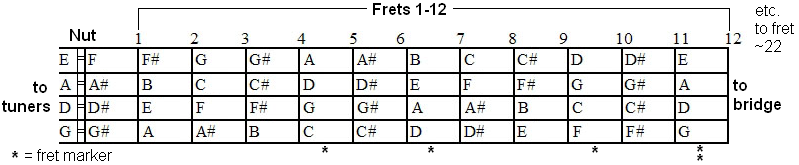
Other tunings exist, including cross-tunings, in which the usually doubled string runs are tuned to different pitches. Additionally, guitarists may sometimes tune a mandolin to mimic a portion of the intervals on a standard guitar tuning to achieve familiar fretting patterns.
Mandolin family

Soprano
The mandolin is the soprano member of the mandolin family, as the violin is the soprano member of the violin family. Like the violin, its scale length is typically about 13 in. Modern American mandolins modelled after Gibsons have a longer scale, about 13+7/8 in. The strings in each of its double-strung courses are tuned in unison, and the courses use the same tuning as the violin: G3–D4–A4–E5.
Piccolo

The piccolo or sopranino mandolin is a rare member of the family, tuned one octave above the mandola and one fourth above the mandolin (C4–G4–D5–A5); the same relation as that of the piccolo (to the western concert flute) or violino piccolo (to the violin and viola). One model was manufactured by the Lyon & Healy company under the Leland brand. A handful of modern instruments makers build piccolo mandolins.
Alto
The mandola, termed the tenor mandola in Britain and Ireland and liola or alto mandolin in continental Europe, is tuned a fifth below the mandolin, in the same relationship as that of the viola to the violin. Some also call this instrument the "alto mandola". Its scale length is typically about 16+1/2 in. It is normally tuned like a viola (perfect fifth below the mandolin) and tenor banjo: C3–G3–D4–A4.
Tenor

The octave mandolin (US and Canada), termed the octave mandola in Britain and Ireland and mandola in continental Europe, is tuned an octave below the mandolin: G2–D3–A3–E4. Its relationship to the mandolin is that of the tenor violin to the violin, or the tenor saxophone to the soprano saxophone. Octave mandolin scale length is typically about 20 in, although instruments with scales as short as 17 in or as long as 21 in are not unknown.
The instrument has a variant off the coast of South America in Trinidad, where it is known as the bandol, a flat-backed instrument with four courses, the lower two strung with metal and nylon strings.
The Irish bouzouki, though not strictly a member of the mandolin family, has a reasonable resemblance and similar range to the octave mandolin. It derives from the Greek bouzouki (a long-necked lute), constructed like a flat-backed mandolin and uses fifth-based tunings, most often G2–D3–A3–D4. Other tunings include: A2–D3–A3–D4, G2–D3–A3–E4 (an octave below the mandolin—in which case it essentially functions as an octave mandolin), G2–D3–G3–D4 or A2–D3–A3–E4. Although the Irish bouzouki's bass course pairs are most often tuned in unison, on some instruments one of each pair is replaced with a lighter string and tuned in octaves, similar to the 12-string guitar. While occupying the same range as the octave mandolin/octave mandola, the Irish bouzouki is theoretically distinguished from the former instrument by its longer scale length, typically from 24 to, although scales as long as 27 in, which is the usual Greek bouzouki scale, are not unknown. In modern usage, however, the terms "octave mandolin" and "Irish bouzouki" are often used interchangeably to refer to the same instrument.
The modern cittern may also be loosely included in an "extended" mandolin family, based on resemblance to the flat-backed mandolins, which it predates. Its own lineage dates it back to the Renaissance. It is typically a five course (ten-string) instrument having a scale length between 20 and. The instrument is most often tuned to either D2–G2–D3–A3–D4 or G2–D3–A3–D4–A4, and is essentially an octave mandola with a fifth course at either the top or the bottom of its range. Some luthiers, such as Stefan Sobell, also refer to the octave mandola or a shorter-scaled Irish bouzouki as a cittern, irrespective of whether it has four or five courses.
Other relatives of the cittern, which might also be loosely linked to the mandolins (and are sometimes tuned and played as such), include the 6-course/12-string Portuguese guitar and the 5-course/9-string waldzither.
Baritone/Bass
The mandocello is classically tuned to an octave plus a fifth below the mandolin, in the same relationship as that of the cello to the violin, its strings being tuned to C2–G2–D3–A3. Its scale length is typically about 26 in. A typical violoncello scale is 27 in.
The mandolone was a Baroque member of the mandolin family in the bass range that was surpassed by the mandocello. It was part of the Neapolitan mandolin family.
The Greek laouto or laghouto (long-necked lute) is similar to a mandocello, ordinarily tuned C3/C2–G3/G2–D3/D3–A3/A3 with half of each pair of the lower two courses being tuned an octave high on a lighter gauge string. The body is a staved bowl, the saddle-less bridge glued to the flat face like most ouds and lutes, with mechanical tuners, steel strings, and tied gut frets. Modern laoutos, as played on Crete, have the entire lower course tuned to C3, a reentrant octave above the expected low C. Its scale length is typically about 28 in.
The Algerian mandole was developed by an Italian luthier in the early 1930s, scaled up from a mandola until it reached a scale length of approximately 25 to 27 inches. It is a flatback instrument, with a wide neck and 4 courses (8 strings), 5 courses (10 strings) or 6 courses (12 strings), and is used in Algeria and Morocco. The instrument can be tuned as a guitar, oud, or mandocello, depending on the music it will be used to play and player preference. When tuning it as a guitar the strings will be tuned (E2) (E2) A2 A2 D3 D3 G3 G3 B3 B3 (E4) (E4); strings in parentheses are dropped for a five- or four-course instrument. Using a common Arabic oud tuning D2 D2 G2 G2 A2 A2 D3 D3 (G3) (G3) (C4) (C4). For a mandocello tuning using fifths C2 C2 G2 G2 D3 D3 A3 A3 (E4) (E4).
Mandobass

The mandobass is the bass version of the mandolin, just as the double bass is the bass to the violin. Like the double bass, it most frequently has four single strings, rather than double courses—and like the double bass, it is most commonly tuned to perfect fourths rather than fifths like most mandolin family instruments: E1–A1–D2–G2,. These were made by the Gibson company in the early 20th century and were never very common. A smaller scale four-string mandobass, usually tuned in fifths: G1–D2–A2–E3 (two octaves below the mandolin), though not as resonant as the larger instrument, was often preferred by players as easier to handle and more portable. Reportedly, however, most mandolin orchestras preferred to use the ordinary double bass, rather than a specialised mandolin family instrument. Calace and other Italian makers predating Gibson also made mandolin-basses.
The relatively rare eight-string mandobass, or "tremolo-bass", also exists, with double courses like the rest of the mandolin family, and is tuned either G1–D2–A2–E3, two octaves lower than the mandolin, or C1–G1–D2–A2, two octaves below the mandola.
Variations
Bowlback
Bowlback mandolins (also known as roundbacks), are used worldwide. They are most commonly manufactured in Europe, where the long history of mandolin development has created local styles. However, Japanese luthiers also make them.
Owing to the shape and to the common construction from wood strips of alternating colors, in the United States these are sometimes colloquially referred to as the "potato bug", "potato beetle", or tater-bug mandolin.{{cite book |last1=Cohen |first1=David J. |last2=Rossing |first2= Thomas D.|editor-last=Rossing |editor-first=Thomas D.
Neapolitan and Roman styles
The Neapolitan style has an almond-shaped body resembling a bowl, constructed from curved strips of wood. It usually has a bent sound table, canted in two planes with the design to take the tension of the eight metal strings arranged in four courses. A hardwood fingerboard sits on top of or is flush with the sound table. Very old instruments may use wooden tuning pegs, while newer instruments tend to use geared metal tuners. The bridge is a movable length of hardwood. A pickguard is glued below the sound hole under the strings. European roundbacks commonly use a 13 in scale instead of the 13+7/8 in common on archtop Mandolins.
Intertwined with the Neapolitan style is the Roman style mandolin, which has influenced it. The Roman mandolin had a fingerboard that was more curved and narrow. The fingerboard was lengthened over the sound hole for the E strings, the high pitched strings. The shape of the back of the neck was different, less rounded with an edge, the bridge was curved making the G strings higher. The Roman mandolin had mechanical tuning gears before the Neapolitan.
Manufacturers of Neapolitan-style mandolins
Prominent Italian manufacturers include Vinaccia (Naples), Embergher (Rome) and Calace (Naples). Other modern manufacturers include Lorenzo Lippi (Milan), Hendrik van den Broek (Netherlands), Brian Dean (Canada), Salvatore Masiello and Michele Caiazza (La Bottega del Mandolino) and Ferrara, Gabriele Pandini.
In the United States, when the bowlback was being made in numbers, Lyon and Healy was a major manufacturer, especially under the "Washburn" brand. Other American manufacturers include Martin, Vega, and Larson Brothers.
In Canada, Brian Dean has manufactured instruments in Neapolitan, Roman, German and American styles but is also known for his original 'Grand Concert' design created for American virtuoso Joseph Brent.
German manufacturers include Albert & Mueller, Dietrich, Klaus Knorr, Reinhold Seiffert and Alfred Woll. The German bowlbacks use a style developed by Seiffert, with a larger and rounder body.
Japanese brands include Kunishima and Suzuki. Other Japanese manufacturers include Oona, Kawada, Noguchi, Toichiro Ishikawa, Rokutaro Nakade, Otiai Tadao, Yoshihiko Takusari, Nokuti Makoto, Watanabe, Kanou Kadama and Ochiai.
Other bowlback styles
Another family of bowlback mandolins came from Milan and Lombardy. These mandolins are closer to the mandolino or mandore than other modern mandolins. The instruments have 6 strings, 3 wire treble-strings and 3 gut or wire-wrapped-silk bass-strings. The strings ran between the tuning pegs and a bridge that was glued to the soundboard, as a guitar's. The Lombard mandolins were tuned g–b–e′–a′–d″–g″ (shown in Helmholtz pitch notation). A developer of the Milanese style was Antonio Monzino (Milan) and his family who made them for six generations.
Samuel Adelstein described the Lombard mandolin in 1893 as wider and shorter than the Neapolitan mandolin, with a shallower back and a shorter and wider neck, with six single strings to the regular mandolin's set of 4. The Lombard was tuned C–D–A–E–B–G. The strings were fastened to the bridge like a guitar's. There were 20 frets, covering three octaves, with an additional 5 notes. When Adelstein wrote, there were no nylon strings, and the gut and single strings "do not vibrate so clearly and sweetly as the double steel string of the Neapolitan."
Brescian mandolin or Cremonese mandolin
Brescian mandolins (also known as Cremonese) that have survived in museums have four gut strings instead of six and a fixed bridge. The mandolin was tuned in fifths, like the Neapolitan mandolin. Bortolazzi said in this book that the new wire-strung mandolins were uncomfortable to play, when compared with the gut-string instruments. Also, he felt they had a "less pleasing...hard, zither-like tone" as compared to the gut string's "softer, full-singing tone." He favored the four single strings of the Cremonese instrument, which were tuned the same as the Neapolitan.
Genoese mandolin, a blend of styles
Like the Lombard mandolin, the Genoese mandolin was not tuned in fifths. Its 6 gut strings (or 6 courses of strings) were tuned as a guitar but one octave higher: e-a-d’-g’-b natural-e”. Like the Neapolitan and unlike the Lombard mandolin, the Genoese does not have the bridge glued to the soundboard, but holds the bridge on with downward tension, from strings that run between the bottom and neck of the instrument. The neck was wider than the Neapolitan mandolin's neck. The peg-head is similar to the guitar's.
Archtop
At the very end of the 19th century, a new style, with a carved top and back construction inspired by violin family instruments began to supplant the European-style bowl-back instruments in the United States. This new style is credited to mandolins designed and built by Orville Gibson, a Kalamazoo, Michigan, instrument maker who founded the "Gibson Mandolin-Guitar Manufacturing Co., Limited" in 1902. Gibson mandolins evolved into two basic styles: the Florentine or F-style, which has a decorative scroll near the neck, two points on the lower body and usually a scroll carved into the headstock; and the A-style, which is pear-shaped, has no points and usually has a simpler headstock.
These styles generally have either two f-shaped soundholes like a violin (F-5 and A-5), or a single oval sound hole (F-4 and A-4 and lower models) directly under the strings. Much variation exists between makers working from these archetypes, and other variants have become increasingly common. Generally, in the United States, Gibson F-hole F-5 mandolins and mandolins influenced by that design are strongly associated with bluegrass, while the A-style is associated with other types of music, although it too is most often used for and associated with bluegrass. The F-5's more complicated woodwork also translates into a more expensive instrument.
Internal bracing to support the top in the F-style mandolins is usually achieved with parallel tone bars, similar to the bass bar on a violin. Some makers instead employ "X-bracing", which is two tone-bars mortised together to form an X. Some luthiers now using a "modified x-bracing" that incorporates both a tone bar and X-bracing.
Numerous modern mandolin makers build instruments that largely replicate the Gibson F-5 Artist models built in the early 1920s under the supervision of Gibson acoustician Lloyd Loar. Original Loar-signed instruments are sought after and extremely valuable. Other makers from the Loar period and earlier include Lyon and Healy, Vega and Larson Brothers.
Pressed archtops
The ideal for archtops has been solid pieces of wood carved into the right shape. However, another archtop exists, the top made of laminated wood or thin sheets of solid wood, pressed into the arched shape. These have become increasingly common in the world of internationally constructed musical instruments in the 21st century.
Pressed-top instruments are made to appear the same as carved-top instruments but do not sound the same as carved-wood tops. Carved-wood tops when carved to the ideal thickness, produce the sound consumers expect. Not carving them correctly dulls the sound. The sound of a carved-wood instrument changes the longer it is played, and older instruments are sought out for their rich sound.
Laminated-wood presstops are less resonant than carved wood, the wood and glue vibrating differently than wood grain. Presstops made of solid wood have the wood's natural grain compressed, typically creating a sound that is less full than a well-made, carved-top mandolin.
Flatback
Flatback mandolins use a thin sheet of wood with bracing for the back, as a guitar uses, rather than the bowl of the bowlback or the arched back of the carved mandolins.
Like the bowlback, the flatback has a round sound hole. This has been sometimes modified to an elongated hole, called a D-hole. The body has a rounded almond shape with flat or sometimes canted soundboard.
The type was developed in Europe in the 1850s.
The bandolim is commonly used wherever the Spanish and Portuguese took it: in South America, in Brazil (Choro) and in the Philippines.
In the early 1970s English luthier Stefan Sobell developed a large-bodied, flat-backed mandolin with a carved soundboard, based on his own cittern design; this is often called a 'Celtic' mandolin.
American forms include the Army-Navy mandolin, the flatiron and the pancake mandolins.
Tone
The tone of the flatback is described as warm or mellow, suitable for folk music and smaller audiences. The instrument sound does not punch through the other players' sound like a carved top does.
Double top, double back
The double top is a feature that luthiers are experimenting with in the 21st century, to get better sound. However, mandolinists and luthiers have been experimenting with them since at least the early 1900s.
Back in the early 1900s, mandolinist Ginislao Paris approached Luigi Embergher to build custom mandolins. The sticker inside one of the four surviving instruments indicates the build was called after him, the Sistema Ginislao Paris). Paris' round-back double-top mandolins use a false back below the soundboard to create a second hollow space within the instrument.
Modern mandolinists such as Joseph Brent and Avi Avital use instruments customized, either by the luthier's choice or at the request of the player. Joseph Brent's mandolin, made by Brian Dean also uses what Brent calls a false back. Brent's mandolin was the luthier's solution to Brent's request for a loud mandolin in which the wood was clearly audible, with less metallic sound from the strings. It is made by one manufacturer in Israel, luthier Arik Kerman. Other players of Kerman mandolins include Alon Sariel, Jacob Reuven,
Others
thumb|right|The bulge on the instrument's back side is visible in this photo of a Vega cylinder-back mandolin
Mandolinetto
Other American-made variants include the mandolinetto or Howe-Orme guitar-shaped mandolin (manufactured by the Elias Howe Company between 1897 and roughly 1920), which featured a cylindrical bulge along the top from fingerboard end to tailpiece and the Vega mando-lute (more commonly called a cylinder-back mandolin manufactured by the Vega Company between 1913 and roughly 1927), which had a similar longitudinal bulge but on the back rather than the front of the instrument.
Mandolin-banjo
An instrument with a mandolin neck paired with a banjo-style body was patented by Benjamin Bradbury of Brooklyn in 1882 and given the name banjolin by John Farris in 1885. Today banjolin is sometimes reserved to describe an instrument with four strings, while the version with the four courses of double strings is called a mandolin-banjo.
Resonator mandolin
A resonator mandolin or "resophonic mandolin" is a mandolin whose sound is produced by one or more metal cones (resonators) instead of the customary wooden soundboard (mandolin top/face). Historic brands include Dobro and National.
Electric mandolin

As with almost every other contemporary chordophone, another modern variant is the electric mandolin. These mandolins can have four or five individual or double courses of strings. They were developed in the early 1930s, contemporaneous with the development of the electric guitar. They come in solid body and acoustic electric forms.
Specific instruments have been designed to overcome the mandolin's rapid decay with its plucked notes. Fender released a model in 1992 with an additional string (a high A, above the E string), a tremolo bridge and extra humbucker pickup (total of two). The result was an instrument capable of playing heavy metal style guitar riffs or violin-like passages with sustained notes that can be adjusted as with an electric guitar.
Playing traditions worldwide

|access-date = 2015-03-30 |archive-url = https://web.archive.org/web/20150402143811/http://wings.buffalo.edu/research/anthrogis/oldsite/JWA/V2N2/Dickson-art.pdf |archive-date = 2015-04-02 |url-status = dead The international repertoire of music for mandolin is almost unlimited, and musicians use it to play various types of music. This is especially true of violin music, since the mandolin has the same tuning as the violin. Following its invention and early development in Italy the mandolin spread throughout the European continent. The instrument was primarily used in a classical tradition with Mandolin orchestras, so-called Estudiantinas or in Germany Zupforchestern appearing in many cities. Following this continental popularity of the mandolin family local traditions appeared outside Europe in the Americas and in Japan. Travelling mandolin virtuosi like Carlo Curti, Giuseppe Pettine, Raffaele Calace and Silvio Ranieri contributed to the mandolin becoming a "fad" instrument in the early 20th century. Lauded across the world for his virtuosity with the instrument, he died young. Although traditionally associated with Italian, American, and bluegrass styles, the mandolin has seen renewed popularity within Celtic and British folk traditions during the 2000s and 2010s, appearing frequently in contemporary Scottish acoustic ensembles.
Notable literature
Western European classical music
The mandolin appears sporadically in the Western Euoropean classical music tradition. It was often perceived historically as a folk instrument. Significant composers did write music specifically for the mandolin, but few large works were composed for it by the most widely regarded composers. The total number of these works is rather small in comparison to—say—those composed for violin. One result of this dearth being that there were few positions for mandolinists in regular orchestras. To fill this gap in the literature, mandolin orchestras have traditionally played many arrangements of music written for regular orchestras or other ensembles. Some players have sought out contemporary composers to solicit new works.
Furthermore, of the works that have been written for mandolin from the 18th century onward, many have been lost or forgotten. Some of these await discovery in museums and libraries and archives. One example of rediscovered 18th-century music for mandolin and ensembles with mandolins is the Gimo collection, collected in the first half of 1762 by Jean Lefebure. Lefebure collected the music in Italy, and it was forgotten until manuscripts were rediscovered.
Vivaldi created some concertos for mandolinos and orchestra: one for 4-chord mandolino, string bass & continuo in C major, (RV 425), and one for two 5-chord mandolinos, bass strings & continuo in G major, (RV 532), and concerto for two mandolins, 2 violons "in Tromba"—2 flûtes à bec, 2 salmoe, 2 théorbes, violoncelle, cordes et basse continuein in C major (p. 16).
Beethoven composed mandolin music and enjoyed playing the mandolin. His 4 small pieces date from 1796: Sonatine WoO 43a; Adagio ma non troppo WoO 43b; Sonatine WoO 44a and Andante con Variazioni WoO 44b.
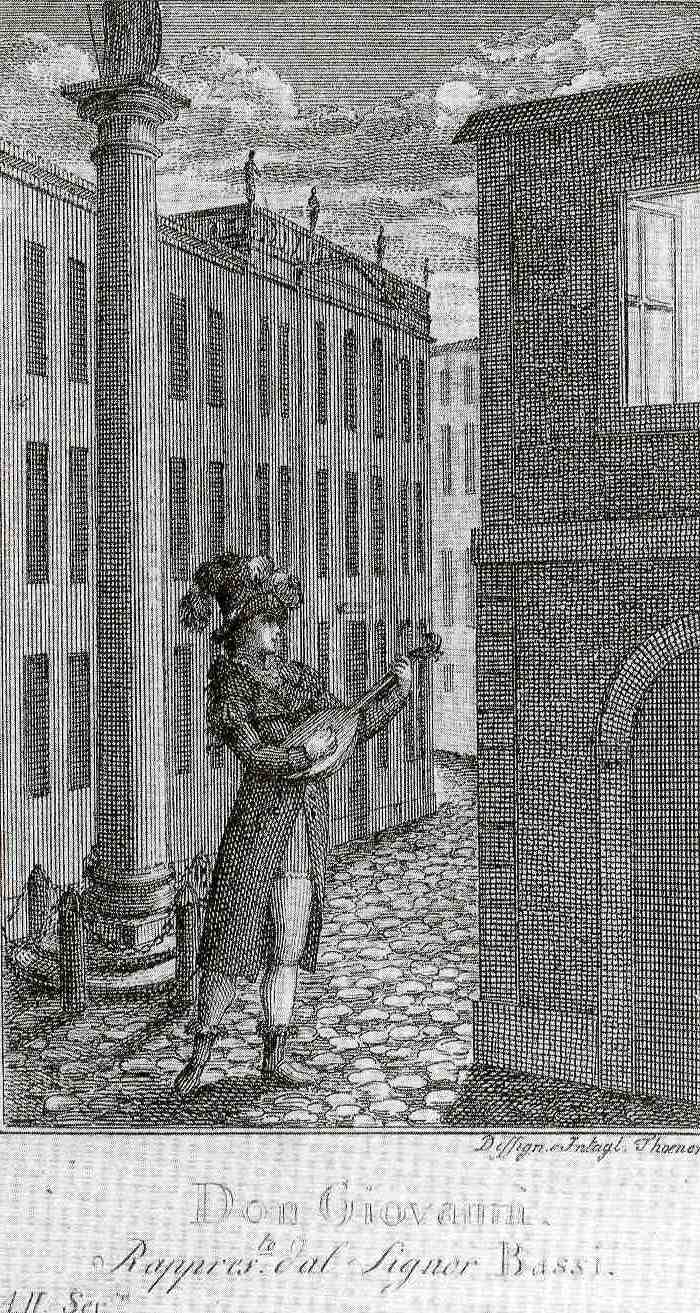
The opera Don Giovanni by Mozart (1787) includes mandolin parts, including the accompaniment to the famous aria Deh vieni alla finestra, and Verdi's opera Otello calls for guzla accompaniment in the aria Dove guardi splendono raggi, but the part is commonly performed on mandolin.
Gustav Mahler used the mandolin in his Symphony No. 7, Symphony No. 8 and Das Lied von der Erde.
Parts for mandolin are included in works by Schoenberg (Variations Op. 31), Stravinsky (Agon), Prokofiev (Romeo and Juliet) and Webern (opus Parts 10)
Some 20th-century composers also used the mandolin as their instrument of choice (amongst these are: Schoenberg, Webern, Stravinsky and Prokofiev).
Among the most important European mandolin composers of the 20th century are Raffaele Calace (composer, performer and luthier) and Giuseppe Anedda (virtuoso concert pianist and professor of the first chair of the Conservatory of Italian Mandolin, Padua, 1975). Today representatives of Italian classical music and Italian classical-contemporary music include Ugo Orlandi, Carlo Aonzo, Dorina Frati, Mauro Squillante and Duilio Galfetti.
Japanese composers also produced orchestral music for mandolin in the 20th century, but these are not well known outside Japan. Notable composers include Morishige Takei and Yasuo Kuwahara. | access-date=2021-11-30}}
Traditional mandolin orchestras remain especially popular in Japan and Germany, but also exist throughout the United States, Europe and the rest of the world. They perform works composed for mandolin family instruments, or re-orchestrations of traditional pieces. The structure of a contemporary traditional mandolin orchestra consists of: first and second mandolins, mandolas (either octave mandolas, tuned an octave below the mandolin, or tenor mandolas, tuned like the viola), mandocellos (tuned like the cello), and bass instruments (conventional string bass or, rarely, mandobasses). Smaller ensembles, such as quartets composed of two mandolins, mandola, and mandocello, may also be found.
Unaccompanied solo
-
Niccolò Paganini :Minuet
-
John Peterson : Moving Fast Through Autumn Light (2000)
-
Larry Sitsky : The Three Names Of Shiva (1992)
-
Silvio Ranieri :Variations on a Theme by Haydn :Song of summer
-
Eric Gross : Cadenza No.1 : Cadenza No.2 : Cadenza No.3 : Cadenza No.4 : Cadenza No.5 : Cadenza No.6 : Cadenza No.7 : Cadenza No.8 : Cadenza No.10 : Cadenza No.11
-
Raffaele Calace :Prelude No. 1 :Prelude No. 2 :Prelude No. 3 :Prelude No. 5 :Prelude No. 10 :Prelude No. 11 :Prelude No. 14 :Prelude No. 15 :Large prelude :Collard :Sylvia :Minuet of rose
-
Heinrich Koniettsuni :Partita No. 1, etc.
-
Herbert Baumann :Sonatine, etc.
-
Siegfried Behrend :Sense – structure
-
John Craton :The Gray Wolf :Perpetuum Mobile :Variations from Der Fluyten Lust-hof
-
Sakutarō Hagiwara :Hataoriru maiden
-
Takei Shusei :Spring to go
-
Seiichi Suzuki :Variations on Schubert lullaby :City of Elm :Variations on Kojonotsuki of subject matter
-
Gilad Hochman :Two Episodes for solo mandolin
-
Jiro Nakano :"Spring has come" Variations :Prayer :Fantasia second No. :Serenata :Beautiful my child and where :Prayer of the evening :Variations on September Affair of the subject matter
-
Makino YukariTaka :Spring snow of ballads
-
Jo Kondo :In early spring
-
Takashi Kubota :Nocturne :Etude :Fantasia first No.
-
Yasuo Kuwahara :Moon and mountain witch :Impromptu :Winter Light :Mukyu motion :Jon-gara :Silent door
Accompaniment with solo
-
Ludwig van Beethoven :Sonatine in C minor, WoO 43a :Adagio in E major WoO 43b :Sonatine in C major WoO 44a :Andante and Variations in D major WoO 44b
-
John Craton :Dioces aztecas :The Legend of Princess Noccalula
-
Giovanni Hoffmann : 4 Quartet for Mandolin, Violin, Viola, and Lute : 4 Divertimenti for Mandolin, Violin & B.c.
-
Johann Nepomuk Hummel :Sonata in C major Op. 35
-
Vittorio Monti :Csárdás
-
Carlo Munier :Spanish Capriccio :Mazurka for concert :Waltz for concert :Bizaria :Aria Varia data :Mandolin Concerto No. 1
-
Raffaele Calace :Mandolin Concerto No. 1 :Mandolin Concerto No. 2 :Mukyu motion :Tarantella :Song of Nostalgia :Elegy :Mazurka for concert
-
Silvio Ranieri :Warsaw of memories
-
Enrico Marcelli :Gypsy style Capriccio :Fantastic Waltz :Mukyu motion :Polonaise for concert
-
Hans Gál :Divertimento for mandolin and harp :Such as a duo for the mandolin and guitar
-
Norbert Shupuronguru :Serenade for mandolin and guitar
-
Franco Marugora :Grand Sonata for mandolin and guitar
-
Kurt Schwaen :Slovenia wind Dances such as
-
Dietrich Erdmann :Sonatine
-
Mari Takano :Light of silence
-
Rikuya Terashima :Sonata for mandolin and piano (2002)
Duo and musical ensemble
A duet or duo is a musical composition for two performers in which the performers have equal importance to the piece. A musical ensemble with more than two solo instruments or voices is called trio, quartet, quintet, sextet, septet, octet, etc.
-
Ella Von Adajewska-Schultz (1846–1926) :Venezuelan Serenade
-
Valentine Abt (1873–1942) :In Venice Waters
-
Charles Acton :Chants Des Gondoliers
-
Hermann Ambrosius :Duo
-
Emanuele Barbella :Sonata in D major for Mandolin and Basso Continuo
-
Ignazio Bitelli (c. 1880–1956) :L'Albero di Natale, pastorale for mandolin & guitar :Il Gondoliere, valse for 2 mandolins & guitar
-
Costantino Bertucci :Il Carnevale Di Venezia Con Variazioni
-
Pietro Gaetano Boni (1686–1741) :Sonate pour mandoline en la, Op. 2 n° 1 :Sonate pour mandoline en ré mineur, Op. 2 n° 2 :Sonate pour mandoline en ré, Op. 2 n° 9
-
Antonio Del Buono :"In Gondola" Serenata Veneziana "Ai Mandolnisti Di Venezia
-
Raffaele Calace :Barcarola Op. 100 Per Chitarra :Barcarola Op. 116 Per Liuto "A Mio Figlio Peppino"
-
Gioacchino Cocchi :* Sinfonia for 2 Mandolins & Continuo, (Gimo 76)
-
Jules Cottin :Au Fil De L'Eau
-
John Craton :Charon Crossing the Styx (mandolin & double bass) :Four Whimsies (mandolin & octave mandolin) :Les gravures de Gustave Doré (mandolin & guitar) :Six Pantomimes for Two Mandolins :Sonatina No. 3 for Mandolin & Violin
-
Hans Gál :Op. 59a Sonatina for 2 mandolins (1952)
-
Eric Gross : Hooperisms Op.181 (1991)
-
Eric Gross : Barbara and Deborah Op.175 (1990)
-
Eric Gross : Three Mandolin Duets Op.282 (2005)
-
Eric Gross : Paul and Adrian Op.165(1989)
-
Giovani Battista Gervasio :Sonata for Mandolin & Continuo (Gimo 141) :Sonata per camera (Gimo 143) :Sinfonia for 2 Mandolins & Continuo, (Gimo 149) :Trio for 2 Mandolins & Continuo, (Gimo 150) :Sonata in D major for Mandolin and Basso Continuo :Sonata in G major for Mandolin and Basso Continuo
-
Giuseppe Giuliano :Sonata in D major for Mandolin and Basso Continuo
-
Geoffrey Gordon :Interiors of a Courtyard (mandolin & guitar)
-
Addiego Guerra :Sonata in G major for Mandolin and Basso Continuo
-
Positive Hattori :Concerto for two mandolin and piano
-
Sean Hickey :Mandolin Canons (mandolin & guitar)
-
Giovanni Hoffmann : 3 Duets for Mandolin and Violin : Serenade for Viola and Mandolin
-
Tyler Kaier :Den lille Havfrue (mandolin & guitar)
-
Peter Machajdík :Mit den Augen eines Falken for mandolin & guitar (2016)
-
Giovanni Battista Maldura :Barcarola Veneziana Di Mendelssohn
-
Edward Mezzacapo (1832–1898) :Le Chant Du Gondolier
-
Heinrich Molbe (1835–1915) :Gondolata Op. 74 Per Mandolino, Clarinetto E Pianoforte
-
Carlo Munier (1859–1911) :"In Gondola" Ricordi di Mendelssohn :Notturno Veneziano Per Quartetto Romantico
-
Jiro Nakano :Medaka, revolving lantern
-
John Peterson : Wired Life (1999)
-
Giuseppe Pettine (1874–1966) :Barcarola Per Mandolino
-
Hideo Saito, Jiro Nakano :Du edge Martino
-
Domenico Scarlatti :Sonata in D minor (K77) :Sonata in E minor (K81) :Sonata in G minor (K88) :Sonata No. 54 (K. 89) in D minor for Mandolin and Basso Continuo :Sonata in D minor (K89) :Sonata in D minor (K90) :Sonata in G (K91)
-
Mari Takano :Silent Light for mandolin & harpsichord (2001) :Two Pieces for Two Mandolins (2002)
-
Sergeij Taneev (1856–1913) :Venezia Di Notte, Barcarola Op. 9 No. 1 :Serenata Per Voce, Mandolino E Pianoforte Op. 9 No. 2 Alla Contessa Tat'jana L'vovna Tolstaja
-
Roberto Valentini (1674–1747) :Sonate pour mandoline en la, Op. 12 n° 1 :Sonate pour mandoline en ré mineur, Op. 12 n° 2 :Sonate pour mandoline en sol, Op. 12 n° 3 :Sonate pour mandoline en sol mineur, Op. 12 n° 4 :Sonate pour mandoline en mi mineur, Op. 12 n° 5 :Sonate pour mandoline en ré, Op. 12 n° 6
Concerto
Concerto: a musical composition generally composed of three movements, in which, usually, one solo instrument (for instance, a piano, violin, cello or flute) is accompanied by an orchestra or concert band.
-
Anna Clyne : Three Sisters, for mandolin and chamber orchestra
-
Eric Gross : Concerto for Mandolin and Chamber Orchestra Op.141 (1984) : Concerto No. 2 Op.151 (1986)
-
Larry Sitsky : Zohar, Sephardic Concerto (1998)
-
Jane Stanley : The Spirit's Lay Concerto for Mandolin and Orchestra (2000)
-
Caroline Szeto : Concerto For Mandolin and Chamber Orchestra (1998)
-
Giovanni Hoffmann : Concerto for Mandolin and Orchestra in D Major
-
Antonio Vivaldi :Mandolin Concerto in C major, :Concerto for two mandolinos in G major :Concerto for two mandolinos, 2 violons " in Tromba"—2 flûtes à bec, 2 salmoe, 2 théorbes, violoncelle, cordes et basse continuein in C major
-
Francisco Rodrigo Arto (Venezuela) :Mandolin Concerto (1984)
-
Dominico Caudioso :Mandolin Concerto in G Major
-
John Craton :Mandolin Concerto No. 1 in D Minor :Mandolin Concerto No. 2 in D Major :Mandolin Concerto No. 3 in E Minor :Mandolin Concerto No. 4 in G Major :Concerto for Two Mandolins ("Rromane Bjavela")
-
Gerardo Enrique Dirié (Argentina) :Los ocho puentes for four recorders, mandolin and percussion (1984)
-
Johann Adolph Hasse :Mandolin Concerto in G major
-
Leopold Kozeluch :Concerto for piano, mandolin, trumpet and double bass in E major
-
Giovanni Battista Pergolesi :Mandolin Concerto in B major
-
Giovanni Paisiello :Mandolin Concerto in E major :Mandolin Concerto in C major :Mandolin Concerto in G major
-
Johann Nepomuk Hummel :Mandolin Concerto in G major
-
Armin Kaufmann :Mandolin Concerto
-
Dietrich Erdmann :Mandolin Concerto
-
Herbert Baumann :Mandolin and the Concerto for Strings
-
Brian Israel (1951–1986) :Concerto for Mandolin (1985) :Sonatinetta (1984) :Surrealistic Serenade (1985)
-
Makino YukariTaka :Mandolin Concerto
-
Julian Dawes :Mandolin and the Concerto for Strings
-
Tanaka Ken :"Arc" for mandolin and orchestra
-
Vladimir Kororutsuku :Suite "positive and negative"
-
Avner Dorman :Mandolin Concerto
-
Gilad Hochman :"Nedudim" ("Wanderings") Fantasia-Concertante for mandolin and string orchestra (2014)
Mandolin in the orchestra
Orchestral works in which the mandolin has a limited part.
-
Domenico Cimarosa :Opera La finta parigina
-
John Craton :Opera The Curious Affair of the Count of Monte Blotto
-
Michel Corrette :Concerto for orchestra 25 Concertos Comiques: Concerto nr 24 in C major "La Marche du Huron"
-
Jonathan Dove :Opera "The Adventures of Pinocchio" (2007)
-
Lukas Foss :Symphony No. 2 "Symphony Of Chorales" (1958)
-
André Grétry : L'Amant jaloux (Paris, 1778)
-
George Frideric Handel :Oratorio Alexander Balus
-
György Ligeti :Opera Le Grand Macabre
-
Bruno Maderna :Opera Don Perlimplin, ovvero il trionfo dell'amore e dell'immaginazione :Violin concerto (1969) :Suite aus der Oper "Hyperion" (1969–1970) :"Amanda"/Serenata VI :"Composizione in tre tempi"
-
Gustav Mahler :Symphony No. 7, Song of the Night :Symphony No. 8, Symphony of Thousands :Symphony Song of the Earth
-
Wolfgang Amadeus Mozart :Opera Don Giovanni
-
Giovanni Paisiello :The Barber of Seville
-
Willem Pijper :Opera Halewijn :Romance sans paroles :Symphony No. 2 :Symphony No. 3
-
Sergei Prokofiev :Ballet music Romeo and Juliet
-
Ottorino Respighi :Symphonic poem Festivals of Rome
-
Antonio Salieri :Tarare (Paris, 1787)
-
Rodion Shchedrin :Ballet music Anna Karenina
-
Arnold Schoenberg :Opera Moses und Aron :Variations for Orchestra
-
Niccola Spinelli : Opera A Basso Porto: Intermezzo for mandolins and orchestra
-
Igor Stravinsky :Ballet music Agon
-
Giuseppe Verdi :Opera Otello
-
Antonio Vivaldi :Oratorio Juditha triumphans
-
Anton Webern :Five Pieces for Orchestra
References
References
- Mendívil, J. (2010). Yo soy el huayno: el huayno peruano como confluencia de lo indígena con lo hispano y lo moderno. A tres bandas. Mestizaje, sincretismo e hibridación en el espacio sonoro iberoamericano, 37–46.
- De Souza Pacheco, J. A. (2022). La construcción de lo andino en el imaginario musical fusión de la banda El Polen en la Lima cosmopolita de la década de 1970.
- Auqui Solis, Marlene. "Las agrupaciones en el Perú". [[National University of Education Enrique Guzmán y Valle]].
- Dave Hynds. "Mandolins: A Brief History".
- ''Musical Instruments: A Comprehensive Dictionary'', by Sibyl Marcuse (Corrected Edition 1975)
- ''The New Grove Dictionary of Music and Musicians, Second Edition'', edited by Stanley Sadie and others (2001)
- {{harvnb. Sparks. 2003
- Roger Vetter. "Mandolin – Neapolitan".
- . (April 20, 2012). ["OM floating bridge?"](http://www.mandolincafe.com/forum/showthread.php?84748-OM-floating-bridge).
- {{harvnb. McDonald. 2008
- {{Cite EB1911. Schlesinger. Kathleen
- (May 3, 2010). "Radiused vs. flat fingerboard on mandolin?".
- Siminoff, Roger H.. (2002). "The Luthier's Handbook". Hal Leonard Corporation.
- Lise Winer. (16 January 2009). "Dictionary of the English/Creole of Trinidad & Tobago: On Historical Principles". McGill-Queen's Press – MQUP.
- Bendamèche, Abdelkader. (25 July 2014). "Mr Abdelkader Bendamèche répond à l'APS au sujet du mandole (Translation: Mr Abdelkader Bendamèche responds to the APS about the mandola)".
- Richards, Tobe A.. "The Musician's Workbook VI, Fretted Instrument Octave Designation Diagram & Charts".
- Parfitt, David. "Arab tuning".
- . ["Thomann Algerian Mondol 10 Standard"](https://www.thomannmusic.com/thomann_algerian_mondol_10_standard.htm#bewertung).
- Ruppa, Paul. "''American Mando-Bass History 101''".
- Marcuse, Sibyl; Musical Instruments: A Comprehensive Dictionary; W. W. Norton & Company (1975). (see entries for ''mandolin'', and for individual mandolin family members.)
- Johnson, J. R.; 'The Mandolin Orchestra in America, Part 3: Other Instruments', ''American Lutherie'', No. 21 (Spring) 1990, pp. 45–46.
- {{harvnb. Tyler. Sparks. 1996
- {{harvnb. Sparks. 2003
- {{harvnb. Tyler. Sparks. 1989
- {{harvnb. Sparks. 2003
- (2004). "The Embergher mandolin". R. Leenen and B. Pratt.
- "Mandolin Glossary".
- "Who are the top classical builders?".
- (21 April 2019). "The Latest from the Shop".
- "Grand Concert".
- "Mandolin (neapolitan, Round Back, Bowl Back...)".
- "Japanese Mandolin Makers".
- Dossena, Luigi. (7 September 2014). "Historia et imago Cremae. La vita di Giovanni Vailati, il Paganini del mandolino: dai caffè cremaschi ai teatri d'Europa [translation: Historia et imago Cremae. The life of Giovanni Vailati, the Paganini of the mandolin: from the cremaschi cafés to the theaters of Europe]".
- "Milanese Mandolin Makers".
- Sparks. 2003
- {{harvnb. Adelstein. 1893
- "Thread: Plans of Brescian mandolin...".
- Bortolazzi, Bartolomeo. (1805). "Anweisung die Mandoline von selbst zu erlernen nebst einigen Uebungsstucken von Bortolazzi". Breitkopf and Härtell.
- {{harvnb. Sparks. 2003
- (1997). "Musical Instruments of the World". Sterling Publishing Company, Inc..
- . ["Mandolin,19th century Italian"](https://www.metmuseum.org/art/collection/search/180013407). *Metropolitan Museum of Art*.
- {{harvnb. McDonald. 2008
- McDonald. 2008
- "Stefan Sobell Guitars » Mandolins and Mandola".
- {{harvnb. McDonald. 2008
- . (20 November 2011). ["Joseph Brent's Brian N. Dean Grand Concert Mandolin"](https://www.mandolincafe.com/news/publish/printer_1420.shtml).
- Speranski, Victor. (November 2014). "The Russian Embergher".
- "Re: Avi Avital and the Arik Kerman mandolin".
- . (20 November 2011). ["Joseph Brent's Brian N. Dean Grand Concert Mandolin"](https://www.mandolincafe.com/news/publish/printer_1420.shtml).
- "Thread: Avi Avital and the Arik Kerman mandolin".
- "Alon Sariel interview".
- "Instrumentarium".
- "Concert artists: Tom Cohen".
- "The Irish Tenor Banjo by Don Meade".
- "Heavy Metal Electric Mandolin, inventions".
- Tsioulcas, Anastasia. (2014-09-25). "Remembering Mandolin Hero U. Srinivas". NPR.
- Martin, Douglas. (2014-10-01). "U. Shrinivas, 45, Indian Mandolin Virtuoso With Global Reach, Dies". The New York Times.
- Henderson, Mark. (2019). "Acoustic Revival: The Mandolin in Modern Folk".
- (2002). "The Gimo Music Collection".
- "Gamut Musical Strings Home Page".
- "DawgTab". Mandozine.com.
- (December 2007). "Orchestral and Chamber Excerpts by Joseph Brent". Lulu.
- . (February 28, 2015). ["Work list"](http://gregorio.jp/terashima/composition.html).
- Sandberg, Eric. "The Gimo Music Collection".
- "Gimo-Samling: 18Th Century Sonatas & Trio Sonatas". [[Centaur Records]].
- Braunstein, Joseph. (1969). "Mandolin Music, Beethoven, Hummel". [[Nonesuch Records]].
This article was imported from Wikipedia and is available under the Creative Commons Attribution-ShareAlike 4.0 License. Content has been adapted to SurfDoc format. Original contributors can be found on the article history page.
Ask Mako anything about Mandolin — get instant answers, deeper analysis, and related topics.
Research with MakoFree with your Surf account
Create a free account to save articles, ask Mako questions, and organize your research.
Sign up freeThis content may have been generated or modified by AI. CloudSurf Software LLC is not responsible for the accuracy, completeness, or reliability of AI-generated content. Always verify important information from primary sources.
Report