From Surf Wiki (app.surf) — the open knowledge base
Mandi (food)
Yemeni chicken or lamb dish

Yemeni chicken or lamb dish
| Field | Value |
|---|---|
| name | Mandi |
| image | Chicken Mandi Rice مندي دجاج.JPG |
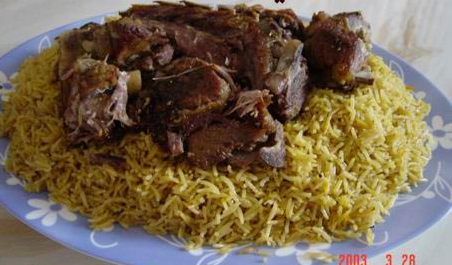
| caption | Chicken mandi |
| region | Hadhramaut |
| course | Lunch or dinner |
| main_ingredient | Rice, meat (lamb or chicken), saffron and a mixture of Hawaij |
| place_of_origin | Yemen |

Mandi () is an Arab traditional dish that originated from the Hadhramaut region in Yemen. It consists mainly of meat and rice with a blend of spices, and is cooked in a pit. It is consumed in most areas of the Arabian Peninsula and also found in Egypt, Hyderabad Deccan (where many people of Yemeni descent live), the Levant, Turkey, Kerala and Southeast Asia.

Etymology
The word "mandi" comes from the Arabic word "nada" (ندى), meaning "dew", and reflects the moist 'dewy' texture of the meat.
Technique
Mandi was usually made from rice, meat (lamb, camel, goat or chicken), and a mixture of spices called hawaij. The main technique that differentiates mandi from other meat dishes is that the meat is cooked in the tannour.
Dry wood (traditionally samer or gadha) is placed in the tandoor and burned to generate heat turning the wood into charcoal.
The meat is then boiled with whole spices until tender, and the spiced stock is then used to cook the basmati rice at the bottom of the tandoor. The meat is suspended inside the tandoor above the rice and without touching the charcoal. After that, the whole tandoor is then closed with clay for up to eight hours.
Regional variations and popularity
Mandi has transcended its Yemeni roots and is now popular in many parts of the Arabian Peninsula, including Saudi Arabia, the UAE, and Egypt. It is also eaten in regions such as the Levant, Turkey, and South Asia, where it is known as "kuzhi mandi" in Kerala, India. Each region often incorporates local spices and cooking methods, leading to unique interpretations of the dish.
In Yemen, mandi is traditionally served on large communal platters and often accompanied by a tangy tomato sauce, known as zahawig in Yemen or dakoos in Saudi Arabia, which enhances the dish's flavors. Salatah, a fresh vegetable salad, is also commonly served alongside mandi, providing a contrast to the flavors of the meat and rice.
References
References
- "Chicken Mandi | Unilever Food Solutions".
- Salloum, Habeeb. (2012-02-28). "Arabian Nights Cookbook: From Lamb Kebabs to Baba Ghanouj, Delicious Homestyle Arabian Cooking". Tuttle Publishing.
- (11 July 2013). "Mandi on my mind".
- (31 July 2024). "Chicken Mandi".
- (18 June 2023). "Mandi: Origin Of The Rice And Meat Delicacy From Yemeni Culture".
This article was imported from Wikipedia and is available under the Creative Commons Attribution-ShareAlike 4.0 License. Content has been adapted to SurfDoc format. Original contributors can be found on the article history page.
Ask Mako anything about Mandi (food) — get instant answers, deeper analysis, and related topics.
Research with MakoFree with your Surf account
Create a free account to save articles, ask Mako questions, and organize your research.
Sign up freeThis content may have been generated or modified by AI. CloudSurf Software LLC is not responsible for the accuracy, completeness, or reliability of AI-generated content. Always verify important information from primary sources.
Report