From Surf Wiki (app.surf) — the open knowledge base
Manchu alphabet
Alphabet used to write the Manchu language
Alphabet used to write the Manchu language
| Field | Value | |
|---|---|---|
| name | Manchu script | |
| altname | ||
| *manju hergen* | ||
| languages | Manchu | |
| Xibe | ||
| type | Alphabet | |
| fam1 | Egyptian hieroglyphs | |
| fam2 | Proto-Sinaitic alphabet | |
| fam3 | Phoenician alphabet | |
| fam4 | Aramaic alphabet | |
| fam5 | Syriac alphabet | |
| fam6 | Sogdian alphabet | |
| fam7 | Old Uyghur alphabet | |
| fam8 | Mongolian script | |
| children | {{Plainlist | |
| sample | Harvard drs 45809275 正紅旗奏摺檔 v.37.pdf | |
| caption | 18th-century manuscript | |
| imagesize | 250px | |
| iso15924 | Mong |
manju hergen Xibe
- Dagur alphabet
- Xibe alphabet
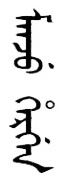
The Manchu alphabet () is the alphabet used to write the now critically endangered Manchu language. A similar script called Xibe script is used today by the Xibe people, whose language is considered either a dialect of Manchu or a closely related, mutually intelligible language. It is written vertically from top to bottom, with columns proceeding from left to right.
History
''Tongki fuka akū hergen''
The Jurchens of a millennium ago became the ancestors of the Manchus when Nurhaci united the Jianzhou Jurchens (1593–1618) and his son subsequently renamed the consolidated tribes as the "Manchu". Throughout this period, the Jurchen language evolved into what we know as the Manchu language. The Jurchen script has no relation to the Manchu alphabet, as it was derived from the Khitan script, itself derived from Chinese characters. After the collapse of the Jin dynasty, the Jurchen script fell into disuse.
According to the ** (; ), in 1599 the Jurchen leader Nurhaci decided to convert the Mongolian alphabet to make it suitable for the Manchu people. He decried the fact that while illiterate Han Chinese and Mongolians could understand their respective languages when read aloud, that was not the case for the Manchus, whose documents were recorded by Mongolian scribes. Overriding the objections of two advisors named Erdeni and G'ag'ai, he is credited with adapting the Mongolian script to Manchu. The resulting script was known as mnc () — the "script without dots and circles".
''Tongki fuka sindaha hergen''
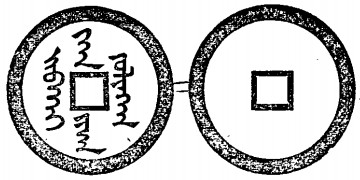
In 1632, Dahai added diacritical marks to clear up a lot of the ambiguity present in the original Mongolian script; for instance, a leading k, g, and h are distinguished by the placement of no diacritical mark, a dot, and a circle, respectively. This revision created the standard script, known as tongki fuka sindaha hergen () — the "script with dots and circles". As a result, the Manchu alphabet contains little ambiguity. Recently discovered manuscripts from the 1620s make clear, however, that the addition of dots and circles to Manchu script began before their supposed introduction by Dahai.
Dahai also added the tulergi hergen ("foreign/outer letters"): ten graphemes to facilitate Manchu to be used to write Chinese, Sanskrit, and Tibetan loanwords. Previously, these non-Manchu sounds did not have corresponding letters in Manchu. Sounds that were transliterated included the aspirated sounds k' (Chinese pinyin: k, ), k (g, ), x (h, ); ts' (c, ); ts (ci, ); sy (si, ); dz (z, ); c'y (chi, ); j'y (zhi, ); and ž (r, ).
19th century – present
By the middle of the nineteenth century, there were three styles of writing Manchu in use: standard script (ginggulere hergen), semi-cursive script (gidara hergen), and cursive script (lasihire hergen). Semicursive script had less spacing between the letters, and cursive script had rounded tails.
The Manchu alphabet was also used to write Chinese. The way in which this was done is explained in Manchu: a Textbook for Reading Documents, which has a comparative table of romanizations of Chinese syllables written in Manchu letters, Hànyǔ Pīnyīn and Wade–Giles. Using the Manchu script to transliterate Chinese words is a source of loanwords for the Xibe language. Several Chinese-Manchu dictionaries contain Chinese characters transliterated with Manchu script. The Manchu versions of the Thousand Character Classic and Dream of the Red Chamber are actually the Manchu transcription of all the Chinese characters.
In the Imperial Liao-Jin-Yuan Three Histories National Language Explanation (欽定遼金元三史國語解 zh) commissioned by the Qianlong Emperor, the Manchu alphabet is used to write Evenki (Solon) words. In the Pentaglot Dictionary, also commissioned by the Qianlong Emperor, the Manchu alphabet is used to transcribe Tibetan and Chagatai (related to Uyghur) words.
Alphabet
| Characters | Transliteration | Notes | isolated | initial | medial | final | Vowels | Consonants | ||||
|---|---|---|---|---|---|---|---|---|---|---|---|---|
| Mong | A second final form is used after mnc ( mnc) and mnc ( mnc). | |||||||||||
| Mong | A second final form is used after mnc ( mnc) and mnc ( mnc). | |||||||||||
| The undotted medial form is used after mnc and before mnc and mnc. | ||||||||||||
| Mong | The second isolated form serves as genitive case marker. | |||||||||||
| Mong | The bow-less final form is used in single-syllable words only. | |||||||||||
| Mong | The dotless medial form is used after mnc. | |||||||||||
| dotted | ||||||||||||
| Mong | Denotes *Mong* after *Mong* [qʰ], *Mong* [q], *Mong* [χ]. | |||||||||||
| Mong | Used in Chinese loanwords. | |||||||||||
| Mong | Used in Chinese loanwords. | |||||||||||
| — | Mong | The dotted form is used before vowels; undotted form before consonants. | ||||||||||
| — | — | Mong | The medial form is used before consonants. | |||||||||
| — | Mong | The undotted medial form is used before *Mong*; dotted form before consonants. | ||||||||||
| [[File:Mongolian letter manchu Ka (isolated form).svg | frameless | upright=0.12]] | font-size=1.6em}}-- | Mong | Initial and medial forms are used before *Mong*. | |||||||
| — | — | Mong | Used before *Mong*. | |||||||||
| [[File:Mongolian letter sibe Ga (isolated form).svg | frameless | upright=0.12]] | font-size=1.6em}}-- | [[File:Mongolian letter sibe Ga (isolated form).svg | frameless | upright=0.12]] | font-size=1.6em}}-- | — | Mong | Used before *Mong*. | ||
| — | — | Mong | Used before *Mong*. | |||||||||
| [[File:Mongolian letter sibe Ha (isolated form).svg | frameless | upright=0.12]] | font-size=1.6em}}-- | [[File:Mongolian letter sibe Ha (isolated form).svg | frameless | upright=0.12]] | font-size=1.6em}}-- | — | Mong | Used before *Mong*. | ||
| — | Mong | |||||||||||
| — | — | Mong | ||||||||||
| — | Mong , before | |||||||||||
| — | — | Mong , before | ||||||||||
| — | — | Mong | ||||||||||
| — | Medial form is used before consonants. | |||||||||||
| — | Used before *Mong*. | |||||||||||
| — | — | Mong | ||||||||||
| Used before *Mong*. | ||||||||||||
| — | Mong | Initial and final forms usually exist in foreign words. | ||||||||||
| — | Mong | |||||||||||
| — | — | Mong , before | ||||||||||
| — | — | Mong , before | ||||||||||
| — | — | Mong | ||||||||||
| — | Mong | Initial and final forms exist mostly in foreign words. | ||||||||||
| — | — | Mong | First initial and medial forms are used before *Mong*; | |||||||||
| — | — | Mong , - | ||||||||||
| — | — | Mong | Used for Chinese k [kʰ]. Used before *Mong*. | |||||||||
| — | — | Mong | Used for Chinese g [k]. Used before *Mong*. | |||||||||
| — | — | Mong | Used in Chinese h [x]. Used before *Mong*. | |||||||||
| — | — | Mong | Used in Chinese c [t͡sʰ]. | |||||||||
| — | Mong | Used in Chinese z [t͡s]. | ||||||||||
| — | — | Mong | Used in Chinese r [ʐ]. | |||||||||
| — | — | Mong | Used in Chinese ch [tʂʰ] and chi/c'y [tʂʰɨ] | |||||||||
| — | Mong | Used in Chinese zh [tʂ] and zhi/j'y [tʂɨ] |
Method of teaching
Despite its alphabetic nature, the Manchu "alphabet" was traditionally taught as a syllabary to reflect its phonotactics. Manchu children were taught to memorize the shapes of all the syllables in the language separately as they learned to write and say right away "la, lo", etc., instead of saying "l, a — la"; "l, o — lo"; etc. As a result, the syllables contained in their syllabary do not contain all possible combinations that can be formed with their letters. They made, for instance, no such use of the consonants l, m, n and r as English; hence if the Manchu letters s, m, a, r and t were joined in that order, a Manchu would not pronounce them as "smart".
Today, it is still divided among experts on whether the Manchu script is alphabetic or syllabic. In China, it is considered syllabic, and Manchu is still taught in this manner, while in the West it is treated like an alphabet. The alphabetic approach is used mainly by foreigners who want to learn the language, as studying the Manchu script as a syllabary takes longer.
Twelve ''uju''
The syllables in Manchu are divided into twelve categories called uju (literally "head") based on their syllabic codas (final phonemes). Here lists the names of the twelve uju in their traditional order:a, ai, ar, an, ang, ak, as, at, ab, ao, al, am.Each uju contains syllables ending in the coda of its name. Hence, Manchu only allows nine final consonants for its closed syllables, otherwise a syllable is open with a monophthong (a uju) or a diphthong (ai uju and ao uju).The syllables in an uju are further sorted and grouped into three or two according to their similarities in pronunciation and shape. For example, a uju arranges its 131 licit syllables in the following order:a, e, i; o, u, ū; na, ne, ni; no, nu, nū;
ka, ga, ha; ko, go, ho; kū, gū, hū;
ba, be, bi; bo, bu, bū; pa, pe, pi; po, pu, pū;
sa, se, si; so, su, sū; ša, še, ši; šo, šu, šū;
ta, da; te, de; ti, di; to, do; tu, du;
la, le, li; lo, lu, lū; ma, me, mi; mo, mu, mū;
ca, ce, ci; co, cu, cū; ja, je, ji; jo, ju, jū; ya, ye; yo, yu, yū;
ke, ge, he; ki, gi, hi; ku, gu, hu; k'a, g'a, h'a; k'o, g'o, h'o;
ra, re, ri; ro, ru, rū;
fa, fe, fi; fo, fu, fū; wa, we;
ts'a, ts'e, ts; ts'o, ts'u; dza, dze, dzi, dzo, dzu;
ža, že, ži; žo, žu; sy, c'y, jy.In general, while syllables in the same row resemble each other phonetically and visually, syllables in the same group (as the semicolons separate) bear greater similarities.
Punctuation
The Manchu alphabet has two kinds of punctuation: two dots (), analogous to a period; and one dot (), analogous to a comma. However, with the exception of lists of nouns being reliably punctuated by single dots, punctuation in Manchu is inconsistent, and therefore not of much use as an aid to readability.
The equivalent of the question mark in Manchu script consists of some special particles, written at the end of the question.
Unicode
The Manchu alphabet is included in the Unicode block for Mongolian.
References
Bibliography
References
- (2021-01-19). "Acoustemologies in Contact: Sounding Subjects and Modes of Listening in Early Modernity". Open Book Publishers.
- Houston, Stephen D.. (2004-12-09). "The First Writing: Script Invention as History and Process". Cambridge University Press.
- Theobald, Ulrich. "Qing Period Money (www.chinaknowledge.de)".
- {{harvp. Gorelova. 2002
- {{harvp. Gorelova. 2002
- {{harvp. Gorelova. 2002
- {{harvp. Li. 2000
- {{harvp. Li. 2000
- (2013). "Literary Migrations: Traditional Chinese Fiction in Asia (17th–20th Centuries)". Institute of Southeast Asian Studies.
- {{harvp. Gorelova. 2002
- {{harvp. Gorelova. 2002
- {{harvp. Gorelova. 2002
- Saarela, Mårten Söderblom. (2014). "Rethinking East Asian Languages, Vernaculars, and Literacies, 1000–1919". Brill.
- Meadows, Thomas Taylor. (1849). "Translations from the Manchu: With the Original Texts, Prefaced by an Essay on the Language". Press of S. Wells Williams.
- {{harvp. Li. 2000
- {{harvp. Li. 2010
- (1855). "Translation of the Ts'ing Wan K'e Mung, a Chinese Grammar of the Manchu Tartar Language; with Introductory Notes on Manchu Literature". London Mission Press.
- Shou-p'ing Wu Ko. (1855). "Translation (by A. Wylie) of the Ts'ing wan k'e mung, a Chinese grammar of the Manchu Tartar language (by Woo Kĭh Show-ping, revised and ed. by Ching Ming-yuen Pei-ho) with intr. notes on Manchu literature". London Mission Press.
- "Dahai".
- {{harvp. Li. 2000
- {{harvp. Gorelova. 2002
This article was imported from Wikipedia and is available under the Creative Commons Attribution-ShareAlike 4.0 License. Content has been adapted to SurfDoc format. Original contributors can be found on the article history page.
Ask Mako anything about Manchu alphabet — get instant answers, deeper analysis, and related topics.
Research with MakoFree with your Surf account
Create a free account to save articles, ask Mako questions, and organize your research.
Sign up freeThis content may have been generated or modified by AI. CloudSurf Software LLC is not responsible for the accuracy, completeness, or reliability of AI-generated content. Always verify important information from primary sources.
Report