From Surf Wiki (app.surf) — the open knowledge base
Macaroni and cheese
Pasta dish

Pasta dish
| Field | Value |
|---|---|
| name | Macaroni and cheese |
| image | Original_Mac_n_Cheese_.jpg |
| alternate_name | Mac and cheese, macaroni cheese |
| country | England |
| region | Widespread across the United Kingdom, the United States, and Canada |
| course | Main or side dish |
| served | Hot or warm |
| main_ingredient | Macaroni, cheese, milk, butter |
Macaroni and cheese (colloquially known as mac and cheese and known as macaroni cheese in the United Kingdom) is a pasta dish of macaroni covered in cheese sauce, most commonly cheddar sauce. Its origins trace back to cheese and pasta casseroles in medieval England. The traditional macaroni and cheese is put in a casserole dish and baked in the oven; however, it may be prepared in a sauce pan on top of the stove, sometimes using a packaged mix such as became popular in the mid-20th century. The cheese is often included as a Mornay sauce added to the pasta. It has been described as "comfort food".
History
A recipe for macaroni and cheese was included in Elizabeth Raffald's 1769 book, The Experienced English Housekeeper. Raffald's recipe is for a bechamel sauce which is mixed with macaroni, sprinkled with Parmesan, and baked until bubbly and golden.
Eliza Acton's 1845 Modern Cookery in All Its Branches has a recipe "Macaroni a la Reine", which directs the cook to "dissolve gently ten ounces of any rich, well-flavoured white cheese in full three quarters of a pint of good cream" with salt, Cayenne pepper, mace, and butter. The 1861 edition of Mrs. Beeton's Book of Household Management included two instances of "Macaroni, as usually served with the Cheese Course".
In the United Kingdom in the 21st century, the dish has risen in popularity, becoming widespread as a meal and as a side order in both fast food and upmarket restaurants.
Canada
Macaroni and cheese was brought to Canada by British immigrants, coming from other parts of the British Empire. Macaroni and cheese recipes have been attested in Canada since at least Modern Practical Cookery in 1845, which suggests a puff pastry lining (suggesting upper-class refinement); a sauce of cream, egg yolks, mace, and mustard; and grated Parmesan or Cheshire cheese on top. Canadian Cheddar cheese was also becoming popularized at this time and was likely also used during that era.
Macaroni and cheese is very popular in contemporary Canada. Kraft Dinner is the most popular brand of packaged macaroni and cheese. Sasha Chapman, writing in The Walrus, considered it to be Canada's national dish, ahead of poutine. In fact, Canadians purchase nearly 25% of the 7 million boxes of Kraft Dinner sold worldwide each week.
United States
One theory is that James Hemings brought the recipe to the United States, prompted by Thomas Jefferson who was interested in extruded pasta. In 1802, Jefferson served "a pie called macaroni" at a state dinner. The menu of the dinner was reported by Reverend Manasseh Cutler, who apparently was not fond of the cheesy macaroni casserole.
A recipe called "macaroni and cheese" appeared in the 1824 cookbook The Virginia House-Wife written by Mary Randolph. Randolph's recipe had three ingredients: macaroni, cheese, and butter, layered together and baked in a hot oven. The cookbook was the most influential cookbook of the 19th century, according to culinary historian Karen Hess. Similar recipes for macaroni and cheese occur in the 1852 Hand-book of Useful Arts, and the 1861 Godey's Lady's Book. By the mid-1880s, cookbooks as far west as Kansas and Festus, Missouri, included recipes for macaroni and cheese casseroles. Factory production of the main ingredients made the dish affordable, and recipes made it accessible, but not notably popular. As it became accessible to a broader section of society, macaroni and cheese lost its upper-class appeal.
Variations
While cheddar cheese is most commonly used for macaroni and cheese, other cheeses may also be used—usually sharp in flavour—and two or more cheeses can be combined. Other cheeses can be used such as Gruyère, Parmesan, Gouda, Havarti, and Jarlsberg cheese.
Macaroni and cheese can be made by simply layering slices of cheese and pasta (often with butter or evaporated milk) then baking in a casserole, rather than preparing as a cheese sauce.
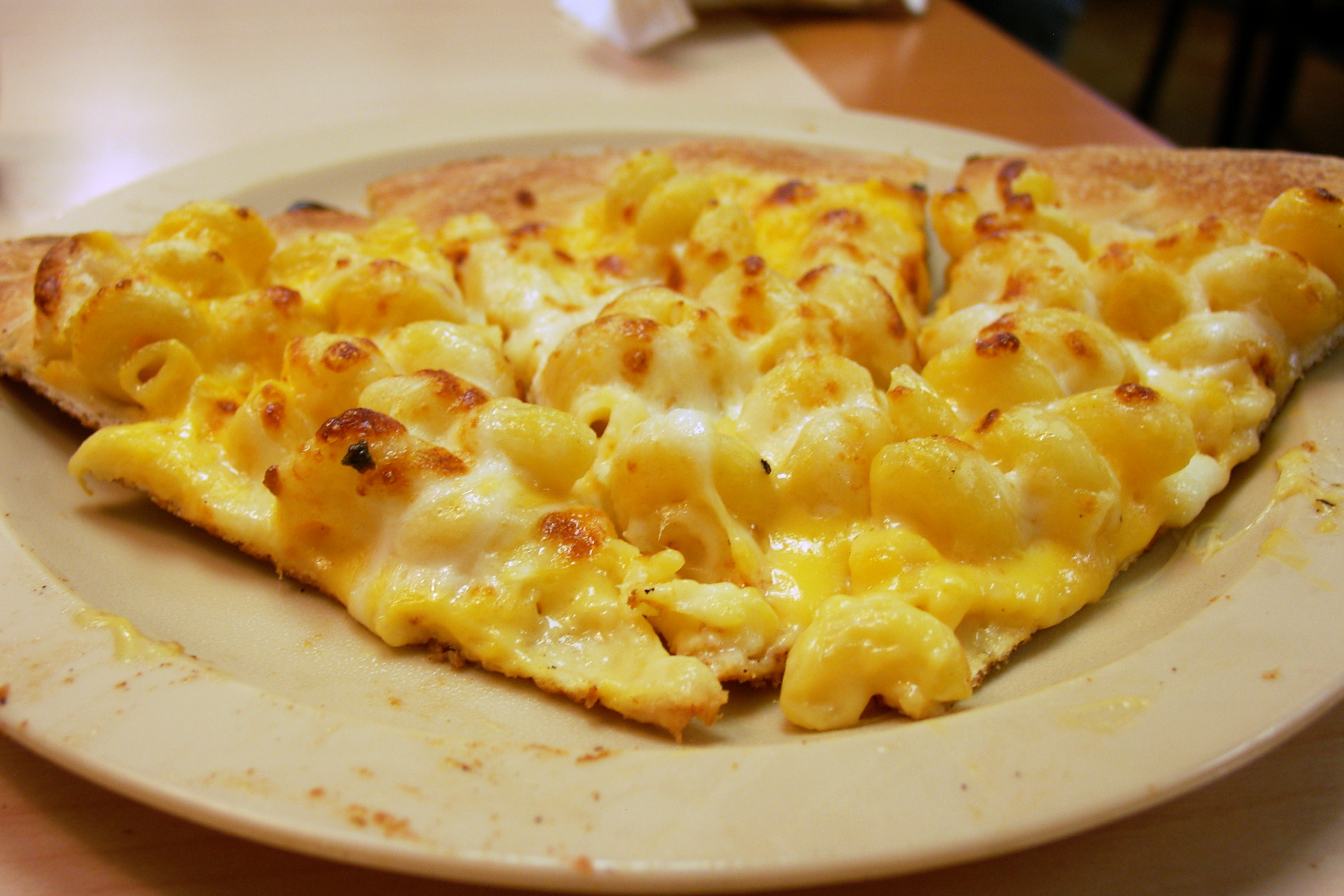
One novelty presentation is deep-fried macaroni and cheese found at fairs and food carts.
Regional variations and analogues
In Scotland, macaroni and cheese can often be found in pies, known as a macaroni pie.
In 1731, the monastery of Disentis in Switzerland purchased a macaroni machine. Monasteries in the country were also known for cheesemaking. Though it is unknown when exactly it was invented, around the 19th century, the traditional dish in Switzerland called Älplermagronen (Alpine herder's macaroni) became popular. Älplermagronen are made of macaroni, cream, cheese, roasted onions, and in some recipes, potatoes. In the Canton of Uri, the potatoes are traditionally omitted, and in some regions, bacon or ham is added. The cheese is often Emmental cheese or Appenzeller cheese. It is usually accompanied by apple sauce.
Prepared and packaged mixes
The earliest known iteration of boxed macaroni and cheese came from a salesman in St. Louis, Missouri, named Grant Leslie. Leslie used rubber bands to attach processed cheese produced by Kraft Foods to boxes of pasta in an attempt to increase pasta sales. Kraft hired Leslie and began to produce Kraft Macaroni & Cheese (known as Kraft Dinner or KD in Canada) in 1937 with the slogan "make a meal for four in nine minutes". It was an immediate success in the US and Canada amidst the economic hardships of the Depression. During the Second World War, rationing led to increased popularity for the product, of which two boxes could be obtained for one food rationing stamp, or one box for 19 cents.
Packaged macaroni and cheese are now available in frozen form or as boxed ingredients for simplified preparation. Boston Market, Michelina's, Kraft Foods, Cracker Barrel, and Stouffer's are some of the more recognizable brands of prepared and frozen macaroni and cheese available in the United States. Macaroni and Cheese is also available canned and in microwavable containers. "Macaroni and cheese loaf", a deli meat which contains both macaroni and processed cheese bits, can be found in some stores. A variety of packaged mixes that are prepared in a sauce pan on the stove or in a microwave oven are available. Some different products on the market use this basic formulation with minor variations in ingredients.
Although high in carbohydrates, calories, fat, and salt, macaroni and cheese is a source of protein and certain variations of the dish can decrease the negative health aspects.
References
References
- "Macaroni cheese recipe".
- Moskin, Julia. (4 January 2006). "Macaroni and Lots of Cheese". [[The New York Times]].
- "Perfect Macaroni and Cheese". Martha Stewart Living.
- Dickson Wright, Clarissa. (2011). "A History of English Food". [[Random House]].
- "First macaroni and cheese". [[Guinness Book of World Records]].
- Joseph, Dana. (10 May 2012). "American food: the 50 greatest dishes". [[CNN Travel]].
- Clark, Liam. (27 July 2016). "What is Macaroni and Cheese (Mac and Cheese)?". Forkit.
- "Mac and cheese facts".
- Raffald, Elizabeth. (1769). "The experienced English housekeeper". Manchester : J. Harrop for the author, etc..
- (2020-06-27). "Macaroni a la Reine".
- Beeton. (1861). "The book of household management". London : S.O. Beeton.
- Samuel Muston. (2013-05-02). "How did macaroni and cheese become elevated to the new sought-after side dish?". The Independent.
- Chapman, Sasha. (September 2012). "Manufacturing Taste". The Walrus.
- "5 odd facts about Canada | Globalnews.ca".
- Medrano, Kastalia. (11 January 2018). "Kitchen of Thomas Jefferson's Slave Discovered". Newsweek.
- McLaughlin, Jack. "Jefferson and Monticello: The Biography of a builder".
- (1888). "Life, Journal, and Correspondence of Manasseh Cutler, Volume 2". R. Clarke & Co..
- "The Project Gutenberg eBook of the Virginia Housewife, by Mary Randolph".
- Randolph, Mary. (1984). "The Virginia House-wife". University of South Carolina Press.
- Kummer, Corby. (July 1986). "Pasta". The Atlantic.
- "Jarlsberg Mac and Cheese with Jalapeño and Crispy Pork Belly".
- Bryan Martin. (May 27, 2014). "Deep fried mac and cheese: A hipster hit".
- Harry Harris. (Jan 23, 2017). "Macaroni Pie Is the Scottish Mash-up Dreams Are Made Of".
- "Wer hat die Älplermagronen erfunden?".
- Genossenschaft, Schweizer Milchproduzenten SMP. "Älplermagronen mit Apfelmus - Rezept".
- "Yum, Mac 'N' Cheese! Chemistry Article for Students {{!}} Scholastic Science World Magazine".
- (2017-02-22). "Manufacturing Taste · thewalrus.ca".
- (2010-08-14). "Kraft Macaroni & Cheese: A History".
- Ellis-Christensen, Tricia. "What is Macaroni and Cheese Loaf?". wiseGEEK.
- "Macaroni and Cheese Ratings & Reviews {{!}} Best & Worst Products {{!}} GoodGuide".
- "The Healthiest Macaroni and Cheese Brands".
This article was imported from Wikipedia and is available under the Creative Commons Attribution-ShareAlike 4.0 License. Content has been adapted to SurfDoc format. Original contributors can be found on the article history page.
Ask Mako anything about Macaroni and cheese — get instant answers, deeper analysis, and related topics.
Research with MakoFree with your Surf account
Create a free account to save articles, ask Mako questions, and organize your research.
Sign up freeThis content may have been generated or modified by AI. CloudSurf Software LLC is not responsible for the accuracy, completeness, or reliability of AI-generated content. Always verify important information from primary sources.
Report