From Surf Wiki (app.surf) — the open knowledge base
M (New York City Subway service)
Rapid transit service
.jpg)
Rapid transit service
| Field | Value | |
|---|---|---|
| service | M | |
| name | Queens Boulevard/ | |
| Sixth Avenue Local | ||
| image1 | R160 M train leaving Myrtle Avenue.jpg | |
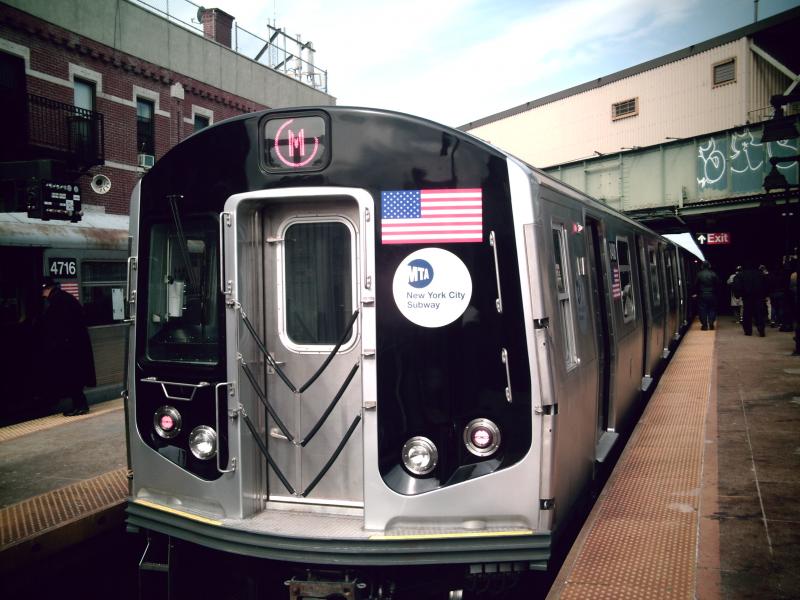
| caption1 | Middle Village–Metropolitan Avenue-bound M train of R160s leaving Myrtle Avenue | |
| north term | Clockwise direction: | |
| {{bulleted list | ||
| south term | Counterclockwise direction: Middle Village–Metropolitan Avenue | |
| stations | 36 | |
| 13 (Weekday evening and weekend non-late night service) | ||
| 8 (late night service) | ||
| depot | East New York Yard | |
| started | ||
| discontinued | {{plainlist | |
| map | ||
| map_state | collapsed |
Sixth Avenue Local {{bulleted list |Forest Hills–71st Avenue (weekday rush hours and middays) |Essex Street (Weekday evenings and weekends except late nights) |Myrtle Avenue (late nights)}} 13 (Weekday evening and weekend non-late night service) 8 (late night service)
- (MJ service only)
The M Queens Boulevard/Sixth Avenue Local is a rapid transit service in the B Division of the New York City Subway. Its route emblem, or "bullet", is colored since it is a part of the IND Sixth Avenue Line in Manhattan.
The M operates 24 hours daily, although service patterns vary based on the time of day. Weekday rush hour and midday service operates between 71st Avenue in Forest Hills and Metropolitan Avenue in Middle Village, Queens and makes all stops along the full route through Manhattan and Brooklyn; weekday evening and weekend non-overnight service short turns at Essex Street on the Lower East Side of Manhattan and does not operate to or from 71st Avenue. Overnight service operates as a shuttle between Metropolitan Avenue in Queens and Myrtle Avenue–Broadway in Brooklyn.
The M is the only service that travels in the same borough via two different and unconnected lines. Additionally, the M is the only non-shuttle service that has both of its full-run terminals in the same borough (Queens). Though the full route length between 71st Avenue and Metropolitan Avenue is about 18.2 mi, the stations are geographically located 2.47 mi apart, marking this as the shortest geographic distance between termini for any New York City Subway service that is not a shuttle service.
An MJ service ran the entire BMT Myrtle Avenue Line until 1969, when the section west of Broadway in Brooklyn was demolished. Before 2010, the full-length M ran from Middle Village to southern Brooklyn via the BMT Nassau Street Line and Montague Street Tunnel. The M had originally ran on the BMT Brighton Line to and from Coney Island–Stillwell Avenue. Beginning in 1986, it used the BMT Fourth Avenue Line and BMT West End Line in Brooklyn, terminating at Ninth Avenue or Bay Parkway.
TOC
History
M service
1914–1960
Until 1914, the only service on the Myrtle Avenue Line east of Grand Avenue was a local service between Park Row (via the Brooklyn Bridge) and Middle Village (numbered 11 in 1924). The Myrtle Viaduct, a two-track ramp connecting the Myrtle Avenue Line with the BMT Broadway Elevated (now the Jamaica) Line at the Myrtle Avenue station was opened on July 29, 1914, allowing for a second service, the daytime Myrtle Avenue–Chambers Street Line, or Myrtle-Chambers Line, which ran along the Broadway elevated and the Williamsburg Bridge to Chambers Street on the Nassau Street Loop in Lower Manhattan.
Following the completion of a third track along the Broadway Elevated between Marcy Avenue and Myrtle Avenue on January 17, 1916, these trains began running express on the Broadway Elevated during the evening rush hour in the peak-direction. By 1920, trains later began running express in the morning rush hour and on Saturday afternoon in the peak direction. The number 10 was assigned to the service in 1924. At the time, service ran on weekdays between 6 a.m. and 8 p.m., on Saturdays from 6 a.m. and 9 p.m., and on Sundays from 12:30 to 11 p.m. In the morning rush hour, trains ran express between Central Avenue and Essex Street, and during the evening rush hour, trains ran express between Bowery and Broadway–Myrtle Avenue.
Sunday service was removed in June 1933. All Saturday trains began running local on June 28, 1952. On February 10, 1958, the four rush hour Brighton-Nassau special trains began stopping at Neck Road and Avenue U. In addition, the evening rush hour trains began stopping at DeKalb Avenue, as had been done by morning rush hour trains. On June 28, 1958, Saturday service was discontinued. On May 26, 1959, midday service was eliminated, making the Myrtle-Chambers Line rush-hours only. Service had previously operated on weekdays from 6 a.m. to 8 p.m. Beginning on February 23, 1960, express trains began stopping at Marcy Avenue, which was originally a local stop.
1961–1978
In 1961, with the arrival of new R27s which featured rollsigns with new lettered designations for the BMT's numbered services, the 10 was renamed the M. Since these cars were not assigned to the route, it remained signed as 10. However, the rush hour Nassau Street specials on the BMT Brighton Line and BMT Fourth Avenue Line were signed using the M designation. The line was officially designated "M" after the Chrystie Street changeover on November 27, 1967.
The second half of the Chrystie Street Connection opened on July 1, 1968, and the , which had run along Nassau Street to Broad Street, was relocated through the new connection to the IND Sixth Avenue Line (and renamed the KK). To augment service to Broad Street, the M was extended two stations, from Chambers Street to Broad Street.
On October 4, 1969, the Myrtle Avenue Elevated was discontinued south of Myrtle Avenue to Jay Street. To make up for the loss of MJ service, M service was expanded to run during middays, operating weekdays between 6 a.m. and 7 p.m., and a new SS shuttle began running between Myrtle Avenue and Metropolitan Avenue at other times. In August 1972, the off-hour SS shuttle was renamed as part of the M.
Effective January 2, 1973, the daytime QJ was truncated to Broad Street as the , and the M was extended beyond Broad Street during the day along the 's former route to Coney Island–Stillwell Avenue, via the Montague Street Tunnel and Brighton Line local tracks. With the extension of the M onto the Brighton Line, there were also changes to D service. Northbound weekday M train service originating at Kings Highway would begin at 5:46 a.m., while northbound service from Coney Island would begin at 6:34 a.m. From 5:40 to 6:34 a.m. northbound D trains would run local from Brighton Beach to Kings Highway, and then run express to Prospect Park. Late morning and early afternoon D trains would from then on run express from Brighton Beach to Kings Highway. The span of D express service to Brighton Beach was extended by 45 minutes to 9:05 p.m. from Prospect Park, and the span of M service from Broad Street to Coney Island was extended by 45 minutes from the previous span of QJ service to cover local stops. Two M trains began service at Brighton Beach in the morning rush hour, and in the early morning, three M trains entered service at Brighton Beach, and six entered service at Kings Highway. In addition, the final nine southbound M trains of the evening terminated at Brighton Beach. On May 13, 1974, two of the three northbound early morning trains that were placed into service at Brighton Beach were moved to enter service at Kings Highway.
The local K (renamed from KK in 1973) was eliminated on August 27, 1976, and M express service between Myrtle Avenue and Marcy Avenue ended.
On December 3, 1979, four northbound weekday morning rush hour trains that had been put into service at Kings Highway began service at Brighton Beach.
1986–2004

M service along Fourth Avenue, operating between 6:30 a.m. and 8:00 p.m., was switched to the local tracks on May 31, 1994, switching with the , which had run local since the M was moved in 1987. The change was implemented on a six-month trial, and was made permanent afterwards. This change was made as part of New York City Transit's Fare Deal, which sought to increase transit ridership by improving service. The change was proposed in November 1993, and public hearings on the change were held. The change reduced travel times by minutes for 26,000 people, a majority of the riders on the corridor. As a result of the change, some riders shifted from using stations on the BMT West End Line to the BMT Sea Beach Line, and from Fourth Avenue local stops to Fourth Avenue express stops.*
- Market research found that 44% of M riders felt that crowding decreased, that 35% of M and 30% of N riders used their service more frequently, that 58% of riders thought the change was a good idea, and that only riders at the 45th Street and 53rd Street stations, which received less frequent service, viewed the changes negatively. This change increased operating costs by $245,000.*
The midday M (between 9:30 a.m. and 3:30 p.m.) was temporarily truncated to Chambers Street on April 30, 1995, from Ninth Avenue in Brooklyn due to the closure of the Manhattan Bridge during weekday middays for structural repairs.*
-
- The change was made to provide capacity in the Montague Street Tunnel for the Q, which was rerouted from the Manhattan Bridge. To replace M local service in Brooklyn, midday N trains began making local stops in Brooklyn. In addition, the span of M service to Brooklyn was reduced by fifteen minutes in the early morning and in the late evening by 25 minutes.*
The elimination of midday service to Brooklyn was made permanent on November 12, 1995, after the six-month repair project was completed, as part of a series of service cuts made by New York City Transit to make up a shortfall in its budget. It had been expecting a $160 million surplus in 1995, but due to reductions in state and federal contributions, it was left with a deficit which could reach $172 million. The elimination of midday M service to Brooklyn was part of a larger plan to reduce spending in order to avert a fare increase, which Governor George Pataki and Mayor Rudy Giuliani had pressured the MTA to avoid. Only 4,200 riders used M service to Brooklyn during middays, with fewer than 20 passengers per car, or 80 passengers per train (the M used four-car trains during middays). Because of the low cost effectiveness of operating service to Brooklyn and because of the existence of alternate service on the N and R, it was decided to cut the service. This service cut saved $664,000 annually. Three alternative operating plans were considered: maintaining existing midday service, terminating midday service at Broad Street, and operating service as a shuttle like weekend and late night service. It was decided not to terminate service at Broad Street because it negated a large portion of the crew savings due to the need for personnel to relay trains at the Broad Street terminal, longer running times, and because it had the potential to delay J service, which already terminated there. The shuttle option was dismissed because it would inconvenience a far larger number of M riders.*
- Truncation of midday M service was proposed as early as January 1991 for an October implementation of that year, subject to approval from the MTA board.

From July 23, 2001, to February 22, 2004, the closure of the north tracks on the Manhattan Bridge resulted in a midday extension back to Ninth Avenue, as well as an extension of the times that the rush hour service was provided to 10 p.m. This change preserved service between the West End Line and Chinatown for passengers that would have taken the to Grand Street. When full Manhattan Bridge service was restored, midday M service was cut back to Chambers Street and replaced in south Brooklyn by the . Neighborhood leaders in Chinatown were angered by the decision to terminate midday at Ninth Avenue, instead of running it to Bay Parkway. A spokesman for New York City Transit stated that it was easier to terminate trains at Ninth Avenue and that a signal upgrade project was going on further down the line. In addition, the temporary midday service to Brooklyn was lightly used, with an average of 50 to 60 riders per train during middays going to Brooklyn, and fewer than 50 riders per train during evenings going to Brooklyn.
After the September 11, 2001 attacks, M service initially operated as a shuttle between Metropolitan Avenue and Myrtle Avenue–Broadway. On September 17, M service was rerouted via the Sea Beach Line and originated and terminated at Stillwell Avenue to replace the , which got suspended; service via the West End Line continued to be provided by trains. M trains made all stops along the reroute. Normal M service was restored on October 28.
2007–2010
In December 2007, the MTA announced that it planned to set aside $27 million in 2008 and $60 million annually afterwards for service enhancements to help riders deal with increased fares. Extended weekday evening M service to Broad Street and weekend service to Chambers Street were part of the plan. However, on March 24, 2008, it was announced that because the agency received substantially less revenue from taxes on real estate transactions, the enhancements were reduced to $4.5 million in 2008 and $8.9 million annually afterwards. The plan to extend weekend service to Chambers Street was dropped. After several months' delay, weekday evening trains were extended to Broad Street on July 27, 2008.[[File:Marty Markowitz, Daniel Squadron, Michael Burke, Paul Nelson.jpg|left|thumb|Brooklyn politicians eulogize the "death" of the Nassau Street Line M]] On November 20, 2008, in light of severe budget woes, the MTA announced a slew of potential service cuts; among them was the potential elimination of rush-hour M service which had extended beyond Chambers Street on the Nassau Street Line in Lower Manhattan to Bay Parkway on the West End Line in Brooklyn. In May 2009, after the New York State Legislature passed legislation to offer financial support to the MTA, the service cut was taken off the table. However, in late 2009, the MTA once again discovered that it was confronting another financial crisis; most of the same service cuts threatened just months earlier were revisited. One proposal included completely phasing out M service and using the as its replacement. Under this proposal, the V would no longer serve its southern terminus at Second Avenue. Instead, after leaving Broadway–Lafayette Street, it would run along the Chrystie Street–Williamsburg Bridge connection, unused since the elimination of the K in 1976, and stop at the upper (BMT) level of Essex Street in Manhattan before serving all M stations to Metropolitan Avenue in Queens.
The MTA determined that this move, while still a service cut, would actually benefit M riders in northern Brooklyn; approximately 17,000 weekday riders used that route to reach its stations in Lower Manhattan, whereas 22,000 transferred to other routes to reach destinations in Midtown Manhattan. However, only about 10,000 riders in Southern Brooklyn used the M to access the Nassau Street Line. This merger opened up new travel options for northern Brooklyn and Queens in that it allowed direct and more convenient access to areas that were not previously served by those routes such as Midtown Manhattan, as before the service changes, M train passengers had to transfer at least once if heading to Midtown.
On March 19, 2010, it was reported that the plan had been changed and that the new combined service would instead carry the M train designation, recolored orange to designate the IND Sixth Avenue Line as its Manhattan trunk line, while discontinuing the V train. Many MTA board members opposed the elimination of the M designation, saying that riders would be more comfortable with that rather than a V designation, and because the M had been around longer than the V. The last M trains to Bay Parkway ran on June 25, 2010, and M service via the Chrystie Street Connection began the following Monday, June 28, 2010.
2011–present
On June 8, 2014, weekend daytime M service was extended to Essex Street as part of an $18 million funding project to improve subway service, as well as to offer a direct connection to the F train on Saturdays and Sundays. Late night service continues to terminate at Myrtle Avenue.
During the morning rush hour, the M is at 90 percent of the New York City Subway's capacity guidelines. Ridership on the M has been growing very rapidly since the 2010 service change, and this trend is expected to continue. In June 2016, the frequencies of service on the M route during peak hours were increased, with the expectation that peak train frequencies would be raised again in the future.
From July 1, 2017, to April 30, 2018, reconstruction of two sections of the BMT Myrtle Avenue Line—the approaches to the line's junction with the BMT Jamaica Line and Fresh Pond Bridge over the Long Island Rail Road's Montauk Branch in Queens—required a reroute of M service. Trains to and from Manhattan and Queens, instead of diverging at Myrtle Avenue to go to Metropolitan Avenue, continued east on the BMT Jamaica Line and terminated at Broadway Junction at all times except late nights, when service was suspended. A limited amount of rush hour trains ran between 71st Avenue in Queens and Second Avenue in Manhattan, replicating the train's routing prior to its discontinuation in 2010. Three shuttle bus routes ran during reconstruction of the Fresh Pond Bridge: one between Myrtle Avenue and Fresh Pond Road; the second between Myrtle and Metropolitan Avenues, skipping the Fresh Pond Road station during the daytime hours; and the third between Flushing Avenue/Broadway and Middle Village–Metropolitan Avenue, stopping at Flushing and Wyckoff Avenues for a transfer to the BMT Canarsie Line at Jefferson Street.
When the Fresh Pond Bridge project was completed on September 2, 2017, two six-car shuttle trains began operating between Metropolitan and Wyckoff Avenues at all times, running separately from each other on each of the two tracks; two additional six-car trains were stored in the Fresh Pond Yard in order to swap consists in and out of service. These shuttles, along with a shuttle bus route that provided service between Wyckoff Avenue and Broadway, ran until April 27, 2018.
When the 14th Street Tunnel shutdown started in April 2019, weekend and weekday evening M service (from 11:00 p.m. to 1:15 a.m.) was extended from Essex Street to 96th Street on the Second Avenue Subway in Manhattan, via 63rd Street, to compensate for limited L service between Brooklyn and Manhattan. The M had to run to 96th Street because of capacity reductions on the Queens Boulevard Line due to ongoing weekend construction. Both weekday and weekend M frequencies were also increased. This extra service was discontinued after completion of tunnel construction on April 27, 2020. Weekday evening service after 9:15 p.m. was also indefinitely cut back from Forest Hills to Essex Street to accommodate maintenance work for the installation of communications-based train control on the Queens Boulevard Line, Eighth Avenue Line, and Sixth Avenue Line.
Weekend frequencies on the M route were increased in July 2023. Starting August 28, 2023, weekday M trains were truncated to 57th Street in Manhattan, and F trains were rerouted via the 53rd Street Tunnel between Queens and Manhattan, due to track replacement and other repairs in the 63rd Street Tunnel. Weekend M service continued to terminate at Essex Street. Service to Forest Hills resumed on April 1, 2024.
In June 2025, internal MTA documents were leaked, indicating that a proposal to reroute M trains through the 63rd Street Tunnel and reroute F trains through the 53rd Street Tunnel would be presented for approval. The route swap was anticipated to reduce overcrowding at 63rd Street line stations, as well as reduce reliance on interlockings west of the 36th Street station in Queens. In September 2025, the MTA confirmed that the F and M trains would swap routings on weekdays starting on December 8, 2025, with the F running via 53rd Street and the M running via 63rd Street. Service on the M route would also be increased during rush hours to provide additional service along the 63rd Street Line, since M trains ran less frequently than F trains.
MJ service

On March 5, 1944, 11 trains stopped running over the Brooklyn Bridge, instead ending at Bridge–Jay Streets on the Brooklyn side, and all 11 trains terminated there (with a free transfer to the IND trains at Jay Street–Borough Hall). In 1967, when the Chrystie Street Connection opened, the label MJ was assigned to the 11 service.
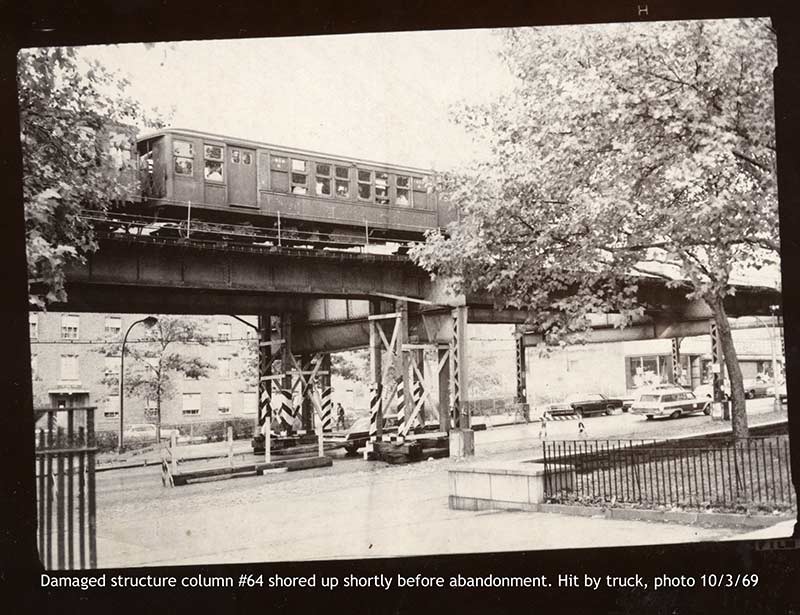
The western half of the Myrtle Avenue Line closed on October 4, 1969, ending MJ service, which was replaced with a free transfer to the B54 bus. Several days before the scheduled closing date, some supports for the elevated structure were hit by a truck, temporarily suspending service. Timber reinforcement was applied to damaged pillars, allowing service to resume until the scheduled closing date.
Route
Service pattern
The following table shows the lines used by the M, with shaded boxes indicating the route at the specified times:
| Line | From | To | Tracks | Times | week­days | week­ends and evenings | late nights |
|---|---|---|---|---|---|---|---|
| IND Queens Boulevard Line | Forest Hills–71st Avenue | [36th Street](36th-street-station-ind-queens-boulevard-line) | local | ||||
| [IND 63rd Street Line](63rd-street-lines) (full line) | [21st Street–Queensbridge](21st-street-queensbridge-station) | Lexington Avenue–63rd Street | all | ||||
| IND Sixth Avenue Line | [57th Street](57th-street-station-ind-sixth-avenue-line) | ||||||
| [47th–50th Streets–Rockefeller Center](47th-50th-streets-rockefeller-center-station) | Broadway–Lafayette Street | local | |||||
| Chrystie Street Connection | all | ||||||
| BMT Nassau Street Line | Essex Street | ||||||
| Williamsburg Bridge | |||||||
| BMT Jamaica Line | Marcy Avenue | Flushing Avenue | local | ||||
| Myrtle Avenue | all | ||||||
| BMT Myrtle Avenue Line (full line) | Central Avenue | Middle Village–Metropolitan Avenue |
Stations

For a more detailed station listing, see the articles on the lines listed above.The M train runs on the following lines:
| [[File:NYCS-bull-trans-M-Std.svg | 20px | M service]] | Stations | Subway transfers | Connections and notes |
|---|---|---|---|---|---|
| Queens | |||||
| IND Queens Boulevard Line | |||||
| (IRT Flushing Line) | |||||
| [63rd Street Line](63rd-street-lines) | |||||
| Manhattan | |||||
| Out-of-system transfers with MetroCard/OMNY: | |||||
| (IRT Lexington Avenue Line at ) | |||||
| (BMT Broadway Line at ) | |||||
| Sixth Avenue Line | |||||
| [[File:Aiga elevator.svg | 20px | alt=Elevator access to mezzanine only]] | |||
| (IRT Flushing Line at ) | |||||
| (IRT Broadway–Seventh Avenue Line at , daytime only) | |||||
| (BMT Broadway Line at , daytime only) | |||||
| ([42nd Street Shuttle](42nd-street-shuttle) at , daytime only) | |||||
| (IND Eighth Avenue Line at , daytime only) | |||||
| (BMT Broadway Line) | |||||
| (BMT Canarsie Line at ) | |||||
| (IRT Broadway–Seventh Avenue Line at ) | |||||
| (IND Eighth Avenue Line) | |||||
| (IRT Lexington Avenue Line at ) | |||||
| BMT Nassau Street Line | |||||
| (IND Sixth Avenue Line) | |||||
| Brooklyn | |||||
| BMT Jamaica Line | |||||
| BMT Myrtle Avenue Line | |||||
| (BMT Canarsie Line) | |||||
| Queens |
Notes
References
References
- {{NYCS const. timetable. M
- "M Train (Queens Boulevard Local/6 Avenue Local/Myrtle Avenue Local) Line Map".
- "MTA Line Colors". Metropolitan Transportation Authority.
- (September 2, 2016). "Distance Between the Middle Village – Metropolitan Avenue and Forest Hills – 71st Avenue Stations: The Shortest Between Two Terminals on Any Route Other Than Shuttles on the New York City Subway".
- (July 29, 1914). "New ''L'' Loop in Use: Long-Sought Improvement Inaugurated Today". The Brooklyn Daily Eagle.
- Linder, Bernard. (February 1971). "A History of BRT/BMT Rapid Transit Service 1908–1949". Electric Railroaders' Association.
- (January 16, 1916). "Express Service on the Broadway Line.". Brooklyn Standard Journal.
- (March 11, 1916). "Ridgewood Heights Seeks Better Elevated Service: Hear B.R.T. Is Investigating Request For Daily Loop Schedule: Want A Morning Express: Cemetery Assessment Bill Prepared by Assemblyman O'Hare—President Gohlinghorst III". The Brooklyn Chat.
- Linder, Bernard. (April 1971). "A History of BRT/BMT Rapid Transit Service 1908–1949 – Part Two". Electric Railroaders' Association.
- "Guide Map to BMT Lines – Rapid Transit Division". Brooklyn—Manhattan Transit. 1924.
- Linder, Bernard. (June 1966). "BMT Service History Part I- 1924–1949 Subway & El". Electric Railroaders' Association.
- (1958). "Additional Service for Neck Road and Avenue "U" Passengers". New York City Transit Authority.
- Kline, Polly. (May 21, 1959). "'Bright New Day' For BMT Riders Has Grey Shades". New York Daily News.
- Linder, Bernard. (August 1966). "History of BMT Subway-L Services Part II-1949 To the Present". Electric Railroaders' Association.
- Sansone, Gene. (November 29, 2004). "New York Subways: An Illustrated History of New York City's Transit Cars". JHU Press.
- (April 1960). "Roll Signs List For BMT-IND R-27's". Electric Railroaders' Association.
- Oszustowicz, Eric R.. (August 2005). "New York City Subway Car Rosters and Assignments, 1961–1971". Electric Railroader's Association.
- (1993). "A History of the New York City Subway System". J. Schmidt, R. Giglio, and K. Lang.
- (November 1967). "Rapid Transit Guide". New York City Transit Authority.
- (July 1, 1968). "Skip-Stop Subway Begins Run Today; KK Line Links 3 Boroughs --Other Routes Changed". The New York Times.
- (October 1969). "Service Changes For Myrtle Avenue "El" Riders". New York City Transit Authority.
- (2012). "Vignelli Transit Maps". RIT Cary Graphic Arts Press.
- (1972). "To Serve You Better... On The Brighton Line in Brooklyn". New York City Transit Authority.
- (1972). "To Serve You Better...". New York City Transit Authority.
- Linder, Bernard. (April 2003). "Brighton Line Schedule Changes". Electric Railroaders' Association.
- (August 31, 1976). "Transit Agency Drops 215 Runs; Resulting Schedule Shifts Bewilder Passengers". The New York Times.
- (August 1976). "Service Adjustment on BMT and IND Lines Effective 1 A.M. Monday, Aug. 30". New York City Transit Authority.
- Rabin, Bernard. (April 16, 1986). "A Change Urged to Lessen Delays in M-Line Rehab". New York Daily News.
- (April 1986). "Brighton Line Riders Your Guide To Service Changes On The B Q M During Rehabilitation Work April 26 Through October 26, 1986". New York City Transit Authority.
- (April 1986). "West End, 4 Ave, Sea Beach Line Riders: Your Guide To Service Changes On The B M N R During Rehabilitation Work April 26 Through October 26, 1986". New York City Transit Authority.
- (May 29, 1994). "A Customer Timetable for New York City Subway Services on the M Train". New York City Transit.
- (May 1994). "May 1994 Subway Map". New York City Transit.
- Holloway, Lynette. (November 14, 1993). "Neighborhood Report: Sunset Park; Subway Express Battle". The New York Times.
- (April 30, 1995). "A Customer Timetable for New York City Subway Services on the M Train; Includes Manhattan Bridge Service Information". New York City Transit.
- (November 12, 1995). "A Customer Timetable for New York City Subway Services on the M Train". New York City Transit.
- (January 4, 1991). "1991 Service Capacity Plan". New York City Transit Authority.
- (1999). "No Trains Over The Williamsburg Bridge". New York City Transit.
- "Williamsburg Bridge". New York City Department of Transportation.
- Donohue, Pete. (September 2, 1999). "It's J – As In Joy – Train Riders Flying High On Fixed-Up W'Burg Span". New York Daily News.
- (September 2001). "The Repeal of Chrystie Street". New York Division, Electric Railroaders' Association.
- "M Train Timetable Effective April 2003". Metropolitan Transportation Authority.
- (February 2004). "B D M N Q R W Weekday Service Manhattan Bridge Map". Metropolitan Transportation Authority.
- (February 5, 2004). "MTA NYC Transit Manhattan Bridge Information". Metropolitan Transportation Authority.
- Lee, Denny. (August 5, 2001). "Neighborhood Report: Chinatown; Deal on Subways Stops Short of Destinations, Riders Say". The New York Times.
- (September 2003). "MTA Board Action Items". Metropolitan Transportation Authority.
- Blood, Michael R.. (September 16, 2001). "Subway Service Ventures Farther into Downtown". New York Daily News.
- Donohue, Pete. (September 17, 2001). "Subways 'Radically Changed'". New York Daily News.
- (October 2001). "World Trade Center Destroyed". Electric Railroaders' Association.
- (December 2001). "New IRT and BMT Schedules". Electric Railroaders' Association.
- (December 2001). "New IRT and BMT Schedules". Electric Railroaders' Association.
- (February 2018). "MTA 2008 Adopted Budget February Financial Plan 2008–2011 Appendix". Metropolitan Transportation Authority.
- Neuman, William. (June 19, 2008). "Subway Service Increase to Be Less Than Hoped". The New York Times.
- Neuman, William. (March 24, 2008). "M.T.A. Postpones Subway and Bus Service Upgrades". The New York Times.
- (December 21, 2008). "M Train Timetable Effective December 2008". Metropolitan Transportation Authority.
- (July 24, 2008). "Service Adjustments on BMW Lines". Metropolitan Transportation Authority.
- (November 20, 2008). "M.T.A. Plans Steep Service Cuts and Fare Increase". The New York Times.
- (May 4, 2009). "Bailout Plan for M.T.A. Gains Two Essential Votes". The New York Times.
- Sparberg, Andrew J.. (November 3, 2014). "From a Nickel to a Token: The Journey from Board of Transportation to MTA". Fordham University Press.
- (January 27, 2010). "2010 NYC Transit Service Reductions". Metropolitan Transportation Authority.
- Grynbaum, Michael M.. (March 19, 2010). "Under a New Subway Plan, The V Stands for Vanished". The New York Times.
- (March 19, 2010). "Re:Modification to 2010 NYC Transit Service Reductions". Metropolitan Transportation Authority.
- (June 24, 2010). "Major Subway Changes Set for Monday". Metropolitan Transportation Authority.
- (September 23, 2011). "Evaluation of 2010 Service Reductions". Metropolitan Transportation Authority.
- Barron, James. (June 28, 2010). "City Commuters Press On Despite Transit Cuts". The New York Times.
- "2014 – 2017 MTA Financial Plan". Metropolitan Transportation Authority.
- "M Weekends Beginning Sunday, June 8, 2014 Go More Places...". Metropolitan Transportation Authority.
- (May 2016). "Feasibility and Analysis of F Express Service in Brooklyn". Metropolitan Transportation Authority.
- (July 2018). "MTA New York City Transit Canarsie Tunnel Project Supplemental Environmental Assessment and Section 4(f) Review July 2018". Metropolitan Transportation Authority.
- Kelley, Ryan. (April 25, 2018). "M Train on Track to Return to Full Service on Myrtle Ave in Ridgewood Next Week". Queens Courier.
- (October 2017). "Subdivision "B" Car Assignments -- Cars Required September 2, 2017". New York Division, Electric Railroaders’ Association.
- (November 2017). "New York City Subway Car Update -- Subdivision "B" News". New York Division, Electric Railroaders’ Association.
- (August 18, 2017). "Final Phase of M Line Overpass Reconstruction Begins September 2". Metropolitan Transportation Authority.
- Rivoli, Dan. (March 17, 2016). "M Line to Be Shut Down Next Year for Repairs". New York Daily News.
- Brown, Nicole. (March 18, 2016). "MTA: M Line Will Shut Down for Part of Next Year". AM New York.
- "Myrtle Avenue Line Infrastructure Projects". Metropolitan Transportation Authority.
- (July 2018-->). "Fixing the L Line's Canarsie Tunnel". New York City Department of Transportation; Metropolitan Transportation Authority.
- (October 22, 2018). "Transit & Bus Committee Meeting October 2018". Metropolitan Transportation Authority.
- (December 13, 2017). "L Train Shutdown to Close Portion of 14th Street to Cars During Rush Hour: MTA". New York's PIX11 / WPIX-TV.
- Nir, Sarah Maslin. (December 13, 2017). "Rerouting Thousands: City Plans for L Train Closure". The New York Times.
- (April 26, 2020). "Service Information for L, M, G, 7, M14 SBS and Free Transfers". Metropolitan Transportation Authority.
- (November 8, 2019). "Transit and Bus Committee Meeting November 2019". Metropolitan Transportation Authority.
- (November 6, 2019). "Re: M Line Subway Schedule Changes Effective April 2020". New York City Transit.
- Izzo, Christina. (May 8, 2023). "Changes Are Coming to the G, J and M Trains This Summer".
- Simko-Bednarski, Evan. (May 2, 2023). "NYC Transit Boosting Subway Service on a Dozen Lines This Summer".
- "Service Changes on the F and M Lines Starting August 28".
- (August 25, 2023). "F, M changes start Monday: What to know about the subway interruptions lasting until 2024".
- (March 19, 2024). "MTA Announces Regular Service Being Restored to F and M Lines Following Critical Track Replacement Work in Manhattan and Queens".
- (March 19, 2024). "F, M service returning to full service in Manhattan and Queens: What to know".
- Simko-Bednarski, Evan. (June 23, 2025). "MTA to swap F and M train routes across the East River, simplifying service".
- Ratliff, Laura. (June 24, 2025). "F and M trains will swap tunnels this fall—here’s what to expect".
- Khalifeh, Ramsey. (September 29, 2025). "MTA to swap F, M subway routes between Manhattan and Queens".
- Russo-Lennon, Barbara. (September 29, 2025). "Subway shakeup: MTA swaps F and M lines; service changes to affect commuter travel".
- Ginsburg, Aaron. (September 30, 2025). "F and M trains will swap routes between Manhattan and Queens".
- (March 5, 1944). "Brooklyn Bridge Train Service Ends Today—Trolley Cars Stay On". The Brooklyn Daily Eagle.
- (October 1954). "Service Changes for Myrtle Avenue "El" Riders". New York City Transit Authority.
- "Damages structural column #64 shored up shortly before abandonment. Hit by truck, Photo on 10/3/69".
- {{NYCS const. serviceguide

This article was imported from Wikipedia and is available under the Creative Commons Attribution-ShareAlike 4.0 License. Content has been adapted to SurfDoc format. Original contributors can be found on the article history page.
Ask Mako anything about M (New York City Subway service) — get instant answers, deeper analysis, and related topics.
Research with MakoFree with your Surf account
Create a free account to save articles, ask Mako questions, and organize your research.
Sign up freeThis content may have been generated or modified by AI. CloudSurf Software LLC is not responsible for the accuracy, completeness, or reliability of AI-generated content. Always verify important information from primary sources.
Report