From Surf Wiki (app.surf) — the open knowledge base
Luton Town F.C.
Association football club in Luton, England
_(cropped).jpg)
Association football club in Luton, England
| Field | Value |
|---|---|
| clubname | Luton Town |
| image | Luton Town logo.svg |
| upright | 0.8 |
| fullname | Luton Town Football Club |
| nickname | The Hatters |
| founded | |
| ground | Kenilworth Road |
| capacity | 12,056 |
| owner | Luton Town Football Club 2020 Ltd |
| chairman | David Wilkinson |
| manager | Jack Wilshere |
| league | |
| season | |
| position | |
| website | |
| pattern_la1 | _luton2324h |
| pattern_b1 | _luton2324h |
| pattern_ra1 | _luton2324h |
| pattern_sh1 | _luton2324h |
| pattern_so1 | _luton2324hl |
| leftarm1 | FF4000 |
| body1 | FF4000 |
| rightarm1 | FF4000 |
| shorts1 | 002244 |
| socks1 | FF4000 |
| pattern_la2 | _luton2425a |
| pattern_b2 | _luton2425a |
| pattern_ra2 | _luton2425a |
| pattern_sh2 | _luton2425a |
| pattern_so2 | _luton2425al |
| leftarm2 | 002244 |
| body2 | 002244 |
| rightarm2 | 002244 |
| shorts2 | 002244 |
| socks2 | 002250 |
| pattern_la3 | _luton2425t |
| pattern_b3 | _luton2425t |
| pattern_ra3 | _luton2425t |
| pattern_sh3 | _luton2425t |
| pattern_so3 | _luton2425tl |
| current | 2025–26 Luton Town F.C. season |
8
Luton Town Football Club is a professional football club from Luton, Bedfordshire, England. The club currently competes in EFL League One, the third tier of the English football league system. Nicknamed "The Hatters", Luton have played their home games at Kenilworth Road since 1905.
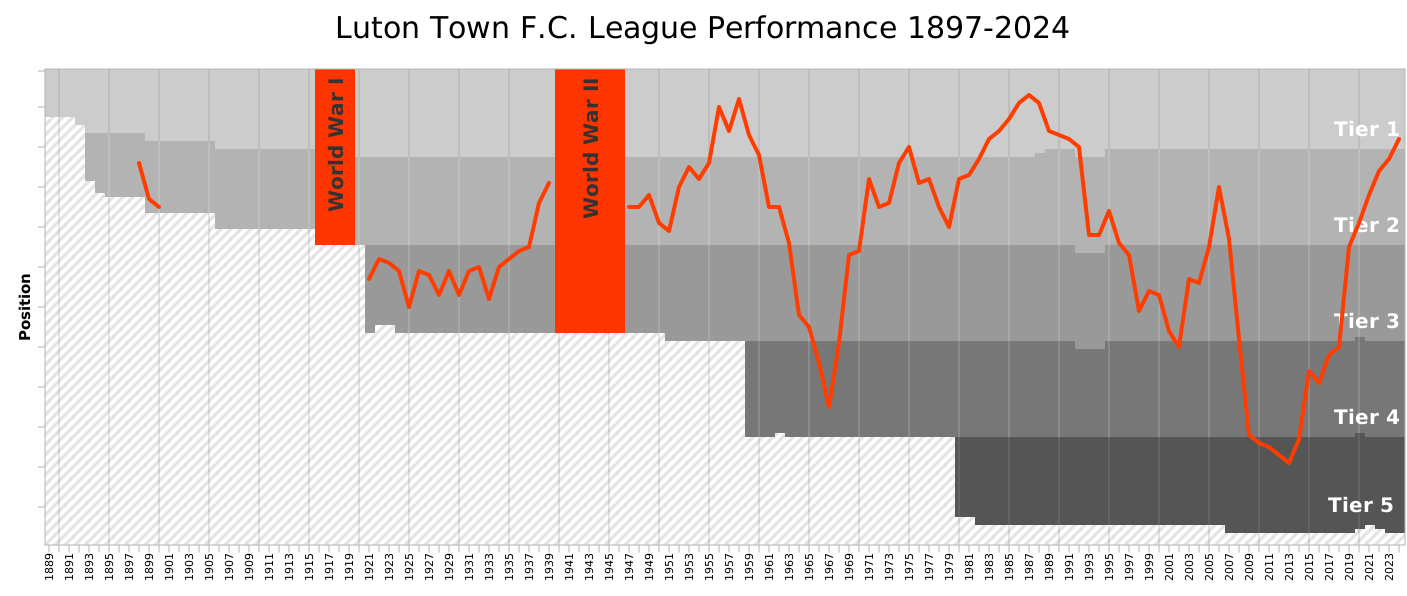
Luton Town joined the Football League before the 1897–98 season but left soon after in 1900 due to financial issues. The club did not rejoin the League until 1920. Luton competed in the First Division for the first time during the 1955–56 season and contested a major final for the first time against Nottingham Forest in the 1959 FA Cup final. The club was then relegated from the First Division at the end of the 1959–60 season, and further relegated twice more in five years, playing in the Fourth Division from the 1965–66 season, before returning to the First Division for the 1974–75 season for a single season.
At the end of the 1981–82 season, the club won the Second Division and gained promotion to the First Division. Several years later, Luton defeated Arsenal 3–2 in the 1988 Football League Cup final and remained in the First Division until relegation at the end of the 1991–92 season.
Between 2007 and 2009, financial difficulties caused the club to fall from the second tier of English football to the fifth in successive seasons. The last of these relegations, in the 2008–09 season, followed a 30-point deduction for financial irregularities. Luton spent five seasons in non-League football before winning the Conference Premier in the 2013–14 season, securing promotion back into the Football League. Luton were promoted from League Two and League One in successive seasons in 2017–18 and 2018–19 before being promoted to the Premier League at the conclusion of the 2023 Championship playoffs. After spending a season in the Premier League, Luton saw two back-to-back relegations, seeing them play in the current 2025–26 League One season.
History
Formation and election to the Southern League (1885–1890)
Luton Town Football Club was founded on 11 April 1885. Prior to its formation, there were many other football clubs in the town, the most prominent of which were Luton Wanderers and Luton Excelsior. A Wanderers player, George Deacon, came up with the idea of a 'Town' club which would include all the best players in Luton. Wanderers secretary Herbert Spratley seized upon Deacon's idea and arranged a secret meeting on 13 January 1885 at St Matthew's School in High Town, near the railway station. The Wanderers committee resolved to rename the club Luton Town—which was not well received by the wider community. The local newspapers referred to the club as 'Luton Town (late Wanderers)'. When George Deacon and John Charles Lomax then arranged a public meeting with the purpose of forming a 'Luton Town Football Club', Spratley protested, saying there was already a Luton Town club; and the atmosphere was tense when the meeting convened in the town hall on 11 April 1885. The meeting, attended by most football lovers in the town, heard about Spratley's secret January meeting and voted down his objections. The motion to form a 'Luton Town Football Club', put forward by GH Small and seconded by EH Lomax, was carried. A club committee was elected by ballot and the team colours were agreed to be pink and dark blue shirts and caps.
Initially based at Excelsior's ground, Dallow Lane, Luton Town began making payments to certain individual players in 1890. The following year, Luton became the first club in southern England to be fully professional. The club was a founder member of the Southern Football League in the 1894–95 season and finished as runners-up in its first two seasons. It then left to help form the United League and came second in that league's inaugural season before joining the Football League (then based mostly in northern and central England) for the 1897–98 season, concurrently moving to a new ground, Dunstable Road. The club continued to enter a team to the United League for two more seasons, winning the title in the1897–98 season. Poor attendance, high wages, in addition to the high travel and accommodation costs that resulted from Luton's distance from the northern heartlands of the Football League crippled the club financially; it became too expensive to compete in that league. A return to the Southern League was therefore arranged for the 1900–01 season.
Early 20th century (1900–1950)
Luton moved into their current ground, Kenilworth Road, in 1905 after having spent eight years at Dunstable Road. A poor 1911–12 season saw Luton relegated to the Southern League's Second Division; the club won promotion back two years later. After the First World War broke out, Luton took part in The London Combination during the 1915–16 season, and afterwards filled each season with friendly matches. A key player of the period was Ernie Simms, a forward. Simms was invalided back to England after being wounded on the Italian front, but recovered enough to regain his place in the Luton team and scored 40 goals during the 1916–17 season.
The Luton side first played in the white and black colours which it retained for much of its history during the 1920–21 season, when the club rejoined the Football League; the players had previously worn an assortment of colour combinations, most permanently sky blue shirts with white shorts and navy socks. Such was the quality of Luton's team at this time that despite playing in the third tier, a fixture between Ireland and England at Windsor Park on 22 October 1921 saw three Luton players on the pitch—Louis Bookman and Allan Mathieson for Ireland, and the club's top goalscorer, Simms, for England. However, after Luton finished fourth in the division, the squad was broken up as Simms, Bookman and Mathieson joined South Shields, Port Vale and Exeter City respectively. Luton stayed in the Third Division South until 1936–37, when the team finished top and won promotion to the Second Division. During the promotion season, striker Joe Payne scored 55 goals in 39 games; during the previous season he had scored 10 in one match against Bristol Rovers, which remains a Football League record today. Towards the end on the 1936-37 season Eddie Parris became the first Black player to represent Luton when he made his debut on 13 March 1937 in a home game against Northampton Town.
Success under Duncan and relegation (1950–1965)
During the early 1950s, one of Luton's greatest sides emerged under manager, Dally Duncan. The team included Gordon Turner, who went on to become Luton's all-time top goalscorer, Bob Morton, who holds the record for the most club appearances and Syd Owen, an England international. During this period, Luton sides also featured two England international goalkeepers, Ron Baynham and Bernard Streten, as well as Irish internationals Seamus Dunne, Tom Aherne and George Cummins. This team reached the First Division for the first time at the end of the 1955–56 season, having finished in second place behind Birmingham City on goal difference. A few years of success followed, including an FA Cup Final appearance against Nottingham Forest in the 1958–59 season where Owen was voted FWA Footballer of the Year. However, the club was relegated the following season and, by the 1964–65 season, was playing in the Fourth Division.
Back to the first tier and late century success (1965–1992)
In yo-yo club fashion, Luton were to return. A team including Bruce Rioch, John Moore and Graham French won the Fourth Division championship in the 1967–68 season under the leadership of former player Allan Brown; while comedian Eric Morecambe became a director of the club. Former Luton player David Pleat was made manager in 1978, and by the 1982–83 season the team was back in the top flight. causing it to accrue "a richer history of black stars than any in the country", in the words of journalist Gavin Willacy.
On the last day of the 1982–83 season, the club's first back in the top tier, it narrowly escaped relegation: playing Manchester City at Maine Road, Luton needed to win to stay up, while City could escape with a draw. A late winner by Yugoslavian substitute Raddy Antić saved the team and prompted Pleat to dance across the pitch performing a "jig of joy", an image that has become iconic. The club achieved its highest ever league position, seventh, under John Moore in the 1986–87 season, and, managed by Ray Harford, won the Football League Cup a year later with a 3–2 win over Arsenal. With ten minutes left on the clock and Arsenal 2–1 ahead, a penalty save from stand-in goalkeeper Andy Dibble sparked a late Luton rally: Danny Wilson equalised, before Brian Stein scored the winner with the last kick of the match. The club reached the League Cup Final once more in the 1988–89 season, but lost 3–1 to Nottingham Forest.
Resurgence and fall to non-League (1992–2009)
The club was relegated from the top division at the end of the 1991–92 season, Luton stayed in the third-tier Second Division until relegation at the end of the 2000–01 season. Under the management of Joe Kinnear, who had arrived halfway through the previous season, the team won promotion from the fourth tier at the first attempt. owner John Gurney unsettled the club in 2003, terminating Kinnear's contract on his arrival in May; Gurney replaced Kinnear with Mike Newell before leaving Luton as the club entered administration. Newell's team finished as champions of the rebranded third-tier Football League One in 2004–05.
While Newell's place was taken first by Kevin Blackwell and later former player Mick Harford, the team was then relegated twice in a row, starting in 2006–07, and spent the latter part of the 2007–08 season in administration, thus incurring a ten-point deduction from that season's total. The club then had a total of 30 points docked from its 2008–09 record by the Football Association and the Football League for financial irregularities dating back several years. These deductions proved to be too large an obstacle to overcome, but Luton came from behind in the final of the Football League Trophy to win the competition for the first time.
Non-league to Premier League (2009–2024)
Relegation meant that the 2009–10 season saw Luton playing in the Conference Premier, a competition in which the club had never before participated. The club unsuccessfully contested the promotion play-offs three times in four seasons during their time as a non-League club, employing five different managers. In the 2012–13 FA Cup fourth round, Luton won their away tie against Premier League club Norwich City 1–0 and, in doing so, became the first non-League team to beat a side from England's top division since 1989.
In the 2013–14 season, under the management of John Still, Luton won the Conference Premier title with three games to spare, and thereby secured a return to the Football League for the 2014–15 season. After reaching the League Two play-offs during the 2016–17 season, when they were beaten 6–5 on aggregate by Blackpool in the semi-final, Luton were promoted back to League One the following season as runners-up. Luton achieved a second successive promotion at the end of the 2018–19 season, after they won the League One title, marking the club's return to the Championship after a 12-year absence. Luton reached the Championship play-offs in 2021–22, where they were beaten 2–1 on aggregate by Huddersfield Town in the semi-final.
At the end of the 2022–23 season, Luton Town secured a consecutive place in the Championship play-offs having finished in 3rd place. Luton Town beat Sunderland 3–2 on aggregate in the play-off semi-finals to reach the play-off final against Coventry City. They went on to beat Coventry City 6–5 on penalties after a tense 1–1 draw to secure promotion to the Premier League for the first time. After collecting one point in their first five matches of the season, Luton won their first Premier League game on 30 September 2023, beating Everton 2–1 away at Goodison Park. After a stable first half of the season, the club's form significantly regressed after January, winning one in seventeen matches before being relegated in May 2024.
Back-to-back relegation to League One (2024–present)
On 3 May 2025, a second successive relegation put Luton back in League One after losing 5–3 on the final day to West Bromwich Albion. Despite compiling 49 points and equaling Hull City's total, their inferior goal difference resulted in them finishing 22nd.
Luton parted ways with head coach Matt Bloomfield on 6 October 2025. Bloomfield was sacked by Luton after a bad run of games, leaving the club in 11th place in the league. Former Hatters player, Alex Lawless, was named interim manager the following day. Jack Wilshere had been a favourite to replace Bloomfield, and was appointed manager on 13th October.
Club identity

The club's nickname, "the Hatters", reflects Luton's historical connection with the hat making trade, which has been prominent there since the 17th century. Supporters of the club are also called Hatters.
The club is associated with two very different colour schemes—white and black (first permanently adopted in 1920), and orange, navy and white (first used in 1973, and worn by the team as of the 2015–16 season). Luton mainly wore a combination of light blue and white before 1920, when white shirts and black shorts were first adopted. These colours were retained for over half a century, with the colour of the socks varying between white and black, until Luton changed to orange, navy and white at the start of the 1973–74 season. Luton began playing in white shirts, shorts and socks in 1979, with the orange and navy motif reduced to trim; navy shorts were adopted in 1984. This palette was retained until the 1999–2000 season, when the team played in orange shirts and blue shorts. From 2000 to 2008, Luton returned to white shirts and black shorts; orange was included as trim until 2007. The white, navy and orange palette favoured in the 1980s was brought back in 2008, following the results of a club poll, but a year later the colours were changed yet again, this time to a predominantly orange strip with white shorts. Navy shorts were readopted in 2011. Luton wore orange shirts, navy shorts and white socks during the 2015–16 season.
Luton Town have traditionally used the town's crest as its own in a manner similar to many other teams. The club's first badge was a white eight-pointed star, which was emblazoned across the team's shirts (then a deep cochineal red) in 1892. Four years later a crest comprising the club's initials intertwined was briefly adopted. The shirts were thereafter plain until 1933, when Luton first adopted a badge depicting a straw boater, which appeared on Luton shirts. The letters "LTFC" were added in 1935, and this basic design remained until 1947. The club then played without a badge until 1970, when the club began to wear the town crest regularly, having first done so in the 1959 FA Cup Final.
In 1973, concurrently with the club's switch to the orange kit, a new badge was introduced featuring the new colours. The new emblem depicted a stylised orange football, bearing the letters "Lt", surrounded by the club's name in navy blue text.
The club released the song "Hatters, Hatters", a collaboration between the Luton team and the Bedfordshire-based musical comedy group the Barron Knights, in 1974. Eight years later another song featuring vocals by the Luton players, "We're Luton Town", was released to celebrate the club's promotion to the First Division.
Shirt sponsors
The first sponsor to appear on a Luton Town shirt was Tricentrol, a local motor company based in Dunstable, who sponsored the club from March 1980 to 1982; the deal was worth £50,000.
A list of subsequent Luton Town shirt sponsors are as follow:
- 1981-1982: Tricentrol
- 1982–1990: Bedford Trucks
- 1990–1991: Vauxhall
- 1991–1999: Universal Salvage Auctions
- 1999–2003: SKF
- 2003–2005: Travel Extras
- 2005–2008: Electrolux
- 2008–2009: Carbrini Sportswear
- 2009–2015: EasyJet and NICEIC
- 2015–2016: Barnfield College and NICEIC
- 2016–2018: NICEIC and SsangYong Motor UK
- 2018–2019: Indigo Residential (home), Star Platforms (away), Northern Gas & Power (third)
- 2019–2020: Indigo Residential (home), Star Platforms (away), Ryebridge Construction (third)
- 2020–2022: JB Developments (home), Star Platforms (away), Ryebridge Construction (third)
- 2022–2023: Utilita (home), Star Platforms (away), Ryebridge Construction (third), The Wood Veneer Hub (training)
- 2023–2024: Utilita (main), FREE NOW (sleeve), TUI (training)
Stadium
Main article: Dallow Lane, Dunstable Road, Kenilworth Road, Power Court Stadium
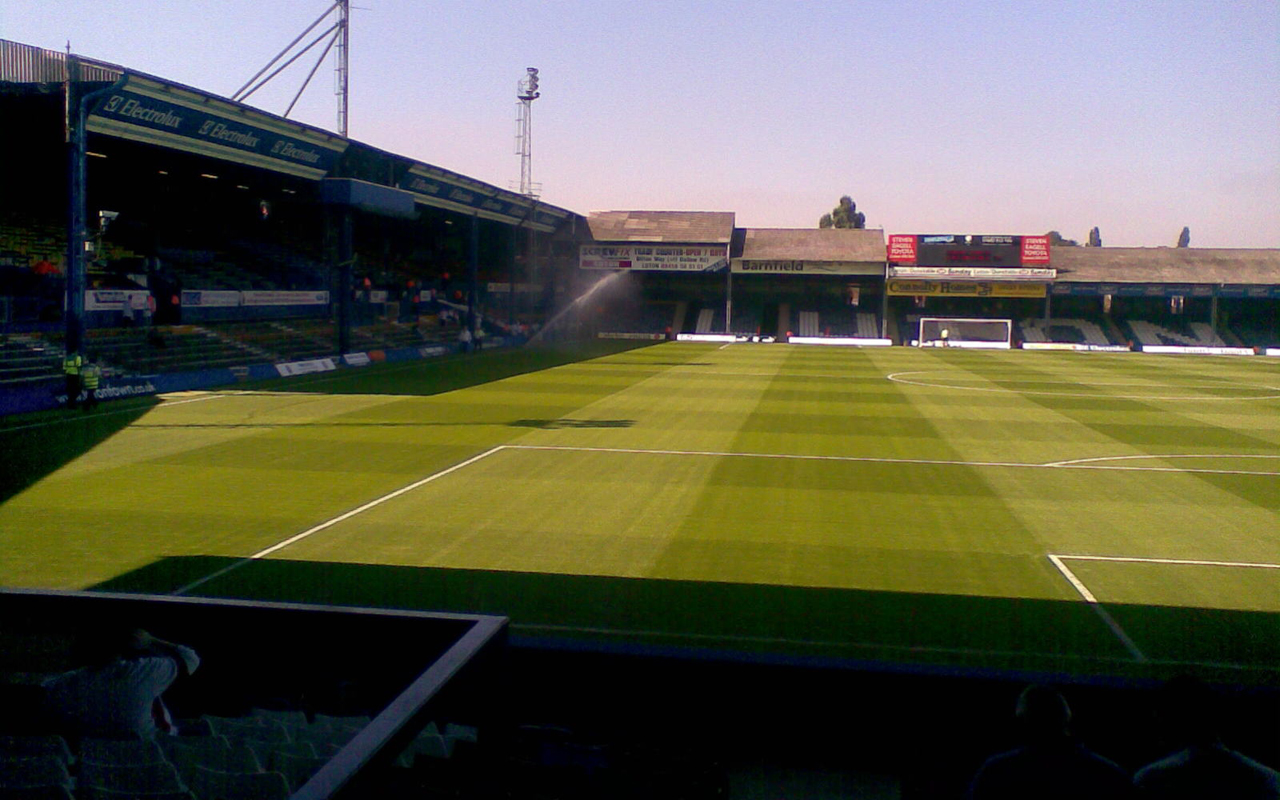
Luton Town's first ground was at Dallow Lane, the former ground of Excelsior. The ground was next to the Dunstable to Luton railway line, and players regularly claimed to have trouble seeing the ball because of smoke from the trains. A damaging financial loss during 1896–97 forced Luton to sell the stadium to stay afloat and, as a result, the club moved across the tracks to a stadium between the railway and Dunstable Road. The Dunstable Road ground was opened by Herbrand Russell, 11th Duke of Bedford, who also donated £50 towards the £800 building costs. When the site was sold for housing in 1905, the club was forced to move again at short notice, to its present Kenilworth Road site, in time for the start of the 1905–06 season.
The stadium has an all-seater capacity of 11,600 and is situated in the Bury Park area of Luton. It was named after the road that runs along one end of it, although the official address of the club is 1 Maple Road. Opposite the eponymous Kenilworth Stand is the Oak Road End, which has evolved from a stand first used exclusively by Luton supporters, then later by away supporters, and now used by both except in times of high ticket demand from away clubs. The Main Stand is flanked by the David Preece Stand, and opposite them stands a row of executive boxes. These boxes replaced the Bobbers Stand in 1986, as the club sought to maximise income.
The original Main Stand burnt down in 1921, and was replaced by the current stand before the 1922–23 season. The ground underwent extensive redevelopment during the 1930s, and the capacity by the start of the Second World War was 30,000. Floodlights were installed before the 1953–54 season, but it was 20 years before any further modernisation was carried out. In 1973 the Bobbers Stand became all-seated, and in 1985 the grass pitch was replaced with an artificial playing surface; it quickly became unpopular and was derided as "the plastic pitch".
A serious incident involving hooliganism before, during and after a match against Millwall in 1985 led to the club's then chairman, Conservative Member of Parliament (MP) David Evans, introducing a scheme effective from the start of 1986–87 supposedly banning all visiting supporters from the ground, and requiring home fans to carry membership cards when attending matches. Conversion to an all-seater ground also began in 1986. and grass a year later. The David Preece Stand was erected in 1991, and the conversion of the Kenilworth Stand to an all-seater was completed in 2005.
New stadium
The club first expressed an interest in building a new stadium away from Kenilworth Road in 1955, the year it won promotion to the First Division for the first time. Even then the ground was small compared to those of most First and Second Division clubs, and its location made significant redevelopment difficult. The team has since made several attempts to relocate. The club sold Kenilworth Road to Luton Council in 1989, and has since leased it. A planning application for a new 20,000-seater indoor stadium, the "Kohlerdome" proposed by chairman David Kohler in 1995, was turned down by the Secretary of State in 1998, and Kohler left soon after.
In 2007, the club's then-owners proposed a controversial plan to relocate to a site near Junction 12 of the M1 motorway, near Harlington and Toddington. A planning application was made on the club's behalf by former chairman Cliff Bassett, but the application was withdrawn almost immediately following the club's takeover in 2008. In 2009, the club began an independent feasibility study to determine a viable location to move to. The club did not rule out redeveloping Kenilworth Road and, in October 2012, entered talks to buy the stadium back from Luton Borough Council. By 2015, these plans had been dropped in favour of a move to a new location, with managing director Gary Sweet confirming that the club was in a position to "buy land, secure the best possible professional advice ... and to see the [planning] application process through to the receipt of consent."
In April 2016, the club announced its intention to build and move into a 17,500-capacity stadium on the Power Court site in central Luton. Outline planning permission for this ground, with potential to expand to 23,000 seats, was granted by Luton Borough Council on 16 January 2019. In March 2021, the club announced that it intended to make a number of changes to the initial scheme to reflect changes caused by the COVID-19 pandemic, but that the capacity of the new stadium was still to be 23,000 and had a target opening date of 2024. This plan was revised in 2023, to delivering the first phase, a 19,500-seat stadium, by 2026, followed by the second, a further 4,000 safe standing seats, at a later date. In September 2024, the club submitted revised plans to the Luton Borough Council for a 25,000 stadium with a planned opening date of 2027. The council approved the plans in January 2025. In April 2025, Turkish contractor Limak International was appointed to build the new stadium, with construction starting in summer 2025 and the stadium now set to hold its first competitive game at the start of the 2028–29 season.
Supporters and rivalries
Main article: Luton Town F.C.–Watford F.C. rivalry
During the 2014–15 season, Luton Town had an average home league attendance of 8,702—the second highest in League Two behind only Portsmouth. In the 2013–14 season, when the club were in the Conference Premier, the club had significantly higher support than the other clubs in its league, with an average home attendance of 7,387; more than twice compared to the second highest of 3,568. Average attendances at Kenilworth Road fell with the installation of seats and the club's reduction in stature, dropping from 13,452 in 1982–83 to their 2014–15 level—a slump of 35% over 32 years. A supporters' trust, Trust in Luton, owns shares in the club and elects a representative to the club's board. The club's official supporters' group, Luton Town Supporters' Club, merged with Trust in Luton in 2014. The club is associated with another supporters' group, the breakaway Loyal Luton Supporters Club. Trust in Luton has, since March 2014, held the legal right to veto any changes to the club's identity, including name, nickname, colours, club crest and mascot.
Luton Town supporters maintain a bitter rivalry with Hertfordshire-based Watford. Watford were the higher ranked team at the end of every season from 1997 until 2022. However, overall Luton still hold the superior record in the fixture between the two clubs; out of 120 competitive matches there have been 55 Luton victories and 38 for Watford, with 29 draws. The 2003 Football Fans Census showed that there was also animosity between Luton Town fans and those of west London club Queens Park Rangers. The fans also maintain a friendly relationship with Dutch side Go Ahead Eagles.
The club produces an official match programme for home matches, entitled Our Town. A character known as Happy Harry, a smiling man wearing a straw boater, serves as the team's mascot and appears on the Kenilworth Road pitch before matches. In December 2014, after the seafront statue of Eric Morecambe in his birthplace Morecambe was restored, Luton and Morecambe F.C. jointly announced that the winners of future Luton–Morecambe fixtures would be awarded the "Eric Morecambe Trophy".
Hooliganism
Luton Town FC and its supporter base has had a prolonged history with football hooliganism. Incidents of violence date back at least to the 1980s, with the most notorious early example, the 1985 Luton riot, occurring on 13 March 1985 during the FA Cup sixth round tie against Millwall. Millwall fans overwhelmed their allocated stand at Kenilworth Road, throwing bottles, billiard balls, and other objects at Luton supporters and police, while players and officials were forced to take cover. The match was halted for 25 minutes due to pitch encroachment, and the disorder extended into Luton town centre, resulting in around 47 hospitalisations and 31 arrests. The scale of violence contributed to subsequent national measures on stadium safety, including CCTV installation, all-ticket matches, and alcohol restrictions. During this period, the Luton Town MIGs (Men In Gear) were active and played a prominent role in orchestrating hooligan clashes, continuing their involvement in violent incidents throughout the 1980s and 1990s.
In September 2003, Luton supporters were involved in orchestrated pre-match violence ahead of a Worthington Cup match against Watford at Vicarage Road. Six Luton fans were jailed for affray, receiving sentences between eight and 14 months and football banning orders of six to seven years, while a total of 20 individuals were imprisoned for disturbances inside and outside the ground. On 6 October 2012, violence occurred in Lincoln before a match against Lincoln City, when Luton fans clashed in the Ritz pub, leading to 21 arrests and subsequent guilty pleas for violent disorder.
During the May 2010 Blue Square Premier play-off semi-final, York City defeated Luton 1-0 at Kenilworth Road. Post-match, York players were attacked by projectiles after a pitch invasion, and police were assaulted by fans armed with improvised weapons. Several arrests were made, prompting apologies from the club chairman and highlighting the need for enhanced security measures. On 24 August 2010, Tommy Robinson, later founder of the English Defence League, led a street brawl between Luton and Newport County supporters. Robinson was convicted in July 2011 for using threatening, abusive, or insulting behaviour and received a 12-month community rehabilitation order, 150 hours of unpaid work, a three-year football banning order, and fines.
On 16 February 2013, prior to a fifth-round FA Cup match against Millwall, minor pre-match disturbances occurred in Luton town centre, followed by incidents in the town after the game, resulting in twelve men charged with public order offences and affray. In October 2019, following a Luton Town versus Bristol City match, a mass brawl occurred in Guildford Street involving multiple groups of football supporters, leading police to issue appeals for information to identify those involved. Luton fans have also been involved in incidents during Championship play-offs, including a pitchside assault on an opposing player in May 2023, prompting FA charges for failing to control spectators despite the club having issued prior bans.
Records and statistics
Main article: List of Luton Town F.C. records and statistics, Luton Town F.C. league record by opponent, List of Luton Town F.C. seasons
The record for the most appearances for Luton is held by Bob Morton, who turned out for Luton 562 times in all competitions. Morton also holds the record for the most Football League appearances for the club, with 495. Fred Hawkes holds the record for the most league appearances for Luton, having played in 509 league matches. Six players, Gordon Turner, Andy Rennie, Brian Stein, Ernie Simms, Herbert Moody and Steve Howard, have scored more than 100 goals for Luton.
The first player to be capped while playing for Luton was left winger Robert Hawkes, who took to the field for England against Ireland at Goodison Park on 16 February 1907. The most capped player is Mal Donaghy, who earned 58 Northern Ireland caps while at the club. The first player to score in an international match was Joe Payne, who scored twice in his only game for England against Finland on 20 May 1937. Payne also holds the Football League record for the most goals in a game—he hit 10 past Bristol Rovers on 13 April 1936.
The club's largest wins have been a 15–0 victory over Great Yarmouth Town on 21 November 1914 in the FA Cup and a 12–0 win over Bristol Rovers in the Third Division South on 13 April 1936. Luton's heaviest loss was a 9–0 defeat against Small Heath in the Second Division on 12 November 1898.
Luton's highest home attendances are 30,069 against Blackpool in the FA Cup on 4 March 1959 and 27,911 against Wolverhampton Wanderers in the First Division on 5 November 1955.
The highest transfer fee received for a Luton Town player is the fee Leicester City paid for Luton-born full-back James Justin on 28 June 2019. The most expensive player Luton Town have ever bought was wing-back Ryan Giles, for a reported fee of £5 million from Wolverhampton Wanderers on 27 July 2023.
The youngest player to make a first-team appearance for Luton Town is Connor Tomlinson at 15 years and 199 days old in the EFL Trophy, replacing Zane Banton as a 92nd-minute substitute in a 2–1 win over Gillingham on 30 August 2016, after the club were given permission for him to play from his headteacher.
Players
Out on loan
Youth team
The club operates a Development Squad, made up of contracted senior players, youth team scholars and trialists, which plays in the Southern Division of The Central League. The club also fields an under-18 team in the Football League Youth Alliance South East Conference. Luton's youth set-up consists of ten Soccer Centres across Bedfordshire and North Hertfordshire, two Centres of Excellence (one in Luton, one in Dunstable), and an academy in Baldock that caters for players in the under-9 to under-16 age groups.
Development squad
Under 18s squad
Notable former players
Main article: List of Luton Town F.C. players
Backroom staff
:As of 24 October 2021
Shareholders
- Kailesh Karavadra
- Luton Town Supporters' Trust
Directors
- Chairman: David Wilkinson
- Chief Executive Officer: Gary Sweet
- Directors: Paul Ballantyne, Stephen Browne, Bob Curson, Mike Herrick, Rob Stringer
Management
- Manager: Jack Wilshere
- Assistant manager: Chris Powell
- First-team coach: David Bridges, Tim Corcoran, Kevin Foley
- Head of goalkeeping: Kevin Pilkington
- Team operations manager: Kevin Dearden
- Chief Recruitment Officer: Mick Harford
- Head of sports science: Josh Hornby
- Head of coaching and player development/Under 21s Lead Coach: Alex Lawless
- Head of recruitment analysis: Jay Socik
- Player Recruitment Manager: Yousuf Sajjad
- Chief Scout: Marc Tracy
- Strength and power coach: Archie Johnson
- Performance analyst: Peter Booker
- Head of medical: Danny Murphy
- Medical Co-Ordinator: Simon Parsell
- Club Drs - Dr Monjour Ahmed, Dr Mo Al-Azzawi
- Physiotherapist: Chris Phillips
- Therapist and kitman: Darren Cook
- Academy and development managers: Paul Benson and Wayne Turner
- Professional Development Phase Assistant Coach: Ronnie Henry
- Under 18s Head Coach: Joe Deeney
- Head of Academy Coaching: Ben Strevens
Managers
Main article: List of Luton Town F.C. managers
:As of 9 January 2025. Only managers in charge for a minimum of 50 competitive matches are counted. :Key: M = matches; W = matches won; D = matches drawn; L = matches lost
| Name | Nation | From | To | M | W | D | L | Win % |
|---|---|---|---|---|---|---|---|---|
| Scotland | ||||||||
| England | ||||||||
| England | ||||||||
| England | ||||||||
| Scotland | ||||||||
| England | ||||||||
| England | ||||||||
| Scotland | ||||||||
| Scotland | ||||||||
| England | ||||||||
| England | ||||||||
| England | ||||||||
| England | ||||||||
| Scotland | ||||||||
| England | ||||||||
| England | ||||||||
| Ireland | ||||||||
| England | ||||||||
| England | ||||||||
| England | ||||||||
| England | ||||||||
| England | ||||||||
| Wales | ||||||||
| Wales | ||||||||
| Wales | 9 January 2025 |
Honours
: :Luton Town's major honours are detailed below. For a list of all club honours, see List of Luton Town F.C. records and statistics : Honours and achievements.
League
- Second Division / Championship (level 2)
- Third Division South / Third Division / League One (level 3)
- Fourth Division / Third Division / League Two (level 4)
- Conference Premier (level 5)
- Champions: 2013–14
Cup
Footnotes
:A. The only other club from the south of England in the Football League at the time was Woolwich Arsenal. :B. Calculated by adding together all the home league attendances for the 2014–15 season to calculate the total attendance (200,157) and then dividing by the number of home league matches (23) to reach an average of 8,702. Attendances taken from BBC report for match that day and Soccerbase statistics. :C. Calculated by adding together all the home league attendances for the 2013–14 season to calculate the total attendance (169,906) and then dividing by the number of home league matches (23) to reach an average of 7,387. Attendances taken from BBC report for match that day and Soccerbase statistics. :D. Before the start of the 2004–05 season, Football League re-branding saw the First Division become the Football League Championship. The Second and Third Divisions became Leagues One and Two, respectively. :E. On its formation for the 1992–93 season, the FA Premier League became the top tier of English football; the First, Second and Third Divisions then became the second, third and fourth tiers, respectively.
References
Bibliography
References
- "Getting to Kenilworth Road". Luton Town F.C..
- (15 June 2015). "Luton Town F.C. Club Contacts". Luton Town F.C..
- Collings, Timothy. (1985). "The Luton Town Story 1885–1985". Luton Town F.C..
- Hayes, Dean P.. (2002). "Completely Top Hatters!". Book Castle Publishing.
- "Chapter Six – 11th April 1885". Brian Webb.
- Collings, Timothy. (1985). "The Luton Town Story 1885–1985". Luton Town F.C..
- "Luton Town". Richard Rundle.
- Hayes, Dean P.. (2002). "Completely Top Hatters!". Book Castle Publishing.
- Collings, Timothy. (1985). "The Luton Town Story 1885–1985". Luton Town F.C..
- "England 1–0 Ireland". England Stats.
- Collings, Timothy. (1985). "The Luton Town Story 1885–1985". Luton Town F.C..
- (1997). "The Definitive Luton Town F.C.". Soccerdata.
- Collings, Timothy. (1985). "The Luton Town Story 1885–1985". Luton Town F.C..
- "Luton Town". Dave Moor.
- "Ireland 1–1 England". England Stats.
- Collings, Timothy. (1985). "The Luton Town Story 1885–1985". Luton Town F.C..
- (1997). "The Definitive Luton Town F.C.". Soccerdata.
- Collings, Timothy. (1985). "The Luton Town Story 1885–1985". Luton Town F.C..
- Burnton, Simon. (18 October 2011). "The forgotten story of ... the Football League's record scoring trio". The Guardian.
- (2020). "Football's Black Pioneers". Conker Editions.
- Collings, Timothy. (1985). "The Luton Town Story 1885–1985". Luton Town F.C..
- Hayes, Dean P.. (2002). "Completely Top Hatters!". Book Castle Publishing.
- Hayes, Dean P.. (2002). "Completely Top Hatters!". Book Castle Publishing.
- Hayes, Dean P.. (2002). "Completely Top Hatters!". Book Castle Publishing.
- Hayes, Dean P.. (2002). "Completely Top Hatters!". Book Castle Publishing.
- Hayes, Dean P.. (2002). "Completely Top Hatters!". Book Castle Publishing.
- Hayes, Dean P.. (2002). "Completely Top Hatters!". Book Castle Publishing.
- Hayes, Dean P.. (2002). "Completely Top Hatters!". Book Castle Publishing.
- Hayes, Dean P.. (2002). "Completely Top Hatters!". Book Castle Publishing.
- Hayes, Dean P.. (2002). "Completely Top Hatters!". Book Castle Publishing.
- Collings, Timothy. (1985). "The Luton Town Story 1885–1985". Luton Town F.C..
- Collings, Timothy. (1985). "The Luton Town Story 1885–1985". Luton Town F.C..
- (19 June 2007). "England Player Honours – Football Writers' Association Footballers of the Year". England Football Online.
- Collings, Timothy. (1985). "The Luton Town Story 1885–1985". Luton Town F.C..
- "Luton Town 1974–1975". Statto Organisation.
- Willacy, Gavin. (23 October 2008). "Opportunity knocked". When Saturday Comes.
- Bevan, Chris. (3 May 2003). "Classic matches at Maine Road". BBC Sport.
- (2 August 2016). "1974–1985". Luton Town F.C..
- "Luton Town 1986–1987". Statto Organisation.
- Lamont, Tom. (6 April 2008). "Frozen in time". The Guardian.
- Haylett, Trevor. (25 April 2001). "Rotherham on the rise as Luton fall". The Independent.
- (8 February 2001). "Kinnear: I'm the boss". BBC Sport.
- (9 May 2003). "Luton ponder Dons merger". BBC Sport.
- (23 June 2003). "Luton pick Newell". The Daily Telegraph.
- (2 April 2007). "Luton Town appoint new manager". BBC Three Counties.
- (16 January 2008). "Mick Harford replaces Kevin Blackwell at Luton". The Daily Telegraph.
- (15 July 2008). "Luton lose appeal against points deduction". The Guardian.
- (13 April 2009). "Luton 0–0 Chesterfield". BBC Sport.
- Fletcher, Paul. (5 April 2009). "Luton 3–2 Scunthorpe (aet)". BBC Sport.
- Osborne, Chris. (26 January 2013). "Norwich 0–1 Luton". BBC Sport.
- (15 April 2014). "Luton Town win Conference Premier and Football League spot". BBC Sport.
- Simmonds, Mike. (29 April 2017). "Hatters hit four as they hammer Accrington". Luton Today.
- Mitchell, Brendon. (18 May 2017). "Luton Town 3–3 Blackpool (agg: 5–6)". BBC Sport.
- Simmonds, Mike. (21 April 2018). "Luton seal promotion to League One with Carlisle draw". Luton Today.
- (28 April 2018). "Luton Town 3–1 Forest Green Rovers". BBC Sport.
- (30 April 2019). "League One promotion: Luton Town and Barnsley return to Championship for 2019–20". BBC Sport.
- (4 May 2019). "League One roundup: Luton seal title as Plymouth go down on goal difference". The Guardian.
- (2022-05-15). "Huddersfield Town 1-0 Luton Town (agg 2-1): Jordan Rhodes goal sends Terriers into Championship play-off final". BBC Sport.
- (19 April 2023). "Report: Reading 1–1 Luton Town". Sky Sports.
- Paul Grunill. (16 May 2023). "Luton Town 2–0 Sunderland (Agg 3–2): Luton overpower Sunderland to reach play-off final". BBC Sport.
- Ged Scott. (27 May 2023). "Coventry City 1–1 Luton Town (5–6 pens)". BBC Sport.
- Hafez, Shamoon. (30 September 2023). "Luton beat Everton to claim first Premier League win". [[BBC Sport]].
- "Luton relegated after defeat to Fulham".
- "Town relegated after 5-3 defeat - Luton Town FC".
- "A history hat making in Luton". Luton Libraries.
- "The Origins of Luton's Hat Industry". Luton Libraries.
- Hayes, Dean P.. (2002). "Completely Top Hatters!". Book Castle Publishing.
- (22 August 2008). "One Day to Go!!". Luton Town F.C..
- (27 July 2009). "Luton Town F.C. Home/Away". Luton Town F.C..
- (2011). "The Hatters: Passion and Pride since 1885". Luton Town F.C..
- (28 July 2009). "Revealed: The New Crest". Luton Town F.C..
- (7 December 2012). "Miranda Hart after Eric Impersonators". Luton Town F.C..
- (1982). "We're Luton Town". Artesian Records.
- (1 March 1980). "Luton sign £50,000 deal". Luton Town F.C..
- (24 January 2021). "Luton Town: the Umbro years part 1, 1989-92".
- (24 January 2021). "Luton Town: the Umbro years part 1, 1989-92".
- (24 January 2021). "Luton Town: the Umbro years part 1, 1989-92".
- "SKF UK history".
- "Football teams sponsored by Travel Extras".
- (19 June 2008). "Electrolux pull out of Luton Town shirt sponsorship deal".
- (25 June 2014). "EasyJet sponsorship + new kit for next season". Luton Town F.C..
- (28 August 2014). "Hatters continue NICEIC partnership". Luton Town F.C..
- (1 August 2015). "Barnfield College named as new Luton shirt sponsor". Luton Town F.C..
- (9 September 2015). "Back of shirt and short sponsors meet the team!". Luton Town F.C..
- (24 June 2016). "New sponsors are SsangYong Motor UK Ltd". Luton Town F.C..
- "2018–19 KITS AND SPONSORS UNVEILED".
- "MAKE YOUR MARK ON THE CHAMPIONSHIP IN OUR 2019–20 KIT".
- "THREE NEW KITS FOR 2020–21. MADE FOR HEROES".
- "Luton Town extend partnership with Utilita!".
- "Local charities set to benefit as Utilita confirmed as shirt sponsors".
- "Hatters flag down FREENOW as new sleeve and mobility partner".
- "Town announce TUI as new training wear sponsor".
- "Safe standing installation complete in the Oak". Luton Town Football Club.
- (21 May 2009). "Kenilworth Stadium". Luton Town F.C..
- Lawton, Graham. (1 June 2005). "Pitch battle over artificial grass". New Scientist.
- Davies, Christopher. (21 May 2004). "Millwall hopes to leave dark history behind in F.A. Cup final". The Japan Times.
- (24 May 1990). "Luton may end its ban on supporters". Times Newspapers.
- (10 November 2004). "Uefa approves artificial pitches". BBC Sport.
- Rose, Neil. (20 June 2005). "Luton Town 1 MK Dons 0". When Saturday Comes.
- Bose, Mihir. (23 October 1994}}; {{cite journal). "Luton chairman ready for a stretch inside". Times Newspapers.
- (15 February 2007). "Luton stadium dream moves closer". BBC Sport.
- Knowles, Keeley. (30 March 2008). "J12 stadium plans run into problems". Bedfordshire on Sunday.
- (1 September 2008). "Junction 12 application withdrawn". Luton Town F.C..
- (23 February 2009). "Luton stadium plan 'unaffordable'". BBC Sport.
- "Chapter 9 – Action Areas". Luton Borough Council.
- (1 October 2012). "Luton Town FC in talks to buy back Kenilworth Road". BBC News.
- (19 April 2015). "Hatters' new stadium location to be revealed soon". Luton Today.
- (22 April 2016). "Nathan Jones: Luton Town's new stadium at Power Court 'not just generic'". BBC Sport.
- (16 January 2019). "Power Court: Luton Town football stadium gains planning permission". BBC Sport.
- "Power Court and Newlands Park update".
- (26 May 2023). "Luton Town unveil images of proposed 19,500-capacity stadium ahead of Championship play-off final". ITV News.
- (26 May 2023). "Luton Town: Club reveals new stadium pictures and plans". BBC News.
- (13 September 2024). "Detailed planning application for Power Court submitted".
- (18 September 2024). "Plans go in for new Luton Town stadium". The Construction Index.
- (3 January 2025). "Green light for new Luton Town football stadium". Building.
- (30 April 2025). "Turkish contractor Limak to build new Luton Town stadium". Construction Enquirer.
- Fullbrook, Danny. (30 April 2025). "Luton Town partner with FC Barcelona stadium team". [[BBC]].
- (1997). "The Definitive Luton Town F.C.". Soccerdata.
- (28 September 2007). "Trust in Luton – Working with others". Loyal Luton Supporters Club.
- "Trust in Luton". Trust in Luton.
- (17 November 2014). "Town fans get united!". Trust in Luton.
- (10 October 2006). "Loyal Luton Supporters Club". Loyal Luton Supporters Club.
- (13 March 2014). "Exclusive: Trusting in Luton". Luton Town F.C..
- "Rivalry uncovered!". Football Fans Census.
- (November 2005). "Motorway madness". When Saturday Comes.
- (March 2002). "Herts rule Beds". When Saturday Comes.
- (19 October 2019). "Get your copy of 'Our Town' this afternoon!". Luton Town F.C..
- (1 April 2008). "Harry Hatter is kidnapped". Luton Town F.C..
- (27 November 2014). "The Eric Morecambe Trophy". Morecambe F.C..
- Ingle, Sean. (15 February 2013). "Luton Town v Millwall 1985 – the night football died a slow death". [[The Guardian]].
- (11 December 2003). "Luton fans jailed for pre-match fight". [[BBC News]].
- (21 September 2013). "Lincoln City V Luton Town violence: Hooligan still wanted by police". [[BBC News]].
- (4 May 2010). "York City's play-off win over Luton marred by violence". [[BBC News]].
- (25 July 2011). "English Defence League founder convicted of leading street brawl". [[The Guardian]].
- (11 November 2019). "Luton football hooligans jailed for brawl with Southend fans". [[BBC News]].
- (17 July 2023). "FA charge Luton with incidents in Sunderland play-off semi-final". The Lutonian.
- (1997). "The Definitive Luton Town F.C.". Soccerdata.
- Collings, Timothy. (1985). "The Luton Town Story 1885–1985". Luton Town F.C..
- (1997). "The Definitive Luton Town F.C.". Soccerdata.
- Hayes, Dean P.. (2002). "Completely Top Hatters!". Book Castle Publishing.
- Collings, Timothy. (1985). "The Luton Town Story 1885–1985". Luton Town F.C..
- "Steve Howard". Centurycomm.
- "Luton Town all time records". Centurycomm.
- "Finland 0–8 England". England Stats.
- (1997). "The Definitive Luton Town F.C.". Soccerdata.
- (1997). "The Definitive Luton Town F.C.". Soccerdata.
- (1997). "The Definitive Luton Town F.C.". Soccerdata.
- (28 June 2019). "James Justin - Leicester's Brendan Rodgers makes Luton full-back his first signing". BBC Sport.
- (28 July 2023). "Luton beat Boro to Giles transfer for reported club record fee".
- May, Jamie. (30 August 2016). "Hatters youngsters take their chance as Gillingham are beaten in Checkatrade Trophy". Luton Today.
- "First Team - Luton Town FC". Luton Town F.C..
- Simmonds, Mike. (11 June 2014). "Hatters to take part in Development League". Luton Today.
- "Luton Town F.C. Under 18s". Luton Town F.C..
- "Luton Town Youth Development". Luton Town F.C. Youth Development.
- "Who's who at Luton Town FC". Luton Town F.C..
- "Luton Manager history". Centurycomm.
- (1997). "The Definitive Luton Town F.C.". Soccerdata.
- Collings, Timothy. (1985). "The Luton Town Story 1885–1985". Luton Town F.C..
- "Luton Town Results/Matches 2013–14". Centurycomm.
This article was imported from Wikipedia and is available under the Creative Commons Attribution-ShareAlike 4.0 License. Content has been adapted to SurfDoc format. Original contributors can be found on the article history page.
Ask Mako anything about Luton Town F.C. — get instant answers, deeper analysis, and related topics.
Research with MakoFree with your Surf account
Create a free account to save articles, ask Mako questions, and organize your research.
Sign up freeThis content may have been generated or modified by AI. CloudSurf Software LLC is not responsible for the accuracy, completeness, or reliability of AI-generated content. Always verify important information from primary sources.
Report