From Surf Wiki (app.surf) — the open knowledge base
Lunokhod 2
Second robotic Moon rover (1973)
Second robotic Moon rover (1973)
| Field | Value |
|---|---|
| name | Lunokhod 2 |
| image | Lunokhod-2 model.jpg |
| image_caption | Model of Lunokhod 2 rover |
| mission_type | Lunar rover |
| COSPAR_ID | 1973-001A |
| dry_mass | 840 kg (rover only) |
| power | |
| launch_date | UTC |
| launch_rocket | Proton-K/D |
| launch_site | Baikonur 81/23 |
| last_contact | |
| orbit_reference | |
| interplanetary | {{Infobox spaceflight/IP |
| type | rover |
| object | Lunar |
| component | Rover |
| arrival_date | January 15, 1973 |
Lunokhod 2 ( ("Moonwalker 2"), also known as Аппарат 8ЕЛ № 204 ("Device 8EL No. 204")) was the second of two uncrewed lunar rovers that landed on the Moon by the Soviet Union as part of the Lunokhod programme.
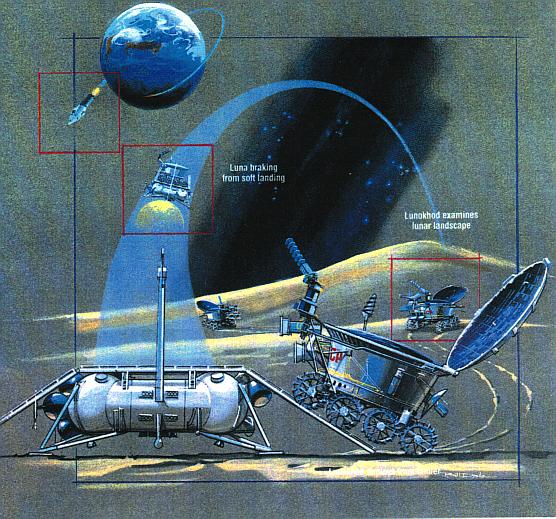
The Luna 21 spacecraft landed on the Moon and deployed the second Soviet lunar rover, Lunokhod 2, in January 1973. The lander and rover together massed 1814 kg.
The primary objectives of the mission were to collect images of the lunar surface, examine ambient light levels to determine the feasibility of astronomical observations from the Moon, perform laser ranging experiments from Earth, observe solar X-rays, measure local magnetic fields, and study the soil mechanics of the lunar surface material.
''Lunokhod 2'' rover and subsystems
The rover stood 135 cm high and had a mass of 840 kg. It was about 170 cm long and 160 cm wide and had eight wheels each with an independent suspension, electric motor and brake. The rover had two speeds, about 1 and. [[File:LunokhodWheels.jpg|thumb|Detail of Lunokhod's wheels|left]] Lunokhod 2 was equipped with three television cameras, one mounted high on the rover for navigation, which could return high resolution images at different frame rates—3.2, 5.7, 10.9 or 21.1 seconds per frame. These images were used by a five-man team of controllers on Earth who sent driving commands to the rover in real time.
Power was supplied by a solar panel on the inside of a round hinged lid which covered the instrument bay, which would charge the batteries when opened. A polonium-210 radioisotope heater unit was used to keep the rover warm during the long lunar nights.
There were four panoramic cameras mounted on the rover. Scientific instruments included a soil mechanics tester, solar X-ray experiment, an astrophotometer to measure visible and ultraviolet light levels, a magnetometer deployed in front of the rover on the end of a 2.5 m (8 ft 2 in) boom, a radiometer, a photodetector (Rubin-1) for laser detection experiments, and a French-supplied laser corner reflector.
The lander carried a bas relief of Vladimir Lenin and the State Emblem of the Soviet Union.
Mission
The Proton-K/D launcher put the spacecraft into Earth parking orbit followed by translunar injection. On January 12, 1973, Luna 21 was braked into a 90 by lunar orbit. On January 13 and 14, the perilune was lowered to 16 km altitude.
Landing and surface operations

On January 15, 1973, after 40 orbits, the descent of the craft was commenced as the braking rocket was fired at 16 km altitude, and the craft began to de-orbit. At an altitude of 750 m the main thrusters began firing, slowing the fall until a height of 22 m was reached. At this point the main thrusters shut down and the secondary thrusters ignited, slowing the fall until the lander was 1.5 m above the surface, where the engine was switched off. Landing occurred at 23:35 UT in Le Monnier crater at 25.85 degrees N, 30.45 degrees E.
After landing, the Lunokhod 2 took TV images of the surrounding area, then rolled down a ramp to the surface at 01:14 UT on January 16 and took pictures of the Luna 21 lander and landing site, driving for 30 metres. After a period of charging up its batteries, it took more pictures of the site and the lander, and then set off to explore the Moon.
The rover would run during the lunar day, stopping occasionally to recharge its batteries with the solar panels. At night the rover hibernated until the next sunrise, heated by the radioactive source.
- January 18, 1973 to January 24, 1973: The rover drives 1,260 metres
- February 8 to 23: The rover drives 9,086 metres further
- March 11 to 23: The rover drives 16,533 metres further
- April 9 to 22: The rover drives 8,600 metres further
- May 8 to June 3: The rover drives 880 metres further
End of mission
On June 4, 1973, it was announced that the program was completed, leading to speculation that the vehicle probably failed in mid-May or could not be revived after the lunar night of May–June.
More recently, Alexander Basilevsky related an account in which on May 9, the rover's open lid touched a crater wall and became covered with dust. When the lid was closed, this dust (a very good insulator) was dumped on to the radiators. The following day, May 10, controllers saw the internal temperature of Lunokhod 2 climb as it was unable to cool itself, eventually rendering the rover inoperable. On May 11, signal from the rover was lost.
Results

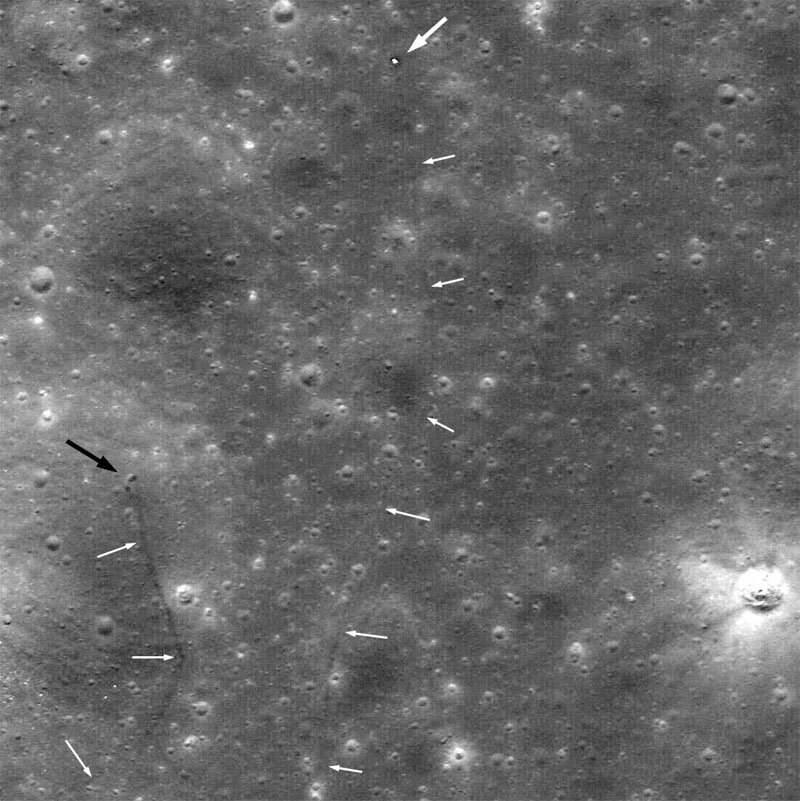
Lunokhod 2 operated for about four months, and the original estimate was that it covered 37 km of terrain, including hilly upland areas and rilles, and sent back 86 panoramic images and over 80,000 TV pictures. Many mechanical tests of the surface, laser ranging measurements, and other experiments were completed during this time. Lunokhod 2 was thought to have covered 37 km based on wheel rotations but Russian scientists at the Moscow State University of Geodesy and Cartography (MIIGAiK) revised that to an estimated distance of about 42.1-42.2 km based on Lunar Reconnaissance Orbiter (LRO) images of the lunar surface. Subsequent discussions with their American counterparts ended with an agreed-upon final distance of 39 km; an international team has confirmed that the methods used to calculate the two rovers' odometry is consistent and comparable from the Moon to Mars.
Lunokhod 2 held the record for off-Earth roving distance until July 27, 2014, when NASA's Mars Opportunity rover exceeded it after having traveled over 40 km.
Current status
Lunokhod 2 continues to be detected by lunar laser ranging experiments and its position is known to sub-meter accuracy. On March 17, 2010, Phil Stooke at the University of Western Ontario announced that he had located Lunokhod 2 in NASA Lunar Reconnaissance Orbiter (LRO) images, Excellent Lunokhod 2 images from LROC were published by Mark Robinson on SESE site of ASU.
Present ownership
Ownership of Lunokhod 2 and the Luna 21 lander was sold by the Lavochkin Association for $68,500 in December 1993 at a Sotheby's auction in New York. (The catalog incorrectly lists lot 68A as Luna 17/Lunokhod 1).
The buyer was computer game entrepreneur and space tourist Richard Garriott (son of the astronaut Owen K. Garriott), who stated in a 2001 interview with ''Computer Games Magazine'''s Cindy Yans that:
:I purchased Lunakod 21 from the Russians. I am now the world's only private owner of an object on a foreign celestial body. Though there are international treaties that say, no government shall lay claim to geography off planet earth, I am not a government. Summarily, I claim the moon in the name of Lord British!
Garriott later confirmed that he is the owner of Lunokhod 2.
References
References
- [https://solarsystem.nasa.gov/missions/lunokhod-02/in-depth/ Lunokhod 02] {{Webarchive. link. (April 18, 2021 , NASA Solar System Exploration; page updated March 15, 2018. Retrieved May 31, 2018.)
- NSSDC Catalog, [https://nssdc.gsfc.nasa.gov/nmc/spacecraft/display.action?id=1973-001A Luna 21/Lunokhod 2], version March 21, 2017. Retrieved May 31, 2018.
- (January 1, 1975). "Laser observations of the moon: Normal points for 1973". NTRS.
- Andrew Chaikin. (March 1, 2004). ["The Other Moon Landings"](http://www.airspacemag.com/space/the-other-moon-landings-6457729/ ). [[Air & Space/Smithsonian]].
- Lewis Page. (March 16, 2012). "New NASA snap of game developer's electric cart FOUND ON MOON: Probe in low pass over Garriott's radioactive tub-rover".
- (March 13, 2012). "Lunokhod 2 Revisited". NASA.
- (June 21, 2013). "Is Opportunity near Lunokhod's distance record? Not as close as we used to think!". [[The Planetary Society]].
- (June 19, 2013). "Space rovers in record race". [[Nature News]].
- Sutherland, Scott (July 29, 2014) [http://www.theweathernetwork.com/news/articles/its-official-nasa-confirms-mars-opportunity-rover-has-broken-the-off-world-driving-record/32813/ It's Official! NASA confirms Mars Opportunity rover has broken the off-world driving record]. theweathernetwork.com
- Robinson, Mark (May 23, 2014) [http://lroc.sese.asu.edu/posts/774 Trundling Across the Moon]. sese.asu.edu
- Wall, Mike (July 29, 2014) [http://www.cbsnews.com/news/nasas-mars-rover-opportunity-breaks-off-world-driving-record/ NASA's Mars rover ''Opportunity'' breaks off-world driving record]. Space.com
- (July 28, 2014). "NASA Long-Lived Mars Opportunity Rover Sets Off-World Driving Record". [[NASA]].
- Knapp, Alex. (July 29, 2014). "NASA's Opportunity Rover Sets A Record For Off-World Driving". [[Forbes]].
- "Lunar Geophysics, Geodesy, and Dynamics". ilrs.gsfc.nasa.gov.
- "Russian Lunar Rover Found: 37-Year-Old Space Mystery Solved".
- David, Leonard. (March 18, 2010). "NASA Lunar Orbiter Spots Old Soviet Moon Landers".
- but later images showed the initial identification was incorrect (the identified point was a mark in the rover tracks near the end of the route, made as ''Lunokhod 2'' turned around), and the LRO LROC team identified the correct location of the rover in March 2012.NASA, [https://www.nasa.gov/content/lroc-coordinates-of-robotic-spacecraft-2013-update/ LROC Coordinates of Robotic Spacecraft 2013], Update September 25, 2013. Retrieved May 31, 2018.
- Mark Robinson, "[http://lroc.sese.asu.edu/posts/699 Lunokhod 2 Revisited"], LROC, SSE, Arizona State University. Retrieved May 31, 2018.
- Sotheby's Catalogue – ''Russian Space History'', Addendum, Lot 68A, December 11, 1993
- Garriott, Richard (April 13, 2001) [http://demiurg.net/games/lb/ Lord British, we hardly knew ye]. demiurg.net
- Chang, Kenneth. (March 20, 2010). "After 17 Years, a Glimpse of a Lunar Purchase". [[New York Times]].
- [http://www.collectspace.com/news/news-100207a.html The Astronaut's Son's Secret Sputnik]. CollectSPACE. October 2007
- [http://radio.seti.org/past-shows.php Are We Alone] {{webarchive. link. (December 19, 2008 . (podcast interview with SETI Institute Director Seth Shostak) December 10, 2007)
This article was imported from Wikipedia and is available under the Creative Commons Attribution-ShareAlike 4.0 License. Content has been adapted to SurfDoc format. Original contributors can be found on the article history page.
Ask Mako anything about Lunokhod 2 — get instant answers, deeper analysis, and related topics.
Research with MakoFree with your Surf account
Create a free account to save articles, ask Mako questions, and organize your research.
Sign up freeThis content may have been generated or modified by AI. CloudSurf Software LLC is not responsible for the accuracy, completeness, or reliability of AI-generated content. Always verify important information from primary sources.
Report