From Surf Wiki (app.surf) — the open knowledge base
Low-Cost Guided Imaging Rocket
South Korean 2.75-inch precision guided rocket

South Korean 2.75-inch precision guided rocket
| Field | Value | |
|---|---|---|
| name | Poniard Low-Cost Guided Imaging Rocket | |
| 비궁 지대함 유도 로켓 | ||
| image_size | 300 | |
| caption | A diagram of a Poniard guided rocket | |
| type | Surface-to-ship rocket | |
| origin | South Korea | |
| is_explosive | yes | |
| is_missile | yes | |
| service | 2017–present | |
| used_by | See *Operators* | |
| designer | Agency for Defense Development | |
| LIG Nex1 | ||
| manufacturer | {{plainlist | |
| production_date | 2016–present | |
| mass | 14 kg | |
| length | 1.9 m | |
| diameter | 70 millimeters (2.75 in) | |
| max_range | 8 km | |
| filling | High explosive | |
| filling_weight | 4 kg | |
| vehicle_range | **Detection:** | |
| 12 km | ||
| **Tracking:** | ||
| 9 km | ||
| guidance | INS/IIR with Fire-and-forget | |
| propellant | Single-stage solid propellant | |
| accuracy | 0.54 meters CEP |
비궁 지대함 유도 로켓 LIG Nex1
- LIG Nex1 (2016–present)}}
- Emirates Defence Group Estates (2022–present)}} 12 km Tracking: 9 km
The Low-Cost Guided Imaging Rocket (LOGIR; ), officially known as Poniard () is a surface-to-ship guided rocket developed by Agency for Defense Development (ADD) and LIG Nex1. The LOGIR was a weapons system under development for the US Navy as part of ONR's Low-Cost Imaging Terminal Seeker (LCITS) FNC. It transitioned as the weapon used in the Medusa Joint Capability Technology Demonstration with South Korea.
Poniard successfully passed four Foreign Comparative Testing (FCT) organized by the U.S. Department of Defense from 2019 to 2024 after achieving 100% accuracy.
Development
The program provided a precision guided 2.75 inch (70 mm) rocket for use with existing Hydra 70 systems in service, as such it has many similarities with the Advanced Precision Kill Weapon System program. The principal difference between the systems is that while APKWS uses terminal laser homing, requiring the target to be 'painted' until impact, LOGIR would guide to a position supplied by the launching aircraft, using imaging infrared in the terminal phase making it a true fire-and-forget weapon. Another advantage of LOGIR was that it was "especially effective against swarm attacks by enemies like small boats, as there’s no need for ongoing guidance."
The South Korean version, designated Poniard (), is used on the ROK Marine Corps mobile coastal defense system. Bigung is a 6×6 truck fitted with 2×18-round containers for 36 rockets to counter North Korean Fast Inshore Attack Craft (FIAC), landing craft and landing vehicles. The rockets are equipped with the LCITS using IIR imaging technology with an additional low-cost inertial correction unit. LOGIR is designed to defeat predominantly small-scale, high-speed surface targets, but because of the limited cost requirements its use for less-contrast ground targets is less effective; it has a weight below 15 kg and a length of 1.9 m with range greater than 8 km.
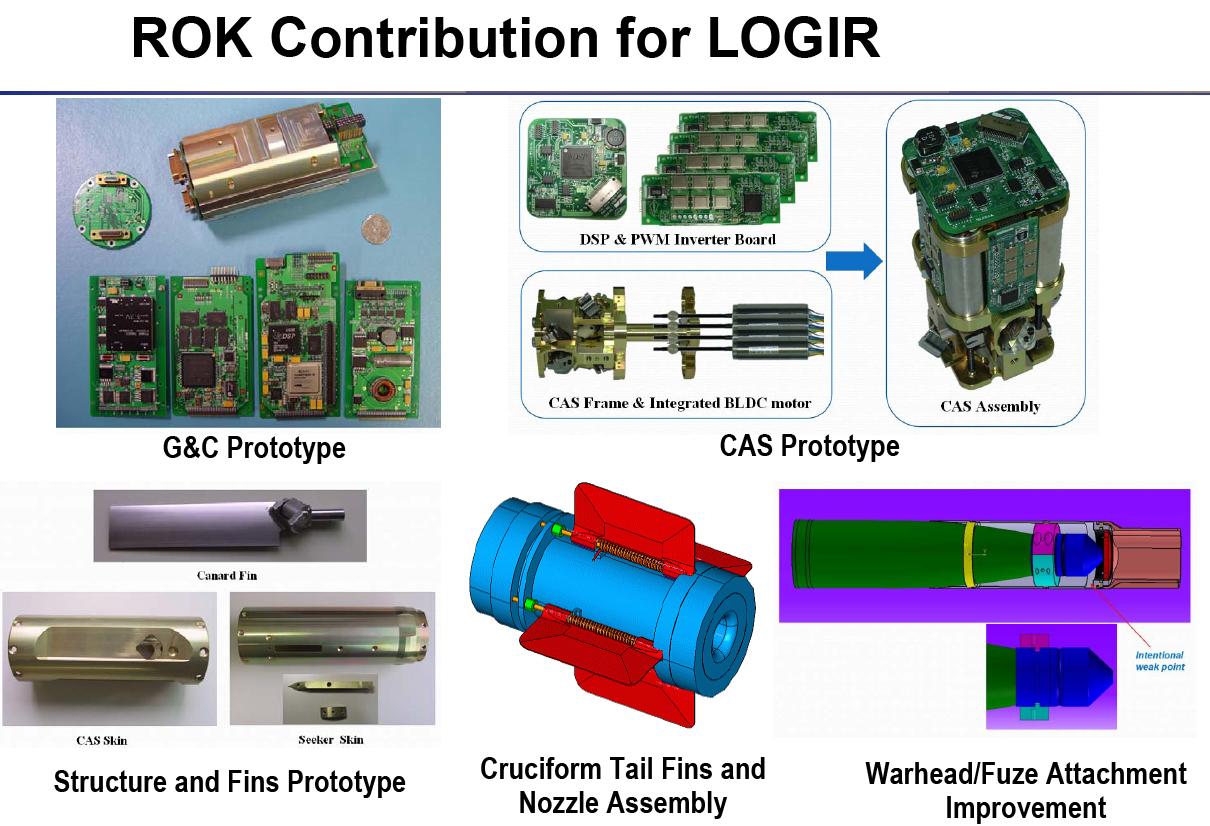
South Korea's contribution in the LOGIR program are the following:
- Electronics for guidance and control system (production only, design by the USA)
- Electronics for control actuation system (DSP and PWM inverter board)
- Assembly parts for control actuation system (CAS frame and integrated BLDC motor)
- Airframe structure and fins (canard fin, CAS skin, seeker skin)
- Cruciform tail fins and nozzle assembly
- Warhead and fuze attachment improvement
U.S. Department of Defense's low-cost rocket procurement program
In October 2019, Poniard successfully passed after 10 rockets hit all targets during a Foreign Comparative Testing (FCT) conducted at the Anheung Proving Ground in South Korea under the observation of the U.S. Department of Defense's evaluation team as part of the U.S. military's low-cost rocket procurement program.
The rocket system proved its capability by passing all four tests conducted in South Korea and Key West and San Diego and Hawaii between 2019 and 2024.
Specifications
- Mass: 14 kg
- Length: 1.9 m
- Diameter: 70 mm (2.75 in)
- Maximum range: 8 km
- Guidance: INS midcourse/Imaging infrared terminal.
- Motor: Existing Hydra 70 motors
Operators
Current operators
;Saudi Arabia
- Royal Saudi Navy
;Republic of Korea
- Republic of Korea Navy
- Republic of Korea Marine Corps
;United Arab Emirates
- United Arab Emirates Navy
References
References
- "PONIARD 2.75 inch Guided Rocket". [[LIG Nex1]].
- (October 2022). "LOGIR Guided Rocket". [[Edge Group.
- (7 April 2020). "South Korea's Poniard guided rocket system passes Pentagon's Foreign Comparative Testing". [[Janes Information Services]].
- [https://web.archive.org/web/20120927044314/http://www.navair.navy.mil/index.cfm?fuseaction=home.NAVAIRNewsStory&id=4331 LOGIR moves a step closer to the fleet]
- "APKWS II "Hellfire Jr." Hydra Rockets Enter SDD Phase - DID".
- (19 July 2024). "South Korean Guided Rocket Test-Fired from USV at RIMPAC 2024". Naval News.
- "Guided Hydra Rockets and hellfire missiles: Program Halts & New Entries - Defense Industry Daily".
- "APKWS II: Laser-Guided Hydra Rockets in Production At Last".
- [https://armyrecognition.com/adex_2017_online_show_daily_news/adex_2017_rok_marine_corps_showcasing_bigung_for_the_1st_time.html ROK Marine Corps Showcasing Bigung for the 1st Time] - Armyrecognition.com, 18 October 2017
- "ROK Contribution for LOGIR".
- "PONIARD, 2.75" GUIDED ROCKET". [[Agency for Defense Development]].
- (11 July 2022). "LIG넥스원, 세계 최대 림팩훈련 현장에서 K-방산의 위상을 높이다 - 2.75인치 유도로켓 전시". [[LIG Nex1]].
- (5 April 2023). "사우디, '천무' 이어 '비궁' 실전배치…K방산 수출 확대". Newsis.
This article was imported from Wikipedia and is available under the Creative Commons Attribution-ShareAlike 4.0 License. Content has been adapted to SurfDoc format. Original contributors can be found on the article history page.
Ask Mako anything about Low-Cost Guided Imaging Rocket — get instant answers, deeper analysis, and related topics.
Research with MakoFree with your Surf account
Create a free account to save articles, ask Mako questions, and organize your research.
Sign up freeThis content may have been generated or modified by AI. CloudSurf Software LLC is not responsible for the accuracy, completeness, or reliability of AI-generated content. Always verify important information from primary sources.
Report