From Surf Wiki (app.surf) — the open knowledge base
Lough Neagh
Freshwater lake in Northern Ireland
Freshwater lake in Northern Ireland
| Field | Value | |
|---|---|---|
| name | Lough Neagh | |
| native_name | ||
| image | Lough Neagh by Sentinel-2.jpg | |
| caption | A ESA Sentinel-2 image of Lough Neagh | |
| pushpin_map | Northern Ireland | |
| location | Northern Ireland, UK | |
| coords | ||
| type | Fresh Water Lough/Lake | |
| inflow | Upper Bann, Six Mile Water, Glenavy River, Crumlin River, Blackwater, Moyola River, Ballinderry River, River Main | |
| outflow | Lower Bann | |
| catchment | 4550 km2 | |
| basin_countries | {{plainlist | |
| length | 19 mi | |
| width | 9.3 mi | |
| area | 151 mi2 | |
| depth | 30 ft | |
| max-depth | 80 ft | |
| volume | 0.85 mi3 | |
| shore | 125 km | |
| elevation | 14.63 m | |
| islands | (see below) | |
| embedded | {{Designation list | |
| embed | yes | |
| designation1 | Ramsar | |
| designation1_offname | Lough Neagh & Lough Beg | |
| designation1_date | 5 January 1976 | |
| designation1_number | 74}} |
- Northern Ireland (91%)
- Republic of Ireland (9%)}} | max-depth = 80 ft
Lough Neagh ( ; ) is a freshwater lake in Northern Ireland and is the largest lake on the island of Ireland and in the British Isles. It has a surface area of 383 km2 and is about 19 mi long and 9 mi wide. According to Northern Ireland Water, it supplies 40.7% of Northern Ireland's drinking water.
Its main inflows are the Upper River Bann and Blackwater, and its main outflow is the Lower Bann. There are several small islands, including Ram's Island, Coney Island and Derrywarragh Island. The lake bed is owned by the 12th Earl of Shaftesbury and the lake is managed by Lough Neagh Partnership. Its name comes from Irish Loch nEachach , meaning "Eachaidh's lake".
Geography
With an area of 383 km2, it is the British Isles' largest lake by area and is ranked 34th in the list of largest lakes of Europe. Located 20 mi west of Belfast, it is about 19 mi long and 9 mi wide. It is very shallow around the margins and the average depth in the main body of the lake is about 30 ft, although at its deepest the lough is about 80 ft deep.
Geology
Geologically the Lough Neagh Basin is a depression, built from many tectonic events dating back as far as 400 million years ago. These tectonic events are responsible for a NE-SW bedrock structure which has controlled many subsequent events. During the Paleozoic era, the Lough Neagh Basin was a depositional graben.
Hydrology
Of the 4550 km2 catchment area, around 9% lies in the Republic of Ireland and 91% in Northern Ireland; altogether 43% of the land area of Northern Ireland is drained into the lough, which itself flows out northwards to the sea via the River Bann. As one of its sources is the Upper Bann, the Lough can itself be considered as part of the Bann. Lough Neagh is fed by many tributaries including the rivers Main (34 mi), Six Mile Water (21 mi), Upper Bann (40 mi), Blackwater (57 mi), Ballinderry (29 mi) and Moyola (31 mi)
The water in the lough has been monitored extensively since 1974 and has undergone considerable eutrophication and toxic algal blooms. According to a 2016 study, it "has become much enriched as a result of anthropogenic eutrophication, most of which occurred in the last century... Despite the recent changes in nutrient loading the lake is still currently classed as hypereutrophic". In 2023 and 2024, toxic algal blooms, mostly caused by agricultural run-off, spread across the lake.
Islands and peninsulas
- Coney Island
- Croaghan Island
- Derrywarragh Island
- Gartree Point
- Kinnegoe (peninsula)
- Kinturk (peninsula)
- Oxford Island (peninsula)
- Padian
- Ram's Island
- Tolans Flat
- Traad (peninsula)
Towns and villages
Towns and villages near the Lough include Craigavon, Antrim, Crumlin, Randalstown, Toomebridge, Ballyronan, Ballinderry, Moortown, Ardboe, Brockagh, Maghery, Lurgan and Magherafelt.

Counties
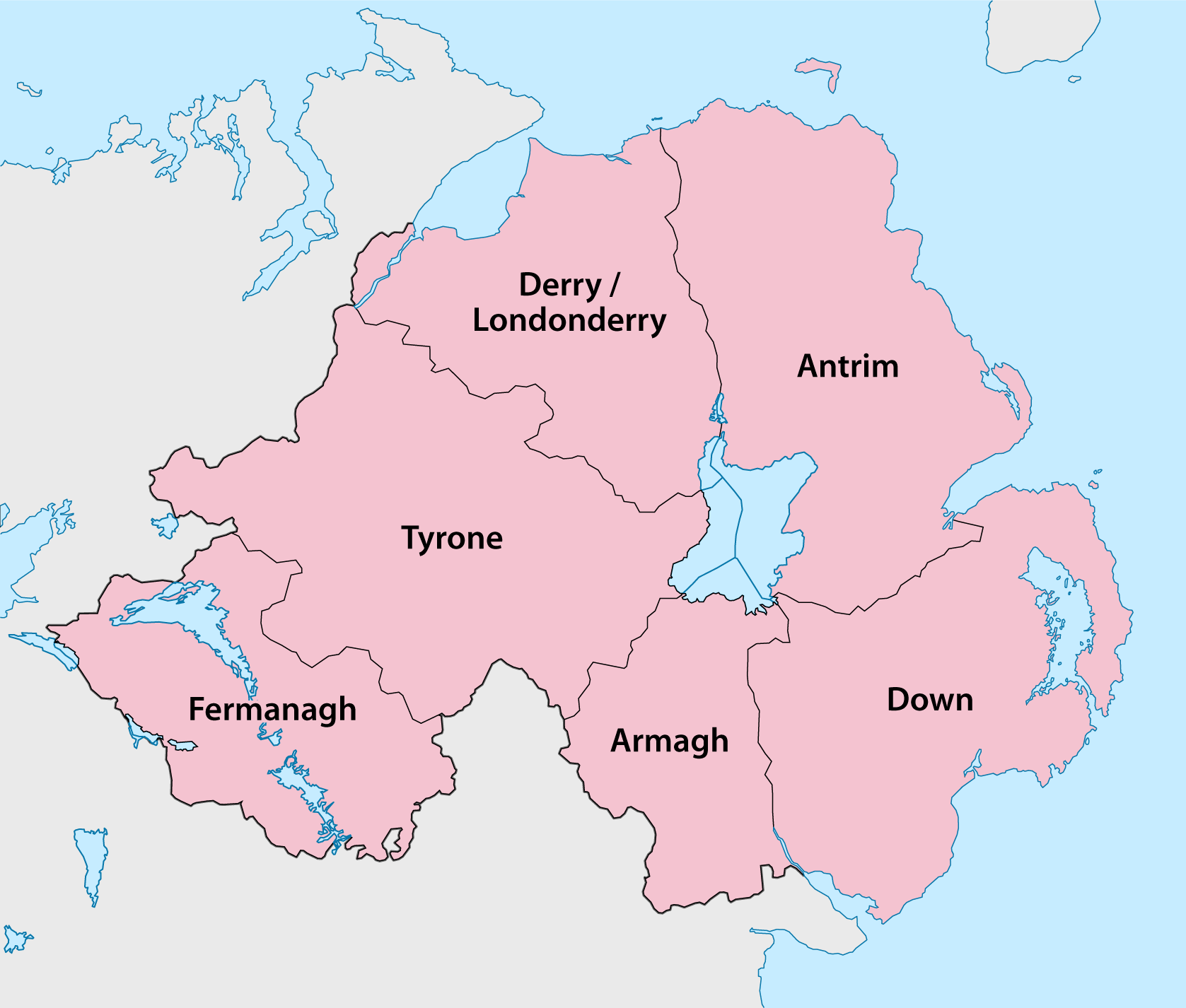
Five of the six counties of Northern Ireland have shores on the Lough (only Fermanagh does not), and its area is split among them. The counties are listed clockwise:
- Antrim (eastern side and northern shore of the lake)
- Down (small part in the south-east)
- Armagh (south)
- Tyrone (west)
- Londonderry (northern part of west shore)
Local government districts
The area of the lake is split between four local government districts of Northern Ireland, which are listed clockwise:
- 3 Antrim and Newtownabbey, in the north-east
- 4 Lisburn and Castlereagh, in the east
- 6 Armagh, Banbridge and Craigavon, in the south
- 9 Mid Ulster, in the west
Management
Lough Neagh is managed by Lough Neagh Partnership Ltd, a stakeholder group made up of elected representatives, land-owners, fishermen, sand traders and local community representatives. Lough Neagh Partnership is responsible for the lough's conservation, promotion and sustainable development together with navigation of the Lough.
Uses
Although the Lough is used for a variety of recreational and commercial activities, it is exposed and tends to get extremely rough very quickly in windy conditions.

Water supply
According to Northern Ireland Water, Lough Neagh supplies 40.7% of Northern Ireland's drinking water. There have long been plans to increase the amount of water drawn from the lough, through a new water treatment works at Hog Park Point, but these are yet to materialise. The lough's ownership by the 12th Earl of Shaftesbury has implications for planned changes to state-run domestic water services in Northern Ireland, as the lough is also used as a sewage outfall, and this arrangement is only permissible through Crown immunity.
Navigation
Traditional working boats on Lough Neagh include wide-beamed 16 to clinker-built, sprit-rigged working boats and smaller flat-bottomed "cots" and "flats". Barges, here called "lighters", were used until the 1940s to transport coal over the lough and adjacent canals. Until the 17th century, log boats (coití) were the main means of transport. Few traditional boats are left now, but a community-based group on the southern shore of the lough is rebuilding a series of working boats.
In the 19th century, three canals were constructed, using the lough to link various ports and cities: the Lagan Navigation provided a link from the city of Belfast, the Newry Canal linked to the port of Newry, and the Ulster Canal led to the Lough Erne navigations, providing a navigable inland route via the River Shannon to Limerick, Dublin and Waterford. The Lower Bann was also navigable to Coleraine and the Antrim coast, and the short Coalisland Canal provided a route for coal transportation. Of these waterways, only the Lower Bann remains open today, although a restoration plan for the Ulster Canal is currently in progress.
Lough Neagh Rescue provides a search and rescue service 24 hours a day and has three stations, situated around the lough. These are at Antrim, Ardboe and Kinnego Marinas, Kinnego being its headquarters and founding station. It is a voluntary service funded by the district councils bordering the Lough. Its members are highly trained and are a declared facility for the Maritime and Coastguard Agency which co-ordinates rescues on Lough Neagh.
Bird watching
Lough Neagh attracts birdwatchers from many nations due to the number and variety of birds which winter and summer in the boglands and shores around the lough.
Flora
The flora of the north-east of Northern Ireland includes the algae: Chara aspera, Chara globularis var. globularis, Chara globularis var. virgate, Chara vulgaris var. vulgaris, Chara vulgaris var. papillata, Tolypella nidifica var. glomerata. Records of Angiospermae include: Ranunculus flammula var. pseudoreptans, Ranunculus auricomus, Ranunculatus sceleratus, Ranunculatus circinatus, Ranunculatus peltatus, Thalictrum flavum, Thalictrum minus subsp. minus, Nymphaea alba, Ceratophyllum demersum, Subularia aquatic, Erophila verna sub. verna, Cardamine pratensis, Cardamine impatiens, Cardamine flexuosa, Rorippa palustris, Rorippa amphibia, Reseda luteola, Viola odorata, Viola reichenbachiana, Viola tricolor ssp. Violoa tricolor ssp. curtissi, Hypericum androsaemum, Hypericum maculatum, Elatine hydropiper, Silene vulgaris, Silene dioica, Saponaria officinalis, Cerastium arvense, Cerastium semidecandrum, Cerastium diffusum, Sagina nodosa, Spergularia rubra, Spergulaia rupicola, Chenopodium bonus-henricus, Chenopodium polyspermum.
Fishing
Eel fishing has been a major industry in Lough Neagh for centuries. These European eels make their way from the Sargasso Sea in the Atlantic Ocean, some 4000 mi along the Gulf Stream to the mouth of the River Bann, and then make their way into the lough. They remain there for some 10 to 15 years, maturing, before returning to the Sargasso to spawn. Today Lough Neagh eel fisheries export their eels to restaurants all over the world, and the Lough Neagh Eel has been granted Protected Geographical Status under European Union law.
Nobel laureate Seamus Heaney produced a collection of poems A Lough Neagh Sequence celebrating the eel-fishermen's traditional techniques and the natural history of their catch.
Other fish species in the lake include dollaghan —a variety of brown trout native to the lake, salmon, trout, perch and pollan; bream, gudgeon, pike and rudd are also found, but are less common.
Human history
Name
The lough's English name derives . At the start of the Plantation of Ulster, the English attempted to rename the lake 'Lough Sydney' and 'Lough Chichester', in honour of the Lord Deputies, but these did not supplant the older name.
Mythology and folklore
In the Irish mythical tale Cath Maige Tuired ("the Battle of Moytura"), Lough Neagh is called one of the twelve chief loughs of Ireland. The origin of the lake and its name is explained in an Irish tale that was written down in the Middle Ages, but is likely pre-Christian. According to the tale, the lake is named after Echaid (modern spelling: Eochaidh or Eachaidh), who was the son of Mairid (Mairidh), a king of Munster. Echaid falls in love with his stepmother, a young woman named Ébliu (Ébhlinne). They try to elope, accompanied by many of their retainers, but someone kills their horses.
In some versions, the horses are killed by Midir (Midhir), which may be another name for Ébliu's husband Mairid. Óengus (Aonghus) then appears and gives them an enormous horse that can carry all their belongings. Óengus warns that they must not let the horse rest or it will be their doom.
After reaching Ulster the horse stops and urinates, and a spring rises from the spot. Echaid builds a house there and covers the spring with a capstone to stop its overflowing. One night, the capstone is not replaced and the spring overflows, drowning Echaid and most of his family, and creating Loch n-Echach (Loch nEachach, the lake of Eachaidh).
The character Echaid refers to the Dagda, a god of the ancient Irish who was also known as Echaid Ollathair (meaning "horseman, father of all"). Ébliu, Midir and Óengus were also names of deities. Dáithí Ó hÓgáin writes that the idea of a supernatural being creating the landscape with its own body is an ancient one common to many pre-Christian cultures. A Gaelic sept called the Uí Echach ("descendants of Echaid") dwelt in the area and it is likely their name comes from the cult of the god. They gave their name to the territory of Iveagh.
Another tale tells how the lake was formed when Ireland's legendary giant Fionn mac Cumhaill (Finn McCool) scooped up a chunk of earth and tossed it at a Scottish rival. It fell into the Irish Sea, forming the Isle of Man, while the crater left behind filled with water to form Lough Neagh.
History
In 839, a group of Vikings based a fleet on Lough Neagh, where they wintered during the winter of 840. Captain of Lough Neagh Prior to the Tudor conquest of Ireland, the lough had been largely unclaimed by local Gaelic nobles, such as the O'Neill and O'Donnell dynasties. During the reign of Elizabeth I, an Englishman, Sir Hugh Clotworthy, settled near Antrim as part of the Plantation of Ulster and was granted the office of "Captain of Lough Neagh" by the Dublin Castle administration, being paid a stipend in return for maintaining boats on the lough to enforce the Crown's authority. Clotworthy was succeeded in the office by the 1st Viscount Massereene and the 2nd Viscount Massereene. In 1660, Charles II of England gave the 1st Viscount Massereene the rights to the fish and bed of the lough.
During the early seventeenth century, Sir Arthur Chichester, later created the 1st Baron Chichester, gradually laid claim to Lough Neagh during the Stuart conquest of Ulster, taking advantage of the Flight of the Earls. He first laid claim to the lough's infrastructure, then to its boats, then the shores and finally the lough in its entirety, including all relevant fishing rights. It is possible he did this without approval from James VI and I. The lough was later inherited by Edward, 1st Viscount Chichester, Sir Arthur's younger brother; Edward's descendants later married into the Shaftesbury family. In 2012, it was reported that the 12th Earl of Shaftesbury was considering transferring ownership of the lough to the Northern Ireland Assembly.
In October 2023, Lord Shaftesbury stated in an interview with BBC Northern Ireland that while he was open to selling Lough Neagh to the Northern Irish public, he would not give it away for free. He stated in the interview that "the sale is one that's borne out of an understanding that my ownership has always been very divisive and quite political and I always get blamed for things that are completely outside of my control. I feel it's often used as an excuse for political inaction and I always want to do the right thing by the people living here and what's in the best interest of the lough."
In February 2024 concerns were raised at the sudden collapse in insect numbers on the Lough and the likely effects this will have on biodiversity in the area.
Algal bloom crises
Lough Neagh underwent catastrophic cyanobacteria or blue green algae bloom events in the summer of 2023 and 2024 which reached international news channels. This has led to numerous local community and environmental organization responses, such as a mock wake for the lake being held in protest and calls for drastic action to solve the problem. The size of these algal blooms in Lough Neagh has allowed them to be visible from space. These algal blooms have the potential to have significant impacts on the lakes ecology due to the toxins they produce posing a serious risk to wildlife, including birds and fish, risking declines in populations and disrupting the food web. In addition, the growth of the algal blooms depletes oxygen in the water which can cause fish kills. There are also threats to human health from toxins and pathogens detected in the algal mats found in the lake.
These harmful algal blooms have a number factors contributing to their occurrence in Lough Neagh. The foremost contributory factor is the eutrophication of the lake with nutrients like phosphorus and nitrates which have provided suitable conditions for the algae to thrive. The lake has been classified as one of the world's most hyper-eutrophic water-bodies due to chronic eutrophication occurring over many years. Key drivers of this eutrophication are increases in nitrates and phosphates in the lake which are generally attributed to runoff from agriculture in the form of animal slurry residue of chemical fertilizer in addition to human sewage. Research has indicated that 62% of the phosphorus inputs are from agricultural origins, 24% are from wastewater treatment works and 12% are from septic tanks.
A number of other environmental factors have contributed to the occurrence of the harmful algal blooms. Climate change has contributed to increasing summer temperatures of, and sunlight intensity on, the lake, creating more suitable conditions for rapid growth of harmful algal blooms. As the lake is relatively shallow with an average depth of 9m, its temperature can increase more rapidly than other deeper lakes, making it more susceptible to algal blooms.
The invasive zebra mussel mollusc species which has invaded the lake has resulted in the lake water having greater clarity and so penetration of light. The increase in light intensity deeper in the water column has increased the chance of harmful algal blooms occurring. The zebra mussel which is a filter feeder on phytoplankton in the lake, will selectively feed on existing phytoplankton species but not on the blue green algae, creating a lower ecological competition scenario for these algae.
When the algal bloom crisis of 2023 occurred, the Northern Ireland Assembly was suspended and Northern Ireland had no functioning devolved government. The Social Democratic and Labour Party MLA Matthew O'Toole referred to the state of the lough as "a metaphor for the poisoned state of politics and governance in the North". After the Assembly and Executive were restored in February 2024, all major parties agreed that action was required to address the crisis, and by July 2024 an action plan proposed by the Minister of Agriculture, Environment and Rural Affairs, the Alliance Party's Andrew Muir had been agreed, although some aspects of the plan had to be scaled back due to resistance from the Democratic Unionist Party (DUP), whose support was required for aspects of the action plan that cut across government departments, due to the rules of power-sharing within the Northern Ireland Executive. Despite supporting the action plan, Sinn Féin MLAs voted alongside DUP members in June 2025 to oppose the proposed contents of a new Nutrients Action Programme that Muir's department was consulting on and which was promised by the Lough Neagh action plan.
Some environmental activists have argued that the lough needs to be brought into community ownership and granted rights, inspired by the global rights of nature movement.
Gallery
File:Loughneagh.jpg|Lough Neagh at Killywoolaghan, County Tyrone File:Lough Neagh - geograph.org.uk - 126920.jpg|Lough Neagh near Ardmore Point File:Lough Neagh at Shane's Castle - geograph.org.uk - 155427.jpg|Lough Neagh at Shane's Castle, County Antrim File:Lough Neagh from Gawley's Gate Quay - geograph.org.uk - 59139.jpg|Lough Neagh at Gawley's Gate, County Antrim File:Maghery Country Park - geograph.org.uk - 51880.jpg|Lough Neagh at Maghery, County Armagh File:Ballyronan Picnic area - geograph.org.uk - 226655.jpg|Lough Neagh at Ballyronan, County Londonderry
References
References
- [http://www.doeni.gov.uk/niea/nh008peatbogsulsterscotsfactsheet2007.pdf Naijural Heirship: Peat Mosses] {{webarchive. link. (6 September 2012 NI Environment and Heritage Service.)
- "Flora of Northern Ireland".
- "Lough Neagh & Lough Beg".
- (2017). "The Routledge Dictionary of Pronunciation for Current English". Taylor & Francis.
- "Lough Neagh/Loch nEathach".
- (2024-05-30). "Lough Neagh Catchment Map {{!}} Department of Agriculture, Environment and Rural Affairs".
- (10 April 2014). "Lough Neagh's future still up in air after owner meets minister". [[Belfast Telegraph]].
- "Home – Lough Neagh Partnership".
- Deirdre Flanagan and Laurance Flanagan, Irish Placenames, (Gill & Macmillan Ltd, 1994)
- R.B. Wood & R.V. Smith eds. ''Lough Neagh: The Ecology of a Multipurpose Water Resource'', Springer Science, 1993.
- "Lough Neagh". UK Environmental Change Network.
- (26 April 2015). "Lough Neagh levels | Department for Infrastructure".
- Ordnance Survey of Ireland: ''Rivers and their Catchment Basins 1958 (Table of Reference)''
- (2016). "The past and future of phytoplankton in the UK's largest lake, Lough Neagh". Ecological Indicators.
- (20 November 2023). "Lough Neagh: An ecological catastrophe".
- (2 January 2024). "Lough Neagh: The year the UK's largest lake turned green". BBC News.
- (18 September 2023). "Explainer: What is causing Lough Neagh to turn green?". Belfast Telegraph.
- (2 August 2024). "'Disgusting' smell at Lough Neagh as algae spreads". BBC News.
- Agency, Northern Ireland Statistics and Research. "statistics".
- Rebecca, Black. (31 December 2024). "Lough Neagh manager calls for water rates to be considered to help solve infrastructure and pollution problems". [[News Letter]].
- "Lough Neagh: Ulster's 'inland sea' can be a truly treacherous body of water". belfasttelegraph.
- "Your water is safe to drink". Northern Ireland Water.
- (19 May 2005). "Sudden death may impact NI water". BBC News.
- "Lough Neagh Boating Heritage Association".
- Hackney, P. 1992. ''Stewart & Corry's Flora of the North-east of Ireland.'' Third Edition. The Institute of Irish Studies, The Queen's University of Belfast. {{ISBN. 0 85389 446 9
- (24 October 2023). "DOOR".
- (1969). "A Lough Neagh Sequence". Phoenix Pamphlet Poets Press.
- "Fishing & Boats".
- William Shaw Mason ''A Statistical Account, Or Parochial Survey of Ireland, Volume II'' (1816), p219
- [[Augusta, Lady Gregory]]. [http://www.sacred-texts.com/neu/celt/gafm/gafm07.htm Part I Book III: The Great Battle of Magh Tuireadh]. ''Gods and Fighting Men'' (1904) at Sacred-Texts.com.
- Ó hÓgáin, Dáithí. ''Myth, Legend & Romance: An encyclopaedia of the Irish folk tradition''. Prentice Hall Press, 1991. p.181
- Mary McGrath, Joan C. Griffith. ''The Irish Draught Horse: A History''. Collins, 2005. p.44
- "Lough Neagh Heritage – Culture – Folklore & Legends".
- (2016). "The Vikings". Penguin Books.
- (1904). "Calendar of the manuscripts of the Marquess of Ormonde, K. P., preserved at Kilkenny castle; N.S. Vol. III". HMSO.
- (17 April 1841). "Antrim Castle". James Duffy.
- (2023-10-02). "Lough Neagh: Tumultuous, tragic history, death, destruction, murder and centuries of controversy".
- (5 October 2012). "Earl of Shaftesbury does not rule out Lough Neagh sale". BBC News.
- (2023-10-03). "Will the Earl of Shaftesbury sell Lough Neagh?".
- Greene, Tommy. (2024-02-19). "'Like the flip of a switch, it's gone': has the ecosystem of the UK's largest lake collapsed?". The Guardian.
- (2023-10-24). "Britain and Ireland's largest lake is dying in plain sight". Nature.
- Greene, Tommy. (2023-08-23). "Lough Neagh 'dying in plain sight' due to vast algal blooms". The Guardian.
- (2024-09-02). "'It's in total collapse': Activists call for urgent action to tackle environmental crisis at Lough Neagh".
- (2023-09-17). "Lough Neagh: Environmentalists hold 'wake' after algal blooms".
- Greene, Tommy. (2023-08-23). "Lough Neagh 'dying in plain sight' due to vast algal blooms". The Guardian.
- (2024-08-01). "Unprecedented Harmful algal bloom in the UK and Ireland's largest lake associated with gastrointestinal bacteria, microcystins and anabaenopeptins presenting an environmental and public health risk". Environment International.
- Davies, Olivia. (2024-06-27). "Algal Blooms and Lough Neagh".
- "Degradation of Water Quality in Lough Neagh, Northern Ireland, by Diffuse Nitrogen Flux from a Phosphorus-rich Catchment {{!}} Request PDF".
- Dwyer, Orla. (2023-10-19). "Lough Neagh: How climate change intensified toxic algae on the UK's largest lake".
- Cave, S., Allen, M., & Research and Information Service. (2023). An overview of algal bloom in Lough Neagh. In ''NIAR 138-23 Briefing Paper'' (pp. 1–4) [Report].
https://www.niassembly.gov.uk/globalassets/documents/raise/publications/2022-2027/2024/aera/0624.pdf - (2020-10-02). "RePhoKUs Report (Oct 2020)".
- The Lough Neagh Report: Blue Green algae and water quality in Northern Ireland. (2024). In ''The Lough Neagh Report''.
https://www.daera-ni.gov.uk/sites/default/files/publications/daera/Lough%20Neagh%20Report%20and%20Action%20Plan.pdf - John, Patrizia. (14 July 2025). "Beyond Groups? Consociational Culture and the Representation of Cross‐Segmental Interests". Swiss Political Science Review.
- (11 April 2025). "Are the Rights of Nature the Only Way to Save Lough Neagh?". The Political Quarterly.
- Agarin, Timofey. (2025-11-23). "The environment as a second policy dimension in a deeply divided society: The politics of Northern Ireland’s Lough Neagh crisis". The British Journal of Politics and International Relations.
- Doran, Peter. (1 December 2024). "Are Lough Neagh and the rights of nature the unfinished business of 'the peace process'?". Administration.
- Corr, Shauna. (28 February 2024). "Lough Neagh: Partnership considering 'rights of nature' for hard hit lake".
This article was imported from Wikipedia and is available under the Creative Commons Attribution-ShareAlike 4.0 License. Content has been adapted to SurfDoc format. Original contributors can be found on the article history page.
Ask Mako anything about Lough Neagh — get instant answers, deeper analysis, and related topics.
Research with MakoFree with your Surf account
Create a free account to save articles, ask Mako questions, and organize your research.
Sign up freeThis content may have been generated or modified by AI. CloudSurf Software LLC is not responsible for the accuracy, completeness, or reliability of AI-generated content. Always verify important information from primary sources.
Report