From Surf Wiki (app.surf) — the open knowledge base
London to Brighton Veteran Car Run
Annual automobile-driving event in England

Annual automobile-driving event in England
_Clément-Panhard.jpg)

The London to Brighton Veteran Car Run is the world's longest-running motoring event, held on a course between London () and Brighton (), England. To qualify, participating cars must have been built before 1905. It is also the world's largest gathering of veteran cars. The first edition, "The Emancipation Run" in 1896, celebrated the recently passed Locomotives on Highways Act 1896, which liberalised motor vehicle laws in the United Kingdom.

The run has taken place most years since its initial revival in 1927. It currently takes place on the first Sunday in November, starting at sunrise, about 7:00 AM, in Hyde Park, London, and mostly following the old A23 road to the finish at Brighton – a distance of 54 mi. There is one official stops along the way: Crawley (for coffee) and Preston Park (in a suburb of Brighton). Preston Park is the official finishing point; the cars then proceed to Madeira Drive on the seafront, the venue for Brighton's Official Finishing Point.
The event is organized on behalf of the Royal Automobile Club, who emphasise that the event is not a race – they do not even publish the order in which cars finish, and participants are not permitted to exceed an average speed of 20 mph. Any that finish before 4:30 PM are awarded a medal.
There are a few other events preceding the Veteran Car Run, such as the Motoring Forum, the Veteran Car Run Sale, a motor show, and a participant reception.
History
1896 Emancipation Run
The first run took place on 14 November 1896, a wet Saturday. Organised by Harry John Lawson,{{cite book
The event started with a breakfast at the Charing Cross Hotel, which included the symbolic tearing in two by Lord Winchelsea of a red flag.
The competitors gathered outside the Metropole Hotel (now the Corinthia Hotel London), with the cars accompanied by a "flying escort" – estimated by one witness as "probably 10,000" – of pedal cyclists, recreational cycling having become popular with the English in the final decades of the 19th century. Louise Bazalgette, one of the earliest women motorists in Britain, was photographed at the start of the event on an Arnold motor car, with her friend Henry Hewetson.
Subsequent runs
During the next few years, Commemoration Run took place between Whitehall Place and Sheen House Club covering the distance of about 8 mi. The London to Brighton run was not staged again until 1927. Since then it has run annually, except from the onset of the Second World War up to 1947 owing to petrol rationing, and in 2020 due to the COVID-19 pandemic. With all this considered, it is the world's longest running motoring event. Since 1930, the event has been controlled by the Royal Automobile Club (RAC).
Participants
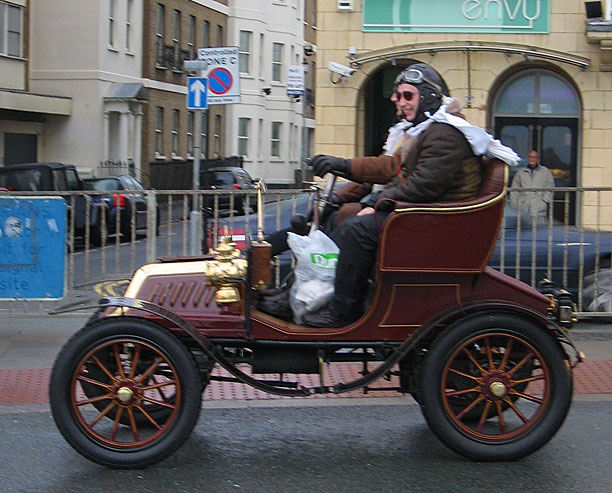
Many racing drivers and celebrities have taken part in the event, including Richard Shuttleworth (1928–1934; 1936–1938), S. C. H. "Sammy" Davis, Sir Malcolm Campbell, Prince Bira, George Eyston, Richard Seaman, Kaye Don, George Formby, Phil Hill, Stirling Moss, Jochen Mass, Nigel Mansell and Damon Hill
The 72nd anniversary run took place in 1968 and was joined by celebrity participants Prince Rainier and Princess Grace of Monaco, in a 1903 De Dion-Bouton. That year Stirling Moss also participated, driving a 1903 four-cylinder Mercedes.
Some participants dress up in a late Victorian or Edwardian style of clothing. In 1971 Queen Elizabeth II was a passenger in a 1900 Daimler. A regular participant is Prince Michael of Kent.
RAC Brighton to London Future Car Challenge
In 2010 the RAC launched the Brighton to London Future Car Challenge, following the same route as the veteran car run, but starting in Brighton and finishing at Regent Street, London – and taking place on the day prior to the veteran run. The event is intended to showcase low energy impact vehicles of various technologies – Electric, Hybrid and Low-Emission ICE (internal combustion engine). Participants compete to minimise energy consumption using "road legal" vehicles in "real world" conditions.
The results of the inaugural 2010 event showed that the electric vehicles used the least energy (0.62 MJ/km on average, or 141 mpgimp petrol equivalent), compared to the hybrid vehicles (1.14 MJ/km average, 76 mpgimp petrol equivalent) and the largely diesel powered internal combustion engine vehicles (1.68 MJ/km average, 52 mpgimp petrol equivalent).
1896 results
The event was not organised as a race, but the general classification of the fastest finishers was:
| Rank | Driver | Car | Type | Time | ||
|---|---|---|---|---|---|---|
| hours:m:s | Speed | Note | ||||
| 1 | Léon Bollée | Léon Bollée Automobiles | 3 hp tricycle, tandem 2-seater, petrol | 3:44:35 | 13.91 mph | |
| 2 | Camille Bollée | Léon Bollée Automobiles | 3 hp tricycle, tandem 2-seater, petrol | 4:00:20 | ||
| 3 | Charles Duryea | Duryea | 2 seater, petrol | |||
| 4 | Henry Finch-Hatton | Panhard & Levassor | 4 hp, 1896, 4 seat, oil | 5:01:10 | ||
| 5 | Otto Mayer | Panhard & Levassor | 4 hp, 1895, 2 seat, petrol | 6:07:30 | ||
| 6 | Émile Mayade | Panhard & Levassor | 8 hp, 1896, phaeton 4 seater, petrol | 6:08:15 |
In popular culture
- The 1953 comedy film Genevieve is set during one of these runs.
- An episode of ChuckleVision, "Wheels of Misfortune", first aired on 15 January 1997, is set during one of these runs.
- In the 100th episode of Wheeler Dealers, Mike Brewer and Edd China restored a 1903 Darracq, borrowed from the Haynes International Motor Museum, to working order and drove it in the veteran car.
Notes
References
References
- ''Motor Sport'', January 2010, Page 113.
- ''The Manchester Guardian'', 24 November 1930, Page 9; ''The Scotsman'', 15 November 1938, Page 14.
- "November 2022 – Sun in Hyde Park".
- "London to Brighton Veteran Car Run". rove.me.
- (4 November 1966). "Personal Memories of the First Brighton Run".
- (5 November 1966). "The long road south".
- "A red flag for one of motoring's most persistent myths". [[The Irish Times]].
- (2 November 1996). "Just the weather for a seaside trip". The Times/Beaulieu.
- (2004). "Bazalgette [née Seville], Louise (1845/6–1918), motorist".
- "Event Info". The Royal Automobile Club.
- Kevin Desmond, ''Richard Shuttleworth: An Illustrated Biography'', Jane’s Publishing Co Ltd., 1982, Pages 187–189.
- ''The Manchester Guardian'', 16 November 1931, Page 5.
- ''The Manchester Guardian'', 16 November 1936, Page 13.
- ''The Observer'', 20 November 1938, Page 23.
- (4 August 2004). "Wide World of Sports: Part 3".
- ''The Manchester Guardian'', 2 November 1953, Page 2.
- (6 November 2011). "Veteran cars take part in London to Brighton rally". BBC.
- Adams, Rob. (15 November 2017). "In pictures: Driving from London to Brighton in a Victorian car".
- (9 November 1968). "Fun in the Sun".
- ''The Guardian'', 25 August 1971, Page 5.
- (2011). "Comparative measurements of the energy consumption of 51 electric, hybrid and internal combustion engine vehicles". Transportation Research D.
- "TeamDan Early results database – 1896".
This article was imported from Wikipedia and is available under the Creative Commons Attribution-ShareAlike 4.0 License. Content has been adapted to SurfDoc format. Original contributors can be found on the article history page.
Ask Mako anything about London to Brighton Veteran Car Run — get instant answers, deeper analysis, and related topics.
Research with MakoFree with your Surf account
Create a free account to save articles, ask Mako questions, and organize your research.
Sign up freeThis content may have been generated or modified by AI. CloudSurf Software LLC is not responsible for the accuracy, completeness, or reliability of AI-generated content. Always verify important information from primary sources.
Report