From Surf Wiki (app.surf) — the open knowledge base
Local government in England
System of state administration on a local level in England

System of state administration on a local level in England
Local government in England broadly consists of three layers: civil parishes, local authorities, and regional authorities. Every part of England is governed by at least one local authority, but parish councils and regional authorities do not exist everywhere. In addition, there are 31 police and crime commissioners, four police, fire and crime commissioners, and ten national park authorities with local government responsibilities. Local government is not standardised across the country, with the last comprehensive reform taking place in 1974.
Local authorities cover the entirety of England, and are responsible for services such as education, transport, planning applications, and waste collection and disposal. In two-tier areas a non-metropolitan county council and two or more non-metropolitan district councils share responsibility for these services. In single-tier areas a unitary authority, London borough, or metropolitan borough provides all services. The City of London and Isles of Scilly have unique local authorities.
Some local authorities collaborate through regional authorities. Combined authorities are statutory bodies which allow two or more local authorities to voluntarily pool responsibilities and negotiate a devolution deal with the UK Government for the area they cover, giving it powers beyond those typically held by a local authority. In Greater London, the Greater London Authority (GLA) has responsibility for transport, policing, fire and rescue, development and strategic planning.
Civil parishes are the lowest tier of local government, and primarily exist in rural and smaller urban areas. The responsibilities of parish councils are limited and generally consist of providing and maintaining public spaces and facilities.
Local authorities are considered statutory corporations and have no authority to act other than where they have been explicitly allowed by law. However, since the Localism Act 2011, local authorities have had a general power of competence meaning that 'a local authority has power to do anything that individuals generally may do.'
History
Main article: History of local government in England
At a time when most parish affairs were dealt with by vestries, the Vestries Act 1831 and the Metropolis Management Act 1855 sought to establish the principle of vestries being elected by ratepayers, both men and women.
Before the Local Government Act 1888, most local government functions in England were carried out by parish vestries, Boards of Guardians, which operated workhouses and former poor law functions; elected school boards, created by the Elementary Education Act 1870, and the unelected county courts of quarter sessions. The Act of 1888 created county councils, consisting of councillors, directly elected by electors, and aldermen, chosen by the councillors. There was to be one county alderman for every three councillors (but only one for every six in the new London County Council). The first elections to the councils were held in January 1889, and on 1 April they came into their powers, most of which were taken over from the quarter sessions. Elections of all councillors and half of the aldermen took place every three years thereafter. The councils' areas were designated as administrative counties. The county councils did not cover the whole country. The larger towns and some historic counties corporate were designated as county boroughs by the same act of 1888. The new system was a major modernisation, which reflected the increasing range of functions carried out by local government in late Victorian Britain. An accretion of powers took place when education was added to county council responsibilities in 1902. County councils were responsible for the more strategic services in a county or county borough.
The Local Government Act 1894 created parish councils, which replaced the vestries, and also urban district councils and rural district councils, responsible mostly for sanitation and locally-maintained highways.
The London Government Act 1899 created 28 Metropolitan boroughs of the County of London, replacing a larger number of vestries and district boards.
The Local Government Act 1929 increased the powers of county councils, which took over from the Boards of Guardians, which were abolished. County councils also took charge of highways in rural districts.
The London Government Act 1963 abolished, with effect from 1965, the London County Council and Middlesex County Council, creating the Greater London Council to replace them. The London Government Act 1963 also established 32 London borough councils.
In 1964, as recommended by the Local Government Commission for England, two pairs of administrative counties were merged to become Cambridgeshire and Isle of Ely and Huntingdon and Peterborough.
The Local Government Act 1972 completely reorganised local authorities in England and Wales. In the six largest conurbations, metropolitan county councils, with increased powers, were created. Aldermen were abolished, and all councillors were to be elected every four years. Outside Greater London and the Isles of Scilly, the Local Government Act 1972 divided England into metropolitan and non-metropolitan counties, which would have one county council and multiple district councils each. That meant that each area would be covered by two tiers of local authorities - both a county council and a district council, which would share local authority functions.
The Greater London Council was abolished by the Local Government Act 1985. In 1986 the six metropolitan county councils were abolished, with their functions transferred to the metropolitan boroughs and joint boards.
The Local Government Act 1992 established a new Local Government Commission, to review of the structure of local administration, and the introduction of some unitary authorities. The number of county councils was reduced: The counties of Avon, Berkshire, Cleveland, Hereford and Worcester, and Humberside were abolished, while Worcestershire County Council was re-established. The Isle of Wight County Council became a unitary authority, renamed as the "Isle of Wight Council".
In May 2022, 21 non-metropolitan county councils and 164 non-metropolitan district councils remain. These are better known as simply county councils and district councils. While the metropolitan county councils were abolished in 1985, 36 metropolitan district councils still survive, as of May 2022.
Local authorities now
There are 317 local authorities (not counting parish councils) covering the whole of England. There are five main types of local authorities: London borough councils, two-tier county and district councils, metropolitan district councils and unitary authorities. Some local authorities have borough, city or royal borough status, but this is purely stylistic.
All local authorities are made up of councillors, who represent geographical wards and divisions. There are 7,026 wards as of December 2021. Local authorities run on four year cycles and councillors may be elected all at once, by halves or by thirds; although the Electoral Commission has recommended that all authorities use whole council elections every 4 years. Local authorities have a choice of executive arrangements under the Local Government Act 2000: mayor and cabinet executive, leader and cabinet executive, a committee system or bespoke arrangements approved by the Secretary of State. As of April 2023, just 15 local authorities have directly-elected mayors. Some functions are just the responsibility of the executive of a local authority, but local authorities must also have at least one overview and scrutiny committee to hold the executive to account.
There are now (as of April 2023) 62 unitary authorities. These carry out the functions of both county and district councils and have replaced two-tier local government in some areas. The creation of these first became possible under the Local Government Act 1992, but now takes place under the Local Government and Public Involvement in Health Act 2007.
In the 2023/24 financial year, 33% of budgeted service expenditure across local government as a whole is set to be on education, 19% on adult social care, 13% on police, 11% on children's social care and 24% on all other services.
Notably, Cornwall Council has been subject to a devolution deal, which are usually reserved to combined authorities for additional functions and funding. And, like some combined authorities and parish councils, local authorities do have a general power of competence. Separate to combined authorities, two or more local authorities can also work together through joint boards (for legally-required services: fire, public transport and waste disposal), joint committees (voluntarily) or through contracting out and agency arrangements.
Greater London includes the sui generis City of London Corporation and the liberties of the Middle Temple and the Inner Temple. The other sui generis local authority in England is the Council of the Isles of Scilly.
Regional government
Greater London Authority
The Greater London Authority Act 1999 established a Mayor of London and 25-member London Assembly. The first mayoral and assembly elections took place in 2000. The former Leader of the Greater London Council, Ken Livingstone, served as the inaugural Mayor, until he was defeated by future Prime Minister Boris Johnson in 2008. The incumbent, Sadiq Khan, was first elected in 2016.
The Mayor's functions include chairing Transport for London, holding the Commissioner of the Metropolitan Police and London Fire Commissioner to account and keeping strategies up to date, including the London Plan. Meanwhile, it is the Assembly's role to regularly hold the Mayor and their key advisers to account and it can also amend the budget or a strategy by a two-thirds majority, though this has not ever happened as of March 2022.
Combined authorities
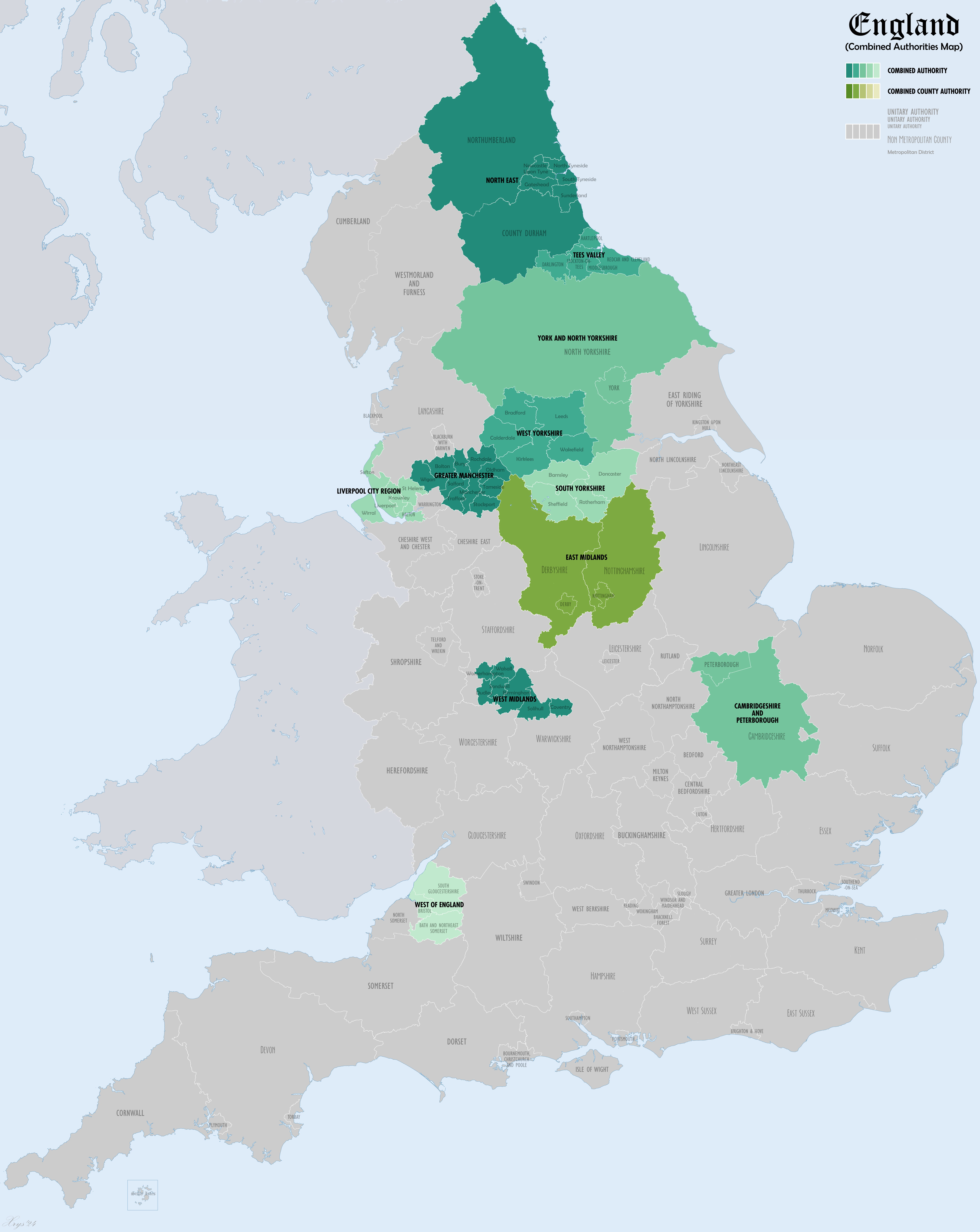
Combined authorities can be created at the request of two or more local authorities. Combined authorities do not replace the local authorities in question, but can receive separate functions and funding. As of May 2022, there are 10 combined authorities covering some of England. The Secretary of State was first granted the power to create combined authorities by the Local Democracy, Economic Development and Construction Act 2009.
The Cities and Local Government Devolution Act 2016 gave the Secretary of State the power to provide for a directly-elected combined authority mayor. And, as of May 2022, nine out of the 10 combined authorities have mayors, including Andy Burnham in Greater Manchester and Andy Street in the West Midlands. In the 2024 local elections, new Combined Authorities were elected; they were the new York and North Yorkshire Combined Authority, North East Mayoral Combined Authority, East Midlands Combined County Authority. They are all controlled by the Labour Party as of 2024 except for Tees Valley.
Each combined authority's executive consists of a representative from each of its constituent local authorities, plus (if applicable) the mayor. Functions can be devolved directly to the mayor, to the combined authority as a whole, or have a different decision-making requirement. The budget and functions of each combined authority can be vastly different, but possible functions include responsibility for the relevant police force and/or fire brigade, bus franchising and spatial strategy.
Parish councils

Parish councils form the lowest tier of local government and have some local functions in their civil parishes. They may also be called a 'community council', 'neighbourhood council', 'village council', 'town council' or (if the parish holds city status) 'city council', but these names are stylistic and do not change their responsibilities. As of December 2021 there are 10,475 parishes in England, but they do not cover the whole of the country as many urban parishes were abolished in 1974.
The only specific statutory function of parish councils, which they must do, is establishing allotments. However, there are a number of other functions given by powers in the relevant legislation, which they can do, such as providing litter bins and building bus shelters. Their statutory functions are few, but they may provide other services with the agreement of the relevant local authorities, and under the Localism Act 2011 eligible parish councils can be granted a "general power of competence" (GPC) which allows them within certain limits the freedom to do anything an individual can do provided it is not prohibited by other legislation, as opposed to being limited to the powers explicitly granted to them by law. To be eligible for this a parish council must meet certain conditions of quality.
Civil parishes developed in the nineteenth century, based on the Church of England's parishes, which had both ecclesiastical and local government functions; parish councils were created by the Local Government Act 1894 (56 & 57 Vict. c. 73), replacing the previous vestries. The ecclesiastical parishes continue to exist, but neither they nor their parochial church councils now have any local government role.
Table of authority types
| Type | Notes | Example(s) | Civil parish council | Non-metropolitan district council in a two-tier system | County council in a two-tier system | Metropolitan district council | Unitary authority | Combined authority | London borough council | Greater London Authority (GLA) | Police and crime commissioner (PCC) | Police, fire and crime commissioner (PFCC) | National park authority | Development corporation | City of London Corporation | Council of the Isles of Scilly | Governing Benchers of the Inn | Parliament of the Middle Temple | ||||
|---|---|---|---|---|---|---|---|---|---|---|---|---|---|---|---|---|---|---|---|---|---|---|
| Lowest level of local government. | Newbald Parish Council, Arlesey Parish Council, Handforth Town Council | |||||||||||||||||||||
| The only specific statutory function of parish councils, which they must do, is establishing allotments. However, there are a number of other functions given by powers in the relevant legislation, which they can do, such as providing litter bins and building bus shelters. According to the Localism Act 2011 eligible parish councils can be granted "general power of competence" (GPC) which allows them, within certain limits, the freedom to do anything an individual can do provided it is not prohibited by other legislation. | ||||||||||||||||||||||
| Type of local authority. | Epping Forest District council, Gosport Borough Council, Woking Borough Council | |||||||||||||||||||||
| Responsible for local planning and building control, local roads, council housing, environmental health, markets and fairs, refuse collection and recycling, cemeteries and crematoria, leisure services, parks, and tourism in a two-tier system. | ||||||||||||||||||||||
| Type of local authority. | Oxfordshire County Council, Nottinghamshire County Council | |||||||||||||||||||||
| Responsible for running the largest and most expensive local services such as education, social services, libraries, main roads, public transport, fire services, Trading Standards, waste disposal and strategic planning in a two-tier system. | ||||||||||||||||||||||
| Type of local authority. | Stockport Metropolitan Borough Council, Newcastle City Council, Sheffield City Council | |||||||||||||||||||||
| Metropolitan district or borough councils were originally part of a two-tier system with metropolitan county councils. They differed from non-metropolitan districts / boroughs in the division of powers between district and county councils. Metropolitan district or borough councils were local education authorities, and were also responsible for social services and libraries. | ||||||||||||||||||||||
| Type of local authority. | Plymouth City Council, Durham County Council, North Somerset Council, Slough Borough Council | |||||||||||||||||||||
| Unitary authorities combine the powers and functions that are normally delivered separately by the councils of non-metropolitan counties and non-metropolitan districts. | ||||||||||||||||||||||
| type=act | year=2016 | chapter=1 | act=Cities and Local Government Devolution Act 2016}} | Greater Manchester Combined Authority, Tees Valley Combined Authority | ||||||||||||||||||
| Combined authorities are created voluntarily and allow a group of local authorities to pool appropriate responsibility and receive certain delegated functions from central government in order to deliver transport and economic policy more effectively over a wider area. | ||||||||||||||||||||||
| Type of local authority in London only. | Tower Hamlets London Borough Council | |||||||||||||||||||||
| The London boroughs are administered by London borough councils (sometimes abbreviated LBCs), which are elected every four years. They are the principal local authorities in London and are responsible for running most local services, such as schools, social services, waste collection and roads. Some London-wide services are run by the Greater London Authority, and some services and lobbying of government are pooled within London Councils. Some councils group together for services such as waste collection and disposal. The boroughs are local government districts and have similar functions to metropolitan boroughs. Each borough council is a local education authority. | ||||||||||||||||||||||
| London only. | Greater London Authority | |||||||||||||||||||||
| The GLA has responsibility for transport, policing, fire and rescue, development and strategic planning. The GLA does not directly provide any services itself. Instead, its work is carried out by functional bodies which, together with the GLA itself, form the GLA Group and work under the policy direction of the mayor and assembly. | ||||||||||||||||||||||
| Replaced police authorities. | Hertfordshire Police and Crime Commissioner | |||||||||||||||||||||
| PCCs are responsible for ensuring an effective police force within their area, and to hold the chief constable to account for the delivery of the police and crime plan. Police and crime commissioners are hold the police fund (from which all policing of the area is financed) and are able to raise the local policing precept from council tax. Police and crime commissioners are also responsible for the appointment, suspension and dismissal of the Chief Constable. | ||||||||||||||||||||||
| Replaced police authorities and fire authorities. | Essex Police, Fire and Crime Commissioner | |||||||||||||||||||||
| Same as PCC, with additional responsibility for Fire and Rescue. | ||||||||||||||||||||||
| type=act | year=1995 | chapter=25 | act=Environment Act 1995 | section=63}} | Peak District National Park Authority | |||||||||||||||||
| Responsible for maintenance of a national park. | ||||||||||||||||||||||
| Middlesbrough Development Corporation | ||||||||||||||||||||||
| Holds planning powers over a specific area and is awarded funding for urban regeneration. | ||||||||||||||||||||||
| Sui generis body for the City of London. | ||||||||||||||||||||||
| Sui generis body for the Isles of Scilly. | ||||||||||||||||||||||
| Sui generis body for the Inner Temple. | ||||||||||||||||||||||
| Sui generis body for the Middle Temple. |
Funding
In England, local authorities have three main sources of funding: UK Government grants, council tax and business rates. In the financial year 2019/20, local authorities received 22% of their funding from grants, 52% from council tax and 27% from retained business rates. In the financial year 2023/24, 51% of revenue expenditure is expected to come from UK Government grants, 31% from council tax and 15% from retained business rates.
Local government can also receive some money from fees and charges for the use of services, returns and interest from investments, commercial income, fixed penalty notices and capital receipts. The Information Commissioner's Office has ruled that there is a public interest in disclosing information about local government investments which will generally outweigh any concerns about whether disclosure could affect an investment's performance or be protected by confidentiality requirements.
Local authorities cannot borrow money to finance day-to-day spending and so must rely on yearly income or reserves for this type of expenditure, although they can borrow to fund capital expenditure.
Local government in England as a whole has limited revenue-raising powers compared to other G7 countries.
UK Government grants
In the 20th century, local authorities found that the costs of providing services exceeded the revenues raised from local taxes and so grants from the UK Government (specifically the Treasury) gradually increased. However, UK Government grants were cut by 40% in real terms between the financial years 2009/10 and 2019/20, although grant income did grow due to the COVID-19 pandemic.
Local government receives two types of grants: the Revenue Support Grant, which can be spent on any service according to the wishes of the local government body in question, and specific grants, which are usually 'ring fenced' to specifically defined service areas.
Council tax
Main article: Council Tax
Council tax was introduced in 1993 to replace the 'poll tax'. It is a domestic property tax, based on eight bands (A to H) depending on the value of the property on 1 April 1991. Various discounts are set out in law and exist at the discretion of billing authorities.
On a yearly basis, local government bodies review and consider whether to increase or decrease the level of council tax to fund their spending plans. The level at which a local authority can increase council tax each year without holding a local referendum is regulated by the Localism Act 2011. In every area, one local authority acts as the billing authority (the district council in two-tier areas), which prepares and collects council tax bills. Other parts of local government (like county councils in two-tier areas, police and crime commissioners, fire authorities, parish councils and combined authorities) act as precepting authorities, which notify the relevant billing authority of their decision on council tax and later receive this money from the billing authority.
Between financial years 2009/10 and 2021/22, council tax rates increased by 30% in real terms, in light of reduced grants from the UK Government.
Business rates
Main article: Business rates in England
Business rates is a tax on business premises. It is based on the rateable value of the premises (set by the Valuation Office Agency) and a business rate multiplier. It is set and collected by billing authorities.
Reforms in 2013 now mean that local authorities keep 50% of business rate revenues raised locally. The UK Government then distributes the remaining 50% of business rate revenues according to its own judgement. It was initially planned to increase the proportion of business rates that local authorities retain to 100%, but this was indefinitely delayed in 2021.
Criticisms
In 2022, the Public Administration and Constitutional Affairs Committee said that it had "significant concerns about the current governance arrangements for England":If the people within government are unsure at times where powers and responsibility, and hence accountability, rest, this lack of clarity is magnified for individuals who have little knowledge or experience of the structures. This has the potential to leave individuals less likely to be able to access what they need from government, leaving them often unable to know who is responsible, and as a result are not properly able to hold their democratic representatives to account.
The Committee also said that "[t]he evidence is clear both practically and democratically that the overly centralised arrangements of government in England are problematic" and that reform was also needed of funding structures.
Administrative hierarchy
As of March 2025, the various combined authorities, county, district, and sui generis councils formed an administrative hierarchy as shown in the table below. Unitary authorities are legally either district councils which also perform county functions or county councils which also perform district functions; they therefore straddle the county and district columns. Metropolitan districts and London boroughs are also shown straddling the county and district columns. In much of the country there is also a lower tier of civil parishes. This administrative hierarchy differs from the ceremonial hierarchy.
| Combined authority | County level | District level |
|---|---|---|
| Cambridgeshire and Peterborough | Cambridgeshire | Cambridge |
| East Cambridgeshire | ||
| Fenland | ||
| Huntingdonshire | ||
| South Cambridgeshire | ||
| Peterborough | ||
| Devon and Torbay | Devon | East Devon |
| Exeter | ||
| Mid Devon | ||
| North Devon | ||
| South Hams | ||
| Teignbridge | ||
| Torridge | ||
| West Devon | ||
| Torbay | ||
| East Midlands | Derby | |
| Derbyshire | Amber Valley | |
| Bolsover | ||
| Chesterfield | ||
| Derbyshire Dales | ||
| Erewash | ||
| High Peak | ||
| North East Derbyshire | ||
| South Derbyshire | ||
| Nottingham | ||
| Nottinghamshire | Ashfield | |
| Bassetlaw | ||
| Broxtowe | ||
| Gedling | ||
| Mansfield | ||
| Newark and Sherwood | ||
| Rushcliffe | ||
| Greater Lincolnshire | Lincolnshire | Boston |
| Lincoln | ||
| East Lindsey | ||
| North Kesteven | ||
| South Holland | ||
| South Kesteven | ||
| West Lindsey | ||
| North Lincolnshire | ||
| North East Lincolnshire | ||
| Greater Manchester | Bolton | |
| Bury | ||
| Manchester | ||
| Oldham | ||
| Rochdale | ||
| Salford | ||
| Stockport | ||
| Tameside | ||
| Trafford | ||
| Wigan | ||
| Hull and East Yorkshire | Hull | |
| East Riding of Yorkshire | ||
| Lancashire | Blackburn with Darwen | |
| Blackpool | ||
| Lancashire | Burnley | |
| Chorley | ||
| Fylde | ||
| Hyndburn | ||
| Lancaster | ||
| Pendle | ||
| Preston | ||
| Ribble Valley | ||
| Rossendale | ||
| South Ribble | ||
| West Lancashire | ||
| Wyre | ||
| Liverpool City Region | Halton | |
| Knowsley | ||
| Liverpool | ||
| St Helens | ||
| Sefton | ||
| Wirral | ||
| London | Barking and Dagenham | |
| Barnet | ||
| Bexley | ||
| Brent | ||
| Bromley | ||
| Camden | ||
| Croydon | ||
| Ealing | ||
| Enfield | ||
| Greenwich | ||
| Hackney | ||
| Hammersmith and Fulham | ||
| Haringey | ||
| Harrow | ||
| Havering | ||
| Hillingdon | ||
| Hounslow | ||
| Islington | ||
| Kensington and Chelsea | ||
| Kingston upon Thames | ||
| Lambeth | ||
| Lewisham | ||
| London (City) | ||
| Merton | ||
| Newham | ||
| Redbridge | ||
| Richmond upon Thames | ||
| Southwark | ||
| Sutton | ||
| Tower Hamlets | ||
| Waltham Forest | ||
| Wandsworth | ||
| Westminster | ||
| North East | Durham | |
| Gateshead | ||
| Newcastle upon Tyne | ||
| North Tyneside | ||
| Northumberland | ||
| South Tyneside | ||
| Sunderland | ||
| South Yorkshire | Barnsley | |
| Doncaster | ||
| Rotherham | ||
| Sheffield | ||
| Tees Valley | Darlington | |
| Hartlepool | ||
| Middlesbrough | ||
| Redcar and Cleveland | ||
| Stockton-on-Tees | ||
| West Midlands | Birmingham | |
| Coventry | ||
| Dudley | ||
| Sandwell | ||
| Solihull | ||
| Walsall | ||
| Wolverhampton | ||
| West of England | Bath and North East Somerset | |
| Bristol | ||
| South Gloucestershire | ||
| West Yorkshire | Bradford | |
| Calderdale | ||
| Kirklees | ||
| Leeds | ||
| Wakefield | ||
| York and North Yorkshire | North Yorkshire | |
| York | ||
| rowspan=191 | Bedford | |
| Bournemouth, Christchurch and Poole | ||
| Bracknell Forest | ||
| Brighton and Hove | ||
| Buckinghamshire | ||
| Central Bedfordshire | ||
| Cheshire East | ||
| Cheshire West and Chester | ||
| Cornwall | ||
| Cumberland | ||
| Dorset | ||
| East Sussex | Eastbourne | |
| Hastings | ||
| Lewes | ||
| Rother | ||
| Wealden | ||
| Essex | Basildon | |
| Braintree | ||
| Brentwood | ||
| Castle Point | ||
| Chelmsford | ||
| Colchester | ||
| Epping Forest | ||
| Harlow | ||
| Maldon | ||
| Rochford | ||
| Tendring | ||
| Uttlesford | ||
| Gloucestershire | Cheltenham | |
| Cotswold | ||
| Forest of Dean | ||
| Gloucester | ||
| Stroud | ||
| Tewkesbury | ||
| Hampshire | Basingstoke and Deane | |
| East Hampshire | ||
| Eastleigh | ||
| Fareham | ||
| Gosport | ||
| Hart | ||
| Havant | ||
| New Forest | ||
| Rushmoor | ||
| Test Valley | ||
| Winchester | ||
| Herefordshire | ||
| Hertfordshire | Broxbourne | |
| Dacorum | ||
| East Hertfordshire | ||
| Hertsmere | ||
| North Hertfordshire | ||
| St Albans | ||
| Stevenage | ||
| Three Rivers | ||
| Watford | ||
| Welwyn Hatfield | ||
| Isle of Wight | ||
| Isles of Scilly | ||
| Kent | Ashford | |
| Canterbury | ||
| Dartford | ||
| Dover | ||
| Folkestone and Hythe | ||
| Gravesham | ||
| Maidstone | ||
| Sevenoaks | ||
| Swale | ||
| Thanet | ||
| Tonbridge and Malling | ||
| Tunbridge Wells | ||
| Leicester | ||
| Leicestershire | Blaby | |
| Charnwood | ||
| Harborough | ||
| Hinckley and Bosworth | ||
| Melton | ||
| North West Leicestershire | ||
| Oadby and Wigston | ||
| Luton | ||
| Medway | ||
| Milton Keynes | ||
| Norfolk | Breckland | |
| Broadland | ||
| Great Yarmouth | ||
| King's Lynn and West Norfolk | ||
| North Norfolk | ||
| Norwich | ||
| South Norfolk | ||
| North Northamptonshire | ||
| North Somerset | ||
| Oxfordshire | Cherwell | |
| Oxford | ||
| South Oxfordshire | ||
| Vale of White Horse | ||
| West Oxfordshire | ||
| Plymouth | ||
| Portsmouth | ||
| Reading | ||
| Rutland | ||
| Shropshire | ||
| Slough | ||
| Somerset | ||
| Southampton | ||
| Southend-on-Sea | ||
| Staffordshire | Cannock Chase | |
| East Staffordshire | ||
| Lichfield | ||
| Newcastle-under-Lyme | ||
| South Staffordshire | ||
| Stafford | ||
| Staffordshire Moorlands | ||
| Tamworth | ||
| Stoke-on-Trent | ||
| Suffolk | Babergh | |
| East Suffolk | ||
| Ipswich | ||
| Mid Suffolk | ||
| West Suffolk | ||
| Surrey | Elmbridge | |
| Epsom and Ewell | ||
| Guildford | ||
| Mole Valley | ||
| Reigate and Banstead | ||
| Runnymede | ||
| Spelthorne | ||
| Surrey Heath | ||
| Tandridge | ||
| Waverley | ||
| Woking | ||
| Swindon | ||
| Telford and Wrekin | ||
| Thurrock | ||
| Warrington | ||
| Warwickshire | North Warwickshire | |
| Nuneaton and Bedworth | ||
| Rugby | ||
| Stratford-on-Avon | ||
| Warwick | ||
| West Berkshire | ||
| West Northamptonshire | ||
| West Sussex | Adur | |
| Arun | ||
| Chichester | ||
| Crawley | ||
| Horsham | ||
| Mid Sussex | ||
| Worthing | ||
| Westmorland and Furness | ||
| Wiltshire | ||
| Windsor and Maidenhead | ||
| Wokingham | ||
| Worcestershire | Bromsgrove | |
| Malvern Hills | ||
| Redditch | ||
| Worcester | ||
| Wychavon | ||
| Wyre Forest |
References
eo:Loka regado kaj administrado en Britio
References
- "Find your PCC".
- UK, National Parks. "Planning and Affordable Housing".
- "Local Government Act 2000".
- Eric Pickles. (13 December 2010). "Localism Act 2011".
- Edwards, John. (1955). "'County' in Chambers's Encyclopedia". George Newnes.
- Local Government Act 1888 c.41
- (14 January 1889). "The County Council Elections". [[The Times]].
- (21 January 1889). "The County Councils". [[The Times]].
- [[Education Act 1902]], c. 42
- [https://archive.org/details/lrpgsv36v371899/page/n45 London Government Act 1899], archive.org, accessed 21 August 2025
- Local Government Act 1929, c.17
- {{Cite legislation UK. (1963)
- {{Cite legislation UK. (1963)
- The Cambridgeshire and Isle of Ely Order (SI 1964/366), The Huntingdon and Peterborough Order 1964 (SI 1964/367)
- {{Cite legislation UK. (1972)
- {{Cite legislation UK. (1985)
- [[Local Government Act 1985]], c.51
- [http://www.legislation.gov.uk/id/uksi/1994/1210 The Isle of Wight (Structural Change) Order 1994, accessed January 9, 2011]
- "Local government structure and elections".
- "List of councils in England by type".
- "English Councils 2021 (Total 331)".
- (1 March 2022). "Wards (December 2021) GB BFE".
- (2004). "The cycle of local government elections in England Report and recommendations". The [[Electoral Commission]].
- Sandford, Mark. (21 May 2021). "Directly-elected mayors".
- {{Cite legislation UK. (2000)
- {{Cite legislation UK. (2000)
- Sandford, Mark. (22 July 2021). "Unitary local government".
- {{Cite legislation UK. (1992)
- {{Cite legislation UK. (2007)
- (22 June 2023). "Local authority revenue expenditure and financing: 2023-24 budget, England".
- "Devolution deals".
- Sandford, Mark. (20 September 2021). "The General Power of Competence".
- (2011). "Local Government in the United Kingdom". [[Palgrave Macmillan]].
- {{Cite legislation UK. (1998)
- {{Cite legislation UK. (1999)
- Sandford, Mark. (3 March 2022). "The Greater London Authority".
- "Board Members".
- {{Cite legislation UK. (1972). (1999)
- {{Cite legislation UK. (1999)
- Sandford, Mark. (17 December 2019). "Combined authorities".
- {{Cite legislation UK. (2016)
- {{Cite legislation UK. (2016)
- Henderson, Duncan. (2024-06-21). "English devolution".
- Sandford, Mark. (10 February 2022). "Devolution to local government in England".
- {{Cite legislation UK. (1972)
- {{Cite legislation UK. (1972)
- (1 April 2022). "Parishes (December 2021) EW BFE".
- Association of Council Secretaries and Solicitors. "Powers and Functions of Parish Councils".
- "The General Power of Competence". Local Government Association.
- {{Cite legislation UK. (2012)
- {{Cite EB1911. .
- "bridekirkparish.org.uk".
- Association of Council Secretaries and Solicitors. (2007). "Powers and Functions of Parish Councils". Association of Council Secretaries and Solicitors.
- {{Cite legislation UK. (2011)
- {{Cite legislation UK. (1972)
- {{Cite legislation UK. (1985)
- {{Cite legislation UK. (1992)
- Nice, Alex. (2022-01-31). "Local government unitarisation".
- {{Cite legislation UK. (2016)
- {{Cite legislation UK. (1963)
- {{Cite legislation UK. (1999)
- {{Cite legislation UK. (2007)
- {{Cite legislation UK. (2017)
- {{Cite legislation UK. (2024)
- {{Cite legislation UK. (2011)
- {{Cite legislation UK. (2017)
- {{Cite legislation UK. (1995)
- {{Cite legislation UK. (1980)
- {{Cite legislation UK. (1981)
- {{Cite legislation UK. (2011)
- {{Cite legislation UK. (1978)
- {{Cite legislation UK. (1972)
- Atkins, Graham. (10 March 2020). "Local government funding in England".
- (29 December 2019). "Councillor workbook – Local government finance".
- Thomas, Richard. (2007-02-01). "Freedom of Information Act 2000 (Section 50)".
- {{Cite legislation UK. (2011)
- [[Public Administration and Constitutional Affairs Committee]]. "Governing England".
- "Election Maps". Ordnance Survey.
This article was imported from Wikipedia and is available under the Creative Commons Attribution-ShareAlike 4.0 License. Content has been adapted to SurfDoc format. Original contributors can be found on the article history page.
Ask Mako anything about Local government in England — get instant answers, deeper analysis, and related topics.
Research with MakoFree with your Surf account
Create a free account to save articles, ask Mako questions, and organize your research.
Sign up freeThis content may have been generated or modified by AI. CloudSurf Software LLC is not responsible for the accuracy, completeness, or reliability of AI-generated content. Always verify important information from primary sources.
Report