From Surf Wiki (app.surf) — the open knowledge base
Ll
Digraph

Digraph
the letter combination
Ll or ll is a digraph that occurs in several languages.
English
In English, often represents the same sound as single : . The doubling is used to indicate that the preceding vowel is (historically) short, or that the "l" sound is to be extended longer than a single would provide (etymologically, in latinisms coming from a gemination). Different English language traditions use and in different words: for example the past tense form of "travel" is spelt "travelled" in British English but "traveled" in American English. See also: Doubled consonants. is also used in syllable-coda position in monosyllabic words or compounds derived from them, such as "will", "mall", and "killjoy"
Welsh==
In Welsh, stands for a voiceless alveolar lateral fricative sound (IPA: ). This sound is very common in place names in Wales because it occurs in the word llan, for example, , where the appears twice, or , where (in the long version of the name) the appears five times – with two instances of llan and two consecutive in -drobwllllan-.
In Welsh, is a separate digraph letter from (e.g., lwc sorts before llaw). In modern Welsh this, and other digraph letters, are written with two symbols but count as one letter. In Middle Welsh it was written with a tied ligature; this ligature is included in the Latin Extended Additional Unicode block as and . This ligature is seldom used in Modern Welsh, but equivalent ligatures may be included in modern fonts, for example the three fonts commissioned by the Welsh Government in 2020.
Romance languages
Asturian

In the standard Asturian orthography published by the Academy of the Asturian Language in 1981, represents the phoneme (palatal lateral approximant).
A variation of this digraph, , is used to separate a verb form that ends in -l and the enclitics lu, la, lo, los or les. This is pronounced as a geminated . For example, val-lo ("it is worth it").
Another variation of this digraph, , is used to represent a set of dialectal phonemes used in Western Asturian that correspond to in other dialects: (voiced retroflex plosive), (voiced retroflex affricate), (voiceless retroflex affricate) or (voiceless alveolar affricate). This may also be written as in devices that do not support the Unicode characters and .
Catalan
In Catalan, represents the phoneme , as in llengua (language, tongue), enllaç (linkage, connection), or coltell (knife).
L with middle dot
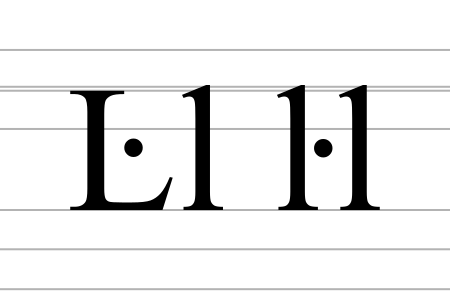
In order to not confuse with a geminated , Catalan uses a middle dot (interpunct or punt volat in Catalan) in between . For example exceŀlent ("excellent"). The first character in the digraph, and , is included in the Latin Extended-A Unicode block at U+013F (uppercase) and U+0140 (lowercase) respectively.
In Catalan typography, is intended to fill two spaces, not three, so the interpunct is placed in the narrow space between the two s: and . However, it is common to write and , occupying three spaces. and , although sometimes seen, are incorrect.
Galician
In official Galician spelling the combination stands for the phoneme (palatal lateral approximant, a palatal counterpart of ).
Spanish
In Spanish, was considered from 1754 to 2010 the fourteenth letter of the Spanish alphabet because of its representation of a palatal lateral articulation consonant phoneme (as defined by the Royal Academy of the Spanish Language).
- The digraph is called elle, pronounced , , etc. in different dialects.
- The letter was collated after as a separate entry from 1803 until April 1994 when the X Congress of the Association of Spanish Language Academies adopted standard Latin alphabet collation rules. Since then, the digraph has been considered a sequence of two characters. (A similar situation occurred with the Spanish-language digraph ch.)
- Hypercorrection leads some to wrongly capitalize as a single letter, as with the Dutch IJ, for example *LLosa instead of Llosa. In handwriting, is written as a ligature of two s, with distinct uppercase and lowercase forms.
- Today, most Spanish speakers pronounce and as the same sound, a phenomenon called yeísmo. In much of the Spanish-speaking Americas, and in many regions of Spain, and are pronounced (voiced palatal fricative); speakers in Colombia and Tabasco, Mexico, as well as Rioplatense speakers in both Argentina and Uruguay, pronounce and as (voiced postalveolar fricative) or (voiceless postalveolar fricative). The original pronunciation of —the phoneme (palatal lateral approximant)— still exists in northern Spain (mostly in rural areas) and in Andes Mountains. In parts of Colombia and in the Andean regions of Ecuador, is pronounced but is pronounced .
Philippine languages
While Philippine languages like Tagalog and Ilocano write or when spelling Spanish loanwords, still survives in proper nouns. However, the pronunciation of is simply rather than . Hence the surnames Llamzon, Llamas, Padilla, Bellen, Basallote and Villanueva are respectively pronounced /, , , , and /.
Furthermore, in Ilocano represents a geminate alveolar lateral approximant , like in Italian.
Icelandic
In Icelandic, the can represent (similar to a voiceless alveolar lateral affricate), {{IPA| [ɬ]}} or depending on which letters surround it. appears in fullur ("full", masculine), appears in fullt ("full", neuter), and appears in fulls ("full", neuter genitive). The geographical name Eyjafjallajökull includes the sound twice.
Broken L
In Old Icelandic, the broken L ligature appears in some instances, such as vꜹꝇum (field) and oꝇo (all). It takes the form of a lowercase with the top half shifted to the left, connected to the lower half with a thin horizontal stroke. This ligature is encoded in the Latin Extended-D Unicode block at U+A746 (uppercase) and U+A747 (lowercase), displaying as Ꝇ and ꝇ respectively.
Other languages
In Albanian, stands for the sound , while is pronounced as the velarized sound .[[File:Greenlandic and Faroese Permanent Representation to the EU.jpg|upright=1.6|thumb| appearing in Greenlandic text. The text reads Kalaallit nunaata aallartitaqarfia.]] In Central Alaskan Yupʼik and the Greenlandic language, stands for .
In the Gwoyeu Romatzyh romanization of Standard Mandarin, the final indicates a falling tone on a syllable ending in .
In Haida (Bringhurst orthography), is glottalized .
References
References
- (December 2003). "Example of a book using the "ll" ligature". Adegi Graphics LLC.
- "Alphabets".
- Everson, Michael & al. "[http://www.mufi.info/proposals/n3027-medieval.pdf Proposal to add medievalist characters to the UCS] {{webarchive. link. (2011-07-16 ". 30 Jan 2006. Accessed 29 January 2013.)
- Wong, Henry. (March 20, 2020). "A typeface has been designed for the Welsh language".
- (2012). "Normes ortográfiques". [[Academy of the Asturian Language]].
- Pompeu, Fabra. (September 1984). "Converses Filològiques Volum II". Fundació Enciclopèdia Catalana.
- Real Academia Española y Asociación de Academias de la Lengua Española, Ortografía de la lengua española (2010), tapa rústica, primera edición impresa en México, Editorial Planeta Mexicana, S.A. de C.V., bajo el sello editorial ESPASA M.R., México D.F., marzo de 2011, páginas 64 y 65.
- [http://www.asale.org/la-asociacion/actividad-institucional/x-congreso-madrid-1994 X Congreso (Madrid, 1994)], official website.
- "Language Log".
- Bulenda, Attila Márk. "Icelandic or Norwegian Scribe? An Empirical Study of AM 310 4to, AM 655 XII-XIII 4to and AM 655 XIV 4to". Háskóli Íslands.
This article was imported from Wikipedia and is available under the Creative Commons Attribution-ShareAlike 4.0 License. Content has been adapted to SurfDoc format. Original contributors can be found on the article history page.
Ask Mako anything about Ll — get instant answers, deeper analysis, and related topics.
Research with MakoFree with your Surf account
Create a free account to save articles, ask Mako questions, and organize your research.
Sign up freeThis content may have been generated or modified by AI. CloudSurf Software LLC is not responsible for the accuracy, completeness, or reliability of AI-generated content. Always verify important information from primary sources.
Report