From Surf Wiki (app.surf) — the open knowledge base
Lithuanian Railways
State-owned railway company of Lithuania
State-owned railway company of Lithuania
| Field | Value |
|---|---|
| name | AB Lietuvos geležinkeliai |
| logo | LTG Lithuania logo.png |
| image | File:„LTG Link“ 04.jpg |
| trading_name | LTG Group |
| type | Group of public companies |
| foundation | 1860 (first railway) |
| 1919 (official) | |
| 1991 (current company) | |
| location_city | Vilnius |
| location_country | Lithuania |
| key_people | Egidijus Lazauskas (General Manager) |
| Kęstutis Šliužas (Chairman) | |
| industry | Rail transport |
| products | Rail transport, cargo transport, services |
| revenue | €434.1 million |
| revenue_year | 2022 |
| operating_income | €5.7 million |
| income_year | 2022 |
| net_income | €1.2 million |
| net_income_year | 2022 |
| assets | €2.280 billion |
| assets_year | 2022 |
| equity | €1.161.5 billion |
| equity_year | 2022 |
| num_employees | 6,126 |
| num_employees_year | 2022 |
| subsid | LTG Link |
| LTG Cargo | |
| LTG Infra | |
| owner | Ministry of Transport and Communications |
| homepage | |
| footnotes |
1919 (official) 1991 (current company) Kęstutis Šliužas (Chairman) LTG Cargo LTG Infra
LTG Group, officially Lietuvos geležinkeliai (**), known as LTG, is the national state-owned railway company of Lithuania. It operates most of the railway network in the country. Its main subsidiary companies are LTG Link, for passenger services, LTG Cargo, for freight service, and LTG Infra, for maintenance and development of infrastructure.
During 2022, Lithuanian Railways transported 4.69 million passengers and 31.0 million tonnes of freight; the majority of freight conveyed comprised oil products and fertilizers.
History and structure
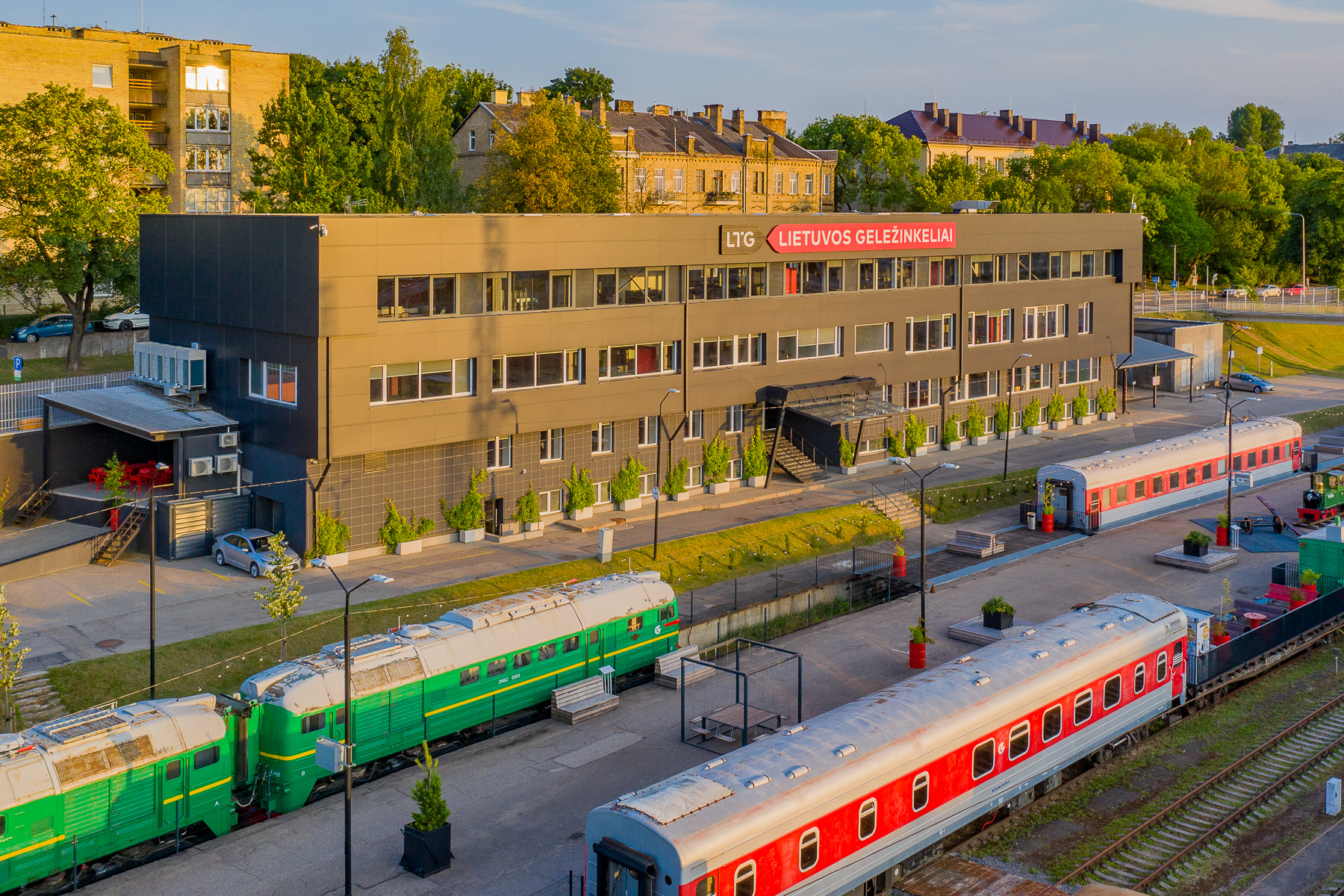

Lietuvos geležinkeliai was established in 1991 to operate the railways following the independence restoration. It provides numerous rail-related services, typically through its numerous subsidiary companies. While LTG Link is the provider for passenger services, while LTG Cargo is responsible for freight operations. Furthermore, another subsidiary, LTG Infra undertakes the maintenance and development of the railway infrastructure.
In 2008, in response to the Polish oil company PKN Orlen plans to reroute freight from its Lithuanian refinery at Mažeikiai to the Latvian port of Ventspils, the Lithuanian Railways unilaterally and intentionally dismantled the cross-border line to Latvia to prevent this. In 2017, the European Commission (EC) issued a €27.87 million fine to the Lithuanian Railways for breaching European Union (EU) competition law by the track's removal. In 2020, the cross-border line and the freight service was restored at a cost of €9.4m.
In May 2017, Lithuanian Railways was one of several companies that facilitated the launch of a new international tank container train service between Europe and China. In September of that same year, the first electrified cross-border trains started between Lithuania and Belarus. On 29 May 2018, the railway companies of the three Baltic states signed an agreement to launch a new intermodal freight service called Amber Train, linking Tallinn and Riga to the Lithuanian-Polish border at Šeštokai where they can be transhipped to the standard gauge network. EU funding was used to support some of these initiatives. During the late 2010s, there was a noticeable uptick in the volume of freight traffic traversing the Lithuanian rail network, along with corresponding increases in revenue.
Between 2018 and 2019, the company's Freight Transport, Passenger Transport and Railway Infrastructure Directorates were reorganized into separate companies, comprising LG CARGO, LG Keleiviams, and Lietuvos geležinkelių infrastruktura. The holding company LTG Group was also established, it remained a state owned enterprise; any excess profits not reinvested into the organisation is paid out to the Lithuanian government. A new group logo, mirroring the colours of the Lithuanian flag and symbolising movement, was also adopted at this time. During late 2020, the reorganisation was hailed for bolstering the competitiveness of Lithuania's railways and maintaining positive growth while also pursuing greater compliance with EU legislation.
One of the more high-profile infrastructure investments being made by LTG Infra in the wider Rail Baltica project, under which a standard gauge high-speed railway will be constructed between the Polish capital of Warsaw and the Estonian capital of Tallinn. The Lithuanian portion of the project involves a 392km line running north–south across the country as well as a new railway node being built in Kaunas to interface with the conventional network. Furthermore, during the late 2010s, a new strategy of widespread railway electrification was announced; specifically, a target for 39% of the Lithuanian rail network being electrified by 2030 was declared, a substantial increase over the 8% that already energised by 2020. Other areas of investment include track doubling, renovated communications, passenger information systems, energy efficiency schemes, routine maintenance, noise reduction, and track renewal programmes. In 2021, investment into key projects was reportedly doubled to €228.9 million, the majority of which was directed to infrastructure-related efforts.
In May 2020, a pilot freight train between Germany and Lithuania was operated under a partnership between LTG Cargo and the German intermodal specialist CargoBeamer. In September of that year, it was announced that LTG Link and the Polish operator PKP Intercity had signed a letter of intent to jointly develop a cross-border intercity passenger service between Vilnius and Warsaw. In March 2021, it was announced that the German specialist IVU Traffic Technologies would supply its digital resource planning and real-time traffic management software to the Lithuanian Railways. That same year, Lithuanian Railways issued multiple tenders calling for the provision of additional electric traction, including hybrid solutions.
In April 2022, LTG Link launched a new ticketing website, displaying more detailed information about services, customer service channels, and travel planning tools; the launch was connected to the introduction of a new smart ticket system that had been promised two years prior. In October 2022, a contract was awarded to ABB to supply 25kV AC electrification apparatus along the 730km line between Vilnius and Klaipėda.
By March 2024, via their software provider, Distribusion, the operator had completed its first integration with Google Maps, providing schedule and ticketing services via the platform.
Rolling stock
At the end of 2021, fleet of LTG Group's subsidiaries consisted of:
-
Locomotives:
- 14+15 EMUs
- 15 Stadler FLIRT
- Škoda EJ 575
- ER9
- 13 railcars
- Pesa 620M, Pesa 630M
- 28 DMUs
- Pesa 730ML
- 218 locomotives
- Siemens ER20
- TEP70, 2M62, TEM2
- 14+15 EMUs
-
Wagons:
- 23 passenger wagons
- 42 EMU wagons
- 92 DMU wagons
- 7176 freight wagons
TEP60_teplovoz_in_Radiviliskis,_Lithuania.jpg|TEP60 TEP70 in Vilnius.jpg|TEP70 LG DR1A-283M Paneriai 01.JPG|DR1 Pilviskiai, Lithuania, 12 Sept. 2008.jpg|2M62 TEM2-5703.JPG|TEM2-5703 ER9M.JPG|ER9 LITHUANIAN RAILWAYS EMU TRAIN BOUND FOR TRAKKAI AT VILLINUS RAILWAY STATION LITHUANIA SEP 2013 (9963272994).jpg|ER9M ER9 electric trainset, Lithuania - interior.JPG|ER9M (interior) ER20CF.jpg|Siemens ER20 EJ575-007, Литва, Вильнюсский уезд, станция Лянтварис (Trainpix 113966) (cropped).jpg|Škoda EJ 575 LTG-Link-Vilnius-Kaunas-EJ575-inside-Sep-2021.jpg|EJ 575 (interior) Railcar-PESA-620M-Vilnius2009-1.jpg|Pesa 620M 730ML-005 (33869202391).jpg|Pesa 730ML „LTG Link“ 07.jpg|Pesa 730ML (close up)
References
References
- Burroughs, David. (5 November 2020). "New structure boosts Lithuanian Railways' competitiveness".
- "Railway Operations in Lithuania". railfaneurope.net.
- "AB "Lietuvos geležinkeliai" Metinė ataskaita". Lietuvos geležinkeliai.
- "AB "Lietuvos geležinkeliai" Metinė ataskaita". Lietuvos geležinkeliai.
- ""Lietuvos geležinkeliai"".
- Briginshaw, David. (17 February 2020). "Lithuania - Latvia rail link reopens". International Railway Journal.
- Green, Anitra. (30 May 2017). "China - Europe tank container train launched". International Railway Journal.
- Barrow, Keith. (19 September 2017). "Minsk - Vilnius electrification completed". International Railway Journal.
- Briginshaw, David. (31 May 2018). "Baltic states launch Amber Train intermodal rail service". International Railway Journal.
- Morant, Sue. (15 March 2016). "EU funds help to unlock rail's potential in Eastern Europe". International Railway Journal.
- Burroughs, David. (21 January 2019). "Lithuanian Railways revenue up 12.5% in 2018". International Railway Journal.
- Barrow, Keith. (21 August 2019). "Lithuanian Railways to establish passenger subsidiary". International Railway Journal.
- Fender, Keith. (20 May 2021). "LTG Group reports profit for 2020". International Railway Journal.
- Burroughs, David. (23 January 2019). "Rail Baltica joint venture outlines plans for 2019". International Railway Journal.
- Cuenca, Oliver. (11 February 2021). "LTG Infra outlines 2021 spending plans". International Railway Journal.
- Smith, Kevin. (15 June 2020). "Embracing intermodal: PKP Cargo develops new strategy". International Railway Journal.
- Burroughs, David. (18 September 2020). "LTG Link and PKP Intercity to launch Vilnius - Warsaw service". International Railway Journal.
- Cuenca, Oliver. (16 March 2021). "Lithuanian Railways to rollout new fleet and staff management software". International Railway Journal.
- Cuenca, Oliver. (5 January 2021). "LTG Link to acquire 30 new electric trains". International Railway Journal.
- Clinnick, Richard. (26 August 2021). "IRJ In-Brief - Fleet: Approval for first expanded Desiro Mainline fleet; M7bmx begins operation in Belgium; electric locomotives for Lithuania". International Railway Journal.
- Carmona, David. (11 April 2022). "LTG Link launches new ticketing website". International Railway Journal.
- Artymiuk, Simon. (21 October 2022). "Vilnius - Klaipeda electrification contract signed". International Railway Journal.
- Vaišvilaitė-Braziulienė, Justina. (2024-03-06). "Train tickets now available via Google Maps". Delfi.lt.
- "Rodiklių duomenų bazė - Oficialiosios statistikos portalas".
- (22 June 2023). "Stadler to roll out FLIRT in Lithuania".
- (2 November 2025). "Lithuania unveils first Stadler electric train in Vilnius".
- Girdenytė, Eglė. (2021-12-17). "Keleiviai baiminasi, kad dažnai gendančiais traukiniais keliauti nesaugu".
This article was imported from Wikipedia and is available under the Creative Commons Attribution-ShareAlike 4.0 License. Content has been adapted to SurfDoc format. Original contributors can be found on the article history page.
Ask Mako anything about Lithuanian Railways — get instant answers, deeper analysis, and related topics.
Research with MakoFree with your Surf account
Create a free account to save articles, ask Mako questions, and organize your research.
Sign up freeThis content may have been generated or modified by AI. CloudSurf Software LLC is not responsible for the accuracy, completeness, or reliability of AI-generated content. Always verify important information from primary sources.
Report