From Surf Wiki (app.surf) — the open knowledge base
Lithium chloride
Chemical compound
Chemical compound
hygroscopic, sharp 74.48 g/100 mL (10 °C) 84.25 g/100 mL (25 °C) 88.7 g/100 mL (40 °C) 123.44 g/100 mL (100 °C) 43.8 g/100 g (20 °C) 42.36 g/100 g (25 °C) 44.6 g/100 g (60 °C) 24.28 g/100 g (20 °C) 25.1 g/100 g (30 °C) 23.46 g/100 g (60 °C) 27.5 g/100 g (25 °C) 0.83 g/100 g (25 °C) 0.61 g/100 g (50 °C) 3.02 g/100 g (25 °C) 10 torr (934 °C) 100 torr (1130 °C) | NFPA-H = 2 | NFPA-R = 0 | NFPA-F = 0 Lithium bromide Lithium iodide Lithium astatide Potassium chloride Rubidium chloride Caesium chloride Francium chloride
Lithium chloride is a chemical compound with the formula LiCl. The salt is a typical ionic compound (with certain covalent characteristics), although the small size of the Li+ ion gives rise to properties not seen for other alkali metal chlorides, such as extraordinary solubility in polar solvents (83.05 g/100 mL of water at 20 °C) and its hygroscopic properties.
Chemical properties
The salt forms crystalline hydrates, unlike the other alkali metal chlorides. Mono-, tri-, and pentahydrates are known. The anhydrous salt can be regenerated by heating the hydrates. LiCl also absorbs up to four equivalents of ammonia/mol. As with any other ionic chloride, solutions of lithium chloride can serve as a source of chloride ion, e.g., forming a precipitate upon treatment with silver nitrate: : LiCl + AgNO3 → AgCl + LiNO3
Preparation
Lithium chloride is produced by treatment of lithium carbonate with hydrochloric acid. Anhydrous LiCl is prepared from the hydrate by heating in a stream of hydrogen chloride.
Uses
Commercial applications
Lithium chloride is mainly used for the production of lithium metal by electrolysis of a LiCl/KCl melt at 450 C. LiCl is also used as a brazing flux for aluminium in automobile parts. It is used as a desiccant for drying air streams. In more specialized applications, lithium chloride finds some use in organic synthesis, e.g., as an additive in the Stille reaction. Also, in biochemical applications, it can be used to precipitate RNA from cellular extracts.{{cite journal
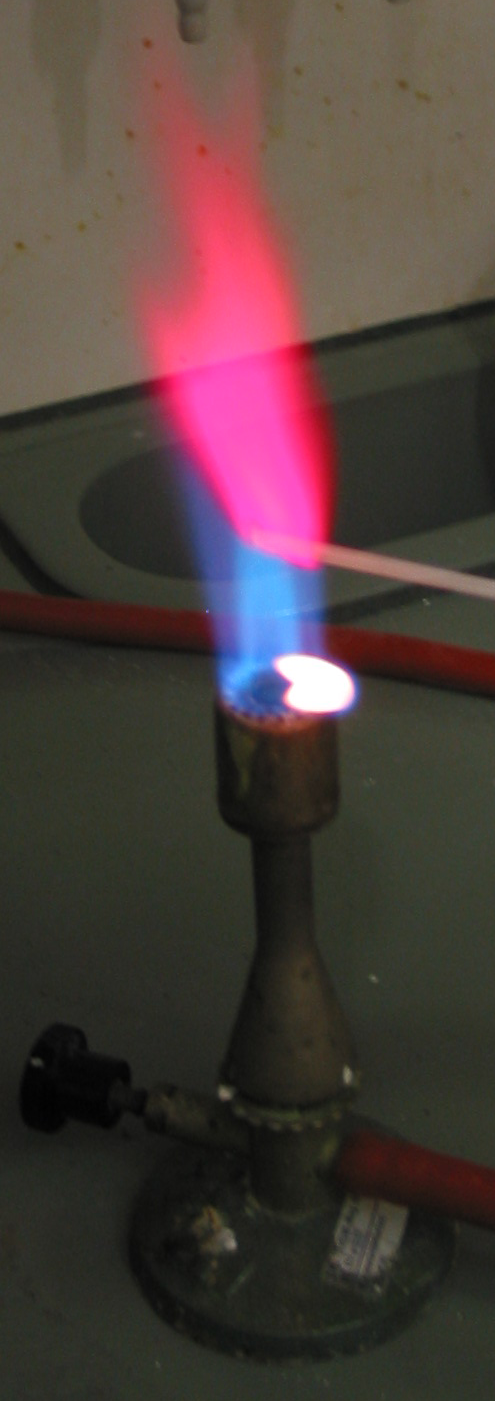
Lithium chloride is also used as a flame colorant to produce dark red flames.
Niche uses
Lithium chloride is used as a relative humidity standard in the calibration of hygrometers. At 25 C a saturated solution (45.8%) of the salt will yield an equilibrium relative humidity of 11.30%. Additionally, lithium chloride can be used as a hygrometer. This deliquescent salt forms a self-solution when exposed to air. The equilibrium LiCl concentration in the resulting solution is directly related to the relative humidity of the air. The percent relative humidity at 25 C can be estimated, with minimal error in the range 10-30 C, from the following first-order equation: RH=107.93-2.11C, where C is solution LiCl concentration, percent by mass.
Molten LiCl is used for the preparation of carbon nanotubes, graphene and lithium niobate.
Lithium chloride has been shown to have strong acaricidal properties, being effective against Varroa destructor in populations of honey bees.
Lithium chloride is used as an aversive agent in lab animals to study conditioned place preference and aversion.
Precautions
Lithium salts affect the central nervous system in a variety of ways. While the citrate, carbonate, and orotate salts are currently used to treat bipolar disorder, other lithium salts including the chloride were used in the past. For a short time in the 1940s lithium chloride was manufactured as a salt substitute for people with hypertension, but this was prohibited after the toxic effects of the compound (tremors, fatigue, nausea) were recognized.{{cite journal
References
- Handbook of Chemistry and Physics, 71st edition, CRC Press, Ann Arbor, Michigan, 1990.
- N. N. Greenwood, A. Earnshaw, Chemistry of the Elements, 2nd ed., Butterworth-Heinemann, Oxford, UK, 1997.
- R. Vatassery, titration analysis of LiCl, sat'd in Ethanol by AgNO3 to precipitate AgCl(s). EP of this titration gives %Cl by mass.
- H. Nechamkin, The Chemistry of the Elements, McGraw-Hill, New York, 1968.
References
- (1952). "Solubilities of Inorganic and Organic Compounds". Van Nostrand.
- [http://chemister.ru/Database/properties-en.php?dbid=1&id=614 lithium chloride]
- {{Sigma-Aldrich
- [https://pubchem.ncbi.nlm.nih.gov/#tab/sidsrcname=ChemIDplus&query=7447-41-8&input_type=text ChemIDplus - 7447-41-8 - KWGKDLIKAYFUFQ-UHFFFAOYSA-M - Lithium chloride - Similar structures search, synonyms, formulas, resource links, and other chemical information]
- Holleman, A. F.; Wiberg, E. ''Inorganic Chemistry'' Academic Press: San Diego, 2001. {{ISBN. 0-12-352651-5.
- (2003). "Die Kristallstrukturen der Monohydrate von Lithiumchlorid und Lithiumbromid". Zeitschrift für anorganische und allgemeine Chemie.
- (2005). "Lithium and Lithium Compounds".
- (2014). "Towards large scale preparation of carbon nanostructures in molten LiCl". Carbon.
- (2015). "Large-scale preparation of graphene by high temperature insertion of hydrogen into graphite". Nanoscale.
- (2014). "Preparation of lithium niobate particles via reactive molten salt synthesis method". Ceramics International.
- (January 12, 2018). "Lithium chloride effectively kills the honey bee parasite ''Varroa destructor'' by a systemic mode of action". [[Scientific Reports]].
- (28 February 1949). "Case of trie Substitute Salt".
This article was imported from Wikipedia and is available under the Creative Commons Attribution-ShareAlike 4.0 License. Content has been adapted to SurfDoc format. Original contributors can be found on the article history page.
Ask Mako anything about Lithium chloride — get instant answers, deeper analysis, and related topics.
Research with MakoFree with your Surf account
Create a free account to save articles, ask Mako questions, and organize your research.
Sign up freeThis content may have been generated or modified by AI. CloudSurf Software LLC is not responsible for the accuracy, completeness, or reliability of AI-generated content. Always verify important information from primary sources.
Report