From Surf Wiki (app.surf) — the open knowledge base
List of states with nuclear weapons
none
none
]]
There are currently nine sovereign states that are generally understood to possess nuclear weapons, though only eight formally acknowledge possessing them. In order of first successful nuclear test, the world's nine nuclear-armed states are the United States (1945), Russia (1949), the United Kingdom (1952), France (1960), China (1964), India (1974), Pakistan (1998), and North Korea (2006); Israel is believed to have acquired nuclear weapons around 1967, but has never openly tested or formally acknowledged having them. Under the Non-Proliferation Treaty (NPT), the United States, Russia, the United Kingdom, France, and China are recognized "nuclear-weapons states" (NWS). They are also the five permanent members of the United Nations Security Council. Israel, India, and Pakistan never signed the NPT, while North Korea acceded to it in 1985 before announcing withdrawal in 2003.
South Africa developed nuclear weapons by 1982 but dismantled them around 1989 and joined the NPT in 1991. Following the dissolution of the Soviet Union in 1991, the former Soviet republics of Ukraine, Kazakhstan, and Belarus had nuclear weapons deployed on their territories, but agreed to transfer them to Russia (which inherited the Soviet Union's international rights and obligations) and join the NPT as non-nuclear-weapon states.
There are six states that do not possess nuclear weapons, but have nuclear weapons deployed on their territory. U.S. nuclear weapons are based in Belgium, Germany, Italy, the Netherlands, and Turkey. Russian nuclear weapons are deployed in Belarus. During the Cold War, at least 23 states were known hosts of U.S., British, or Soviet nuclear weapons.
According to the Federation of American Scientists (FAS), there are 12,331 nuclear warheads in the world and approximately 3,904 of these are active, . In 2024, the Stockholm International Peace Research Institute (SIPRI) estimated that the total number of nuclear warheads had reached 12,121. Approximately 9,585 nuclear warheads are kept with military stockpiles. About 3,904 warheads are deployed with operational forces. 2,100 warheads, which are primarily from Russia and the United States, are maintained for high operational alerts.
Statistics and force configuration
The following is a list of states that have acknowledged the possession of nuclear weapons or are presumed to possess them, the approximate number of warheads under their control, and the year they tested their first weapon and their force configuration. This list is informally known in global politics as the "Nuclear Club". With the exception of Russia and the United States (which have subjected their nuclear forces to independent verification under various treaties) these figures are estimates, in some cases quite unreliable estimates. In particular, under the Strategic Offensive Reductions Treaty thousands of Russian and US nuclear warheads are inactive in stockpiles awaiting processing. The fissile material contained in the warheads can then be recycled for use in nuclear reactors.
From a high of 70,300 active weapons in 1986, there are approximately 3,880 active nuclear warheads and 12,119 total nuclear warheads in the world. Many of the decommissioned weapons were simply stored or partially dismantled, not destroyed.
Additionally, since the dawn of the Atomic Age, the delivery methods of most states with nuclear weapons have evolved—with four acquiring a nuclear triad, while others have consolidated away from land and air deterrents to submarine-based forces.
| Country | First test | Thermo-nuclear power? | Delivery method | date=17 June 2025 | title=Role of nuclear weapons grows as geopolitical relations deteriorate—new SIPRI Yearbook out now SIPRI | url=https://www.sipri.org/media/press-release/2025/nuclear-risks-grow-new-arms-race-looms-new-sipri-yearbook-out-now | access-date=17 June 2025 | website=www.sipri.org | language=en}} | Deployed | Date | Site | Sea | Air | Land | Notes |
|---|---|---|---|---|---|---|---|---|---|---|---|---|---|---|---|---|
| Flag of the United States.svg United States | 3,700 | 1,770 | 16 July 1945 (*Trinity*) | Alamogordo, New Mexico | [[File:Symbol_confirmed.svg | 19x19px]] | Party | Signatory | [[File:Symbol_confirmed.svg | 19x19px]] | [[File:Symbol_confirmed.svg | 19x19px]] | [[File:Symbol_confirmed.svg | 19x19px]] | US triad | |
| Flag of Russia.svg Russian Federation | 4,309 | 1,718 | 29 August 1949 (*RDS-1*) | Semipalatinsk, Kazakh SSR | [[File:Symbol_confirmed.svg | 19x19px]] | Party | Signatory (ratified, but later revoked ratification) | [[File:Symbol_confirmed.svg | 19x19px]] | [[File:Symbol_confirmed.svg | 19x19px]] | [[File:Symbol_confirmed.svg | 19x19px]] | Russian triad | |
| Flag of the United Kingdom.svg United Kingdom | 225 | 120 | 3 October 1952 (*Hurricane*) | Monte Bello Islands, Australia | [[File:Symbol_confirmed.svg | 19x19px]] | Party | Ratifier | [[File:Symbol_confirmed.svg | 19x19px]] | [[File:Symbol_oppose_vote.svg | 19x19px]] | [[File:Symbol_oppose_vote.svg | 19x19px]] | Trident submarines | |
| Flag of France.svg France | 290 | 280 | 13 February 1960 (*Gerboise Bleue*) | Reggane, French Algeria | [[File:Symbol_confirmed.svg | 19x19px]] | Party | Ratifier | [[File:Symbol_confirmed.svg | 19x19px]] | [[File:Symbol_confirmed.svg | 19x19px]] | [[File:Symbol_oppose_vote.svg | 19x19px]] | *Triomphant* submarines, air capability | |
| Flag of China.svg China | 600 | 24 | 16 October 1964 (*596*) | Lop Nur, Xinjiang | [[File:Symbol_confirmed.svg | 19x19px]] | Party | Signatory | [[File:Symbol_confirmed.svg | 19x19px]] | [[File:Symbol_confirmed.svg | 19x19px]] | [[File:Symbol_confirmed.svg | 19x19px]] | Chinese triad | |
| Flag of India.svg India | 180 | 0 | 18 May 1974 (*Smiling Buddha*) | Pokhran, Rajasthan | [[File:Pictogram-voting_question.svg | 18x18px]] | Non-party | Non-signatory | [[File:Symbol_confirmed.svg | 19x19px]] | [[File:Symbol_confirmed.svg | 19x19px]] | [[File:Symbol_confirmed.svg | 19x19px]] | Indian triad | |
| Flag of Pakistan.svg Pakistan | 170 | 0 | 28 May 1998 (*Chagai-1*) | Ras Koh Hills, Balochistan | [[File:Symbol_oppose_vote.svg | 19x19px]] | Non-party | Non-signatory | [[File:Symbol oppose vote.svg | 19x19px]] | [[File:Symbol_confirmed.svg | 19x19px]] | [[File:Symbol_confirmed.svg | 19x19px]] | Air capability, Missile delivery system | |
| Flag of Israel.svg Israel | 90 | 0 | 1960–1979 | *Unknown* | [[File:Pictogram-voting_question.svg | 18x18px]] | Non-party | Signatory | [[File:Pictogram-voting_question.svg | 18x18px]] | [[File:Pictogram-voting_question.svg | 18x18px]] | [[File:Pictogram-voting_question.svg | 18x18px]] | Suspected Israeli triad | |
| Flag of North Korea.svg North Korea | 50 | 0 | [9 October 2006](2006-north-korean-nuclear-test) | Kilju, North Hamgyong | [[File:Pictogram-voting_question.svg | 18x18px]] | Announced withdrawal | Non-signatory | [[File:Symbol_confirmed.svg | 19x19px]] | [[File:Symbol_oppose_vote.svg | 19x19px]] | [[File:Symbol_confirmed.svg | 19x19px]] | North Korean delivery systems |
Nuclear forces comparison
The table uses the following identifiers:
- [[File:Symbol_confirmed.svg|19x19px]] — This country has a nuclear mission assigned to this delivery system.
- [[File:Pictogram_voting_delete.svg|19x19px]] — This country does not have a nuclear mission assigned to this delivery system.
- [[File:Pictogram-voting_question.svg|18x18px]] — It is unclear if this country has a nuclear mission assigned to this delivery system.
- [[File:Pictogram_voting_wait.svg|19x19px]] — This country is developing this delivery system with a nuclear mission envisioned.
Many countries formerly operated a wider range of strategic and especially tactical systems, especially during the Cold War. While most of these are no longer operational, Russia is the only country as of 2025 believed to operate nuclear-armed anti-ballistic missiles, surface-to-air missiles, anti-ship missiles anti-submarine weapons, depth bombs, and torpedoes.{{Pie chart
Recognized nuclear-weapon states
These five states are known to have detonated a nuclear explosive before 1 January 1967 and are thus nuclear weapons states under the Treaty on the Non-Proliferation of Nuclear Weapons. They also happen to be the UN Security Council's (UNSC) permanent members with veto power on UNSC resolutions.
United States
Main article: Nuclear weapons of the United States, United States and weapons of mass destruction
The United States developed the first nuclear weapons during World War II in cooperation with the United Kingdom and Canada as part of the Manhattan Project, out of the apprehension that Nazi Germany would develop them first. It tested the first nuclear weapon on 16 July 1945 ("Trinity") at 5:30 am, and remains the only country to have used nuclear weapons in war, having bombed the Japanese cities of Hiroshima and Nagasaki in the closing stages of World War II. The project expenditure through 1 October 1945 was reportedly $1.845–$2billion, in nominal terms, roughly 0.8 percent of the US GDP in 1945 and equivalent to about $billion today.
The United States was the first nation to develop the hydrogen bomb, testing an experimental prototype in 1952 ("Ivy Mike") and a deployable weapon in 1954 ("Castle Bravo"). Throughout the Cold War it continued to modernize and enlarge its nuclear arsenal, but from 1992 on has been involved primarily in a program of stockpile stewardship. The US nuclear arsenal contained 31,175 warheads at its Cold War height (in 1966). During the Cold War, the United States built more nuclear weapons than all other nations at approximately 70,000 warheads.
Russia (successor to the Soviet Union)
Main article: Russia and weapons of mass destruction, Strategic Rocket Forces

The Soviet Union tested its first nuclear weapon ("RDS-1") in 1949. This crash project was developed partially with information obtained via the atomic spies at the United States' Manhattan Project during and after World War II. The Soviet Union was the second nation to have developed and tested a nuclear weapon. It tested its first megaton-range hydrogen bomb ("RDS-37") in 1955. The Soviet Union also tested the most powerful explosive ever detonated by humans, ("Tsar Bomba"), with a theoretical yield of 100 megatons, reduced to 50 when detonated. After its dissolution in 1991, the Soviet weapons entered officially into the possession of its successor state, the Russian Federation. The Soviet nuclear arsenal contained some 45,000 warheads at its peak (in 1986), more than any other nation had possessed at any point in history; the Soviet Union built about 55,000 nuclear warheads since 1949.
United Kingdom
Main article: Nuclear weapons of the United Kingdom, United Kingdom and weapons of mass destruction
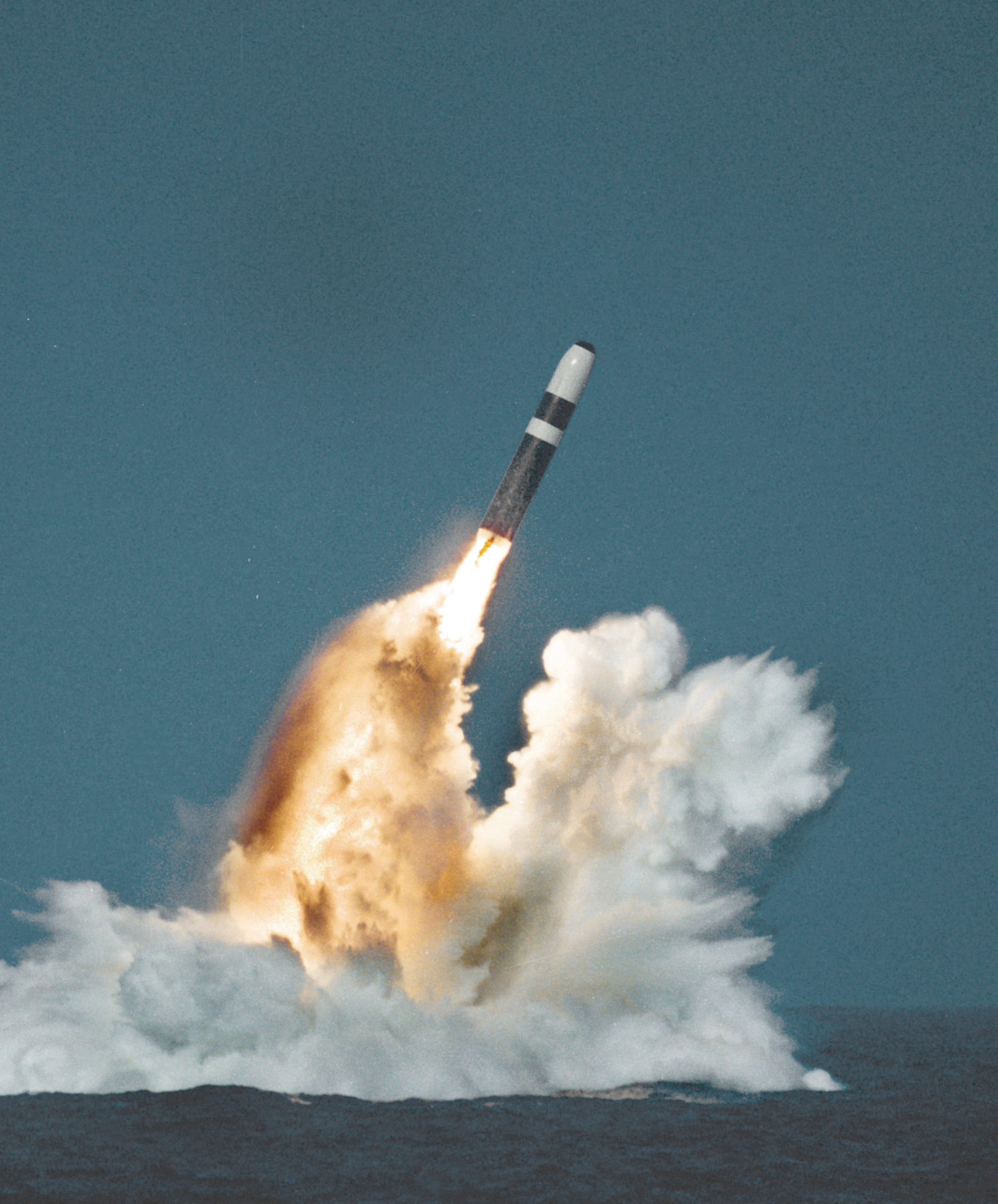
The United Kingdom tested its first nuclear weapon ("Hurricane") in 1952. The UK had provided considerable impetus and initial research for the early conception of the atomic bomb, aided by Austrian, German and Polish physicists working at British universities who had either fled or decided not to return to Nazi Germany or Nazi-controlled territories. The UK collaborated closely with the United States and Canada during the Manhattan Project, but had to develop its own method for manufacturing and detonating a bomb as US secrecy grew after 1945. The United Kingdom was the third country in the world, after the United States and the Soviet Union, to develop and test a nuclear weapon. Its programme was motivated to have an independent deterrent against the Soviet Union, while also maintaining its status as a great power. It tested its first hydrogen bomb in 1957 (Operation Grapple), making it the third country to do so after the United States and Soviet Union.
The British Armed Forces maintained a fleet of V bomber strategic bombers and ballistic missile submarines (SSBNs) equipped with nuclear weapons during the Cold War. The Royal Navy currently maintains a fleet of four ballistic missile submarines equipped with Trident II missiles. In 2016, the UK House of Commons voted to renew the British nuclear weapons system with the , without setting a date for the commencement of service of a replacement to the current system.
At the 2025 NATO summit, the UK announced it would purchase 12 US-made F-35A jets which are expected to carry US-made atomic bombs—expanding UK nuclear capability to include airborne delivery systems.
France
Main article: France and weapons of mass destruction, Force de dissuasion
France tested its first nuclear weapon in 1960 ("Gerboise Bleue"), based mostly on its own research. It was motivated by the Suez Crisis diplomatic tension in relation to both the Soviet Union and its allies, the United States and United Kingdom. It was also relevant to retain great power status, alongside the United Kingdom, during the post-colonial Cold War (see: Force de frappe). France tested its first hydrogen bomb in 1968 ("Opération Canopus"). After the Cold War, France has disarmed 175 warheads with the reduction and modernization of its arsenal that has now evolved to a dual system based on submarine-launched ballistic missiles (SLBMs) and medium-range air-to-surface missiles (Rafale fighter-bombers). However, new nuclear weapons are in development and reformed nuclear squadrons were trained during Enduring Freedom operations in Afghanistan.
France acceded to the Nuclear Non-Proliferation Treaty in 1992. In January 2006, President Jacques Chirac stated a terrorist act or the use of weapons of mass destruction against France would result in a nuclear counterattack. In February 2015, President François Hollande stressed the need for a nuclear deterrent in "a dangerous world". He also detailed the French deterrent as "fewer than 300" nuclear warheads, three sets of 16 submarine-launched ballistic missiles and 54 medium-range air-to-surface missiles and urged other states to show similar transparency.
China
Main article: China and weapons of mass destruction, People's Liberation Army Rocket Force

China tested its first nuclear weapon device ("596") in 1964 at the Lop Nur test site. The weapon was developed as a deterrent against both the United States and the Soviet Union. Two years later, China had a fission bomb capable of being put onto a nuclear missile. It tested its first hydrogen bomb ("Test No. 6") in 1967, 32 months after testing its first nuclear weapon (the shortest fission-to-fusion development known in history). China is the only NPT nuclear-weapon state to give an unqualified negative security assurance with its "no first use" policy. China acceded to the Nuclear Non-Proliferation Treaty in 1992. As of 2016, China fielded SLBMs onboard its JL-2 submarines. As of February 2024, China had an estimated total inventory of approximately 500 warheads.
According to Stockholm International Peace Research Institute (SIPRI), China is in the middle of a significant modernization and expansion of its nuclear arsenal. Its nuclear stockpile is expected to continue growing over the coming decade and some projections suggest that it will deploy at least as many intercontinental ballistic missiles (ICBMs) as either Russia or the US in that period. However, China's overall nuclear warhead stockpile is still expected to remain smaller than that of either of those states. The Yearbook published by SIPRI in 2024 revealed that China's nuclear warheads stockpile increased by 90 in 2023, reaching 500 warheads.
US Department of Defense officials estimate that the Chinese had more than 600 operational nuclear warheads as of December 2024, and it was on track to possess 1,000 nuclear weapons by the year 2030.
States declaring possession of nuclear weapons
India
Main article: India and weapons of mass destruction
India is not a party to the Nuclear Non-Proliferation Treaty. Indian officials rejected the NPT in the 1960s on the grounds that it created a world of nuclear "haves" and "have-nots", arguing that it unnecessarily restricted "peaceful activity" (including "peaceful nuclear explosives"), and that India would not accede to international control of their nuclear facilities unless all other countries engaged in unilateral disarmament of their own nuclear weapons. The Indian position has also asserted that the NPT is in many ways a neo-colonial regime designed to deny security to post-colonial powers.
The country tested what is called a "peaceful nuclear explosive" in 1974 (which became known as "Smiling Buddha"). The test was the first test developed after the creation of the NPT, and created new questions about how civilian nuclear technology could be diverted secretly to weapons purposes (dual-use technology). India's secret development caused great concern and anger particularly from nations that had supplied its nuclear reactors for peaceful and power generating needs, such as Canada. After its 1974 test, India maintained that its nuclear capability was primarily "peaceful", but between 1988 and 1990 it apparently weaponized two dozen nuclear weapons for delivery by air. In 1998 India tested weaponized nuclear warheads ("Operation Shakti"), including a thermonuclear device, and declared itself as a nuclear state. India adopted a "no first use" policy in 1998.
In July 2005, US president George W. Bush and Indian prime minister Manmohan Singh announced a civil nuclear cooperation initiative that included plans to conclude an Indo-US civilian nuclear agreement. This initiative came to fruition through a series of steps that included India's announced plan to separate its civil and military nuclear programs in March 2006, the passage of the India–United States Civil Nuclear Agreement by the US Congress in December 2006, the conclusion of a US–India nuclear cooperation agreement in July 2007, approval by the IAEA of an India-specific safeguards agreement, agreement by the Nuclear Suppliers Group to a waiver of export restrictions for India, approval by the US Congress and culminating in the signature of US–India agreement for civil nuclear cooperation in October 2008. The US State Department said it made it "very clear that we will not recognize India as a nuclear-weapon state". The United States is bound by the Hyde Act with India and may cease all cooperation with India if India detonates a nuclear explosive device. The US had further said it is not its intention to assist India in the design, construction or operation of sensitive nuclear technologies through the transfer of dual-use items. In establishing an exemption for India, the Nuclear Suppliers Group reserved the right to consult on any future issues which might trouble it. As of June 2024, India was estimated to have a stockpile of 172 warheads.
Pakistan
Main article: Pakistan and weapons of mass destruction
Pakistan is also not a party to the Nuclear Non-Proliferation Treaty. Pakistan covertly developed nuclear weapons over decades, beginning in the late 1970s. Pakistan first delved into nuclear power after the establishment of its first nuclear power plant near Karachi with equipment and materials supplied mainly by western nations in the early 1970s. Pakistani prime minister Zulfiqar Ali Bhutto promised in 1971 that if India could build nuclear weapons then Pakistan would too, according to him: "We will develop Nuclear stockpiles, even if we have to eat grass."
It is believed that Pakistan has possessed nuclear weapons since the mid-1980s. The United States continued to certify that Pakistan did not possess such weapons until 1990, when sanctions were imposed under the Pressler Amendment, requiring a cutoff of US economic and military assistance to Pakistan. In 1998, Pakistan conducted its first six nuclear tests at the Ras Koh Hills in response to the five tests conducted by India a few weeks before.
In 2004, the Pakistani metallurgist Abdul Qadeer Khan, a key figure in Pakistan's nuclear weapons program, confessed to heading an international black market ring involved in selling nuclear weapons technology. In particular, Khan had been selling gas centrifuge technology to North Korea, Iran, and Libya. Khan denied complicity by the Pakistani government or Army, but this has been called into question by journalists and IAEA officials, and was later contradicted by statements from Khan himself.
As of early 2013, Pakistan was estimated to have had a stockpile of around 140 warheads, and in November 2014 it was projected that by 2020 Pakistan would have enough fissile material for 200 warheads. As of 2024, SIPRI estimated that Pakistan had a stockpile of around 170 warheads.
On 27 April 2025, in a fiery response to India's declared suspension of the Indus Waters Treaty in retaliation for the 2025 Pahalgam attack, Hanif Abbasi, the Pakistani minister of railways warned that any attempt to cut off Pakistan's water supply could lead to full-scale war and stated Pakistan's nuclear stockpile of 130 warheads was aimed towards India.
North Korea
Main article: North Korea and weapons of mass destruction
North Korea was a party to the Nuclear Non-Proliferation Treaty, but announced a withdrawal on 10 January 2003, after the United States accused it of having a secret uranium enrichment program and cut off energy assistance under the 1994 Agreed Framework. In February 2005, North Korea claimed to possess functional nuclear weapons, though their lack of a test at the time led many experts to doubt the claim. In October 2006, North Korea stated that, in response to growing intimidation by the United States, it would conduct a nuclear test to confirm its nuclear status. North Korea reported a successful nuclear test on 9 October 2006 (see 2006 North Korean nuclear test). Most US intelligence officials believed that the test was probably only partially successful with a yield of less than a kiloton. North Korea conducted a second, higher-yield test on 25 May 2009 (see 2009 North Korean nuclear test) and a third test with still-higher yield on 12 February 2013 (see 2013 North Korean nuclear test).
North Korea claimed to have conducted its first hydrogen-bomb test on 5 January 2016, though measurements of seismic disturbances indicate that the detonation was not consistent with a hydrogen bomb. On 3 September 2017, North Korea detonated a device, which caused a magnitude 6.1 tremor, consistent with a low-powered thermonuclear detonation; NORSAR estimates the yield at 250 kilotons of TNT. In 2018, North Korea announced a halt in nuclear weapons tests and made a conditional commitment to denuclearisation of the Korean Peninsula; however, in December 2019, it indicated it no longer considered itself bound by the moratorium.
Kim Jong Un officially declared North Korea a nuclear weapons state during a speech on 9 September 2022, the country's foundation day.
According to the Stockholm International Peace Research Institute (SIPRI), North Korea's military nuclear programme remains central to its national security strategy and it may have assembled up to 30 nuclear weapons and could produce more. North Korea conducted more than 90 ballistic missile tests during 2022, the highest number it has ever undertaken in a single year.
States believed to possess nuclear weapons
Israel
Main article: Nuclear weapons and Israel, Israel and weapons of mass destruction, Samson Option
Israel is generally understood to have been the sixth country to develop nuclear weapons, but does not acknowledge it. It had "rudimentary, but deliverable," nuclear weapons available as early as 1966. Israel is not a party to the NPT. Israel engages in strategic ambiguity, saying it would not be the first country to "introduce" nuclear weapons to the Middle East without confirming or denying that it has a nuclear weapons program or arsenal. This policy of "nuclear opacity" has been interpreted as an attempt to get the benefits of deterrence with a minimal political cost. As of 2006, some analysts believe that, due to a US ban on funding countries that proliferate weapons of mass destruction, Israel could lose around $2 billion a year in military and other aid from the US if it admitted to possessing nuclear weapons.
According to the Natural Resources Defense Council and the Federation of American Scientists, Israel likely possesses around 80–400 nuclear weapons. Former US president Jimmy Carter stated in 2008 that Israel has over 150 nuclear weapons. The Stockholm International Peace Research Institute estimates that Israel has approximately 90 intact nuclear weapons, of which 50 are thought to be assigned for delivery by land-based Jericho ballistic missiles and 30 are gravity bombs for delivery by F-16I or F-15 aircraft. SIPRI also reports that Israel operates five German-built Dolphin-class (Dolphin-I and Dolphin-II) diesel–electric submarines. The submarines are based at Haifa on the Mediterranean coast. There are unconfirmed reports that all or some of the submarines have been equipped to launch an indigenously produced nuclear-armed sea-launched variant of the Popeye cruise missile, giving Israel a sea-based nuclear strike capability.
On 7 November 2023, during the Gaza war, Heritage Minister Amihai Eliyahu said during a radio interview that a nuclear strike would be "one way" to deal with Gaza, which commentators and diplomats interpreted as a tacit admission that Israel possesses such a capability. His remarks were criticized by the United States and Russia, and Eliyahu was subsequently suspended from the Israeli cabinet.
Launch authority
The decision to use nuclear weapons is always restricted to a single person or small group of people. The United States and France require their respective presidents to approve the use of nuclear weapons. In the US, the Presidential Emergency Satchel is always handled by a nearby aide unless the president is near a command center. The decision rests with the prime minister in the United Kingdom. In the People's Republic of China, launch authority rests with the Chairman of the Central Military Commission of the Chinese Communist Party under its principle of "the Party commands the gun." Russia grants such power to the president but may also require approval from the minister of defence and the chief of the General Staff. The supreme commander of the Armed Forces has authority in North Korea. India, Pakistan and Israel have committees for such a decision.
Some countries are known to have delegated launch authority to military personnel in the event that the usual launch authority is incapacitated; whether or not the 'pre-delegated' authority exists at any particular time is kept secret. In the United States, some military commanders have been delegated authority to launch nuclear weapons "when the urgency of time and circumstances clearly does not permit a specific decision by the President." Russia has a semi automated Dead Hand system which may allow military commanders to act based on certain pre-defined criteria. British nuclear-armed submarine commanders are issued with "letters of last resort" written by the Prime Minister containing secret instructions which may or may not give them delegated launch authority.
| Country | Authority | Notes |
|---|---|---|
| United States United States | President of the United States | See the Presidential Emergency Satchel. |
| Russia Russia | President of Russia | Briefcases may also be issued to the Minister of Defence and the Chief of the General Staff. |
| United Kingdom United Kingdom | Prime Minister of the United Kingdom | The prime minister and a secretly designated 'second' may order a launch, but this may be challenged by Parliament. |
| France France | President of France | The Chief of the Military Staff of the President of the Republic and the Chief of the Defence Staff may also be involved in decisions. |
| China China | Chairman of the Central Military Commission | The chairman of the Central Military Commission is the supreme military commander and is held by the Chinese Communist Party general secretary. |
| India India | Prime Minister of India | Nuclear Command Authority includes an Executive Council and a Political Council. |
| Pakistan Pakistan | National Command Authority | Approval from National Command Authority and requires a consensus of the council's members. |
| North Korea North Korea | President of the State Affairs | The president of the state affairs is the ultimate decisionmaker in regards to North Korea's nuclear arsenal. The position is held by the WPK general secretary and serves as the supreme leader of North Korea. |
| Israel Israel | Prime Minister of Israel | Requires agreement of the Minister of Defense and Chief of the General Staff. |
Nuclear weapons sharing
Main article: Nuclear sharing
Nuclear weapons shared by the United States
| Country | Base | Estimated | 100 | ||
|---|---|---|---|---|---|
| Kleine Brogel | |||||
| Büchel | |||||
| Aviano | |||||
| Ghedi | |||||
| Volkel | |||||
| Incirlik |
Under NATO nuclear weapons sharing, the United States has provided nuclear weapons for Belgium, Germany, Italy, the Netherlands, and Turkey to deploy and store. This involves pilots and other staff of the "non-nuclear" NATO states practicing, handling, and delivering the US nuclear bombs, and adapting non-US warplanes to deliver US nuclear bombs. However, since all US nuclear weapons are protected with Permissive Action Links, the host states cannot easily arm the bombs without authorization codes from the US Department of Defense. Former Italian president Francesco Cossiga acknowledged the presence of US nuclear weapons in Italy. US nuclear weapons were also deployed in Canada as well as Greece from 1963. However, the United States withdrew three of the four nuclear-capable weapons systems from Canada by 1972, the fourth by 1984, and all nuclear-capable weapons systems from Greece by 2001. , the United States maintained around 100 nuclear weapons in Europe, as reflected in the accompanying table.
Nuclear weapons shared by Russia
| Country | Air base | Warheads |
|---|---|---|
| Probably Lida | ~130 |
, the leaders of Russia and Belarus have claimed that a "number of" nuclear weapons are located on Belarusian territory while remaining in Russian possession. Sources hostile to these countries have confirmed that nuclear warheads have been delivered to Belarus, but claim that the first transfers were instead made in August 2023. Russia's stated intention is to provide Belarus with two delivery systems: dual-capable Iskander-M missile systems and necessary training and modifications for Belarusian Su-25 aircraft to carry nuclear weapons.
The deployment of Russian weapons to Belarus was framed by Russian president Vladimir Putin as being equivalent to the deployments of American nuclear weapons to NATO countries in Europe under international law.
Criticism of nuclear weapons sharing
Members of the Non-Aligned Movement have called on all countries to "refrain from nuclear sharing for military purposes under any kind of security arrangements." The Institute of Strategic Studies Islamabad (ISSI) has criticized the arrangement for allegedly violating Articles I and II of the NPT, arguing that "these Articles do not permit the NWS to delegate the control of their nuclear weapons directly or indirectly to others." NATO has argued that the weapons' sharing is compliant with the NPT because "the US nuclear weapons based in Europe are in the sole possession and under constant and complete custody and control of the United States."
States formerly possessing nuclear weapons
Nuclear weapons have been present in many nations, often as staging grounds under control of other powers. However, in only one instance has a nation given up nuclear weapons after being in full control of them. The fall of the Soviet Union left several former Soviet republics in physical possession of nuclear weapons, although not operational control which was dependent on Russian-controlled electronic Permissive Action Links and the Russian command and control system. Of these, Kazakhstan and Ukraine continue to have neither their own nuclear weapons nor another state's nuclear weapons stationed in their territory whereas Belarus does again claim to have Russian-owned nuclear weapons stationed on its territory since 2023.
South Africa
Main article: South Africa and weapons of mass destruction, Nuclear programme of South Africa

South Africa produced six nuclear weapons, obtaining its first in 1982, but dismantled them in the early 1990s.
In 1979, there was a detection of a putative covert nuclear test in the Indian Ocean, called the Vela incident. It has long been speculated that it was a test by Israel, in collaboration with and with the support of South Africa, though this has never been confirmed. South Africa could not have constructed such a nuclear bomb by itself until November 1979, two months after the "double flash" incident.
South Africa acceded to the Nuclear Non-Proliferation Treaty in 1991.
Former Soviet republics
- Kazakhstan had 1,400 Soviet-era nuclear weapons on its territory and transferred them all to Russia by 1995, after Kazakhstan acceded to the NPT.
- Ukraine had an estimated 1,700 nuclear weapons deployed on its territory when it became independent from the Soviet Union in 1991, equivalent to the third-largest nuclear arsenal in the world. At the time Ukraine acceded to the NPT in December 1994, Ukraine had agreed to dispose of all nuclear weapons within its territory. The warheads were removed from Ukraine by 1996 and disassembled in Russia. Despite Russia's subsequent and internationally disputed annexation of Crimea in 2014, Ukraine reaffirmed its 1994 decision to accede to the Nuclear Non-Proliferation Treaty as a non-nuclear-weapon state.
- Belarus, which since 2023 has resumed hosting Russian nuclear weapons, also had single warhead missiles stationed on its territory into the 1990s while a constituent of the Soviet Union. When the Soviet Union collapsed in 1991, 81 single warhead missiles were stationed on newly Belarusian territory, but were all transferred to Russia by 1996. Belarus was a member of the Nuclear Non-Proliferation Treaty (NPT) from May 1992 through February 2022, when it held a constitutional referendum resulting in the cessation of its non-nuclear status.
In connection with their accession to the NPT, all three countries received assurances that their sovereignty, independence, and territorial integrity would be respected, as stated in the Budapest Memorandum on Security Assurances. These assurances have been flouted by Russia since the Russo-Ukrainian War began in 2014, during which Russia claimed to annex Crimea, occupied Eastern Ukraine, and in 2022, launched a full-scale invasion, with limited responses by the other signatories.
Stationed countries
Up until the 1990s the US had stationed nuclear weapons outside of its territories and sharing countries.
South Korea
Main article: South Korea and weapons of mass destruction
Philippines
Main article: Philippines and weapons of mass destruction
During the Cold War, specifically during the presidency of Ferdinand Marcos from 1965 to 1986, American nuclear warheads were secretly stockpiled in the Philippines.
Taiwan
Main article: Taiwan and weapons of mass destruction, Timeline of the Republic of China's nuclear program
Taiwan was developing capacities to construct nuclear weapons up until 1988. Before 1974, the United States stationed some of its arsenal in Taiwan.
Japan
Main article: United States nuclear weapons in Japan
After World War II the US had nuclear weapons stationed in Japan until the 1970s.
Canada
Main article: Canada and weapons of mass destruction
The US stationed nuclear weapons at CFB Goose Bay in Labrador between 1964 and 1984.
Greece
The US stationed nuclear weapons in Greece until they were removed in 2001.
Notes
References
Bibliography
References
- (January 2020). "World Nuclear Forces, SIPRI yearbook 2020".
- (2022-01-02). "Israeli nuclear weapons, 2021". Bulletin of the Atomic Scientists.
- (13 May 2010). "Trilateral Nuclear Dialogues Role of P3 Nuclear Weapons Consensus Statement".
- Dosseva, A. (2006). "North Korea and the Non-Proliferation Treaty".
- [https://treaties.unoda.org/t/npt/declarations/PRK_moscow_ACC United Nations Office of Disarmament Affairs Treaty Database]
- Arms Control and Global Security, Paul R. Viotti – 2010, p 312
- Moniz, E. (2024-10-17). "South Africa".
- (2022-01-02). "Setting the Deadline for Nuclear Weapon Removal from Host States under the Treaty on the Prohibition of Nuclear Weapons". Journal for Peace and Nuclear Disarmament.
- (2024-06-17). "Role of nuclear weapons grows as geopolitical relations deteriorate—new SIPRI Yearbook out now {{!}} SIPRI".
- "Nuclear club", ''Oxford English Dictionary'': "nuclear club n. the nations that possess nuclear weapons." The term's first cited usage is from 1957.
- Jane Onyanga-Omara, [https://www.usatoday.com/story/news/world/2016/01/06/nine-nations-possess-nuclear-weapns/78350588/ "The Nuclear Club: Who are the 9 members?"] {{Webarchive. link. (4 September 2017, ''USA TODAY'', 6 January 2016)
- Webster, Paul (July/August 2003). "[https://www.theguardian.com/news/datablog/2009/sep/06/nuclear-weapons-world-us-north-korea-russia-iran Nuclear weapons: how many are there in 2009 and who has them?] {{Webarchive. link. (2017-01-08" ''The Guardian'', 6 September 2009.)
- Taylor, Adam. (2016-01-06). "Map: The countries believed to have tested hydrogen bombs". The Washington Post.
- "Treaty on the Non-Proliferation of Nuclear Weapons".
- "Status of Signature and Ratification of the Comprehensive Test Ban Treaty".
- (August 2022). "The Nuclear Testing Tally". [[Arms Control Association]].
- (17 June 2025). "Role of nuclear weapons grows as geopolitical relations deteriorate—new SIPRI Yearbook out now {{!}} SIPRI".
- (2023). "Status Of World Nuclear Forces". Bulletin of the Atomic Scientists.
- [[#IISS2012. IISS 2012]], pp. 54–55
- (2023-05-04). "Russian nuclear weapons, 2023". Bulletin of the Atomic Scientists.
- (2023-11-02). "Putin revokes Russia's ratification of nuclear test ban treaty". Reuters.
- (July 2019). "Nuclear Weapons: Who Has What at a Glance". Arms Control Association.
- [[#IISS2012. IISS 2012]], p. 169
- (2023-07-04). "French nuclear weapons, 2023". Bulletin of the Atomic Scientists.
- [[#IISS2012. IISS 2012]], p. 111
- (2023-03-04). "Chinese nuclear weapons, 2023". Bulletin of the Atomic Scientists.
- ''The Long Shadow: Nuclear Weapons and Security in 21st Century Asia'' by Muthiah Alagappa (NUS Press, 2009), page 169: "China has developed strategic nuclear forces made up of land-based missiles, submarine-launched missiles, and bombers. Within this triad, China has also developed weapons of different ranges, capabilities, and survivability."
- [[#IISS2012. IISS 2012]], pp. 223–224
- (2022-07-04). "Indian nuclear weapons, 2022". Bulletin of the Atomic Scientists.
- [[#IISS2012. IISS 2012]], p. 243
- (18 October 2016). "Now, India has a nuclear triad". The Hindu.
- (12 June 2014). "India's Nuclear Triad Finally Coming of Age".
- (7 July 2014). "Nuclear triad weapons ready for deployment: DRDO".
- (2021-09-03). "Pakistani nuclear weapons, 2021". Bulletin of the Atomic Scientists.
- Mizokami, Kyle. (2021-11-26). "How Pakistan Developed Its Own Nuclear Triad".
- "Babur (Hatf 7)".
- (2022-01-02). "Israeli nuclear weapons, 2021". Bulletin of the Atomic Scientists.
- Farr, Warner D (September 1999), The Third Temple's holy of holies: Israel's nuclear weapons, The Counterproliferation Papers, Future Warfare Series 2, USAF Counterproliferation Center, Air War College, Air University, Maxwell Air Force Base, retrieved 2 July 2006.
- Hersh, Seymour. (1991). "The Samson option: Israel's Nuclear Arsenal and American Foreign Policy". Random House.
- ''An Atlas of Middle Eastern Affairs'' By Ewan W. Anderson, Liam D. Anderson, (Routledge 2013), page 233: "In terms of delivery systems, there is strong evidence that Israel now possesses all three elements of the nuclear triad."
- [[#IISS2012. IISS 2012]], p. 328
- (2022-09-03). "North Korean nuclear weapons, 2022". Bulletin of the Atomic Scientists.
- (13 October 2006). "U.S.: Test Points to N. Korea Nuke Blast". The Washington Post.
- "Treaty on the Non-Proliferation of Nuclear Weapons: Declarations, statements, reservations and notes".
- [https://missilethreat.csis.org/country/dprk/ CSIS 2022]
- (2025-05-04). "Russian nuclear weapons, 2025". Bulletin of the Atomic Scientists.
- Nichols, Kenneth D.. (1987). "The Road to Trinity". William Morrow and Company.
- (7 August 1945). "Atomic Bomb Seen as Cheap at Price". Edmonton Journal.
- Hansen, Chuck. (1988). "U.S. nuclear weapons: The secret history". Aerofax.
- Hansen, Chuck. (1995). "The Swords of Armageddon: U.S. nuclear weapons development since 1945". Chukelea Publications.
- Stephen I. Schwartz, ed., ''Atomic Audit: The Costs and Consequences of U.S. Nuclear Weapons Since 1940'' (Washington, D.C.: Brookings Institution Press, 1998).
- (2016). "An Aging Army".
- (3 May 2010). "Fact Sheet: Increasing Transparency in the U.S. Nuclear Weapons Stockpile". U.S. Department of Defense.
- "Policy Library".
- Robert S. Norris and Hans M. Kristensen, "[https://web.archive.org/web/20081119090924/http://thebulletin.metapress.com/content/c4120650912x74k7/fulltext.pdf Global nuclear stockpiles, 1945–2006]," Bulletin of the Atomic Scientists 62, no. 4 (July/August 2006), 64–66...
- Holloway, David. (1994). "Stalin and the bomb: The Soviet Union and atomic energy, 1939–1956". Yale University Press.
- Gowing, Margaret. (1974). "Independence and deterrence: Britain and atomic energy, 1945–1952". Macmillan.
- Arnold, Lorna. (2001). "Britain and the H-bomb". Palgrave.
- Clover, Charles. (24 June 2025). "UK to purchase US jets capable of carrying nuclear weapons".
- [http://disarmament.un.org/treaties/t/npt?OpenView Treaty on the Non-Proliferation of Nuclear Weapons] {{Webarchive. link. (17 December 2014, United Nations Office for Disarmament Affairs.)
- [http://news.bbc.co.uk/2/hi/europe/4627862.stm France 'would use nuclear arms'] {{Webarchive. link. (19 December 2006 (BBC, January 2006))
- "Nuclear deterrent important in 'dangerous world', says Hollande". spacedaily.com.
- John Wilson Lewis and Xue Litai, ''China Builds the Bomb'' (Stanford, California: Stanford University Press, 1988). {{ISBN. 0-8047-1452-5
- "No-First-Use (NFU)". Nuclear Threat Initiative.
- (6 April 1995). "Statement on security assurances issued on 5 April 1995 by the People's Republic of China". United Nations.
- (4 July 2019). "Chinese nuclear forces, 2019". Bulletin of the Atomic Scientists.
- [https://fas.org/publication/chinese-nuclear-forces-2024-a-significant-expansion/ Chinese Nuclear Forces, 2024: A “Significant Expansion”], Federation of American Scientists, January 16, 2024.
- Kristensen, Hans M; Korda, Matt. (2023). "[https://www.sipri.org/yearbook/2023/07 World Nuclear Forces 2023]". In ''[https://www.sipri.org/yearbook/2023 SIPRI Yearbook 2023: Armaments, Disarmament and International Security].''Oxford University Press.
- "Chinese Nuclear Arsenal Grows by Seventeen Percent in 2022, SIPRI Reports".
- McLeary, Paul. (December 18, 2024). "Pentagon report: China boosts nuclear stockpile". [[Politico]].
- George Perkovich, ''India's Nuclear Bomb: The Impact on Global Proliferation'' (Berkeley: University of California Press, 1999), 120–121, and 7.
- "18 MAY 1974 – SMILING BUDDAH".
- George Perkovich, ''India's Nuclear Bomb: The Impact on Global Proliferation'' (Berkeley: University of California Press, 1999), 293–297.
- (1998). "India's Nuclear Weapons Program: Operation Shakti".
- (2019-08-29). "No first use nuclear policy: Explained". The Times of India.
- "Joint Statement Between President George W. Bush and Prime Minister Manmohan Singh". [[whitehouse.gov]].
- (3 September 2006). "Implementation of the India-United States Joint Statement of July 18, 2005: India's Separation Plan".
- (27 July 2007). "U.S.- India Civil Nuclear Cooperation Initiative – Bilateral Agreement on Peaceful Nuclear Cooperation".
- (31 July 2008). "IAEA Board Approves India-Safeguards Agreement".
- "Statement on Civil Nuclear Cooperation with India".
- (2 October 2008). "Congressional Approval of the U.S.-India Agreement for Cooperation Concerning Peaceful Uses of Nuclear Energy (123 Agreement)".
- (10 October 2008). "Secretary of State Condoleezza Rice and Indian Minister of External Affairs Pranab Mukherjee At the Signing of the U.S.-India Civilian Nuclear Cooperation Agreement".
- [http://www.armscontrol.org/interviews/20060518_Joseph Interview With Undersecretary of State for Arms Control and International Security Robert Joseph] {{Webarchive. link. (23 October 2008, ''Arms Control Today'', May 2006.)
- [http://www.indianexpress.com/story/356926.html Was India misled by America on nuclear deal?] {{webarchive. link. (10 September 2008, ''Indian Express''.)
- "ACA: Final NSG Statement".
- "India and Pakistan".
- Sublettle, Carey. (15 October 1965). "Historical Background: Zulfikar Ali Bhutto". Federation of American Scientists (FAS).
- [http://www.nti.org/country-profiles/pakistan/ NTI Pakistan Profile] {{Webarchive. link. (16 April 2012, retrieved 22 April 2012.)
- "Case Studies in Sanctions and Terrorism: Pakistan". Iie.com.
- See [[A.Q. Khan#Investigation, dismissal, confession, pardon and aftermath. A.Q. Khan: Investigation, dismissal, confession, pardon and aftermath]], for citations and details.
- "Status of World Nuclear Forces".
- (November 2014). "Pakistan to Have 200 Nuke Weapons by 2020: US Think Tank". The Times of india.
- (2025-04-27). "'Our nukes and missiles aren't for show, they're for India,' says Pakistan Minister".
- (2025-04-28). "Pakistan minister's nuclear attack threat at India while his people panic over Pahalgam revenge". Hindustan Times.
- Nova, Redazione Agenzia. (2025-04-27). "Pakistan Railway Minister Threatens India: 'We Have 130 Nuclear Warheads For You'".
- (18 February 2017). "How the North Korean Nuclear Threat Has Grown". The New York Times.
- (25 May 2009). "TIMELINE:North Korea: climbdowns and tests". Reuters.
- (7 January 2016). "North Korea Test Shows Technical Advance". The Wall Street Journal.
- "The nuclear explosion in North Korea on 3 September 2017: A revised magnitude assessment".
- "North Korea has Begun Dismantlement of the Punggye-ri Nuclear Test Site'". 38north.org.
- "'Destruction at North Korea's Nuclear Test Site: A Review in Photos'".
- Sang-Hun, Choe. (31 December 2019). "North Korea Is No Longer Bound by Nuclear Test Moratorium, Kim Says". The New York Times.
- (9 September 2022). "North Korea declares itself a nuclear weapons state, in 'irreversible' move".
- Cohen, Avner. (1998). "Israel and the Bomb". Columbia University Press.
- ElBaradei, Mohamed. (27 July 2004). "Transcript of the Director General's Interview with Al-Ahram News". [[International Atomic Energy Agency]].
- "Nuclear Overview". NTI.
- ''My Promised Land'', by [[Ari Shavit]], (London 2014), page 188
- Nuclear Proliferation International History Project. (28 June 2013). "Israel's Quest for Yellowcake: The Secret Argentina-Israel Connection, 1963–1966". [[Woodrow Wilson International Center for Scholars]].
- "Nuclear Weapons".
- [http://www.nti.org/e_research/profiles/Israel/Nuclear/index.html NTI Israel Profile] {{Webarchive. link. (28 July 2011 Retrieved 12 July 2007.)
- Avner Cohen. (2010). "The Worst-Kept Secret: Israel's bargain with the Bomb". Columbia University Press.
- Harding, Luke. (12 December 2006). "Calls for Olmert to resign after nuclear gaffe Israel and the Middle East". The Guardian.
- There are a wide range of estimates as to the size of the Israeli nuclear arsenal. For a compiled list of estimates, see [[Avner Cohen]], ''The Worst-Kept Secret: Israel's bargain with the Bomb'' (Columbia University Press, 2010), Table 1, page xxvii and page 82.
- [https://www.reuters.com/article/instant-article/idCAL2673174120080526/ Israel has at least 150 atomic weapons: Carter], Reuters, May 26, 2008.
- (30 September 2024). "SIPRI Yearbook 2024". Oxford University Press.
- "Israel's nuclear option remark raises 'huge number of questions': Russia's foreign ministry says Israel appeared to have admitted that it has nuclear weapons and is willing to use them.". Al Jazeera America.
- (December 2017). "Whose Finger Is On the Button?". Union of Concerned Scientists.
- (October 16, 2017). ""When the Urgency of Time and Circumstances Clearly Does Not Permit . . .": Pre-delegation in Nuclear and Cyber Scenarios".
- (2024-01-08). "MILITARY GOT AUTHORITY TO USE NUCLEAR ARMS IN 1957". Washington Post.
- Taylor, Adam. (July 13, 2016). "Every new British prime minister pens a handwritten 'letter of last resort' outlining nuclear retaliation". Washington Post.
- "Whose Finger Is on the Button? {{!}} Union of Concerned Scientists".
- Mikhail Tsypkin. (September 2004). "Adventures of the "Nuclear Briefcase"". Strategic Insights.
- Alexander Golts. (20 May 2008). "A 2nd Briefcase for Putin". Moscow Times.
- Ji, You. (2026-01-14). "Chinese Communist Party Endeavors to Institutionalize Armed Power: Civilian Control of China's Central Military Commission". [[The China Journal]].
- "N. Korea adopts nuclear use manual, signaling return to parallel pursuit of nukes, economy".
- {{cite Q. Q105699219
- "Berlin Information-center for Transatlantic Security: NATO Nuclear Sharing and the N.PT – Questions to be Answered". Bits.de.
- "Security Engineering: A Guide to Building Dependable Distributed Systems". Ross Anderson, University of Cambridge Computing Laboratory.
- "Cossiga: "In Italia ci sono bombe atomiche Usa"".
- [https://www.institutmontaigne.org/en/expressions/weapons-mass-debate-greece-key-security-player-both-europe-and-nato Weapons of Mass Debate - Greece: a Key Security Player for both Europe and NATO], Institut Montaigne, 7 December 2001]
- Hans M. Kristensen. (February 2005). "U.S. Nuclear Weapons in Europe". [[Natural Resources Defense Council]].
- (30 June 2023). "Russian Nuclear Weapons Deployment Plans in Belarus: Is There Visual Confirmation?".
- (6 July 2023). "Lukashenko: I have veto over use of Russian nuclear weapons in Belarus".
- "Russia delivers first nuclear warheads to Belarus - Budanov". NV.
- "Russian Foreign Ministry Announces Conversion of Belarusian Su-25 Aircraft to Carry Nuclear Weapons". European Pravada.
- [https://web.archive.org/web/20050508053154/http://www.un.org/events/npt2005/statements/npt02malaysia.pdf Statement on behalf of the non-aligned state parties to the Treaty on the Non-Proliferation of Nuclear Weapons], 2 May 2005
- [http://www.issi.org.pk/journal/2000_files/no_4/article/6a.htm ISSI – NPT in 2000: Challenges ahead], Zafar Nawaz Jaspal, The Institute of Strategic Studies, Islamabad {{webarchive. link. (9 January 2009)
- "NATO's Positions Regarding Nuclear Non-Proliferation, Arms Control and Disarmament and Related Issues". [[NATO]].
- William C. Martel. (1998). "Pulling Back from the Nuclear Brink: Reducing and Countering Nuclear Threats". Psychology Press.
- Alexander A. Pikayev. (Spring–Summer 1994). "Post-Soviet Russia and Ukraine: Who can push the Button?". The Nonproliferation Review.
- (3 December 2015). "Revisiting South Africa's Bomb".
- McGreal, Chris. (24 May 2010). "Revealed: how Israel offered to sell South Africa nuclear weapons". The Guardian.
- [https://fas.org/nuke/guide/rsa/nuke/index.html Nuclear Weapons Program (South Africa)] {{Webarchive. link. (16 October 2015, [[Federation of American Scientists]] (29 May 2000).)
- Von Wielligh, N. & von Wielligh-Steyn, L. (2015). The Bomb – South Africa's Nuclear Weapons Programme. Pretoria: Litera.
- "Kazakhstan Special Weapons". [[Federation of American Scientists]].
- Chiu, Leo. (2023-12-10). "Day in History: Ukraine Gave Up Its Soviet Nuclear Arsenal for Unfulfilled Guarantees". Kyiv Post.
- "Ukraine Special Weapons". [[Federation of American Scientists]].
- [https://obamawhitehouse.archives.gov/the-press-office/2014/03/25/joint-statement-united-states-and-ukraine Joint Statement by the United States and Ukraine] {{Webarchive. link. (16 February 2017, 25 March 2014.)
- "Belarus Special Weapons". [[Federation of American Scientists]].
- "Belarus votes to give up non-nuclear status".
- Borda, Aldo Zammit. (2 March 2022). "Ukraine war: what is the Budapest Memorandum and why has Russia's invasion torn it up?".
- Pifer, Steven. (2014-04-12). "The Budapest Memorandum and U.S. Obligations". [[Brookings Institution]].
- (12 May 2014). "Ukraine's forgotten security guarantee: The Budapest Memorandum". [[Deutsche Welle]].
- Hans M. Kristensen. (September 28, 2005). "The Withdrawal of U.S. Nuclear Weapons From South Korea". [[Federation of American Scientists]].
- (2024-04-15). "US stored nukes in Philippines under Marcos–Bayan".
- "Presidential Decision on Categories of Information for Symington Subcommittee to be protected by executive privilege".
- (2018). "Taiwans's Former Nuclear Weapons Program: Nuclear Weapons On-Demand". [[Institute for Science and International Security]].
- Hau, Pei-tsun. (1 January 2000). "Ba nian can mou zong zhang ri ji". [[:zh:天下文化.
- (20 October 1999). "United States Secretly Deployed Nuclear Bombs In 27 Countries and Territories During Cold War". [[National Security Archive]].
- Noakes, Taylor C.. "Canada and Nuclear Weapons".
- "Greece".
This article was imported from Wikipedia and is available under the Creative Commons Attribution-ShareAlike 4.0 License. Content has been adapted to SurfDoc format. Original contributors can be found on the article history page.
Ask Mako anything about List of states with nuclear weapons — get instant answers, deeper analysis, and related topics.
Research with MakoFree with your Surf account
Create a free account to save articles, ask Mako questions, and organize your research.
Sign up freeThis content may have been generated or modified by AI. CloudSurf Software LLC is not responsible for the accuracy, completeness, or reliability of AI-generated content. Always verify important information from primary sources.
Report