From Surf Wiki (app.surf) — the open knowledge base
List of optics equations
None
None
This article summarizes equations used in optics, including geometric optics, physical optics, radiometry, diffraction, and interferometry.
Definitions
Geometric optics (luminal rays)
Main article: Geometrical optics
General fundamental quantities
| Quantity (common name/s) | (Common) symbol/s | SI units | Dimension | Object distance | Image distance | Object height | Image height | Angle subtended by object | Angle subtended by image | Curvature radius of lens/mirror | Focal length |
|---|---|---|---|---|---|---|---|---|---|---|---|
| *x, s, d, u,* *x*1, *s*1, *d*1, *u*1 | m | [L] | |||||||||
| *x', s', d', v,* *x*2, *s*2, *d*2, *v*2 | m | [L] | |||||||||
| *y, h,* *y*1, *h*1 | m | [L] | |||||||||
| *y', h', H,* *y*2, *h*2, *H*2 | m | [L] | |||||||||
| *θ, θo,* *θ*1 | rad | dimensionless | |||||||||
| *θ', θi,* *θ*2 | rad | dimensionless | |||||||||
| *r, R* | m | [L] | |||||||||
| *f* | m | [L] |
| Quantity (common name/s) | (Common) symbol/s | Defining equation | SI units | Dimension | Lens power | Lateral magnification | Angular magnification |
|---|---|---|---|---|---|---|---|
| *P* | P = 1/f \,\! | m−1 = D (dioptre) | [L]−1 | ||||
| *m* | m = - x_2/x_1 = y_2/y_1 \,\! | dimensionless | dimensionless | ||||
| *m* | m = \theta_2/\theta_1 \,\! | dimensionless | dimensionless |
Physical optics (EM luminal waves)
Main article: Physical optics
There are different forms of the Poynting vector, the most common are in terms of the E and B or E and H fields.
| Quantity (common name/s) | (Common) symbol/s | Defining equation | SI units | Dimension | Poynting vector | Poynting flux, EM field power flow | RMS Electric field of Light | Radiation momentum | Radiation pressure |
|---|---|---|---|---|---|---|---|---|---|
| **S**, **N** | \mathbf{N} = \frac{1}{\mu_0}\mathbf{E}\times\mathbf{B} = \mathbf{E}\times\mathbf{H} \,\! | W m−2 | [M][T]−3 | ||||||
| *ΦS*, *ΦN* | \Phi_N = \int_S \mathbf{N} \cdot \mathrm{d}\mathbf{S} \,\! | W | [M][L]2[T]−3 | ||||||
| *E*rms | E_\mathrm{rms} = \sqrt{\langle E^2 \rangle} = E/\sqrt{2}\,\! | N C−1 = V m−1 | [M][L][T]−3[I]−1 | ||||||
| *p, pEM, pr* | p_{EM} = U/c\,\! | J s m−1 | [M][L][T]−1 | ||||||
| *Pr, pr, PEM* | P_{EM} = I/c = p_{EM}/At \,\! | W m−2 | [M][T]−3 |
Radiometry
Main article: Radiometry
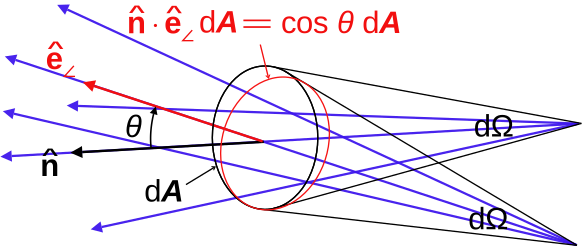
For spectral quantities two definitions are in use to refer to the same quantity, in terms of frequency or wavelength.
| Quantity (common name/s) | (Common) symbol/s | Defining equation | SI units | Dimension | Radiant energy | Radiant exposure | Radiant energy density | Radiant flux, radiant power | Radiant intensity | Radiance, intensity | Irradiance | Radiant exitance, radiant emittance | Radiosity | Spectral radiant flux, spectral radiant power | Spectral radiant intensity | Spectral radiance | Spectral irradiance |
|---|---|---|---|---|---|---|---|---|---|---|---|---|---|---|---|---|---|
| *Q, E, Qe, Ee* | J | [M][L]2[T]−2 | |||||||||||||||
| *He* | H_e = \mathrm{d} Q/\left ( \mathbf{\hat{e}}_{\angle} \cdot \mathrm{d}\mathbf{A} \right ) \,\! | J m−2 | [M][T]−3 | ||||||||||||||
| *ωe* | \omega_e = \mathrm{d} Q/\mathrm{d}V \,\! | J m−3 | [M][L]−3 | ||||||||||||||
| *Φ, Φe* | Q = \int \Phi \mathrm{d} t | W | [M][L]2[T]−3 | ||||||||||||||
| *I, Ie* | \Phi = I \mathrm{d} \Omega \,\! | W sr−1 | [M][L]2[T]−3 | ||||||||||||||
| *L, Le* | \Phi = \iint L\left ( \mathbf{\hat{e}}_{\angle} \cdot \mathrm{d}\mathbf{A} \right ) \mathrm{d} \Omega | W sr−1 m−2 | [M][T]−3 | ||||||||||||||
| *E, I, Ee, Ie* | \Phi = \int E \left ( \mathbf{\hat{e}}_{\angle} \cdot \mathrm{d}\mathbf{A} \right ) | W m−2 | [M][T]−3 | ||||||||||||||
| *M, Me* | \Phi = \int M \left ( \mathbf{\hat{e}}_{\angle} \cdot \mathrm{d}\mathbf{A} \right ) | W m−2 | [M][T]−3 | ||||||||||||||
| *J, Jν, Je, Jeν* | J = E + M \,\! | W m−2 | [M][T]−3 | ||||||||||||||
| *Φλ, Φν, Φeλ, Φeν* | Q=\iint\Phi_\lambda{\mathrm{d} \lambda \mathrm{d} t} | W m−1 (*Φ*λ) | |||||||||||||||
| W Hz−1 = J (*Φ*ν) | [M][L]−3[T]−3 (*Φ*λ) | ||||||||||||||||
| [M][L]−2[T]−2 (*Φ*ν) | |||||||||||||||||
| *Iλ, Iν, Ieλ, Ieν* | \Phi = \iint I_\lambda \mathrm{d} \lambda \mathrm{d} \Omega | W sr−1 m−1 (*Iλ*) | |||||||||||||||
| W sr−1 Hz−1 (*Iν*) | [M][L]−3[T]−3 (*Iλ*) | ||||||||||||||||
| [M][L]2[T]−2 (*Iν*) | |||||||||||||||||
| *Lλ, Lν, Leλ, Leν* | \Phi = \iiint L_\lambda \mathrm{d} \lambda \left ( \mathbf{\hat{e}}_{\angle} \cdot \mathrm{d}\mathbf{A} \right ) \mathrm{d} \Omega | W sr−1 m−3 (*L*λ) | |||||||||||||||
| W sr−1 m−2 Hz−1 (*L*ν) | [M][L]−1[T]−3 (*L*λ) | ||||||||||||||||
| [M][L]−2[T]−2 (*L*ν) | |||||||||||||||||
| *Eλ, Eν, Eeλ, Eeν* | \Phi = \iint E_\lambda \mathrm{d} \lambda \left ( \mathbf{\hat{e}}_{\angle} \cdot \mathrm{d}\mathbf{A} \right ) | W m−3 (*E*λ) | |||||||||||||||
| W m−2 Hz−1 (*E*ν) | [M][L]−1[T]−3 (*E*λ) | ||||||||||||||||
| [M][L]−2[T]−2 (*E*ν) |
Equations
Luminal electromagnetic waves
| Physical situation | Nomenclature | Equations | Energy density in an EM wave | Kinetic and potential momenta (non-standard terms in use) | Irradiance, light intensity | Doppler effect for light (relativistic) | Cherenkov radiation, cone angle | Electric and magnetic amplitudes | EM wave components |
|---|---|---|---|---|---|---|---|---|---|
| \langle u \rangle \,\! = mean energy density | For a dielectric: | ||||||||
| \langle u \rangle = \frac{1}{2} \left ( \varepsilon\mathbf{E}^2 + {\mathbf{B}^2\over\mu} \right ) \,\! | |||||||||
| Potential momentum: | |||||||||
| I = \langle \mathbf{S} \rangle = E^2_\mathrm{rms}/c\mu_0\,\! | |||||||||
| \lambda=\lambda_0\sqrt{\frac{c-v}{c+v}}\,\! | |||||||||
| \cos \theta = \frac{c}{n v} = \frac{1}{v\sqrt{\varepsilon\mu}} \,\! | |||||||||
| For a dielectric | |||||||||
| Electric |
Geometric optics
| Physical situation | Nomenclature | Equations | Critical angle (optics) | Thin lens equation | Image distance in a plane mirror | Spherical mirror |
|---|---|---|---|---|---|---|
| \sin\theta_c = \frac{n_2}{n_1}\,\! | ||||||
| \frac{1}{x_1} +\frac{1}{x_2} = \frac{1}{f} \,\! | ||||||
| x_2 = -x_1\,\! | ||||||
| *r* = curvature radius of mirror | Spherical mirror equation |
Subscripts 1 and 2 refer to initial and final optical media respectively.
These ratios are sometimes also used, following simply from other definitions of refractive index, wave phase velocity, and the luminal speed equation:
\frac{n_1}{n_2} = \frac{v_2}{v_1} = \frac{\lambda_2}{\lambda_1} = \sqrt{\frac{\varepsilon_1 \mu_1}{\varepsilon_2 \mu_2}} ,!
where:
- ε = permittivity of medium,
- μ = permeability of medium,
- λ = wavelength of light in medium,
- v = speed of light in media.
Polarization
| Physical situation | Nomenclature | Equations | Angle of total polarisation | intensity from polarized light, Malus's law |
|---|---|---|---|---|
| *θB* = Reflective polarization angle, Brewster's angle | \tan \theta_B = n_2/n_1\,\! | |||
| I = I_0\cos^2\theta\,\! |
Diffraction and interference
| Property or effect | Nomenclature | Equation | Thin film in air | The grating equation | Rayleigh's criterion | Bragg's law (solid state diffraction) | Young's double slit experiment | Single slit diffraction intensity | *N*-slit diffraction (*N* ≥ 2) | *N*-slit diffraction (all *N*) | Circular aperture intensity | Amplitude for a general planar aperture | Huygens–Fresnel–Kirchhoff principle | Kirchhoff's diffraction formula | |||
|---|---|---|---|---|---|---|---|---|---|---|---|---|---|---|---|---|---|
| \frac{\delta}{2\pi}\lambda = a \left ( \sin\theta + \sin\alpha \right ) \,\! | |||||||||||||||||
| \theta_R = 1.22\lambda/\,\!d | |||||||||||||||||
| \frac{\delta}{2\pi} \lambda = 2d \sin\theta \,\! | |||||||||||||||||
| \Delta y = \lambda D / a | |||||||||||||||||
| I = I_0 \left [ \frac{ \sin \left( \phi/2 \right ) }{\left( \phi/2 \right )} \right ]^2 \,\! | |||||||||||||||||
| I = I_0 \left [ \frac{ \sin \left( N \delta/2 \right ) }{\sin \left( \delta/2 \right )} \right ]^2 \,\! | |||||||||||||||||
| I = I_0 \left [ \frac{ \sin \left( \phi/2 \right ) }{\left( \phi/2 \right )} \frac{ \sin \left( N \delta/2 \right ) }{\sin \left( \delta/2 \right )} \right ]^2 \,\! | |||||||||||||||||
| I = I_0 \left ( \frac{2 J_1(ka \sin \theta)}{ka \sin \theta} \right )^2 | |||||||||||||||||
| Cartesian and spherical polar coordinates are used, xy plane contains aperture | Near-field (Fresnel) | ||||||||||||||||
| \mathbf{r} \right | \left | \mathbf{r}_0 \right | } \left [ \cos \alpha_0 - \cos \alpha \right ] \mathrm{d}S \,\! | ||||||||||||||
| \mathbf{r}_0 \right | } \left[ i \left | \mathbf{k} \right | U_0 \left ( \mathbf{r}_0 \right ) \cos{\alpha} + \frac {\partial A_0 \left ( \mathbf{r}_0 \right )}{\partial n} \right ] \mathrm{d}S |
Astrophysics definitions
In astrophysics, L is used for luminosity (energy per unit time, equivalent to power) and F is used for energy flux (energy per unit time per unit area, equivalent to intensity in terms of area, not solid angle). They are not new quantities, simply different names.
| Quantity (common name/s) | (Common) symbol/s | Defining equation | SI units | Dimension | Comoving transverse distance | Luminosity distance | Apparent magnitude in band *j* (UV, visible and IR parts of EM spectrum) (Bolometric) | Absolute magnitude | Distance modulus | Colour indices | Bolometric correction | |
|---|---|---|---|---|---|---|---|---|---|---|---|---|
| *DM* | pc (parsecs) | [L] | ||||||||||
| *DL* | D_L = \sqrt{\frac{L}{4\pi F}} \, | pc (parsecs) | [L] | |||||||||
| *m* | \frac {F_j}{F_j^0} \right | \, | dimensionless | dimensionless | ||||||||
| *M* | M = m - 5 \left [ \left ( \log_{10}{D_L} \right ) - 1 \right ]\!\, | dimensionless | dimensionless | |||||||||
| *μ* | \mu = m - M \!\, | dimensionless | dimensionless | |||||||||
| (No standard symbols) | U-B = M_U - M_B\!\, | |||||||||||
| dimensionless | dimensionless | |||||||||||
| *C*bol (No standard symbol) | \begin{align} C_\mathrm{bol} & = m_\mathrm{bol} - V \\ | dimensionless | dimensionless |
Notes
This article was imported from Wikipedia and is available under the Creative Commons Attribution-ShareAlike 4.0 License. Content has been adapted to SurfDoc format. Original contributors can be found on the article history page.
Ask Mako anything about List of optics equations — get instant answers, deeper analysis, and related topics.
Research with MakoFree with your Surf account
Create a free account to save articles, ask Mako questions, and organize your research.
Sign up freeThis content may have been generated or modified by AI. CloudSurf Software LLC is not responsible for the accuracy, completeness, or reliability of AI-generated content. Always verify important information from primary sources.
Report