From Surf Wiki (app.surf) — the open knowledge base
List of mammals of Tuvalu
none
none
This is a list of the mammal species recorded in Tuvalu. There are three mammal species in Tuvalu identified in the IUCN Red List, all of which are marine mammals of the order Cetacea: ginkgo-toothed beaked whale (Mesoplodon ginkgodens), pygmy killer whale (Feresa attenuata), and pantropical spotted dolphin (Stenella attenuata).
The literature review by Miller (2006) found four additional cetaceans reported: orca or killer whale (Orcinus orca), spinner dolphin (Stenella longirostris), bottlenose dolphin (Tursiops truncatus), and sperm whale (Physeter macrocephalus). The pantropical spotted dolphin (Stenella attenuata) is found in the lists of both Miller and the IUCN.
A revision of the list of cetaceans reported in the ocean surrounding Tuvalu was carried out by Miller (2009), who listed a "minke-like" whale (Balaenoptera species) and a diminutive sperm whale (Kogia species).
In 2010 a research voyage was conducted within the exclusive economic zones (EEZs) of Kiribati and Tuvalu. The survey confirmed the presence of seven species of cetaceans: sperm whale, killer whale, Bryde's whale (Balaenoptera brydei), short-finned pilot whale (Globicephala macrorhynchus), false killer whale (Pseudorca crassidens), spinner dolphin, and striped dolphin (Stenella coeruleoalba).
The Pacific Ocean surrounding Tuvalu is within the range of these cetaceans although sightings of some of these species may be infrequent.
The following tags are used to highlight each species' conservation status as assessed by the International Union for Conservation of Nature:
| DD | **Data deficient** | There is inadequate information to make an assessment of the risks to this species. |
|---|
Order: [[Cetacea]] (whales)

.jpg)
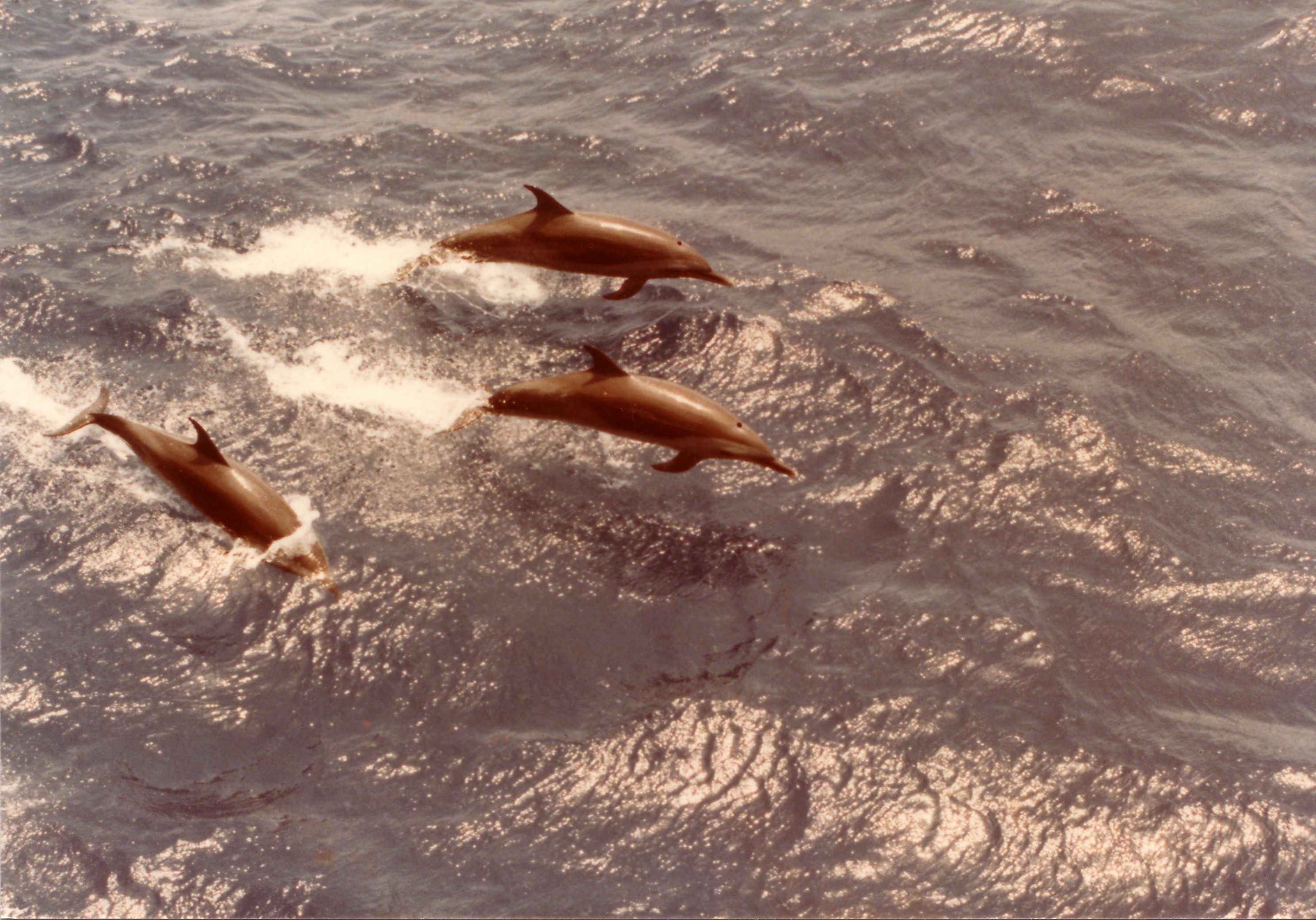
The order Cetacea includes whales, dolphins and porpoises. They are the mammals most fully adapted to aquatic life with a spindle-shaped nearly hairless body, protected by a thick layer of blubber, and forelimbs and tail modified to provide propulsion underwater.
- Parvorder Mysticeti: baleen whales
- Superfamily Balaenopteroidea
- Family Balaenopteridae: rorquals
- Subfamily Balaenopterinae
- Genus Balaenoptera: slender rorquals
- Bryde's whale, Balaenoptera brydei DD
- Genus Balaenoptera: slender rorquals
- Subfamily Balaenopterinae
- Parvorder Odontoceti: toothed whales
- Superfamily Delphinoidea: dolphins and relatives
- Family Delphinidae: oceanic dolphins
- Subfamily Delphininae
- Genus Stenella
- Pantropical spotted dolphin, Stenella attenuata LR/cd
- Spinner dolphin, Stenella longirostris LR/cd
- Striped dolphin, Stenella coeruleoalba LC
- Genus Tursiops
- Common bottlenose dolphin, Tursiops truncatus DD
- Genus Stenella
- Subfamily Orcininae
- Genus Feresa
- Pygmy killer whale, Feresa attenuata DD
- Genus Globicephala
- Short-finned pilot whale, Globicephala macrorhyncus LR/cd
- Genus Orcinus
- Killer whale (orca), Orcinus orca DD
- Genus: Pseudorca
- False killer whale, Pseudorca crassidens DD
- Genus Feresa
- Subfamily Delphininae
- Family Delphinidae: oceanic dolphins
- Superfamily Physeteroidea, sperm whales
- Family Kogiidae
- Genus Kogia
- Dwarf sperm whale, Kogia sima LR/lc
- Genus Kogia
- Family Physeteridae: sperm whale family
- Genus Physeter
- Sperm whale, Physeter macrocephalus VU
- Genus Physeter
- Family Kogiidae
- Superfamily Ziphioidea, beaked whales
- Family Ziphidae, beaked whales
- Subfamily Hyperoodontinae
- Genus Mesoplodon, mesoplodont whales
- Ginkgo-toothed beaked whale, Mesoplodon ginkgodens DD
- Genus Mesoplodon, mesoplodont whales
- Subfamily Hyperoodontinae
- Family Ziphidae, beaked whales
- Superfamily Delphinoidea: dolphins and relatives
Notes
- Edgar Waite published an account of The Mammals, Reptiles, and Fishes of Funafuti (Australian Museum, Sydney, 1897).
References
- {{cite web |access-date = 4 November 2011
- {{cite web |access-date=22 May 2007 |archive-url=https://web.archive.org/web/20070427043030/http://nmnhgoph.si.edu/msw/ |archive-date=27 April 2007 |url-status=dead
- {{cite web |access-date = 22 May 2007
References
- This list is derived from the [[IUCN Red List]] which lists species of mammals and includes those mammals that have recently been classified as extinct (since 1500 AD). The taxonomy and naming of the individual species is based on those used in existing Wikipedia articles as of 21 May 2007 and supplemented by the common names and taxonomy from the IUCN, Smithsonian Institution, or University of Michigan where no Wikipedia article was available.
- (14 February 2006). "Current State of Knowledge of Cetacean Threats, Diversity and Habitats in the Pacific Islands Region". WDCS Australasia Inc.
- (2008). "Secretariat of the Pacific Regional Environment Programme (SPREP)". Pacific Islands Regional Species Programme 2008-2012.
- (1 July 2009). "Current State of Knowledge of Cetacean Threats, Diversity and Habitats in the Pacific Islands Region". WDCS Australasia Inc.
- Murase, H & Temoai, I & Kirata, Taratau & Finkaso, S & Yasunaga, Genta & Pastene, L.A.. (2023). "A note on cetaceans off Kiribati and Tuvalu from a research cruise in October 2010". Journal of Cetacean Research and Management.
- (1897). "The mammals, reptiles, and fishes of Funafuti". Australian Museum Memoir 3(3): 165–202.
This article was imported from Wikipedia and is available under the Creative Commons Attribution-ShareAlike 4.0 License. Content has been adapted to SurfDoc format. Original contributors can be found on the article history page.
Ask Mako anything about List of mammals of Tuvalu — get instant answers, deeper analysis, and related topics.
Research with MakoFree with your Surf account
Create a free account to save articles, ask Mako questions, and organize your research.
Sign up freeThis content may have been generated or modified by AI. CloudSurf Software LLC is not responsible for the accuracy, completeness, or reliability of AI-generated content. Always verify important information from primary sources.
Report