From Surf Wiki (app.surf) — the open knowledge base
List of birds of Trinidad and Tobago
None
.jpg)
None
The South American Classification Committee (SACC) lists 489 species of birds that have been confirmed on the islands of Trinidad and Tobago as of November 2025. Of them, two are endemic, seven have been introduced by humans, 131 are rare or vagrants, 11 have been extirpated, and the status of one is not known. The origin of one species (vagrant or introduced) is uncertain. As of December 2023 the Trinidad & Tobago Bird Status & Distribution Committee (BSDC) did not recognize three of them and had added nine, all of them vagrants.
There are few places in the world where so many bird species can be seen in such a small area, many of them unique, very rare, or of particular interest. They range from the many species of hummingbird to the cave-dwelling oilbird (which uses echo-location to fly in the dark) and the scarlet ibis.
The islands are within a few miles of Venezuela, and the species are therefore typical of tropical South America. However, the number of species is relatively low compared to the mainland, as would be expected on small islands. The resident breeding birds are augmented in the northern winter by migrants from North America, although the variety of migrant passerines is very limited compared to Central America.
Unless noted otherwise, the list of species is that of the SACC with distribution notes by the BSDC. Capitalization within English names follows Wikipedia practice, i.e. only the first word of a name is capitalized unless a place name such as São Paulo is used.
Species in the list are common on both main islands except as indicated otherwise. Many are also present on other, small, islands which are usually not named in the list. Tobago has only about half the number of bird species of Trinidad, but several species and subspecies have occurred only on the smaller island. Some of the smaller islands off Tobago, such as Little Tobago, have important seabird breeding colonies.
Tinamous
Order: TinamiformesFamily: Tinamidae
The tinamous are one of the most ancient groups of bird. Although they look similar to other ground-dwelling birds like quail and grouse, they have no close relatives and are classified as a single family, Tinamidae, within their own order, the Tinamiformes.
| Name | Binomial | Status |
|---|---|---|
| Little tinamou | *Crypturellus soui* | Trinidad only |
Screamers
Order: AnseriformesFamily: Anhimidae
The screamers are a small family of birds related to the ducks. They are large, bulky birds, with a small downy head, long legs and large feet which are only partially webbed. They have large spurs on their wings which are used in fights over mates and in territorial disputes.
| Name | Binomial | Status |
|---|---|---|
| Horned screamer | *Anhima cornuta* | extirpated |
Ducks
.jpg)
.jpg)
Order: AnseriformesFamily: Anatidae
Anatidae includes the ducks and most duck-like waterfowl, such as geese and swans. These birds are adapted to an aquatic existence with webbed feet, flattened bills, and feathers that are excellent at shedding water due to an oily coating.
| Name | Binomial | Status |
|---|---|---|
| Fulvous whistling-duck | *Dendrocygna bicolor* | Trinidad only |
| White-faced whistling-duck | *Dendrocygna viduata* | Trinidad only |
| Black-bellied whistling-duck | *Dendrocygna autumnalis* | |
| Muscovy duck | *Cairina moschata* | Trinidad only - vagrant |
| Comb duck | *Sarkidiornis sylvicola* | Trinidad only - vagrant |
| Northern shoveller | *Spatula clypeata* | vagrant |
| Blue-winged teal | *Spatula discors* | |
| Eurasian wigeon | *Mareca penelope* | Tobago only - vagrant |
| American wigeon | *Mareca americana* | Tobago only - vagrant |
| White-cheeked pintail | *Anas bahamensis* | |
| Northern pintail | *Anas acuta* | vagrant |
| Green-winged teal | *Anas crecca* | vagrant |
| Southern pochard | *Netta erythrophthalma* | Trinidad only - vagrant |
| Ring-necked duck | *Aythya collaris* | vagrant |
| Lesser scaup | *Aythya affinis* | vagrant |
| Masked duck | *Oxyura dominica* |
Guans
Order: GalliformesFamily: Cracidae
The Cracidae are large birds, similar in general appearance to turkeys. The guans and curassows live in trees, but the smaller chachalacas are found in more open scrubby habitats. They are generally dull-plumaged, but the curassows and some guans have colorful facial ornaments.
| Common name | Binomial | Status |
|---|---|---|
| Trinidad piping-guan | *Aburria pipile* | Endemic to Trinidad |
| Rufous-vented chachalaca | *Ortalis ruficauda* | Tobago only |
Flamingos
Order: PhoenicopteriformesFamily: Phoenicopteridae
Flamingos are gregarious wading birds, usually 3 to tall, found in both the Western and Eastern Hemispheres. Flamingos filter-feed on shellfish and algae. Their oddly shaped beaks are specially adapted to separate mud and silt from the food they consume and, uniquely, are used upside-down.
| Name | Binomial | Status |
|---|---|---|
| American flamingo | *Phoenicopterus ruber* | Trinidad only |
Grebes
Order: PodicipediformesFamily: Podicipedidae
Grebes are small to medium-large freshwater diving birds. They have lobed toes and are excellent swimmers and divers. However, they have their feet placed far back on the body, making them quite ungainly on land.
| Name | Binomial | Status |
|---|---|---|
| Least grebe | *Tachybaptus dominicus* | |
| Pied-billed grebe | *Podilymbus podiceps* |
Pigeons
Order: ColumbiformesFamily: Columbidae
Pigeons and doves are stout-bodied birds with short necks and short slender bills with a fleshy cere.
| Name | Binomial | Status |
|---|---|---|
| Rock pigeon | *Columba livia* | Introduced species |
| Scaled pigeon | *Patagioenas speciosa* | Trinidad only |
| Scaly-naped pigeon | *Patagioenas squamosa* | Tobago and Little Tobago only |
| Band-tailed pigeon | *Patagioenas fasciata* | Trinidad only - extirpated |
| Pale-vented pigeon | *Patagioenas cayennensis* | |
| Eurasian collared dove | *Streptopelia decaocto* | Trinidad only - introduced |
| Ruddy quail-dove | *Geotrygon montana* | Trinidad only |
| White-tipped dove | *Leptotila verreauxi* | |
| Gray-fronted dove | *Leptotila rufaxilla* | Trinidad only |
| Lined quail-dove | *Zentrygon linearis* | Trinidad only |
| Eared dove | *Zenaida auriculata* | |
| Blue ground dove | *Claravis pretiosa* | Trinidad only |
| Common ground dove | *Columbina passerina* | Trinidad only |
| Plain-breasted ground dove | *Columbina minuta* | Trinidad only |
| Ruddy ground dove | *Columbina talpacoti* | |
| Scaled dove | *Columbina squammata* | Trinidad only |
Cuckoos
_To.jpg)
Order: CuculiformesFamily: Cuculidae
The family Cuculidae includes cuckoos, roadrunners, and anis. These birds are of variable size with slender bodies, long tails, and strong legs.
| Name | Binomial | Status |
|---|---|---|
| Greater ani | *Crotophaga major* | Trinidad only |
| Smooth-billed ani | *Crotophaga ani* | |
| Striped cuckoo | *Tapera naevia* | Trinidad only |
| Little cuckoo | *Coccycua minuta* | Trinidad only |
| Dwarf cuckoo | *Coccycua pumila* | Trinidad only - vagrant |
| Squirrel cuckoo | *Piaya cayana* | Trinidad only |
| Dark-billed cuckoo | *Coccyzus melacoryphus* | Trinidad only - vagrant |
| Yellow-billed cuckoo | *Coccyzus americanus* | |
| Mangrove cuckoo | *Coccyzus minor* | |
| Black-billed cuckoo | *Coccyzus erythropthalmus* | Trinidad only - vagrant |
Oilbird

Order: SteatornithiformesFamily: Steatornithidae
The oilbird is a slim, long-winged bird related to the nightjars. It is nocturnal and a specialist feeder on the fruit of the oil palm.
| Common name | Binomial | Status |
|---|---|---|
| Oilbird | *Steatornis caripensis* | Trinidad only |
Potoos
Order: NyctibiiformesFamily: Nyctibiidae
The potoos (sometimes called poor-me-ones) are large near passerine birds related to the nightjars and frogmouths. They are nocturnal insectivores which lack the bristles around the mouth found in the true nightjars.
| Common name | Binomial | Status |
|---|---|---|
| Common potoo | *Nyctibius griseus* |
Nightjars
Order: CaprimulgiformesFamily: Caprimulgidae
Nightjars are medium-sized nocturnal birds that usually nest on the ground. They have long wings, short legs, and very short bills. Most have small feet, of little use for walking, and long pointed wings. Their soft plumage is camouflaged to resemble bark or leaves.
| Common name | Binomial | Status |
|---|---|---|
| Nacunda nighthawk | *Chordeiles nacunda* | Trinidad only |
| Lesser nighthawk | *Chordeiles acutipennis* | Common Trinidad, vagrant Tobago |
| Common nighthawk/Antillean nighthawk | *Chordeiles minor*/*Chordeiles gundlachii* | Trinidad - vagrant |
| Short-tailed nighthawk | *Lurocalis semitorquatus* | Trinidad only |
| Common pauraque | *Nyctidromus albicollis* | Trinidad only |
| White-tailed nightjar | *Hydropsalis cayennensis* | |
| Rufous nightjar | *Antrostomus rufus* | Trinidad only |
Swifts
Order: ApodiformesFamily: Apodidae
Swifts are small birds which spend the majority of their lives flying. These birds have very short legs and never settle voluntarily on the ground, perching instead only on vertical surfaces. Many swifts have long swept-back wings which resemble a crescent or boomerang.
| Common name | Binomial | Status |
|---|---|---|
| Chestnut-collared swift | *Cypseloides rutilus* | Trinidad only |
| White-collared swift | *Streptoprocne zonaris* | Common Trinidad, vagrant Tobago |
| Gray-rumped swift | *Chaetura cinereiventris* | |
| Band-rumped swift | *Chaetura spinicaudus* | Trinidad only |
| Vaux's swift (not on the BDSC list) | *Chaetura vauxi* | vagrant |
| Chapman's swift | *Chaetura chapmani* | Trinidad only |
| Short-tailed swift | *Chaetura brachyura* | |
| Fork-tailed palm-swift | *Tachornis squamata* | |
| Lesser swallow-tailed swift | *Panyptila cayennensis* | Trinidad only |
Hummingbirds
.jpg)

_female.jpg)
_male_in_flight.jpg)

Order: ApodiformesFamily: Trochilidae
Hummingbirds are small birds capable of hovering in mid-air due to the rapid flapping of their wings. They are the only birds that can fly backwards.
| Common name | Binomial | Status |
|---|---|---|
| White-necked jacobin | *Florisuga mellivora mellivora* | |
| Rufous-breasted hermit | *Glaucis hirsutus insularum* | |
| Little hermit | *Phaethornis longuemareus* | Trinidad only |
| Green hermit | *Phaethornis guy* | Trinidad only |
| Brown violetear | *Colibri delphinae* | Common Trinidad, vagrant Tobago |
| White-tailed goldenthroat | *Polytmus guainumbi* | Trinidad only |
| Ruby-topaz hummingbird | *Chrysolampis mosquitus* | |
| Green-throated mango | *Anthracothorax viridigula* | Trinidad only |
| Black-throated mango | *Anthracothorax nigricollis* | |
| Tufted coquette | *Lophornis ornatus* | Trinidad only |
| Long-billed starthroat | *Heliomaster longirostris* | Trinidad only |
| Rufous-shafted woodstar | *Chaetocercus jourdanii* | Trinidad only - vagrant |
| Amethyst woodstar | *Calliphlox amethystina* | Trinidad only - vagrant |
| Blue-tailed emerald | *Chlorostilbon mellisugus* | Trinidad only |
| White-tailed sabrewing | *Campylopterus ensipennis* | Tobago only - near-threatened |
| Copper-rumped hummingbird | *Saucerottia tobaci erythronota* | Trinidad only for subspecies |
| Copper-rumped hummingbird | *Saucerottia tobaci tobaci* | Tobago only for subspecies |
| White-chested emerald | *Chrysuronia brevirostris* | Trinidad only |
| Blue-chinned sapphire | *Chlorestes notata* | Common Trinidad, vagrant Tobago |
Limpkin
Order: GruiformesFamily: Aramidae
The limpkin resembles a large rail. It has drab-brown plumage and a grayer head and neck.
| Name | Binomial | Status |
|---|---|---|
| Limpkin | *Aramus guarauna* | Common Trinidad, vagrant Tobago |
Rails
Order: GruiformesFamily: Rallidae
Rallidae is a large family of small to medium-sized birds which includes the rails, crakes, coots, and gallinules. Typically they inhabit dense vegetation in damp environments near lakes, swamps, or rivers. In general they are shy and secretive birds, making them difficult to observe. Most species have strong legs and long toes which are well adapted to soft uneven surfaces. They tend to have short, rounded wings and to be weak fliers.
| Name | Binomial | Status |
|---|---|---|
| Mangrove rail | *Rallus longirostris* | Trinidad only |
| Purple gallinule | *Porphyrio martinica* | |
| Azure gallinule | *Porphyrio flavirostris* | Common Trinidad, vagrant Tobago |
| Gray-breasted crake | *Laterallus exilis* | Trinidad only |
| Ash-throated crake | *Mustelirallus albicollis* | Trinidad only - extirpated |
| Paint-billed crake | *Mustelirallus erythrops* | Trinidad only - vagrant |
| Spotted rail | *Pardirallus maculatus* | Trinidad only - vagrant |
| Gray-cowled wood-rail | *Aramides cajaneus* | Trinidad only |
| Rufous-necked wood-rail | *Aramides axillaris* | Trinidad only |
| Uniform crake | *Amaurolimnas concolor* | Trinidad only - vagrant |
| Yellow-breasted crake | *Haplocrex flaviventer* | Common Trinidad, vagrant Tobago |
| Sora | *Porzana carolina* | |
| Common gallinule | *Gallinula galeata* | |
| American coot | *Fulica americana* | vagrant |
Finfoots
Order: GruiformesFamily: Heliornithidae
Heliornithidae is a small family of tropical birds with webbed lobes on their feet similar to those of grebes and coots.
| Name | Binomial | Status |
|---|---|---|
| Sungrebe | *Heliornis fulica* | Trinidad only - vagrant |
Plovers
.jpg)
Order: CharadriiformesFamily: Charadriidae
The family Charadriidae includes the plovers, dotterels, and lapwings. They are small to medium-sized birds with compact bodies, short, thick necks, and long, usually pointed, wings. They are found in open country worldwide, mostly in habitats near water.
| Name | Binomial | Status |
|---|---|---|
| Black-bellied plover | *Pluvialis squatarola* | |
| American golden-plover | *Pluvialis dominica* | |
| Pied lapwing | *Hoploxypterus cayanus* | Trinidad only - vagrant |
| Killdeer | *Charadrius vociferus* | vagrant |
| Semipalmated plover | *Charadrius semipalmatus* | |
| Common ringed plover | *Charadrius hiaticula* | vagrant |
| Southern lapwing | *Vanellus chilensis* | |
| Wilson's plover | *Anarynchus wilsonia* | Trinidad only |
| Collared plover | *Anarynchus collaris* | Common Trinidad, vagrant Tobago |
| Snowy plover | *Anarynchus nivosus* | Tobago only - vagrant |
Oystercatchers
Order: CharadriiformesFamily: Haematopodidae
The oystercatchers are large and noisy plover-like birds, with strong bills used for smashing or prising open molluscs.
| Name | Binomial | Status |
|---|---|---|
| American oystercatcher | *Haematopus palliatus* | vagrant |
Avocets and stilts
Order: CharadriiformesFamily: Recurvirostridae
Recurvirostridae is a family of large wading birds which includes the avocets and stilts. The avocets have long legs and long up-curved bills. The stilts have extremely long legs and long, thin, straight bills.
| Name | Binomial | Status |
|---|---|---|
| Black-necked stilt | *Himantopus mexicanus* | Common Trinidad, vagrant Tobago |
| American avocet | *Recurvirostra americana* | Tobago only - vagrant |
Thick-knees
Order: CharadriiformesFamily: Burhinidae
The thick-knees are a group of waders found worldwide within the tropical zone, with some species also breeding in temperate Europe and Australia. They are medium to large waders with strong black or yellow-black bills, large yellow eyes, and cryptic plumage. Despite being classed as waders, most species have a preference for arid or semi-arid habitats.
| Name | Binomial | Status |
|---|---|---|
| Double-striped thick-knee | *Hesperoburhinus bistriatus* | vagrant |
Sandpipers
.jpg)
.jpg)
Order: CharadriiformesFamily: Scolopacidae
Scolopacidae is a large diverse family of small to medium-sized shorebirds including the sandpipers, curlews, godwits, shanks, tattlers, woodcocks, snipes, dowitchers, and phalaropes. The majority of these species eat small invertebrates picked out of the mud or soil. Variation in length of legs and bills enables multiple species to feed in the same habitat, particularly on the coast, without direct competition for food.
| Name | Binomial | Status |
|---|---|---|
| Upland sandpiper | *Bartramia longicauda* | |
| Eskimo curlew | *Numenius borealis* | extirpated, possibly extinct |
| Whimbrel | *Numenius phaeopus* | |
| Long-billed curlew | *Numenius americanus* | Tobago only - vagrant |
| Black-tailed godwit | *Limosa limosaa* | Trinidad only - vagrant |
| Hudsonian godwit | *Limosa haemastica* | Trinidad only |
| Marbled godwit | *Limosa fedoa* | Trinidad only - vagrant |
| Ruddy turnstone | *Arenaria interpres morinella* | |
| Red knot | *Calidris canutus* | Trinidad only |
| Ruff | *Calidris pugnax* | vagrant |
| Stilt sandpiper | *Calidris himantopus* | |
| Curlew sandpiper | *Calidris ferruginea* | Trinidad only - vagrant |
| Sanderling | *Calidris alba* | |
| Baird's sandpiper | *Calidris bairdii* | Trinidad only - vagrant |
| Least sandpiper | *Calidris minutilla* | |
| White-rumped sandpiper | *Calidris fuscicollis* | |
| Buff-breasted sandpiper | *Calidris subruficollis* | |
| Pectoral sandpiper | *Calidris melanotos* | |
| Semipalmated sandpiper | *Calidris pusilla* | |
| Western sandpiper | *Calidris mauri* | |
| Short-billed dowitcher | *Limnodromus griseus* | |
| Wilson's snipe | *Gallinago delicata* | |
| Pantanal snipe | *Gallinago paraguaiae* | Trinidad only |
| Wilson's phalarope | *Phalaropus tricolor* | vagrant |
| Terek sandpiper | *Xenus cinereus* | Trinidad only - vagrant |
| Spotted sandpiper | *Actitis macularius* | |
| Solitary sandpiper | *Tringa solitaria* | |
| Common greenshank | *Tringa nebularia* | vagrant |
| Greater yellowlegs | *Tringa melanoleuca* | |
| Willet | *Tringa semipalmata* | |
| Lesser yellowlegs | *Tringa flavipes* | |
| Spotted redshank | *Tringa erythropus* | Tobago only - vagrant |
| Wood sandpiper | *Tringa glareola* | Tobago only - vagrant |
Jacanas
Order: CharadriiformesFamily: Jacanidae
The jacanas are a group of waders found throughout the tropics. They are identifiable by their huge feet and claws which enable them to walk on floating vegetation in the shallow lakes that are their preferred habitat.
| Name | Binomial | Status |
|---|---|---|
| Wattled jacana | *Jacana jacana* |
Skuas
Order: CharadriiformesFamily: Stercorariidae
The family Stercorariidae are, in general, medium to large birds, typically with gray or brown plumage, often with white markings on the wings. They nest on the ground in temperate and arctic regions and are long-distance migrants.
| Name | Binomial | Status |
|---|---|---|
| South polar skua | *Stercorarius maccormicki* | Trinidad only - vagrant |
| Pomarine jaeger | *Stercorarius pomarinus* | Trinidad only - vagrant |
| Parasitic jaeger | *Stercorarius parasiticus* | Trinidad only - vagrant |
Gulls
Order: CharadriiformesFamily: Laridae
Laridae is a family of medium to large seabirds and includes gulls, kittiwakes, terns, and skimmers. They are typically gray or white, often with black markings on the head or wings. They have stout, longish bills and webbed feet. Terns are a group of generally medium to large seabirds typically with gray or white plumage, often with black markings on the head. Most terns hunt fish by diving but some pick insects off the surface of fresh water. Terns are generally long-lived birds, with several species known to live in excess of 30 years.
| Name | Binomial | Status |
|---|---|---|
| Brown noddy | *Anous stolidus* | |
| Atlantic white-tern | *Gygis alba* | Tobago only - vagrant |
| Black skimmer | *Rynchops niger* | |
| Black-legged kittiwake | *Rissa tridactyla* | vagrant |
| Sabine's gull | *Xema sabini* | Trinidad only - vagrant |
| Black-headed gull | *Chroicocephalus ridibundus* | vagrant |
| Laughing gull | *Leucophaeus atricilla* | |
| Franklin's gull | *Leucophaeus pipixcan* | Trinidad only |
| Audouin's gull | *Ichthyaetus audouinii* | Trinidad only - vagrant |
| Ring-billed gull | *Larus delawarensis* | Trinidad only - vagrant |
| Great black-backed gull | *Larus marinus* | Trinidad only - vagrant |
| Kelp gull | *Larus dominicanus* | Trinidad only - vagrant |
| Lesser black-backed gull | *Larus fuscus* | Common Trinidad, vagrant Tobago |
| Herring gull | *Larus argentatus* | vagrant |
| Sooty tern | *Onychoprion fuscata* | |
| Bridled tern | *Onychoprion anaethetus* | |
| Least tern | *Sternula antillarum* | |
| Yellow-billed tern | *Sternula superciliaris* | Trinidad only |
| Large-billed tern | *Phaetusa simplex* | Trinidad only |
| Gull-billed tern | *Gelochelidon nilotica* | Common Trinidad, vagrant Tobago |
| Caspian tern | *Hydroprogne caspia* | Trinidad only - vagrant |
| Black tern | *Chlidonias niger* | Trinidad only |
| Common tern | *Sterna hirundo* | |
| Roseate tern | *Sterna dougallii* | |
| Arctic tern | *Sterna paradisaea* | vagrant |
| Sandwich tern | *Thalasseus sandvicensis* | |
| Royal tern | *Thalasseus maxima* |
Tropicbirds
_with_chick.jpg)
Order: PhaethontiformesFamily: Phaethontidae
Tropicbirds are slender white birds of tropical oceans with exceptionally long central tail feathers. Their heads and long wings have black markings.
| Common name | Binomial | Status |
|---|---|---|
| Red-billed tropicbird | *Phaethon aethereus* | |
| White-tailed tropicbird | *Phaethon lepturus* | Tobago only |
Southern storm-petrels
Order: ProcellariiformesFamily: Oceanitidae
The storm-petrels are the smallest seabirds, relatives of the petrels, feeding on planktonic crustaceans and small fish picked from the surface, typically while hovering. The flight is fluttering and sometimes bat-like. Until 2018, this family's species were included with the other storm-petrels in family Hydrobatidae.
| Common name | Binomial | Status |
|---|---|---|
| Wilson's storm-petrel | *Oceanites oceanicus* | vagrant |
Northern storm-petrels
Order: ProcellariiformesFamily: Hydrobatidae
Though the members of this family are similar in many respects to the southern storm-petrels, including their general appearance and habits, there are enough genetic differences to warrant their placement in a separate family.
| Common name | Binomial | Status |
|---|---|---|
| Leach's storm-petrel | *Hydrobates leucorhous* |
Shearwaters
Order: ProcellariiformesFamily: Procellariidae
The procellariids are the main group of medium-sized "true petrels", characterised by united nostrils with medium septum and a long outer functional primary.
| Common name | Binomial | Status |
|---|---|---|
| Bulwer's petrel | *Bulweria bulwerii* | Trinidad only - vagrant |
| Cory's shearwater | *Calonectris diomedea* | vagrant |
| Cape Verde shearwater | *Calonectris edwardsii* | vagrant |
| Sooty shearwater | *Ardenna grisea* | Trinidad only - vagrant |
| Great shearwater | *Ardenna gravis* | vagrant |
| Manx shearwater | *Puffinus puffinus* | Trinidad only - vagrant |
| Audubon's shearwater | *Puffinus lherminieri* | Little Tobago only |
Storks
Order: CiconiiformesFamily: Ciconiidae
Storks are large, long-legged, long-necked, wading birds with long, stout bills. Storks are mute, but bill-clattering is an important mode of communication at the nest. Their nests can be large and may be reused for many years. Many species are migratory.
| Name | Binomial | Status |
|---|---|---|
| Maguari stork | *Ciconia maguari* | Trinidad only - vagrant |
| Jabiru | *Jabiru mycteria* | vagrant |
| Wood stork | *Mycteria americana* | Trinidad only - vagrant |
Frigatebirds
Order: SuliformesFamily: Fregatidae
Frigatebirds are large seabirds usually found over tropical oceans. They are large, black-and-white, or completely black, with long wings and deeply forked tails. The males have colored inflatable throat pouches. They do not swim or walk and cannot take off from a flat surface. Having the largest wingspan-to-body-weight ratio of any bird, they are essentially aerial, able to stay aloft for more than a week.
| Common name | Binomial | Status |
|---|---|---|
| Magnificent frigatebird | *Fregata magnificens* |
Boobies
Order: SuliformesFamily: Sulidae
The sulids comprise the gannets and boobies. Both groups are medium to large coastal seabirds that plunge-dive for fish.
| Common name | Binomial | Status |
|---|---|---|
| Masked booby | *Sula dactylatra* | |
| Red-footed booby | *Sula sula* | |
| Brown booby | *Sula leucogaster* | |
| Northern gannet | *Morus bassanus* | Tobago only - vagrant |
Anhingas
Order: SuliformesFamily: Anhingidae
Anhingas are often called "snake-birds" because they have long thin necks, which gives a snake-like appearance when they swim with their bodies submerged. The males have black and dark-brown plumage, an erectile crest on the nape, and a larger bill than the female. The females have much paler plumage, especially on the neck and underparts. The darters have completely webbed feet and their legs are short and set far back on the body. Their plumage is somewhat permeable, like that of cormorants, and they spread their wings to dry after diving.
| Common name | Binomial | Status |
|---|---|---|
| Anhinga | *Anhinga anhinga* |
Cormorants
Order: SuliformesFamily: Phalacrocoracidae
Phalacrocoracidae is a family of medium to large coastal, fish-eating seabirds that includes cormorants and shags. Plumage coloration varies; the majority of species have mainly dark plumage, but some are pied black and white, and a few are more colorful.
| Common name | Binomial | Status |
|---|---|---|
| Neotropic cormorant | *Phalacrocorax brasilianus* |
Pelicans
_immature.jpg)
Order: PelecaniformesFamily: Pelecanidae
Pelicans are large water birds with a distinctive pouch under their beak. As with other members of the order Pelecaniformes, they have webbed feet with four toes.
| Common name | Binomial | Status |
|---|---|---|
| Brown pelican | *Pelecanus occidentalis* |
Herons
Order: PelecaniformesFamily: Ardeidae
_Tobago.jpg)
_young_adult.jpg)
.jpg)
The family Ardeidae contains the bitterns, herons, and egrets. Herons and egrets are medium to large wading birds with long necks and legs. Bitterns tend to be shorter necked and more wary. Members of Ardeidae fly with their necks retracted, unlike other long-necked birds such as storks, ibises, and spoonbills.
| Name | Binomial | Status |
|---|---|---|
| Rufescent tiger-heron | *Tigrisoma lineatum* | Trinidad only |
| Fasciated tiger-heron | *Tigrisoma fasciatum* | Trinidad only - vagrant |
| Boat-billed heron | *Cochlearius cochlearius* | Trinidad only |
| Agami heron | *Agamia agami* | Trinidad only - vagrant |
| Stripe-backed bittern | *Ixobrychus involucris* | Trinidad only |
| Least bittern | *Ixobrychus exilis* | Trinidad only |
| Pinnated bittern | *Botaurus pinnatus* | Trinidad only |
| Capped heron | *Pilherodius pileatus* | vagrant |
| Whistling heron | *Syrigma sibilatrix* | Trinidad only - vagrant |
| Little blue heron | *Egretta caerulea* | |
| Tricolored heron | *Egretta tricolor* | |
| Reddish egret | *Egretta rufescens* | vagrant |
| Snowy egret | *Egretta thula* | |
| Little egret | *Egretta garzetta* | |
| Western reef-heron | *Egretta gularis* | Trinidad only - vagrant |
| Yellow-crowned night-heron | *Nyctanassa violacea* | |
| Black-crowned night-heron | *Nycticorax nycticorax* | |
| Striated heron | *Butorides striata* | Trinidad only |
| Green heron | *Butorides virescens virescens* | Common Tobago, vagrant Trinidad |
| Squacco heron | *Ardeola ralloides* | vagrant |
| Cattle egret | *Ardea ibis* | |
| Great egret | *Ardea alba* | |
| Gray heron | *Ardea cinerea* | vagrant |
| Great blue heron | *Ardea herodias* | |
| Cocoi heron | *Ardea cocoi* | Common Trinidad, vagrant Tobago |
| Purple heron | *Ardea purpurea* | vagrant |
Ibises
Order: PelecaniformesFamily: Threskiornithidae
Threskiornithidae is a family of large terrestrial and wading birds which includes the ibises and spoonbills. They have long, broad wings with 11 primary and about 20 secondary feathers. They are strong fliers and despite their size and weight, very capable soarers.
| Name | Binomial | Status |
|---|---|---|
| White ibis | *Eudocimus albus* | Trinidad only - vagrant |
| Scarlet ibis | *Eudocimus ruber* | Common Trinidad, vagrant Tobago |
| Glossy ibis | *Plegadis falcinellus* | |
| Buff-necked ibis | *Theristicus caudatus* | Trinidad only - vagrant |
| Eurasian spoonbill | *Platalea leucorodia* | vagrant |
| Roseate spoonbill | *Platalea ajaja* | vagrant |
New World vultures

Order: CathartiformesFamily: Cathartidae
The New World vultures are not closely related to Old World vultures, but superficially resemble them because of convergent evolution. Like the Old World vultures, they are scavengers. However, unlike Old World vultures, which find carcasses by sight, New World vultures have a good sense of smell with which they locate carrion.
| Name | Binomial | Status |
|---|---|---|
| King vulture | *Sarcoramphus papa* | Trinidad only - vagrant |
| Black vulture | *Coragyps atratus* | Common Trinidad, vagrant Tobago |
| Turkey vulture | *Cathartes aura* | Trinidad only |
Osprey

Order: AccipitriformesFamily: Pandionidae
The family Pandionidae contains only one species, the osprey. The osprey is a medium-large raptor which is a specialist fish-eater with a worldwide distribution.
| Name | Binomial | Status |
|---|---|---|
| Osprey | *Pandion haliaetus* |
Hawks
Order: AccipitriformesFamily: Accipitridae
Accipitridae is a family of birds of prey which includes hawks, eagles, kites, harriers, and Old World vultures. These birds have powerful hooked beaks for tearing flesh from their prey, strong legs, powerful talons, and keen eyesight.
| Name | Binomial | Status |
|---|---|---|
| Pearl kite | *Gampsonyx swainsonii* | Trinidad only |
| White-tailed kite | *Elanus leucurus* | Trinidad only - vagrant |
| Hook-billed kite | *Chondrohierax uncinatus* | |
| Gray-headed kite | *Leptodon cayanensis* | Trinidad only |
| Swallow-tailed kite | *Elanoides forficatus* | Common Trinidad, vagrant Tobago |
| Black hawk-eagle | *Spizaetus tyrannus* | Trinidad only |
| Ornate hawk-eagle | *Spizaetus ornatus* | Trinidad only, extirpated Tobago |
| Black-collared hawk | *Busarellus nigricollis* | Trinidad only - vagrant |
| Snail kite | *Rostrhamus sociabilis* | Trinidad only |
| Slender-billed kite | *Helicolestes hamatus* | Trinidad only - vagrant |
| Double-toothed kite | *Harpagus bidentatus* | Trinidad only |
| Plumbeous kite | *Ictinia plumbea* | Trinidad only |
| Long-winged harrier | *Circus buffoni* | Common Trinidad, vagrant Tobago |
| Black kite | *Milvus migrans* | Trinidad only - vagrant |
| Crane hawk | *Geranospiza caerulescens* | Trinidad only |
| Common black hawk | *Buteogallus anthracinus* | Common Trinidad, vagrant Tobago |
| Rufous crab hawk | *Buteogallus aequinoctialis* | Trinidad only |
| Savanna hawk | *Buteogallus meridionalis* | Common Trinidad, vagrant Tobago |
| Great black hawk | *Buteogallus urubitinga* | Common Tobago, vagrant Trinidad |
| Roadside hawk | *Rupornis magnirostris* | Trinidad only - vagrant |
| White-tailed hawk | *Geranoaetus albicaudatus* | Trinidad only - vagrant |
| White hawk | *Pseudastur albicollis* | Trinidad only |
| Gray-lined hawk | *Buteo nitidus* | Trinidad only |
| Broad-winged hawk | *Buteo platypterus* | |
| Short-tailed hawk | *Buteo brachyurus* | Trinidad only |
| Swainson's hawk | *Buteo swainsoni* | vagrant |
| Zone-tailed hawk | *Buteo albonotatus* | |
| Red-tailed hawk | *Buteo jamaicensis* | vagrant |
Barn owls
Order: StrigiformesFamily: Tytonidae
Barn owls are medium to large owls with large heads and characteristic heart-shaped faces. They have long strong legs with powerful talons.
| Common name | Binomial | Status |
|---|---|---|
| American barn owl | *Tyto furcata* |
Owls
Order: StrigiformesFamily: Strigidae
The typical owls are small to large solitary nocturnal birds of prey. They have large forward-facing eyes and ears, a hawk-like beak, and a conspicuous circle of feathers around each eye called a facial disk.
| Common name | Binomial | Status |
|---|---|---|
| Tropical screech-owl | *Megascops choliba* | Trinidad only |
| Spectacled owl | *Pulsatrix perspicillata* | Trinidad only |
| Mottled owl | *Strix virgata* | Trinidad only |
| Ferruginous pygmy-owl | *Gaucidium brasilianum* | Trinidad only |
| Burrowing owl | *Athene cunicularia* | Trinidad only - vagrant |
| Striped owl | *Asio clamator* | Tobago only |
| Stygian owl | *Asio stygius* | Trinidad only - vagrant |
| Short-eared owl | *Asio flammeus* | Trinidad only - vagrant |
Trogons
Order: TrogoniformesFamily: Trogonidae
The family Trogonidae includes trogons and quetzals. Found in tropical woodlands worldwide, they feed on insects and fruit, and their broad bills and weak legs reflect their diet and arboreal habits. Although their flight is fast, they are reluctant to fly any distance. Trogons have soft, often colorful, feathers with distinctive male and female plumage.
| Common name | Binomial | Status |
|---|---|---|
| Green-backed trogon | *Trogon viridis* | Trinidad only |
| Guianan violaceous-trogon | *Trogon violaceus* | Trinidad only |
| Collared trogon | *Trogon collaris* |
Motmots

Order: CoraciiformesFamily: Momotidae
The motmots have colorful plumage and long, graduated tails which they display by waggling back and forth. In most of the species, the barbs near the ends of the two longest (central) tail feathers are weak and fall off, leaving a length of bare shaft and creating a racket-shaped tail.
| Common name | Binomial | Status |
|---|---|---|
| Trinidad motmot | *Momotus bahamensis* | endemic to main islands |
Kingfishers

Order: CoraciiformesFamily: Alcedinidae
Kingfishers are medium-sized birds with large heads, long pointed bills, short legs, and stubby tails.
| Common name | Binomial | Status |
|---|---|---|
| Ringed kingfisher | *Megaceryle torquata* | Trinidad, vagrant to Tobago |
| Belted kingfisher | *Megaceryle alcyon* | |
| Amazon kingfisher | *Chloroceryle amazona* | Trinidad only - vagrant |
| American pygmy kingfisher | *Chloroceryle aenea* | Trinidad only |
| Green kingfisher | *Chloroceryle americana* |
Jacamars
_male.jpg)
Order: GalbuliformesFamily: Galbulidae
The jacamars are near passerine birds from tropical South America, with a range that extends up to Mexico. They feed on insects caught on the wing, and are glossy, elegant birds with long bills and tails. In appearance and behavior they resemble the Old World bee-eaters, although they are more closely related to woodpeckers.
| Common name | Binomial | Status |
|---|---|---|
| Rufous-tailed jacamar | *Galbula ruficauda* |
Toucans
Order: PiciformesFamily: Ramphastidae
Toucans are near passerine birds from the Neotropics. They are brightly marked and have enormous, colorful bills which in some species amount to half their body length.
| Common name | Binomial | Status |
|---|---|---|
| Channel-billed toucan | *Ramphastos vitellinus* | Trinidad only |
Woodpeckers
_female.jpg)
Order: PiciformesFamily: Picidae
Woodpeckers are small to medium-sized birds with chisel-like beaks, short legs, stiff tails, and long tongues used for capturing insects. Some species have feet with two toes pointing forward and two backward, while several species have only three toes. Many woodpeckers have the habit of tapping noisily on tree trunks with their beaks.
| Common name | Binomial | Status |
|---|---|---|
| Red-crowned woodpecker | *Melanerpes rubricapillus rubricapillus* | Tobago only |
| Red-rumped woodpecker | *Dryobates kirkii* | |
| Crimson-crested woodpecker | *Campephilus melanoleucos* | Trinidad only |
| Lineated woodpecker | *Dryocopus lineatus* | Trinidad only |
| Chestnut woodpecker | *Celeus elegans* | Trinidad only |
| Golden-olive woodpecker | *Piculus rubiginosus* |
Falcons

Order: FalconiformesFamily: Falconidae
Falconidae is a family of diurnal birds of prey. They differ from hawks, eagles, and kites in that they kill with their beaks instead of their talons.
| Common name | Binomial | Status |
|---|---|---|
| Crested caracara | *Caracara plancus* | |
| Yellow-headed caracara | *Milvago chimachima* | |
| Eurasian kestrel | *Falco tinnunculus* | Trinidad only - vagrant |
| American kestrel | *Falco sparverius* | vagrant |
| Merlin | *Falco columbarius* | |
| Bat falcon | *Falco rufigularis* | Common Trinidad, vagrant Tobago |
| Orange-breasted falcon | *Falco deiroleucus* | Trinidad only - vagrant |
| Aplomado falcon | *Falco femoralis* | |
| Peregrine falcon | *Falco peregrinus* |
New World and African parrots
.jpg)
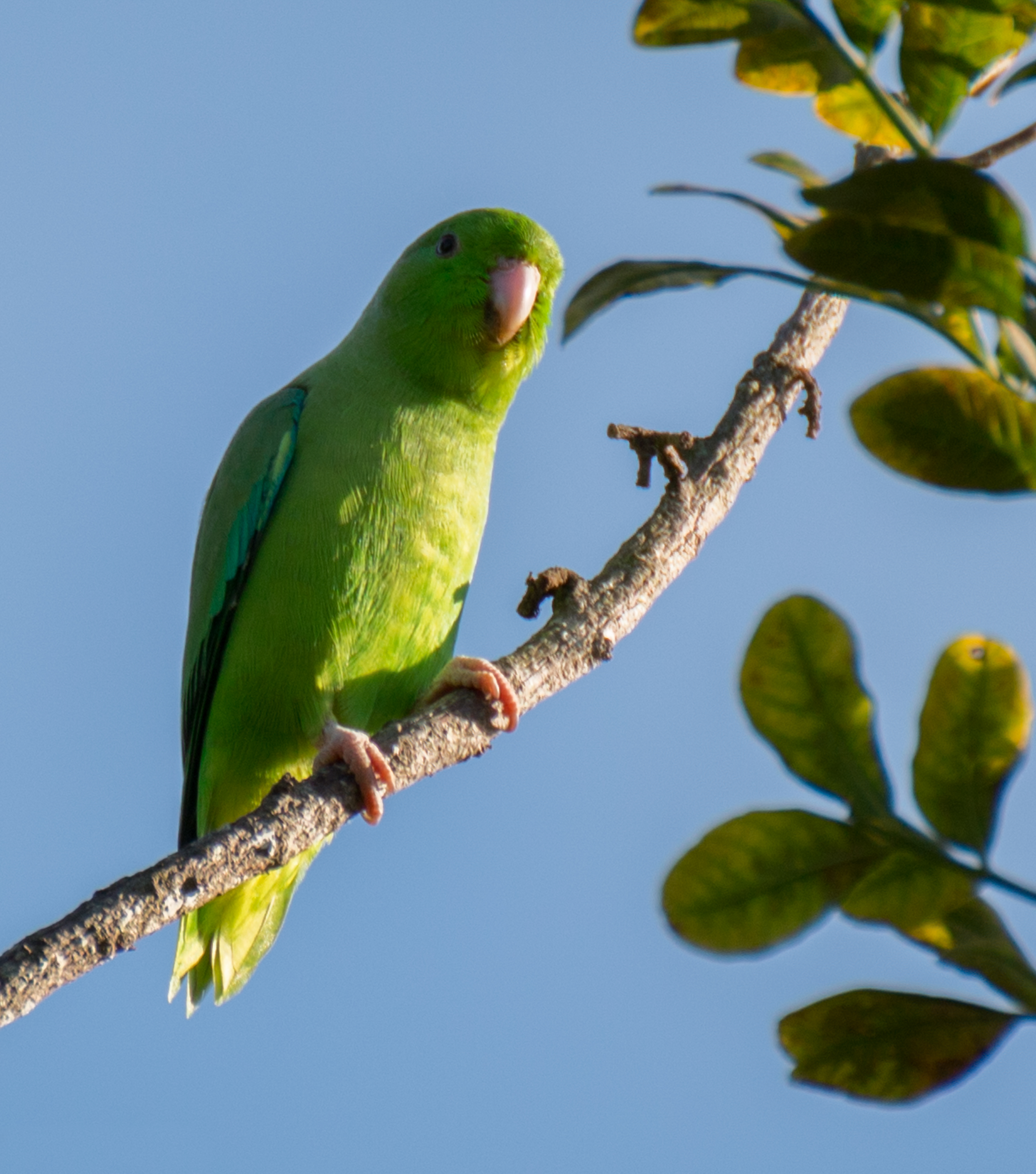
Order: PsittaciformesFamily: Psittacidae
Parrots are small to large birds with a characteristic curved beak. Their upper mandibles have slight mobility in the joint with the skull and they have a generally erect stance. All parrots are zygodactyl, having the four toes on each foot placed two at the front and two to the back.
| Name | Binomial | Status |
|---|---|---|
| Lilac-tailed parrotlet | *Touit batavicus* | Trinidad only |
| Scarlet-shouldered parrotlet | *Touit huetii* | vagrant |
| Blue-headed parrot | *Pionus menstruus* | Trinidad only |
| Yellow-crowned amazon | *Amazona ochrocephala* | Trinidad only |
| Orange-winged amazon | *Amazona amazonica* | |
| Green-rumped parrotlet | *Forpus passerinus* | |
| Brown-throated parakeet | *Eupsittula pertinax* | Trinidad only |
| Red-bellied macaw | *Orthopsittaca manilatus* | Trinidad only |
| Blue-and-yellow macaw | *Ara ararauna* | Trinidad only, reintroduced |
| Scarlet macaw | *Ara macao* | Trinidad only - vagrant |
| Red-and-green macaw | *Ara chloropterus* | Trinidad only - vagrant/population of unknown origin |
| White-eyed parakeet | *Psittacara leucophthalmus* | Trinidad only |
Antbirds
_male_To.jpg)
Order: PasseriformesFamily: Thamnophilidae
The antbirds are a large family of small passerine birds of subtropical and tropical Central and South America. They are forest birds which tend to feed on insects at or near the ground. A sizable minority of them specialize in following columns of army ants to eat small invertebrates that leave their hiding places to flee from the ants. Many species lack bright color; brown, black, and white being the dominant tones.
| Common name | Binomial | Status |
|---|---|---|
| Great antshrike | *Taraba major* | Trinidad only |
| Black-crested antshrike | *Sakesphorus canadensis* | Trinidad only |
| Barred antshrike | *Thamnophilus doliatus tobagensis* | |
| Plain antvireo | *Dysithamnus mentalis* | |
| White-flanked antwren | *Myrmotherula axillaris* | Trinidad only |
| White-fringed antwren | *Formicivora grisea* | Tobago only |
| Silvered antbird | *Sclateria naevia* | Trinidad only |
| White-bellied antbird | *Myrmeciza longipes* | Trinidad only |
Antpittas
Order: PasseriformesFamily: Grallariidae
Antpittas resemble the true pittas with strong, longish legs, very short tails, and stout bills.
| Common name | Binomial | Status |
|---|---|---|
| Scaled antpitta | *Grallaria guatimalensis* | Trinidad only - vagrant |
Antthrushes
Order: PasseriformesFamily: Formicariidae
Antthrushes resemble small rails with strong, longish legs, very short tails, and stout bills.
| Common name | Binomial | Status |
|---|---|---|
| Black-faced antthrush | *Formicarius analis* | Trinidad only |
Ovenbirds

Order: PasseriformesFamily: Furnariidae
Ovenbirds comprise a large family of small sub-oscine passerine bird species found in Central and South America. They are a diverse group of insectivores which gets its name from the elaborate "oven-like" clay nests built by some species, although others build stick nests or nest in tunnels or clefts in rock. The woodcreepers are brownish birds which maintain an upright vertical posture, supported by their stiff tail vanes. They feed mainly on insects taken from tree trunks.
| Common name | Binomial | Status |
|---|---|---|
| Gray-throated leaftosser | *Sclerurus albigularis* | |
| Olivaceous woodcreeper | *Sittasomus griseicapillus* | Tobago only |
| Plain-brown woodcreeper | *Dendrocincla fuliginosa* | |
| Cocoa woodcreeper | *Xiphorhynchus susurrans* | |
| Straight-billed woodcreeper | *Dendroplex picus* | Trinidad only |
| Streak-headed woodcreeper | *Lepidocolaptes souleyetii* | Trinidad only |
| Streaked xenops | *Xenops rutilans* | Trinidad only |
| Yellow-chinned spinetail | *Certhiaxis cinnamomeus* | Trinidad only |
| Pale-breasted spinetail | *Synallaxis albescens* | Trinidad only |
| Stripe-breasted spinetail | *Synallaxis cinnamomea* |
Manakins

Order: PasseriformesFamily: Pipridae
The manakins are a family of subtropical and tropical mainland Central and South America, and Trinidad and Tobago. They are compact forest birds, the males typically being brightly colored, although the females of most species are duller and usually green-plumaged. Manakins feed on small fruits, berries and insects.
| Common name | Binomial | Status |
|---|---|---|
| Blue-backed manakin | *Chiroxiphia pareola* | Tobago only |
| White-bearded manakin | *Manacus manacus* | Trinidad only |
| Golden-headed manakin | *Pipra erythrocephala* | Trinidad only |
Cotingas
Order: PasseriformesFamily: Cotingidae
The cotingas are birds of forests or forest edges in tropical South America. Comparatively little is known about this diverse group, although all have broad bills with hooked tips, rounded wings and strong legs. The males of many of the species are brightly colored or decorated with plumes or wattles.
| Common name | Binomial | Status |
|---|---|---|
| White bellbird | *Procnias alba* | Trinidad only - vagrant |
| Bearded bellbird | *Procnias averano* | Trinidad only |
Tityras
Order: PasseriformesFamily: Tityridae
Tityridae are suboscine passerine birds found in forest and woodland in the Neotropics. They are small to medium-sized birds. They do not have the sophisticated vocal capabilities of the songbirds. Most, but not all, have plain coloring.
| Common name | Binomial | Status |
|---|---|---|
| Black-tailed tityra | *Tityra cayana* | Trinidad only |
| White-winged becard | *Pachyramphus polychopterus* |
Tyrant flycatchers
.jpg)
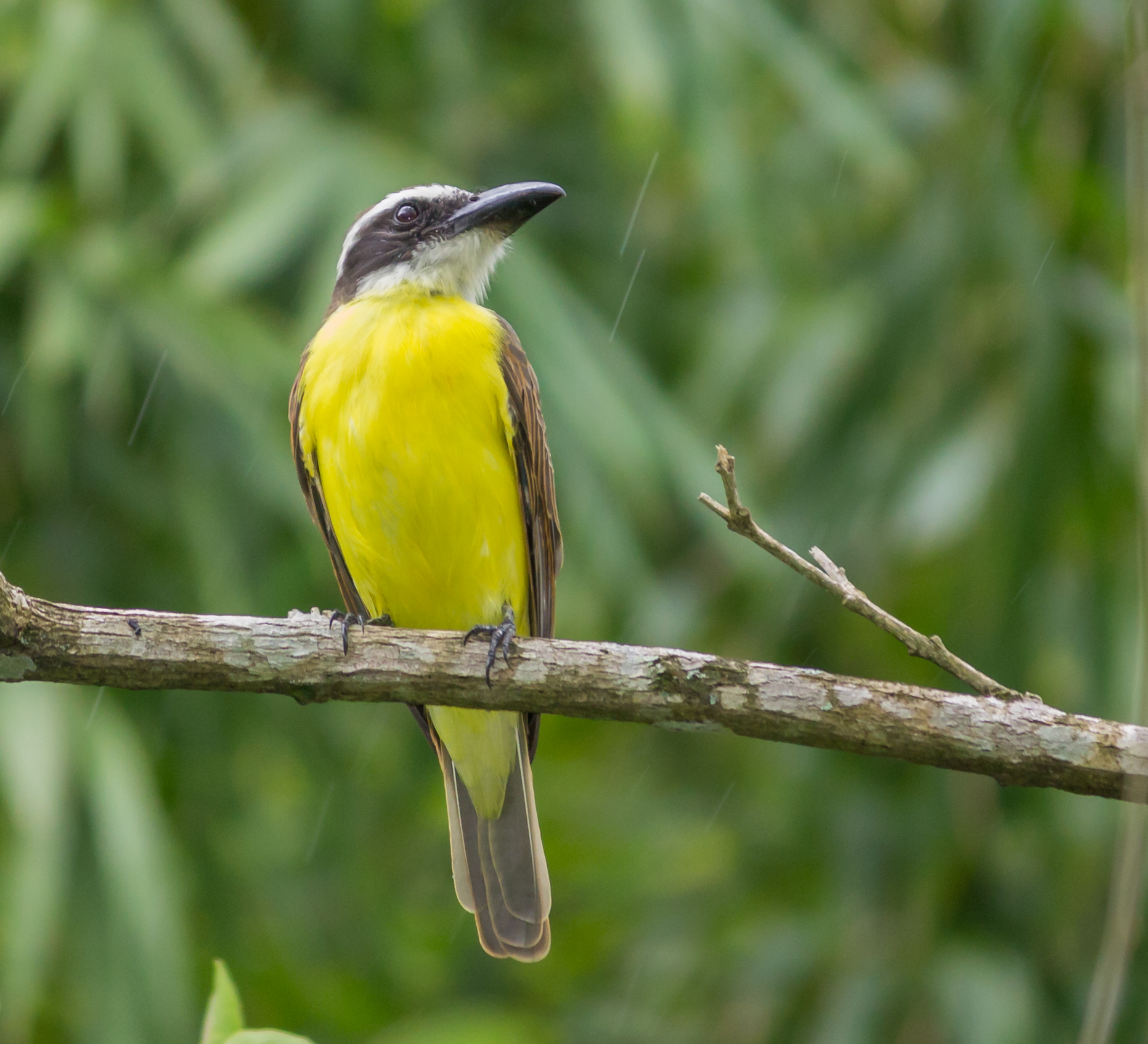
Order: PasseriformesFamily: Tyrannidae
Tyrant flycatchers are passerine birds which occur throughout North and South America. They superficially resemble the Old World flycatchers, but are more robust and have stronger bills. They do not have the sophisticated vocal capabilities of the songbirds. Most, but not all, have plain coloring. As the name implies, most are insectivorous.
| Common name | Binomial | Status |
|---|---|---|
| White-throated spadebill | *Platyrinchus mystaceus* | |
| Olive-striped flycatcher | *Mionectes olivaceus* | Trinidad only |
| Ochre-bellied flycatcher | *Mionectes oleagineus* | |
| Slaty-capped flycatcher | *Leptopogon superciliaris* | Trinidad only |
| Yellow-breasted flatbill | *Tolmomyias flaviventris* | |
| Yellow-olive flatbill | *Tolmomyias sulphurescens* | Trinidad only |
| Short-tailed pygmy-tyrant | *Myiornis ecaudatus* | Trinidad only |
| Spotted tody-flycatcher | *Todirostrum maculatum* | Trinidad only |
| Yellow-bellied elaenia | *Elaenia flavogaster* | |
| Small-billed elaenia | *Elaenia parvirostris* | Trinidad only |
| Slaty elaenia | *Elaenia strepera* | Trinidad only - vagrant |
| Lesser elaenia | *Elaenia chiriquensis* | Trinidad only |
| Forest elaenia | *Myiopagis gaimardii* | Trinidad only |
| Southern beardless-tyrannulet | *Camptostoma obsoletum* | Trinidad only |
| Mouse-colored tyrannulet | *Nesotriccus murinus* | Trinidad only |
| Crested doradito | *Pseudocolopteryx sclateri* | Trinidad only - vagrant |
| Bright-rumped attila | *Attila spadiceus* | Trinidad only |
| Piratic flycatcher | *Legatus leucophaius* | |
| Great kiskadee | *Pitangus sulphuratus* | Trinidad only |
| Sulphury flycatcher | *Tyrannopsis sulphurea* | Trinidad only |
| Boat-billed flycatcher | *Megarynchus pitangua* | Trinidad only |
| Streaked flycatcher | *Myiodynastes maculatus* | |
| Variegated flycatcher | *Empidonomus varius* | Trinidad only |
| Tropical kingbird | *Tyrannus melancholicus* | |
| Fork-tailed flycatcher | *Tyrannus savana* | |
| Eastern kingbird | *Tyrannus tyrannus* | Trinidad only - vagrant |
| Gray kingbird | *Tyrannus dominicensis vorax* | |
| Dusky-capped flycatcher | *Myiarchus tuberculifer* | Trinidad only |
| Swainson's flycatcher | *Myiarchus swainsoni* | Trinidad only - vagrant |
| Venezuelan flycatcher | *Myiarchus venezuelensis* | Tobago only |
| Brown-crested flycatcher | *Myiarchus tyrannulus* | |
| Bran-colored flycatcher | *Myiophobus fasciatus* | Trinidad only |
| Northern scrub-flycatcher | *Sublegatus arenarum* | Trinidad only |
| Pied water tyrant | *Fluvicola pica* | Trinidad only |
| White-headed marsh tyrant | *Arundinicola leucocephala* | Trinidad only |
| Fuscous flycatcher | *Cnemotriccus fuscatus* | |
| Euler's flycatcher | *Lathrotriccus euleri* | Trinidad only |
| Olive-sided flycatcher | *Contopus cooperi* | Trinidad only |
| Eastern wood-pewee | *Contopus virens* | Trinidad only - vagrant |
| Tropical pewee | *Contopus cinereus* | Trinidad only |
Vireos

Order: PasseriformesFamily: Vireonidae
The vireos are a group of small to medium-sized passerine birds. They are typically greenish in color and resemble New World warblers apart from their heavier bills.
| Common name | Binomial | Status |
|---|---|---|
| Rufous-browed peppershrike | *Cyclarhis gujanensis* | Trinidad only |
| Scrub greenlet | *Hylophilus flavipes* | Tobago only |
| Golden-fronted greenlet | *Pachysylvia aurantiifrons* | Trinidad only |
| White-eyed vireo | *Vireo griseus* | vagrant; Trinidad only |
| Yellow-throated vireo | *Vireo flavifrons* | vagrant |
| Red-eyed vireo | *Vireo olivaceus* | |
| Chivi vireo | *Vireo chivi* | |
| Black-whiskered vireo | *Vireo altiloquus* |
Swallows
Order: PasseriformesFamily: Hirundinidae
The family Hirundinidae is adapted to aerial feeding. They have a slender streamlined body, long pointed wings, and a short bill with a wide gape. The feet are adapted to perching rather than walking, and the front toes are partially joined at the base.
| Common name | Binomial | Status |
|---|---|---|
| Blue-and-white swallow | *Pygochelidon cyanoleuca* | Trinidad only - vagrant |
| Southern rough-winged swallow | *Stelgidopteryx ruficollis* | Common Trinidad, vagrant Tobago |
| Caribbean martin | *Progne dominicensis* | vagrant Trinidad, common Tobago |
| Gray-breasted martin | *Progne chalybea* | Trinidad only |
| White-winged swallow | *Tachycineta albiventer* | |
| Bank swallow | *Riparia riparia* | |
| Barn swallow | *Hirundo rustica* | |
| Cliff swallow | *Petrochelidon pyrrhonota* |
Wrens
Order: PasseriformesFamily: Troglodytidae
The wrens are mainly small and inconspicuous except for their loud songs. These birds have short wings and thin down-turned bills. Several species often hold their tails upright. All are insectivorous.
| Common name | Binomial | Status |
|---|---|---|
| Southern house-wren | *Troglodytes musculus* | |
| Rufous-breasted wren | *Pheugopedius rutilus* |
Gnatcatchers
Order: PasseriformesFamily: Polioptilidae
These dainty birds resemble Old World warblers in their build and habits, moving restlessly through the foliage seeking insects. The gnatcatchers and gnatwrens are mainly soft bluish gray in color and have the typical insectivore's long sharp bill. They are birds of fairly open woodland or scrub, which nest in bushes or trees.
| Common name | Binomial | Status |
|---|---|---|
| Trilling gnatwren | *Ramphocaenus melanurus* | Trinidad only |
Thrushes

Order: PasseriformesFamily: Turdidae
The thrushes are a group of passerine birds that occur mainly in the Old World. They are plump, soft plumaged, small to medium-sized insectivores or sometimes omnivores, often feeding on the ground. Many have attractive songs.
| Common name | Binomial | Status |
|---|---|---|
| Orange-billed nightingale-thrush | *Catharus aurantiirostris* | Trinidad only |
| Veery | *Catharus fuscescens* | Trinidad only - vagrant |
| Gray-cheeked thrush | *Catharus minimus* | Trinidad only - vagrant |
| Yellow-legged thrush | *Turdus flavipes* | |
| Cocoa thrush | *Turdus fumigatus* | Trinidad only |
| Spectacled thrush | *Turdus nudigenis* | |
| White-necked thrush | *Turdus albicollis* |
Mockingbirds
Order: PasseriformesFamily: Mimidae
The mimids are a family of passerine birds that includes thrashers, mockingbirds, tremblers, and the New World catbirds. These birds are notable for their vocalizations, especially their ability to mimic a wide variety of birds and other sounds heard outdoors. Their coloring tends towards dull-grays and browns.
| Common name | Binomial | Status |
|---|---|---|
| Tropical mockingbird | *Mimus gilvus* |
Weavers
Order: PasseriformesFamily: Ploceidae
The weavers are small passerine birds related to the finches. They are seed-eating birds with rounded conical bills. The males of many species are brightly colored, usually in red or yellow and black, some species show variation in color only in the breeding season.
| Common name | Binomial | Status |
|---|---|---|
| Village weaver (not on the BDSC list) | *Ploceus cucullatus* | introduced species |
Estreldids
Order: PasseriformesFamily: Estrildidae
The estrildid finches are small passerine birds of the Old World tropics and Australasia. They are gregarious and often colonial seed eaters with short thick but pointed bills. They are all similar in structure and habits, but have wide variation in plumage colors and patterns.
| Common name | Binomial | Status |
|---|---|---|
| Common waxbill | *Estrilda astrild* | Trinidad, accidental Tobago - introduced species |
| Tricolored munia | *Lonchura malacca* | Trinidad only - introduced species |
Old World sparrows
Order: PasseriformesFamily: Passeridae
Sparrows are small passerine birds. In general, sparrows tend to be small, plump, brown or gray birds with short tails and short powerful beaks. Sparrows are seed eaters, but they also consume small insects.
| Common name | Binomial | Status |
|---|---|---|
| House sparrow | *Passer domesticus* | Trinidad only - Introduced species |
Pipits and wagtails
Order: PasseriformesFamily: Motacillidae
Motacillidae is a family of small passerine birds with medium to long tails. They include the wagtails, longclaws and pipits. They are slender ground-feeding insectivores of open country.
| Common name | Binomial | Status |
|---|---|---|
| White wagtail | *Motacilla alba* | vagrant |
Finches
Order: PasseriformesFamily: Fringillidae
Finches are seed-eating passerine birds, that are small to moderately large and have a strong beak, usually conical and in some species very large. All have twelve tail feathers and nine primaries. These birds have a bouncing flight with alternating bouts of flapping and gliding on closed wings, and most sing well.
| Common name | Binomial | Status |
|---|---|---|
| Red siskin | *Carduelis cucullata* | Trinidad only - extirpated |
| Lesser goldfinch | *Spinus psaltria* | Trinidad only - vagrant |
| Golden-rumped euphonia | *Chlorophonia cyanocephala* | Trinidad only - extirpated |
| Trinidad euphonia | *Euphonia trinitatis* | Trinidad only |
| Violaceous euphonia | *Euphonia violacea* |
Blackbirds
.jpg)
Order: PasseriformesFamily: Icteridae
The icterids are a group of small to medium-sized, often colorful, passerine birds restricted to the New World and include the grackles, New World blackbirds, and New World orioles. Most species have black as the predominant plumage color, often enlivened by yellow, orange, or red.
| Common name | Binomial | Status |
|---|---|---|
| Bobolink | *Dolichonyx oryzivorus* | |
| Red-breasted meadowlark | *Leistes militaris* | Common Trinidad, vagrant Tobago |
| Crested oropendola | *Psarocolius decumanus* | |
| Yellow-rumped cacique | *Cacicus cela* | Trinidad only |
| Epaulet oriole (moriche) | *Icterus cayanensis chrysocephalus* | Trinidad only |
| Orchard oriole | *Icterus spurius* | Trinidad only - vagrant |
| Baltimore oriole | *Icterus galbula* | vagrant |
| Yellow oriole | *Icterus nigrogularis* | Trinidad only |
| Red-winged blackbird | *Agelaius phoeniceus* | Trinidad only - vagrant |
| Giant cowbird | *Molothrus oryzivorus* | |
| Shiny cowbird | *Molothrus bonariensis* | |
| Carib grackle | *Quiscalus lugubris* | |
| Great-tailed grackle | *Quiscalus mexicanus* | Trinidad only - vagrant |
| Yellow-hooded blackbird | *Chrysomus icterocephalus* | Trinidad only |
Wood-warblers

Order: PasseriformesFamily: Parulidae
The wood-warblers are a group of small, often colorful, passerine birds restricted to the New World. Most are arboreal, but some are terrestrial. Most members of this family are insectivores.
| Common name | Binomial | Status |
|---|---|---|
| Ovenbird | *Seiurus aurocapilla* | vagrant |
| Northern waterthrush | *Parkesia noveboracensis* | |
| Golden-winged warbler | *Vermivora chrysoptera* | vagrant |
| Black-and-white warbler | *Mniotilta varia* | vagrant |
| Prothonotary warbler | *Protonotaria citrea* | |
| Tennessee warbler | *Leiothlypis peregrina* | Trinidad only - vagrant |
| Masked yellowthroat | *Geothlypis aequinoctialis* | Trinidad only |
| Kentucky warbler | *Geothlypis formosa* | Trinidad only - vagrant |
| Common yellowthroat | *Geothlypis trichas* | Trinidad only - vagrant |
| Hooded warbler | *Setophaga citrina* | Trinidad only - vagrant |
| American redstart | *Setophaga ruticilla* | |
| Cape May warbler | *Setophaga tigrina* | vagrant |
| Cerulean warbler | *Setophaga cerulea* | vagrant |
| Northern parula | *Setophaga americana* | vagrant |
| Tropical parula | *Setophaga pitiayumi* | Trinidad only |
| Magnolia warbler | *Setophaga magnolia* | vagrant |
| Bay-breasted warbler | *Setophaga castanea* | vagrant |
| Blackburnian warbler | *Setophaga fusca* | Trinidad only - vagrant |
| Yellow warbler | *Setophaga petechia* | |
| Chestnut-sided warbler | *Setophaga pensylvanica* | Trinidad only - vagrant |
| Blackpoll warbler | *Setophaga striata* | |
| Black-throated blue warbler | *Setophaga caerulescens* | Trinidad only - vagrant |
| Yellow-rumped warbler | *Setophaga coronata* | Tobago only - vagrant |
| Prairie warbler | *Setophaga discolor* | Trinidad only - vagrant |
| Black-throated green warbler | *Setophaga virens* | Trinidad only - vagrant |
| Golden-crowned warbler | *Basileuterus culicivorus* | Trinidad only |
| Canada warbler | *Cardellina canadensis* | Trinidad only - vagrant |
Cardinal grosbeaks
Order: PasseriformesFamily: Cardinalidae
The cardinals are a family of robust, seed-eating birds with strong bills. They are typically associated with open woodland. The sexes usually have distinct plumages.
| Common name | Binomial | Status |
|---|---|---|
| Hepatic tanager | *Piranga flava* | Trinidad only |
| Summer tanager | *Piranga rubra* | |
| Scarlet tanager | *Piranga olivacea* | vagrant |
| Red-crowned ant-tanager | *Habia rubica* | Trinidad only |
| Rose-breasted grosbeak | *Pheucticus ludovicianus* | vagrant |
| Indigo bunting | *Passerina cyanea* | Trinidad only - vagrant |
| Dickcissel | *Spiza americana* | Common Trinidad, vagrant Tobago |
Tanagers
.jpg)
_male.jpg)
_male.jpg)
Order: PasseriformesFamily: Thraupidae
The tanagers are a large group of small to medium-sized passerine birds restricted to the New World, mainly in the tropics. Many species are brightly colored. As a family they are omnivorous, but individual species specialize in eating fruits, seeds, insects, or other types of food. Most have short, rounded wings.
| Common name | Binomial | Status |
|---|---|---|
| Green honeycreeper | *Chlorophanes spiza spiza* | Trinidad only |
| Bicolored conebill | *Conirostrum bicolor* | Trinidad only |
| Orange-fronted yellow-finch | *Sicalis columbiana* | Trinidad only - vagrant |
| Saffron finch | *Sicalis flaveola* | Trinidad only |
| Grassland yellow-finch | *Sicalis luteola* | Trinidad only |
| Blue-black grassquit | *Volatinia jacarina* | |
| White-shouldered tanager | *Loriotus luctuosus* | Trinidad only |
| White-lined tanager | *Tachyphonus rufus* | |
| Silver-beaked tanager | *Ramphocelus carbo* | Trinidad only |
| Purple honeycreeper | *Cyanerpes caeruleus longirostris* | Trinidad only |
| Red-legged honeycreeper | *Cyanerpes cyaneus* | |
| Swallow tanager | *Tersina viridis* | Common Trinidad, vagrant Tobago |
| Blue dacnis | *Dacnis cayana* | Trinidad only |
| Lesson's seedeater | *Sporophila bouvronides* | Trinidad only - status undetermined |
| Lined seedeater | *Sporophila lineola* | Trinidad only - vagrant |
| Ruddy-breasted seedeater | *Sporophila minuta* | Trinidad only |
| Chestnut-bellied seed-finch | *Oryzoborus angolensis* | Trinidad only - extirpated |
| Large-billed seed-finch (not on the BDSC list) | *Oryzoborus crassirostris* | Trinidad only - vagrant |
| Great-billed seed-finch | *Sporophila maximiliani* | vagrant |
| Gray seedeater | *Sporophila intermedia* | Trinidad only - extirpated |
| Wing-barred seedeater | *Sporophila americana* | Tobago only - extirpated |
| Yellow-bellied seedeater | *Sporophila nigricollis* | Trinidad only |
| Slate-colored seedeater | *Sporophila schistacea* | Trinidad only - extirpated |
| Olive-gray saltator | *Saltator olivascens* | Trinidad only |
| Streaked saltator | *Saltator striatipectus* | Trinidad only |
| Bananaquit | *Coereba flaveola luteola* | |
| Sooty grassquit | *Asemospiza fuliginosa* | Trinidad only |
| Black-faced grassquit | *Melanospiza bicolor* | Tobago only |
| Masked cardinal | *Paroaria nigrogenis* | Trinidad only |
| Blue-capped tanager | *Sporathraupis cyanocephala* | Trinidad only |
| Turquoise tanager | *Tangara mexicana* | Trinidad only |
| Bay-headed tanager | *Tangara gyrola* | Trinidad only |
| Blue-gray tanager | *Thraupis episcopus berlepschi* | |
| Palm tanager | *Thraupis palmarum* | |
| Speckled tanager | *Ixothraupis guttata* | Trinidad only |
References
References
- Kenefick, Martyn. (December 25, 2022). "Species lists of birds for South American countries and territories: Trinidad and Tobago". South American Classification Committee of the American Ornithological Society.
- Remsen, J. V., Jr., J. I. Areta, E. Bonaccorso, S. Claramunt, D. F. Lane, L, N. Naka, M. B. Robbins, F. G. Stiles, and K. J. Zimmer. Version 29 November 2025. Species Lists of Birds for South American Countries and Territories. South American Classification Committee associated with the International Ornithologists' Union. https://www.museum.lsu.edu/~Remsen/SACCCountryLists.htm retrieved November 30, 2025
- . (27 February 2001). ["Red-and-green Macaw Page"](https://ttbsdc.ttfnc.org/SECB/records/ttred-and-greenmacaw.html). *Trinidad and Tobago Field Naturalists' Club, Trinidad & Tobago Bird Status & Distribution Committee*.
- (December 2023). "Official checklist of Trinidad & Tobago". Trinidad & Tobago Bird Status & Distribution Committee.
- Kenefick, Martyn. (December 2023). "Reports and Publications". Trinidad & Tobago Bird Status & Distribution Committee.
- The list's [[Taxonomy (biology)|taxonomic]] treatment (sequence of orders, families, and species) and nomenclature (common and scientific names) are also those of the SACC.Remsen, J. V., Jr., J. I. Areta, E. Bonaccorso, S. Claramunt, D. F. Lane, L, N. Naka, M. B. Robbins, F. G. Stiles, and K. J. Zimmer. Version 29 November 2025. A classification of the bird species of South America. South American Classification Committee associated with the International Ornithologists' Union. https://www.museum.lsu.edu/~Remsen/SACCBaseline.htm retrieved November 30, 2025
- Collar, N., P. F. D. Boesman, and C.J. Sharpe (2020). Blue-and-yellow Macaw (''Ara ararauna''), version 1.0. In Birds of the World (J. del Hoyo, A. Elliott, J. Sargatal, D. A. Christie, and E. de Juana, Editors). Cornell Lab of Ornithology, Ithaca, NY, USA. https://doi.org/10.2173/bow.baymac.01 Retrieved April 15, 2023.
This article was imported from Wikipedia and is available under the Creative Commons Attribution-ShareAlike 4.0 License. Content has been adapted to SurfDoc format. Original contributors can be found on the article history page.
Ask Mako anything about List of birds of Trinidad and Tobago — get instant answers, deeper analysis, and related topics.
Research with MakoFree with your Surf account
Create a free account to save articles, ask Mako questions, and organize your research.
Sign up freeThis content may have been generated or modified by AI. CloudSurf Software LLC is not responsible for the accuracy, completeness, or reliability of AI-generated content. Always verify important information from primary sources.
Report