From Surf Wiki (app.surf) — the open knowledge base
List of birds of Madagascar
none
none
Madagascar is an island nation located off the southeastern coast of Africa. Because of its long separation from neighboring continents—through tectonic movement, it split from Africa about 160 million years ago, and from India around 90 million years ago—it contains many species endemic to the island. Of the 311 bird species recorded on Madagascar, 109 are found nowhere else on earth, and a handful of others are shared only with the neighbouring Comoro Islands, 2 have been declared extinct, 36 are globally threatened, 7 species are introduced by humans.
This list's taxonomic treatment (designation and sequence of orders, families and species) and nomenclature (common and scientific names) follow the conventions of The Clements Checklist of Birds of the World, 2022 edition. The family accounts at the beginning of each heading reflect this taxonomy, as do the species counts found in each family account. Introduced and accidental species are included in the total counts for Madagascar.
Species status comments are taken from Morris and Hawkins's Birds of Madagascar: A Photographic Guide unless otherwise noted. Introduced and accidental species are included in the total counts. The IUCN Red List codes are those given by the International Union for the Conservation of Nature and Natural Resources; they come from the IUCN's Red List website.
Table legend
NOTOC
| Code | Description |
|---|---|
| CR | Critically endangered |
| EN | Endangered |
| EX | Extinct |
| LC | Least concern |
| NR | Not recognised as a species by IUCN |
| NT | Near threatened |
| VU | Vulnerable |




Greater elephant birds
Order: AepyornithiformesFamily: Aepyornithidae
Aepyornis is an extinct genus of elephant birds formerly endemic to Madagascar. The genus had two species, the smaller A. hildebrandti and the larger A. maximus, which is possibly the largest bird ever to have lived. Its closest relative is the New Zealand kiwi. They became extinct sometime around 1000 CE, probably as a result of human activity.
| Common name | Scientific name | Status | IUCN code |
|---|---|---|---|
| Hildebrandt's elephant bird | *Aepyornis hildebrandti* | Extinct | EX |
| Giant elephant bird | *Aepyornis maximus* | Extinct | EX |
Lesser elephant bird
Order: AepyornithiformesFamily: Mullerornithidae
Mullerornis modestus is an extinct species of elephant birds, and the only member of the genus Mullerornis. It is smaller than the more well-known Aepyornis, with a still substantial body mass of approximately 80 kilograms (180 lb.) A bone possibly belonging to Mullerornis has been radiocarbon dated to about 1260 BP, suggesting that the animal was still extant at the end of the first millennium.
| Common name | Scientific name | Status | IUCN code |
|---|---|---|---|
| Lesser elephant bird | *Mullerornis modestus* | Extinct | EX |
Ducks, geese, and waterfowl
Order: AnseriformesFamily: Anatidae
Anatidae includes the ducks and most duck-like waterfowl, such as geese and swans. These birds are adapted to an aquatic existence with webbed feet, flattened bills, and feathers that are excellent at shedding water due to an oily coating.
| Common name | Scientific name | Status | IUCN code |
|---|---|---|---|
| White-faced whistling-duck | *Dendrocygna viduata* | Common resident | LC |
| Fulvous whistling-duck | *Dendrocygna bicolor* | Uncommon resident | LC |
| White-backed duck | *Thalassornis leuconotus* | Rare resident | LC |
| Knob-billed duck | *Sarkidiornis melanotos* | Locally common resident | LC |
| African pygmy-goose | *Nettapus auritus* | Common resident | LC |
| Blue-billed teal | *Spatula hottentota* | Locally common resident | LC |
| Meller's duck* | *Anas melleri* | Uncommon resident | EN |
| Mallard% | *Anas platyrhynchos* | Introduced species | LC |
| Red-billed duck | *Anas erythrorhyncha* | Common resident | LC |
| Bernier's teal* | *Anas bernieri* | Rare resident | EN |
| Madagascar pochard* | *Aythya innotata* | Recently rediscovered | CR |
Guineafowl
Order: GalliformesFamily: Numididae
The guineafowl are a family of birds native to Africa. They typically eat insects and seeds, are ground-nesting, and resemble partridges, except with featherless heads.
| Common name | Scientific name | Status | IUCN code |
|---|---|---|---|
| Helmeted guineafowl% | *Numida meleagris* | Common resident | LC |
Pheasants, grouse, and allies
Order: GalliformesFamily: Phasianidae
Phasianidae consists of the pheasants and their allies. These are terrestrial species, variable in size but generally plump, with broad, relatively short wings. Many species are gamebirds or have been domesticated as a food source for humans.
| Common name | Scientific name | Status | IUCN code |
|---|---|---|---|
| Madagascar partridge* | *Margaroperdix madagarensis* | Uncommon resident | LC |
| Common quail | *Coturnix coturnix* | Uncommon resident | LC |
| Harlequin quail | *Coturnix delegorguei* | Uncommon visitor | LC |
Flamingos
Order: PhoenicopteriformesFamily: Phoenicopteridae
Flamingos are gregarious wading birds, usually 3 to tall, found in both the Western and Eastern Hemispheres. Flamingos filter-feed on shellfish and algae. Their oddly shaped beaks are specially adapted to separate mud and silt from the food they consume and, uniquely, are used upside-down.
| Common name | Scientific name | Status | IUCN code |
|---|---|---|---|
| Greater flamingo | *Phoenicopterus roseus* | Regular, rare breeder | LC |
| Lesser flamingo | *Phoenicopterus minor* | Erratic migrant | NT |
Grebes
Order: PodicipediformesFamily: Podicipedidae
Grebes are small to medium-large freshwater diving birds. They have lobed toes and are excellent swimmers and divers. However, they have their feet placed far back on the body, making them quite ungainly on land.
| Common name | Scientific name | Status | IUCN code |
|---|---|---|---|
| Alaotra grebe* | *Tachybaptus rufolavatus* | Extinct | EX |
| Little grebe | *Tachybaptus ruficollis* | Locally common resident | LC |
| Madagascar grebe* | *Tachybaptus pelzelnii* | Uncommon resident | EN |
Pigeons and doves
Order: ColumbiformesFamily: Columbidae
Pigeons and doves are stout-bodied birds with short necks and short slender bills with a fleshy cere.
| Common name | Scientific name | Status | IUCN cod |
|---|---|---|---|
| Rock pigeon% | *Columba livia* | LC | |
| Malagasy turtle-dove | *Nesoenas picturatus* | LC | |
| Namaqua dove | *Oena capensis* | LC | |
| Zebra dove% | *Geopelia striata* | LC | |
| Madagascar green-pigeon | *Treron australis* | LC | |
| Madagascar blue-pigeon* | *Alectroenas madagascariensis* | LC |
Mesites
Order: MesitornithiformesFamily: Mesitornithidae
The mesites (Mesitornithidae) are a family of birds that are part of a clade (Columbimorphae) that include Columbiformes and Pterocliformes. They are smallish flightless or near flightless birds endemic to Madagascar. They are the only family with more than two species in which every species is threatened (all three are listed as vulnerable).
| Common name | Scientific name | Status | IUCN code |
|---|---|---|---|
| White-breasted mesite* | *Mesitornis variegata* | Locally common resident | VU |
| Brown mesite* | *Mesitornis unicolor* | Uncommon resident | VU |
| Subdesert mesite* | *Monias benschi* | Uncommon resident | VU |
Sandgrouse
Order: PterocliformesFamily: Pteroclidae
Sandgrouse have small, pigeon like heads and necks, but sturdy compact bodies. They have long pointed wings and sometimes tails and a fast direct flight. Flocks fly to watering holes at dawn and dusk. Their legs are feathered down to the toes.
| Common name | Scientific name | Status | IUCN code |
|---|---|---|---|
| Madagascar sandgrouse* | *Pterocles personatus* | LC |
Cuckoos
Order: CuculiformesFamily: Cuculidae
The family Cuculidae includes cuckoos, roadrunners and anis. These birds are of variable size with slender bodies, long tails and strong legs.
| Common name | Scientific name | Status | IUCN cod |
|---|---|---|---|
| Crested coua* | *Coua cristata* | LC | |
| Verreaux's coua* | *Coua verreauxi* | LC | |
| Blue coua* | *Coua caerulea* | LC | |
| Red-capped coua* | *Coua ruficeps* | LC | |
| Red-fronted coua* | *Coua reynaudii* | LC | |
| Coquerel's coua* | *Coua coquereli* | LC | |
| Running coua* | *Coua cursor* | LC | |
| Giant coua* | *Coua gigas* | LC | |
| Snail-eating coua* | *Coua delalandei* | Extinct | EX |
| Red-breasted coua* | *Coua serriana* | LC | |
| Malagasy coucal | *Centropus toulou* | LC | |
| Thick-billed cuckoo | *Pachycoccyx audeberti* | LC | |
| Madagascar cuckoo | *Cuculus rochii* | LC |
Nightjars and allies
Order: CaprimulgiformesFamily: Caprimulgidae
Nightjars are medium-sized nocturnal birds that usually nest on the ground. They have long wings, short legs and very short bills. Most have small feet, of little use for walking, and long pointed wings. Their soft plumage is camouflaged to resemble bark or leaves.
| Common name | Scientific name | Status | IUCN cod |
|---|---|---|---|
| Collared nightjar* | *Gactornis enarratus* | LC | |
| Madagascar nightjar | *Caprimulgus madagascariensis* | LC |
Swifts
Order: ApodiformesFamily: Apodidae
Swifts are small birds which spend the majority of their lives flying. These birds have very short legs and never settle voluntarily on the ground, perching instead only on vertical surfaces. Many swifts have long swept-back wings which resemble a crescent or boomerang.
| Common name | Scientific name | Status | IUCN cod |
|---|---|---|---|
| Madagascar spinetail | *Zoonavena grandidieri* | Widespread resident | LC |
| Alpine swift | *Apus melba* | Widespread resident | LC |
| African swift | *Apus barbatus* | LC | |
| Malagasy swift | *Apus balstoni* | Widespread resident | LC |
| Little swift | *Apus affinis* | Recent colonist | LC |
| Malagasy palm-swift | *Cypsiurus gracilis* | Widespread resident | LC |
Flufftails
Order: GruiformesFamily: Sarothruridae
The flufftails are a small family of ground-dwelling birds found only in Madagascar and sub-Saharan Africa.
| Common name | Scientific name | Status | IUCN cod |
|---|---|---|---|
| Madagascar wood-rail* | *Mentocrex kioloides* | LC | |
| Tsingy wood-rail* | *Mentocrex beankaensis* | Range-restricted resident | NT |
| Madagascar flufftail* | *Sarothrura insularis* | LC | |
| Slender-billed flufftail* | *Sarothrura watersi* | EN |
Rails, gallinules, and coots
Order: GruiformesFamily: Rallidae
Rallidae is a large family of small to medium-sized birds which includes the rails, crakes, coots and gallinules. Typically they inhabit dense vegetation in damp environments near lakes, swamps or rivers. In general they are shy and secretive birds, making them difficult to observe. Most species have strong legs and long toes which are well adapted to soft uneven surfaces. They tend to have short, rounded wings and to be weak fliers.
| Common name | Scientific name | Status | IUCN cod |
|---|---|---|---|
| Madagascar rail* | *Rallus madagascariensis* | VU | |
| White-throated rail | *Dryolimnas cuvieri* | LC | |
| Corn crake | *Crex crex* | Rare/accidental | LC |
| Spotted crake | *Porzana porzana* | Rare/accidental | LC |
| Eurasian moorhen | *Gallinula chloropus* | LC | |
| Red-knobbed coot | *Fulica cristata* | LC | |
| Allen's gallinule | *Porphyrio alleni* | LC | |
| African swamphen | *Porphyrio madagascariensis* | NR | |
| Little crake | *Zapornia parva* | Rare/accidental | LC |
| Baillon's crake | *Zapornia pusilla* | LC | |
| Sakalava rail* | *Zapornia olivieri* | EN |
Stilts and avocets
Order: CharadriiformesFamily: Recurvirostridae
Recurvirostridae is a family of large wading birds, which includes the avocets and stilts. The avocets have long legs and long up-curved bills. The stilts have extremely long legs and long, thin, straight bills.
| Common name | Scientific name | Status | IUCN cod |
|---|---|---|---|
| Black-winged stilt | *Himantopus himantopus* | Fairly common resident | LC |
| Pied avocet | *Recurvirostra avosetta* | Very rare vagrant | LC |
Plovers and lapwings
Order: CharadriiformesFamily: Charadriidae
The family Charadriidae includes the plovers, dotterels and lapwings. They are small to medium-sized birds with compact bodies, short, thick necks and long, usually pointed, wings. They are found in open country worldwide, mostly in habitats near water.
| Common name | Scientific name | Status | IUCN cod |
|---|---|---|---|
| Black-bellied plover | *Pluvialis squatarola* | LC | |
| Pacific golden-plover | *Pluvialis fulva* | Rare/accidental | LC |
| Lesser sand-plover | *Charadrius mongolus* | Rare/accidental | LC |
| Greater sand-plover | *Charadrius leschenaultii* | LC | |
| Kittlitz's plover | *Charadrius pecuarius* | LC | |
| Common ringed plover | *Charadrius hiaticula* | LC | |
| Madagascar plover* | *Charadrius thoracicus* | VU | |
| Little ringed plover | *Charadrius dubius* | Rare/accidental | LC |
| Three-banded plover | *Charadrius tricollaris* | LC | |
| White-fronted plover | *Charadrius marginatus* | LC | |
| Oriental plover | *Charadrius veredus* | LC |
Painted-snipes
Order: CharadriiformesFamily: Rostratulidae
Painted-snipes are short-legged, long-billed birds similar in shape to the true snipes, but more brightly coloured.
| Common name | Scientific name | Status | IUCN cod |
|---|---|---|---|
| Greater painted-snipe | *Rostratula benghalensis* | LC |
Jacanas
Order: CharadriiformesFamily: Jacanidae
The jacanas are a family of waders found worldwide within the tropical zone. They are identifiable by their huge feet and claws which enable them to walk on floating vegetation in the shallow lakes that are their preferred habitat.
| Common name | Scientific name | Status | IUCN cod |
|---|---|---|---|
| Madagascar jacana* | *Actophilornis albinucha* | NT |
Sandpipers and allies
Order: CharadriiformesFamily: Scolopacidae
Scolopacidae is a large diverse family of small to medium-sized shorebirds including the sandpipers, curlews, godwits, shanks, tattlers, woodcocks, snipes, dowitchers, and phalaropes. The majority of these species eat small invertebrates picked out of the mud or soil. Different lengths of legs and bills enable multiple species to feed in the same habitat, particularly on the coast, without direct competition for food.
| Common name | Scientific name | Status | IUCN code |
|---|---|---|---|
| Whimbrel | *Numenius phaeopus* | LC | |
| Eurasian curlew | *Numenius arquata* | NT | |
| Bar-tailed godwit | *Limosa lapponica* | NT | |
| Black-tailed godwit | *Limosa limosa* | Very rare vagrant | NT |
| Ruddy turnstone | *Arenaria interpres* | LC | |
| Ruff | *Calidris pugnax* | LC | |
| Sharp-tailed sandpiper | *Calidris acuminata* | Very rare vagrant | LC |
| Curlew sandpiper | *Calidris ferruginea* | NT | |
| Sanderling | *Calidris alba* | LC | |
| Little stint | *Calidris minuta* | LC | |
| Buff-breasted sandpiper | *Calidris subruficollis* | Very rare vagrant | NT |
| Pectoral sandpiper | *Calidris melanotos* | Very rare vagrant | LC |
| Madagascar snipe* | *Gallinago macrodactyla* | VU | |
| Terek sandpiper | *Xenus cinereus* | LC | |
| Red-necked phalarope | *Phalaropus lobatus* | Very rare vagrant | LC |
| Common sandpiper | *Actitis hypoleucos* | LC | |
| Green sandpiper | *Tringa ochropus* | LC | |
| Common greenshank | *Tringa nebularia* | LC | |
| Marsh sandpiper | *Tringa stagnatilis* | LC | |
| Wood sandpiper | *Tringa glareola* | LC |
Buttonquails
Order: CharadriiformesFamily: Turnicidae
The buttonquails are small, drab, running birds which resemble the true quails. The female is the brighter of the sexes and initiates courtship. The male incubates the eggs and tends the young.
| Common name | Scientific name | Status | IUCN cod |
|---|---|---|---|
| Madagascar buttonquail* | *Turnix nigricollis* | Common resident | LC |
Crab-plover
Order: CharadriiformesFamily: Dromadidae
The crab-plover is related to the waders. It resembles a plover but with very long grey legs and a strong heavy black bill similar to a tern. It has black-and-white plumage, a long neck, partially webbed feet and a bill designed for eating crabs.
| Common name | Scientific name | Status | IUCN cod |
|---|---|---|---|
| Crab-plover | *Dromas ardeola* | Common visitor | LC |
Pratincoles and coursers
Order: CharadriiformesFamily: Glareolidae
Glareolidae is a family of wading birds comprising the pratincoles, which have short legs, long pointed wings and long forked tails, and the coursers, which have long legs, short wings and long, pointed bills which curve downwards.
| Common name | Scientific name | Status | IUCN cod |
|---|---|---|---|
| Oriental pratincole | *Glareola maldivarum* | Rare/accidental | LC |
| Madagascar pratincole | *Glareola ocularis* | NT |
Skuas and jaegers
Order: CharadriiformesFamily: Stercorariidae
The family Stercorariidae are, in general, medium to large birds, typically with grey or brown plumage, often with white markings on the wings. They nest on the ground in temperate and arctic regions and are long-distance migrants.
| Common name | Scientific name | Status | IUCN cod |
|---|---|---|---|
| South polar skua | *Stercorarius maccormicki* | Rare/accidental | LC |
| Brown skua | *Stercorarius antarcticus* | Rare/accidental | LC |
| Pomarine jaeger | *Sterocorarius pomarinus* | Rare/accidental | LC |
| Long-tailed jaeger | *Stercorarius longicaudus* | Rare/accidental | LC |
Gulls, terns, and skimmers
Order: CharadriiformesFamily: Laridae
Laridae is a family of medium to large seabirds, the gulls and terns. Gulls are typically grey or white, often with black markings on the head or wings. They have stout, longish bills and webbed feet. Terns are a group of generally medium to large seabirds typically with grey or white plumage, often with black markings on the head. Most terns hunt fish by diving but some pick insects off the surface of fresh water. Terns are generally long-lived birds, with several species known to live in excess of 30 years.
| Common name | Scientific name | Status | IUCN cod |
|---|---|---|---|
| Gray-hooded gull | *Chroicocephalus cirrocephalus* | LC | |
| Sooty gull | *Ichthyaetus hemprichii* | Rare/accidental | LC |
| Kelp gull | *Larus dominicanus* | LC | |
| Brown noddy | *Anous stolidus* | LC | |
| Lesser noddy | *Anous tenuirostris* | LC | |
| Sooty tern | *Onychoprion fuscatus* | LC | |
| Bridled tern | *Onychoprion anaethetus* | LC | |
| Little tern | *Sternula albifrons* | Rare/accidental | LC |
| Saunders's tern | *Sternula saundersi* | LC | |
| Gull-billed tern | *Gelochelidon nilotica* | Rare/accidental | LC |
| Caspian tern | *Hydroprogne caspia* | LC | |
| Black tern | *Chlidonias niger* | Rare/accidental | LC |
| White-winged tern | *Chlidonias leucopterus* | LC | |
| Whiskered tern | *Chlidonias hybrida* | LC | |
| Roseate tern | *Sterna dougallii* | LC | |
| Black-naped tern | *Sterna sumatrana* | LC | |
| Common tern | *Sterna hirundo* | LC | |
| Great crested tern | *Thalasseus bergii* | LC | |
| Sandwich tern | *Thalasseus sandvicensis* | LC | |
| Lesser crested tern | *Thalasseus bengalensis* | LC |
Tropicbirds
Order: PhaethontiformesFamily: Phaethontidae
Tropicbirds are slender white birds of tropical oceans, with exceptionally long central tail feathers. Their heads and long wings have black markings.
| Common name | Scientific name | Status | IUCN cod |
|---|---|---|---|
| White-tailed tropicbird | *Phaethon lepturus* | Visiting breeder | LC |
| Red-billed tropicbird | *Phaethon aethereus* | Very rare vagrant | LC |
| Red-tailed tropicbird | *Phaethon rubricauda* | Visiting breeder | LC |
Penguins
Order: SphenisciformesFamily: Spheniscidae
The penguins are a group of aquatic, flightless birds living almost exclusively in the Southern Hemisphere. Most penguins feed on krill, fish, squid and other forms of sea life caught while swimming underwater. There is only one reported case of a penguin in Madagascar; a male rockhopper penguin of an unknown species appeared on the country's southern coast in 1956, most likely having swum from South Africa.
Albatrosses
Order: ProcellariiformesFamily: Diomedeidae
The albatrosses are among the largest of flying birds, and the great albatrosses from the genus Diomedea have the largest wingspans of any extant birds.
| Common name | Scientific name | Status | IUCN cod |
|---|---|---|---|
| Yellow-nosed albatross | *Thalassarche chlororhynchos* | EN | |
| Salvin's albatross | *Thalassarche salvini* | VU | |
| Black-browed albatross | *Thalassarche melanophrys* | Rare vagrant | EN |
| Wandering albatross | *Diomedea exulans* | VU |
Southern storm-petrels
Order: ProcellariiformesFamily: Oceanitidae
The southern storm-petrels are relatives of the petrels and are the smallest seabirds. They feed on planktonic crustaceans and small fish picked from the surface, typically while hovering. The flight is fluttering and sometimes bat-like.
| Common name | Scientific name | Status | IUCN cod |
|---|---|---|---|
| Wilson's storm-petrel | *Oceanites oceanicus* | Regular migrant | LC |
| White-faced storm-petrel | *Pelagodroma marina* | Very rare vagrant | LC |
| White-bellied storm-petrel | *Fregetta grallaria* | LC | |
| Black-bellied storm-petrel | *Fregetta tropica* | Regular | LC |
Shearwaters and petrels
Order: ProcellariiformesFamily: Procellariidae
The procellariids are the main group of medium-sized "true petrels", characterised by united nostrils with medium septum and a long outer functional primary.
| Common name | Scientific name | Status | IUCN cod |
|---|---|---|---|
| Southern giant-petrel | *Macronectes giganteus* | Regular offshore | LC |
| Cape petrel | *Daption capense* | Offshore migrant, Rare/accidental | LC |
| Great-winged petrel | *Pterodroma macroptera* | Uncommon | LC |
| Soft-plumaged petrel | *Pterodroma mollis* | LC | |
| Barau's petrel | *Pterodroma baraui* | EN | |
| Broad-billed prion | *Pachyptila vittata* | Rare vagrant | LC |
| Salvin's prion | *Pachyptila salvini* | Rare vagrant | LC |
| Bulwer's petrel | *Bulweria bulwerii* | Very rare vagrant | LC |
| Jouanin's petrel | *Bulweria fallax* | Very rare vagrant | NT |
| Cory's shearwater | *Calonectris diomedea* | LC | |
| Flesh-footed shearwater | *Ardenna carneipes* | NT | |
| Wedge-tailed shearwater | *Ardenna pacifica* | Uncommon offshore | LC |
| Tropical shearwater | *Puffinus bailloni* | Uncommon offshore | LC |
Storks
Order: CiconiiformesFamily: Ciconiidae
Storks are large, long-legged, long-necked, wading birds with long, stout bills. Storks are virtually mute, but bill-clattering is an important mode of communication at the nest. Their nests can be large and may be reused for many years. Many species are migratory.
| Common name | Scientific name | Status | IUCN cod |
|---|---|---|---|
| African openbill | *Anastomus lamelligerus* | Resident | LC |
| Yellow-billed stork | *Mycteria ibis* | Locally common | LC |
Frigatebirds
Order: SuliformesFamily: Fregatidae
Frigatebirds are large seabirds usually found over tropical oceans. They are large, black and white or completely black, with long wings and deeply forked tails. The males have coloured inflatable throat pouches. They do not swim or walk and cannot take off from a flat surface. Having the largest wingspan-to-body-weight ratio of any bird, they are essentially aerial, able to stay aloft for more than a week.
| Common name | Scientific name | Status | IUCN cod |
|---|---|---|---|
| Lesser frigatebird | *Fregata ariel* | Casual visitor | LC |
| Great frigatebird | *Fregata minor* | Casual visitor | LC |
Boobies and gannets
Order: SuliformesFamily: Sulidae
The gannets and boobies in the family Sulidae are medium to large coastal seabirds that plunge-dive for fish.
| Common name | Scientific name | Status | IUCN cod |
|---|---|---|---|
| Masked booby | *Sula dactylatra* | Very rare vagrant | LC |
| Brown booby | *Sula leucogaster* | Visiting breeder | LC |
| Red-footed booby | *Sula sula* | Uncommon visitor | LC |
Anhingas
Order: SuliformesFamily: Anhingidae
Anhingas or darters are often called "snake-birds" because they have long thin necks, which gives a snake-like appearance when they swim with their bodies submerged. The males have black and dark-brown plumage, an erectile crest on the nape, and a larger bill than the female. The females have much paler plumage, especially on the neck and underparts. The darters have completely webbed feet and their legs are short and set far back on the body. Their plumage is somewhat permeable, like that of cormorants, and they spread their wings to dry after diving.
| Common name | Scientific name | Status | IUCN cod |
|---|---|---|---|
| African darter | *Anhinga rufa* | Resident | LC |
Cormorants and shags
Order: SuliformesFamily: Phalacrocoracidae
Phalacrocoracidae is a family of medium to large coastal, fish-eating seabirds that includes cormorants and shags. Plumage colouration varies; the majority of species have mainly dark plumage, but some are pied black and white, and a few are more colourful.
| Common name | Scientific name | Status | IUCN code |
|---|---|---|---|
| Long-tailed cormorant | *Microcarbo africanus* | Resident | LC |
Pelicans
Order: PelecaniformesFamily: Pelecanidae
Pelicans are large water birds with a distinctive pouch under their beak. As with other members of the order Pelecaniformes, they have webbed feet with four toes.
| Common name | Scientific name | Status | IUCN code |
|---|---|---|---|
| Pink-backed pelican | *Pelecanus rufescens* | Rare vagrant | LC |
Hamerkop
Order: PelecaniformesFamily: Scopidae
The hamerkop is a medium-sized bird with a long shaggy crest. The shape of its head with a curved bill and crest at the back is reminiscent of a hammer, hence its name. Its plumage is drab-brown all over.
| Common name | Scientific name | Status | IUCN code |
|---|---|---|---|
| Hamerkop | *Scopus umbretta* | Resident | LC |
Herons, egrets, and bitterns
Order: PelecaniformesFamily: Ardeidae
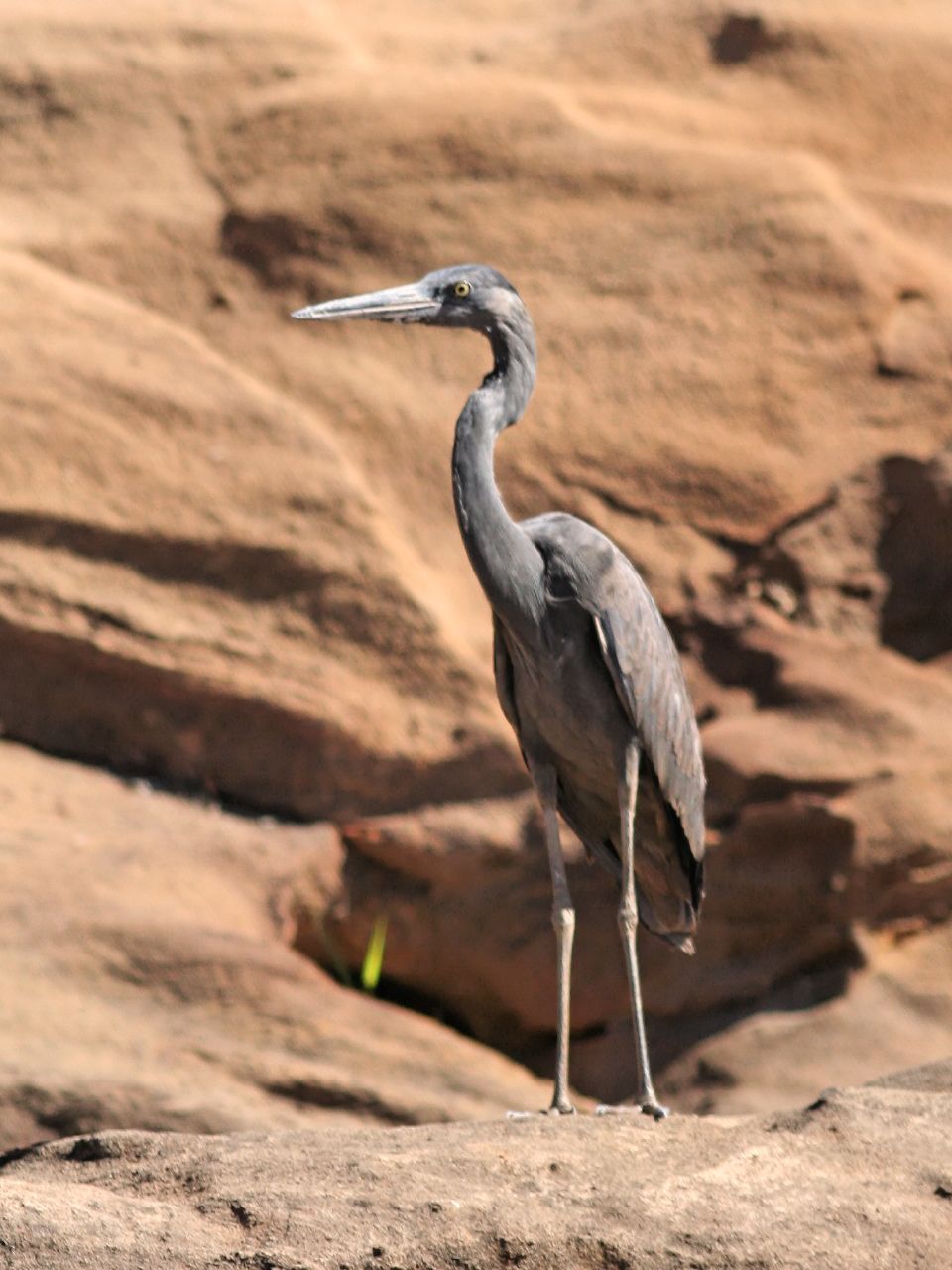
The family Ardeidae contains the bitterns, herons, and egrets. Herons and egrets are medium to large wading birds with long necks and legs. Bitterns tend to be shorter necked and more wary. Members of Ardeidae fly with their necks retracted, unlike other long-necked birds such as storks, ibises, and spoonbills.
| Common name | Scientific name | Status | IUCN code |
|---|---|---|---|
| Little bittern | *Ixobrychus minutus* | Scarce breeder | LC |
| Gray heron | *Ardea cinerea* | Fairly common resident | LC |
| Black-headed heron | *Ardea melanocephala* | Very rare vagrant | LC |
| Humblot's heron | *Ardea humbloti* | Uncommon resident | EN |
| Purple heron | *Ardea purpurea* | Fairly common resident | LC |
| Great egret | *Ardea alba* | Common resident | LC |
| Little egret | *Egretta garzetta* | LC | |
| Western reef-heron | *Egretta gularis* | Rare/accidental | LC |
| Black heron | *Egretta ardesiaca* | Fairly common resident | LC |
| Cattle egret | *Bubulcus ibis* | Common resident | LC |
| Squacco heron | *Ardeola ralloides* | Common resident | LC |
| Malagasy pond-heron | *Ardeola idae* | Visiting breeder | EN |
| Striated heron | *Butorides striata* | Fairly common resident | LC |
| Black-crowned night-heron | *Nycticorax nycticorax* | Uncommon resident | LC |
Ibises and spoonbills
Order: PelecaniformesFamily: Threskiornithidae
Threskiornithidae is a family of large terrestrial and wading birds which includes the ibises and spoonbills. They have long, broad wings with 11 primary and about 20 secondary feathers. They are strong fliers and despite their size and weight, very capable soarers.
| Common name | Scientific name | Status | IUCN code |
|---|---|---|---|
| Glossy ibis | *Plegadis falcinellus* | Common resident | LC |
| Madagascar ibis* | *Lophotibis cristata* | Rare resident | NT |
| African sacred ibis | *Threskiornis aethiopicus* | Rare/accidental | LC |
| Malagasy sacred ibis | *Threskiornis bernieri* | Rare resident | EN |
| African spoonbill | *Platalea alba* | Uncommon resident | LC |
Osprey
Order: AccipitriformesFamily: Pandionidae
The family Pandionidae contains only one species, the osprey. The osprey is a medium-large raptor which is a specialist fish-eater with a worldwide distribution.
| Common name | Scientific name | Status | IUCN code |
|---|---|---|---|
| Osprey | *Pandion haliaetus* | Rare vagrant | LC |
Hawks, eagles, and kites
Order: AccipitriformesFamily: Accipitridae
Accipitridae is a family of birds of prey, which includes hawks, eagles, kites, harriers and Old World vultures. These birds have powerful hooked beaks for tearing flesh from their prey, strong legs, powerful talons and keen eyesight.
| Common name | Scientific name | Status | IUCN code |
|---|---|---|---|
| Black-winged kite | *Elanus caeruleus* | Rare/accidental | LC |
| African harrier-hawk | *Polyboroides typus* | LC | |
| Madagascar harrier-hawk* | *Polyboroides radiatus* | LC | |
| Madagascar serpent-eagle* | *Eutriorchis astur* | EN | |
| Madagascar cuckoo-hawk* | *Aviceda madagascariensis* | LC | |
| Bat hawk | *Macheiramphus alcinus* | LC | |
| Long-crested eagle | *Lophaetus occipitalis* | Rare/accidental | LC |
| Eurasian marsh-harrier | *Circus aeruginosus* | Rare/accidental | LC |
| Malagasy harrier | *Circus macrosceles* | EN | |
| Pallid harrier | *Circus macrourus* | Rare/accidental | NT |
| Frances's sparrowhawk* | *Accipiter francesii* | LC | |
| Madagascar sparrowhawk* | *Accipiter madagascariensis* | NT | |
| Henst's goshawk* | *Accipiter henstii* | NT | |
| Black kite | *Milvus migrans* | LC | |
| Madagascar fish-eagle* | *Haliaeetus vociferoides* | CR | |
| Madagascar buzzard* | *Buteo brachypterus* | LC |
Barn owls
Order: StrigiformesFamily: Tytonidae
Barn owls are medium to large owls with large heads and characteristic heart-shaped faces. They have long strong legs with powerful talons.
| Common name | Scientific name | Status | IUCN code |
|---|---|---|---|
| Western barn owl | *Tyto alba* | LC | |
| Red owl* | *Tyto soumagnei* | VU |
Owls
Order: StrigiformesFamily: Strigidae
The typical owls are small to large solitary nocturnal birds of prey. They have large forward-facing eyes and ears, a hawk-like beak and a conspicuous circle of feathers around each eye called a facial disk.
| Common name | Scientific name | Status | IUCN code |
|---|---|---|---|
| African scops-owl* | *Otus senegalensis* | Rare/accidental | LC |
| Madagascar scops-owl* | *Otus rutilus* | LC | |
| White-browed owl | *Athene superciliaris* | LC | |
| Madagascar owl* | *Asio madagascariensis* | LC | |
| Marsh owl | *Asio capensis* | LC |
Cuckoo-roller
Order: LeptosomiformesFamily: Leptosomidae
The cuckoo roller or courol (Leptosomus discolor) is the only bird in the family Leptosomidae, which was previously often placed in the order Coraciiformes but is now placed in its own order Leptosomiformes. Its nearest relative is not clear.
| Common name | Scientific name | Status | IUCN code |
|---|---|---|---|
| Cuckoo-roller | *Leptosomus discolor* | LC |
Hoopoes
Order: BucerotiformesFamily: Upupidae
Hoopoes have black, white and orangey-pink colouring with a large erectile crest on their head.
| Common name | Scientific name | Status | IUCN code |
|---|---|---|---|
| Eurasian hoopoe | *Upupa epops* | LC | |
| Madagascar hoopoe* | *Upupa marginata* | LC |
Kingfishers
Order: CoraciiformesFamily: Alcedinidae
Kingfishers are medium-sized birds with large heads, long, pointed bills, short legs and stubby tails.
| Common name | Scientific name | Status | IUCN code |
|---|---|---|---|
| Malachite kingfisher | *Corythornis cristatus* | LC | |
| Malagasy kingfisher | *Corythornis vintsioides* | Common resident | LC |
| Madagascar pygmy kingfisher* | *Corythornis madagascariensis* | Common resident | LC |
Bee-eaters
Order: CoraciiformesFamily: Meropidae
The bee-eaters are a group of near passerine birds in the family Meropidae. Most species are found in Africa but others occur in southern Europe, Madagascar, Australia and New Guinea. They are characterised by richly coloured plumage, slender bodies and usually elongated central tail feathers. All are colourful and have long downturned bills and pointed wings, which give them a swallow-like appearance when seen from afar.
| Common name | Scientific name | Status | IUCN code |
|---|---|---|---|
| Madagascar bee-eater | *Merops superciliosus* | LC | |
| European bee-eater | *Merops apiaster* | Very rare vagrant | LC |
Rollers
Order: CoraciiformesFamily: Coraciidae
Rollers resemble crows in size and build, but are more closely related to the kingfishers and bee-eaters. They share the colourful appearance of those groups with blues and browns predominating. The two inner front toes are connected, but the outer toe is not.
| Common name | Scientific name | Status | IUCN code |
|---|---|---|---|
| Broad-billed roller | *Eurystomus glaucurus* | LC |
Ground-rollers
Order: CoraciiformesFamily: Brachypteraciidae
The ground-rollers are a small family of non-migratory near-passerine birds restricted to Madagascar. They are related to the kingfishers, bee-eaters and rollers. They most resemble the latter group, and are sometimes considered a sub-family of the true rollers.
| Common name | Scientific name | Status | IUCN code |
|---|---|---|---|
| Short-legged ground-roller* | *Brachypteracias leptosomus* | Resident | VU |
| Scaly ground-roller* | *Brachypteracias squamigera* | Resident | VU |
| Pitta-like ground-roller* | *Atelornis pittoides* | Resident | LC |
| Rufous-headed ground-roller* | *Atelornis crossleyi* | Resident | NT |
| Long-tailed ground-roller* | *Uratelornis chimaera* | Resident | VU |
Falcons and caracaras
Order: FalconiformesFamily: Falconidae
Falconidae is a family of diurnal birds of prey. They differ from hawks, eagles and kites in that they kill with their beaks instead of their talons.
| Common name | Scientific name | Status | IUCN code |
|---|---|---|---|
| Malagasy kestrel | *Falco newtoni* | Resident | LC |
| Banded kestrel* | *Falco zoniventris* | Uncommon resident | LC |
| Eleonora's falcon | *Falco eleonorae* | Winter visitor | LC |
| Sooty falcon | *Falco concolor* | Winter visitor | VU |
| Peregrine falcon | *Falco peregrinus* | Scarce resident | LC |
Old World parrots
Order: PsittaciformesFamily: Psittaculidae
Characteristic features of parrots include a strong curved bill, an upright stance, strong legs, and clawed zygodactyl feet. Many parrots are vividly colored, and some are multi-colored. In size they range from 8 cm to 1 m in length. Old World parrots are found from Africa east across south and southeast Asia and Oceania to Australia and New Zealand.
| Common name | Scientific name | Status | IUCN code |
|---|---|---|---|
| Greater vasa parrot | *Coracopsis vasa* | LC | |
| Lesser vasa parrot | *Coracopsis nigra* | LC | |
| Gray-headed lovebird* | *Agapornis canus* | LC |
Asities
Order: PasseriformesFamily: Philepittidae
The asities are a family of birds, Philepittidae, that are endemic to Madagascar. The asities consist of four species in two genera. The Neodrepanis species are known as sunbird-asities and were formerly known as false sunbirds.
| Common name | Scientific name | Status | IUCN code |
|---|---|---|---|
| Velvet asity* | *Philepitta castanea* | LC | |
| Schlegel's asity* | *Philepitta schlegeli* | NT | |
| Common sunbird-asity* | *Neodrepanis coruscans* | LC | |
| Yellow-bellied sunbird-asity* | *Neodrepanis hypoxanthus* | VU |
Cuckooshrikes
Order: PasseriformesFamily: Campephagidae
The cuckooshrikes are small to medium-sized passerine birds. They are predominantly greyish with white and black, although some minivet species are brightly coloured.
| Common name | Scientific name | Status | IUCN code |
|---|---|---|---|
| Madagascar cuckooshrike | *Ceblepyris cinereus* | LC |
Old World orioles
Order: PasseriformesFamily: Oriolidae
The Old World orioles are colourful passerine birds which are not closely related to the New World orioles.
| Common name | Scientific name | Status | IUCN code |
|---|---|---|---|
| Eurasian golden oriole | *Oriolus oriolus* | Rare/accidental | LC |
Vangas, helmetshrikes, and allies
Order: PasseriformesFamily: Vangidae
The family Vangidae is highly variable, though most of its members resemble true shrikes to some degree.
| Common name | Scientific name | Status | IUCN code |
|---|---|---|---|
| Archbold's newtonia* | *Newtonia archboldi* | LC | |
| Common newtonia* | *Newtonia brunneicauda* | LC | |
| Dark newtonia* | *Newtonia amphichroa* | LC | |
| Red-tailed newtonia* | *Newtonia fanovanae* | VU | |
| Tylas vanga* | *Tylas eduardi* | LC | |
| Red-tailed vanga* | *Calicalicus madagascariensis* | Fairly common resident | LC |
| Red-shouldered vanga* | *Calicalicus rufocarpalis* | Uncommon resident | VU |
| Nuthatch-vanga* | *Hypositta corallirostris* | LC | |
| Chabert vanga* | *Leptopterus chabert* | LC | |
| Crossley's vanga* | *Mystacornis crossleyi* | LC | |
| Madagascar blue vanga* | *Cyanolanius madagascarinus* | LC | |
| Hook-billed vanga* | *Vanga curvirostris* | LC | |
| Ward's flycatcher* | *Pseudobias wardi* | Range-restricted resident | LC |
| Rufous vanga* | *Schetba rufa* | LC | |
| Helmet vanga* | *Euryceros prevostii* | VU | |
| Bernier's vanga* | *Oriolia bernieri* | EN | |
| Sickle-billed vanga* | *Falculea palliata* | LC | |
| White-headed vanga* | *Artamella viridis* | LC | |
| Pollen's vanga* | *Xenopirostris polleni* | NT | |
| Lafresnaye's vanga* | *Xenopirostris xenopirostris* | LC | |
| Van Dam's vanga* | *Xenopirostris damii* | EN |
Drongos
Order: PasseriformesFamily: Dicruridae
The drongos are mostly black or dark grey in colour, sometimes with metallic tints. They have long forked tails, and some Asian species have elaborate tail decorations. They have short legs and sit very upright when perched, like a shrike. They flycatch or take prey from the ground. All are notorious for mobbing predators.
| Common name | Scientific name | Status | IUCN code |
|---|---|---|---|
| Crested drongo | *Dicrurus forficatus* | Common resident | LC |
Monarch flycatchers
Order: PasseriformesFamily: Monarchidae
The monarch flycatchers are small to medium-sized insectivorous passerines which hunt by gleaning, hovering or flycatching.
| Common name | Scientific name | Status | IUCN code |
|---|---|---|---|
| Malagasy paradise-flycatcher | *Terpsiphone mutata* | Common resident | LC |
Crows, jays, and magpies
Order: PasseriformesFamily: Corvidae
The family Corvidae includes crows, ravens, jays, choughs, magpies, treepies, nutcrackers, and ground jays. Corvids are above average in size among the Passeriformes, and some of the larger species show high levels of intelligence.
| Common name | Scientific name | Status | IUCN code |
|---|---|---|---|
| House crow | *Corvus splendens* | Very rare vagrant | LC |
| Pied crow | *Corvus albus* | Common resident | LC |
Larks
Order: PasseriformesFamily: Alaudidae
Larks are small terrestrial birds with often extravagant songs and display flights. Most larks are fairly dull in appearance. Their food is insects and seeds.
| Common name | Scientific name | Status | IUCN code |
|---|---|---|---|
| Madagascar lark* | *Eremopterix hova* | LC |
Cisticolas and allies
Order: PasseriformesFamily: Cisticolidae
The Cisticolidae are warblers found mainly in warmer southern regions of the Old World. They are generally very small birds of drab brown or grey appearance found in open country such as grassland or scrub.
| Common name | Scientific name | Status | IUCN code |
|---|---|---|---|
| Common jery* | *Neomixis tenella* | LC | |
| Green jery* | *Neomixis viridis* | LC | |
| Stripe-throated jery* | *Neomixis striatigula* | LC | |
| Madagascar cisticola | *Cisticola cherinus* | LC |
Reed warblers and allies
Order: PasseriformesFamily: Acrocephalidae
The members of this family are usually rather large for "warblers". Most are rather plain olivaceous brown above with much yellow to beige below. They are usually found in open woodland, reedbeds, or tall grass. The family occurs mostly in southern to western Eurasia and surroundings, but it also ranges far into the Pacific, with some species in Africa.
| Common name | Scientific name | Status | IUCN code |
|---|---|---|---|
| Malagasy brush-warbler* | *Nesillas typica* (E) | LC | |
| Subdesert brush-warbler* | *Nesillas lantzii* (E) | LC | |
| Madagascar swamp warbler* | *Acrocephalus newtoni* | LC |
Grassbirds and allies
Order: PasseriformesFamily: Locustellidae
Locustellidae are a family of small insectivorous songbirds found mainly in Eurasia, Africa, and the Australian region. They are smallish birds with tails that are usually long and pointed, and tend to be drab brownish or buffy all over.
| Common name | Scientific name | Status | IUCN code |
|---|---|---|---|
| Gray emutail* | *Bradypterus seebohmi* | LC | |
| Brown emutail* | *Bradypterus brunneus* | LC |
Malagasy warblers
Order: PasseriformesFamily: Bernieridae
The Malagasy warblers are a newly validated family of songbirds. They were formally named Bernieridae in 2010. The family currently consists of eleven species (in eight genera) of small forest birds. These birds are all endemic to Madagascar.
| Common name | Scientific name | Status | IUCN code |
|---|---|---|---|
| White-throated oxylabes* | *Oxylabes madagascariensis* | LC | |
| Long-billed bernieria* | *Bernieria madagascariensis* | LC | |
| Cryptic warbler* | *Cryptosylvicola randriansoloi* | LC | |
| Wedge-tailed jery* | *Hartertula flavoviridis* | NT | |
| Thamnornis* | *Thamnornis chloropetoides* | LC | |
| Yellow-browed oxylabes* | *Crossleyia xanthophrys* | NT | |
| Spectacled tetraka* | *Xanthomixis zosterops* | LC | |
| Appert's tetraka* | *Xanthomixis apperti* | VU | |
| Dusky tetraka* | *Xanthomixis tenebrosus* | VU | |
| Gray-crowned tetraka* | *Xanthomixis cinereiceps* | NT | |
| Rand's warbler* | *Randia pseudozosterops* | LC |
Swallows
Order: PasseriformesFamily: Hirundinidae
The family Hirundinidae is adapted to aerial feeding. They have a slender streamlined body, long pointed wings, and a short bill with a wide gape. The feet are adapted to perching rather than walking, and the front toes are partially joined at the base.
| Common name | Scientific name | Status | IUCN code |
|---|---|---|---|
| Plain martin | *Riparia paludicola* | LC | |
| Bank swallow | *Riparia riparia* | Rare/accidental | LC |
| Mascarene martin | *Phedina borbonica* | LC | |
| Barn swallow | *Hirundo rustica* | Rare/accidental | LC |
| Common house-martin | *Delichon urbicum* | Rare/accidental | LC |
Bulbuls
Order: PasseriformesFamily: Pycnonotidae
Bulbuls are medium-sized songbirds. Some are colourful with yellow, red, or orange vents, cheeks, throats, or supercilia, but most are drab, with uniform olive-brown to black plumage. Some species have distinct crests.
| Common name | Scientific name | Status | IUCN code |
|---|---|---|---|
| Malagasy bulbul | *Hypsipetes madagascariensis* | LC |
White-eyes, yuhinas, and allies
Order: PasseriformesFamily: Zosteropidae
The white-eyes are small birds of rather drab appearance, the plumage above being typically greenish-olive, but some species have a white or bright yellow throat, breast, or lower parts, and several have buff flanks. As the name suggests, many species have a white ring around each eye.
| Common name | Scientific name | Status | IUCN code |
|---|---|---|---|
| Malagasy white-eye | *Zosterops maderaspatanus* | LC |
Starlings
Order: PasseriformesFamily: Sturnidae
Starlings are small to medium-sized passerine birds. Their flight is strong and direct and they are very gregarious. Their preferred habitat is fairly open country. They eat insects and fruit. Plumage is typically dark with a metallic sheen.
| Common name | Scientific name | Status | IUCN code |
|---|---|---|---|
| Wattled starling | *Creatophora cinerea* | Very rare vagrant | LC |
| Common myna% | *Acridotheres tristis* | Introduced and spreading | LC |
| Madagascar starling* | *Hartlaubius auratus* | Fairly common northwest, north and east | LC |
Old World flycatchers
Order: PasseriformesFamily: Muscicapidae
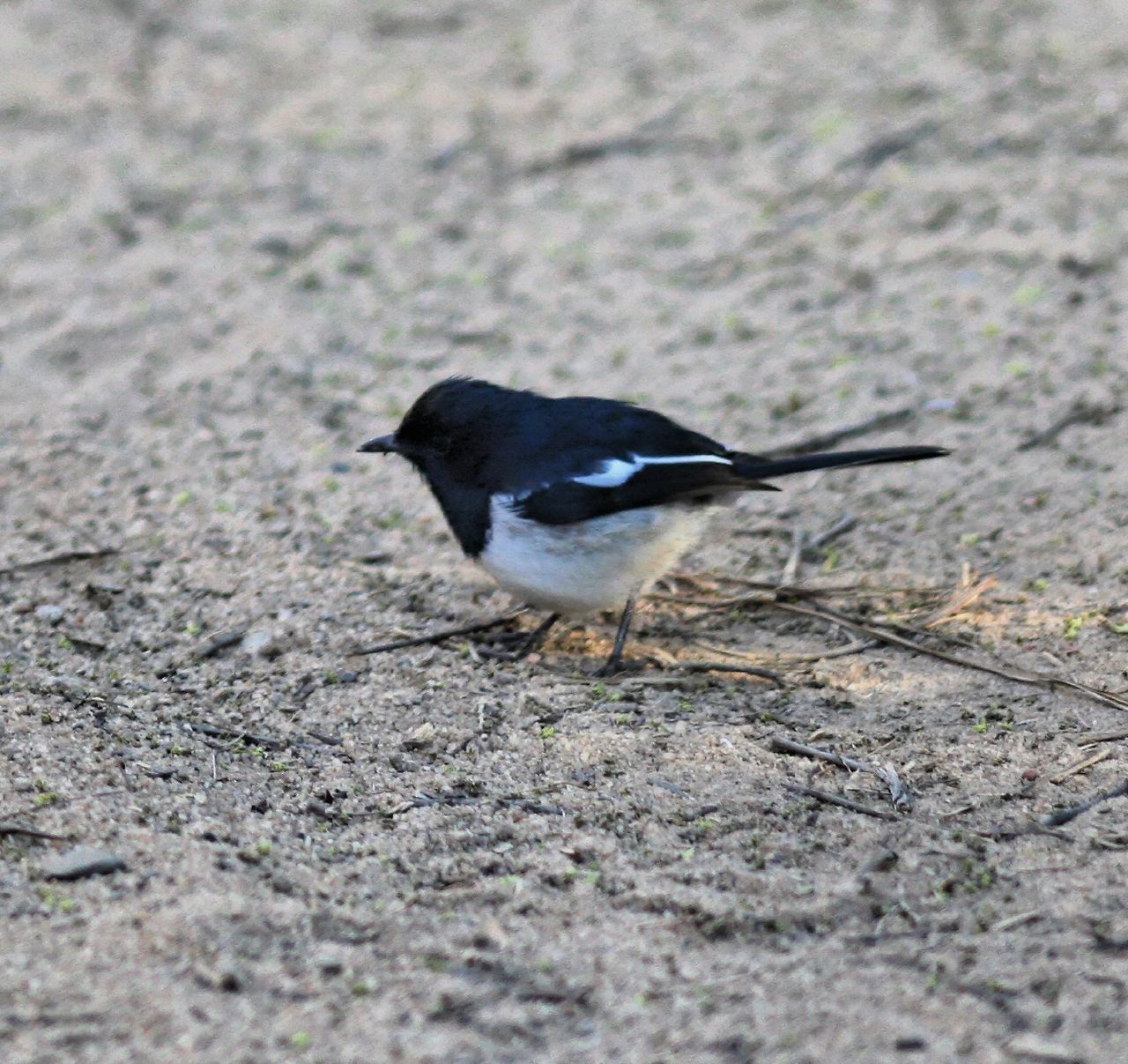
Old World flycatchers are a large group of small arboreal insectivores. The appearance of these birds is highly varied, but they mostly have weak songs and harsh calls.
| Common name | Scientific name | Status | IUCN code |
|---|---|---|---|
| Madagascar magpie-robin* | *Copsychus albospecularis* | LC | |
| Forest rock-thrush* | *Monticola sharpei* | LC | |
| Amber Mountain rock thrush* | *Monticola erythronotus* | EN | |
| Littoral rock-thrush* | *Monticola imerinus* | LC | |
| African stonechat* | *Saxicola torquatus* | LC | |
| Northern wheatear | *Oenanthe oenanthe* | Very rare vagrant | LC |
Sunbirds and spiderhunters
Order: PasseriformesFamily: Nectariniidae
The sunbirds and spiderhunters are very small passerine birds which feed largely on nectar, although they will also take insects, especially when feeding young. Their flight is fast and direct on short wings. Most species can take nectar by hovering like a hummingbird, but usually perch to feed.
| Common name | Scientific name | Status | IUCN code |
|---|---|---|---|
| Souimanga sunbird | *Cinnyris sovimanga* | LC | |
| Malagasy sunbird | *Cinnyris notatus* | LC |
Weavers and allies
Order: PasseriformesFamily: Ploceidae
The weavers are small passerine birds related to the finches. They are seed-eating birds with rounded conical bills. The males of many species are brightly coloured, usually in red or yellow and black, but some species show variation in colour only in the breeding season.
| Common name | Scientific name | Status | IUCN code |
|---|---|---|---|
| Nelicourvi weaver* | *Ploceus nelicourvi* | Fairly common in suitable habitat | LC |
| Sakalava weaver* | *Ploceus sakalava* | LC | |
| Red fody* | *Foudia madagascariensis* | Very common | LC |
| Forest fody* | *Foudia omissa* | Fairly common | LC |
Waxbills and allies
Order: PasseriformesFamily: Estrildidae
The estrildid finches are small passerine birds of the Old World tropics and Australasia. They are gregarious and often colonial seed eaters with short thick but pointed bills. They are all similar in structure and habits, but have wide variation in plumage colours and patterns.
| Common name | Scientific name | Status | IUCN code |
|---|---|---|---|
| Madagascar munia* | *Lepidopygia nana* | Common in suitable habitat | LC |
| Common waxbill% | *Estrilda astrild* | Introduced and local | LC |
Old World sparrows
Order: PasseriformesFamily: Passeridae
Sparrows are small passerine birds, typically small, plump, brown or grey with short tails and short powerful beaks. They are seed-eaters, but also consume small insects.
| Common name | Scientific name | Status | IUCN code |
|---|---|---|---|
| House sparrow% | *Passer domesticus* | LC |
Wagtails and pipits
Order: PasseriformesFamily: Motacillidae
Motacillidae is a family of small passerine birds with medium to long tails and comprises the wagtails, longclaws, and pipits. These are slender ground-feeding insectivores of open country.
| Common name | Scientific name | Status | IUCN code |
|---|---|---|---|
| Madagascar wagtail* | *Motacilla flaviventris* | LC | |
| White wagtail | *Motacilla alba* | A | LC |
References
Sources
References
- Morris & Hawkins (1998), p. 5.
- "IUCN Red List". IUCN.
- Morris & Hawkins 1998, p. 108
- Morris & Hawkins 1998, p. 36
- Morris & Hawkins 1998, p. 40
- Morris & Hawkins 1998, p. 46
- (March 2006). "First Pink-backed Pelican ''Pelecanus rufescens'' sightings in Madagascar since 1960". The Bulletin of the African Bird Club.
- Morris & Hawkins 1998, p. 54
- {{Harvnb. Morris. Hawkins. 1998
- "Madagascar Crested Ibis – BirdLife Species Factsheet". BirdLife International.
- "Haliaeetus vociferoides". [[IUCN]].
- {{Harvnb. Morris. Hawkins. 1998
- {{Harvnb. Morris. Hawkins. 1998
- {{Harvnb. Morris. Hawkins. 1998
- {{Harvnb. Morris. Hawkins. 1998
- {{Harvnb. Morris. Hawkins. 1998
- {{Harvnb. Morris. Hawkins. 1998
- {{Harvnb. Morris. Hawkins. 1998
- (2014). "Whole-genome analyses resolve early branches in the tree of life of modern birds". Science.
- Harrison, Peter. (1991). "Seabirds: A Complete Guide to the Seabirds of the World (Helm Identification Guides)". Christopher Helm Publishers Ltd..
- (2017-11-27). "The Penguins of Isla Magdalena".
- del Hoyo, J. Elliott, A. & Sargatal, J. (2001)
- del Hoyo, J. Elliott, A. & Christie, D. (editors). (2003) ''Handbook of the Birds of the World. Volume 8: Broadbills to Tapaculos''. Lynx Edicions. {{ISBN. 84-87334-50-4
- (2011). "Patterns of morphological and genetic variation in the ''Mentocrex kioloides'' complex (Aves: Gruiformes: Rallidae) from Madagascar, with the description of a new species". Zootaxa.
- Walker, Matt. (2010-05-26). "Bird conservation: Alaotra grebe confirmed extinct". BBC News Online.
- Koenig, Paul. (September 2009). "Prèmiere mention du Traquet motteux ''Oenanthe oenanthe'' pour Madagascar". African Bird Club Bulletin.
- (September 2014). "First record of House Crow for Madagascar – potential impacts and suggested management of an invasive bird species". African Bird Club Bulletin.
- Patient, R.. (March 2003). "The first Sharp-tailed Sandpiper ''Calidris acuminata'' for Madagascar". African Bird Club Bulletin.
- Karanth, K. Praveen. (March 2006). "Out-of-India Gondwanan origin of some tropical Asian biota". Current Science.
- Rollinson, Dominic P.. (September 2015). "Rare seabird sightings off north and west Madagascar, January–February 2014". African Bird Club Bulletin.
- (September 2014). "First records of Buff-breasted Sandpiper and Red-necked Phalarope for Madagascar". African Bird Club Bulletin.
This article was imported from Wikipedia and is available under the Creative Commons Attribution-ShareAlike 4.0 License. Content has been adapted to SurfDoc format. Original contributors can be found on the article history page.
Ask Mako anything about List of birds of Madagascar — get instant answers, deeper analysis, and related topics.
Research with MakoFree with your Surf account
Create a free account to save articles, ask Mako questions, and organize your research.
Sign up freeThis content may have been generated or modified by AI. CloudSurf Software LLC is not responsible for the accuracy, completeness, or reliability of AI-generated content. Always verify important information from primary sources.
Report