From Surf Wiki (app.surf) — the open knowledge base
List of ancient peoples of Italy
None
None
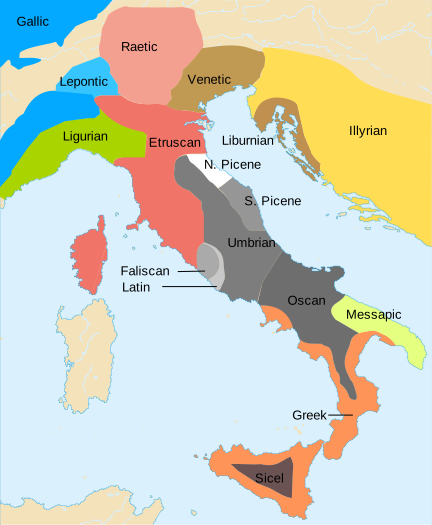
This list of ancient peoples living in Italy summarises all the different Italian populations that existed in antiquity; in historiography, they are generally referred to as the "Italic peoples" (in linguistics, this term has a stricter meaning and refers specifically to the sub-group of Indo-Europeans consisting of the Latino-Faliscans and Osco-Umbrians). Among these peoples, the Romans succeeded in Romanizing the entire Italian peninsula following the Roman expansion in Italy, which provides the time-window in which most of the names of the remaining ancient Italian peoples first appear in existing written documentation. Many names are exonyms assigned by the ancient writers of works in ancient Greek and Latin, while others are scholarly inventions.
Nearly all of these peoples and tribes spoke Indo-European languages: Italic languages, Celtic, Ancient Greek, in addition to intermediate positions between these language groups. On the other hand, some Italian peoples (such as the Rhaetians, Camuni, Etruscans) likely spoke non- or pre-Indo-European languages. In addition, peoples speaking languages of the Afro-Asiatic family, specifically the largely Semitic Phoenicians and Carthaginians, settled and colonized parts of western and southern Sardinia and western Sicily.
Speakers of non-Indo-European languages
Scholars believe - though sometimes on the basis of scanty evidence - that the following peoples spoke non-Indo-European languages. Some of them were Pre-Indo-Europeans or Paleo-Europeans while, with regard to some others, Giacomo Devoto proposed the definition of Peri-Indo-European (i.e. everything that has hybrid characters between Indo-European and non-Indo-European).
Sardinians
- The Sardinians were possibly Sherden.
- Balares (Balari)
- Ilienses/Iolaes/Diagesbes (Iliensi/Iolei)
- Corsi (Possibly related to Ligures)
Tyrrhenians
The Tyrrhenians were the Etruscans and their linguistic relatives.
- Etruscans - Centered in Etruria with later influences stretching from the Po Valley to Campania.
- Raeti
- Camunni
.jpg)


Others (classification uncertain)
- North Picenes - Centered on the Adriatic Coast with settlements around the region of Ancona.
- Rutuli
- Sicani
- Ligures
Speakers of Indo-European languages
- Proto-Indo-Europeans
Italo-Celtic
Main article: Italo-Celtic
Italic and Celtic languages are commonly grouped together on the basis of features shared by these two branches and no others. This could imply that they are descended from a common ancestor and/or Proto-Celtic and Proto-Italic developed in close proximity over a long period of time.
Italic
Speakers of Italic languages included:
- Latino-Faliscans
- Latins- centered around the central plain of Italy between the Tiber and the Alban Hills.
- Romans- centered in the city of Rome.
- Falisci
- Latins- centered around the central plain of Italy between the Tiber and the Alban Hills.
- Sicels
- Adriatic Veneti - centered in an area corresponding to the modern-day region of Veneto.
- Carni
- Catali
- Catari
- Histri
- Liburnians
- Lopsi
- Secusses
- Venetulani
- Umbri - Centered in central Italy stretching from the Adriatic coast to the upper Tiber.
- Sabines - Centered north of Rome and by the river Tiber.
- Marsi - Centered around Lake Fucinus
- Volsci - Centered on the Pontine plain
- South Picenes
- Marrucini

- Oscans - Centered in the part of Italy towards Tyrrhenia".
- Opici
- Aurunci/Ausones
- Sidicini
- Campanians - Centered in the region of Naples
- Mamertines
- Paeligni
- Frentani - Centered on the southern Adriatic coast.
- Samnites - Centered in central Italy, south-east of Rome north-east of Capua.
- Pentri
- Caraceni
- Caudini
- Hirpini
- Lucani - Centered on the south-western coast of Italy.
- Bruttii
- Opici
- Oenotri
- Itali
- Morgetes
- Others
- Aequi
- Hernici
- Vestini
- Euganei
Celts
The Celts of the Italian peninsula included,
- Cisalpine Gauls - Centered in the area south of Lepontii.
- Boii
- Carni
- Cenomani
- Lingones
- Senones
- Vertamocorii
- Gaesatae?
- Insubres
- Arverni
- Aedui
- Ambarri
- Aulerci
- Bituriges
- Carnutes
- Lepontics
- Graioceli
- Lepontii
- Salassi
- Medulli
- Ceutrones
- Allobroges
- Veragri
- Helvetii
- Seduni
Ligures

The Ligures, who may have spoken Pre-Indo-European or an Indo-European language, were:
- Ligures
- Apuani
- Bagienni
- Briniates
- Friniates
- Garuli
- Hercates
- Ilvates
- Orobii
- Laevi
- Lapicini
- Marici
- Segusini
- Statielli
- Taurini
Greeks
Sometimes referred in ancient sources as Pelasgi, the Ancient Greeks of the Italian peninsula included,
- Achaeans
- Dorians
- Ionians
- Italiotes
- Siceliotes
Others (classification uncertain)
- Iapygians or Apulians (possibly related to Illyrians) - Centered in an area corresponding to the modern-day region of Apulia.
- Messapians
- Peucetians
- Daunians
- Elymians, who inhabited the western part of Sicily during the Bronze Age and Classical antiquity.
Prehistoric [[archeological culture]]s
Main article: Prehistoric Italy
The specific identities or names of the tribes or groups of peoples that practiced these pre-Roman archeological cultures are mostly unknown. The posited existence of these archeological cultures is based on archeological assemblages of artifacts that share common traits and are found within a certain region and originate within a certain prehistoric period. Therefore, many of these archeological cultures may not necessarily correspond to a specific group of ancient people and, in fact, may have been shared among various groups of ancient peoples. The extent to which an archeological culture is representative of a particular cohesive ancient group of people is open for debate; many of these cultures may be the product of a single ancient Italian tribe or civilization (e.g. Latial culture), while others may have been spread among different groups of ancient Italian peoples and even outside of Italy. For example, Latial culture is believed to be the product specifically of the Ancient Latin tribe; the Canegrate culture and Golasecca culture have been associated with various ancient proto-Celtic, Celtic and Ligure tribes including the Lepontii, Orobii, and Insubres, while other archeological cultures may have been present among multiple groups throughout and beyond the Italian peninsula.

[[Neolithic]]
- Pre-Nuragic Sardinia
- Cardial Culture
- Grotta Verde culture
- Filiestru culture
- Bonu Ighinu culture
- San Ciriaco culture
- Arzachena culture
- Ozieri culture
- Gaudo culture
[[Copper Age]]
- Pre-Nuragic Sardinia
- Abealzu-Filigosa culture
- Monte Claro culture
- Sardinian Beaker culture
- Beaker culture
- Remedello culture
- Rinaldone culture
- Laterza culture
- Gaudo culture
- Conelle-Ortucchio culture
- Serraferlicchio culture
- Spilamberto group
[[Bronze Age]]


- Apennine culture
- Bonnanaro culture
- Nuragic civilization
- Torrean civilization
- Canegrate culture
- Proto-Villanovan culture
- Polada culture
- Castelluccio Culture
- Thapsos Culture
- Terramare culture
- Castellieri culture
- Luco-Meluno culture
- Scamozzina culture
[[Iron Age]]
- Hallstatt culture
- La Tène culture
- Villanova culture
- Latial culture
- Este culture
- Golasecca culture
- Camunni culture
- Fritzens-Sanzeno culture
Genetics
A genetic study published in Science in November 2019 examined the remains of six Latin males buried near Rome between 900 BC and 200 BC. They carried the paternal haplogroups R-M269, T-L208, R-311, R-PF7589 and R-P312 (two samples), and the maternal haplogroups H1aj1a, T2c1f, H2a, U4a1a, H11a and H10. A female from the preceding Proto-Villanovan culture carried the maternal haplogroups U5a2b. These examined individuals were distinguished from preceding populations of Italy by the presence of ca. 25-35% steppe ancestry. Overall, the genetic differentiation between the Latins, Etruscans and the preceding proto-villanovan population of Italy was found to be insignificant.
References
Bibliography
References
- "Sicilian Peoples: The Carthaginians - Best of Sicily Magazine - Carthaginians, Phoenicians, Hanibal, Hamilcar, Punic Wars, Punic Language, Carthage, Palermo, Zis, Sis, Panormos, Solus, Motya, Motia, Mozia.".
- [[Giacomo Devoto]], ''Gli antichi Italici'', Firenze, Vallecchi, 1931.
- "sardi in "Dizionario di Storia"".
- "SARDI in "Enciclopedia Italiana"".
- (February 3, 2017). "ARCHIVIO. Nuovo studio dell'archeologo Ugas: "È certo, i nuragici erano gli Shardana"".
- "SP INTERVISTA>GIOVANNI UGAS: SHARDANA".
- "LacusCurtius • Ptolemy's Geography — Book III, Chapter 3".
- Ugas, Giovanni. (2006). "L'alba dei nuraghi". Fabula Editore.
- (2004). "Treasures from Tuscany: the Etruscan legacy". National Museums Scotland Enterprises Limited.
- (2004). "Tarquinia. An Etruscan City". Duckworth Press.
- (2001). "The Etruscans Outside Etruria". Getty Trust Publications.
- [http://spazioinwind.libero.it/popoli_antichi/Etruschi/Etruria%20Campana.html Etruria campana]
- [[Strabo]]. ''[https://www.perseus.tufts.edu/hopper/text?doc=Strab.+5.4&fromdoc=Perseus%3Atext%3A1999.01.0239 Geography]''. Book V, Chapter IV. Perseus Digital Library. Tufts University. [https://web.archive.org/web/20220902170235/https://www.perseus.tufts.edu/hopper/text?doc=Strab.+5.4&fromdoc=Perseus%3Atext%3A1999.01.0239 Archived] from the original on 2 September 2022. Retrieved 2 September 2022.
- Francesco Belsito. (2013). "Storia di Nocera. Monumenti, personaggi, leggende". Angri, Gaia.
- [[Harald Haarmann]]. (2014). "A Companion to Ethnicity in the Ancient Mediterranean". John Wiley & Sons, Inc.
- (2008). "Shared Symbolics, Genre Diffusion, Token Perception and Late Literacy in North-Western Europe". NOWELE.
- ''Piceni popolo d'Europa'', Vv.Aa., Edizioni De Luca, Roma, 1999, p. 139
- Hazlitt, William. ''The Classical Gazetteer'' (1851), p. 297.
- Pietrina Anello. "I Sicani nel IV secolo a.C.". Atti del convegno di studi su Diodoro Siculo e la Sicilia indigena.
- (2011). "Liguri". [[Treccani.
- (2014-12-16). "Ligurian language". Britannica.com.
- Villar, cit., pp. 447-482.
- Hartmann, Markus. (2017). "Handbook of Comparative and Historical Indo-European Linguistics". Walter de Gruyter.
- [http://www.venetoimage.com/svc.htm Storia, vita, costumi, religiosità dei Veneti antichi] at www.venetoimage.com (in Italian). Accessed on 2009-08-18.
- (16 January 2009). "L'alfabeto umbro su Omniglot.com".
- Aristotle. (1932). "Politics".
- Pliny the Elder. "Natural History".
- [[Livy]], ''[[Ab urbe condita libri (Livy). Ab urbe condita]]'', [[s:From the Founding of the City/Book 2#22. 2.22]]
- Strabo. (1917). "Geography".
- G. Micali, ''Storia degli antichi popoli italiani'', Tomo II, Firenze 1832, p. 24.
- Kruta, Venceslas. (1991). "The Celts". Thames and Hudson.
- Stifter, David. (2008). "Old Celtic Languages".
- "LinguistList: Lepontic".
- John T. Koch (ed.) ''Celtic culture: a historical encyclopedia'' ABC-CLIO (2005) {{ISBN. 978-1-85109-440-0
- (2011). "Liguri". [[Treccani.
- (2014-12-16). "Ligurian language". Britannica.com.
- [[Herodotus]], ''[[Histories (Herodotus)
- "IAPIGI".
- "Gli Elimi: storia e archeologia di Segesta, Erice, Entella".
- (2011). "Tra panellenismo e tradizioni locali: nuovi contributi". Claudio Meliadò.
This article was imported from Wikipedia and is available under the Creative Commons Attribution-ShareAlike 4.0 License. Content has been adapted to SurfDoc format. Original contributors can be found on the article history page.
Ask Mako anything about List of ancient peoples of Italy — get instant answers, deeper analysis, and related topics.
Research with MakoFree with your Surf account
Create a free account to save articles, ask Mako questions, and organize your research.
Sign up freeThis content may have been generated or modified by AI. CloudSurf Software LLC is not responsible for the accuracy, completeness, or reliability of AI-generated content. Always verify important information from primary sources.
Report